Modernizing Malta – awk!

Screen Shot 2016-10-19 at 8.13.21 PM.png

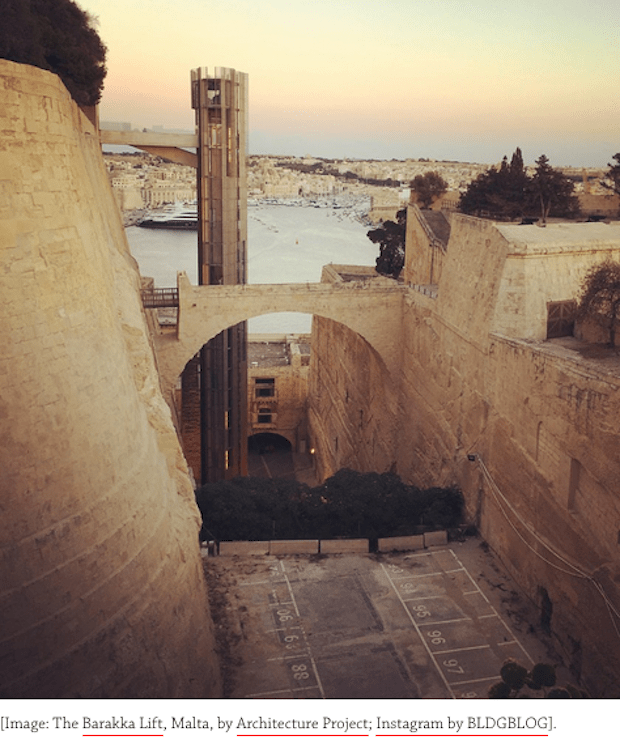
This photo from “Totemic elevator” on Geoff Manaugh’s fine blog BLDGBLOG had me fooled for a moment. The shot shows a lovely scene taken along the fortifications of Valletta, the capital of the island nation of Malta in the Mediterraean Sea, between Sicily and Libya. I visited once at the invitation of former Providence mayor Joseph Paolino Jr., who had been appointed ambassador by Bill Clinton The harbor at Valletta is where the Knights of Malta held off Turkey’s emperor Suleiman the Magnificent in the Great Siege of 1565. There was a lot of catapulting of severed heads back and forth. It was not a civilized engagement.

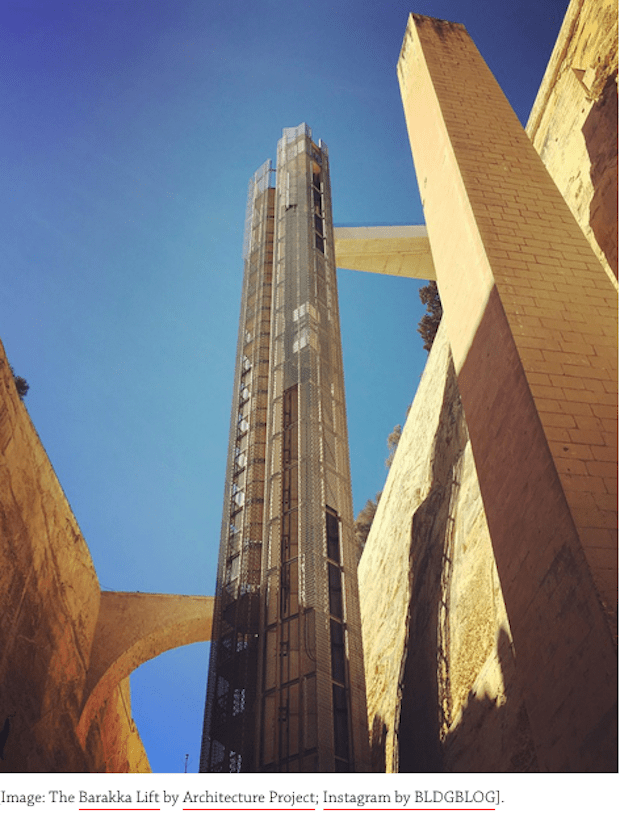
I don’t like some of the architecture that has arisen in Malta – which a colleague once described as “Baroque from stem to stern” – in recent decades. But like Paris and Providence, Malta’s historic fabric is too intact to easily overwhelm. While I was there, however, I met an architect, a Malta native, Richard England. whose goal in life was, it seemed, to deprive the nation of its history. And yet there was an effort to synthsize with that history in his work. Not enough, however. Maybe he was the designer of the stand-alone elevator near the center of the fabulous photo above. It almost looks as if it fits in, but when you see the close-up shot (below) at the end of Manaugh’s text, the degree of its insult to its surroundings becomes clear.

London has done modern architecture all wrong, allowing it to permeate the historical center of the city. Paris had been doing it right for decades (with the Tour Montparnesse the one appalling major exception) until recently, when the City of Light has come under ISIS-like assault from its own barbarian mayor. Valletta, when I was there in 1996, had kept modernism to a minimum. I have not been there since, and I hope that aside from such twits as this elevator the principle is still being upheld.

In 1996 I wrote three columns about my trip to Malta, including one generally about its history, another about its architecture, and a third, called “An Ocean State cabal?,” about the curious goings on in the embassy and at the ambassador’s residence. Unfortunately, I’ve only put the last of these online, as a sort of memorial to Mayor Cianci after his death. If anyone wants me to dig out the other two, please let me know and I will try. (Getting to the Journal’s online archive is difficult these days for some reason.)
Screen Shot 2016-10-19 at 8.13.05 PM.png

Posted in Architecture | Tagged , , , , , , , , | 2 Comments

Battle of the baseball parks

Screen Shot 2016-10-18 at 9.03.01 PM.png

Griffith Stadium, in Washington, D.C.

Here’s an engaging romp through the history of baseball stadia in a piece by Los Angeles Times architecture critic Christopher Hawthorne. “Battle of the ballparks: Cubs vs. Dodgers and the lost history of L.A.’s own Wrigley Field.”

About that, let me just say this: I don’t follow baseball much these days. Last time I saw the Boston Red Sox play at Fenway was 1984, during my trip to Providence for my first interview for a job with the Journal. In those days I lived in Washington, where the Senators had played in one of history’s worst ballparks, RFK Stadium, home also, until recently, to the hapless Washington Redskins. The baseball Senators were equally hapless, but still beloved. It is often assumed that Richard Nixon is the most hated man in Washington history. No, it is Bob Short, who moved his Senators to Texas in 1971. That was the second theft of the Washington team, the first being Calvin Griffith’s relocation of the team to Minnesota in 1960. A new franchise was created, again the Senators, and they played in (Clark) Griffith Stadium for one year before moving to D.C. Stadium, which was renamed RFK Stadium.

I am straying far afield, and hope readers will enjoy Hawthorne’s description of the architectural one-upmanship between Chicago and L.A., who are in a playoff bout for the National League pennant. I was born in Chicago so I am rooting for the Cubs and for Wrigley Field. The Sox are out of it, and so am I as far as baseball is concerned. I did go see the Washington Nationals play a few years ago in old RFK, before they moved to a new stadium (of traditional design, in an actual city neighborhood, near the Navy Yard in Southeast), but I haven’t rooted for a team with my heart since the Senators’ ignominious absquatulation. (Look it up!) Years ago, I saw a guy sitting at a table in Union Station Brewery (here in Providence) wearing a No. 44 Senators baseball jersey. “Hey, hey!” I said. “Frank Howard!” The guy looked at me like I had two heads. Hey! Frank Howard, man! I’m outta here.*

(Tip o’ the baseball cap to Kristen Richards and her indispensable (and free) ArchNewsNow.com for putting Hawthorne’s article on her site.)

* Can it be that I’ve had Howard’s number wrong in my head for decades? I thought he wore the No. 44 jersey for the Senators. Now, doublechecking, I find that it was 33. Did I trade 33 for 44 because he twice hit 44 homers in a season? No wonder that guy looked at me like I had two heads. I’ve been telling that story for years. Good grief!

Screen Shot 2016-10-18 at 8.50.44 PM.png

Posted in Architecture History | Tagged , , , , , , , , | 2 Comments

Kafka on China’s Great Wall

Screen Shot 2016-10-17 at 12.25.52 PM.png

Even though I did a post not long ago on the Great Wall of China – linking to magnificent photographs on the website Kuriositas – I lack the knowledge to assess the comments by Franz Kafka on this subject. Kafka wrote about the Great Wall? Who knew? In Kafka’s short story “The Great Wall of China,” he, in the persona of one of its builders, reveals that it was built in many, many segments rather than starting at point x and then adding and adding until it was done. He then offers reasons why it was built that way. Does anyone ever build walls anymore? And then Kafka goes on to ruminate about the character and the stability of China’s empire. Very Kafkaesque!

Here is the full story in a translation by Ian Johnson. My excerpts were translated by Tania and James Stern from Kafka: The Complete Stories, published by Schocken Books, with a forward by John Updike (originally published as an essay in The New Yorker. There are some interesting thoughts on supporting the self-confidence of architects.

***

Now on first thought one might conceive that it would have been more advanta- geous in every way to build the wall continuously, or at least continuously within the two main divisions. After all, the wall was intended, as was universally proclaimed and known, to be a protection against the peoples of the north. But how can a wall protect if it is not a continuous structure? Not only can such a wall not protect, but what there is of it is in perpetual danger. These blocks of wall left standing in deserted regions could be easily pulled down again and again by the nomads, especially as these tribes, rendered apprehensive by the building operations, kept changing their encampments with incredible rapidity, like locusts, and so perhaps had a better general view of the progress of the wall than we, the builders. …

Fifty years before the first stone was laid, the art of architecture, and especially that of masonry, had been proclaimed as the most important branch of knowledge throughout the whole area of a China that was to be walled around, and all other arts gained recognition only insofar as they had reference to it. I can still remember quite well us standing as small children, scarcely sure on our feet, in our teacher’s garden, and being ordered to build a sort of wall out of pebbles; and then the teacher, girding up his robe, ran full tilt against the wall, of course knocking it down, and scolded us so terribly for the shoddiness of our work that we ran weeping in all directions to our parents. A trivial incident, but significant of the spirit of the time.

I was lucky inasmuch as the building of the wall was just beginning when, at twenty, I had passed the last examination of the lowest school. I say lucky, for many who before my time had achieved the highest degree of culture available to them could find nothing year after year to do with their knowledge, and drifted uselessly about with the most splendid architectural plans in their heads, and sank by thousands into hopelessness. But those who finally came to be employed in the work as supervisors, even though it might be of the lowest rank, were truly worthy of their task. They were masons who had reflected much, and did not cease to reflect, on the building of the wall, men who with the first stone they sank in the ground felt themselves a part of the wall. …

[It took five years to complete a 500-yard section of the wall, and the supervisors often became exhausted and lost faith in themselves.]

Accordingly, while they were still exalted by the jubilant celebrations marking the completion of the thousand yards of wall, they were sent far, far away, saw on their journey finished sections of the wall rising here and there, came past the quarters of the high command and were presented with badges of honor, heard the rejoicings of the new armies of labor streaming past from the depths of the land, saw forests being cut down to become supports for the wall, saw mountains being hewn into stones for the wall, heard at the holy shrines hymns rising in which the pious prayed for the completion of the wall. … They set off earlier than they needed; half the village accompanied them for long distances. Groups of people with banners and streamers waving were on all the roads; never before had they seen how great and rich and beautiful and worthy of love their country was. Every fellow countryman was a brother for whom one was building a wall of protection, and who would return lifelong thanks for it with all he had and did. Unity! Unity! Shoulder to shoulder, a ring of brothers, a current of blood no longer confined within the narrow circulation of one body, but sweetly rolling and yet ever returning throughout the endless leagues of China.

Screen Shot 2016-10-17 at 3.59.30 PM.png

Posted in Architecture, Books and Culture | Tagged , , , , | Leave a comment

No fine center for fine arts

Screen Shot 2016-10-13 at 6.22.06 PM.png

Fine Arts Center at the University of Rhode Island. (Providence Journal)

Colleen Kelly Mellor asks a fine question on today’s Providence Journal oped page. (Her name is a fine art!) “URI should make its fine arts fine,” her piece suggests. The University of Rhode Island is becoming a high-class institution in many study areas, but it remains a dinosaur in much of its architecture. The Fine Arts Center is an excellent example. Visiting campus and seeking directions to get to the arts facility, Mellor arrives but assumes she must have taken a wrong turn:

“That can’t be it,” I said, as I stared at the concrete structure that had all the allure of a bomb shelter of the 1960s. “Is this someone’s idea of a joke? Because, if it is, it’s a sad one.” I wondered if I’d been misdirected by a student guide, but then I noted the sign. “Nope, this is the place. No mistake, although its name defies reality.” There’s nothing physically “fine” about this place.

Screen Shot 2016-10-13 at 7.21.45 PM.png

Wider angle on Fine Arts Center.

No, there is not. It does look like a bomb shelter. The style, Colleen, is called Brutalism. What could be more perfectly descriptive? Indeed, wait until you read the definition of the term in the Penguin Dictionary of Architecture: “Brutalism nearly always uses concrete exposed at its roughest (BÉTON BRUT) and handled with overemphasis on big, clunky members that collide ruthlessly.” No wonder its supporters are trying to rebrand Brutalism as “heroic”! I wonder whether it was written by Nikolaus Pevsner, one of the dictionary’s three authors.

And yet the Fine Arts Center is not the best example, for it can be blamed on the grandparents of today’s students at URI – the administrators, university board members, the former governors and elected leaders who saw such ridiculous architecture going up under their noses and said nothing.

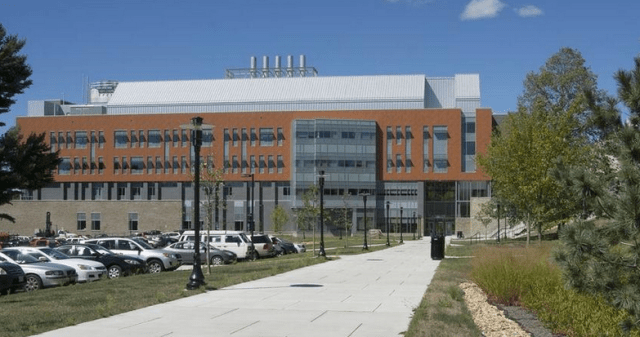
More disheartening are things like the new engineering building at URI, which Mellor herself described as having “a gleaming façade, indicating that department’s importance as a posh, state-of-the-art facility that bespeaks seriousness of purpose and commitment.” But what does it look like?

Below is the newly opened Richard E. Beaupre Center for Chemical and Forensic Sciences. Readers may judge for themselves. Still, after 100 years of being sold the line that a machine age requires a machine architecture, we have a machine metaphor without the promised machine efficiency. And surprise! – the buildings look like machines! If just engineering facilities were allowed to look like machines, maybe the trade-off would be acceptable – but today buildings of every sort are supposed to look like machines. If they were affordable and sustainable, then maybe the trade-off would be acceptable. But they are not. For the URI Fine Arts Center we can blame earlier generations. For the new engineering facility we have only ourselves to blame. But at least Colleen Kelly Mellor is heading in the right direction in her disgust at the “Fine” Arts Center at the Biggest Little’s university.

Screen Shot 2016-10-13 at 7.43.41 PM.png

Richard E. Beaupre Center for Chemical and Forensic Sciences. (Providence Journal)

Posted in Architecture, Art and design | Tagged , , , , | 4 Comments

Facing the faces in facades

Screen Shot 2016-10-12 at 8.44.02 PM.png

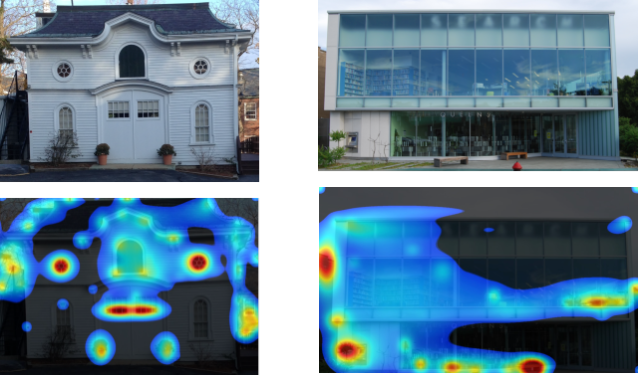
Heat map of  carriage house in Cambridge, Mass. and new library in Queens. (Ann Sussman)

Most architects don’t get it. The brain is hardwired to prefer traditional buildings over modernist buildings because building facades with more things going on – windows and doors clearly marked, ornament and detail at a range of scales – make it more likely that the brain will be able to do what it really likes to do. And that is find a face in the facade.

Ann Sussman has a new post on her blog The Genetics of Design where she hones in on this fact. “We See Like an Animal … and that Matters” shows computer “heat map” images of buildings that track what the eye looks at in a building and for how long. In her blog post she writes, “Our brain evolved to anthropomorphize things, a trait which turns out to carry a survival advantage. From our brain’s perspective, the carriage house [which gets the most attention] appears to be looking at us, and in so doing, orients us, and puts us at ease.” In an email Sussman expanded on this point:

This is why the palazzos in Venice or streets in Paris work so well – even if, as a visitor, you don’t speak the language. Subconsciously, your brain feels “seen” by these old buildings, or “regulated,” as your analyst might say. So they let you have happy thoughts. You are not scared or on alert the way you are walking around glass-box business centers such as the Innovation District in Boston or other typical office parks.  Our brain can’t regulate to feel safe around these buildings.  They weren’t around when we evolved, so Mommy Nature doesn’t really “see” them. Therefore, walking near them we feel isolation: we feel on alert, unhappy, disconnected.

And as we all know, you can’t fool Mommy Nature – though the modernists have been trying for almost a century. But they are proving that even if you can’t fool Mommy Nature, you can fool societies that leave their brains in park. Now, at long last, science is fighting back.

Posted in Architecture | Tagged , , , , | Leave a comment

“Vessel” and Gaillard Center

Screen Shot 2016-10-11 at 1.52.49 PM.png

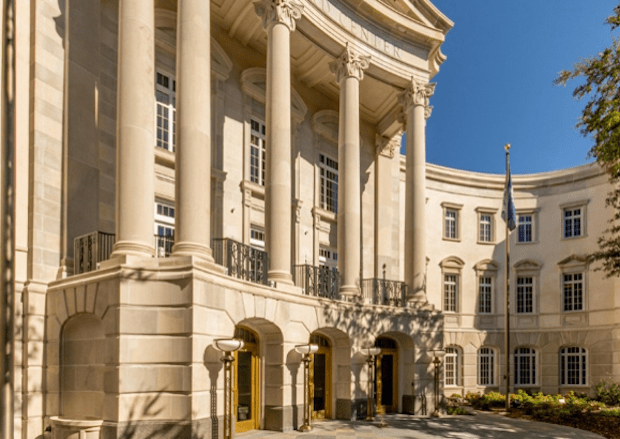
Gaillard Center, in Charleston, S.C. (BDCNetwork.com)

Far distant on the spectrum of the architectural firmament from “The Vessel,” whose status as Jim Kunstler’s Eyesore of the Month I touted in a post, “Stairway to nowhere in N.Y.,” earlier today, is the new Gaillard Center, a concert hall in Charleston, S.C., designed by David Schwarz and completed last year. I just read about it in Nathaniel Walker’s essay in The Classicist, which I received today as a member of the Institute of Classical Architecture & Art. And since the photograph was an interior shot, showing some of the Gullah-inspired embellishments in the auditorium, I decided to look up the exterior online. It is stunning. I don’t believe I’ve ever seen the sort of curved pedimental portico that is its main architectural feature. Surely there must be some precedent for this, maybe in Vienna. Either way, this is classical creativity on steroids. My congratulations to Schwarz and his people.

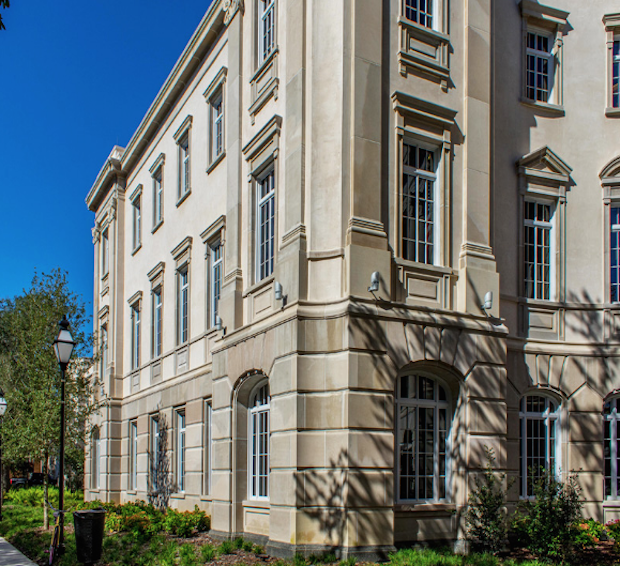
The ‘new’ Gaillard Center gets a standing ovation for its exterior cladding,” in Building Design + Construction, discusses the Thermocromex it used to simulate stucco cladding. It is described in the BD+C article this way:

A unique, ultra-high-performance limestone plaster cladding, Thermocromex is an advanced technical re-formulation that can be applied to virtually any substrate, including CMU, frame/sheathing, tilt wall, poured-in -place concrete and lightweight blocks/cement.

So I don’t really know exactly what it is, but the photos suggest that it is quite nice looking, and it is said to be maintenance-free for years – though I worry this means it will not age or weather up to par. I hope I am wrong.

But I’ve gone on about all of this because I noticed that the concert hall cost $142 million. Kunstler points out that Heatherwick’s “Vessel” in New York is already 100 percent over its $75 million budget. That means that Charleston got a concert hall for less than what New York is getting for a cockamamie thingamajig. Good grief! What does this mean? Doesn’t anyone notice?

Screen Shot 2016-10-11 at 2.05.28 PM.png

Sides of Gaillard Center, clad in Thermocromex. (BDCNetwork.com)

Posted in Architecture | Tagged , , , , , , , , , , | 1 Comment

Cry for Palmyra, not Paris?

Screen Shot 2016-10-06 at 8.47.51 PM.png

Far be it from me to wish people would shut up about Palmyra and cry for Paris instead. For one thing, Paris isn’t anywhere near as close to death as Palmyra and other archaeological sites in the ISIS cross-hairs. But for all the indubitable importance of such digs and the pre-history they uncover, Paris is more important. It is more beautiful and its beauty makes far more people happy. People from around the world visit Paris. Palmyra? Not so much.

But anger is not a zero-sum game. You can be angry at what’s happening to Paris without diminishing anger worth expressing on behalf of Palmyra.

So I am going to indulge myself by reprinting the extraordinarily moving first paragraph of a  piece by Mary Campbell Gallagher on this theme of why cry for Palmyra but not Paris. She is founder of the International Coalition for the Preservation of Paris. It first ran on my blog (“We’ll always have Paris?“). Here it is:

When the masked thugs of ISIS swing their sledgehammers through Iraq’s museums and dynamite Palmyra, the world gasps and screams. But what if the vandal is a chic Parisian woman wearing high-heeled boots and talking like a visionary? What if her target is the world’s most beloved and most-visited city? Does the world gasp, or does it not even hear what she is saying? … Doesn’t anyone get what Paris is doing to itself?

Gallagher certainly is brave. She called Paris’s mayor, Anne Hidalgo, a vandal. Gallagher said Hidalgo is targeting Paris. Her fashionable garb, high heels and visionary rhetoric are mocked by Gallagher. She compares Hidalgo to ISIS. Is there anything out of bounds in these passages? No, not by the standards of punditry today. In my opinion, the lady handled Hidalgo with kid gloves. Hidalgo, not Hillary, deserves to be thrown in jail. (Now that’s tough, I suppose, right?)

Is the mayor of Paris a shrinking violet who requires the protection of gentlemen, male or female? No, certainly not. She is one of the big boys.

So she can take it. She seems to think that her political stripe entitles her to destroy Paris. I believe she is mistaken about whatever bright lines she may think she sees in the subject of what buildings should look like.

In fact, architecture is not a commodity that breaks down easily along the lines of political faction. Liberals may be more associated with modern architecture and conservatives with traditional architecture, but there are many issues in architectural discourse where the normal political fault lines are crossed and recrossed frequently. Traditional architecture is more sustainable, for example, and modernism is the brand of the 1 percent.

Yet you’d think that whatever their stripe, lovers of cities and beauty would be bipartisan in their support for Paris.

Screen Shot 2016-10-06 at 8.52.57 PM.png

Posted in Architecture, Urbanism and planning | Tagged , , , | Leave a comment

Notre Dame’s 6-10 charrette

Screen Shot 2016-10-05 at 10.04.30 AM.png

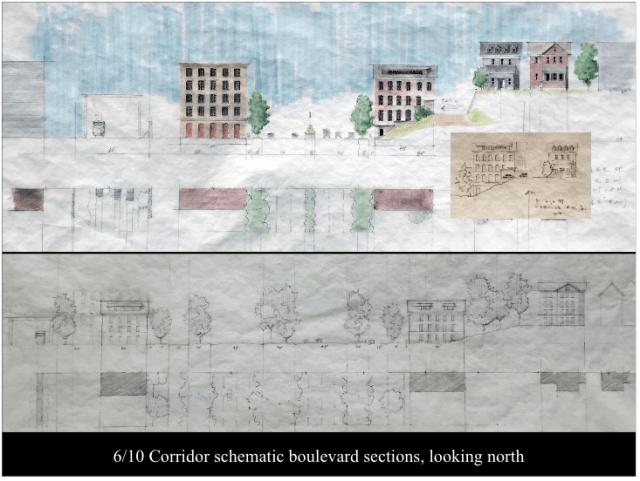
An illustrative board from the Notre Dame 6-10 presentation.

Here are the boards – images reflecting thoughts thus far – of the charrette or brainstorming session on the 6-10 connector and Route 195 land issues, hosted last month by Prof. Philip Bess and his graduate students from the School of Architecture at Notre Dame. This is part of Bess’s annual After Burnham studio on city planning. Coincidentally, as these boards were being released, the city of Providence released its own preliminary plan for a boulevard, sort of, to resolve the 6-10 aging problem. The Rhode Island Department of Transportation wants now, alas, to simply rebuild the connector as a 1950s-era limited-access highway.

After Governor Raimondo’s decision, I ran a post referring to the Notre Dame visit to Providence, “Build the boulevard anyway.”

To some degree, I suspect, the city’s plan for 6-10 is much closer to the Notre Dame plan for a 6-10 boulevard than the state’s rebuild plan. And the Notre Dame plan is closer than the city’s plan to a possible simpler boulevard plan, without bells and whistles (sort of like boulevards used to be back in the day before everything had to be ridiculously complicated). The simpler boulevard plan might address the speed-of-implementation (that is, safety) issues that are allegedly behind the state’s new plan to simply rebuild the awful raised highway originally built half a century ago.

I include a link to the Notre Dame boards thus far, showing progress toward reaching a proposal on 6-10 (and, to a lesser degree, on 195). I also include several links to the recently released city boulevard plan, with its “halo” intersection between 6 and 10. It is a lot of material, but worth going through. First, the Notre Dame link. Below are the several city links:

Draft Plan: http://bit.ly/2cPY8Ep

PDF of the presentation: http://bit.ly/2dO1ldE

Live Stream Video of the presentation: http://bit.ly/2d04ODf


Posted in Architecture, Urbanism and planning | Tagged , , , , , | Leave a comment

From Bauhaus to Coolhaus


Screen Shot 2016-10-03 at 9.30.39 PM.png

The definition of “to brand” must be to promote a product as the opposite of what it is.

Screen Shot 2016-10-03 at 9.27.54 PM.png

Freya Estreller and Natasha Case.

For example, take Coolhaus Ice Cream. It riffs on the Bauhaus, the Weimar German cult of artists from which emerged modern architecture about a century ago. And on modernist starchitect Rem Kookhaus – oops, Koolhaas, sorry. On a pint of “Sundae Funday, aka Moshe Saf-isticated Sundae,” the flavor is described on the front as “Tahitian Vanilla Bean Ice Cream, Chocolate Hazelnut Swirl & Salted Roasted Almonds.” Kool! But on the back, the story of the Coolhaus brand is told: “Even though we’ve grown, nothing has changed about our [local and sustainable] sourcing, making things from scratch, innovating our favorite flavor combinations, or our punny architectural names.” Sounds a lot like the slow ice cream movement!

In short, in spite of the Bauhaus pun in the brand, the product is clearly made using traditional techniques. For the fact is,  traditional architecture is sustainable in a way modern architecture can never be. Modern architecture is processed architecture. If Coolhaus lived up to its name, this brand would be the processed Sealtest ice cream we kids of a certain age rolled our eyes at back in the day. The why of the Coolhaus brand is the $64,000 question. If it is great ice cream, why employ a brand that suggests otherwise?

But I must be a churl to wax snarkly about a brand of ice cream owned by such a pair of capitalists. And ice cream has been berry berry good to me. I met my wife while she was in the supermarket checkout line with an arsenal of Ben & Jerry’s. So, just to make sure I was not unjustly impugning the Sealtest name, I went to Wikipedia, where I found:

At one time, the advertising agency on record, Young & Rubicam, wanted to reintroduce the brand as “Now with Natural Vanilla.”[citation needed] Consumers responded that they believed the brand to be “all natural” already and the effort to increase brand spending was ended before it went to market.[citation needed]”

Perhaps it’s got a little too much “citation needed” mixed into the flavor of the story, but for a story about branding, it sure tastes good. Dee-lishus!

By the way, if it’s Bauhaus, the roof should be flat. But let’s not hold ’em to that.

Posted in Architecture, Art and design | Tagged , , , , , | 2 Comments

The architecture of music

Screen Shot 2016-09-30 at 8.13.15 AM.png

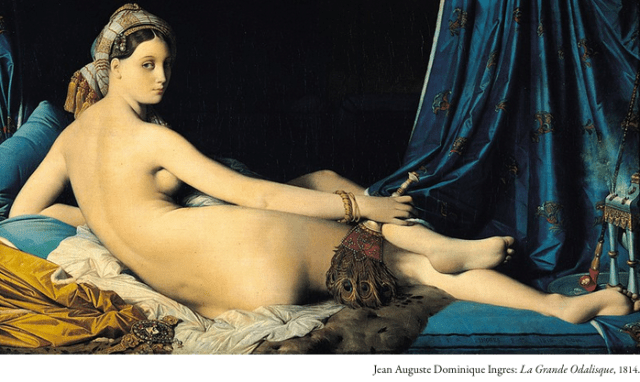
And vice versa, with painting thrown in. This is the subject of a fascinating essay written a decade ago by Steven Semes, author more recently of one of my bibles, The Future of the Past: A Conservation Ethic for Architecture, Urbanism and Historic Preservation. First written for the American Arts Quarterly, “Le Voilon d’Ingres” was republished recently by the online journal of the Future Symphony Institute, which seeks to “orchestrate a renaissance” in classical music, classical architecture and classical art.

The title of “Le Voilon d’Ingres: Some Reflections on Music, Painting and Architecture” refers to the painter Jean-Auguste-Dominique Ingres’s violin and its artistic qualities as a physical instrument. “The instrument he plays is a composition of molding profiles drawn from classical architecture – torus, scotia, bead and cyma recta – culminating in a spiral resembling the volute of an Ionic capital.” This leads, after some notations on other artists who have immersed themselves in more than one art, into Semes’s admirable thoughts on how the various classical arts reflect each other. I will quote several passages and you can click on the link above to read the rest.

[W]e often find it natural to speak of the architecture of music or the musicality of architecture. What is the source of this connection? Goethe’s famous definition of architecture as “frozen music” is suggestive, but not very specific. My sense is that there are three fundamental points of intersection between music and the visual arts: the first is the analogy between tonality and perspective, the second is their common interest in proportion, and the third is their non-representational, nonverbal expressiveness.

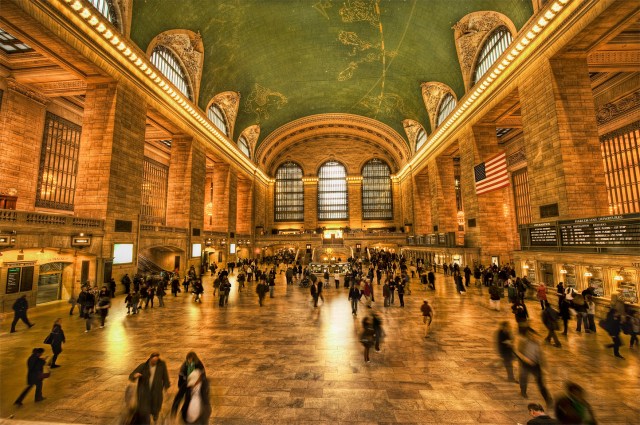
In an architectural analogue to musical space, commuters entering Grand Central Terminal [see below] in New York from 42nd Street pass through a low vestibule into the generously proportioned Vanderbilt Hall, continue through a Piranesian passage where ramps lead to the lower levels, and finally emerge into the great concourse, a crescendo worthy of Beethoven. It is not only the spaces themselves that impress us, but the way the elements enclosing them are organized compositionally. We see walls, floors and ceilings punctuated by openings and organized proportionally by the classical orders – the exact opposite of randomness.

Modern cosmology debunked this ancient picture of the cosmos as mysticism, a view paralleled in Schoenberg’s dismissal of tonality as an arbitrary convention and the modernist architects’ dismissal of the classical orders as relics of an exhausted past.

In recent decades, however, there has been growing scientific interest in the formative power of naturally occurring patterns as a far more complex cosmology slowly emerges. Scientists are interested in pattern and proportion once again. Neuroscience is beginning to reveal ways in which pattern-recognition is built into the complex and subtle mechanisms of the brain. From this viewpoint, classical music and architecture are analogous, not just because they reflect one another, but because they reflect us and the way our minds work. It should come as no surprise, then, that both music and architecture today are engaged in retrieving their respective traditional languages: melody, tonality, proportion, ornament, the classical orders – the whole lot.

Whatever music Ingres played on his violin, it did not express definite thoughts about a non-musical subject that could be restated in words. Architecture, too, may be intensely expressive, communicating strong feelings purely by manipulation of “space, mass, line, and coherence” (to borrow Geoffrey Scott’s terms), but it cannot say anything definite about a non-architectural subject. This is why architecture needs decorative painting and sculpture to introduce narrative content, and why music relies on sung or spoken words for the same purpose.

2000x1333px-611-27-kb-grand-central-station.jpg

Grand Central Terminal. (wallpaperfolder.com)

Posted in Architecture | Tagged , , , , , , | 2 Comments