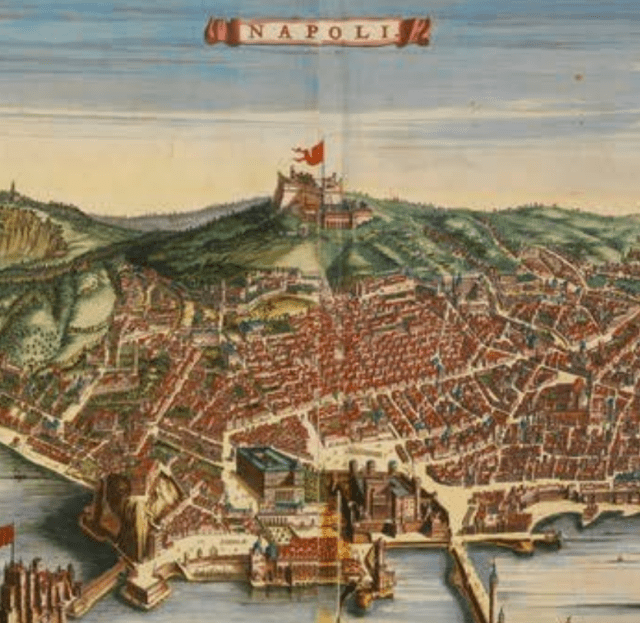
Yesterday’s post, “‘Building Beauty’ in Naples,” discusses a new program of architecture education in Italy that emphasizes beauty. It is mind-boggling that even in Italy an architecture program that emphasizes beauty is news. I issued a tentative warning about the program, invalid I hope, but in doing so I neglected to sufficiently describe the program itself. So here goes.
First off, the University Suor Orsola Benincasa (UniSOB) is surrounded by the old city of Naples, founded as Parthenope or Palaepolis in the 9th century B.C., and subsequently re-established as Neapolis (New City) in 470 B.C. The university sits amid the very beauty that its new “Building Beauty” program was founded to re-establish in architecture. But of course many architecture programs that intend to destroy beauty – yes, intend – are also situated amid lovely settings. Not always are such settings used as models of excellence in design or permitted to impart the wisdom of beauty to students.
Although most modernist architects today are unaware or have forgotten, modern architecture is not just a style but a vital facet of a world view that sees itself as the summit of human progress. Under its domain, obsolete systems of design will, like other traditions, be overtaken and eliminated. This is already happening in almost every field of human endeavor. Why should architecture be any different?
Well, because the obliteration of tradition in architecture reflects erroneous ideas about human nature and human progress whose continuation is dangerous to society. It seems to me that “Building Beauty” must intend to act against that trend in architecture, or it is not really a new system of architectural education, let alone a builder of beauty.
Fortunately, the program does seem to see itself, albeit without really saying so, as reacting against trends in architecture and educational practices that have failed humanity for almost a century by now.
A pamphlet that explains “Building Beauty” reads:
The program emphasizes the generation of beauty by means of the practical work of making; it is offered to all those willing to explore that beauty which makes a difference in the world.
Above all, “Building Beauty” is scientific as opposed to utilitarian. Utility and science are two different things. In its quest for the utility of the machine, modern architecture seeks to don the reputation of science even as it has abandoned the rigor of science. This program will re-embrace science as an ally of nature. Christopher Alexander, as lead developer of the curriculum, is well known for his scientific research into the organic generation of forms at the heart of a living architecture. Science knows that nature copies itself, often making small advances in utility – just as architecture has evolved over centuries of practice. This parallel is at the heart of the new program.
Although technology is an important aspect of building, the conception of what is built is – if I am interpreting the program correctly – more directly tied to the way architecture changes over time as builders develop best practices through trial and error at the level of the construction site. The program incorporates the experience of construction in ways that were long ago abandoned in conventional design education.
No. 9 of the “Building Beauty” program’s 13 principles is:
The “Unfolding” Nature of Beauty Generation Essentially a process of adaptive transformation, making beauty happens in steps whereby each step expands the pre-existent beauty and, in itself, is complete and makes full sense. We test and explore the unfolding nature of beauty generation both in the process of making and in that of teaching how to make.
This is pure Alexander. Clearly, referring back to my warning at the top of this post, a mindset that rejects “mimicry” or “copying the past” as inimical to creativity in design is incompatible with this program. A new program of any sort cannot succeed if it is untrue to itself, so I believe, after reading the materials linked to above, that “Building Beauty” is well founded and likely to succeed, if success is measured in terms of helping students create beauty in the face of the opposition of the architectural establishment.











 Architecture Here and There