A thrilling week of classicism

Screen Shot 2019-05-26 at 10.08.19 PM.png

Our table in the dining hall at the University Club of New York.

I am still coming down from the high honor of attending the Arthur Ross Awards, of the Institute of Classical Architecture & Art, as guest of James Stevens Curl, author of Making Dystopia and, for that, winner of the 2019 Ross in the category of History and Writing. The gala celebration of this year’s laureates was held, as it always is, at the University Club of New York, an elegant pile by Charles Follen McKim of the Gilded Age’s leading firm, McKim, Mead & White (all three were club members).

Screen Shot 2019-05-26 at 10.16.49 PM.png

James Stevens Curl at the club’s Table 33.

It’s probably no longer true that Cambridge academics with books printed by the Oxford University Press are required to represent, in their dress and elocution, the bygone Empire. Stevens Curl’s black-tie outfit was impeccable, with not one but two watch fobs in the pockets of his vest. He looked (and sounded) the very model of a – um – modern major general.

Readers of my blog are forgiven for thinking it has become the James Stevens Curl Here and There blog, but his book’s publication may finally turn the tables on modern architecture. For that, he was welcomed as royalty by the gala’s attendees, spoke longer than anyone in accepting his award, and was rewarded with the most rousing applause, although the winners included, among other luminaries, his estimable fellow Brit, Julian Fellowes, writer and producer of Downton Abbey, a BBC production dear to the hearts of all classicists. Fellowes, whose Ross was in the category of fine arts, had the audacity, and to my mind poor taste, to reveal in his brief remarks that he’s not against modern architecture – a fact belied by his life’s work.

Notwithstanding my awareness of the man’s denizenship in the Hollywood swamp, my jaw dropped so far as to upset my demitasse of postprandial joe.

Well, Stevens Curl does oppose modern architecture, to state the matter gently, and by rights his book ought to kill it. This became clear a week later when he visited Boston to lecture at the College Club of Boston, an event hosted by the New England chapter of the ICAA. His stentorian persona had rattled the chapter’s board members, so much so that they were astonished at the 83-year-old’s sweet personal gentility, evident even after two gruelling weeks of travel across the country to speak at other ICAA events.

During his lecture at the College Club, even as he manifested his exhaustion by fumbling his notes, he rose to the occasion again and again with roaring denunciations of modern architecture that were nevertheless couched in his sharp Brit wit. He quieted the room with a flood of details exposing the close ties of the early modernists to totalitarians of the left and right, stonewalled for decades by acolytes of Corbusier, Mies and Grope (as Professor Curl likes to call Walter Gropius, founder of the modernist cult; 2019 is the centennial of the Bauhaus School, which got the dystopian ball rolling).

Many classicists and architects specializing in traditional design, while aware that modern architecture sneers at their “twee confections,” do not really seem to be aware that the proper word for the relationship is not rivalry but enmity. Modernism’s failure to destroy the practice of classicism is not for want of trying. It may well be that today’s modernists are not up to speed on their history, but if classical architecture had had the sort of relationship with, say, the Third Reich that the early modernists did, the tom-toms of expulsion from the profession would beat loud in our ears.

I think that even so knowledgeable a crowd as the audience at Stevens Curl’s lecture in Boston was generally stunned by the facts that flew from the lectern. The applause at the end seemed, to me, generous but nonetheless slightly hushed. Most classicists, who just want to design buildings in their preferred styles, are miffed by the “war of styles,” and wish it could be dispensed with. “Can’t we all just get along?” is the common refrain.

No, says Professor Curl. We cannot. Speaking truth to power is often as difficult for the members of the choir who hear and shudder at the speaker’s truth as it is for the speaker himself. James Stevens Curl epitomizes the tough love required to bring beauty, and sanity, back to the world of architecture. The ICAA, with its chapters, is to be applauded for stiffening its upper lip and bringing the great man over to our side of the pond.

Screen Shot 2019-05-26 at 10.04.39 PM.png

James Stevens Curl enjoys dinner at the Parker House after his lecture in Boston.

Posted in Architecture | Tagged , , , , , , , | 4 Comments

How to break into Fort Knox

Screen Shot 2019-05-24 at 9.32.13 PM.png

Fort Knox, the U.S. gold bullion repository in Kentucky. (Louisville Courier-Journal)

Fort Knox, officially the United States Bullion Depository, in Fort Knox, Kentucky, holds a large portion of the U.S. gold reserves. Designed by the architect Louis Simon in the Art Deco style, it received its first gold shipment in 1937. In its time it has held an amount equal to 2.3 percent of all the gold refined around the world and throughout history. Aside from being next to a U.S. Army base, it is said to be legendarily hard to break into, so much so that its name is a synonym for impregnability.

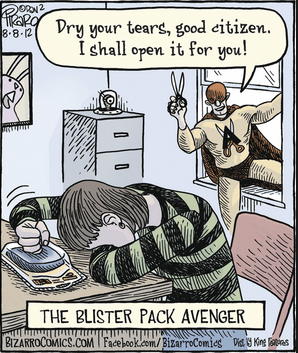
So why is Fort Knox the model for product packaging? I just tried to liberate several inmates from one of four caches of crackers in a box of Ritz. What could be more innocuous? But it was like trying to break into Fort Knox. The plastic wrapping would not be forced. Almost drove me nuts! In fact, the phenomenon has grown so ubiquitous that it has a name, “wrap rage.”

Screen Shot 2019-05-24 at 10.32.08 PM.png

Think of aspirin that forces you to align the “arrows” on the lid and bottle, and once they are in line it’s still hard to pry the lid open. It seems designed to strengthen a headache. The “clamshell” packaging of many products, as it’s called, no doubt in recognition of a clam’s interest in its own impregnability, is impossible to open by hand. You must seek some sort of mechanical assistance from the basement, or stab the product with a heavy pair of scizzors, as if it were some sort of home invader – at some considerable risk to product survival and personal safety. Packages that arrive from Amazon or other services are often wrapped with such inviolable skeins of industrial-strength tape that the joy of getting a package is entirely deflated. Consumer Reports gives an annual “Oyster Award” to the most difficult-to-open packaging. There must be a lot of contenders.

Yes, keeping medications from children, or complicating the task of the shoplifter, are valid reasons for packaging overkill, but does this genuinely require making packages as difficult to access as Fort Knox? Manufacturers are allegedly working to find a happy medium, but the earliest detected use of the phrase wrap rage was in 2003. I do not think I’m the first person to wonder if aggressive packaging is really about power. The production of packaging that wants to be Fort Knox is a problem that ought to have been solved years ago. Fort Knox is not nuclear physics; neither is packaging.

This is a design issue and thus within the purview of this blog, or at least it is this evening. To be sure, wrap rage is safer than road rage. While road rage happens at 60, 70, 80 miles per hour on the open road, wrap rage occurs on your living room couch or at your kitchen counter. That is less hazardous, but no less frustrating or debilitating to one’s amour propre. Congress passes many unnecessary laws. Let it outlaw packaging that thinks it is Fort Knox.

Has anyone successfully broken into Fort Knox? Nobody has even tried since it opened in 1935. So for all we know, product packaging is even harder to break into than Fort Knox.

Posted in Architecture | Tagged , , , , | 6 Comments

Make Mr. Highways smile

Screen Shot 2019-05-21 at 8.43.18 PM.png

Image of proposed new Henderson Bridge between Providence and East Providence. (RIDOT)

The late George Henderson, of Rumford, is the engineer who designed the Henderson Bridge across the Seekonk River, replacing upstream the old Red Bridge between Providence and East Providence. Known as “Mr. Highways,” he must have been a pretty popular guy, because the bridge, completed in 1969 as part of a never-built connector to Route 195, is of no distinction whatever. It looks like what it is – a highway overpass.

Screen Shot 2019-05-21 at 9.01.21 PM.png

Barrington/Warren Bridge.

Put some sort of an arch on the bridge, something recognizing Rhode Island’s status as a fount of lovely bridges, such as the Newport Bridge, the Mount Hope Bridge and, more recently, the two bridges taking Route 114 from Barrington to Warren. Those two bridges took eight years to build (quadruple what it took to build the Empire State Building in 1930), and went over budget, too, but the payback was in the elegant lamp posts, which gave them distinction.

A bridge arch or maybe a set of truly lovely bridge lamp posts would be sure to make George Henderson smile.

RIDOT held a public session on the bridge’s design yesterday at the Lincoln School, on Hope Street in Providence.* It was a start. The bridge lamps in the RIDOT working image atop this post have the sort of cheesy olde-timey lamp posts similar to those erected not long ago along the east end of Westminster Street in downtown. What a letdown they are! Westminster deserves better, and so would the Henderson, if beauty is to be the strategy by which the bridge’s distinction will be achieved.

Screen Shot 2019-05-21 at 9.12.18 PM.png

Henderson Bridge. (Providence Journal)

Assuming beauty is part of the strategy. But it cannot be assumed. Jersey barriers? Give us a break! Which is why Monday’s meeting at Lincoln was so important.

A more ambitious strategy would be to add an arch superstructure to the bridge, as recently suggested by the architect Michael Tyrrell, of Providence, who sits with me on the board of the New England chapter of the Institute of Classical Architecture & Art. Such an arch (along with three imposing pylons at each end) gives considerable distinction to the new IWAY bridge over the Providence from the Jewelry District to Fox Point. It should be considered for the Henderson Bridge.

Screen Shot 2019-05-21 at 10.41.58 PM.png

Red Bridge replaced by Henderson, 1969

Dodgy, to say the least, is the word for RIDOT’s planned three roundabouts in the plan for the new Henderson Bridge. In fact, the bridge, whose size has already been greatly narrowed and downsized, should be shifted away from its current long diagonal track across the Seekonk. That would shorten it, lower its cost, and incorporate its new and smaller approaches into the existing street grid on either side of the river. The result of such a shift would enable the two main streets that approach the narrowest part of the river to be connected by the span. Those streets are Waterman Street and Waterman Avenue, once connected by the old Red Bridge.

Such a shift would eliminate entirely the need for on-ramps, off-ramps and confusing roundabouts. It would open up more land on either side of the river for development. It would probably decrease the cost in time and money to build the project, enabling RIDOT to add a much nicer archway, better lamp pots, pleasing pylons, or some combination of these (or maybe something else) to turn the bridge into a span worth driving, biking or walking over, not to mention looking at, and commensurate with the charming new communities that could spring up on either side.

Think big, RIDOT! Think smart! Even Mr. Highways would agree.

***

[*This post originally reported an upcoming meeting about the Henderson Bridge design at the Lincoln School on Monday. The meeting took place this past Monday, the day before this post was written, based on a Providence Journal report published on the day of the meeting and announcing the day (Monday) but not the date of the meeting. My apologies for absent diligence in not double-checking the Journal’s reporting, and I hope nobody was inconvenienced.]

Screen Shot 2019-05-21 at 10.02.04 PM.png

Providence River/I-195 Bridge should be named for the late Bill Warner. (Flickr)

Posted in Architecture | Tagged , , , , , , , , | 7 Comments

I. M. Pei, rest in peace

boris feldblyum.png

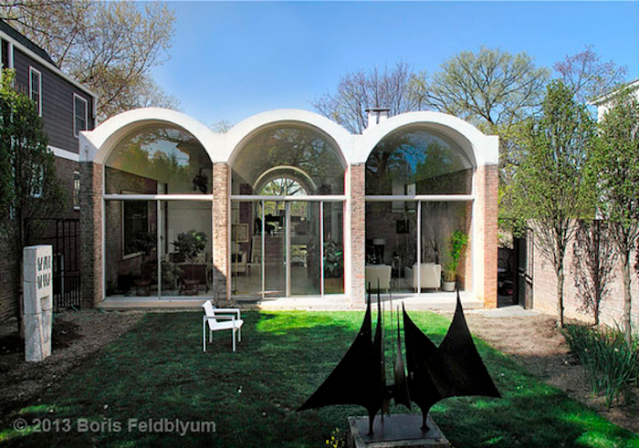
William Slayton House, 3411 Ordway St., Washington, D.C., by I.M. Pei. (Boris Feldblyum)

The Chinese-American architect Ieoh Ming Pei died last week at age 102 after a career designing modernist buildings, many of them now famous. Since it is poor manners to speak ill of the dead, I will say only that most readers of this post can guess my opinion of Pei’s work. His life and work intersected frequently with my life, however, so here, in his honor, are several of those points of intersection.

In the 1950s, not long after Pei started out as an architect, my father worked as a planner for a development firm called Webb & Knapp, which worked on projects initiated by its owner, the real-estate tycoon William Zeckendorf. Among the firm’s architects was Pei, who designed three residential towers for the Society Hill project in Philadelphia.

IMG_0118.jpg

Princess Stephanie. (Franz von Hohenlohe)

My father managed the acquisition of land for that project, and hired a Hungarian lady, age 64, to go to high-society parties and teaze out who had land for sale. She used to come to our house for dinner and give me toy airplanes (I was 5). Later, my parents told me “Princess Stephanie” had been “in the Hitler circle” during World War II, which, I figured, meant she lived in Berlin during the war. Well, decades later I read a book, Explaining Hitler, by Ron Rosenbaum, and came upon several pages about Stephanie von Hohenlohe (a princess by marriage) in a chapter on Office of Strategic Services debriefings during the war. It seems she was not only a courtier in the Hitler circle but was a suspected spy thought by some historians to have had a relationship, of some sort, with the mad Führer.

Well, I’ve strayed from Pei. Sorry! But not long afterward, my father’s boss at Webb & Knapp, Bill Slayton, hired Pei to build him a house at 3411 Ordway St., three or four blocks from our house on Rodman Street, in Washington’s Cleveland Park neighborhood. He created three concrete barrel vaults you could see right through. My old buddy Steve Mields, who also grew up on Rodman, recalls that “Slayton’s house was always dark, dank and humid. Smelled of mildew. I was paid peanuts to weed and cut the grass when I was a kid. Never thought much of the design.” Still, it became the local curiosity in a neighborhood of rambling old houses eclectic in style, each lovelier than the next. Pei was among the “Slayton Irregulars,” who dined together and chewed on architecture and planning. Slayton served in top posts at both the American Institute of Architects and the U.S. Urban Renewal Administration, which were, I suspect, then as now, in each others’ pockets.

To me, even as a kid, the Slayton House (1960) seemed mainly an exercise in silliness. As a formal design it had too many humps to be either an M&M logo or a Bacterian camel.

Screen Shot 2019-05-20 at 12.35.13 AM.png

John Hancock Tower (yelp.com)

In the 1970s I attended Emerson College in Boston. One of my several apartments there looked over Marlborough Street, with the Pei-designed Hancock Tower at the epicenter of my view above the townhouses of the Back Bay. Pei had overseen a design whose windows started popping out soon after the building opened. The windows were filled with plywood until their repair, so I resided at Ground Zero for the “world’s tallest wooden building.” Eventually, glass panes replaced the plywood, and thank goodness. Because of its parallelogram shape, especially from a certain spot in Copley Place, it seems two dimensional, as if it were a razor blade.

Beautiful? Hardly. But exciting? Like any gigantic razor blade, yes! (“I cut off your head!”) The apogee of modern architecture’s allure is not called “The Wow Factor” for nothing.

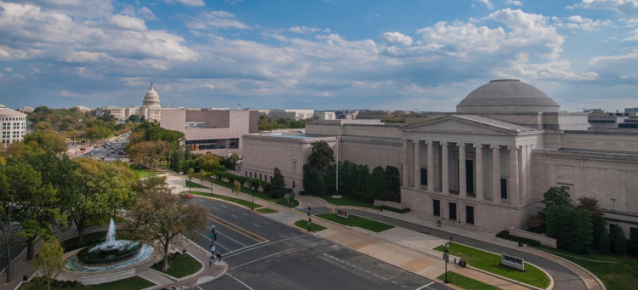
In the 1970s, Pei designed the East Wing of the glorious National Gallery of Art. The West Building (1940) was reached by a sculpture garden, which blessedly separated the two – one a classical beauty of gentle articulation by John Russell Pope and the other a modern clash of triangular forms famous for its sharpest exterior angle and the degree to which the public has rubbed it into a becoming softness. I am among the millions to have stroked it, but have not been able to determine whether the $68 million renovation of the East Wing begun in 2013 has abolished this beloved feature, one of the few humanistic elements, however unintended, in the building’s design.

Screen Shot 2019-05-20 at 12.56.54 AM.png

Cross atop penthouse atop Lamar Building, in Augusta. (Kirby’s Augusta)

In 1981, I took my first newspaper job with the Augusta (Ga.) Chronicle. Augusta was a charming place, or had been. By ’81, it had a hat trick – Civic Center, Chamber of Commerce Building and even a Bicentennial Park – by Pei. Fifteen years before his Louvre Pyramid, Pei plopped a pyramidal penthouse atop Augusta’s Lamar Building, a landmark classical tower. Villain!

Oops, could not resist. No speaking ill of the dead. Sorry.

(Speaking of villainy, after placing an illuminated cross on top of the penthouse pyramid in the 1970s, an owner of the building, state senator R. Eugene Holley, was convicted of bank fraud and served time in prison. And down came the cross. The penthouse, I hear, stands empty.)

Again, I recognized this (the penthouse and cross) as blasphemy well before I joined the Providence Journal in 1984 and became “Daoud” (as a Journal colleague rebranded me): the crusader against modern architecture. And Pei continued to dog my every turn in life.

Screen Shot 2019-05-20 at 1.29.17 AM.png

Optimistic project rendering of Cathedral Square. (DB archives)

After I started writing about architecture for the Journal in 1990, I was not surprised to learn that the lonely and meditative Cathedral Square was designed by I.M. Pei. Was its isolation a sort of religious element of the design? I do not know. The square was one of the very few proposals from the uber-modernist urban-renewalesque Downtown Providence 1970 plan (announced in 1960) to be built. Its architecture mainly served to block off views of the two towers of the Cathedral of Sts. Peter & Paul. They are reminiscent of Notre-Dame’s two towers. Cathedral Square has been compared for years since its completion with the plaza where Westminster and Weybosset streets meet – the eastern end of the “bow” whose western end, at Cathedral Square, was obliterated by urban removal.

So, there you have it. Given his long shadow across my life and career, I must admit that I.M. Pei’s modern architecture is among the chief influences in the formation of my love for classical architecture. May he rest in peace.

Screen Shot 2019-05-20 at 1.35.40 AM.png

National Gallery of Art. Note East Wing just to right of U.S. Capitol dome. (Trip Advisor)

Screen Shot 2019-05-24 at 9.00.22 AM.png

Our house at 3015 Rodman St., built in 1917, we paid $22,000 in 1962; Metro subway stop a block away, 1976; Mom sold in mid 1990s for $300,000; just sold for $1.4 M. (redfin.com)

Posted in Architecture | Tagged , , , , , , , , | 13 Comments

Andreozzi’s Shingle on acid

Screen Shot 2019-05-16 at 2.47.04 PM.png

Not long ago, during an online conversation about whether traditional architects can steal back the world “modern” from modernist architects, Rhode Island architect David Andreozzi, who is president of the New England chapter of the Institute of Classical Architecture & Art, linked to a house he’d designed in Westerly from 2003, and called it “modern.”

I objected. It was a traditional Shingle style house, of, yes, a wild and crazy design, but a dazzling example of how creative tradition can be. That’s different from being “modern,” unless Andreozzi was using the word, as he wishes to do, in its normal meaning: of today; using the latest methods – which could equally apply to a new traditional house. The discussion about the word and its usage went on and on. It was laudable and fascinating.

In my opinion, however, the modernists successfully kidnapped the word a hundred years ago, and the trads are unlikely to be able to free it and limit its use to its proper meaning as long as modernists control the architectural discourse. Ending that control is more likely to occur if traditional architects concentrate on designing great traditional buildings that teach the public that beauty is an equally valid design strategy for today, not just an artifact of the historical past. And they can also repeat, as I like to do, the argument that modern architecture is ugly and stupid – using, of course, as others are more likely to do, sophisticated versions of that argument. This house is obviously not ugly or stupid so it cannot be modern architecture.

But that’s neither here nor there. Readers should look at the photographs of Andreozzi’s Fertig residence and decide for themselves whether it qualifies as “modern” architecture.

Screen Shot 2019-05-16 at 2.47.20 PM.png

Screen Shot 2019-05-16 at 2.48.12 PM.png

Screen Shot 2019-05-16 at 3.06.56 PM.png

Screen Shot 2019-05-16 at 2.51.56 PM.png

Screen Shot 2019-05-16 at 2.52.07 PM.png

Screen Shot 2019-05-16 at 2.52.21 PM.png

Screen Shot 2019-05-16 at 2.54.03 PM.png

Screen Shot 2019-05-16 at 2.52.38 PM.png

Screen Shot 2019-05-16 at 3.07.54 PM.png

Screen Shot 2019-05-16 at 3.05.11 PM.png

Screen Shot 2019-05-16 at 3.05.28 PM.png

Screen Shot 2019-05-16 at 3.06.22 PM.png

Screen Shot 2019-05-16 at 2.52.51 PM.png

Screen Shot 2019-05-16 at 2.53.09 PM.png

Screen Shot 2019-05-16 at 3.09.52 PM.png

Posted in Architecture | Tagged , , , , , , , , , | 8 Comments

While Our Lady is restored

Screen Shot 2019-05-14 at 10.09.39 PM.png

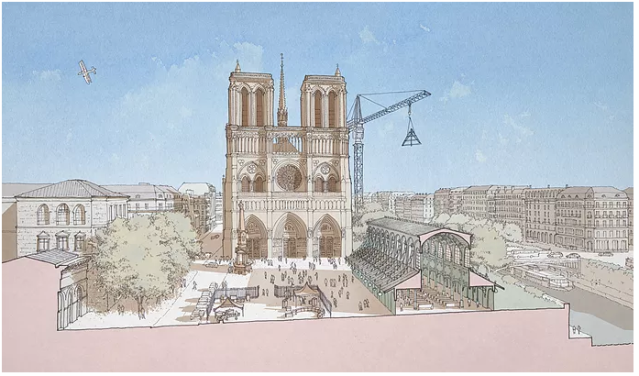
The as yet officially unannounced international design competition on how to repair Notre-Dame de Paris after her extensive damage by fire has already spawned a number of predictably ridiculous proposals. One would replace the roof with a swimming pool intended, it would appear, to collapse what the fire did not. Another proposal comes from Sir Norman Foster.

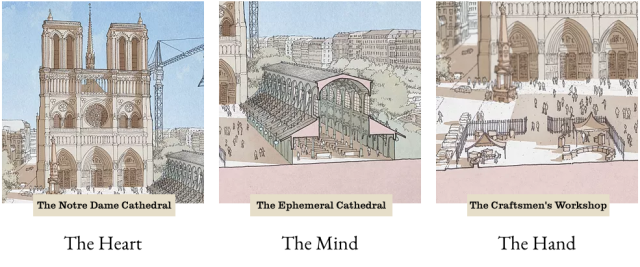
One proposal that eschews the ridiculous, called “A Vision for Notre Dame,” has emerged from three young architects who met at Notre Dame – that is, in architecture school at the University of Notre Dame in South Bend, Ind. – and now all work in Atlanta. Two of them, Rene Salas and Jacques Levet, are at Historical Concepts and Reinaldo Hernandez is at Peter Block Architects. Paul Knight, of Historical Concepts, who sojourned in Providence early this decade, has helped spread their idea as expressed in the proposal:

Our Hands need our Minds, guided by the Heart.  We support the full restoration of Notre Dame as it stood prior to the tragic fire. Our proposal focuses on how the site surrounding Notre Dame can be used during the restoration process. The rebuilding of Notre Dame should be a public process and the site should convey the important meanings of what has existed there, the traditions that contributed toward its development, and the people that materialized and crafted it. 

No doubt every proposal intends to restore (or “restore”) the cathedral. Although the forces arrayed against replication are far from insignificant – modernist architecture is a cult as powerful in France as in America – the likelihood is that the spire and roof will be reproduced consonant with their pre-catastrophe appearance. The institutional forces pushing back against a modernist reconceptualization include the cathedral’s status as a UNESCO World Heritage site (described by its former heritage director, Francesco Bandarin), France’s conservation community, and the organized artisans who still know how to do the work. France’s workers are quite capable of exerting pressure on its government (which, by the way, owns Notre-Dame).

Screen Shot 2019-05-14 at 10.39.05 PM.png

The workplace of the “Vision.”

So that is heartening. But if the restoration of Notre Dame is to reach its greatest significance, it must contribute to a trend toward beauty that may have its heart in Paris but exists throughout the world. The reconstruction of the cathedral must feed momentum toward a global revival of tradition in architecture. Fortunately, the “Vision for Notre Dame” proposal appears perfectly capable of embracing that mission.

Notre Dame’s restoration should engage the public in that effort. In addition to restoring the cathedral and building a temporary communal building, the “Vision” contemplates erecting a craftsmen’s workshop in the square facing the cathedral. The workshop would introduce the public to the work of hand that reflects the values of construction that have atrophied in recent decades dominated by the bogus “machine age” metaphor that has ripped the heart out of architecture. “Relearning the lessons of history, and the wisdoms of culture,” the proposal reads, “will strengthen our abilities to conceptualize a more dignified and human habitat. The progress of society is inseparable from the traditions that we chose to maintain.” In short:

“How many young people will be inspired by what they may see?”

Precisely. Reconstructions of major historic civic, institutional, commercial and ecclesiastical buildings and squares, and new places designed in the spirit that once made cities great, have been proceeding in Europe and elsewhere for decades. The reconstruction of Dresden’s Frauenkirche district and the construction of a popular new town, Poundbury, in the style of old Britain epitomize both sides of that equation. In the United States, new buildings that recapture beloved old styles are increasingly common (most recently the federal courthouse of Tuscaloosa, Ala., in the style of a Greek temple). No project promises to engage the public’s imagination like that of rebuilding Penn Station as originally designed. (“One entered the city like a god,” said Vincent Scully after its demolition. “One scuttles in now like a rat.”)

Architecture is inherently slow, difficult work, as are the preservation and reconstitution of culture and tradition. But it can be done and should be done. It is likely that if Notre Dame is rebuilt in a mere five years, it will be an epic fail. That must not happen.

Work on Notre Dame may be expected to stir a popular yearning for beauty and grandeur in our cities, and not just in Paris. Coming from Atlanta, with its Millennium Gate, “A Vision for Notre Dame” would add boosters to this aspiration for a renewed pride in place that has taken all too many years to regenerate. Let’s wish “Vision” well in the upcoming competition.

Screen Shot 2019-05-14 at 10.10.24 PM.png

Posted in Architecture, Preservation | Tagged , , , , , , , , , , , , , | 10 Comments

The foreboding of H.H. Reed

Screen Shot 2019-05-12 at 3.13.26 PM.png

Here’s a passage from “Warning to the Architectural Avant-Garde,” in the May 1959 issue of the journal L’Architettura, by Bruno Zevi, as translated in a collection of essays called Architecture in America: A Battle of Styles, edited by William A. Coles and (the late) Henry Hope Reed, Jr., published in 1961*:

If historical-critical thinking in Italy has any value, it should succeed in defeating the intertia, uncertainties, formalistic evasions, and superficialities which presently pollute the Modern Movement and threaten its development. …

Screen Shot 2019-05-12 at 3.22.34 PM.png

Henry Hope Reed in Rome.

This year there was published in the United States a book entitled The Golden City by Henry Hope Reed, Jr. It is the most reactionary but also the most skilful attack on Modern architecture written in the last decades. It begins by comparing a series of buildings executed in the Greco-Roman style between 1860 and 1920 with their Modern equivalents and it concludes in favor of the former. …

With a consistency and a display of ideas worthy of a better cause, Reed denies the significance of a century of history and maintains that it is not only necessary to return to false arches, columns with bases and capitals, and pastiche decoration, but that we will inevitably return to these because the language of Modern architecture has gone sterile and its crisis can only end in a return to the neoclassical.

We must consider this book not so much to refute it analytically as to understand how the project could have been conceived, how in the world a scholar with a solid knowledge of history dares to prophesy with tightly argued logic the coming of the neo-Roman and the neo-Renaissance. It is not a question here of dealing with an old man nostalgic for the past, like our late teachers, but with a culturally equipped individual who has followed the development of Modern architecture and still, with an astonishingly anti-historical mode of approach, denies its significance.

The Golden City denounced the architecture of the Bauhaus school 40 years after its wretched founding, and 60 years before its ridiculous centennial this year. Even then the modernists knew what was wrong with modern architecture. But they are still here. Why?

***

* Henry Hope Reed Jr. and William A. Coles were art historians and, in 1968, founders of Classical America, which merged with the Institute of Classical Architecture in 2002 to become the Institute of Classical Architecture & Art.

Posted in Architecture | Tagged , , , , , , | 2 Comments

The streets of New York

nyyc.png

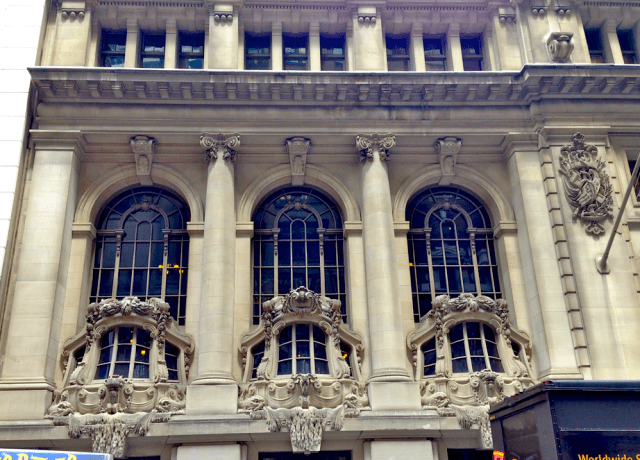
The New York Yacht Club’s bay windows on W44th St., NYC. (NYYC)

I was in New York on Monday to celebrate James Stevens Curl’s laureateship, bestowed by the Institute of Classical Architecture & Art’s 2019 Arthur Ross Awards, at the University Club of New York, for his book Making Dystopia, now high on my shelf of architectural bibles, up there even with Tom Wolfe’s From Bauhaus to Our House and Steven Semes’s The Future of the Past.

tripadvisor.png

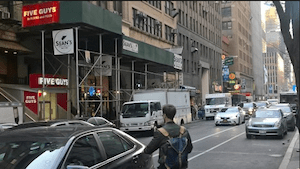
Scaffolding on NYC street. (tripadvisor)

All three are astute observers of the streets of the city, any city, surely those of New York City. But none, so far as I know, has mentioned the main reason for the desultory appearance of most streets in Manhattan. Not their fault. The answer is too in-your-face for anyone to notice. I refer to the scaffolding that mars just about every block, often the entire block, whether it is populated by traditional or modernist buildings. As regrettable are the garish cheapo plastic awnings that seem so eager to besmirch any façade not besmirched by the scaffolding. Only the numbered residential streets between the avenues seem mostly free of this architectural disease.

Screen Shot 2019-04-29 at 9.27.28 PM.png

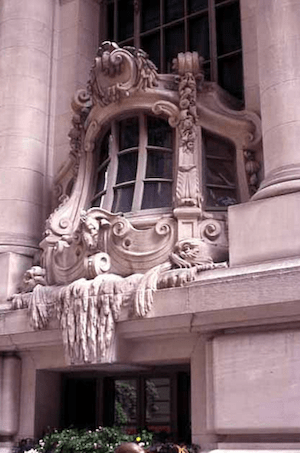
Nautical bay window at NYYC.

The photo on top is the New York Yacht Club on West 44th St., my favorite building in Manhattan. Look at its “galleon-style” windows, which were fashioned by Whitney Warren, of Warren & Wetmore, as the glazed sterns of British (I assume, though exactly why I’m not sure) warships in the Napoleonic era. Whenever a modernist argues that classical architecture lacks creativity, I throw this 1901 Baroque fenestration in his face, and it always sinks him. Please don’t tell me if scaffolding ever masks that glorious façade!

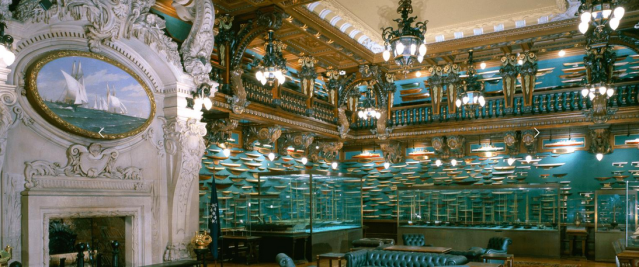
Across 44th is the General Society of Mechanics & Tradesmen Building, headquarters of the ICAA. At the bottom of this post is the NYYC’s famous Model Room.

Throughout the city today, scaffolding masks and uglifies the elegant carving of the first and second floors of traditional buildings but not of modernist buildings, because of course they don’t have any carving, or any other sort of decoration, so most modernist buildings, masked or unmasked, are just as ugly. You might even say that such scaffolding serves as a kind of obscene decoration, without which modernist buildings might be even more boring. Modernists probably even consider it beautiful, absurdly declaring that its beauty is in its utility. But then we don’t go to them for beauty, do we?

Thankfully, many buildings of ornate classical and other traditional styles are free of scaffolding, and they often strut along Broadway, Fifth Avenue, and other thoroughfares, such as West 44th, putting their bland modernist neighbors to shame even as the latter dominate (or rather suffocate) the streets. It is a blessing that the tedium of modernist dullards is interrupted on occasion by Beauty. That is true in New York and around the world: Let this type of interruption go forth and multiply! It is the sensibility that stokes the spirit of the ICAA, and its award programs – the idea that beauty should arise again in the world, and not in the distant future.

nyycmodel.png

Model Room of the New York Yacht Club, which sits behind nautical bay windows. (NYYC)

Posted in Architecture | Tagged , , , , , , , | 1 Comment

Hits every nail on the head

Screen Shot 2019-05-05 at 9.53.59 PM.png

“Spreadsheet architecture” exemplified by art with Peter Franklin article. (UnHerd.com)

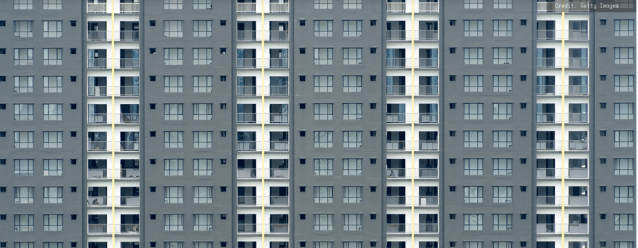
Peter Franklin, at the website UnHerd.com, has written “The hideous spread of ‘spreadsheet’ architecture: It’s time to rise up against the uglification of our cities.” It knocks the ball out of the park. I have read many great articles on architecture that get a lot of things right, but few roll it all up in a single piece. Nathan J. Robinson and Brianna Rennix did it in Current Affairs, a left-wing journal, with “Why You Hate Contemporary Architecture” on Oct. 31, 2017. So here’s a toast to Peter Franklin and UnHerd.com.

But first, a timely quote I cannot resist: “Should modernist architects be involved in the rebuilding of Notre Dame? Yes, absolutely they should – they’d make fantastic gargoyles. After all, no one does ugly better.” And another: “Any other profession would be embarrassed to be overshadowed by the accomplishments of their forebears.”

Rather than express my admiration for Franklin’s essay in prose, I will use poetry – a list of all the points that he makes in one article that took me hundreds of articles and posts to make. That is the definition of poetry:

  • Deadening ubiquity of modernist ugliness
  • Beauty survives only in old architecture
  • Unpopularity of modern architecture
  • Modernism’s respectable code of silence
  • “We’ve been conditioned not to resist”
  • Tech progress could beautify the new
  • Today’s wealth affords tomorrow’s beauty
  • Old architecture attracts premium price
  • Now should be architecture’s golden age
  • But modernism is hoist on its own petard
  • Architects streamlined out of architecture
  • Streamlined process creates bland design
  • Fewer parameters equals greater ugliness
  • Blame lies with “form follows function”
  • Banality of the functionalist credo proved
  • Victims of “spreadsheet architecture”
  • Also known as “form follows finance”
  • Buildings actually look like spreadsheets
  • Functionalism is the assassin of beauty
  • Spreadsheetism makes Brutalism shine
  • Developers now clash with communities
  • Interests of ugliness versus local interests
  • The power of developers could be resisted
  • No one now believes new improves on old
  • Preservation feeds on this lost expectation
  • The old is thus more valuable than the new
  • Modernists won’t inhabit modernist homes
  • Lost faith in modernity damns architecture
  • Modernists overshadowed by traditionalists
  • Old architecture shames modern architects
  • Future deserves beauty as much as the past
  • Past time for people to rise up against ugly

Sheer poetry. Thank you, Peter Franklin.

Posted in Architecture, Development | Tagged , , , , , , | 1 Comment

Curl’s American lecture tour

Screen Shot 2019-05-03 at 11.15.44 PM.png

Screen Shot 2019-05-03 at 11.17.18 PM.png

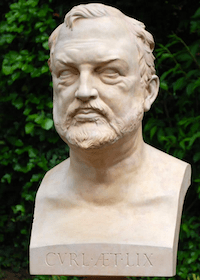
Bust by Alexander Stoddart

Professor James Stevens Curl, author of the pathbreaking Making Dystopia: The Strange Rise and Survival of Architectural Barbarism, will be visiting on our side of the pond to receive a Ross Award from the Institute of Classical Architecture & Art. He will hobnob with classicists at the University Club in New York City, and at the Union Club in Philadelphia as guest of that city’s ICAA chapter. Finally, he will deliver lectures in Washington, New Orleans, Denver and Boston. These lectures are open to the public; their dates and locations are listed below, with links to ICAA chapter websites for more information and reservations.
Professor Curl’s book has ignited controversy in Britain, where it was published last October by the Oxford University Press. Stevens Curl has spent some five decades writing books about architecture – erudite volumes describing, among other things, the culture of buildings associated with drinking, dying, pleasure gardens of London, Freemasonry, the erosion of Oxford, and many other architectural topics, plus the highly regarded OED Dictionary of Architecture – more than 40 books in all.

Here are the locations, dates and times of each public lecture on the tour:

  • Washington, D.C. Friday, May 10. Lecture sponsored by the ICAA chapter and the National Civic Art Society, at the Cosmos Club, 2121 Massachusetts Ave., N.W. Reception at 6 p.m., lecture at 7 p.m. For more information, click here.
  • New Orleans. Monday, May 13. Lecture sponsored by the Louisiana chapter of the ICAA, at Tulane University, the Albert and Tina Small Center for Collaborative Design, 1725 Baronne St. Lecture at 6:30 p.m. For more information, click here.
  • Denver, Tuesday, May 14. Lecture sponsored by the Rocky Mountain chapter of the ICAA, at the Denver University Club, 1673 Sherman St. Cocktails at 6 p.m., lecture at 6:30 p.m. For more information, click here.
  • Boston, Thursday, May 16. Lecture sponsored by the New England chapter of the ICAA, at the College Club of Boston, 44 Commonwealth Ave. Lecture at 6 p.m. For more information, click here.

With the publication of Dystopia, heads are exploding among modernist architects and their allies in academia and the architectural media, whose long-protected secrets are exposed in the book. And on both sides of the pond, hope arises among tired members of the public that the Era of the Eyesore might be noticeably closer to its demise. Stevens Curl’s lecture tour hopes to expose the vacuity of the founding modernist ideas, the totalitarian connections of the founding modernists such as Le Corbusier, Walter Gropius and Ludwig Mies van der Rohe, the participation of GM, the CIA and other institutions in the propaganda campaigns to turn Americans away from architecture they love and sucker them into putting up with what they hate, and some ideas for what can be done to bring sanity back to the once-proud profession of architecture and beauty back to our built environment: the reformation of the deformation, so to speak.

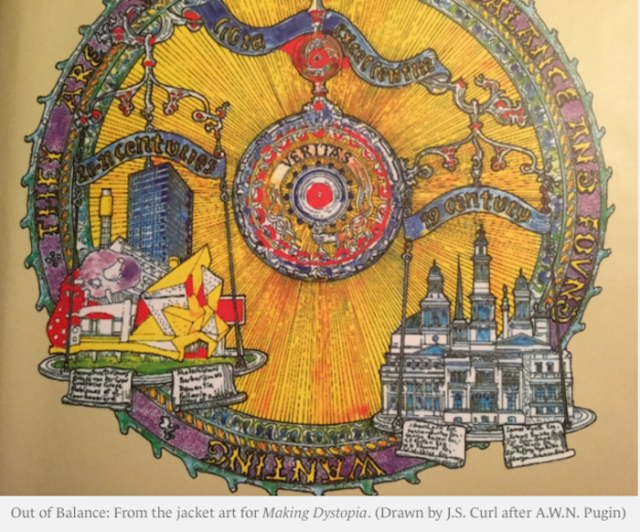
These are some of the themes of the book, whose cover is hot with anger at the villainies Professor Curl describes inside. In the cities he visits, he may be expected to offer a lively evening for those who attend his lectures.

Posted in Architecture, Books and Culture | Tagged , , , , , | 1 Comment