Things we’ve left behind us

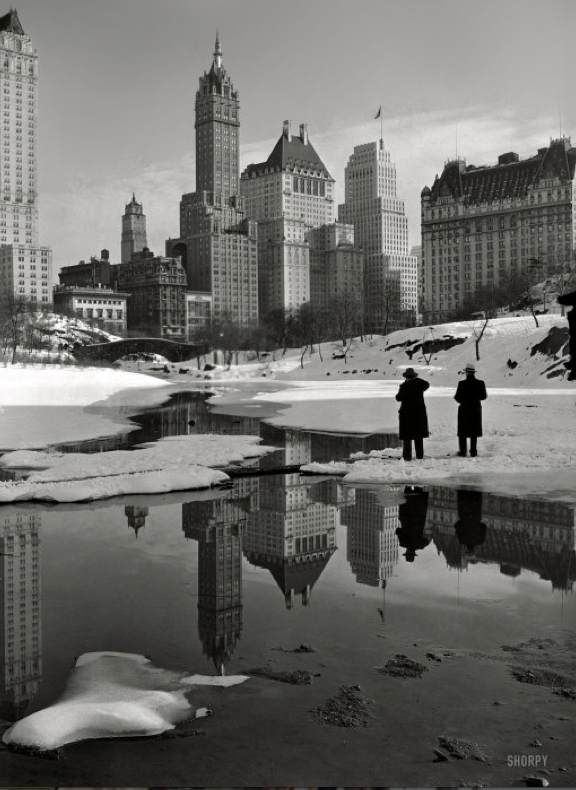
Buildings around Grand Army Plaza seen from Central Park, New York, in 1933. (Gottscho-Schleisner/Shorpy)

Buildings around Grand Army Plaza seen from within Central Park, New York City, in 1933. (Gottscho-Schleisner/Shorpy)

Hats off to Cliff Vanover for sending this glorious photo, a timely reminder of the things we’ve left behind us. One we know will return next winter. The others … well, some day beautiful buildings will come back into fashion.

Posted in Architecture, Architecture History, Photography, Urbanism and planning | Tagged , , , , , | Leave a comment

Beam me up, Alex!

Famously disliked and inhospitable Boston City Hall. (Jodi Hilton/NYT)

Famously disliked and inhospitable Boston City Hall. (Jodi Hilton/NYT)

Boston Globe columnist Alex Beam recently saw “Look Up!” – the TV ad beamed around the country by the American Institute of Architects. In his latest piece, “Look up, there is a problem with architecture,” he seems not to have been impressed: “How did the profession of Michelangelo and Frank Lloyd Wright get reduced to hyping its legitimacy in paid promotions on CNN and Fox News?” Beam then recounts the growing chorus of dismay expressed in the media about architecture and the growing chorus of pieces in the media about the growing dismay.

“But what is the problem?” he asks, then answers his own question:

For one thing, architecture is a medium that you are forced to consume. If I choose not to read Donna Tartt’s The Goldfinch, because the reviews look squirrely to me, then I don’t have to read it. But if I go downtown to shout hosannas to Super Bowl star Malcolm Butler, then I have to look at Boston City Hall.

That is a very big part of the problem, a big reason why most people dislike modern architecture, but early on Beam puts his finger on another part of the problem when he describes architecture as “a profession dwelling comfortably under the radar.”

Thing about it. A profession that specializes in designing very large things that cost very large piles of money and which play a very large role in whether one likes or dislikes the built environment, which very many – that is all – people are forced to experience day in and day out. Why is this profession dwelling under the radar? That’s a very good question.

The answer is that unlike most professions, and indeed most human endeavors, the establishment that runs it brooks no debate about its most fundamental principles. With its slick commercial the AIA appears eager to prove that it brooks no debate. You will see in the commercial nothing that does not seem to confirm the AIA’s belief that modern architecture is the only architecture. Its self-infatuation unwittingly high-fives everyone – Alex Beam, Justin Shubow of the National Civic Art Society, whom Beam quotes, and many others, including me – who has recently taken the AIA to task. Doesn’t it want to know why it wants everyone to “look up”? Apparently not. It’s circle-the-wagons time. Clearly the AIA is an organization that has no clue and doesn’t want one.

Watch the AIA commercial here to see if indeed you do “Look Up” as your eyes roll and roll toward the heavens.

What the AIA looks up to. (Screenshot from AIA "Look Up" commercial)

What the AIA looks up to. (Screenshot from AIA “Look Up” commercial)


Posted in Architects, Architecture, Art and design, Book/Film Reviews | Tagged , , , , , | 1 Comment

Latest on Macintosh rebuild

The Glasgow School of Art after last year's fire. (Paul Stewart/Demotix)

The Glasgow School of Art after last year’s fire. (Paul Stewart/Demotix)

An experienced Glasgow firm, Page/Park, has been chosen in a competition to restore and renovate the burned masterpiece of Scotland’s great architect Charles Rennie Macintosh – the Glasgow School of Art and its Macintosh Library. The Guardian’s story runs under the headline “Glasgow school to be restored by local firm Page/Park.”

About 90 percent of the building was saved, much more than observers thought at the time, but the library was completely gutted. Fortunately, its construction was extraordinarily well documented, and even more is being learned in the process of analysis required before the rebuilding begins – expected by next April, with completion now estimated for 2018. For example, Page/Park’s David Page explained a recent discovery to Guardian writer Haroon Siddique:

We took a bay of the library and basically examined it for three months in terms of how it was originally made. The fire has revealed things we didn’t know. For example, the columns in the library are made from eight different pieces and they were nailed together. That is something we’d never have anticipated – the idea that you had carpenters from Glasgow, probably working in the shipyards, coming in with hammers and nails. That was quite a discovery. We are going to continue that analysis of how that magical place was constructed, and that allows others to take decisions on how the restoration takes place.

Others? Page sounds like a straightforward guy. I hope he is not giving away too much authority. He’s the one with the experience of working on Macintosh buildings. There has been since the fire a circus sideshow of modern architects and architectural historians expressing the need to bring Macintosh’s designs into the 21st century.

The Guardian piece reads as pretty much a confirmation that the job will be done more as restoration of the GSA and the library to their original design, with new elements primarily intended to incorporate mechanical systems “bolted on” over time, with little thought given to fitting in. There seems to be no hint that any sort of kooky effort will be tolerated to “revise and extend” Macintosh’s “remarks,” as it were.

Very good! Yet my antennae quiver when I read lines like this: “Amid the devastation, while conscious of the need to be faithful to Macintosh’s vision, the school and architects see the renovation as a chance to bring 21st century thinking to the building, which was completed in 1909.” Siddique’s description was followed by the passage regarding the need to upgrade “bolted on” modernizations of technology. Still, I am not perfectly at ease.

Macintosh Library after the fire. (Jeff J Mitchell/Getty Images)

Macintosh Library after the fire. (Jeff J Mitchell/Getty Images)

Posted in Architecture, Architecture Education, Architecture History, Other countries | Tagged , , , , , , , | Leave a comment

Last wooden bridge in Prov.

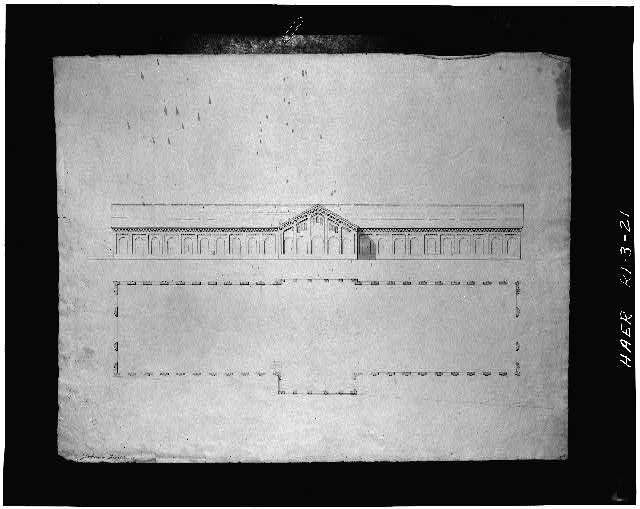
Architectural plan and elevation of North Freight Station, by Thomas Tefft.

Plan and elevation of North Freight Station, by Thomas Tefft. (Historic American Buildings Survey)

In an excellent online post for the Providence Journal, photographer Sandor Bodo notes the demise and, more recently, the removal of the last wooden river bridge in Providence. It is called “Documenting the fall of Providence’s last wooden river bridge,” and includes a video that shows its demolition in December and many historical photographs.

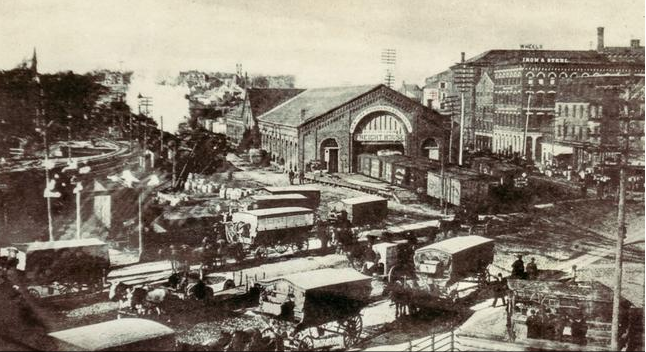
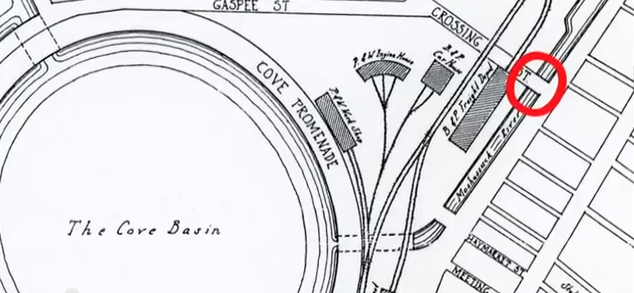
Sandor interviews Rick Greenwood, the late historian at the Rhode Island Historical Preservation & Heritage Commission, about the role the 40-foot bridge – the Railroad Crossing Street Bridge, which tee’d at Canal Street – played along the Moshassuck River. The bridge was built in 1856 and is seen in photos of Rhode Island troops marching off to join the Union cause in 1861, not to mention shots of the activity around the rail yard nearby, with commerce centering at the brick North Freight Station, built in 1847, that burned down in the early 1980s. Like the Union Depot also built in 1847 but razed and then replaced by Union Station in the late 1890s, the warehouse that lived so much longer than its more well remembered brother was designed by Thomas Tefft, who died very young.

The post by Sandor and his collaboration with Rick are “must-see TV” for Providence history and transportation buffs. I doff my cap to Lee Juskalian for sending it.

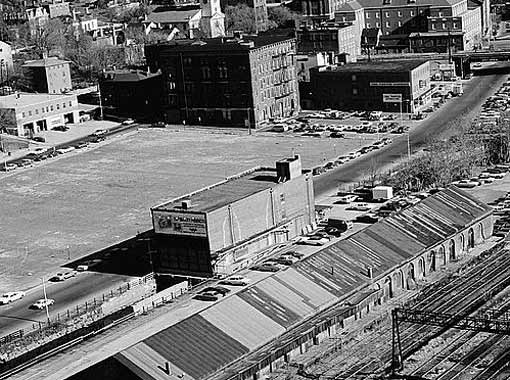
I used to regularly riffle past an engrossing photo of the North Freight Station on fire as I searched over three decades through the Journal’s photo archives. The closest I’ve come online are the two images here, one atop this post of the freight warehouse’s design by Tefft, and the other, below, of land cleared along North Main Street for the Roger Williams Memorial Park east of Canal Street, the foreground of which includes the warehouse in a dilapidated condition not long before it burned down.

[I just thought of taking screen shots of Sandor’s video, which I post below.]

Tefft freight station in foreground, near Canal Street. (

Tefft freight station in foreground, near Canal Street.

Archival photo of Tefft's North Freight Station. (providencejournal.com)

Archival photo of Tefft’s North Freight Station. (providencejournal.com)

Map shows bridge near Cove Basin. (John Hutchins Cady)

Map shows Rail Road Crossing Street Bridge near Cove Basin. (John Hutchins Cady)

Rail Road Crossing Street Bridge, with Tefft warehouse in background. (providencejournal.com)

RR Crossing Street Bridge, with (I believe) Tefft warehouse in background. (providencejournal.com)

Posted in Architecture, Architecture History, Book/Film Reviews, Development, Preservation, Providence, Urbanism and planning | Tagged , , , , | 3 Comments

Hyperadvertising in Russia

"Versailles," by Jean-Francois Rauzier. (http://www.waterhousedodd.com)

“Versailles,” by Jean-Francois Rauzier. (http://www.waterhousedodd.com)

Roy Lewis has sent two marvelous illustrations, below, that remind me of my post on the “Hyperphotography of Jean-François Rauzier,” in particular his “Versailles,” above, which I used to illustrate a number of posts a year or so ago. When I first saw a smaller version of “Versailles” I thought it was a field of wheat. Feel free, indeed feel empowered by the link offered for free on this blog, to visit the website of Jean-François Rauzier.

The use of multiple imagery replicating a single masterpiece of architecture, variously manipulated, creates a scene that performs a happy jujitsu move upon the mind’s eye. You are not at first sure what it is or whether it is real. The artist/photographer has staged a coup, two of them below, one of which adumbrates a famous Stalinist building, Moscow State University. The other is a play upon the Bolshoi Ballet.

The illustrations below, plus a third that may be seen at the following link, are being widely used as ads for the Schusev State Museum of Architecture, in Moscow. The ad campaign is by the global advertising firm of Saachi & Saachi. The artist, it seems, remains anonymous. Maybe it is J.-F. Rauzier!

Schusev-State-Museum-of-Architecture-Advertising-Campaign-121-600x90052215_Theater

Posted in Architecture, Art and design, Blast from past, Other countries, Photography | Tagged , , , , | 6 Comments

Yemen, we hardly knew ye!

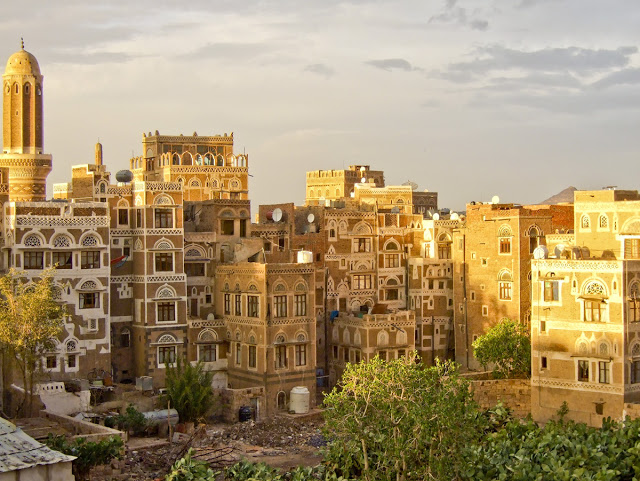
Part of a town in Yemen. (curiositas.com)

Part of a town in Yemen. (curiositas.com)

Jules Pitt has sent to TradArch an extraordinary photo of a town in Yemen, which he notes is in the news. So it is. I suppose the civil war there (now it’s a civil war; what has it been these several years?) prevents journalists from traveling to sites like this, which suggest the Yemenis aren’t the antediluvian folk that the world makes of them from news of that benighted “country.” Pirates, rascally sects of nomadic villains grappling with what we are invited to conclude are equally rascally villains in the “capital” of Sana’a – Insana’a one wants to murmur under one’s breath. The president has fled the capital and is begging for help from fellow Arab leaders confabulating this weekend in Cairo. Saudi Arabia has sent in its jets, and hankers for the bomb, which the Iranian mullahs seem set to get their hands on first. Good grief! So no, let us not gild the lily, let alone the turd.

Yet with such loveliness sprung clearly from the aesthetic, architectural and urbanistic intuition of a backward population, a fond wish that the Yemenis transcend their travails must be in order. Click the link. As endearing as is the photograph Jules chose to send, the many others posted in “The Secret Cities of Yemen” in 2011 on the Kuriositas website are difficult to imagine in the context of what we think we know of Yemen. They are heart-rendingly sad given what we certainly do know of the fate of other works of art and architecture in lands contested by ISIS (though Yemen is contested by the other side, the Shia, at least for now).

Go to Kuriositas.com and then go figure.

Posted in Architecture, Architecture History, Art and design, Other countries, Urbanism and planning | Tagged , , , , , | Leave a comment

Surprise! Walkers can drive

Anybody know what city this is? Thomas/Flickr isn't saying.

“Scramble” intersection in the Shibuya section of Tokyo. (Thomas/Flickr)

City Lab has an article by Eric Jaffe called “Toward a Simple and Universal Law of Pedestrian Behavior” that belongs in the files of the Department of Redundancy Department. Not that it isn’t interesting. To a flâneur like me, anything about whatever happens on a sidewalk in a city is interesting. So go ahead and read it, click the links and wander through the obvious, oblivious (if you can manage remaining so) to the amount of grant money being spent on stuff like this.

People are good at walking. They are much better at driving than is acknowledged. (Which city doesn’t believe its drivers are the worst!) If people really were bad drivers, more of them would be dead. A lot more. People are good drivers in much the same way they are good walkers. It’s instinctual. Being a good walker is a good thing, but the hazard represented by other pedestrians is precisely suggested by the fact, as determined by the study written up by Jaffe, that energy devoted to avoiding other pedestrians does not increase until a collision is about to occur. Duh!

Although it hardly takes place on a city sidewalk, I prefer to wallow in William Hazlitt’s “On Going a Journey,” written by the British essayist in 1821. Here he is describing why he’d rather walk alone in the countryside than with someone else:

"How to be a flaneur" is actually the caption of this image. (mookychick.co.uk)

“How to be a flaneur” is the caption of this image. (mookychick.co.uk)

Instead of an awkward silence, broken by attempts at wit or dull common-places, mine is that undisturbed silence of the heart which alone is perfect eloquence. No one likes puns, alliterations, antitheses, argument, and analysis better than I do; but I sometimes had rather be without them. “Leave, oh, leave me to my repose!” I have just now other business in hand, which would seem idle to you, but is with me “the very stuff of the conscience.” Is not this wild rose sweet without a comment? Does not this daisy leap to my heart, set in its coat of emerald? Yet if I were to explain to you the circumstance that has so endeared it to me, you would only smile. Had I not better then keep it to myself, and let it serve me to brood over, from here to yonder craggy point, and from thence onward to the far-distant horizon? I should be bad company all that way, and therefore prefer being alone.

Don’t expect to come across any wild roses or daisies in that hardscape pavement in the photo of that forlorn plaza in the megacity wannabe pictured atop this post. (Oops! Just learned it’s in Tokyo!) And if your gaze follows the cutie crossing your path – watch out! You may find that the energy you must devote to avoiding collision is otherwise engaged, and that you will not avoid colliding with that other fellow who has made the same observation as you.

Posted in Architecture, Landscape Architecture, Uncategorized, Urbanism and planning | Tagged , , , , , | 1 Comment

At the Ecole des Beaux-Arts

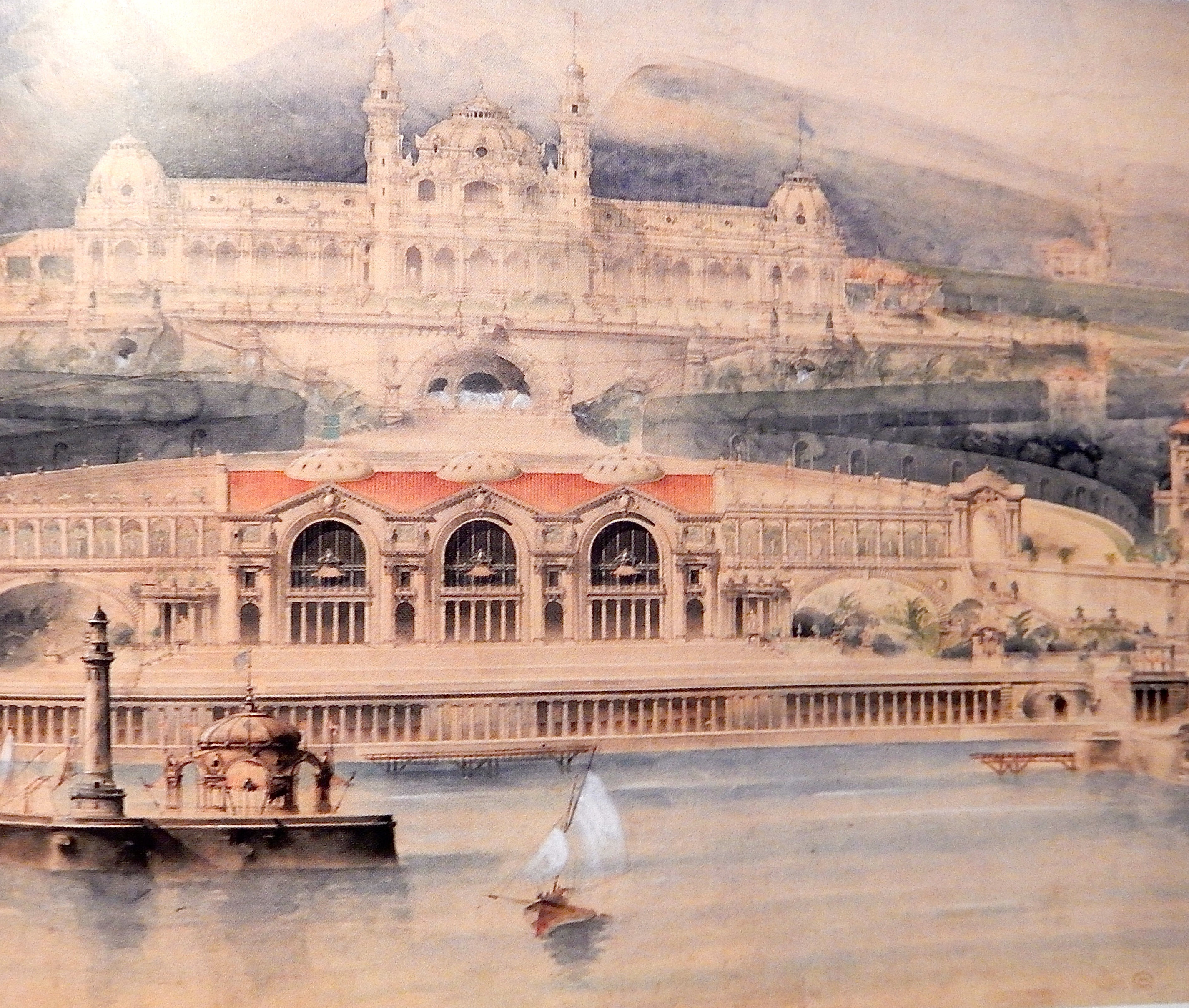
Portion of the elevation of a seaside casino, 1889. (Rizzoli)

Portion of the elevation of a seaside casino, 1889. (Rizzoli)

Friday evening’s lecture by Margot Ellis at the College Club of Boston about Americans in Paris, the book she wrote with Jean Paul Carlhian about the American students at L’École des Beaux-Arts, was a marvel to behold – as is the book. Her discussion was sponsored by the New England chapter of the Institute of Classical Architecture & Art. The book has just been published by Rizzoli. It is subtitled “Foundations of America’s Architectural Gilded Age: Architecture Students at the École des Beaux-Arts 1846 to 1946.”

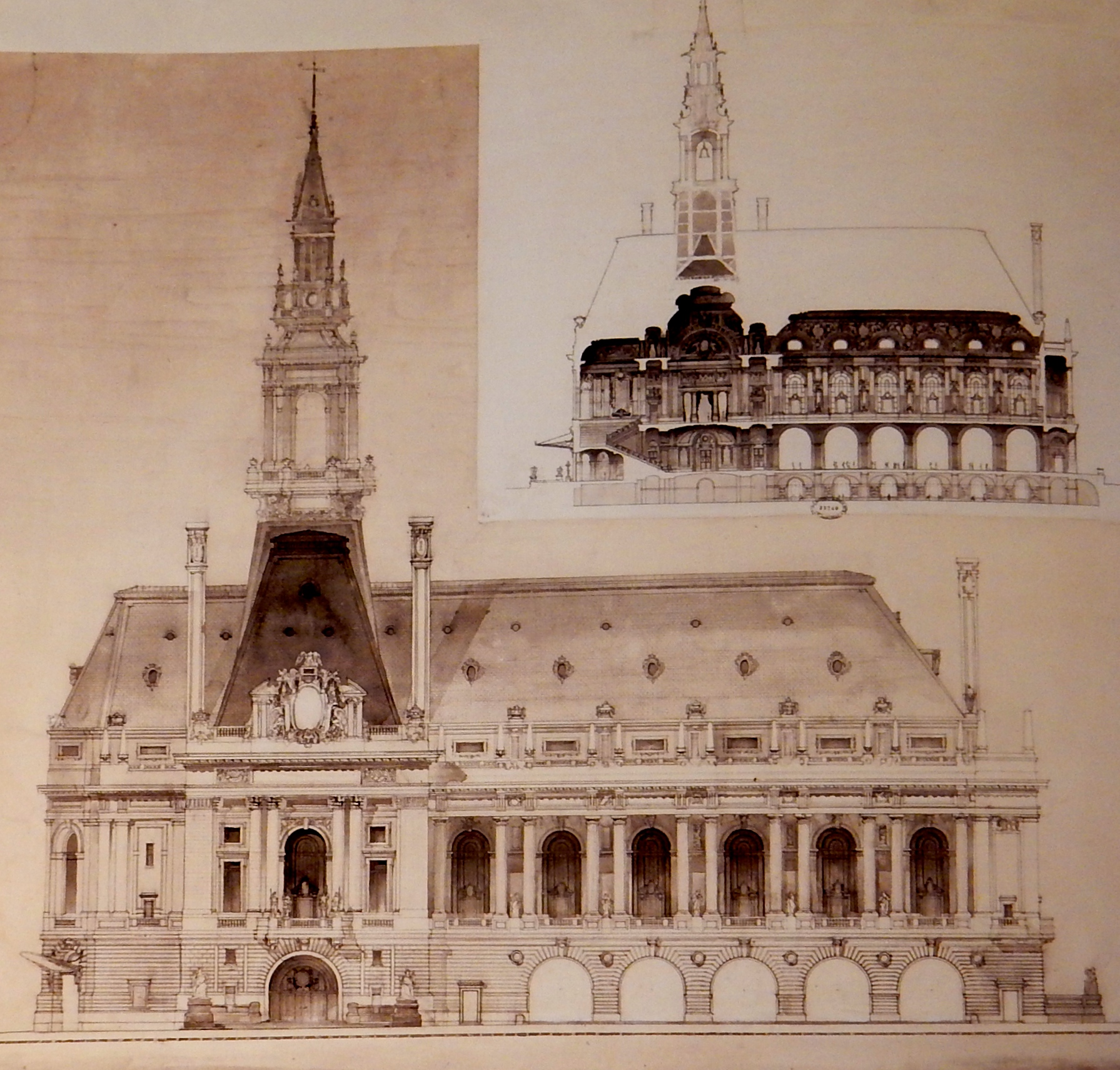
A city hall, by William Van Alen. (Rizzoli)

A city hall, by William Van Alen. (Rizzoli)

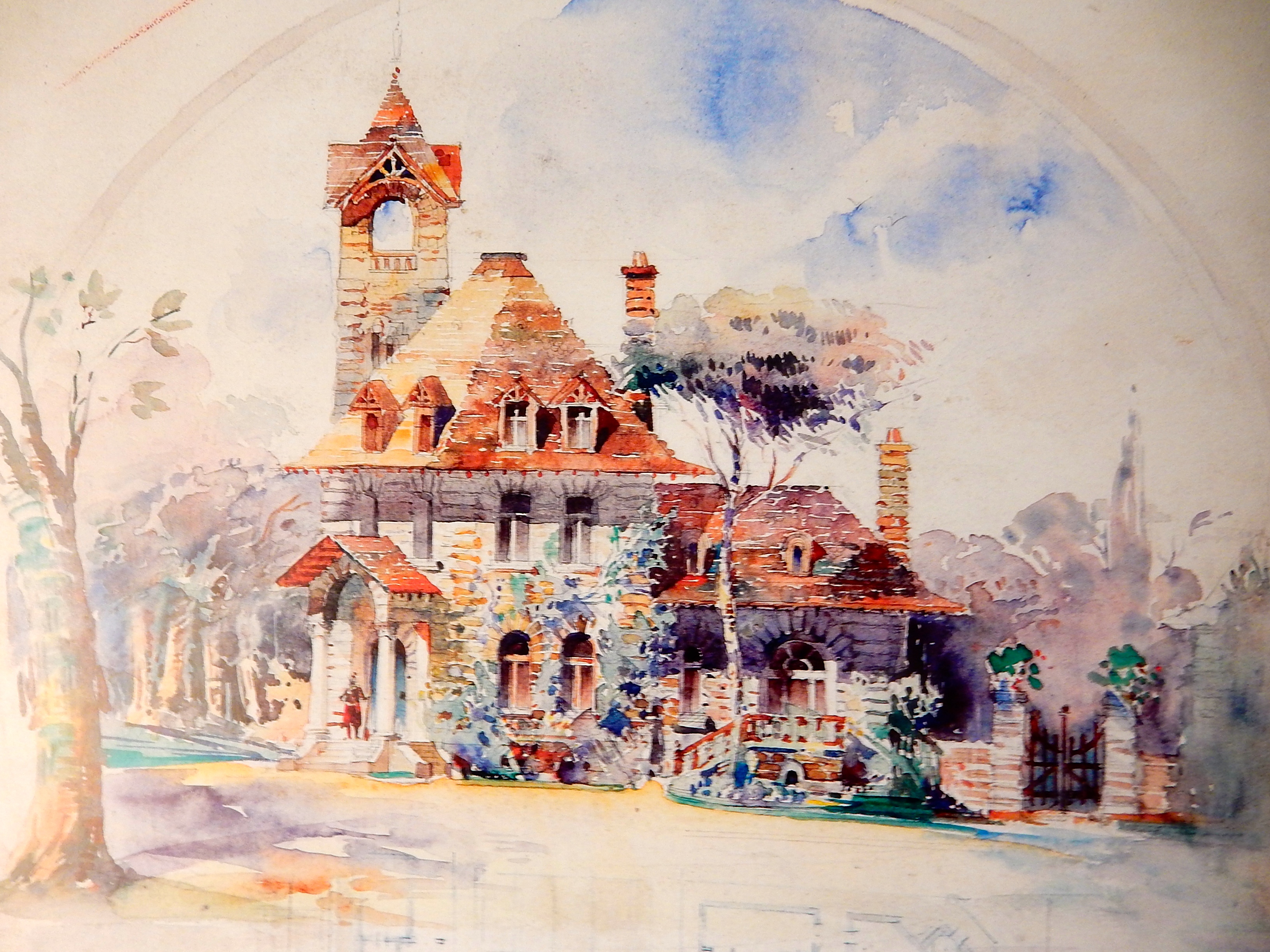
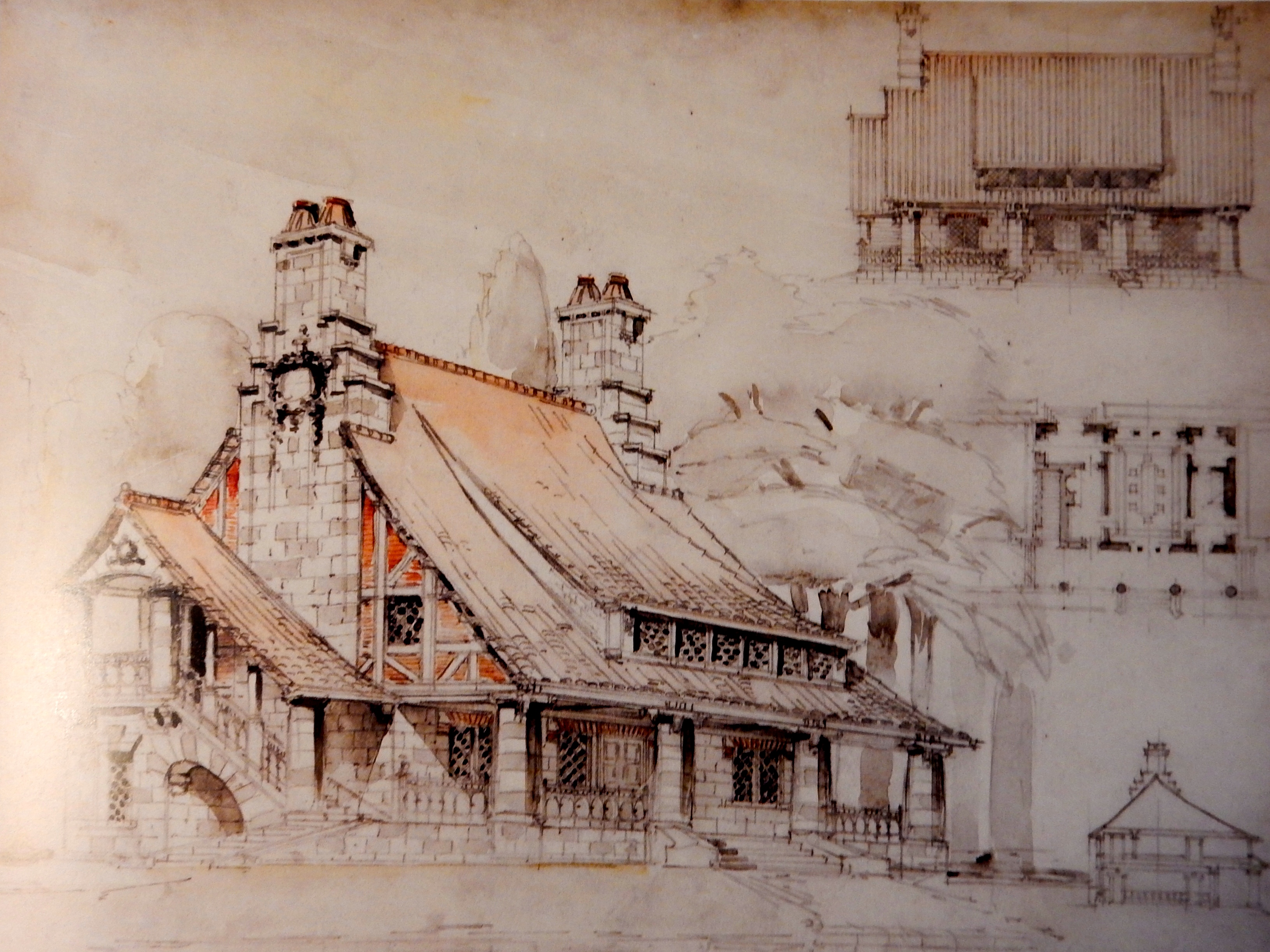
The book is as rich as its title. Anyone who likes to luxuriate in highly detailed drawings of great buildings by the grand masters of architectural composition and rendering in India ink and color wash – well, step right in and wallow. But anyone who expects the range of stylistic variety here to be narrow, be warned. Yes, there are enchanting classical pieces such as the seaside casino by French student Constant-Desiré Despradelle in 1889, above, and the city hall by William Van Alen in 1909 (he later designed the Chrysler Building), at left. But there are also many instances of far-less-than-strictly-canonical pieces such as the forester’s house by Paul Armon Davis III in 1897, below, and the guard house for a large property by Everett Victor Meeks in 1908, bottom.

The classical orders may have been designed to be obeyed, like your mother, but in practice, while the cat’s away, working architects – and the students at the École certainly worked – would play. Encouraging such play is what the canon, any canon, is, or should be, all about. Understanding orthodoxy is key to any truly valuable sense of the heterodoxical. But it is a mistake to think of the canon as a ball and chain. No, it is a springboard, a springboard to beauty, which can be achieved by hewing close to its prescriptions no less than by wandering toward liberation far away.

Margot Ellis emphasized that the American students of whom she and Jean Paul Carlhian (who died in 2012) wrote were “always adding in an American freedom from orthodoxy.” Perhaps the French are more wedded than we are to the canon of strict symmetrical classicism, but Ellis carries a notebook for her engagements with a picture of the Eiffel Tower under the motto “Paris Is Always a Good Idea.” The City of Light certainly demonstrates that it’s hard cheat beauty by embracing the ancient principles of classical orthodoxy. So wander if you like, but do not fear that by sticking to the canon you are doing any harm to the future of enchantment in the world.

The profusion of work on display in this excellent book, both that of students and that of practitioners putting their educations to work after returning to America, demonstrates the high variety of roads that may be traveled to get from the classical to the beautiful.

(By the way, in my post previewing the lecture I wondered what the graduates of the Ecole des Beaux-Arts produce today. Well, it appears that its architecture school no longer exists – it closed in 1968 – but the school itself still does, and draws students eager to paint and sculpt. I suppose my question remains valid, albeit not directed as I’d expected.)

A forester's lodge, 1897. (Rizzoli)

A forester’s lodge, 1897. (Rizzoli)

A guard house, 1907. (Rizzoli)

A guard house, 1907. (Rizzoli)

Posted in Architects, Architecture, Architecture Education, Architecture History, Art and design, Book/Film Reviews | Tagged , , , , , | 1 Comment

Thom Mayne in Alaska, 2005

Thom Mayne (Morpheus) design for Alaskan capitol. (sitnews.us

Thom Mayne (Morphosis) design for Alaskan capitol. (sitnews.us

I referred yesterday in “Heidi’s chilly new neighbor,” to my column almost precisely a decade ago on Thom Mayne’s submission in a design competition for a new state capitol in Juneau, Alaska. Here is that column:

A ‘bad-boy’ capitol for Alaska?
March 24, 2005

ON THE LAST DAY of February, architect Thom Mayne and his Santa Monica firm, Morphosis, won a competition to design a capitol for Alaska, the only state without one. All of the finalists’ preliminary designs lacked a dome, except for the one by Mayne. All of them were modernist, including Mayne’s, and all were panned by the public.

Counterproposal by Marianne Cusato. (tndtownpaper.com)

Counterproposal by Marianne Cusato. (tndtownpaper.com)

Cusato proposal, side view. (archidodse.blogspot.com)

Cusato proposal, side view. (archidodse.blogspot.com)

“People reacted very badly to all four,” jury member Joe Henri told the Anchorage Daily News. “But at least some of them liked the idea of a dome.” They don’t necessarily like the idea of a translucent glass dome that glows at night. Even Mayne admits that “some people said it looks like an egg. When I finish the design,” he promises, “it won’t look like an egg. If you say ‘egg,’ I fail.”

How about “igloo”? Not likely. That might actually risk connecting with Alaska’s heritage. More so, at any rate, than the swooping glass wings — hockey sticks? — that seem, in the illustration, to flank the dome. Okay, so hockey is heritage, too. Go, team!

“I think the [jury members] have lost their freaking minds,” wrote Rick Tyner in a letter to the editor of The Empire, in Juneau, the state’s capital city. “I would rather move the capital to Anchorage than look at one of these eyesores the rest of my life.”

Politics in the 49th state often revolve around whether to move the state capital from Juneau to Anchorage, Alaska’s largest city, with a population of 260,283. The population of Juneau, Alaska’s second largest city, is only 30,711.

The Alaska legislature meets in a modest brick office building erected in 1931 as the territory’s administrative headquarters. Forty-six years after its admission to the Union, and still no capitol.

The Anchorage Daily News reports that Juneau Mayor Bruce Botelho wants to have the capitol “by the 50th anniversary of statehood, in 2009.” But Gov. Frank Murkowski has been “noncommittal,” and “[Alaska] House Majority Leader John Coghill (R.-North Pole)” — ! — “said he doubts that would happen.” State Sen. Charlie Huggins says “the answer is to move the capital and get new designs.”

But wait! To the rescue, in the nick of time, comes the Pritzker Prize, architecture’s most prestigious award. Announced on Monday, the winner this year is none other than Thom Mayne himself.

Every Pritzker winner has been a modernist, but 14 years have passed since the last American, Robert Venturi, won the prize. Why Mayne? Why now?

I may be the only architecture critic in the nation – the only person in the nation — who thinks giving the Pritzker to Mayne was not a coincidence.

After all, Alaska is the only state without a capitol, and modernists who control the profession want it to be a modernist capitol, even if the public considers it an ugly boondoggle. Already, it teeters on the edge of oblivion. Now the Alaska legislature would have to reject a Pritzker Prize winner — and that might be hard to do. Sort of like telling a Nobel Peace Prize laureate to butt out of your country’s election.

Hilariously, press coverage has painted Mayne, 61, as a sort of “bad boy” iconoclast in the mold of rugged Alaska. “American Maverick Wins Pritzker Prize,” said The New York Times — as if Mayne’s wacky and tedious modernism weren’t right in step with architectural orthodoxy. “I have been such an outsider all my life,” Mayne told the Times’s Robin Pogrebin, apparently with a straight face.

Times architecture critic Nicolai Ouroussoff says Mayne’s early work expressed a “brooding aggression.” On the basis of photos of his Caltrans District 7 Headquarters, in Los Angeles, and his Diamond Ranch High School, in Pomona, Calif., his later work does too.

I’ll admit that the Pritzker jury retreated from last year’s award to Zaha “Ha-Ha” Hadid. To get even nuttier, they’d have had to give it to a kindergartner working in pickup sticks.

Mayne isn’t that bad.

But are there no prizes for architects who don’t think buildings should be ugly and stupid?

In fact, Notre Dame, the only major architecture school in the country based on a classical curriculum, awarded the third Richard H. Driehaus Prize last week to the classicist Quinlan Terry, of Britain. And Henry Hope Reed’s Classical America, now joined with the Institute of Classical Architecture [renamed in 2011 the Institute of Classical Architecture & Art], has been handing out the Arthur Ross awards since 1982. But how much press do these prizes get? Precious little.

The world should know more, for example, about Marianne Cusato. In a rebuke to the Alaska finalists, Cusato, a third-generation Alaskan, submitted a lovely design for the capitol. The onionesque domes of its cupolas reflect the Russian strain in Alaska’s history — a reflection of heritage expressed in beauty, not the abstract metaphor Mayne prefers. (He says the forms that I took for hockey sticks are supposed to be glaciers. Who’d have guessed?)

As long as modernists can use their institutional chokehold to block traditionalists from major commissions like the World Trade Center and the Alaska capitol, we will continue to get buildings of ego rather than beauty. Cusato believes that the Alaska capitol imbroglio might finally end the public’s acceptance of architecture’s arrogant refusal to design buildings the public can love. Let’s hope so.

 

Posted in Architecture, Architecture Education, Architecture History, Art and design, Blast from past | Tagged , , , , , , | Leave a comment

Friday: “Americans in Paris”

This lecture is tonight!

David Brussat's avatarArchitecture Here and There

Front cover of "Americans in Paris." (amazon.com) Front cover of “Americans in Paris.” (amazon.com)

Margot Ellis will be in Boston to discuss her book Americans in Paris, co-authored and inspired by the late Jean Paul Carlhian, who died before its completion. Carlhian was a Frenchman who attended L’École des Beaux-Arts – the subject of the book along with its Yankee grads – moved to America after WWII, taught at the Harvard GSD and was long an architect at the Boston firm of Shepley, Bulfinch, Richardson & Abbott, known for its founder, Henry Hobson Richardson, also a L’École graduate, and who probably spins in his grave for a lot of reasons, not least perhaps the contemporary work of the firm now known officially as Shepley Bulfinch, which today has offices in Phoenix, too.

Ellis spent 15 years researching and writing Americans along with Carlhian. I met the architect several years ago at an event honoring Shepley…

View original post 248 more words

Posted in Uncategorized | Leave a comment