Cosmo + Prozac Architects

Cosmo Brussalaurantis

Cosmo Brussarantis

This morning, before any of us had arisen, my wife murmured that my brother’s dog Cosmo wasn’t doing well, showing the signs of anxiety at Extended Stay America, where they’re awaiting the renovation of their house in Gaithersburg, Md. While Billy snoozed between us, Victoria read exchanges from Guy’s wife Laura’s Facebook page about whether to put Cosmo on Prozac.

“Cosmo + Prozac,” I murmured to myself. Great firm name! Modern architecture. Near you.

The demented, self-infatuated, every-man-a-king Cosmo Kramer on Seinfeld must have had Jerry dropping Prozac, right? Cosmo + Prozac. Perfect name for a firm that designs buildings that knock on your door in the middle of the night.

Posted in Architecture, Humor, Uncategorized | Tagged , , , , , , , , , | 1 Comment

The secret lives of scalies

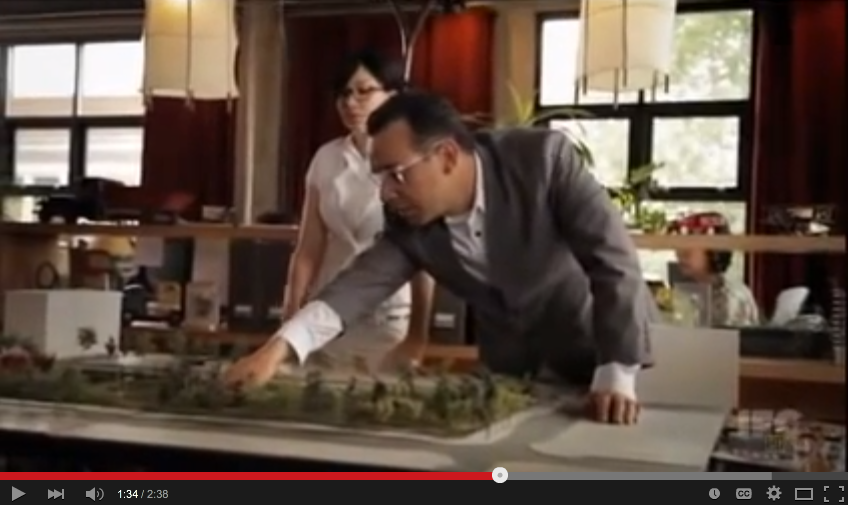
Screen shot of video about Lipsky Park design. (Gizmodo)

Screen shot of video on park design. Don’t click on this but on the video at bottom of post. (Gizmodo)

From comments to article by Alissa Walker.

From comments to article by Alissa Walker.

Scalies, according to Alissa Walker’s excellent report on an exhibit out in Berkeley, “The Secret Lives of Little People in Architectural Renderings,” are the little people in architectural renderings. That’s the term used by professionals. Scalies. They are mainly there to give a sense of scale to drawings of often gargantuan and indeed inhumane architecture. One of the first collections of people drawn into an architectural rendering was for a building by the Prussian architect Karl Friedrich Schinkel. That news comes from a commenter after Walker’s article. Another commenter posted, apropos of nothing, a GIF (moving) shot of a guy asking about a model of a proposed modernist building, “What’s this, a center for ants?” Walker replied, “Completely relevant: See also:” and then posted a video of a group of architects presenting a plan for a park honoring a mayor who had died and whose widow is in the audience. I have to assume that this is some sort of comedy routine, not a real presentation. Anyway, take a look:


Posted in Architects, Architecture, Art and design, Development, Humor, Urbanism and planning | Tagged , , , , , | 2 Comments

Heidi’s chilly new neighbor

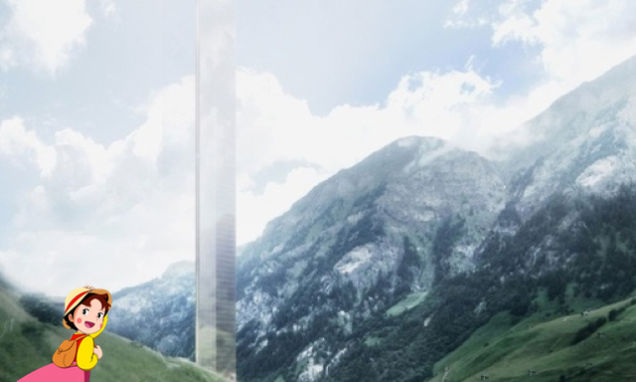
Tower by Thomas Mayne for Vals, Switz. (uncredited montage in Gizmodo)

Tower by Thomas Mayne proposed for Vals, Switz. (Uncredited montage in Gizmodo)

Kudos to Gizmodo.com not just for the inspired montage above but to its correspondent Alissa Walker, who reports that starchitect Thom Mayne has announced an evaporating glass slab for poor Vals, Switz. At 80 stories and 1,250 feet in the Swiss Alps, it will be, if built, Europe’s tallest tower.

Mayne built a new building for Cooper Union that forced the college to end its history of free tuition. In exchange, the school got a piece of junk that looks as if an airplane flew into its glass curtain wall. But hey, New York can take that. But what about Mother Nature in all her glory? As Walker writes in “The Tallest Tower in Europe Will Be in … a Quaint Swiss Village?“:

The renderings show a plane of glass shimmering high into the alpine sky, where it appears to evaporate into the atmosphere.

In fact, that seems to be the theme: A vaporous facade which has no exterior form, merely reflecting its idyllic surroundings. But we know that will not be the case, of course, as no building is invisible enough to simply dissipate into nothingness.

(Nothingness, by the way, is all that’s left of author Ray Bradbury’s home, which was demolished by Mayne earlier this year to make way for his new house. Which will likely also stick out like a sore phallus.)

The disappearing glass building, along with “erasing the boundary between inside and outside,” is one of modern architecture’s most predictable clichés, dragged out whenever a developer suspects that the public might not like his building’s design. Hey, it will just reflect its surroundings, or the clouds in the sky, practically invisible … whatever! That’s what they said about the GTECH building before it went up in Providence. What a crock!

Thom Mayne has already won a Pritzker prize, of course. Back in 2005 he was a finalist in the competition for a new (and the first) purpose-built state capitol in Alaska. All of the four finalists were starkly modernist, and the public had risen in anger at them all. The entry by Mayne looked like a hockey stick on the ground with a gargantuan egg behind it. My theory at the time was that the jury thought giving Mayne a Pritzker might ice the project for him. Instead, the entire project collapsed. Alaskan taxpayers continue to run their state out of a bland office building completed in 1931 in Juneau, 28 years before statehood.

I wrote a column unpacking my conspiracy theory at the time. It featured a brilliant classical counter-proposal by Alaska native Marianne Cusato, which picked up on the state’s Russian heritage in the cupola domes of her design. She has since achieved a sort of fame for her Katrina Cottages, tiny houses for those left homeless by flood or hurricane. They are for emergencies but are designed to be appealing to refugees, unlike the boring boxes offered by FEMA. The cottages can be expanded, or lived in as is by those who, like occupants of microlofts in the latest urban trend, love the cozy lifestyle.

We last heard from Alissa Walker last year when Frank Gehry gave the finger to a roomful of journalists in Spain. Later he apologized. Walker wrote a story for Gizmodo about Gehry’s claim that 99 percent of architecture is shit, and illustrated it with proof (that is, photos of his buildings). She added: “Hey, no need to apologize, Frank! You’re 85! And you know what? You can keep on building whatever shit you want.”

Walker has an excellent essay for Gizmodo, “The Secret Lives of the Tiny People in Architectural Renderings.” It reminded me of the people drawn into the proposed scenes of the Downtown Providence 1970 Plan, a mostly (and thankfully) unbuilt effort, announced in 1960, to drag the capital of Rhode Island into the 20th century. What I liked about the plan was that all the men in its illustrations of what Providence could be like had male pattern baldness. No doubt caused by too much modern architecture!


Posted in Architects, Architecture, Art and design, Development, Other countries, Providence, Urbanism and planning | Tagged , , , , , , | 1 Comment

Plecnik capitals you can see

IMG_6217IMG_6220IMG_6221IMG_6213IMG_6219IMG_6208IMG_6210IMG_6218IMG_6216IMG_6215IMG_6222IMG_6214IMG_6212IMG_6211IMG_6207Here is that page of column capitals disambiguated from the shot taken and sent to TradArch by Angelo Gueli yesterday and posted in a cropped and undisambiguated (I think that’s a word) by me. The photos were too small for readers to examine very helpfully with the naked eye. Angelo saw my post and shot each capital on those pages separately and sent them to me. Here they are.

But I cannot let the opportunity created by Angelo’s compassion pass without comment. Now that you can closely peruse each capital, you can see that all of them possess a uniquely expressive character that arises from features that would be purged by modernists, just as former Bauhaus founder and director Walter Gropius literally threw out Harvard’s famous collection of classical plasters, causing dumbkopf architecture-school deans around the nation and the world to do likewise, as if they were an unusually idiotic species of sheep.

Let’s shove the nasty modernists aside and focus our attention on enjoying the beauty of the Plecnik capitals. I tried to figure out which of them comes closest to the canonical. It’s a tough quiz, but I suppose the closest must be the sixth, which seems to be a regular column of the Tuscan order but with a large fasces, as I think it that scroll-like tubular feature is called, intervening between the Tuscan capital what would otherwise be the entablature above were it not that a coffered ceiling rests upon the fasces, an ornament that derives from the symbol for Roman authority.

Which is my favorite? That’s just as tough a nut to crack. Perhaps it is the second capital with the melancholy face between the two Ionic scrolls. Since, according to Cognitive Architecture, by Ann Sussman and Justin Hollander, our brains read faces as their number one job, maybe that explains my preference here. But I also like the capital forged from four columns arising to their own capitals at the top of a post.

It is almost impossible not to feel outrage at the meatheadedness that has robbed the world of the joy of classicism.

Here I leave readers to luxuriate alone in this heterodoxual display.IMG_6209


Posted in Architecture, Architecture Education, Architecture History, Art and design, Uncategorized | Tagged , , , , | 7 Comments

Recapture Joze Plecnik!

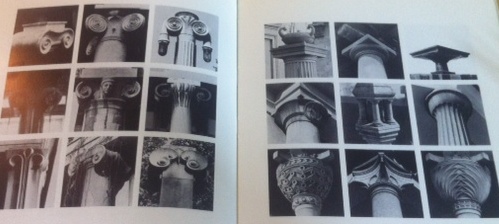
Two pages of column capitals designed by architect Joze Plecnik.

Two pages of column capitals designed by architect Joze Plecnik.

Hats off to Angelo Gueli*, who photographed and sent to TradArch a pair fascinating pages from a book he has acquired of the work of Slovenian architect Joze Plecnik (1872-1957). He is a favorite of Andrès Duany and a candidate for “recapture” from the modernists, who consider him less an architect in his own right than a “precursor” to modernism.

Precursor to modernism? How so? Although there is much in the above set of column capitals to suggest that he was not bound tightly to the classical canon, neither is there anything to suggest that he rejects it, that he would have liked anything the modernists whipped up, and certainly not in any way that declares classicism an illegitimate world view through which to imagine a built environment that satisfies human needs and desires.

I did a post on Plecnik a while back. He deserves more attention than I have given him, and I take pleasure from every TradArch post that brings his work before my eyes.

Plecnik is certainly wandering out in the wilderness of architectural discourse, a fit target for recapture and relabeling as a classicist. Plecnik and other architects, such as Louis Sullivan, were knocked upside the head and rebranded as modernists once they could do nothing to protect themselves. Their spirits live in a nether world of dubious reputation, beloved by those who worship beauty but hard to find. They are pinned and catalogued by those who know nothing about what architecture is really about. This sinister rebranding by modernists does an injustice not only to the late architects and their work but to their potential fans, not to mention the rest of us in a world already thrown into confusion by modernism and its ability, cult-like, to transform abject failure into a kind of pop stardom. No wonder architecture “makes our head hurt,” to quote Tom Wolfe’s famous line in his slender 1981 book From Bauhaus to Our House.

Here is that excellent passage:

But after 1945 our plutocrats, bureaucrats, board chairmen, CEOs, commissioners, and college presidents undergo an inexplicable change. They become diffident and reticent. All at once they are willing to accept that glass of ice water in the face, that bracing slap across the mouth, that reprimand for the fat on one’s bourgeois soul, known as modern architecture.

And why? They can’t tell you. They look up at the barefaced buildings they have bought, those great hulking structures they hate so thoroughly, and they can’t figure it out themselves. It makes their heads hurt.

Sad but true. I have no doubt whatever that Plecnik, were he allowed to stop spinning wildly in his grave, would agree. He is an elixir, and, if successfully recaptured, will live on as an antidote.

* I accidentally attributed this initally to Joel Pidel, who was responding to the shots from Angelo.


Posted in Architects, Architecture, Architecture Education, Architecture History, Art and design | Tagged , , , , , , | 3 Comments

Friday: “Americans in Paris”

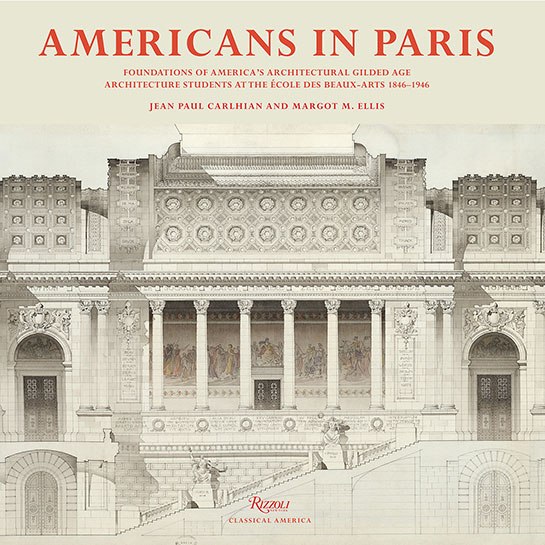
Front cover of "Americans in Paris." (amazon.com)

Front cover of “Americans in Paris.” (amazon.com)

Margot Ellis will be in Boston to discuss her book Americans in Paris, co-authored and inspired by the late Jean Paul Carlhian, who died before its completion. Carlhian was a Frenchman who attended L’École des Beaux-Arts – the subject of the book along with its Yankee grads – moved to America after WWII, taught at the Harvard GSD and was long an architect at the Boston firm of Shepley, Bulfinch, Richardson & Abbott, known for its founder, Henry Hobson Richardson, also a L’École graduate, and who probably spins in his grave for a lot of reasons, not least perhaps the contemporary work of the firm now known officially as Shepley Bulfinch, which today has offices in Phoenix, too.

Ellis spent 15 years researching and writing Americans along with Carlhian. I met the architect several years ago at an event honoring Shepley Bulfinch’s extensive library of architectural books and papers, sponsored by the New England chapter of the Institute of Classical Architecture & Art, which is sponsoring Friday’s event. It will begin at 6 p.m. at the College Club of Boston, 44 Commonwealth Ave. You may see more details and make a reservation at the ICAA chapter website.

The book, whose title brings to mind Gershwin’s musical – and whose subtitle is “Foundations of America’s Architectural Gilded Age” – has been published by Rizzoli and has a wealth of illustrations of buildings influenced by the classical education received in Paris by their architects. These include Richardson, Richard Morris Hunt, Charles Follen McKim, John Merven Carrère, Thomas Hastings, James Gamble Rogers, John Russell Pope, Julia Morgan, Bernard Maybeck and others.

Who knows what the graduates of the school produce today! Like almost every other school of architecture, L’École des Beaux-Arts has been kidnapped by those who have kidnapped architecture and architectural education around the world.

Unlike many other problems that face humanity, creating a beautiful world again could be so easy. Unlike abolishing poverty, hunger and war, the virtual abolition of ugliness from our surroundings was once done routinely – indeed, often by rote except for the occasional outcropping of genius, or the invention fostered by the classical orders. I doubt that Americans in Paris delves much into that, but it’s worth looking deeply, via the book and Friday’s lecture, into possibilities that are, in fact, ours for the choosing.

Posted in Architects, Architecture, Architecture Education, Architecture History | Tagged , , , | 2 Comments

Houses by George & Andrew

Swimming pool in large vestibule of small house in Charleston. (newworldbyzantine.com)

Swimming pool in large vestibule of small house in Charleston. (newworldbyzantine.com)

This website of houses, new and restored, and other work by Andrew Gould and George Holt, mostly in Charleston, including some remarkably tiny ones, cannot be resisted. See if you can examine the shots of each house in turn and then claim that they can be resisted. I deny it. They are irresistible. Architect and social-media guru Steve Mouzon says George’s House, the one with the huge arcaded swimming pool in the sizable entry vestibule before one progresses to the salon, is the “greatest recent built expression of the vernacular mind that I’ve seen in the past several years.” I will second and even third that emotion.

A tip of the hat to Gary Brewer, who sent a New York Times story on these to the TradArch list, which elicited a link to the website. Might some of us on the list have a tour in Charleston this April during the TradArch confab?

Enjoy this fine architecture at the website of Andrew Gould and George Holt. Amazing.

Posted in Architects, Architecture, Architecture History, Art and design, Development, Preservation | Tagged , , , , , , | Leave a comment

ICAA’s Arthur Ross Awards

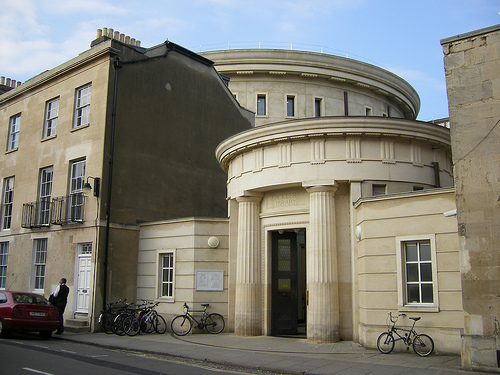
Sackler Library at Oxford University. (flickr.com)

Sackler Library at Oxford University. (flickr.com)

The Institute of Classical Architecture & Art has announced its Arthur Ross awards for 2015. The top award, for architecture, goes to Adam Architecture, the London firm founded by Robert Adam. His inventive classicism joins his peerless erudition in the attempt to lure the world back to building cities and towns with beauty. Beauty is part and parcel of functionality. Without it nobody would care enough about buildings to keep them up and running into a long future.

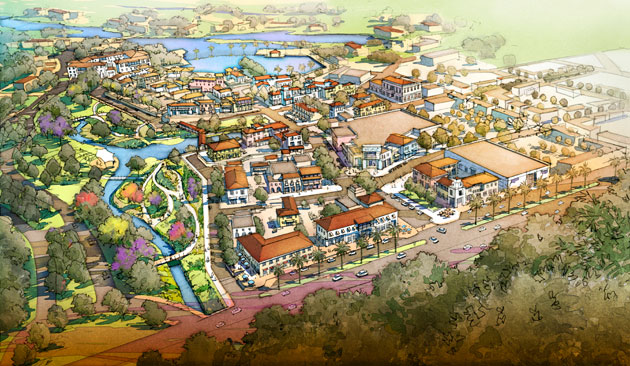
Santa Clara, Panama, city center. (Moule & Polyzoides)

Santa Clara, Panama, city center. (Moule & Polyzoides)

Poster for "Room With a View." (brothermarc7theatre.tumbler.com)

Poster for “Room With a View.” (brothermarc7theatre.tumbler.com)

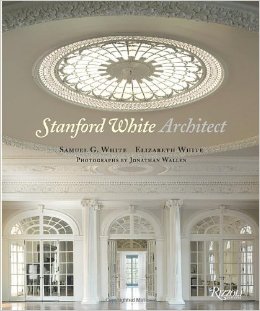
"Stanford White, Architect." (amazon.com)

“Stanford White, Architect.” (amazon.com)

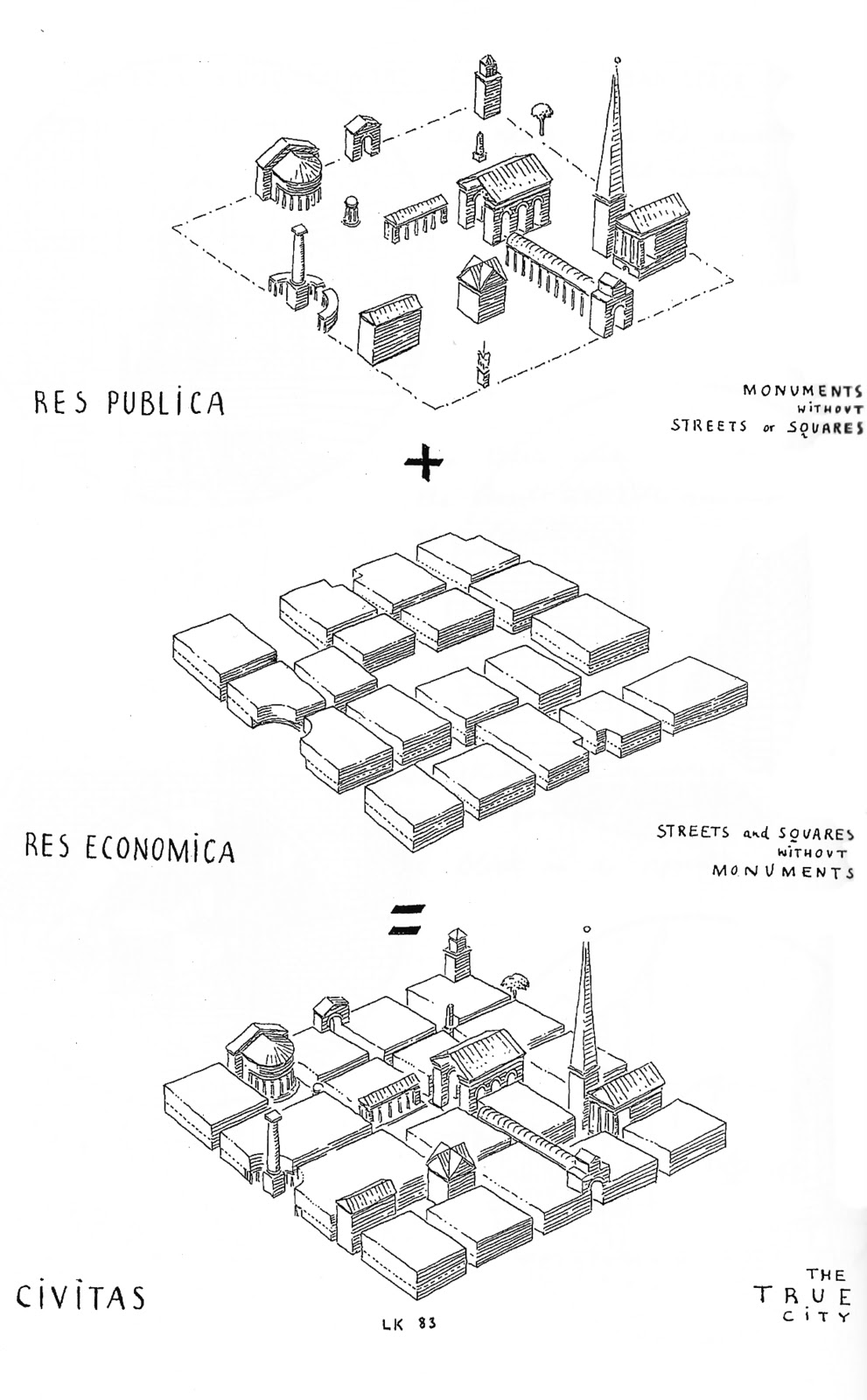
Sketch by Leon Krier. (architectural-review.com)

Sketch by Leon Krier. (architectural-review.com)

Peter Lyden, who joined the ICAA as its president last year, succeeding the inimitable Paul Gunther, summed up this year’s slate of awards, saying that they “illustrate the proud legacy of Arthur Ross and his vision of promoting the appreciation and awareness of the classical tradition. By honoring these individuals and organizations, we recognize the continued importance and relevance of classicism in our cities and communities today.”

The other Ross winners buttress the classical revival, some in surprising ways:

• The award for city planning goes to Moule & Polyzoides, Architects and Urbanists, of Pasedena, Calif. Elizabeth Moule and Stefanos Polyzoides, who helped found the Congress for the New Urbanism decades ago and have pioneered new towns and neighborhoods in the old urbanism now known as the New Urbanism, often in the Mediterranean style that came to California by way of Mexico and Spain.

• The award for fine arts goes to James Ivory for the many so-called “Merchant & Ivory” films directed by Ivory and produced by the late Ismail Merchant. They use craft and historical veracity to leverage cinema that helps we moderns feel the bliss that was once the birthright of all peoples and all classes by merely walking around and seeing. It is a bliss that could be easily recaptured today.

• The award for writing and editing goes to Elizabeth White and Samuel G. White, who write books on architecture that celebrate “the classical tradition, presenting the work beautifully and intelligently and revealing the intentions of the designer as clearly as possible in two dimensions.”

• The board of directors award this year honors the life work (not yet concluded!) of Léon Krier, whose architecture and town planning, especially as the masterplanner of Prince Charles’s new town of Poundbury, along with Krier’s playful but tart sketches of urbanism, and his books on the same vital subject, have brought to life a treasury of thoughts that have done so much to advance the dream of returning the world to the design of places that embrace, on behalf of a theoretically artful future, the best practices of a past going back hundreds and thousands of years.

Having mentioned the past, I had the honor of sitting on a Ross jury back in 2011. I committed the faux pas of writing about the process in a column I deep-sixed after I was informed that it was supposed to be secret! This year’s judges, imbued with more judicial savvy, were Gary Brewer, David Dowler, Michael Lykoudis, Andrew Skurman and jury chairman Robert Davis.


Posted in Architects, Architecture, Architecture Education, Architecture History, Art and design | Tagged , , , , , , , , | 1 Comment

Kunstler’s City Beautiful

The World's Columbian Exposition in Chicago, 1893. (pinterest.com)

The World’s Columbian Exposition in Chicago, 1893. (pinterest.com)

James Howard Kunstler, author of The Geography of Nowhere and The World Made by Hand, and coiner of the word “crudscape,” knows all too well what we as a civilization have wrought since we won World War II. In many ways, not just the Ugly American but the Ugly America. “Eyesore of the Month” is a must for every reader. Jim’s blog is a running, leaping, yodeling castigation of what’s wrong with our age, but for Orion Magazine he has has penned a graceful essay on the City Beautiful Movement, really the City Beautiful Moment – or What It Could Have Been Like in our world but for …

The Modern Movement, which has destroyed much of it and replaced it with a civitas that not only calls for a B-29 flyover but resembles the result. It has lasted now more than three times as long as the City Beautiful Movement. This video produced by Orion, City Beautiful, is a sweet reflection on that moment – one that could someday return in all its glory if, as Jim suggests, modernism is in the process of fading from the scene. Would that it could fade as fast as the World’s Columbian Exposition of 1893 did! Talk about a throwaway society! There was a big fire, but the White City, as it was called, was made, unbelievably – almost every Beaux Arts inch of it – of papier maché and would have come down anyway. It was a fair, after bloody all, as temporary as the ones that move on down the road after a week of thrills.

Take a look. These are three beautiful decades, lovingly photographed and with a memorable Kunstler soundtrack that wraps gently around the video, picking up on his Orion essay. This is rare Kunstler, a Kunstler in love. “It was really possible a century ago to imagine a Golden Age burgeoning.”

In fact, visit Orion, for the series of which this beautiful video is a part. A tip of the hat to John Massengale for posting this fine material to the TradArch list.

Posted in Architecture, Architecture History, Art and design, Preservation, Urbanism and planning | Tagged , , , , , | Leave a comment

Landmark the neighbors

Beautiful block of houses in Blackstone neighborhood. (providenceri.com)

Beautiful block of houses in Blackstone neighborhood. (providenceri.com)

Many Providence residents live on beautiful streets lined with houses built before ugly architecture became almost mandatory. Few neighborhoods are dominated by midcentury modern houses, although some jackanapes might even argue that they qualify as historic. Historic, perhaps, if the term is broadened beyond all meaning. Beautiful? No way.

Residents of the Blackstone neighborhood gathered Wednesday evening at a meeting of the Blackstone Neighborhood Organization to hear from the experts about petitioning City Council to create a local historic district. Bob Azar and Jason Martin of the city planning department were there to outline the difference between the two types of historic district and the benefits or drawbacks of each.

The Blackstone neighborhood is already covered by several of the city’s 35 National Register Historic Districts, including the Blackstone Boulevard Realty Plat District, in which sits the Granoff estate. Its subdivision was recently derailed by the City Plan Commission – perhaps only temporarily. That battle naturally generated an interest in creating a local historic district to protect the neighborhood.

To make a long story short, a local historic district does not protect a neighborhood from a subdivision. That is under the purview of the CPC. Being under the purview of the Providence Historic District Commission can make it more difficult for a property owner to erect houses on any land, subdivided or not, that would degrade the historic character of the neighborhood.

Difficult but not impossible. Because the historic district commission does not discriminate against houses that don’t fit into a neighborhood’s character. It rules on appropriate massing, height and materials, but not on style – although style is what most people consider, and ought to consider, the main factor. Location in a local historic district will no more protect you from a Neo-Midcentury Modern house next door than your neighbors were able to protect themselves from the ilk over the last half-century.

During those years, the housing stock of the Blackstone neighborhood took it upside the head from the Modern Movement, with little evident pushback. The result is that an HDC member considering whether a proposed house would be “appropriate” has few standards to rely on in making such a judgment.

This fact only makes it more important to create a local historic district. The solidarity of a neighborhood seeking to protect its property values – values determined in large part by the beauty of its streets, not just its individual houses – is the real reason to have a historic district.  To show a strong front to others who might have different – that is, modernist – ideas about what constitutes beauty, and thus value, is the only real reason to band together and put up with the restrictions faced by homeowners in historic districts. It’s the neighborhood and its solidarity, not the city’s pliable regulations or their overseers’ often hazy notions of what is vital to be protected, that will preserve what’s best about a beautiful neighborhood.

Bob Azar pointed out that at least 90-95 percent of the homeowners must buy into a historic district. But they must be united as well in their belief of what a historic district is. Woe betide a community that does not know what it wants. The beauty of a divided community with a historic district is no better protected than a united community without a historic district.

Posted in Architecture, Development, Preservation, Providence, Uncategorized, Urbanism and planning | Tagged , , , , , | Leave a comment