More architecture by Gaudi

Screen Shot 2016-03-12 at 12.50.49 PM.png

Sagrada Familia, in Barcelona. (Archdaily.com; most images Wikipedia)

My recent post “Didn’t quite get Gaudì,” criticizing a modernist supposedly won over by his architecture, has inspired me to post a few more shots of his work. Most of these are my favorites among images from Wikipedia’s list of his most eminent buildings. Even among those I did not select it would be hard to find examples that a modernist could enjoy without betraying the principles of her dastardly modernist style. Antoni Gaudì was not a classicist but a traditionalist in spite of his wide swing away from the classical orders. Even his break from the traditions of architecture in (primarily) Barcelona betrays a reverence for that flair for beauty which have endeared tradition to the public. I hope you will enjoy these shots, and will close by noting that the ancient classical orders inspired many offshoots of architectural style. The classical style (with its own many offshoots) eventually became one among many traditional styles that span the earth – the real International Style – which yet maintain a timelessness next to which modernist work becomes dated soon after its erection. Okay. Now to Gaudì:

Screen Shot 2016-03-12 at 11.45.44 AM.png

Schools associated with Gaudi’s Sagrada Familia cathedral. (Wikipedia)

Screen Shot 2016-03-12 at 11.47.25 AM.png

Episcopal Palace of Astorga, in Leon.

Screen Shot 2016-03-12 at 11.48.29 AM.png

Casa Botines, in Leon.

Screen Shot 2016-03-12 at 11.49.12 AM.png

Casa Calvet, in Barcelona.

Screen Shot 2016-03-12 at 11.46.11 AM.png

Casa Batllo, in Barcelona.

Screen Shot 2016-03-12 at 12.45.13 PM.png

Bellesguard, in Barcelona. (barcelonatosee.com)

Screen Shot 2016-03-12 at 11.47.45 AM.png

Pavilions at the Park Guell, in Barcelona.

Screen Shot 2016-03-12 at 11.48.56 AM.png

Bodegas Guell, in Barcelona.

Screen Shot 2016-03-12 at 11.50.03 AM.png

Artigas Gardens, in Barcelona.

Posted in Architects, Architecture, Architecture Education, Architecture History, Art and design, Other countries, Photography, Urbanism and planning | Tagged , , , , , | 1 Comment

Indian classical dance Monday morning at Brown

Screen Shot 2016-03-11 at 9.45.04 PM.png

Sophia Salingaros performs classical Indian dance. (samskritihouston.org)

This Monday at 10:30 a.m., Sophia Salingaros will perform classical Indian dance at Brown’s Lyman Hall. She is the daughter of architectural theorist and University of Texas mathematician Nikos Salingaros, whose thoughts have appeared here often, with and without attribution. He has sent me word of Sophia’s appearance before the dance class of Prof. Priyadarshini Shome at Lyman’s Ashamu Dance Studio. The class is part of the dance curriculum at Brown’s Department of Theater Arts and Performance Studies. All are welcome to the event, which is free.

Here is a YouTube video of Sophia dancing. It is 3:24 minutes in length.

The community arts group Bihl Haus Arts, in San Antonio, informs its readers that Sophia is “a disciple of Bharatanatyam, a dance form that originated 2,000 years ago in southern India.”  Regarding Sophia’s performance for Bihl Haus guests in January, the writer of its description enticingly stated:

Audiences will be mesmerized by Sophia’s every precise step, every darting glance, every hummingbird-like flourish of her hands. Through dance, she’ll tell traditional Indian divine and love stories in selected solo pieces that alternate between lyrical vignettes and more bracing passages peppered with percussive footwork and arching arms.

Sophia will dance a number of dances on Monday, between each of which the audience will be asked to ask her questions. Leaving aside the beauty of her performance, if she is anything like her dad, who has deeply studied the relationship between architecture and neurobiology, I’m sure her answers will bring quantum enlightenment.


Posted in Architecture, Architecture Education, Art and design, Video | Tagged , , , , , , , , | 2 Comments

Didn’t quite get Gaudi

Screen Shot 2016-03-09 at 8.24.25 PM.png

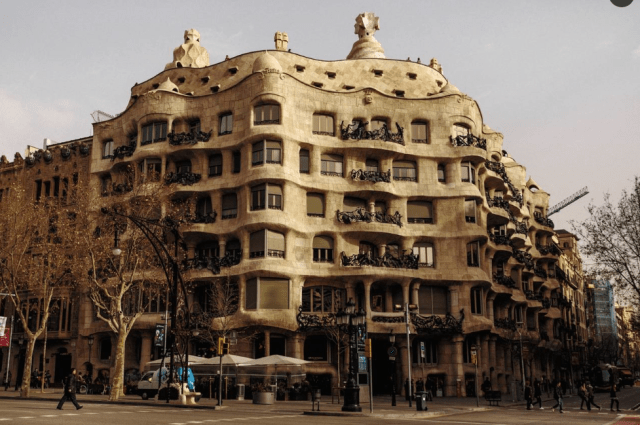
Antoni Gaudi’s 1910 Casa Mila. (WSJ)

Ayesha Khan’s essay on the Spanish Catalan Antoni Gaudí (1852-1926) in the Wall Street Journal, “How a Gaudi Building Won Over a Strict Minimalist,” doesn’t quite live up to the headline. It is not clear that she really likes Gaudí much, let alone understands him. She is a modernist designer and writer, no doubt eager to put her open-mindedness on display. Laudable? Perhaps. But she could have done a much better job of pretending to like Gaudí.

I like Gaudí very much. He shows that whimsy need not undermine beauty. His work in the early 20th century is far closer to Art Nouveau than anything on the modernist runway since. It is not altogether surprising that Khan spends most of her article dissing Gaudí’s architecture. She begins by introducing readers to her real feelings:

My architect hero was Norman Foster, whose steel-and-glass towers were rising all over the globe. So it’s no wonder my eyelids drooped when we covered Catalan architect Antoni Gaudí (1852-1926) in my second-year history of architecture class. Curlicues here, wrought-iron nonsense there, no straight walls, obscure sculptures and adornments—in my modernist mind, it did not compute.

That was before she saw his work. And then? Well, visiting his showplace, Barcelona, she decided to spurn his Sagrada Familia and instead visited his Casa Milà apartment building, my favorite of his works:

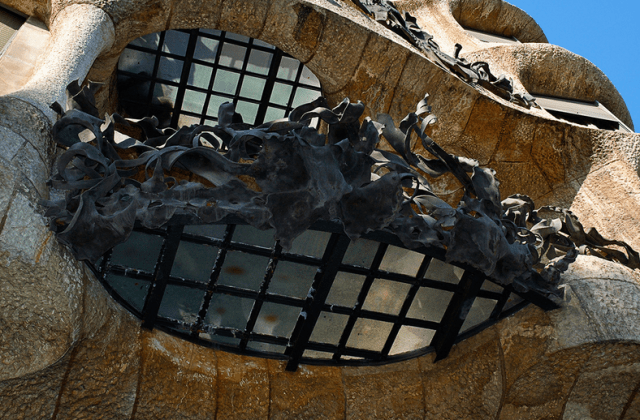
Casa Milà’s exterior, whose wrought-iron balcony railings evoked mangled dead leaves to me, would have left the modernist in me cold had I not been sweltering in the summer sun, waiting to go inside to humor my sister.

Many advocates of modernism who like Gaudí seem to believe that the “blobbish” forms of his Casa Milà place him in the “precursor to modernism” camp. In trying to kidnap Gaudí’s reputation, much as they did that of Louis Sullivan, modernist architectural historians must turn a blind eye to his fanciful embellishments. Classical they are not but traditional they quite surely are – in maintaining a conventional sense of ornamentation’s vital role in the creation of beauty, which modernists firmly reject. Earlier modernists criticized his style as Baroque and “excessively imaginative.”

Toward the end of her piece, Khan quotes Foster’s admiration for Gaudí. His remarks are typical modernist flapdoodle. No doubt he joins her either in his failure to understand Gaudí – or in his willingness to feign an appreciation that contravenes every jot and tittle of his stylistic principles. Complexity and contradiction live on!

Hats off to John Landry, of Providence, for sending me the story.

Screen Shot 2016-03-09 at 10.15.11 PM.png

Detail of Casa Mila. (daniellaondesign.com)


Posted in Architects, Architecture, Architecture Education, Architecture History, Art and design, Other countries | Tagged , , , , , , , | 5 Comments

Fallen Rome, fallen moderns

Screen Shot 2016-03-08 at 9.15.48 PM.png

“A Capriccio of Roman Ruins” (1720s) by Marco Ricci. (National Gallery of Art)

Passages from Stephen Greenblatt’s The Swerve: How the World Became Modern evoke a Rome in the 15th century fallen from its imperial glory:

The population of Rome, a small fragment of what it had once been, lived in detached settlements, one at the Capitol where the massive ancient Temple of Jupiter had once stood, another near the Lateran whose old imperial palace had been given by Constantine to the bishop of Rome, yet another around the crumbling fourth-century Basilica of St. Peter’s. Between these settlements spread a wasteland of ruins, hovels, rubble-strewn fields, and the shrines of martyrs. Sheep grazed in the Forum. Armed thugs, some in the pay of powerful families, others operating on their own, swaggered through dirty streets, and bandits lurked outside the walls. There was virtually no industry, very little trade, no thriving class of skilled artisans or burghers, no civic pride, and no prospect of civic freedom. One of the only spheres of serious enterprise was the trade in digging out the metal clasps that had knitted the ancient buildings together and in peeling off the thin sheets of marble veneer so that they could be reused in churches and palaces.

What came next, over several centuries, is what was described in the online course “The Meaning of Rome,” taught by David Mayernik and Jay Hobbs of Notre Dame’s School of Architecture. I wrote of it in my Jan. 6 post “Rome’s exaltation explained.” What Greenblatt describes above is the depths from which Rome later rose. He continues:

Like Petrarch before him, Poggio [the papal official, protagonist of The Swerve, who went searching European monasteries for copies of ancient manuscripts] cultivated an archaeologist’s sense of what had once existed, so that vacant spaces and the jumble of contem-porary Rome were haunted by the past. “The hill of the Capitol, on which we sit,” he wrote, “was formerly the head of the Rome empire, the citadel of the earth, the terror of kings; illustrated by the footsteps of so many triumphs, enriched by the spoils and the tributes of so many nations.” Now just look at it:

This spectacle of the world, how it is fallen! How changed! How defaced! The path of victory is obliterated by vines, and the benches of the senators are concealed by a dunghill. … The forum of the Roman people, where they assembled to to enact their laws and elect magistrates, is now inclosed for the cultivation of pot-herbs or thrown open for the reception of swine and buffaloes.

The relics of the fallen greatness only made the experience of the present more melancholy. …

So says Greenblatt. He imagines a Poggio saddened by the fall. Fine. I am saddened by a fall of equal sorrow, and certainly even greater magnitude, even though it is reflected not in the crumbling of great architecture but in the rise of glass and steel manifestations of hubris that are as pathetic as the dunghills of Rome before it rose again. At least you can build something new upon a dunghill. A starchitectural blotch of God’s wrath on architecture, let alone an endlessness of them, cannot be replaced without a very expensive process of removal. And that will not begin without a very difficult and very unlikely revaluation of values in city-making. One hesitates to try to imagine what that will require.

Posted in Architects, Architecture, Architecture Education, Architecture History, Art and design, Books and Culture, Landscape Architecture, Other countries, Preservation, Urbanism and planning | Tagged , , , , , , | 1 Comment

How to square the square

Screen Shot 2016-03-07 at 9.53.35 PM.png

Toward uncompleted intersection near Providence Place mall. (RIDOT)

Seventeen years ago, Providence Place mall opened up downtown, in the Capital Center District, where an exit ramp from Route 95 meets Francis Street and continues on as Memorial Boulevard. Ever since then, too many pedestrians have endangered their lives by crossing at the end of the ramp where there is no crosswalk. Planners expect them instead to cross Francis, then cross Memorial, then cross Francis again to reach the mall.

If I were a pedestrian I would feel dissed. Why make me go all that extra way around to reach the shopping mall? Why not let me cross from Point A to Point B instead of forcing me to add A-to-C, C-to-D and D-to-B to my itinerary? Even this intersection’s No. 1 fan (me) is not so enthralled by its curiously attractive architecture – except for GTECH, which is thankfully hidden in the view above – as to covet extra footsteps to look at it.

So now the planners are finally going to solve the problem. The Providence Journal’s John Hill, in today’s article “No Thru Here,” describes how. Not with common sense, not by implementing the solution that’s been staring them in the face for 17 years, but by trying harder to block the shortcut near Fleming’s Steakhouse with even more concrete planters.

It’s not as if the ramp is too short for drivers to stop in time. There is plenty of room. No problem. It is not squaring a circle but squaring a square.

This sort of thing wakens the inner cynicism that these days sends voters into the arms of Trump. Why use a can of paint to solve a problem that can be solved with several hundred thousand dollars worth of concrete and steel designed by my aunt’s daughter-in-law’s infrastructure-supply firm, built by my barber’s son’s fabricating company, and installed by a road contractor owned by the second cousin of the top legislative assistant to my favorite politician? Will the landscaper of the Omni Hotel, who must be nephew to somebody, tend to the flowering dogwoods in the planters seasonally? Or will that job go to RIDOT?

Ah, Rogue Island!

Posted in Architecture, Art and design, Development, Providence, Providence Journal, Rhode Island, Urbanism and planning | Tagged , , , , , , | 6 Comments

More AIA “first issues”

DSCN0200.JPG

DSCN0201

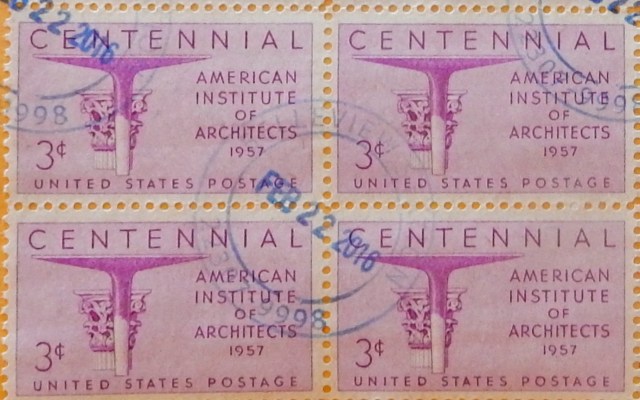
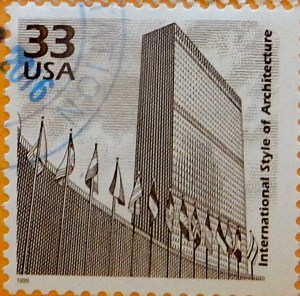
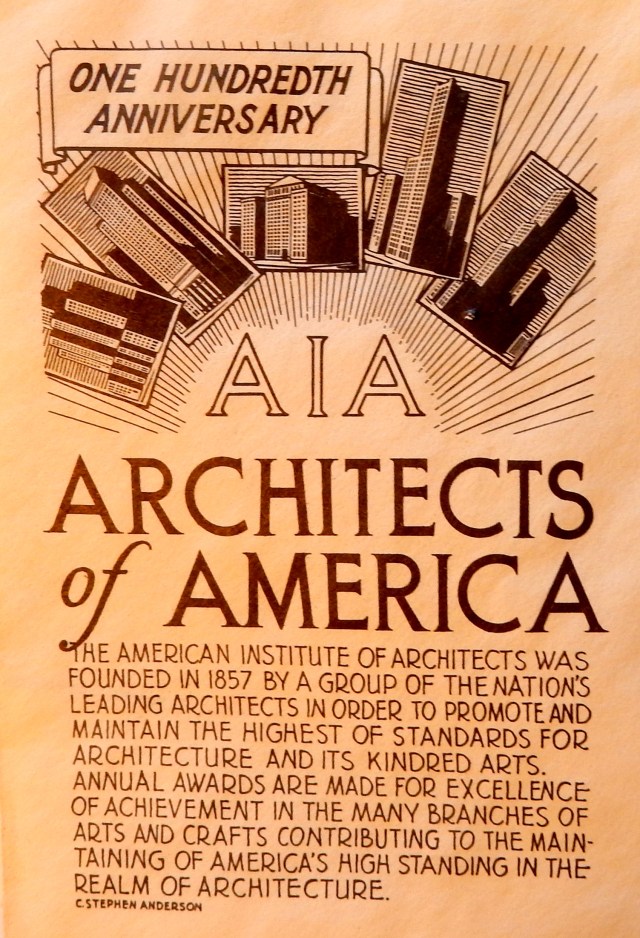
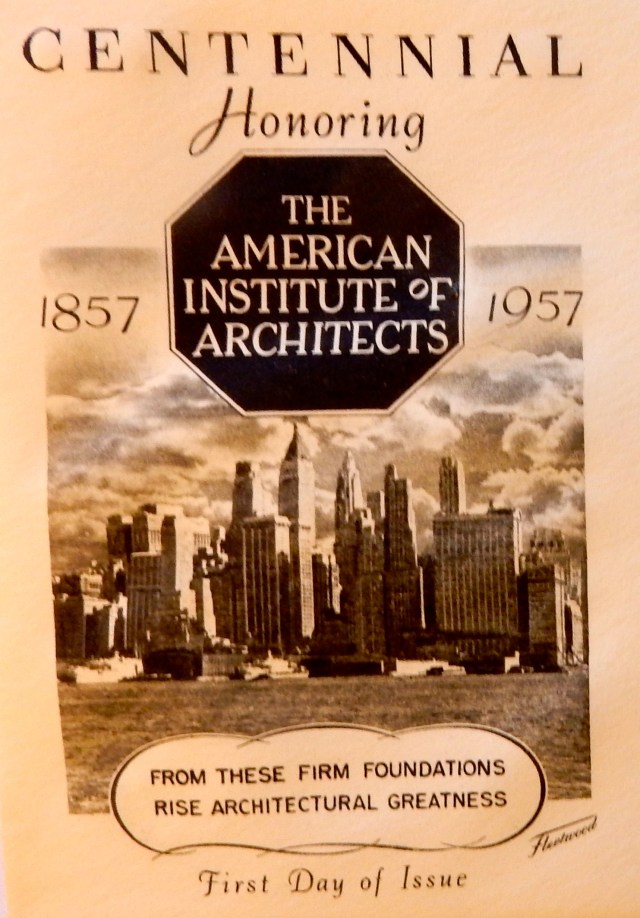
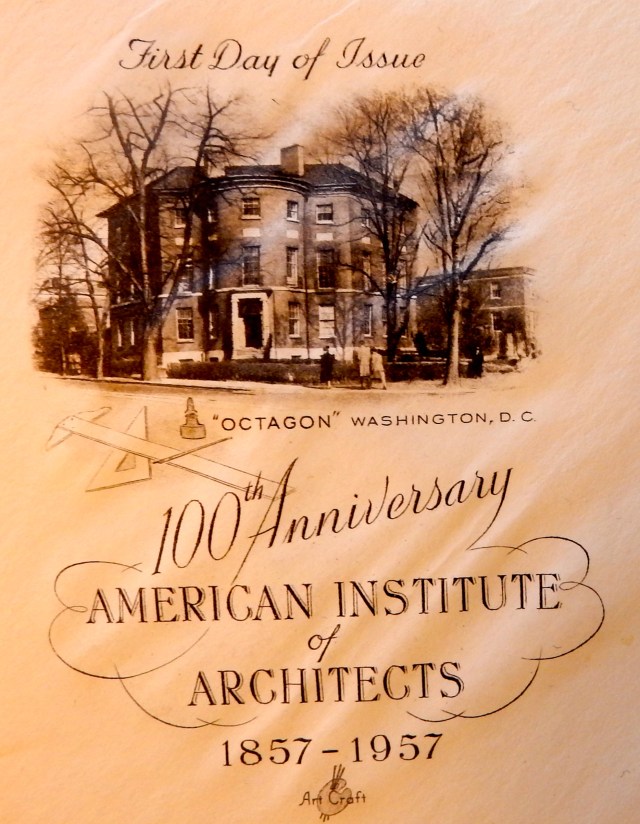
My friend Steve “The Philatecstatic” Mields has sent me more “First Issue” envelopes, this time celebrating the 100th anniversary of the American Institute of Architects. They are not as funny as the first-issue envelopes of the American Planning Association, with their silly engravings of suits dreaming up ways to uglify the built environment. Yet this sort of thing always raises eyebrows among those who recognize how the celebrated organizations have evolved over time. The packet of envelopes was sent by Steve in a 4×8 inch manila envelope half covered with 15 of the AIA stamps. These had nothing to say about how the AIA has ditched the one form of capital in favor of the other, which may or may not be a capital but is certainly not capital. There is also a 33¢ stamp, popped to the right just below the 3c stamps, of the United Nations with the motto “International Style of Architecture.” Chuckle if you wish.

DSCN0199.JPG

DSCN0197.JPG

DSCN0196.JPG

Posted in Architects, Architecture, Architecture History, Urbanism and planning | Tagged , , , , , , , , | Leave a comment

Roots of the classical revival

Screen Shot 2016-03-05 at 3.56.29 PM.png

“The Three Muses”? Illustration for the “Swerve”/Greenblatt video linked below.

Here’s a passage from The Swerve, a 2011 book by Stephen Greenblatt on how the discovery of the lost poem “On the Nature of Things” by Lucretius helped spark the Renaissance. The passage has to do with handwriting, not architecture, but feel free to read into the passage some thoughts about the recovery of the classical orders and how that resembled – or differed from – the recovery of other classical modes of art or thinking.

Greenblatt refers to Poggio, the papal official who lost his job and went around looking in far-flung monasteries for copied manuscripts of lost works of Greek and Roman literature. Greenblatt also refers to Petrarch, the 14th century scholar and poet whose rediscovery of Cicero’s letters is said to have been the first spark of the Renaissance.

Poggio arrived in Rome a quarter of a century after Petrarch’s death, at a time when the charismatic moment of the movement had already begun to fade. The sense of creative daring was gradually giving way to a spirit of antiquarianism and with it a desire to discipline, correct, and regulate all relations with the ancient past. Poggio and his generation became increasingly caught up in the desire to avoid mistakes in Latin grammar and to catch the blunders of others. But the lingering sense of the strangeness of the recovery of classical antiquity helps to explain the peculiar impact of his handwriting. The script that he fashioned was not a direct evocation of the handwriting used by the ancient Romans: all traces of that handwriting had long since vanished, leaving only the carved inscriptions in handsome capital letters on stone and occasional rough graffiti. But Poggio’s script was a graphic expression of the deep longing for a different style of beauty, a cultural form that would signal the recovery of something precious that had been lost. The shape of his letters was based on the manuscript style of certain Carolingian scribes. But Poggio and his contemporaries did not identify this style with the court of Charlemagne; they called it lettera antica, and, in doing so, they dreamed not of Charlemagne’s tutor Alcuin but of Cicero and Virgil.

The passage brings to mind how architecture after the decline and fall of Rome had changed, and yet how the differences between the Gothic style and its predecessors and its successors are often overemphasized. In fact, much of ancient classicism and its elements are common to the Gothic. Likewise, perhaps, Petrarch is said by Greenblatt to have exaggerated, for what we would call careerist reasons, the degree to which classical influences from Greece and Rome had disappeared from Western culture prior to their recovery by him. Moreover, Greenblatt describes Poggio’s handwriting and its relationship to that of original manuscripts that had disappeared, which remained only in copied form. This can help us to think about the classical revival and the process of rediscovering and reinvigorating not just ancient architecture but the broad traditional architecture that arose everywhere from its influences, and whose suppression in the past century resembles, in some ways, the suppression of certain classical ideas in the Middle Ages.

There is an irony in the subtitle of Greenblatt’s book! It is “How the World Became Modern.”

(“Stephen Greenblatt Discusses The Swerve” for about 23 minutes on this YouTube video, which I have not yet viewed. I trust it is interesting, but you be the guinea pig. … Four hours later I’ve listened to it and it was interesting. Not must-see TV, but okay.)


Posted in Architecture, Architecture History, Art and design, Book/Film Reviews, Books and Culture, Video | Tagged , , , , , , , , , , , , | 6 Comments

Reflect the Pan-Am Building

Screen Shot 2016-03-05 at 10.57.25 AM.png

View of Grand Central and N.Y. Central before Pan-Am. (ny-pics.com)

Few things are, I believe, more ridiculous than the frequent claim that glass buildings “reflect their context” by mirroring their neighborhoods in their glass façades. It does not happen, or even seem to happen, except when the sun is just right. Still less do such buildings “disappear,” as their advocates insist, usually in design hearings before actual approval and construction. (Why is that supposed to be a good thing?) But the six winners of a façade-redesign contest for the Pan-Am (MetLife) Building on Park Avenue near Grand Central Terminal force me to revise and extend my remarks.

Here, from ArchNewsNow.com, are the winners of the “Reimagine a New York City Icon” competition, sponsored by Metals In Construction magazine. The six laureates will split the contest’s $15,000 first-place award. I do not believe it is contemplated that any of the winners’ visions, let alone all six, are intended actually to be inflicted on the building.

None of the entries embraced the mirror concept. The New York Central (Helmsley) Building would still be blocked from the south on Park Avenue by the Pan-Am, which perhaps for that reason is also considered the most hated building in New York City. (Walter Gropius, a founder of modern architecture, was one of its design consultants.) I believe that if the building were literally encased in mirrors, literally reflecting its surroundings, then it would not be such a blot on the city’s architectural escutcheon.

A mirror could be installed in each window frame. The cantedness of the building’s facades, all eight of them, might actually offer an interesting set of reflections up and down Park Avenue. Of course, the buildings have mostly changed, almost entirely for the worse, so now the reflections would reflect the abominable glass boxes of the Mieslings (modernists who copy the work of fellow founder Ludwig Mies van der Rohe). The new Pan-Am windows would need to be two-way mirrors, so as not to box in the building’s poor occupants. That would be expensive but that expense would itself fit into the iconography of iconic modernist buildings.

Screen Shot 2016-03-05 at 11.05.11 AM.png

Grand Central and N.Y. Central after Pan-Am. (nyc-architecture.com)

Posted in Architects, Architecture, Architecture Education, Architecture History, Art and design, Development, Urbanism and planning | Tagged , , , , , , | 3 Comments

Archaeology at Penn Station

Screen Shot 2016-03-04 at 11.25.22 AM.png

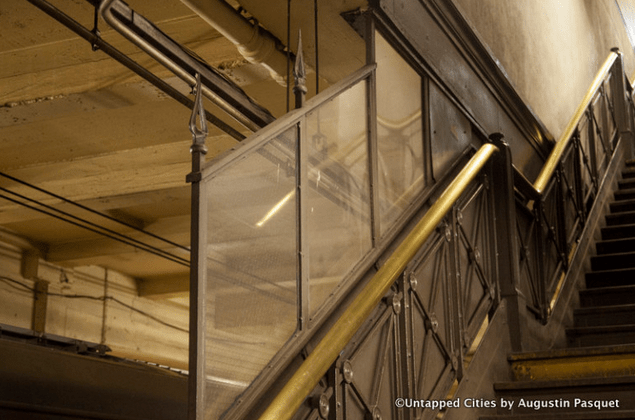
Original staircase and railing down to Track 17 of Long Island Railroad concourse.

The website Untapped Cities has apparently been sending people out (or at least receiving reports from disparate individuals and then signing them up) to find parts of the old and beloved Penn Station in the bowels of the new and reviled Penn Station. The latest find is a staircase from the old McKim Mead & White station, whose lower levels – train platforms and staircases down to them – were kept largely intact when the beautiful structure was removed and replaced what people scurry into and out of today. “New Remnant of Old Penn Station Discovered by Untapped Cities Team” is a pleasant romp, especially if you drill down into the previous reports of Untapped Cities’ urban archaeologists.

Except for Governor Cuomo’s ridiculous non-proposal last month, I don’t think there has been any big news regarding the prospect of rebuilding the station as proposed by architect Richard Cameron. Untapped Cities should keep its teams going farther and farther into the station to find more and more parts of the original that can be applied to rebuilding it. After all, much of what exists under the rabbit warren is original and can be applied to keeping the cost of the project down – compared, no doubt, to the modernist proposals, which can be expected to bring renewal (that is the usual combo of ugliness and stupidity) to every aspect of what exists today – with the exception of bringing back what we once loved so much. The horror!

I recently discussed the latest developments, if you can call them that, in “Hint, hint: Rebuild Penn Sta.,” which links to an in-depth description of Cameron’s plan in Traditional Building magazine.

Posted in Architects, Architecture, Architecture Education, Architecture History, Art and design, Blast from past, Development, Interior Design, Preservation, Urbanism and planning | Tagged , , , , | 2 Comments

Craco, abandoned in 1963

Screen Shot 2016-03-03 at 6.40.31 PM

Craco, Italy, abandoned in 1963 after a landslide. (thefamilycoppolaresorts.com)

This haunting film depicts Craco, Italy, abandoned in 1963 after landslides rendered it uninhabitable. Ancient ruins are, well, ancient ruins, and their mysteries pull on different chords of our hearts. Craco is a city – granted, an ancient one – abandoned in modern times. Time has and has not been kind to Craco. Its citizens were doubtless the last of generations in their line to inhabit the village. Their reluctance to play Russian roulette with nature is understandable. Filmmakers have found the village’s potential as a site for films irresistable. The Nymph, by Lina Wertmüller (1996), was filmed there along with others of more ecclesiastical bent. But to return to Craco for an hour reduces considerably the tragical odds, and one can only wonder how many of the tourists who visit once had homes in this sadly beautiful alluring village. Wallow in whatever feelings wash over you as you watch Walter Molfese’s 3½-minute film “Craco: The Abandoned Town,” on the Kuriositas website. In 2010 Craco became the 93rd place on the World Monuments Fund’s list of cities and towns to be saved.

Screen Shot 2016-03-03 at 6.44.58 PM

Balcony hangs on after landslide cracks facade. (geolocation.ws)

Posted in Architecture, Architecture History, Art and design, Landscape Architecture, Preservation, Urbanism and planning, Video | Tagged , , , , , , , , , , | 1 Comment