Froma Harrop: Don’t bury our cities in megatowers

Screen Shot 2016-03-02 at 5.51.19 PM.png

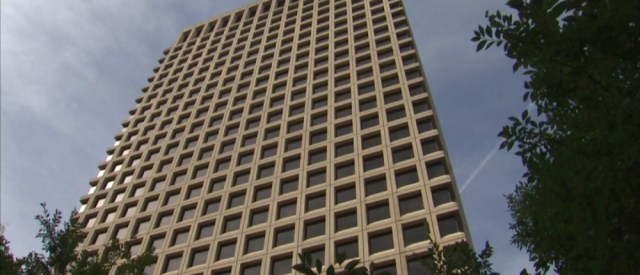
This image accompanied the Creators Syndicate version of Froma Harrop’s column.

An excellent rattling of sabres at megatowers was published in Sunday’s Providence Journal by Froma Harrop, my former colleague on the paper’s editorial board. Froma writes a twice-weekly syndicated column for Creators Syndicate on the full panoply of issues in politics and society. Now she has started her own website, silkstocking.nyc, to address issues on the Upper East Side of New York, where she lives when she’s not in Providence. Recently, she asked me to write a piece for her on a proposed residential megatower in the Sutton Place neighborhood. “Stepping heavy on Sutton Place” is now on her website, which exists officially as of today.

***

Don’t bury our cities in megatowers

By Froma Harrop

Many longtime residents of San Francisco, Miami and other hot U.S. cities complain of “Manhattanization” when developers put up 20- or 30-story apartment complexes. In Portland, Oregon, they’re debating the wisdom of 40 stories.

Screen Shot 2016-03-02 at 6.09.08 PM.png

They should try 100 stories on for size — or not, if they value the amenities of urban life. That’s the height of a megatower proposed for downtown Seattle. It was “downsized” from 102 stories after aviation authorities warned the tower could interfere with air traffic.

Tall buildings don’t normally shock New Yorkers, but many Gothamites are appalled by the growing scourge of “billionaire’s row” on West 57th Street. This is a forest of freakishly high sticks casting shadows on Central Park.

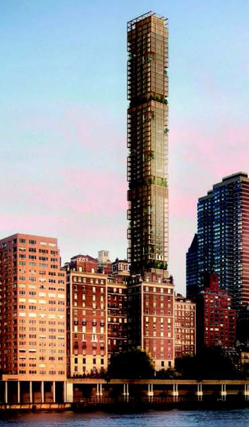
In the sedate residential enclave of Sutton Place to the east, a developer wants to drop an oblong almost as tall as the Empire State Building smack in the middle of narrow 58th Street. Glomming onto the neighborhood’s reputation for quiet elegance, the developer is perversely calling his monstrosity Sutton 58.

What’s so terrible about megatowers? They cause wind tunnels at ground level. They block out the sun, putting huge swaths of city in shadow. They create canyons trapping air pollution and heat in summer. They kill others’ views.

Michael Mehaffy, an architectural critic based in Portland, Oregon, has likened super-tall residential buildings to vertical gated communities cut off from the neighbors far below. Furthermore, the buildings are often half empty.

That’s because these ultra-expensive spaces are being marketed to a global elite seeking a safe place to stash their money. Billions are pouring in from Russia, China, Saudi Arabia and Latin America.
Screen Shot 2016-03-02 at 6.19.35 PM.png

Megatower proposed near Sutton Place. (Bloomberg)

Here’s how Alan Kersh, president of the East River Fifties Alliance (a group fighting the Sutton Place megatower), sums up the raw deal: “The neighborhood is being ripped up for foreign owners who may fly in for a couple of days and just want to have a safe deposit box in the sky.”

Seattle’s proposed 4/C megatower — so named for its location at Fourth Avenue and Columbia Street — would be the tallest building on the West Coast. Why would Seattleites want such an outlandishly high structure?

“Vancouver envy,” Mehaffy responds, referring to the tower-crazed Canadian city about 150 miles to the north. “The irony of that is a lot of people there are upset at the development.”

Such discontent may explain one Vancouver developer’s announcement that his project’s $18 million penthouse would be sold only to a local resident.

Much of the money flowing into this super-expensive real estate is dirty — all-cash deals using shell companies. The buyers’ identities are hidden. A concerned U.S. Treasury Department is starting to track these purchasers.

Builders and their pliant mayors try to pass off this luxury construction as a boon to affordable housing — as though adding to the stock of residences selling in the eight figures is somehow going to trickle down to working folks’ rent. The opposite is often the case.

Developers look for “soft” building sites. In older residential areas, such as Sutton Place, that means demolishing the tenements and five-story walkups where people of modest means still live. When the Sutton 58 developer is done, 80 families will be displaced.

The theme this campaign season is ordinary Americans’ wanting their power back. That should extend to politics on the very local level. Residents have a right to determine the destiny of their neighborhoods.

The real estate barons often call the shots in America’s city halls. The people must tell the politicians inside that there will be consequences to ignoring their opinions.

***

Follow Froma Harrop on Twitter @FromaHarrop. She can be reached at fharrop@gmail.com. To find out more about Froma Harrop and read features by other Creators writers and cartoonists, visit the Creators Web page.

Posted in Architects, Architecture, Architecture History, Art and design, Development, Preservation, Providence Journal, Urbanism and planning | Tagged , , , , , , , , | Leave a comment

Buildings that kill people

sick-building-image-2-1000x430.jpg

Example of “Sick Building Syndrome” atop article by Lance Hosey. (commonedge.org)

I didn’t want to be the first to say this. Thankfully now Lance Hosey, chief sustainability officer and a principal of the design firm Perkins Eastman, has written “Buildings That Kill.” His piece ran yesterday on CommonEdge.org. He is identified as serving “on the AIA Committee on the Environment Advisory Group and the AIA Energy Leadership Group, and he chairs the USGBC’s LEED Advisory Committee.”

So you heard it from Hosey first, though you’ve heard the existence of killer buildings intimated here, on this blog, many times.

Hosey opens citing the call by Raphael Sperry, president of Architects/ Designers/ Planners for Social Responsibility, to boycott commissions for buildings where killing happens, especially prisons. “Which is worse,” asks Hosey, “buildings that are the setting for thousands of deaths, or buildings that are the cause of millions of deaths?” Good question! He notes that

Amnesty International reports that from 2007-2012 nine countries with capital punishment (excluding China, which puts to death thousands annually) executed a total of 6,221 people. But according to the World Health Organization (WHO), in 2012 alone buildings contributed to the deaths of 4.3 million people. All of these were due to a single cause: indoor air pollution.

But isn’t there a difference between buildings where people are killed either intentionally or by the predictable outcome of their purpose, and buildings that kill people unintentionally, as through Sick Building Syndrome? Hosey answers that question: “Maybe not on purpose, but arguably the unintended consequences of indoor air pollution are significantly more harmful.”

The word “unintended” is not a very effective blame-shifter. How can the consequences be unintended if they have been warned against time and time again, with all warnings brusquely ignored?

Buildings with HVAC systems that spread deadly germs are legion. The effectiveness of such systems at recirculating germs is exacerbated by inoperable windows, which prevent germs from drifting into the outside environment. Inoperable windows are an invention of modern architecture, and arise from its ethos of machine architecture and its rejection of tradition. Among the traditions given the heave-ho by modern architecture are those that used nature and climate to regulate the heating and cooling needs of buildings for centuries and centuries. Before the Thermostat Age, these techniques were honed by trial and error, with the best practices handed down from generation to generation.

There are, so far as I am aware, no sick buildings that have windows that open and close. Insofar as the circulation and recirculation of germs is a problem that modern architecture has failed to solve – and certainly the notion of revisiting some of the old building technologies that modernism has junked has been met with scorn – maybe modern architecture is not so easily absolved of millions of deaths a year.

Of course, modern architecture has created a built environment whose detrimental effects on societies around the world victimize populations whether millions of deaths are attributed to Sick Building Syndrome and blamed on (modern) architects or not. Architecture has clearly abandoned its age-old concern for civitas – for firmitas, utilitas and venustas of street and city as well as of the single building.

It’s more than just stadiums that look like vaginas in nations whose women are barred from revealing their faces. It’s more even than the role of modern architecture as the brand of crony capitalism. It’s the rape and pillage of the cultures of the great societies of the world, from London to Timbuktu, that is the chief crime of modern architecture.

Posted in Architects, Architecture, Architecture Education, Architecture History, Art and design, Development, Preservation, Urbanism and planning | Tagged , , , , , | 1 Comment

Slice of Camelot lost to fire

Drexel-Fire-Newport-RI-Bellevue-Stonor-Lodge.png

The Stonor Lodge on fire in Newport. (Instagram/curtbagnpt

Last Thursday, Newport’s famous Bellevue Avenue lost its Stoner Lodge, across from Château-sur-Mer, to a fire probably caused by an accident resulting from its ongoing extensive renovation. The lodge was sold by the daughter of socialite Noreen Drexel in 2012. The original house, known as Mayfield Cottage and completed in 1880, was destroyed by fire a century ago. After the 1916 conflagration, Lord and Lady Camoys, Ralph Stonor and Mildred Sherman bought the ruins then “built a completely new home on the spot,” according to one account.

Mark Reynolds reports in the Providence Journal that according to historian Tyler Hughes, Jacqueline Bouvier, contemplating on Sept. 11, 1953, her marriage the next day to John F. Kennedy, visited the Stonor Lodge, owned by Bouvier family friends from Philadelphia, to chill before her wedding: “Hughes [said] that the owner of the lodge, Noreen Drexel, recalled that the future First Lady had felt overwhelmed and so she had grabbed her favorite book, driven down Bellevue Avenue, and rung the doorbell at the lodge.”

Mrs. Drexel recalled to Hughes that Jackie said, “Oh Mrs. Drexel! Could I please stay here for the day? I just need to get away – I won’t bother you! I brought a book!,” Jackie is said to have sat on a sofa in the sunroom of the lodge and read for hours. I wonder whether the title of her book is known.

Unlike the one a century ago, Thursday’s fire left no salvageable rooms. In photographs of the fire you can see through the walls, as if its plaster’s removal had completely exposed its structure, which the owner of the construction company doing the work confirmed. Early speculation suggests that space heaters might have sparked the blaze.

It seems likely, to me at least, that renovating an historic building poses more risk of fire than restoring it. More things can go wrong when you are making more changes, and the workers are less likely to be experts at how to avoid the most common hazards.

I posed the question to Jean Dunbar, a leading preservation practitioner and scholar, who replied, with some reluctance, that the evidence suggests that renovation and restoration were just as dangerous.

As a specialist in recreating historic interiors, I’d like to think that restoration causes fewer fires, but I fear that isn’t so.  Since it’s difficult to define just what is renovation and what is restoration, I can’t point to statistics—just cases.  Restoration at the historic Philadelphia Waterworks resulted in fire, so did the work at Central Synagogue, and many otherwise carefully planned projects have had the same unintended and catastrophic outcome.  The threat isn’t the extent of the work, but the failure to recognize that messing with building fabric renders it vulnerable to fire.

Two weeks ago the Ritz Hotel in Paris, near the finish of a $150 million renovation in the Place Vendôme, was seriously damaged by a fire of an origin apparently similar to that in Newport. It is the hotel that Princess Diana left just before her death in an auto accident, and the hotel I slipped into briefly to consume the tiniest thing on the menu, in 2003.

Posted in Architecture, Architecture History, Art and design, Preservation | Tagged , , , , , , | 2 Comments

Glide over St. Petersburg

Screen Shot 2016-02-29 at 7.48.35 AM.png

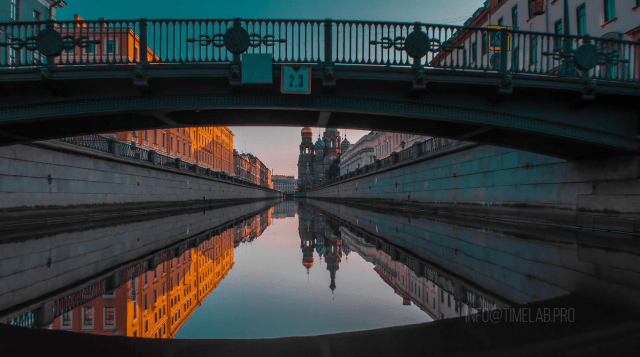
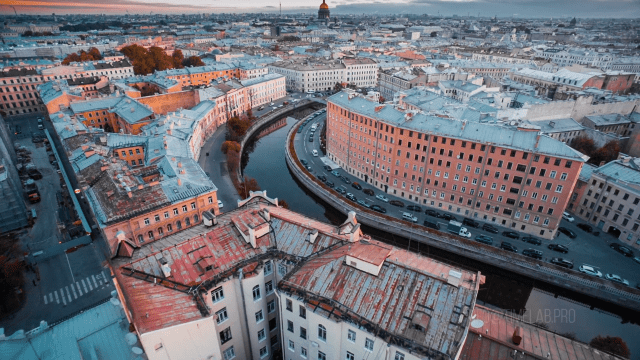
This astonishing video, posted on Kuriositas, of Russia’s capital under the czars is called “If You Never Wanted to Visit St. Petersburg, You Will After Watching This.” St. Petersburg recently celebrated its 300th anniversary as a city – it is quite young. Look not merely at the featured buildings but at the streetscapes in their vicinity and marvel at how intact the city has remained through all the vicissitudes of its history. Citizens recently defeated an effort by Gazprom, Russia’s state energy monopoly, to erect a megatower there. Was it wisdom or poverty that prevented the communists from doing to their old capital what London, possibly now Paris, and so many American cities have done to erase their beauty and torpedo their livability?

Screen Shot 2016-02-29 at 7.44.45 AM.png

Posted in Architecture, Architecture History, Art and design, Other countries, Photography, Urbanism and planning, Video | Tagged , , , , , , | 7 Comments

Glide through Angkor Wat

Screen Shot 2016-02-28 at 11.09.12 AM.png

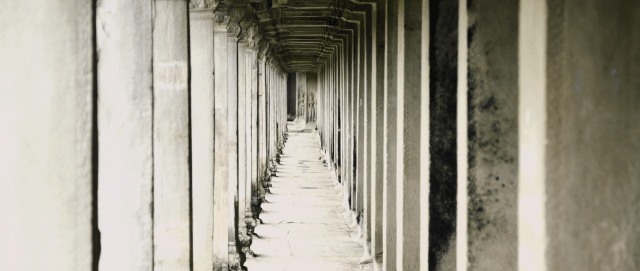
A temple at Angkor Wat. (kuriositas.com)

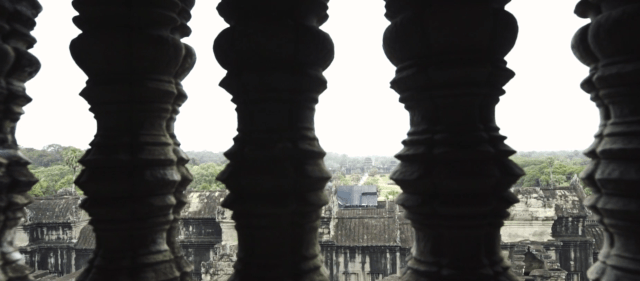
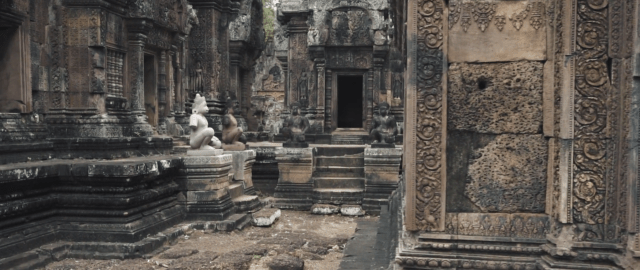
The website Kuriositas has a five-minute film of Angkor Wat, the Hindu-turned-Buddhist temple ruins in Cambodia. Filmmaker Tyler Fairbank, based in New York, shot the film using glidecam technology. The ruins seen in “The Temples of Angkor” and originally built in the 12th century strongly suggest, along with other ancient sites beyond the Greco-Roman sphere of influence, that classicism has its roots in the very nature of construction and is the true “International Style.” Elements of the classical orders that are structural and ornamental show up in the temples’ columns, cornices, balustrades and other features. Hence the reverence paid them over the centuries and millennia not just on behalf of a deity but on behalf of beauty.

Screen Shot 2016-02-28 at 12.08.42 PM.png

Screen Shot 2016-02-28 at 12.09.09 PM.png

Screen Shot 2016-02-28 at 11.07.43 AM.png

Posted in Architecture, Architecture Education, Architecture History, Art and design, Blast from past, Other countries, Urbanism and planning, Video | Tagged , , , , , , , | 1 Comment

Nice public comfort stations

Public toilet Torun Poland-1 (2) resized.jpg

Public toilet in Torun, Poland. (Photo by C.W. Westfall)

Paris always had great places to take a leak. New York’s public restrooms at Bryant Park, outside of the New York Public Library, also astonish us (today) that so much effort was made to celebrate the accomplishment of our most basic bodily functions. Providence had at least two elegant comfort stations. One was at Exchange Place (Kennedy Plaza) and became the Plaza Café, run by Pat Cortelessa, longtime opponent of the late Buddy Cianci, mayor for 21 years, then expanded to become an intermodal transit station. The other was opposite the Providence Performing Arts Center on Weybosset Street, which was also expanded to become a police substation and ticket sales kiosk. The design of neither addition attempted to reflect the degree of beauty of the original public pissoirs, but neither did they try to box the originals on the ears, as is more common these days. The facility on Weybosset was recently trimmed back to its original size to serve as a folly in the street’s recent, but only partially satisfactory, renovation.

I was launched on this quest for rare Providence comfort station images by Carroll William (“Bill”) Westfall’s photo, sent to TradArch, of a public toilet in Torun, Poland, which he photographed in 1968. In response, Christopher Liberatos sent in a selection of Parisian toilets, some of which I’ve printed below, concluding with an apparent modernist pissoir attempt.

Screen Shot 2016-02-27 at 1.16.16 PM.png

Exchange Place comfort station; Butler Exchange, 1878, in background, before Industrial Trust, 1928. (The American City, 1914)

Screen Shot 2016-02-27 at 1.55.12 PM.png

Expanded into bus station, 2002 (Flickr.com)

TheAmCityJul-Dec14VolXI.png

Weybosset Street comfort station, 1914. (The American City)

Screen Shot 2016-02-27 at 1.32.41 PM.png

Weybosset comfort station expanded, 1992. (Flickr.com)

Screen Shot 2016-02-25 at 8.16.49 PM.png

Weybosset comfort station reduced to folly. (gcpvd.org)

Screen Shot 2016-02-27 at 1.02.14 PM.png

Restrooms at Bryant Park/NYPL. (nytimes.com)

Screen Shot 2016-02-25 at 7.51.16 PM.png

Photos of Parisian pissoirs publiques here and below. (messynessychic.com)

messynessychic.com.png

Screen Shot 2016-02-25 at 7.51.52 PM.png

Screen Shot 2016-02-25 at 7.52.17 PM.png

Screen Shot 2016-02-25 at 7.54.08 PM.png

Screen Shot 2016-02-25 at 7.53.41 PM.png

Posted in Architecture, Architecture History, Art and design, Other countries, Photography, Preservation, Providence, Urbanism and planning | Tagged , , , , , , , | 2 Comments

Tip me over! Faster! Faster!

curbed.com.jpg

The proposed Nexus Building (right), in China. (curbed.com)

A proposed new megatower is planned in China’s Pearl River delta. The city is not named in either the Curbed or the Building Design & Construction articles, perhaps because the city will not exist until the building is finished. It boasts (if that’s the proper word) a novel tower concept. It will not have a core, where, typically, elevators and other services for the entire building are centered, along with the tensile strength element that holds the building up. Designed by PLP Architecture, the Nexus Building will feature three slabs totaling 251 stories and 1,952 feet.

bdcnetwork.com

How do these slabs deflect the wind? (bdcnetwork.com)

Despite the descriptions in these two articles, I’m not really sure quite what will keep the building from falling. Though I’m sure the engineers have it all figured out. That’s what they’re paid for, isn’t it?

Each slab pivots like a page connected to the spine of a book – that’s the simile used by Curbed’s Patrick Sisson. David Malone describes the structure as akin to a transformer – not an electricity conduit tower but the toy. I am assuming that the three slabs do not really “pivot” or “transform.” They just look like they pivot or transform. And of course, as we all know, a building that looks like it can do something no building has ever done before is, well, really, really great! Today, and for the past hundred years, buildings have been made to look like machines because we are in the Machine Age. Buildings do not have to behave like machines – displaying such qualities as efficiency, for example – they just have to look as if they behave like one. Everyone who is not an architect seems to understand, however, that getting the machine metaphor without the machine efficiency was not a good deal.

Anyhow, as described by Malone, the structure’s “tripod-like design will be better equipped to deal with natural forces, such as high winds.” That may be the testimony of the engineers’ calculations but my eyes arrive at a different and scarier conclusion.

Architects used to design extra strength into a structure since they realized that science could not offer a precise method of engineering the structure to assure its “firmitas” – its strength. For decades, however, computers have given engineers the confidence that they can determine exactly how much strength a bridge or a tall building needs to ensure its structural integrity.

Forgive me, but I do not trust the computers, the engineers or the architects who depend on their calculations, whom I certainly do not trust, let alone the developers that gather all of this remarkable brain power together, or the insurance companies who provide for relief if all those folks slip up. The Nexus Building almost looks as if it is designed to be felled by high winds of the sort that climate change is huffing and puffing even harder to create.

The building’s completion date is said to be no sooner than 2020, but that’s only four years off. Don’t tell me what city it’s in, and if you find out, please don’t invite me to the grand opening.

curbed2.jpg

The proposed Nexus Building (left) complex from above. (curbed.com)

Posted in Architects, Architecture, Architecture Education, Architecture History, Art and design, Development, Other countries, Urbanism and planning | Tagged , , , , , , , | 2 Comments

Calatrava’s dinosaur

hilaryswiftnyt.jpg

Santiago Calatrava’s Oculus at Ground Zero, in Lower Manhattan. (Hilary Swift/NYT)

Next week, starchitect Santiago Calatrava’s dinosaur of a transportation hub will open at Ground Zero in Lower Manhattan. The cost, mostly in federal dollars, was $4 billion for the station and its Oculus, a sculptural – or, really, sepulchral – public space. It looks like a dinosaur skeleton. Weren’t the bones supposed to open and close or flap or something? Well, that bit ended up on the cutting room floor. What we got was a replacement for the transit hub destroyed on 9/11 – a necessary investment, one must suppose – plus a shopping mall. Just what New Yorkers were demanding!

Today the New York Times published a silly bit of fluff, perhaps intended to sooth the hurt feelings of Calatrava, a Spaniard, and others involved in the massive boondoggle. New York decided to spend not a nickel to celebrate the PATH center’s public opening, so ace Timesman David Dunlap was sent in to fill as many column inches as he could (“Oculus, Centerpiece of Transit Hub and Selfie Magnet, Is Set to Open“) with hosannahs. For instance:

Say this about the Oculus: It is breathtaking from the inside — luminous, intricate, uplifting and tranquil. Photos of it resemble idealized architectural renderings.

It had better be! Dunlap assures readers that the Oculus will be “selfie central,” and that it will be compared with Grand Central Terminal. Yes and no, methinks. It may be selfie central but it bears no comparison to Grand Central. Whole different kettle of fish. (I was startled to read, in Dunlap’s article,  that while entering this public space is free, entering the museum at Ground Zero costs a family of four $179. C’mon now. Can that be true?)

But don’t miss “How Cost of Train Station at World Trade Center Swelled to $4 billion,” also by Dunlap. The photo from above the Oculus automatically turns into an excellent series of time-lapse photos of Calatrava’s extravaganza in construction. That’s the only dance the public will get to see it perform. So it’s worth the effort to click the link to watch it happen. Otherwise, it is doomed to sit there like a fossil.

Accompanying the NYT graphics is Dunlap’s catalogue of blunders that  doubled the cost and stretched construction beyond the completion date by seven years. Read it if you dare. It will curl your toenails even faster than the time-lapse photos can speed the arrival of the facility’s erection.

Screen Shot 2016-02-24 at 7.06.18 PM.png

Screen shot of Oculus from David Dunlap’s NYT story today.

Posted in Architects, Architecture, Art and design, Development, Urbanism and planning | Tagged , , , , , , , , , , | 6 Comments

Renovating Castle Lyndon

large_barry_lyndon_blu-ray_9.jpg

Kubrick’s Barry Lyndon: “Each shot acts as a kind of narrated painting.” (hopelies.com)

Here is a set of passages from William Makepeace Thackeray’s Barry Lyndon, which I am reading for the first time after seeing the movie, directed by Stanley Kubrick in a sort of cinematic slo-mo. The novel is an extended exercise in irony, narrated by Captain Barry, in which every line exaggerates the Irish adventurer’s supposed lineage and breeding. Here he is reminiscing, decades later (1814), at the changes he made to his new wife’s family castle.

The exterior was, when I first arrived, a quaint composition of all sorts of architecture; of feudal towers, and gable-ends in Queen Bess’s style, and rough-patched walls built up to repair the ravages of the Roundhead cannon: but I need not speak of this at large, having had the place new-faced at a vast expense, under a fashionable architect, and the façade laid out in the latest French-Greek and most classical style. There had been moats and drawbridges, and outer walls; these I had shaved away into elegant terraces, and handsomely laid out in parterres, according to the plans of M. Cornichon, the great Parisian architect, who visited England for the purpose. …

All the rest [of the bedrooms] were redecorated by Cornichon in the most elegant taste; not a little to the scandal of some of the steady old country dowagers; for I had pictures of Boucher and Vanloo to decorate the principal apartments, in which the Cupids and Venuses were painted in a manner so natural, that I recollect the old wizened Countess of Frumpington pinning over the curtains of her bed, and sending her daughter, Lady Blanche Whalebone, to sleep with her waiting-women, rather than allow her to lie in a chamber hung all over with looking-glasses, after the exact fashion of the queen’s closet at Versailles. …

Venuses and Cupids were the rascal’s adoration: he wanted to take down the Gothic screen and place Cupids in our pew there [the castle’s chapel]; but old Doctor Huff the rector came out with a large oak stick, and addressed the unlucky architect in Latin, of which he did not comprehend a word, yet made him understand that he would break his bones if he laid a single finger upon the sacred edifice. Cornichon made complaints about the “Abbé Huff,” as he called him (“Et quel abbé, grand Dieu!” added he, quite bewildered: “un abbé avec douze enfans!”): but I encouraged the church in this respect and bade Cornichon exert his talents only in the castle. …

Whilst these improvements were going on in my estates, my house, from an antique Norman castle, being changed to an elegant Greek temple, or palace – my gardens and woods losing their rustic appearance to be adapted to the most genteel French style – my child growing up at his mother’s knees, and my influence in the country increasing, – it must not be imagined that I stayed in Devonshire all this while, and that I neglected to make visits to London and my various estates in England and Ireland.

I’ll see if I can find an illustration connected to the book or, more likely, the movie. Long ago I avoided reading the book because the movie was criticized as boring. The movie is not boring. It is deliberate in the sweep of its lens as it captures beauty. “Each shot is a kind of narrated painting,” writes a critic. So I am pleased, also, at finding the book itself so entertaining. Old historical novels by writers like Thackeray are not a taste inculcated in many young people by their teachers these days. Too bad!

Posted in Architects, Architecture, Architecture Education, Architecture History, Art and design, Book/Film Reviews, Books and Culture, Humor, Interior Design, Preservation | Tagged , , , , , , , , | Leave a comment

Oh, to be in, um, China!

e15-975.jpg

Poster celebrating first anniversary of Mao’s Yangtze swim in 1956. (chineseposters.net)

It seems the People’s Republic of China has finally followed through on its maximum leader’s threat a year and a half ago to bar goofiness from its architecture. I penned a post, “Xi a Chinese visionary?” expressing my pleasure, or at least my astonishment, but stopped short of exulting with hosannahs at the possibility that Beijing might host the next Renaissance. But here is a passage from CNN’s report of the new regulations:

On Sunday, China’s State Council released new urban planning guidelines. According to the document, “odd-shaped” buildings – or “bizarre architecture that is not economical, functional, aesthetically pleasing or environmentally friendly” would be forbidden in the future. The document follows a 2014 call by Chinese President Xi Jinping for less “weird architecture” to be built.

Buildings are henceforth to be designed so as to better reflect Chinese culture. Imagine that!

“Architects can be creative within constraints,” says James Shen, a founder of the People’s Architecture Office, in Beijing, who adds, “It’s not having enough constraints that causes problems.” Working within constraints was key to beauty in classical architecture over centuries, even millennia, before the anything-goes design era began about a century ago. Since then, warped definitions of creativity have caused most architects to eschew innovation that lifts the virtue of artistic methods to ever higher levels in favor of innovation that strikes an attitude that lasts a few years – or minutes.

Of course, Western architects and their camp followers are crying in their beer. “Is this the end of ambitious Chinese architecture?” wail CNN’s Matt Rivers and Stephy Chung, who prove in “Future Chinese Skylines Could Look More Uniform” that they do not understand the very idea of creativity.

Screen Shot 2016-02-22 at 10.05.18 PM.png

Their story says, “The golden People’s Daily headquarters has also been made fun of. Midway through construction, a doctored photo of the phallic building superimposed under the CCTV’s ‘pants’ went viral.”

Two things that are not in the story should be mentioned. First, the “phallic” newspaper headquarters is not just phallic (most tall buildings are phallic); it literally looks like a penis. And, of the CCTV building, it is never ever asserted that, while it arguably looks like “Big Pants,” the big pants look very clearly to be in the act of Stomping on the People. Dollars to doughnuts the architect, notwithstanding his reputation, was not being subversive. Quoth the masses: Thank you, Rem Koolhaas!

Chinese architecture, like China’s government, has bigger problems than the definition of creativity, and some of the new regulations appear unlikely to solve them. But to celebrate the admittedly modest promise represented by this new Cultural Revolution we’d gladly swim across the Yangtze River.

Off with our Mao caps to Dan Morales for sending this tidbit along to TradArch.

Posted in Architects, Architecture, Architecture Education, Architecture History, Art and design, Development, Humor, Other countries, Urbanism and planning | Tagged , , , , , , , , , | 1 Comment