Long shots of Providence

DSCN0206.JPG

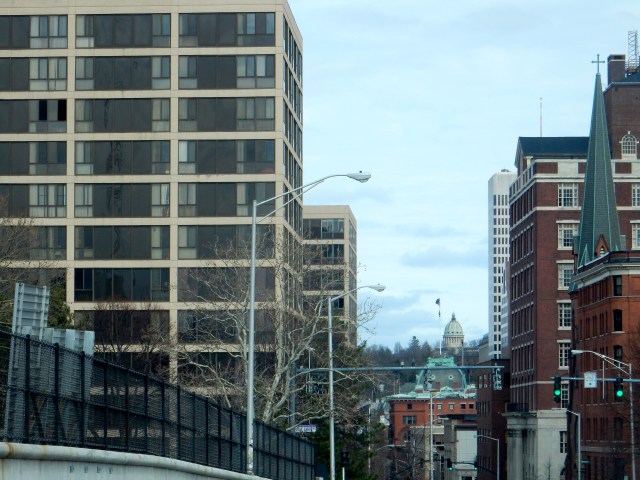
Looking east down Washington Street into downtown. The Regency apartments, a product of 1960s urban renewal, don’t play as big a role in the city view from most perspectives.

Everyone’s filling out their wuddayacallits, the basketball thingies. President Obama did it. Well, Providence is hosting the regional NCAA semifinals, or did so this past weekend, whatever. I’m not sure how the Friars made out, but here are some even longer shots of Providence, which I took on Sunday morning on the way home with my son Billy from lunch at Wes’s Rib House, on the West Side. Yum! Anyhow, I took a picture each time I had to stop the car for a red light or whatever, and here are some of the results.
DSCN0209.JPG

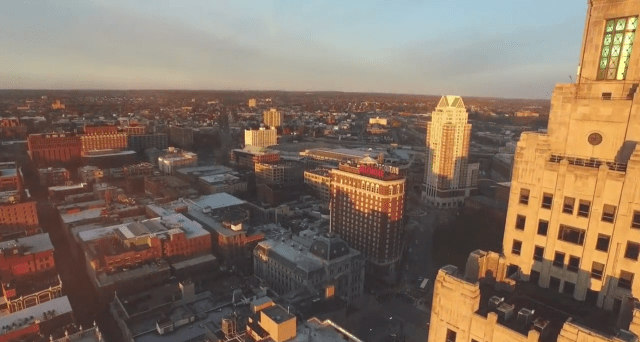
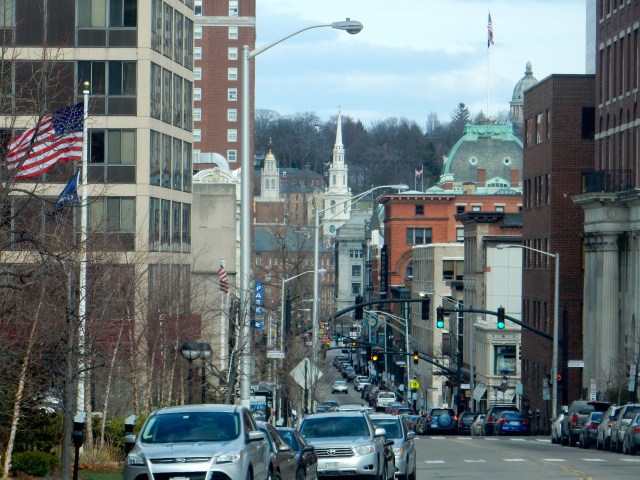
Closer in, you see just a few of the city’s profusion spires, domes and cupolas, and the Biltmore hotel, of brick, that blocks out the Regency in crucial views from the east.

DSCN0212.JPG

Even closer. Ah, that’s better. I was so excited to find the Regency edged out of my frame that my camera must’ve shook a little bit, hence the blur. It wasn’t that I was shooting while driving.
DSCN0215.JPG

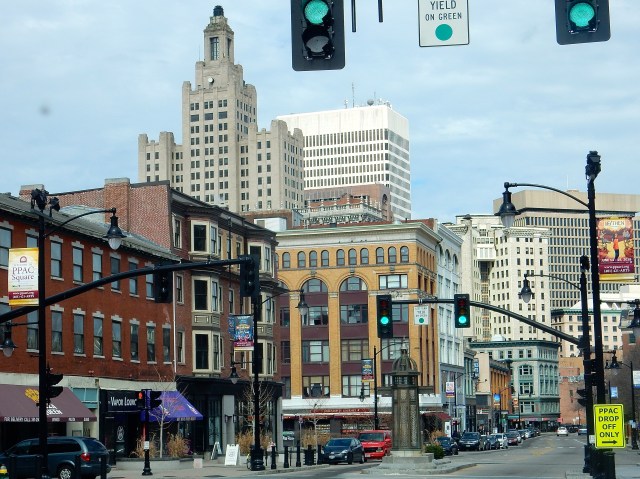
Heading east on Weybosset you see one of the best jumbles of architecture in the city. The Industrial Trust (“Superman”) Building, left of center, is still unoccupied. Any takers?
DSCN0216.JPG

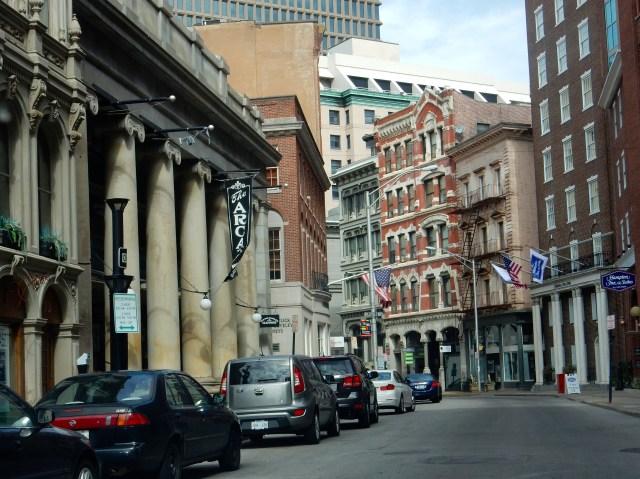
Further east on Weybosset is the curvature of street that won my heart and sold me on living in Providence (in 1984, plus a job offer). The Arcade, America’s oldest mall, is left of center.
DSCN0217.JPG

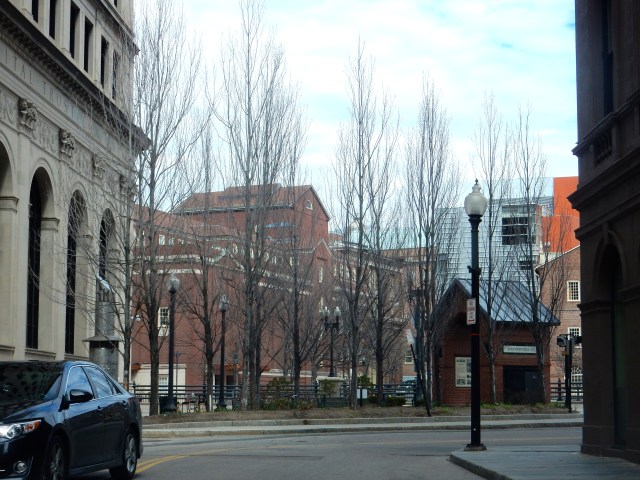
Weybosset meets Westminster just before the Providence River. Beyond, at the base of College Hill, is RISD’s waterfront campus, including the 2007 addition by Rafael Moneo to the RISD Museum.
 

DSCN0218.JPG

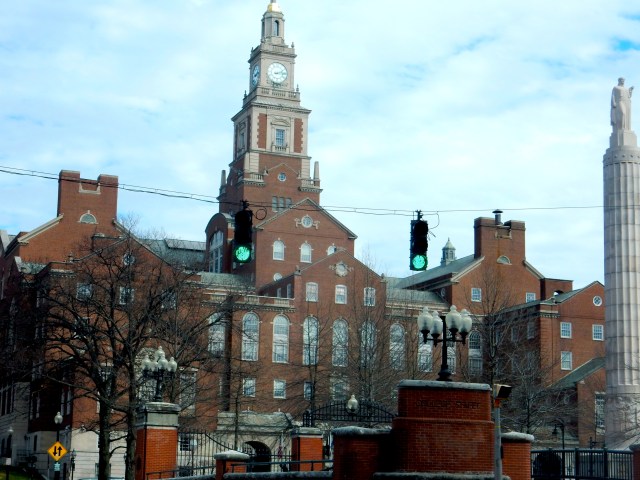
Not a great shot of the Providence County Superior Court, whose design so enthralled H.P. Lovecraft, but this is the view just before you cross the Providence River to College Hill.

DSCN0221.JPG

To the left before chugging uphill: The city and state gave RISD a free waterfront campus, and in return it gave the city Moneo’s addition, which is like a graffartist defacing a da Vinci.
DSCN0219.JPG

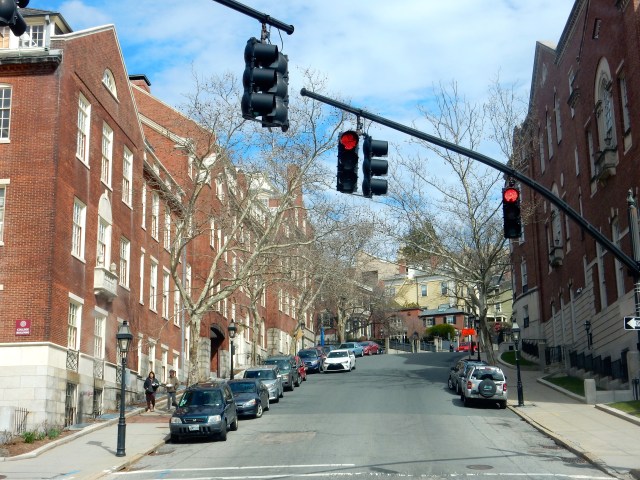
Up College Street toward Brown between delightful brick buildings, RISD’s curving College Edifice at left, and at right the courthouse, possibly the world’s largest Georgian building.
DSCN0225.JPG

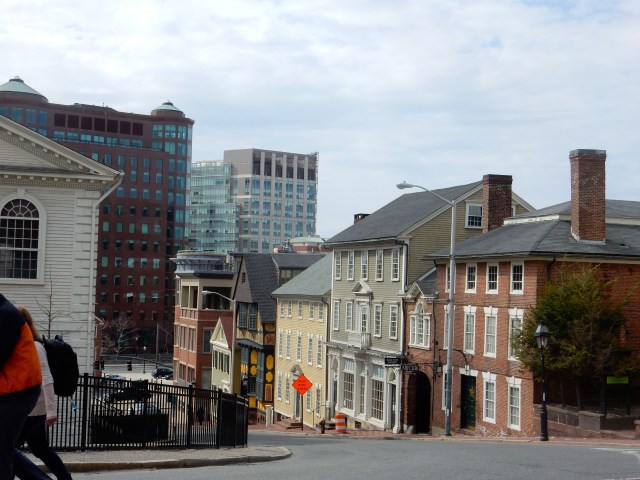
After a left onto Benefit Street you can look back down Angell Street into the city between the nation’s first Baptist church, left, and the buildings of the Providence Art Club, right.
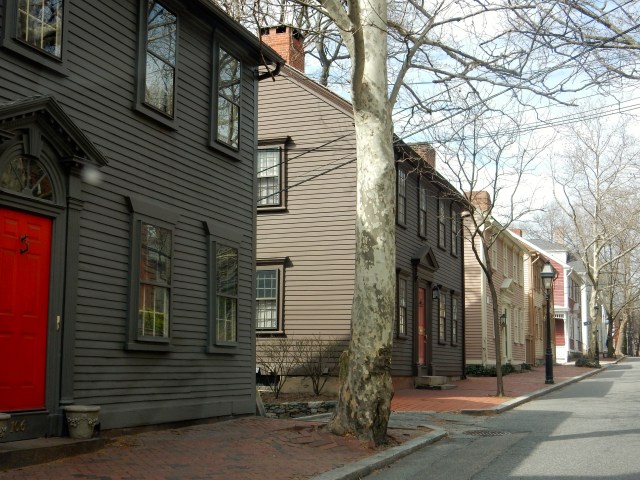
DSCN0227.JPG

Some of the Colonials that line much of the west side of the northern end of Benefit Street, “Providence’s Mile of History,” with almost every variety of traditional building.
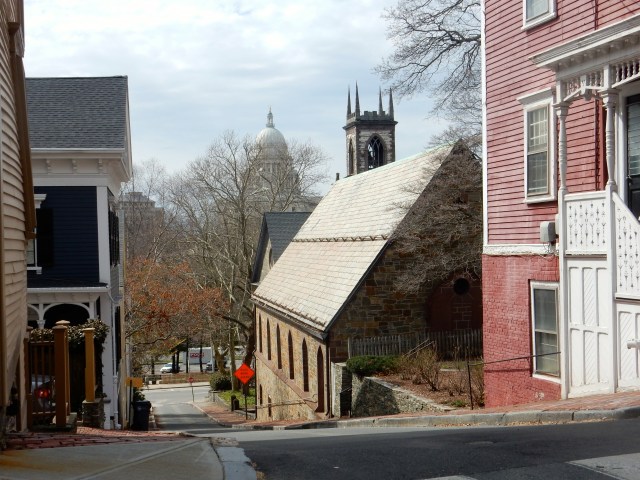
 

DSCN0228.JPG

Looking down Church Street, you see the R.I. State House (1900, McKim Mead & White) in the distance. The red house at right is where Edgar Allan Poe met Sarah Whitman.

I did not try to sanitize these shots by excluding all modernist buildings. But that would be amazingly easy for a discerning and tasteful photographer to do in Providence, which is why it’s such a beautiful city.

Posted in Architecture, Architecture History, Art and design, Landscape Architecture, Photography, Preservation, Providence, Rhode Island, Urbanism and planning | Tagged , , , , , , , , , | 3 Comments

Silence for S.W. Pavilion

Screen Shot 2016-03-21 at 11.33.09 AM.png

Rhode Island Hospital’s Southwest Pavilion. (PPS)

For about an hour tomorrow afternoon may be spent in silence for a good cause – sitting mute at a meeting to save the Southwest Pavilion. This is the oldest survivor from the day when Rhode Island Hospital looked like a place to care for people rather than like a pile of adding machines to tot up the obscene profits of a health industry gone bonkers.

The Zoning Board of Review meeting begins at 4:45 p.m. tomorrow on the first floor of the city’s planning office, 444 Westminster St. That’s the clunky brick building acquired by the city so that its planners could trade down from their old offices in the Caesar Misch Building (1903), across Empire Street, into a Brutalist building that seems to represent the city’s blunted ambition for architecture. (See any design proposed for the I-195 land.)

But that’s neither here nor there. The point is that Rhode Island Hospital seeks to overturn a decision last December by the City Plan Commission that blocked a proposed demolition of the Southwest Pavilion. The hospital’s claim that it can find no use for it is highly dubious. It does not want to find a use for it. It will not say so, but it probably wants eventually to build another new building to further uglify its campus. Why? So that it will seem more in sync with the modern mission of its leadership.

Really? I don’t know. I only know what it looks like.

Hospitals used to be about people – patients, nurses, doctors. Now they are about money. That has been the far from subtle message of its architecture for decades.

I am sure the Providence Preservation Society, which is sponsoring this silent protest, does not see eye-to-eye with my cynicism on this, but the society is against tearing down a building of beauty, which means maybe it is getting back to its original mission.

The public is barred from speaking at this meeting, so a loud silence will reign. You can sign to participate in this sit-in by clicking here.

Posted in Architecture, Architecture History, Art and design, Development, Preservation, Providence, Urbanism and planning | Tagged , , , , , , | Leave a comment

Mehaffy on why we rebuild

Screen Shot 2016-03-20 at 5.07.52 PM.png

After the collapse in 1902 of the Venice Campanile. (buildingfailures.wordpress.com)

A retrograde opinion by a thinker of apparently native good sense can generate a cavalcade of truths from another thinker in response. Thus we have Michael Mehaffy’s response to Duo Dickinson’s curious “Sprinting to the Past,” against the idea of rebuilding Penn Station. Mehaffy notes that humans have long rebuilt beloved buildings snatched away before their time, and then expands the theme:

***

Why we rebuild

by Michael Mehaffy

The [Duo Dickinson] article completely overlooks the question of quality of what came before. I would be all for replacing the original Penn Station with something even better.  (That happened to Grand Central, by the way – what is there now replaced a previous building that was also quite beautiful.)

Screen Shot 2016-03-20 at 5.08.35 PM.png

Consider the Venice Campanile – a structure that dated from the 9th century, with its current appearance dating from the 16th century.  It collapsed in 1902 as the result of a defective foundation. The Venetians were militant about rebuilding it “com’era, dov’era” (as it was, where it was). Most people, including historians, are now very glad that they were.  Interpretive materials satisfy all of the Venice Charter stipulations of “contemporary stamp” (i.e. the history and reconstructions are identifiable and distinguishable to the public).

This is only one example of many others that we now take for granted – including the very idea itself of revival or renaissance, which is nothing other than the rebuilding of previous styles or even buildings. (Jefferson’s reconstructions of Palladio are just one case in point.)

Yet for most people, there is something disquieting about rebuilding of this sort. After all, aren’t we “modern” people, for whom such rebuilding is just somehow “inauthentic” on its face?   After all (as the Modernists argued), the entire world has fundamentally changed forever, thanks to modern technology. Don’t we have to do everything differently now?

Screen Shot 2016-03-20 at 5.21.13 PM.png

Rebuilt by 1912. (easywebsite.net)

This is ex cathedra thinking – a kind of cultish “kool-aid” – more appropriate to marketing a program of industrialization of the human environment than to a serious philosophical discourse. Indeed, one can find little rational basis for such an idea.

Note how Modernist doctrine has been ideologically rabid on this point from the beginning. The CIAM 1933 Athens Charter (drafted by Le Corbusier) stated:

70. The practice of using styles of the past on aesthetic pretexts for new structures erected in historic areas has harmful consequences. Neither the continuation of such practices nor the introduction of such initiatives will be tolerated in any form.

Such methods are contrary to the great lesson of history. Never has a return to the past been recorded, never has man retraced his own steps.

The sheerest nonsense, on its face!  And the sheerest totalizing fanaticism. Yet this ideology is steeped into the thinking of our age, as received orthodoxy and emotional anchor. We have been marketed to, and we must now have the New!  the Improved! Any violation of this received framing causes cognitive dissonance.

So a more radical idea is to challenge this orthodoxy, and to ask if we have not become brainwashed in a very real sense.  (I don’t have time for it here, but yes, I think we have.  We have bought into the fallacy that we can “re-invent ourselves in a new age.”)

By the way, I do agree that technologies will change architecture – and they always have.  The first Greek temples were wood, only later stone – but they largely kept their form.  Glass, steel and lighting produced remarkable embellishments on this same architecture.  Only later were these elements cited as part of a radical formula of tectonic determinism, arguing for a fundamentally altered architecture “of our time.”

***

Michael Mehaffy is a founder of the Sustasis Foundation, in Portland, Ore., an organization devoted to the study how good, livable, workable, sustainable streets and cities are made, and works to carry out its ideas and the good ideas for cities and living conceived by others.

This passage is reprinted from a TradArch email from Michael Mehaffy enlarging on a response by Calder Loth, both of whom wrote against Duo Dickinson’s article against rebuilding Penn Station. I commented on Dickinson’s article in my post “Gird Penn Station’s rebuild” last week.

Screen Shot 2016-03-20 at 5.11.40 PM.png

Canaletto’s painting of the Piazza San Marco, 1723. (wikipedia.org)

Posted in Architecture, Architecture Education, Architecture History, Art and design, Urbanism and planning | Tagged , , , , , , , , , , | 1 Comment

Froma vs. NYT on towers

Screen Shot 2016-03-19 at 12.25.07 PM

E85th St. walkups targeted for tower.

The irrepressible Froma Harrop, my former colleague at the Providence Journal who has started a news/culture website, Silk Stocking, for Manhattan’s Upper East Side, has taken on the New York Times. Taking aim at its editorial of March 11, “Saving a Mixed-Income New York,” Froma condemns Mayor de Blasio’s housing policy: megatowers for the rich stomping on neighborhoods where regular families can still (just barely) afford to live. Read “Clueless: NYT backs de Blasio’s building scheme,” which links to the Times editorial. Her site also links to my post on rebuilding Penn Station, which she supports.

Posted in Architecture, Art and design, Development, Preservation, Urbanism and planning | Tagged , , , , , , , , | 3 Comments

VidSmartRI on Providence

Screen Shot 2016-03-18 at 7.59.13 PM copy.png

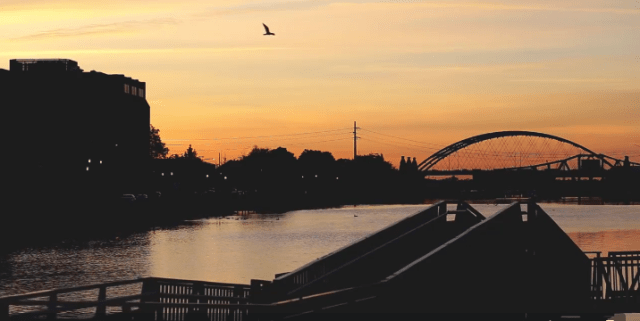
Grow Smart Rhode Island has produced a short video, “PVD: Personality. Vitality. Distinction,” about the charms of the Ocean State’s capital city. It begins looking downriver along the Providence from an abandoned water taxi stop near the new Crawford Street Bridge. In the foreground the ramp’s peak is backgrounded by the hump of the Point Street Bridge and the arch of the William D. Warner Memorial Bridge (what the Iway bridge should be named). The scene, with gull awing, is awash in a pink sunset.

This sort of lovely cinematography bathes the film in a glow that epitomizes the beauty that is a large part of what makes Rhode Island and its capital so attractive. Providence’s architectural heritage plays a major role in the film. It was upon this heritage that the late Bill Warner erected the design of the waterfront, key to the many “best city” awards Providence has won in recent years. (The list in the video only cracks the surface.) Urbanist Richard Florida has said that cities with character are places where the young and the hip (“Millennials”) want to be, where the old and established (“Perennials”) can find joy in what the young and hip have brought to town. Providence’s status as a mecca for the tech-savvy is amply illustrated in the video.

Yes, the GTECH building is caught looming up, threatening all that makes Providence lovable, but then it goes away. Joy and beauty return.

“PVD: Personality. Vitality. Distinction” is the motto. Very good!

The claim that Providence has never been more alive can be debated, but only by historians. It is certainly alive today, with ample room for growth. How WaterFire, the city’s signature artistic triumph, was omitted beggars the imagination – the shot of a gondola may be an allusion to the waterfront festival every two weeks or so from spring into fall. Still, the city’s edgy artistic life takes center stage nevertheless.

This is not your father’s civic promo. An oddly downcast voice narrates the film, reciting its story in a poetic tenor that comes off surprisingly upbeat in a way that the more knowing will understand. The video is a good example of film noir as the cinema of happiness. There is a lot of grit in the video, but it does nothing to soil the optimism that it portrays. The people in the film have faces that are wreathed in pleasure.

Consciously or unconsciously, the videographer focused on how Providence’s historic architecture is at the heart of its vital character. With that one exception of the alien GTECH, most of the backdrops spread old buildings before our eyes. With no attempt to pretty them up for the camera, they make an important point with aesthetic force. Bill Warner understood that to perfection when he designed a new waterfront styled to help the city ride into its future saddled on the loveliness of its past.

That is why the city and state should rethink the designs proposed for the area to be revitalized in the wake of the relocation of Route 195. That, too, was the work, largely, of Bill Warner. If the new section of town is decked out in glass boxes with faux creative swirls, an opportunity to build on the city’s strengths will have been lost. But if “personality, vitality and distinction” are truly PVD, a more beautiful and forward-looking plan will prevail.

Grow Smart Rhode Island deserves applause for expressing in a mere three minutes a profound understanding of Providence – how its past, intelligently reinterpreted, can be the animating force of its future. Thus only can it keep its status as a unique city and avoid sliding into the all-too-typical sterile miasmic parody of the city in Ridley Scott’s Blade Runner.

Screen Shot 2016-03-19 at 10.18.05 AM.png

Posted in Architects, Architecture, Architecture History, Art and design, Development, I-195 Redevelopment District, Providence, Rhode Island, Urbanism and planning, Video | Tagged , , , , , , , , , | Leave a comment

Please hit ‘follow’ for blog

DSCN0202 - Version 2The gatekeepers are still trying to frog-march my blog out of your inbox. I have not sent forth this reminder for a while. Until my email server quits intercepting my bulk posts under the (false) suspicion that they are spam, hitting “Follow” in the right margin of my blog is the best way to get my regular posts again. Those who get it on social media or who are on the TradArch or Pro-Urb listservs have been getting them because they are sent a different way. I’ve tried to get help to solve this problem but so far without success.

Posted in Architecture, Humor | Tagged , , , , , , | 1 Comment

Breuer Whitney/Met Breuer

Screen Shot 2016-03-18 at 1.17.35 PM.png

The Met Breuer, formerly the Whitney Museum of American Art. (Met)

The Met Breuer opened today. It is the Brutalist building that the Whitney Museum of American Art left before moving last year into a building designed for it by Renzo Piano in New York’s Meatpacking District. The Metropolitan Museum of Art has leased the old Whitney – designed by Hungarian architect Marcel Breuer and opened in 1966 – for eight years.

My former Providence Journal colleague, the syndicated columnist Froma Harrop, asked me to write about this for her elegant new news/culture site, Silkstocking.NYC, mainly about the Upper East Side, where the old Whitney sits on Madison Avenue. Here is the second paragraph of my piece for Froma, “Breuer’s Whitney to Met’s Breuer.” (Click to read the whole thing.)

Rarely has any building better epitomized “form follows function” than the old Whitney. It was designed by Bauhaus-trained architect Marcel Breuer (pronounced BROY-er) precisely to hold modern art. It’s difficult to imagine the Met exiling any of its vast collection of traditional art to the Met Breuer’s cold confines. So perhaps the building really cries “function follows form.” Like so many works of modern art and architecture (and their slogans), you can turn it any which way without affecting its ability to do its job.

“It’s ability to do its job.” I tried to be gentle with the building. It was built to resist the Met’s former longstanding arm’s-length, hand’s-off – okay, let’s say cool, though some will insist hostile is the more accurate word – attitude toward modern art. In my opinion, Beuer’s building sticks out like a sore thumb, and putting part of the Met’s collection of modern art there won’t soften its impact on the famous streetscape. Froma used a shot of it upside down with her social media versions of my blog post. But at least the old Whitney’s façade is not boring like its rival, the Museum of Modern Art.

Screen Shot 2016-03-18 at 2.55.20 PM

American Folk Art Museum, left. (hyperallergenic.com)

MoMA recently demolished an iconic modernist building attached to its hip – the American Folk Art Museum – designed by Tod Williams and Billie Tsien. It went backrupt and their building was bought by MoMA, which recently tore it down – to the howls of le tout modernism. My take on this was giddy: Let’s you and him fight!” To make matters worse, the demo makes way for an addition by the the rising starchitectural firm of Diller Scofidio + Renfro – yes, the very same “Dildo Scrofulous + Rent-free” who designed Brown University’s Granoff Center for the Creative Arts. It opened in 2013 looking for all the world like an accordion being struck by an earthquake. In fact, the new Granoff looks like what the old Whitney might look like if it had been designed by Mies.

So click on my “Breuer’s Whitney to Met’s Breuer,” and then explore the rest of Froma’s enticing new site.

(Here is the New York Times’s summary of the Met Breuer, “Becoming Modern: The Met’s Mission at the Breuer Building.” Becoming modern”? Odd way to put it.)

Screen Shot 2016-03-18 at 2.50.32 PM.png

Brown’s Granoff Center for the Creative Arts. (mitchellcenterforthearts.org)

Posted in Architects, Architecture, Architecture Education, Architecture History, Art and design, Development, Preservation, Urbanism and planning | Tagged , , , , , , , , | 5 Comments

Gird Penn Station’s rebuild

Screen Shot 2016-03-17 at 8.34.37 AM.png

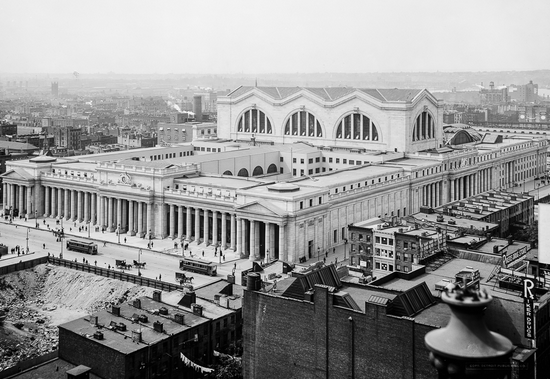
Pennsylvania Station, 1910-1963. (mashable.com)

Connecticut architect Duo Dickinson, who writes regularly on architecture, often critical of modernism, has just written “Sprinting to the Past” in Common/Edge. He rails against Brooklyn architect Richard Cameron’s proposal to rebuild Penn Station as Charles Follen McKim designed it in the years leading up to its completion in 1910. Its demolition in 1963 was a mistake, perhaps the worst in New York City’s long history.

He describes the project, recently the subject of National Civic Art Society president Justin Shubow’s column in Forbes, as “Xeroxing nostalgia.” Restoration would be

a statement of extreme veneration based solely on aesthetics: Resurrection reanimates, it creates the living dead: it takes creativity off the table as a design criteria. Adaptation can be creative: but in the straightjacket of a deadly defined husk it’s all problem-solving and engineering—it begs all questions of reflecting the here and now, let alone offering up innovation.

First let’s understand that nobody has proposed to rebuild the station exactly as it was originally designed. Cameron has not proposed, as Dickinson charges, to “literally 3D print a clone” of the building. It will be filled with modern amenities, such as 21st century engineering and shopping malls. Dickinson seems to believe that rebuilding Penn Station is being conceived as some sort of template for all future design, that every new building should look like some old building. Leaving aside that McKim’s precedent was not, as Dickinson writes, a Roman temple but a Roman public baths, that is patently absurd. Rebuilding Penn Station would be a one-off.

Dickinson’s stock modernist cant about innovation is the old “of its time” hooey decked out in creativity blather. The flaws inherent in that reasoning are too well known to be rehearsed here. What does our era, this moment in history, say of how today’s buildings should look? Not very much. Our era, most would say, is violent and barbaric. So has the Bjarke Ingels Group (BIG) really put its finger on something crucial in its proposed redesign of 2 Penn Plaza? The tower next to Madison Square Garden atop Penn Station seems to be exploding and crashing down on it. Brilliant. This is all we need.

Architecture today seems to want to reflect rather than heal the ills of our time. Those who want to rebuild Penn Station want to correct an error New York City made half a century ago.

Cameron’s grand proposal, as described by Clem Labine in Traditional Building, aims not just to correct a mistake by rebuilding the station as it was, but to reconstitute a famously tedious precinct of Midtown Manhattan into a transit hub and commercial mecca. Its popularity would help stoke the area’s financial revival as a strategy for funding its improvement. That’s doing more than “creating the living dead,” and there’s plenty of precedent in New York and elsewhere for its success.

Before signing off here, let’s consider that bit about new buildings all looking like old buildings. Not like specific old buildings but as if they were built according to classical and traditional principles that had characterized all architecture for two millennia. The fact is that there is far more diversity, building to building, in this old set of styles and its product than in the modern architecture that preens so absurdly on its creativity and innovation. It is no wonder: Modernism has purged architecture of most of the tools in its design toolbox that are useful to differentiate one building from another. There is little real diversity in modern architecture. To find it, modernists must resort to increasingly ridiculous exercises in aesthetic oneupmanship. Rebuilding Penn Station as McKim designed it would, arguably, bring some real diversity, some real beauty, some real joy back into “our era,” and back into Midtown. Why is Duo Dickinson against that?

Screen Shot 2016-03-17 at 7.29.23 AM.png

Proposed renovation of 2 Penn Plaza. (BIG)

Posted in Architects, Architecture, Architecture Education, Architecture History, Art and design, Development, Preservation, Urbanism and planning | Tagged , , , , , , | 3 Comments

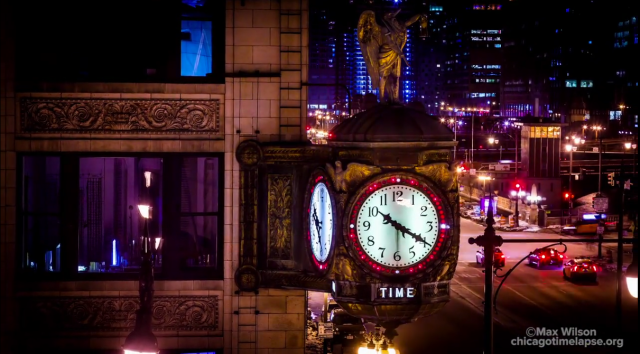
Video: ‘Windy City Nights’

Screen Shot 2016-03-15 at 3.27.57 PM.png

Screenshot from “Chicago: Windy City Nights.”

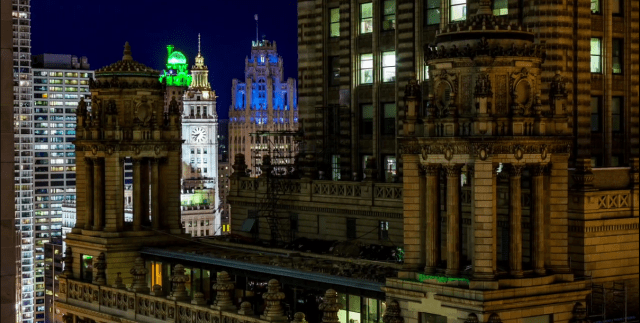
This splendid video from Vimeo by Max Wilson of chicagotimelapse.org, called “Chicago: Windy City Nights,” shows off Chicago in much (if not all) of its glory. Chicago is the city of my birth and is considered a mecca amongst architects, mostly for its modern architecture. This video focuses not on that, or on the city’s excellent classical architecture, but on the city’s skyline and grid of streets in night-time time-lapse photography stitched together as if it were a film. It shows a lot of traffic – streets lit up by street lamps but also etched in the headlights and brake lights of traffic. It shows a lot of clouds rushing by in the sky. The moon proceeds faster than usual. Some buildings are distant, some in a middle view. All are shown as collections. Get closer to the city and its buildings and you will find the good, the bad and the ugly is more truly in your face. Mostly it’s the traditional buildings of the Windy City that get the close-ups. Such an experience is not a happy one for modern architecture, even the occasional fine modernist buildings such as are on tap in the Windy City. Close up, classical architecture wins hands down. The vid should have shown more of the classical skyscrapers near where Michigan Avenue crosses the Chicago River. Modern architecture is hardly given any close ups at all in this video, because Max Wilson seems to understand that modernism’s sweet spot is as seen from a distance – a skyline, a jumble of rising glass-scapes. Too bad people cannot zoom around in the sky to be blessed with the best of modernism. No, we must see it from ground level, where its oppressive sterility smacks us upside the head. Luckily, “Chicago, Windy City Nights” is not guilty of inflicting that punishment on its viewers. It won the 2015 Emmy for outstanding achievement in photography. It is a real trip. Watch it!

Hats off (by hand not gust) to Lewis Dana for sending this fine video to me.

Screen Shot 2016-03-15 at 3.24.05 PM.png

Screen Shot 2016-03-15 at 3.27.08 PM.png

Posted in Architecture, Architecture History, Art and design, Photography, Urbanism and planning, Video | Tagged , , , , , | Leave a comment

What in blazes is that!?

Screen Shot 2016-03-13 at 9.53.23 PM.png

Huh? (Photo by Cliff Vanover)

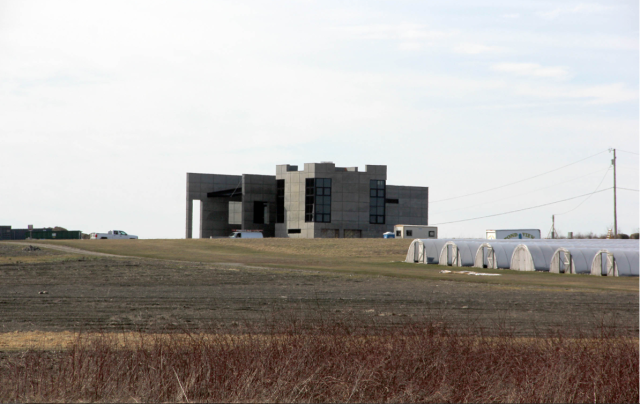
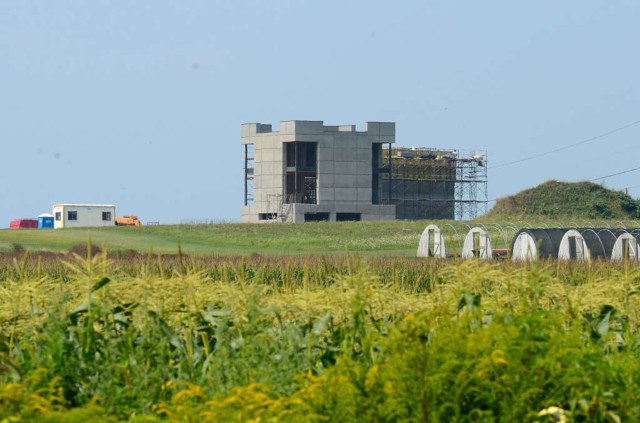
My friend and mapmeister Cliff Vanover sent me the above photo of … heck if I know! He says it sits in Little Compton – Little Compton! – just west of Route 77 near the entrance to the Sakonnet Vineyards, once Rhode Island’s vintner extraordinaire, but, after falling on hard times, bought by Alex & Ani, the lifestyle conglomerate that seems to be gobbling up the state. Today the Sakonnet Vineyards! Tomorrow, the world! Now called Carolyn’s Sakonnet Vineyards, it may for all I know still be producing drinkable wines.

But what’s that across the road? Does Carolyn realize that alien forces are marshaling against her tidy little field of grapes? Or maybe not. Maybe it is just the residence of a standard-issue sado-masochist. On the other hand, look at all those trucks. Either the aliens are moving in or the place is some sort of commercial operation. But of what sort? Or maybe it is a nonprofit, or a philanthropic institute, some outfit run by a nut with a world-class artist-wannabe complex? Or maybe it is the new addition to a genteel art museum waiting to be helicoptered into place. Those seem to be Quonset huts nearby. What does that mean? In this day and age even such a hulk can hardly be a bomb shelter. Maybe Donald Trump’s proposed relocation of Area 51 to the Ocean State has already been accomplished.

What sort of person would inflict such an abomination on beautiful Rhode Island? And what sort of county permitting commission would permit it?

Later today arrives the answer: “Concrete ‘Castle’ Turns Heads in Little Compton,” by EastBayRI.com, published last September. It is a house. Local building official Bill Moore says he gets a call a day about it. It is rumored to have been designed by Providence architect Friedrich St. Florian, famous for Providence Place and the National World War II Memorial, in Washington. I hope not! It is owned, according to eastbayri.com, by Domenic and Laurie Carcieri. Have they no shame?

20160212093925-07f6-eastbayri56be975d7b349.jpg

Home of Domefic and Laurie Carcieri. (eastbayri.com)

Posted in Architecture, Art and design, Development, Humor, Landscape Architecture | Tagged , , , , , , , , , | 6 Comments