I’ll second that emotion!

Screen Shot 2016-04-12 at 8.55.22 PM.png

archofthecapit.png

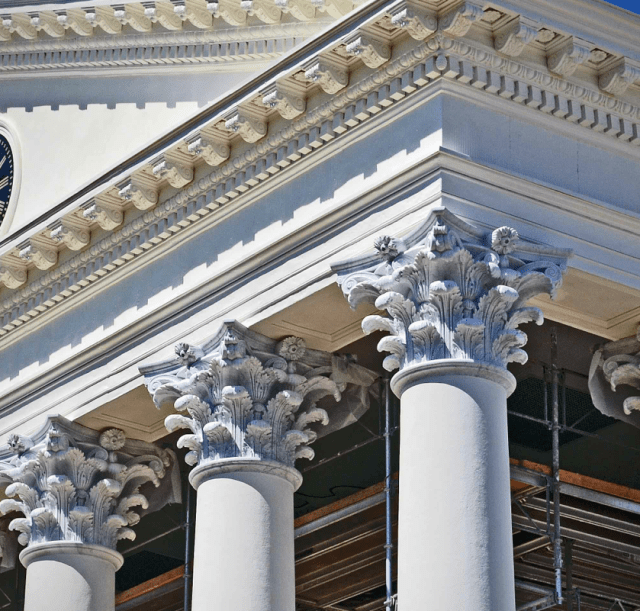
Corn capital in the U.S. Capitol. (Architect of the Capitol)

The collection of parents who wait for their kids’ school bus every morning and afternoon at our corner on Hope Street testifies to the greatness of the Vartan Gregorian Elementary School in Fox Point. This afternoon the line “I’ll second that emotion” was heard, and a reference to its origin followed as day follows the night. Technically, “second that emotion” is a pun on “second that motion.” I drop it into every conversation I have. By now more people are familiar with Smokey Robinson and the Miracles’ “second that emotion” than the “second that motion” of Robert’s Rules of Order – how many folks nowadays attend committee meetings, after all!

So what does that have to do with architecture? Well, glad you asked that. A pun is sort of like a visual twist on a conventional detail of ornament. Benjamin Henry Latrobe’s corn capital atop columns inside the U.S. Capitol – with corn replacing the Corinthian capital’s acanthus leaves – is one of the most famous architectural puns. The first person to substitute “motion” with “emotion” – Smokey Robinson, I suppose, or his lyricist – was using a supple sensibility to add ornamental humor to the language, just like a great architect occasionally does in designing a building.

Posted in Architecture, Art and design, Books and Culture, Humor, Video | Tagged , , , , , , , , , , , | 5 Comments

The politics of preservation

Screen Shot 2016-04-11 at 5.00.20 PM.png

The completed Cherry house, in Raleigh, N.C. (newsobserver.com)

Gail Wiesner is a real-estate agent in Raleigh, N.C., who, a couple years ago, raised concerns about a modernist addition to a neighbor’s house in her Oakwood neighborhood, a designated historic district. A more recent example, now resolved in court, inspired her to send to the TradArch list an email about Raleigh’s preservationist environment.

Proponents of modern architecture, including architecture firms, have gained significant influence in Raleigh’s development world over the last ten years or so, including an increased presence within the historic commission.

Three years ago the historic district commission voted to approve a  major Corten steel addition to a small historic cottage. The architect was on the approval committee. He recused himself, but the committee was peopled with modernists by then.

We preservationists became alarmed. When a second modernist project came up a few months later, we were ready and presented our points as to how the house failed to meet the architectural guidelines. However, the committee approved it. I appealed. I have been in court ever since. The owner/builder, himself a modernist architect, and the city, are my opposition.  Modernist supporters have been very aggressive but factually inaccurate in their efforts to sway public opinion.

We also asked for a review of the guidelines. It almost backfired as the developers packed a public hearing with their employees. Fortunately, we prevailed, as the majority of the citizens at the hearing – not all preservationists – stated that they preferred traditional architecture and preserving older neighborhoods.

Oddly enough, my husband and I both like modernist architecture very much, but this bullying and shaming of others into thinking you are not one of the “cool kids” unless you worship the style is not acceptable.

A couple of years ago, in my post “This old neighborhood,” I discussed the new modernist house Wiesner opposed. Opponents of the house designed and built by the Cherrys had been unfairly attacked by critic Paul Goldberger in an article that had trotted out all of the purposeful misconceptions that modernists rely on in circumstances such as this. Those misconceptions are enforced as status quo by tactics such as the ones Wiesner describes above.

In the Cherry case, the historic district commission approved the proposed house, apparently disregarding its own regulations. Its approval was overturned, and that was appealed. This past February, a Tar Heel appeals judge ruled, appropriately, that the Cherrys should not be punished just because the historic district officials made a mistake.

According to the Charlotte News & Observer in “Oakwood modernist house backed by NC Court of Appeals,” the court ruled against Wiesner because her objection to the Cherry house was “essentially aesthetic.” Well, duh! Yet the news story said the court found nothing amiss in the district commission’s error of judgment. Instead, ruled the judge, “even if [Wiesner] is correct in her assessment of the [Cherry] house’s design, respondent has failed to show that she is an ‘aggrieved party.’”

Something smells fishy in all this. Either the judge or the reporter was confused about the principles involved in the case – or the basis of the ruling is perfectly clear to them, but the Cherrys and the architecture media elite don’t want anyone to know the real reason, in law, why the Cherrys don’t have to tear down their new house. Better for it to be seen as a victory on behalf of the “right” to build a modernist house in a traditional historic neighborhood. That, of course, would eviscerate the legal basis for historic district zoning across the nation, which is exactly what modernists arrayed behind the Cherry’s goofy-looking house intend.

Indeed, many of Wiesner’s observations dovetail with my experiences covering architecture, preservation and development here in Providence. Modernists deploy misleading ideas about freedom and creativity to denigrate people who oppose architecture that erodes the beauty – and hence property values – of historic districts. Families invest their money where they have chosen to live, often for aesthetic reasons, and have a right to fight against threats to its most lovable attributes.

Those families have as much right to try to protect their neighborhood’s character as families with modernist taste have to express their “freedom” by ruining it. And their taste is no more “creative” than the art of the craftsmen who produced the character of the neighborhood in the first place.

Homeowners such as the Cherrys do have a right to try to impose their own aesthetic on those districts, but if the laws and guidelines that create historic districts are to have any meaning, then the boards and commissions that oversee them must pay scrupulous attention to the wording of applicable laws. Often, as described by Wiesner and as evident in the Cherry case, that is not the case. This, too, is politics. Local zoning is where the rubber of our representative democracy meets the road.

What that means is that neighborhoods must fight to protect their values. Alas, depending on our elected representatives to do the right thing, and on members of the establishment design media to report a story objectively, is usually not enough. People like Wiesner and her allies must hold the feet of politicians, the bureaucrats and the media to the fire.

This is precisely what she has done, and in the process she has strengthened the guidelines both legally and politically. For the modernists gnawing away at the rules that protect traditional architecture in a historic district, the Cherry case has turned out to be the definition of a Pyrrhic victory.

As Gail Wiesner’s observations suggest, the preservation movement has been taken over by professionals who sympathize with the anti-preservationist goals of most modernist architects. If the dues-paying members of and donors to preservationist organizations were aware of what many staff think preservation is all about – Providence Preservation Society, call your office! – there would be a massive flight of membership from such societies.

Posted in Architects, Architecture, Architecture Education, Architecture History, Art and design, Development, Preservation, Providence, Rhode Island, Urbanism and planning | Tagged , , , , , , , , , , | Leave a comment

John King, read your words!

Screen Shot 2016-04-10 at 8.31.46 AM.png

New LinkedIn building in San Francisco. Caption: “We’ll let you pick out which one it is.” (John King)

John King is the architecture critic for the San Francisco Chronicle. I met him maybe a decade ago at a conference and have followed his criticism since. This latest piece, “SF skyline’s new LinkedIn addition built by, for New Yorkers,” about a new building near the S.F. financial district, is excellent, among his best, filled with insight about this ugly building and how it affects the rise and fall of its neighborhood. I was so moved that I left a comment:

John, an excellent assessment of how this LinkedIn building affects its setting. But the same can be written about almost any modernist building inserted into a reasonably nice setting – only an already failed setting would fail to be hurt by this building or any of its hundreds of thousands of mates. However well designed, they reduce rather than improve the quality of any environment that people love. Please take what you have written and try to understand how much more widely it applies to the world of architecture than this one building.

The problem is not, as King says, that this building was designed and built by New Yorkers who do not understand San Francisco. The problem is that this is a building built by modernists who do not understand cities anywhere. It’s not that cities should not evolve; of course they should. But change ought to imply improvement. This is not rocket science.

Almost every architecture critic who takes the “it’s not the style, it’s the quality of the design” line has written one or two articles that are intended to establish their objectivity. They find a modernist building they are pleased as punch to denounce – but do not realize how widely their critique applies to modern architecture as a whole. I wish they would take their own words to heart.

Posted in Architects, Architecture, Architecture Education, Architecture History, Art and design, Development, Urbanism and planning | Tagged , , , , , , , , | 1 Comment

Shubow to speak in Boston

Screen Shot 2016-04-09 at 11.46.35 AM.png

Three of 20 newly installed Carrara marble capitals at Jefferson’s Rotunda, UVa. (Calder Loth)

Justin Shubow, president of the National Civic Art Society and a leading proponent of classical architecture, is also a leading opponent of modern architecture. He and his organization, along with the Eisenhower family, have led the fight against Frank Gehry’s design for a memorial to Ike. The NCAS overlaps in its mission with the mission of the Institute of Classical Architecture & Art, whose New England chapter has invited Shubow to speak at its Bulfinch Awards ceremony at 1 p.m. in the Algonquin Club on Saturday, April 23.

In his lecture, Shubow is expected to address the broader significance, with an eye to his opposition to the Gehry Ike, of architecture and its influence on national character. Whereas modern architecture reflects the bureaucratic state and its disregard for the individual, classical architecture reflects the grandeur of a national polity that exalts the free individual as the apotheosis of the rule of law. I would be surprised if Shubow does not take that line of thinking. As Gehry might say, it’s just warmed-over Jefferson.

The fight against the Gehry memorial has almost been won. Congress has refused to pass construction funding for three straight years. The Eisenhower Memorial Commission, which chose Gehry in a dubious competition process, has had to fall back on retired Sen. Bob Dole, of Kansas, to raise the funds privately. Maybe he will have more success than the commission by itself. Its fundraising campaign in recent years raised less than it cost to hire the firm to raise funds. It seems that while the commission still has enough money to maintain offices and pay staff, the memorial itself is on life support.

That’s the latest, and I hope Shubow will give us some more insider tidbits. But of even more interest is whether he will map out a strategy to return classical architecture to its former authority, not only as the architecture Jefferson chose to represent the ideals of democracy, but as the default architecture for the civic realm in the nation’s capital and throughout the country. It is the architecture that the public prefers, and in a democracy that is (or should be) no small beer.

Shubow and his organization have been sneered at by conventional architecture critics from Paul Goldberger on down. He wears this disdain as a feather in his cap, and rightly so. He has spoken before Congress about how Washington should re-embrace classicism, and I expect his lecture will be equally thoughtful and inspiring.

Reservations for the lecture can be made here. Reservations for the gala to celebrate the 2016 Bulfinch Awards laureates, to be held at the Harvard Club just up Commonwealth Avenue from the Algonquin Club, starting at 6 p.m. that evening, can be made here.


Posted in Architects, Architecture, Architecture Education, Architecture History, Art and design, Preservation, Urbanism and planning | Tagged , , , , , , , , , | Leave a comment

The periodic table of fonts

Screen Shot 2016-04-08 at 7.32.35 PM.png

Here, from a stable of tables courtesy of the Kuriositas website of oddities, is a periodic table of typefaces. This periodic table comes last in “Fun and Interesting Periodic Table Spin-Offs,” courtesy of the Save Best for Last Dept. A periodic table of fonts is doubly intriguing because a period table looks a little bit like a typewriter keyboard, adding a twist to the fun. Of course, unlike the letters of the alphabet, I am prejudiced against the sans-serif typefaces. But here is some of the thinking behind this table:

Like traditional periodic tables, families and classes of typefaces are grouped: script, sans-serif, realist, blackletter and more.  They are also given a ranking depending on the number of lists the typeface appeared on.  Interestingly, the creator’s favorites receive a special ranking on the table.

The table was created by Cam Wilde, whose favorites I am unable to grok because I do not understand a periodic table, not even the periodic table of the elements, which we all memorized in, what, seventh grade? I suppose the places of the most notable elements are where Wilde has placed his favorite fonts. Someone will have to decipher that for me.

The other periodic table parodies that appear before the typeface one are, in order from the top: Periodic Table of the Elements (with cartoon symbols), of Alcohol, of Wine Grape Varietals, of Herbs and Spices, and the Periodic Table of Game Controllers (the patterns of the buttons on remotes for Playstation, Nintendo, etc., can be grouped intelligently, it seems). They all have a degree of fun for various types of people – different strokes for different folks, ya know – who can probably also be grouped in a funny periodic table.

Visit, and know that you can bump up the size of the periodic tables on the site so that the fine print is readable.

Posted in Architecture, Art and design, Books and Culture, Humor | Tagged , , , , , , , , , | 3 Comments

Save Peter Pan’s birthplace

Screen Shot 2016-04-07 at 9.53.53 PM.png

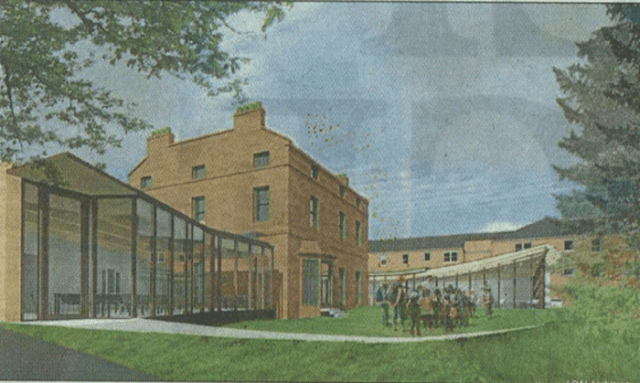
Moat Brae after the restoration phase of its proposed renovation. (Scots Magazine)

Moat Brae survives. Moat Brae is the 1823 house and garden in Dumfries, Scotland, where J.M. Barrie, age 8 in 1868 and playing at pirates, conceived Neverland, the land of eternal childhood. That’s the good news. Moat Brae lives – for now.

The bad news is that for two years the Peter Pan Moat Brae Trust’s board of directors, after restoring the house, has tinkered with undoing that good work. They want to build two modernist additions to contain a National Centre for Children’s Literature – at the cost of trashing the house and destroying the possibility of ever restoring the garden.

How Moat Brae has managed to hold out this long I do not know, but opponents of this crime against childhood dreams hope to convince the board to change its plans and instead build a more sensitive addition to house its program. Luke Moloney, chairman of the Dumfries Historic Building Trust and a leading opponent, asked the trust to embrace a more fitting plan but was told that such a proposal would be “pastiche” – a derisive modernist word for imitative – and thus out of the questions.

Two years ago I devoted a column, “Help save history and Peter Pan,” to Moat Brae and a similarly threatened treasure – Winchester, the original capital of England. Winchester’s citizens have fought a crudely inept development in court and on the hustings for two years. Now, in Dumfries, citizens who would save Moat Brae are calling on those around the world who remember growing up with Peter Pan to sign a letter to the trust pleading for a last-minute reprieve for Moat Brae and the garden that inspired Neverland.

To sign the letter by Roger Windsor, who started the trust, lost control of it after ensuring the preservation of the house and now leads the opposition to its desecration, email him at peterpangarden@aol.com.

Screen Shot 2016-04-07 at 10.00.16 PM.png

Proposed additions, second phase of Moat Brae renovation. (Dumfries Courier April 1, 2016)

Posted in Architecture, Architecture History, Art and design, Development, Other countries, Preservation | Tagged , , , , , , , , , , , | 2 Comments

Ross Award laureates, 2016

CAYALÁ.jpg

The new city of Cayala, in Guatemala. (Vicente Aguirre)

This year’s winners of the Arthur Ross Awards have been announced by their sponsor, the Institute of Classical Architecture & Art. The institute is the leading organization in the United States fostering classical and traditional architecture and its allied arts: sculpture, painting and landscape design. The awards program, named for the noted philanthropist, advocate of classicism and longtime supporter of the ICAA, was founded in 1982. This year marks the 35th round of Ross laureates in classicism.

After last year’s 34th round, some modernist wags applauded the awardees’ work snarkily as both classical and innovative, as if that were some sort of contradiction in terms, suggesting that the Ross jury had ventured out on a limb. Isn’t creativity modernism’s gig? In fact, classicism evokes a far more genuine and humane creativity, not to mention more lovely, and has done so for some 3,000 years. Vitruvius himself was quite famously unslavish to his own principles. Even those who adhere most closely to the classical orders are avatars of innovation, as the orders themselves are above all a fount of “ordered” creativity. That is true of this year’s winners no more and no less than last year’s or any other year’s winners.

Duncan_Stroik_Thomas_Aquinas_College_Chapel.png

Duncan Stroik: Aquinas College Chapel, Grand Rapids, Mich. (Stephen Schafer)

SCAD_Eckburg.jpg

Eckburg Hall, SCAD, Savannah, Ga. (SCAD)

CAYALÁ.jpg

Paseo Cayala, Ciudad Cayala. (Vicente Aguirre)

Robert_AM_Stern.jpg

Robert A.M. Stern at Yale. (RAMSA)

Anne_Day.png

Anne Day: Lobby, New York Public Library. (From cover of “The Architecture and Decoration of the Stephen A. Schwarzman Building,” by Henry Hope Reed and Francis Morrone)

Here are this year’s five laureates:

  • Duncan Stroik, in Architecture, in the ICAA’s words: “Duncan G. Stroik’s work utilizes hand drawing, full-scale details, and watercolor renderings, as well as close collaboration with painters, sculptors, and other craftsmen. His work as an architect and professor exemplifies the principles of classical architecture and ecclesiastical design.”
  • Robert A.M. Stern, in Education: “Robert A.M. Stern’s decades of teaching and his embrace of plurality in architectural education have tremendously advanced the causes of classical and traditional architecture and urbanism. No one has done more to enlarge the possibilities of architecture in the 21st century.”
  • Paula Wallace and SCAD, in Stewardship: “Under Paula Wallace’s visionary leadership, the Savannah College of Art and Design (SCAD) revived the city of Savannah through the adaptive reuse of historic buildings and a reinvention of campus planning, using the city itself as a campus that instructs and inspires. Paula Wallace’s SCAD is the urban equivalent of Thomas Jefferson’s lawn.”
  • Ciudad Cayalá, Guatemala, in Civic Design: “At the new town of Cayalá in Guatemala, mixed-use and programmatically tuned architectural variety has laid the foundation for a robust, emerging public realm. Ciudad Cayalá was brought to fruition by the Town Architects of Cayalá, Maria Fernanda Sánchez and Pedro Pablo Godoy of Estudio Urbano; as well as architect and urban planner Léon Krier; and the Leal family, led by developer Hector Leal.”
  • Anne Day, in Fine Arts/Photography: “Anne Day’s work beautifully illuminates the symmetry, elegance, and proportion of classical buildings. She has exquisitely captured some of America’s greatest buildings and her timeless photographs have been featured in many significant publications about classical architecture.

As a Ross laureate myself (in 2002, for my writing), the program is close to my heart, as is the founder of Classical America, Henry Hope Reed, whose organization bestowed a Ross on me the year it merged with the Institute of Classical Architecture to form what is now called the ICAA. Henry Reed was a strict constructionist when it came to classicism and its orders, and he occasionally castigated the Gothic and other “deviant” strains of classicism even as he leveled blast after blast against “the Modern” or “Anorexic Architecture.” But even he recognized that the orders serve as a springboard for innovation. This year’s Ross laureates prove that, and so will next year’s.

The ICAA’s New England chapter will celebrate its 6th round of Bulfinch Award laureates at a gala on Saturday, April 23 at the Harvard Club in Boston. I wrote about the winners in February on my post “6th annual Bulfinch winners,” where you will find details and a link to reservations for the affair, which will feature a lecture by Justin Shubow of the National Civic Art Society.

Posted in Architects, Architecture, Architecture Education, Architecture History, Art and design, Books and Culture, Development, Interior Design, Landscape Architecture, Other countries, Photography, Preservation, Urbanism and planning | Tagged , , , , , , , , , , | Leave a comment

Incense and monuments

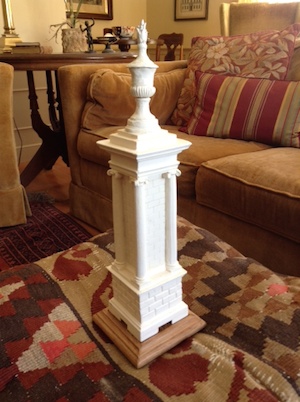
photo.JPGHere is the latest ancient ruin from Clayton Fulkerson, whose Greek and Roman monuments graced this blog (“Ancient temples on parade“), and Cranston’s William Hall Free Library, last November. I dined with Clay this afternoon at the Chapel Grille, also in Cranston, and asked him whether he had started any new ancient temples. He replied that he had completed an incense burner inspired (he imagines) by the four ornamental pylons on the Alexander III Bridge, in Paris, among other things. His thinking reflects the tendrils and penumbra of memory that influence how a design arrives in the mind of a designer:

It’s an original design, but I find that almost everything is derivative.  A few weeks ago I found a pair of similar structures just off of Commonwealth Avenue in Boston.  In addition, I’m sure I was inspired by the Alexander III Bridge in Paris.  In short, it’s a common form, but the removable urn is mine, I think.

In addition to the photo at left, Clay sent a brief video of the monument in the process of smoking. To see the fumes curl forth into the air is almost to smell it. I was unable to slide it off his email and onto my desktop for plantation in this post. I will add it as soon as I can. [Update: The 29-second video is now posted beneath the bridge below.]

Screen Shot 2016-04-05 at 10.44.19 PM.png

Pont d’Alexandre III, in Paris. (edaccessible.com)

Posted in Architecture, Architecture History, Art and design, Video | Tagged , , , , , | Leave a comment

Providence prints on parade

Screen Shot 2016-04-03 at 11.42.08 AM.png

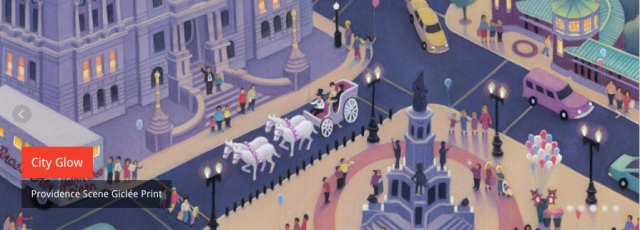
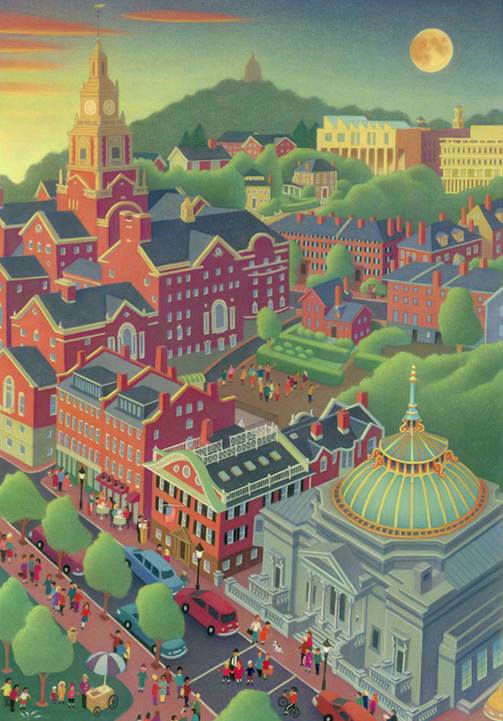
Thursday evening I beheld the fine prints of Peter Thornton lining the walls of City Hall, showing the artist’s sweet take on the most pleasing points in Providence. There was City Hall flanked by the Biltmore, with the Westin addition rising up beyond and Burnside Park across Dorrance Street. There was the Industrial Trust (“Superman”) Bank Building, lit to the nines and standing proud (as once was) beyond the skating rink and Kennedy Plaza. There was Old Stone Bank, with its gilt dome, next to the Providence County Superior Court climbing College Hill to Benefit Street. There was the East Embankment of the Providence River at dusk on a WaterFire night, with Old Stone Square gracefully nudged out of the picture off the print’s right edge.

There are several more that I will not show. There has to be some secrecy, some surprise, for the lover of art, something to call him to learn more of Peter Thornton, who in addition to his prints also illustrates children’s books and is a storyteller to boot. Those and other aspects of his existence in this world, and how to order his prints and the books he has illustrated, are revealed in the website of a very good egg.

Peter’s exhibit runs through May 15 at City Hall, floor the second.

Screen Shot 2016-04-01 at 12.42.16 PM.png

Screen Shot 2016-04-01 at 12.42.57 PM.png

Screen Shot 2016-04-01 at 12.44.40 PM.png


Posted in Architecture, Architecture History, Art and design, Preservation, Providence, Urbanism and planning | Tagged , , , , , , | 2 Comments