ICAA New England’s gala

DSCN0342.JPG

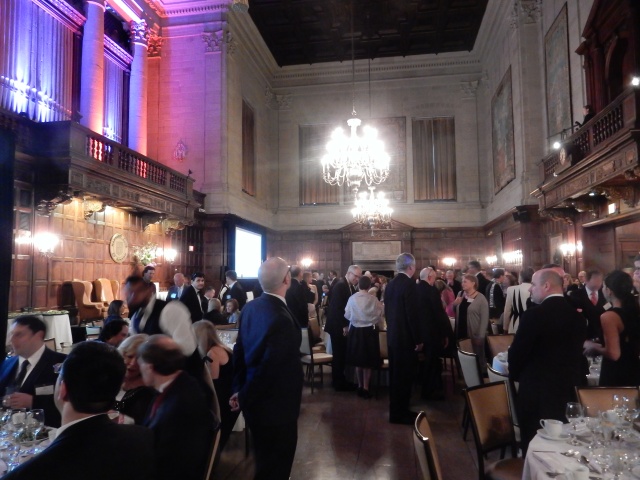
Assembling to dine at Bulfinch Awards gala last night in Harvard Hall. (photo by David Brussat)

This weekend, the New England chapter of the Institute of Classical Architecture & Art celebrated its ambitious new Bulfinch Awards program. For the first time we invited competition entries from across the nation for work performed in New England. This, we thought, was a good excuse to push the chapter’s annual party to a new level.
DSCN0376 - Version 2.JPG

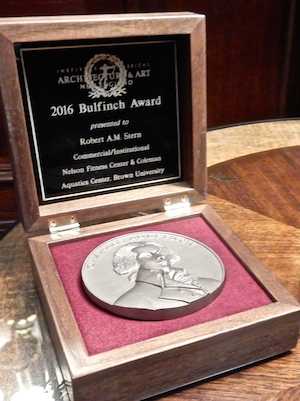
ICAA Bulfinch Medal

We feted this year’s laureates and Platinum-level sponsors with cocktails at the Eliot Hotel, on Boston’s Commonwealth Avenue. We brought in Justin Shubow, of the National Civic Art Society, to discuss the future of classical and modern architecture at the nearby Algonquin Club, and finally, at the Harvard Club, we hosted a gala dinner soirée for the laureates, the sponsors at all levels, their friends and colleagues – and for ourselves. Almost twice as many people came since our last celebration at the Massachusetts State House.

Most important, everyone seemed to have a rollicking good time. Events such as this one, with reservations costing $200, often attract winners, sponsors, board members, and few others not more or less directly connected with the event. But nobody here stood around pulling their chins at the forces arrayed against classical architecture. The hope is to turn the Bulfinch gala into a sort of mosh pit for the sophisticated set, a big annual see-and-be-seen evening for Boston. Our chapter president, Sheldon Kostelecky, emcee’d in a very come-on-in-the-water’s-fine tone, setting up vice president Dave Andreozzi’s juicy jury quotes, tossing off Bulfinch medals to some very chatty and evocative artists and architects. The entire venue was abrim with good cheer. The difficulty of making one’s way through the hall suggests that the chapter is heading in the right direction – though maybe a strategic withdrawal of the mosh-pit simile is in order, at least for now.

A good party is a good thing in and of itself, as the philosophers say. But the point of this good time is to raise the visibility of the primary organization working on behalf of classical architecture and its allied arts. When more people know that someone is working to maintain and revive the beauty they love but thought had been lost, then the first step to recovery, as the psychiatrists say, has been taken. That it can be so much fun is just icing on the cake, or, as the architects say, pediment on the architrave.
DSCN0379

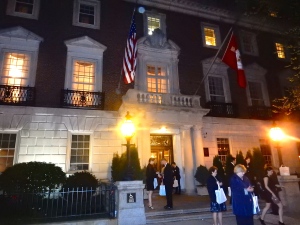
Harvard Club, Commonwealth Avenue

More to come when photos of the event come in, and when Justin Shubow sends a text from which I can quote some spicy lines from his excellent lecture on how classical architecture expresses democracy better than modern architecture (which doesn’t even try, and even finds the idea kind of sketchy). The chapter certainly is pushing the envelop on the revival of a great tradition. Find out more at the chapter’s website, where, along with the website of the national ICAA in New York City, you can join or just read about a fine crusade to bring beauty back to civic life.

Great architecture plus great sponsorship and stewardship add up to a chapter on a roll, not to mention a new burst of energy for a lovely old gal.

(The ICAA symbol is Diana, Roman goddess of the moon and of the hunt, and the symbol atop the second Madison Square Garden, in Madison Square, designed by Stanford White of McKim, Mead & White. Diana aiming a bow, by Augustus Saint-Gaudens, can be seen inside the top of the wooden box with the Bulfinch medallion in the middle photo above.)

Posted in Architects, Architecture, Architecture Education, Architecture History, Art and design, Development, Landscape Architecture, Preservation, Urbanism and planning | Tagged , , , , , , , , , | 4 Comments

A modern sculptor’s lament

Screen Shot 2016-04-24 at 12.10.03 PM.png

Sculpture by Donald Gerola on Parcel 12, or Bad Sculpture Park. (Providence Journal)

The grassy triangular plot of land at the corner of Kennedy Plaza and Burnside Park in downtown Providence – officially Parcel 12 of Capital Center – is unofficially called Bad Sculpture Park. A hotel is going to be built there, finally, and the bad sculpture is being taken away.

The sculptor, it turns out, is Donald Gerola, of Pawtucket, who moved here a decade ago from New York. Today’s Providence Journal has a piece by Mark Reynolds, “Sculptor dismayed by lack of acceptance,” that, perhaps without intending to do so, expresses many home truths about art and public taste.

He’s [also] in the process of retrieving four of his sculptures from public exhibits on Hope Street in Providence, at Pawtucket’s Slater Mill and at the Courthouse Center for the Arts in South Kingstown “I should never have brought them to Rhode Island,” he says. “I really regret it all,” adds Gerola, who once stretched 30,000 feet of colorful synthetic fabric cord across the Blackstone River to create an abstract weaving near the old Slater Mill.

Other transplants like Gerola and native Rhode Islanders, too, have followed big dreams and felt stymied by politics or lackluster economics or their own miscalculations. The nature of Gerola’s experience, which involves public art and ambitions of great scale, is one of the rarer tales of regret.

Between the lines is regret that the public often chuckles at art like this. I like to think I played a bit part by calling Parcel 12 “Bad Sculpture Park.”

But do not blame Gerola for this. He may have great talent as an artist within him, but he came up within an artistic milieu that encourages artists to believe they can make a living creating lesser art, work of often childish fatuity. Reynolds reports that Gerola works in a vein that resembles Christo, the artist who cloaks buildings in colorful tarps. This is not art, it is publicity.

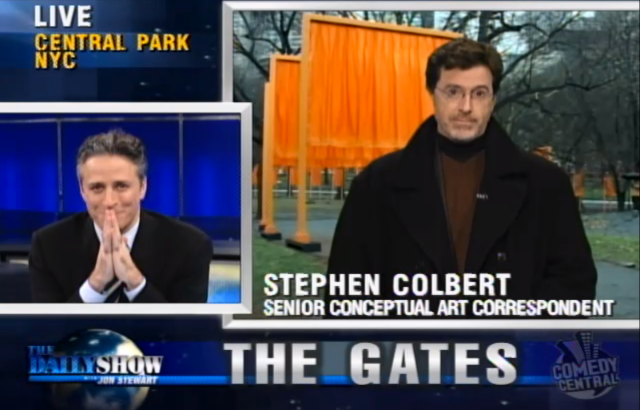
Christo’s work was spoofed by Stephen Colbert on The Daily Show a few years ago with a hilarity that was probably far more profound, as a statement of art criticism or even of cultural criticism, than even Colbert or Jon Stewart realized. Here is “The Gates,” and its best passage:

Jon, “The Gates” is a triumph of contemporary installation art. Each gate redefining its section of the park not as a private place for public reflection but as a public place for private reflection. Juxtaposed with the barrenness of mid-winter, “The Gates” posits a chromatic orgy. This riot of color achieves a rare redefamiliar- ization with the nature of place/time, the “whatness” of our “whereness.” No longer framed … I’m sorry, I’ve run out of crap.

The skit’s “final act of resandwichment” might equal that. Check it out.

People who want to become artists in America and elsewhere are not encouraged to stretch their talents to create serious art that the public consciously or unconsciouly identifies and reveres as such. Institutions such as local and state art councils that funnel money through 1 percent for art and other programs foster a dumbed-down concept of art that boosts the number of people who believe they are artists. Christo exemplifies that trend, and while it may energize conventional art critics and their ilk, this reconceptualization of art suppresses the real value of art, and suppresses the money most artists can make. Only those artists, like Christo, who manage, via PR, to infatuate the artist-wannabes of the 1 percent, who buy junk for millions to make a social statement of their ability to throw away those millions, have the “right” to laugh all the way to the bank.

The Colbert segment’s ridicule drills down to reveal a sophisticated sensibility toward such art that the public strongly feels and that the art establishment fears. Gerola is a victim of this disengagement of the art establishment from genuine art. He joins a vast pool of creator-victims in sculpture, in painting and many other fields. But the greatest victims are members of the public who have every right to expect artists to stretch their talents rather than to participate (with the art establishment) in the atrophy of art as a whole.

The public’s recognition of the lack of seriousness (let alone beauty) of most public art these days is a valuable persistence of memory that relies on the widespread existence of beautiful figurative statuary and sculptural groups in fountains or plazas in public parks and public squares. That work puts the work of artists like Donald Gerola into proper perspective. Inevitably, that’s uncomfortable and unprofitable for him, but it’s good for the public and for the hope of an eventual revival of genuine civic art in America.

Truly talented sculptural works such as the Bajnotti Fountain in Providence’s Burnside Park are a lot harder for the art establishment to demolish of than the works of classical and traditional architecture that the architectural establishment eradicates with relative ease. So the cityscapes of traditional architecture tend to degenerate at an even faster pace than the parks and squares that feature old public art. The work of preservationists should be to slow down that slide, but professional preservationists are themselves in bed with the modernist establishment in art and architecture who are to blame.

Screen Shot 2016-04-24 at 12.49.00 PM.png


Posted in Architects, Architecture, Architecture Education, Architecture History, Art and design, Humor, Providence, Providence Journal, Rhode Island, Urbanism and planning, Video | Tagged , , , , , , , , , , , , | 7 Comments

Fascism, modernism paired

Screen Shot 2016-04-21 at 11.08.31 AM.png

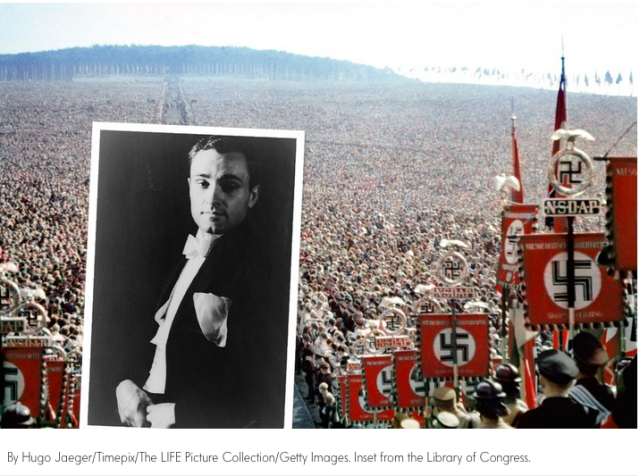
Photograph of Philip Johnson backdropped by photo of Nazi rally. (Vanity Fair)

Mother’s milk flowing from her gentle soul, a good friend expressed at lunch yesterday her dismay at the fascist tendencies of modernist architect Philip Johnson. She is no fan of his buildings (there are two in Providence), but she was unaware of his Nazi past. This was hardly surprising, given her intensely local focus on architecture.

Coincidentally, another friend of mine, who has tutored me on many aspects of the connection between modern architecture and fascist ideology, sent me “You can easily be a bad person and a great architect” from Dezeen. Its key error is to equate Johnson’s work with great architecture.

Here’s a piece in this month’s Vanity Fair, “Famed Architect Philip Johnson’s Hidden Nazi Past,” by Marc Wortman, excerpted from his new book 1941: Fighting the Shadow War.

See also this piece, “When a Famous Architect Is Also an Anti-Semite,” by Rachel Shukert in The Tablet two years ago. “I love Philip Johnson’s buildings not in spite of him,” she writes, “but to spite him.” Huh? This is a very long and erudite essay that focuses on the slave-owning Jews of early Suriname. Whether she rectifies the distinction she makes via the word spite, and how much it bears on the question of fascism and modernism, I leave to others.

The Dezeen article is actually a much briefer collection of quotes from people who know about Johnson’s flaws but love his buildings anyway.

Nazi past: American journalist Marc Wortman has chronicled Johnson’s role in promoting the Nazi agenda in the US in his new book. But many readers were underwhelmed by the revelations.

“Maybe I have no soul, but to me this doesn’t mean anything,” wrote Jan Limon. “Millions supported the Nazis at the time and they were both ignorant and in denial about exactly what evil was taking place.”

“We have to remember figures like Mies [van der Rohe] and Le Corbusier were also at least ambivalent towards Fascism,” added Davide. “Fascism and Modernism – especially early Modernism – did have some common ground in their striv[ing] for permanent, radical, functional methods that essentially disregarded human conditions.”

In 1939, seven years after curating the MoMA exhibit that introduced modern architecture to America, Johnson rode into Poland as a guest of the troops of the invading Wehrmacht. He later returned to the United States, where he founded an organization, the Grey Shirts, to support the fascist ideology here. He was an avowed anti-Semite. Later in his career he laughed off his years as a Nazi sympathizer as a youthful peccadillo, and it became a sort of faux pas among modernists to refer to his fascist tendencies – which, to be sure, were not altogether rare in the United States. He seems to have forsworn Hitler but did he ever forswear his anti-Semitism?

Wortman, in Vanity Fair, uses this passage to bring his long article to its conclusion:

Years later, in 1978, the journalist and critic Robert Hughes interviewed Hitler’s architect, Albert Speer, who had spent 20 years in prison for his crimes. Hughes described the meeting in an article in The Guardian in 2003—he had just come across a lost tape recording of the conversation. He wrote:

“Suppose a new Führer were to appear tomorrow. Perhaps he would need a state architect? You, Herr Speer, are too old for the job. Whom would you pick? ‘Well,’ Speer said with a half-smile, ‘I hope Philip Johnson will not mind if I mention his name. Johnson understands what the small man thinks of as grandeur. The fine materials, the size of the space.'”

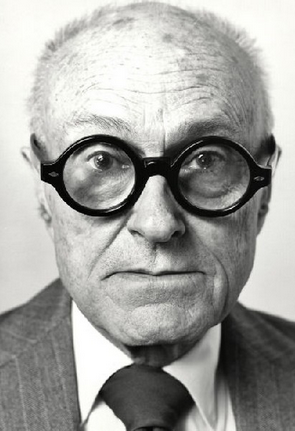
Screen Shot 2016-04-21 at 11.32.42 AM.png

Johnson

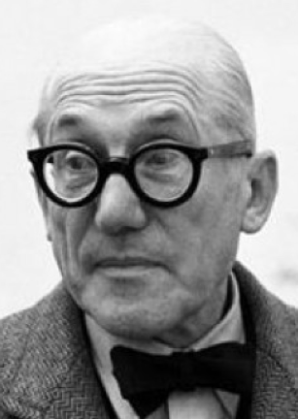
Screen Shot 2016-04-21 at 11.39.56 AM.png

Le Corbusider

None of it seems to matter to his acolytes today, any more than Ludwig Mies van der Rohe’s desire to become Hitler’s Speer, or Mies’s effort to persuade the Nazis, in the mid-30s, with Goebbels’ help, to accept modernism as the design brand of the Third Reich. Or Le Corbusier’s work for the Nazi puppet Vichy government of France during World War II.

I told my friend over lunch how I feared, with regret, that the modernist architects who fled Hitler’s Germany in the ’30s may nevertheless have brought a certain iron fistedness with them – perhaps, among some, in part because of their flirtations with communism during the Weimar and early Nazi years. Might there be an instinctive totalitarian tendency that subsists as part of the DNA of a German character that arose from centuries of rule by feudal lords commanding the countryside from castles long before Germany was united under Bismarck? (I’m a quarter German.) Is there something in the German mindset that permitted a highly intellectualized society to follow the beast Hitler step by step on a course toward brutalism and war?

Is there any of that mindset in the modernist establishment today, given its suppression of diverse tendencies in architecture?

I am only asking questions, not positing answers. Still, most notables and celebrities at the top of their fields in America, and even more so in Europe, would be hounded out of respectability for expressions of belief that characterized modernism’s founding theorists. What this has to say about architecture’s role in a deeply dangerous, divided, unhappy world is a topic worthy of discussion.

Some classicists and traditionalists are just as afraid as modernists are of having this discussion because of the connection between the architecture they like and the bastards that history has placed within its walls. The big difference is that traditional architecture was the default architecture for 3,000 years. A tyrant could no more choose between a traditional palace and another sort of palace than a Hittite could choose between a chariot and a Maserati. Modern architecture, on the other hand, sprang from a more recent past amid a world that contemplated embracing ideologies – fascism, communism, etc. – that we now mainly associate with dystopian films. A choice was possible and the wrong choice was made.

The importance of that distinction manifests itself clearly in the very look of the buildings that arose from either span. Should humankind follow the sensibility of the span that encompassed millennia or the span of our darkest recent decades. Good question.

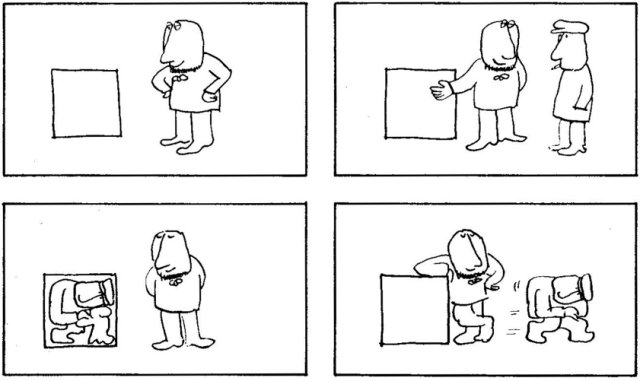
Screen Shot 2016-04-21 at 12.30.13 PM.png

Sketch by Louis Hellman

Posted in Architects, Architecture, Architecture Education, Architecture History, Art and design, Books and Culture, Urbanism and planning | Tagged , , , , , , , , , , , | 4 Comments

The reactionary avant-garde

Screen Shot 2016-04-20 at 11.15.58 AM.png

Richmond Riverside, London. (photo by David Iliff, from Public Square)

The epitome of a contradiction in terms, the idea of a reactionary avant-garde is a most appropriate description of what the theorist Nikos Salingaros calls the “cult” of modern architecture. Charles Siegel uses the term in the title of his new book The Humanists versus the Reactionary Avant-Garde, and Rob Steuteville’s review, “A human-centered architecture for our time,” for Public Square – the online journal of the Congress of the New Urbanism – has me awaiting the book most eagerly.

Modern architecture as cult suggests the stodgy backwardness reflected even by its most outlandishly wacko projects. Reactionary avant-garde defines that attitude to a tee. Neither its practitioners nor its establishment (the AIA, etc.) seem to have any idea how ridiculous the public considers their work, and yet their refusal to brook any discussion of the impact of their work suggests that they do have some idea, and do not want to address it. Why should they? The leaders of the profession are rolling in money, and laughing all the way to the bank. So why should they indeed? The good of humanity? Nah.

Rather than review a review of the book, I will merely attest that Steuteville’s lengthy treatment seems almost to be a table of contents for my own thoughts about the style wars to which this blog is devoted. Naturally, Steuteville’s review of Siegel’s book highlights CNU’s role in those wars, whereas another reviewer might highlight the “contemporary classicists” of the Institute of Classical Architecture & Art. No matter. Both wage the war against modernism from similar perspectives, whether they like to admit it or not. And you’d be surprised at the vigorous debate within each organization over whether to confront modernism directly.

That I still need to read the book itself is an even greater inducement for me not to write about it here. So I merely invite the reader to read the review and, if it sits well, to buy the book. The links for each are above.

I have illustrated this post as Steuteville has illustrated his review – with Richmond Riverside, near London, a mixed-use development designed by Quinlan Terry that epitomizes the humanism of the architecture that both author and reviewer, and I, support. I visited Richmond Riverside in 1998. Modernist critics complain that the modern technology and conveniences inside somehow render its exterior design inauthentic. Siegel will, I’m sure, take a sledge hammer to that kind of modernist thinking.

Posted in Architects, Architecture, Architecture Education, Architecture History, Art and design, Book/Film Reviews, Development, Preservation, Urbanism and planning | Tagged , , , , , , , | 1 Comment

Your brain on architecture

Screen Shot 2016-04-19 at 11.29.30 AM.png

Lauinger Library at Georgetown University. (blog.thehoya.com)

Here’s another scientific study about architecture. Look through the methodology and your eyeballs may roll furiously at its conclusion that “contemplative” buildings cause contemplative activity in the brain.

Showing pictures of such buildings (old and new) to a dozen architects while they undergo a brain scan in the expectation that “their critical training and experience would make them sensitive to features of the buildings that a lay person might overlook” sounds doubtful at best. After all, early training for students in architecture school aims to purge their innate feel for beauty as traditionally conceived. Still, “What Architecture Is Doing to Your Brain” by Emily von Hoffman in CityLab (The Atlantic) is not without its titillations.

Von Hoffman and her source, Dr. Julio Bermudez, who performed the study, spend a good portion of the article assuming a defensive crouch, anticipating objections. Bermudez asserts that “though everyone encounters architecture, studies on the built environment struggle for funding because,” as Bermudez remarked with a sigh, “it’s difficult to suggest that people are dying from it.”

Personally, I believe studies on the built environment remain rare because the architecture establishment doesn’t want to generate publicity for what it recognizes is the public’s widespread disdain for modern architecture.

Von Hoffman began her article with an amusing take on the Lauinger Library, a Brutalist concoction at Georgetown University. The school paper, The Hoya, had an article on Von Hoffman’s piece entitled “The Atlantic Calls the Lau ‘Soul-Crushing,’ Confirming Everything We Already Knew.” Here is Von Hoffman’s lede (as journalists call the opening of their stories):

At a particular moment during every tour of Georgetown University’s campus, it becomes necessary for the student guide to acknowledge the singular blight in an otherwise idyllic environment. “Lauinger Library was designed to be a modern abstraction of Healy Hall …,” a sentence that inevitably trails off with an apologetic shrug, inviting the crowd to arrive at their own conclusions about how well it turned out. Much of the student population would likely agree that the library’s menacing figure on the quad is nothing short of soul-crushing.

One shot shown to the 12 architects undergoing brain scans was the Salk Institute, in La Jolla, Calif., a modernist set of research buildings designed by Louis Kahn along an allée concluding with a view of the Pacific Ocean. I will grant it is lovely, but if the Salk were placed in a typical urban setting, unable to focus the eye on the Pacific, would it be so revered today? I do not quarrel that some modern architecture is extraordinarily contemplative. And yet, as is not the case for traditional architecture, genius is definitely required.

The author concludes with a roundup of the sort of more useful, less “contemplative” things about architecture that scientific researchers are looking into: “optimal ceiling heights for different cognitive functions; the best city design for eliciting our natural exploratory tendencies and making way-finding easier; the ideal hospital layout to improve memory-related tasks in patients recovering from certain brain injuries; the influence of different types and quantities of light within a built space on mood and performance.”

Very interesting piece.

Screen Shot 2016-04-19 at 3.38.09 PM.png

Image of Salk Institute used in study. (Rex Boggs/Flickr)

Posted in Architects, Architecture, Architecture Education, Architecture History, Art and design, Urbanism and planning | Tagged , , , , , , , , , , | 2 Comments

Shubow speaks this Saturday

Screen Shot 2016-04-18 at 2.43.56 PM.png

National Mall, Washington, D.C. (wikipedia.org)

Reminder: Still possible to hear Justin Shubow’s lecture in Boston this Saturday.

Justin Shubow, president of the National Civic Art Society and a leading proponent of classical architecture, is also a leading opponent of modern architecture. He and his organization, along with the Eisenhower family, have led the fight against Frank Gehry’s design for a memorial to Ike. The NCAS overlaps in its mission with the mission of the Institute of Classical Architecture & Art, whose New England chapter has invited Shubow to speak at its Bulfinch Awards ceremony at 1 p.m. in the Algonquin Club on Saturday, April 23.

In his lecture, Shubow is expected to address the broader significance, with an eye to his opposition to the Gehry Ike, of architecture and its influence on national character. Whereas modern architecture reflects the bureaucratic state and its disregard for the individual, classical architecture reflects the grandeur of a national polity that exalts the free individual as the apotheosis of the rule of law. I would be surprised if Shubow does not take that line of thinking. As Gehry might say, it’s just warmed-over Jefferson.

The fight against the Gehry memorial has almost been won. Congress has refused to pass construction funding for three straight years. The Eisenhower Memorial Commission, which chose Gehry in a dubious competition process, has had to fall back on retired Sen. Bob Dole, of Kansas, to raise the funds privately. Maybe he will have more success than the commission by itself. Its fundraising campaign in recent years raised less than it cost to hire the firm to raise funds. It seems that while the commission still has enough money to maintain offices and pay staff, the memorial itself is on life support.

That’s the latest, and I hope Shubow will give us some more insider tidbits. But of even more interest is whether he will map out a strategy to return classical architecture to its former authority, not only as the architecture Jefferson chose to represent the ideals of democracy, but as the default architecture for the civic realm in the nation’s capital and throughout the country. It is the architecture that the public prefers, and in a democracy that is (or should be) no small beer.

Shubow and his organization have been sneered at by conventional architecture critics from Paul Goldberger on down. He wears this disdain as a feather in his cap, and rightly so. He has spoken before Congress about how Washington should re-embrace classicism, and I expect his lecture will be equally thoughtful and inspiring.

Reservations for the lecture can be made here. Reservations for the gala to celebrate the 2016 Bulfinch Awards laureates, to be held at the Harvard Club, four blocks up Commonwealth Avenue from the Algonquin Club, starting at 6 p.m. that evening, can be made here.


Posted in Architects, Architecture, Architecture Education, Architecture History, Art and design, Development, Preservation, Urbanism and planning | Tagged , , , , , | Leave a comment

Techno-narcissist Kunstler’d

Screen Shot 2016-04-17 at 11.58.34 AM.png

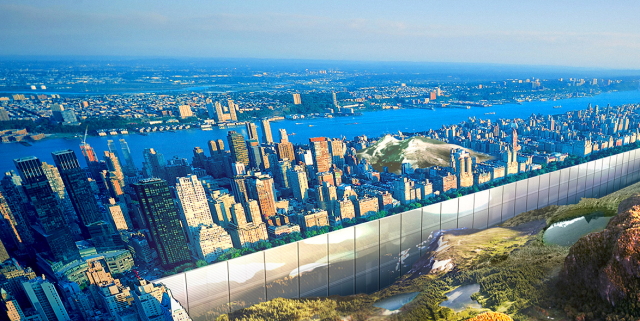
James Howard Kunstler’s latest Eyesore of the Month, which I reprint from his blog Clusterfuck Nation, had to be the winner of this year’s ridiculous eVolo Magazine architecture contest. And so it was. Only the ugliest and the stupidest entries are permitted. In this case the winner digs up Central Park and surrounds it with a horizontal skyscraper in glass stretching around the park’s four sides … And then …

Here is Kunstler’s delightful evisceration:

Behold  the winner of eVolo Magazine’s 2016 Skyscraper Competition.

I know. “Say, what…?” you say.

This latest exercise in techno-narcissism by trendster architects Yitan Sun and Jianshi Wu imagines the massive excavation of New York’s Central Park and the re-fashioning of its bedrock into a fantasy sunken wilderness landscape with a 1,000-foot high glass wall around the whole shootin’ match. Maybe the genetic engineer techno-narcissists can be enlisted to supply a King Kong and a few tyrannosaurs to liven up the scene. (Or just set Donald J. Trump loose in it when the GOP mandarins pull the plug on his crusade for the White House.)

Note that one sign of cultural collapse is the widespread inability to distinguish mental health from mental illness.

We are so in trouble, America.

Screen Shot 2016-04-17 at 8.51.42 PM.png

Screen Shot 2016-04-17 at 8.52.23 PM.png

Screen Shot 2016-04-17 at 8.54.07 PM.png

Screen Shot 2016-04-17 at 8.54.28 PM.png

New York Horizon (Images from Yitan Sun and Jianshi Wu)

Posted in Architects, Architecture, Development, Humor, Landscape Architecture | Tagged , , , , , , | 6 Comments

Kley: Trials of the pedestrian

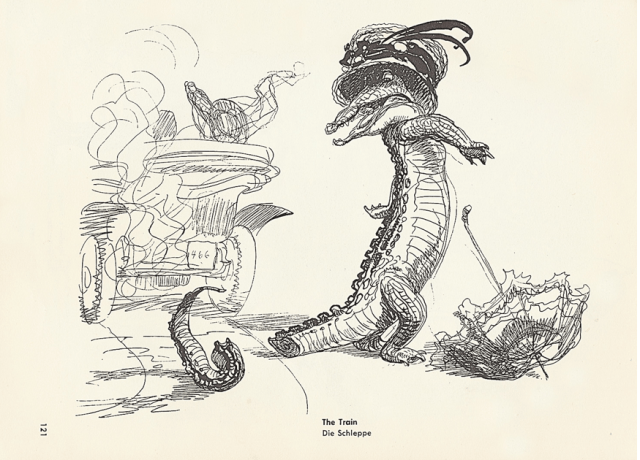
Screen Shot 2016-04-16 at 11.55.40 AM.png

Sketch by Heinrich Kley, circa 1910. (SkitzoidLloyd)

This sketch, called “The Train,” by Heinrich Kley was probably etched in about 1910 to judge by the auto, by the fashionable attire of the alligator, or by the era in which Kley was publishing his more curious work. The sketch was sent to me by a reader, SkitzoidLloyd, in reply to a post in which I related my travails in locating a copy of it. Thank you, Lloyd.

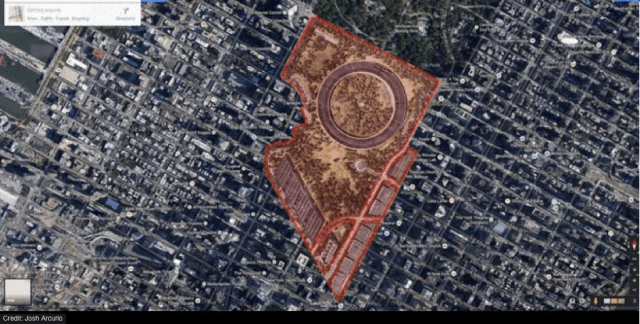
By the way, I had originally summoned up a set of Kley sketches related to transit issues as they were perceived in the early part of the last century. Rob Steuteville, editor of CNU’s Public Square blog, has begun a series featuring illustrations pertaining to transit and pedestrian issues. His recent “Got a Minute?” of Apple’s Cupertino campus superimposed on Manhattan suggests that Kley wasn’t quite what he had in mind for that series. But it is quite what I have in mind, and I hope you’ll enjoy it.

Check out the expression on the alligator’s face as she realizes that her “train” – the lagging indicator of ladies’ dresses back then – has been cut off by one of those newfangled locomotive devices. Did she get the license number? (“466”)

Kley spent his earlier career doing professional sketches of industrial buildings for clients, eventually started drawing cities – mainly of his native Germany – and then graduated to drawing social commentary of the most ascerbic kind. I am waiting for a couple of volumes of Kley’s work to arrive from Joseph V. Procopio’s online lost-art-0f books.

Here and here are posts with other illustrations or book trailers (!) by Kley.

Here is Rob’s latest “Got a Minute?” illustration, designed to highlight the absurdity of Apple’s claim that its campus is “green” in the sense of sustainability.

Screen Shot 2016-04-16 at 12.19.20 PM.png

Apple’s new alien spaceship lands in Manhattan. (Josh Arcurio)

Posted in Art and design, Book/Film Reviews, Books and Culture, Humor, Urbanism and planning | Tagged , , , , , , , , , | Leave a comment

Beauty and the bore

Screen Shot 2016-04-14 at 12.34.11 PM.png

Unidentified building atop New York Magazine article. (Phllip Laurell/Getty)

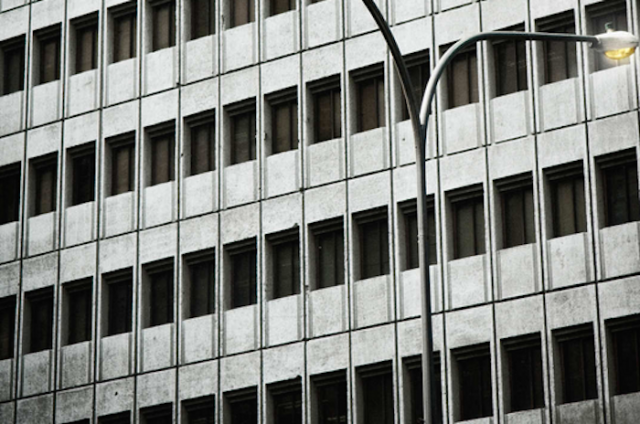
Several people have sent me “The Psychological Cost of Boring Buildings,” by Jacoba Urist in New York Magazine. The title hooked me, of course, but her essay hardly went down like an oyster. First, I am distrustful of “studies,” especially studies that claim to assess our interior state of mind. Predictably, the article strung together a bunch of studies and books that argued that dull architecture and streetscapes were not as stimulating as architecture and streetscapes that had a jumble of complexity, whether beautiful or not.

brklynbrewry.com

Whole Foods, NYC. (brooklynbrewery.com)

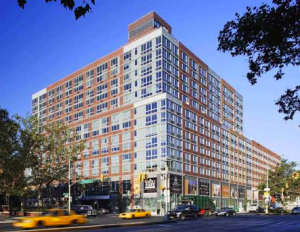
The building in the photograph at the top of the article seems to say it all. If only Urist had addressed that building and called it quits. But it remains unnamed and undiscussed. Instead, she proceeds to focus her ire on a new, bad-trad Whole Foods building on Houston Street, which she seems to find the epitome of boring. It is poorly done, granted, but not nearly as ugly or boring as the building on top. She refers to buildings and streets that trigger ADD or ADHD responses – or “severe case of modern life.” But why must we accept such irksomeness as intrinsic to modern life?

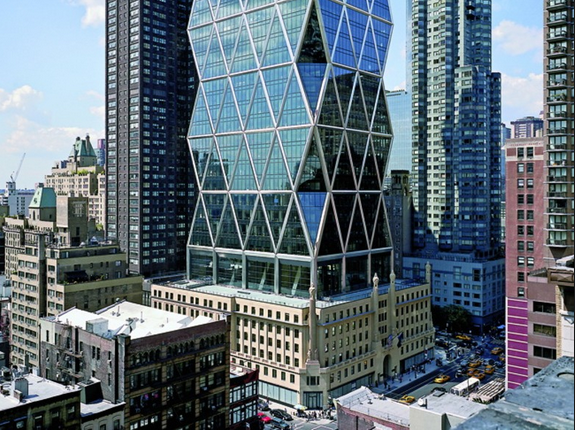
Urist concludes unhappily, pointing to Norman Foster’s Hearst Tower as an example of a building that balances under- and over-stimulation. Suddenly mentioning beauty, a concept that had gone unaddressed throughout the article, she writes that “new architecture can achieve the optimal level of cacophony and beauty.” Maybe she intended to praise the elegant Art Deco base, completed in the late ’20s, and deplore the tower Foster plopped on top of it in 2006. Passersby are not likely to be “bored” by it, she insists.

arcspace.com.png

Base of Hearst Tower. (arcspace.com)

Perhaps the reason this article and its collection of studies seems to miss the point is that it fails to cite beauty as part of the equation. Beauty soothes the savage breast; variety does not, and neither do ugliness or boredom. But architects do not like to talk about beauty, which, they say, is in the eye of the beholder so just chuck it out of the discussion. But its absence leaves a big hole. Filling that hole would tie up a lot of loose ends in the article and the broader discussion of why so much of our built environment leaves us cold.

We are not talking rocket science here, and we don’t need surveys to expose home truths that most regular people already understand.

The Hearst Tower, which is for some curious reason not pictured in the NYM article, has a beautiful base and an ugly shaft. That is, it is off-putting from afar and more pleasant as you approach. Maybe this is the balance that Urist finds so compelling. But I suspect it would be even more compelling if it were beautiful from top to bottom.

central-nyc.com.png

Hearst Tower as completed in 2006. (central-nyc.com)

Posted in Architects, Architecture, Architecture Education, Architecture History, Art and design, Development, Preservation, Urbanism and planning | Tagged , , , , , , , , , | 5 Comments

Skandalkonzert vindicated?

Screen Shot 2016-04-13 at 3.25.33 PM.png

Drawing from the magazine Zeit, volume 6, April 1913. (srf.ch)

A post on the website Artlark, “Skandalkonzert: The Battle for Modernism,” describes a riot that had classical concertgoers in Vienna battling amongst themselves in the pits and with the musicians and the even the composers. Pieces by Schonberg, Weber and Mahler were featured, and Schoenberg himself conducted. Fisticuffs ensued. Punches were thrown.

After a lengthy description of the riot, its causes and its influence were assessed by the anonymous Artlark writer. Here is the summary passage:

All these accounts construct a picture of the continuous battles existing between Viennese society and its artistic circles. However, apart from inherent exaggerations, they also depict the vastness of the void between nineteenth-century mentality and the shocking, incomprehensive, modernist rhetoric at the beginning of the twentieth century. Even such artistically and literary inclined minds as Altenberg found it difficult to adjust to modernism in music. He said: “I understand nothing of this latest ‘modern music’, my brain-soul still hears, feels, understands only Richard Wagner, Hugo Wolf, Brahms, Dvořák, Grieg, Puccini, Richard Strauss!” (Pople). But no matter how lengthy the process of cultural and mental adjustment was, and how much ‘blood was shed’ during the process, the positive aspect of it is that the much criticised avant garde were eventually vindicated.

I beg to disagree. Modernism in music – no more than modernism in architecture – has never been “vindicated.” Rather, the “establishment” of western civilization lost its nerve and modernists were able to capture the summits of authority in such fields as art and architecture, where they have not yet been dislodged in spite of the harshness that has overtaken both fields. The result has been tragic, with so much beauty removed from the quality of life worldwide and replaced by bogus intellectualizing.

The proof, one might surmise, is that such a riot is unimaginable today. The Viennese treated art as a serious subject. Today, art and architecture have so blighted the landscape of the mind and the streetscape of the environment that few pay that much attention to the latest developments in conventional art or building. By conventional I mean art and building that is designed to “épater la bourgeoisie,” not traditional art or architecture, which people still prefer, when they can get it. Fortunately, in art and architecture (more the former than the latter) a reaction against experimenting on the sensibilities of the public has led to a revival of tradition. May that trend continue!

Posted in Architecture, Art and design, Books and Culture, Humor | Tagged , , , , , , , , , , , , , , | 1 Comment