1 man, 53 years, 1 cathedral

Screen Shot 2016-07-18 at 6.42.23 PM.png

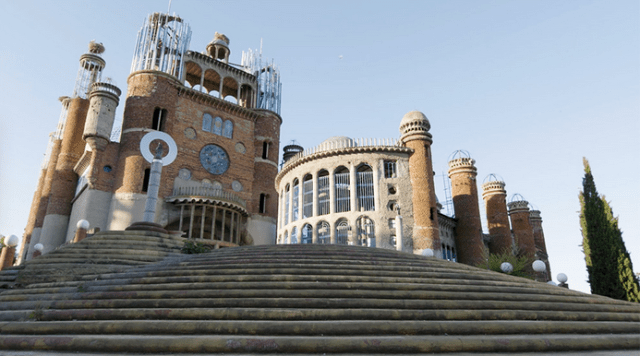
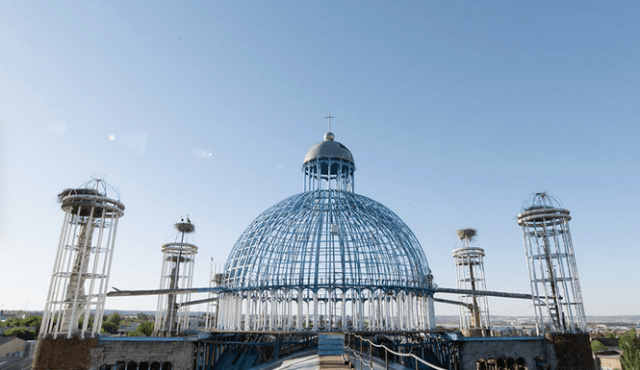
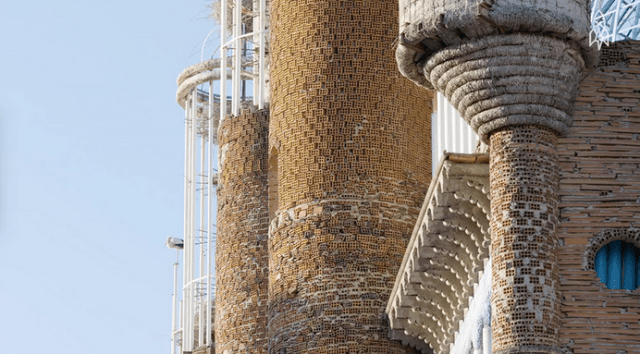
Watch this brief video about a man in his 90s who has spent 53 years building a cathedral near Madrid by hand – solely his own. Not sure what I think of the cathedral’s design. There seem clear references, at least in his roughly traditional sensibility, to Gaudi. Perhaps Justo Gallego’s technique reveals his lack of an architectural education – but that’s a good thing. Nor does he have any formal training in construction. No education could have taught him how to build anything by himself – only why not to. Although he has not completed his cathedral, it is already amazing. Does he plan to fill in the dome and towers as he has filled in the walls and windows with such charm? His ambition runs on faith, but I wonder whether the church has a congregation. Is it built on his own land? How has he financed it? The video doesn’t go into such details. Such whimsicality is its own reward, at least for those who see it. I trust that Justo Gallego’s reward springs from his faith, and his faith is anchored in firmer rock than whimsy.

Hats off to Gary Brewer for sending the article, from a website called Colossal, and its video to TradArch.

Screen Shot 2016-07-18 at 6.42.42 PM.png

Screen Shot 2016-07-18 at 6.45.32 PM.png

Posted in Architecture, Video | Tagged , , , , , , | Leave a comment

Fallen angel in Charleston

Screen Shot 2016-07-12 at 9.24.02 AM.png

Latest building proposed for WestEdge project in Charleston, S.C. (Publix)

As mayor of Charleston, S.C., for some 40 years, Joe Riley was a hero to the preservation movement. But lately he has hopped in bed with preservation’s nemesis, modern architecture.

An article from 2015 on the website Next Cities, “Southern Rivals Struggle to Balance Historic Preservation and Modern Architecture,” expresses its theme with considerable confusion. Its quotations of Riley speaking to CBS seem to contradict each other. The first quote expresses the theme; the second, about a painting, contradicts it; the third, about a garage, also contradicts it. The theme is that preservation and progress are somehow mutually exclusive.

Here is the first Riley quote:

“A historic city should be a living place,” Riley told CBS. “Because if you don’t have that, then it’s a former something. A former once-great city that now is pretty to see.”

Here is the second Riley quote:

“You know, it’s like there is this beautiful painting that has been painted and you have an opportunity to paint something within that beautiful painting,” said Riley. “You’ve got to be careful that in what you paint there, you don’t detract from the overall context of what has been created.”

Here is the third Riley quote:

“I said I want a building that doesn’t look like a parking garage,” Riley recalled. “And he very nicely explained to me that’s not what you do. And I said, ‘No, that’s what we do here in Charleston. I don’t want it to look like a parking garage.’”

Unlike the second and third quote, the first quote suggests a confused Riley who seems to believe that modern architecture moves a city into the future but preservation does not. It’s as if new architecture must reflect a machine mentality in order to represent progress. Granted, modernism has done an excellent job promoting that idea, but good p.r. does not make an idea true, and it has definitely not been popular among most of the public.

Progress in a city should evolve its physicality forward in ways that make it increasingly beautiful and increasingly lovable to the majority of its citizens. The easiest, most sensible way to do that is to use the past that has been deemed worthy of preservation as a model for future development.

At least in cities like Charleston and its rival Savannah, not to mention Providence, the main job for preservation is no longer saving individual historic buildings. Though it is occasionally still necessary, that has been largely accomplished. The main job now is promoting new buildings that add to rather than undermine the setting created by successful preservation. Riley’s support for ugly new architecture in Charleston’s WestEdge development suggests that he does not understand this anymore.

Providence, which is happily paving the way for architecture nobody will love in its latest economic development plan, has never had a mayor who understood this, so the betrayal of Charleston represented by Riley’s new attitude is difficult to grasp here.

Providence’s sad/glad fate is that for more than a century it has been too poor to bulldoze its charms. Alas for prosperous Charleston, the loss of a mayor who understands preservation leaves it prey to ugly developments that might boost its economy in the short run but undermine its future in the long run. Instead, it should plan developments that boost its economy in the short run without undermining its future in the long run. That is, in fact, relatively easy. It is not rocket science. The entire world did it successfully for hundreds and even thousands of years, until about 1950.

Charleston now has its first new mayor in many decades. Its citizens can only hope he has as deep a grasp of these vital issues as his predecessor once did.

Screen Shot 2016-07-12 at 10.37.52 AM.png

Charleston’s Rainbow Row. (photo by Melizabethi123)

Posted in Preservation | Tagged , , , , , | 2 Comments

Slowing Prov’s 6/10 Big Dig

Screen Shot 2016-07-11 at 8.09.22 PM.png

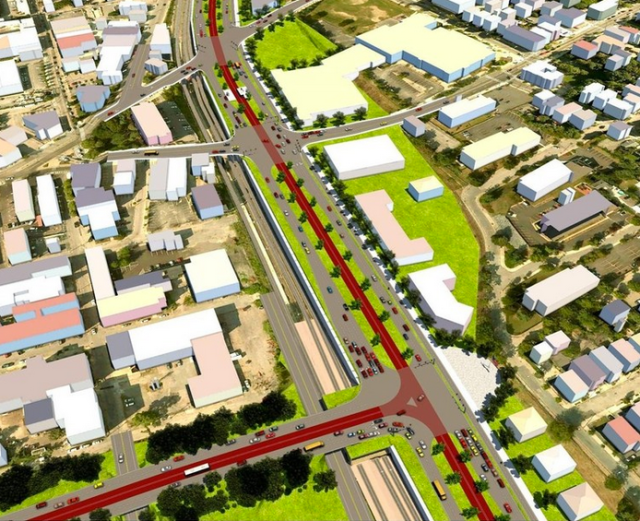
Boulevard version of proposed Route 6/10 connector project. (RIDOT)

A state transportation agency used to routinely grabbing buckets of federal money was probably taken aback last week when the U.S. Department of Transportation rejected its bid for a $175 million FASTLANE grant to help it rebuild Providence’s 6/10 connector. So startled that RIDOT may have been, so to speak, scared straight.

One of the local transit watchdog blogs published “Burying R.I.’s 6/10 Big Dig,” relaying news of the funding snafu. The Providential Gardener, as the blog is known, speculated that a more rational plan for the job may have been given if not a green light then a second wind.

In an era where city planners, backed by the U.S. Department of Transportation, take every opportunity to replace urban highways with more efficient, transportation-friendly, and cost-effective networks, RIDOT’s “Big Dig” plan looks like a throwback to the 1950s. Typical of Eisenhower-era highway systems, RIDOT’s approach benefits long distance commuters at the expense of the residents who bear the brunt of living near the highway. It’s an antiquated, suburbs-first philosophy.

The Gardener gives the city planning department credit for pushing a proposal that, instead of rebuilding the highway with a tunnel twist, as RIDOT wants, would replace the highway with a boulevard. With the project reaching for a billion-dollar pricetag, a rethink was in order.

The Gardener also praised RIDOT for its apparently greater transparency, saying goodbye, finally, to “the dark days of the ’90s” when DOT Watch kept a sharp eye out for RIDOT no-no’s. But let’s also not forget that RIDOT spent the ’90s abandoning the ’50s mentality. It moved Amtrak rails underground, daylighted the city’s rivers, helped bring in Providence Place, and relocated Route 195 away from the city center.

Advocates for the full-monty boulevard option really ought to crank up their artistic side. The RIDOT-generated image above is unlikely to win many supporters, and I do not find any alternative images online. Not only the boulevard itself but new development along it should be re-imagined so as to generate public support rather than undermining it with the sort of sterile institutional dreck that the Route 195 folks seem to have taken such a shine to. Notice how hard they are struggling to move forward.

CommerceRI may have a bad case of ’50s mentality, and the 6/10 connector plans seemed to suggest that RIDOT, too, had contracted a relapse after all these years. Perhaps last week’s federal smackdown will bring relief.

Let’s hope that the 6/10 connector project will morph into something that lives up to RIDOT’s glory years, during which the agency earned kudos for projects that the public loved. Slowing the connector down could, as The Gardener suggests, smarten it up.

Posted in Development, Providence | Tagged , , , , | 3 Comments

Big bear barely Brunonian

Screen Shot 2016-07-05 at 8.55.39 PM.png

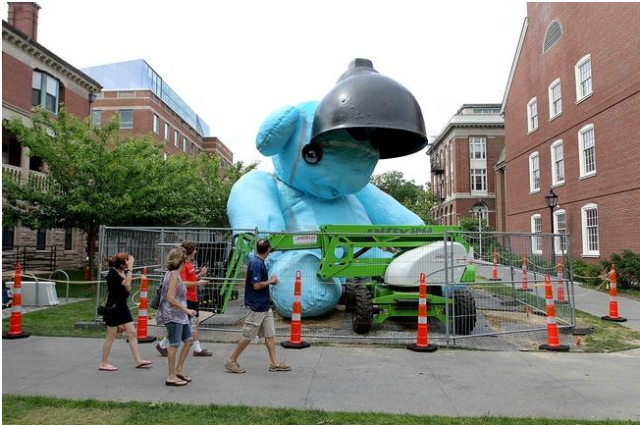
Sculpture newly installed on Brown Campus. (Providence Journal)

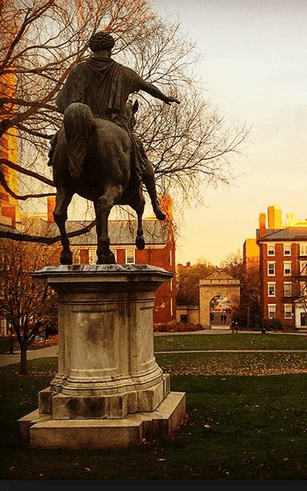
Just off the Main Green at Brown, a mounted Marcus Aurelius presides over Lincoln Field, now called Simmons Field after the university’s most recent former president. Or at least the Roman general used to preside. And Ruth Simmons is now dissed. On Sunday I opened the Providence Journal to find a photo of the above abomination squatting on the quadrangle green.

The story in the Journal reads:

The teddy bear sits now behind a chain-link fence, an installation in progress that left passersby wondering Sunday whether people might eventually cozy up to a bear that doesn’t seem cuddly despite its plush appearance. Chipped black buttons for eyes adorn the 23-foot-tall sculpture that’s bisected with an oversized black desk lamp, awaiting its light bulb.

Screen Shot 2016-07-06 at 10.50.11 AM.png

Marcus Aurelius (twitter.com)

Giant bear sculpture at Brown University has its friends, foes,” by Kate Bramson, reports that the sculpture is a baby-blue copy of artist Urs Fischer’s other work. His most celebrated bear is yellow, purchased at auction from Christie’s for $6.8 million by a member of the Qatar royal family, who had it installed at the airport in Doha. Yeah, yeah. We all missed our calling. The one at Brown is owned by hedge-fund manager Steven Cohen and wife Alexandra, and it is on loan to the university for five years.

Five years!

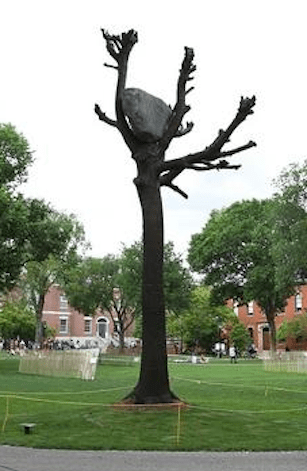
One can roll one’s eyes at the Cohens, but Brown’s leadership has a duty to its community, its alumni, its past and its future. The university and its campus are handed down in trust, and that trust has been violated. Another recently installed sculpture, “Idee di pietra” by Italian artist Giuseppe Penone, on the Main Green, is a bronze tree that looks real but for a boulder nestled in the crook of its dead branches. Fine.

Many sculptures, venerable and otherwise, adorn this bastion of the Ivy League, founded in 1764, the nation’s seventh-oldest college. None so alters the character of its setting as the blue bear. It arguably violates all five of the “values of public art” asserted by the university’s Public Art Committee. Four of the five, all but the last regarding donors, are violated inarguably. If this sculpture is indeed Brunonian, then the longtime critics of Brown’s lack of serious academic standards must be right.

“‘Ghostbusters’ meets ‘Toy Story'” suggested a professor of computer science, Anna Lysyanskaya, to Bramson while touring friends through campus.

Screen Shot 2016-07-06 at 10.56.47 AM.png

“Ideas of Stone” (Journal)

Bramson found few to take the bear’s side. That’s no surprise. When it comes to their own environment, student taste is surprisingly conservative. Students at Columbia are demanding the removal of a far less egregious sculpture by Henry Moore. These are not issues of free speech but of community values. Objecting to the unsought reconceptualization of Lincoln Field is not to be against art but to favor artistic standards.

And what to make of the placidity with which the blue bear reacts to being cleaved through the skull by a giant desk lamp? Does it make light of violence? Or is it merely a reference to the distress students feel at having to study at night instead of partying? Just asking.

If the Public Art Committee, the Campus Planning Committee and the University Curator cannot wrap their heads around the damage done to a wide range of university priorities by this over-the-top sculpture, University President Christina Paxson should step in and remove the thing.

RAMSA partner Gary Brewer just sent this Brown Daily Herald article about a much better bear sculpture then planned, now erected, as part of the excellent Nelson Fitness Center building completed a few years ago.

Screen Shot 2016-07-06 at 12.07.46 PM.png

Statue of Kodiak bear near Brown’s new Nelson Fitness Center. (from Gary Brewer)

Posted in Art and design | Tagged , , , , , | 2 Comments

Less is more … or a bore?

Screen Shot 2016-07-05 at 2.54.54 PM.png

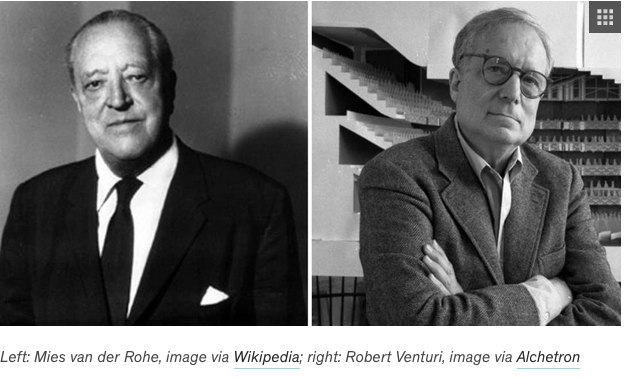
Happy belated birthday (it was June 24) to Robert Venturi, avatar of the postmodern movement in architecture and the self-appointed rebutter-in-chief to arch-modernist Ludwig Mies van der Rohe and his infamous dictum.

In the battle of slogans, “Less is more” has beat “Less is a bore” hands down. Mies’s line is pithier, pregnant with meaning and it swept the battlefield. Venturi’s line was reactive – the sort of cocktail-party riposte that you think of moments too late, or in this case not just too late by 19 years and long after the horse has left the barn but just a shade lame.

And too bad, because “Less is more” is wrong.

“Less is more” was wrong before it became a slogan. The kind of architecture embodied by the phrase was a mistake the first time someone thought it up. We were told a machine age required a machine architecture. No plausible reason was given. All we got was an architectural metaphor for efficiency, not efficiency itself. The kind of architecture modernism replaced worked better at pleasing our eye and serving our needs. Traditional architecture developed over thousands of years, its best practices tested by trial and error and handed down by practitioners generation after generation. It failed to maintain its market share because modernism had better advertising, not because it was a better product.

The brief heyday of postmodernism was valuable to the extent that it provided a small opening for a return to genuine traditional architecture. Postmodernists won their argument against modernism but failed to follow up, offering instead a goopy amalgam of cartoon typologies and then leaving the field for the true modernism – modernism with all of its flaws exposed, its ideals abandoned, yet still leaping from peak to psychodelic peak.

Whether modernism’s dependence on oil will bring this truth to light before it brings an end to the earth’s economy and its environment remains to be seen. But the truth is and has always been there to see, and easy to see for those who will only open their eyes. Less is more, indeed. Harumph!

Posted in Architecture | Tagged , , , , , , | 4 Comments

Who owns Europe’s night?

Screen Shot 2016-07-01 at 10.10.35 PM.png

Videographer Luke Shepard and a companion traveled through 36 cities in 21 European countries to film “Nightvision: The Brilliance and Diversity of Euoropean Architecture.” It captures buildings of both chief types, old and new, traditional and modernist They are different. The modernist buildings seemed of interest, in the end, only because they were as big as … well, as buildings, real buildings. Viewers can judge of how interesting. Below may be the best of the bottom lot. Tip of the cap to Kuriositas. Enjoy!

Screen Shot 2016-07-01 at 10.15.03 PM.png

Posted in Architecture | Tagged , , , , , , , | Leave a comment

Lucas, return to Light Side

Screen Shot 2016-06-30 at 8.59.57 PM.png

Theed, capital of Naboo, painted by Jacob Charles Dietz. (deviantart.com)

George Lucas, having been rejected in efforts to build a museum with his own money first in San Francisco’s Presidio and then on the lakefront of Chicago, is back in the Paris of the West with a third proposal, but the same architect – MAD, a Japanese firm – that did him dirt in the Windy City.

Does the creator of Star Wars not learn? His plan for a classically designed Lucas Museum of Narrative Art in the Presidio unravelled when the city’s culture leaders refused to accept the Beaux Arts as a legitimate museum style in the 21st century – that’s my interpretation, which relies on what I read between the lines in 2014, including a piece in Metropolis by the normally reliable critic of the San Francisco Chronicle, John King. Here’s my post, “SF rejects free museum.”

Then Lucas went to Chicago, where land in historic Burnham Park on the coast of Lake Michigan beckoned, but he hired MAD’s Ma Yansong to design what seemed like a set of aluminum mountains along the lakefront. The public was nonplussed, a friend-of-the-park group sued, Lucas dug in his heels, but this week he pulled the plug.

Before he oopses all over the place yet again, Lucas, who is now considering Treasure Island off the coast of San Francisco (plus an L.A. site in reserve), should check to see if the Force is with him. His Star Wars saga has always seemed to house evil in places like the modernist Death Star, headquarters of Darth Vader and his Dark Side, and the good guys (or at least the victims) in places like Tatooine. Get the drift? The saga’s human refugees live in Naboo, amid the adorable classical vernacular of its capital, Theed. Is this accidental or is it a deeply intuitive recapitulation of good vs. evil? That matters less than that its lessons be heeded by Lucas, as they have apparently long been subconsciously internalized.

Learn from your creation’s own narrative, George. Return to the Light Side.

Screen Shot 2016-06-30 at 8.42.26 PM.png

Rendering by Urban Design Group of Dallas for museum on S.F.’s Presidio park. (Lucas)

Screen Shot 2016-06-30 at 7.28.33 PM.png

Rendering of MAD design proposed for Grant Park, in Chicago. (AP/MAD)

Screen Shot 2016-06-30 at 7.29.15 PM.png

Rendering of proposed development on Treasure Island, site of latest museum plan. (Dbox)

Screen Shot 2016-06-30 at 9.18.21 PM.png

Tatooine, setting for scenes throughout Star Wars saga. (starwars.wikia.com)

Posted in Architecture | Tagged , , , , , , | 5 Comments

Musical skyscrapers afloat

Screen Shot 2016-06-29 at 5.37.05 PM.png

Painting by Geoff Hunt, artist for many O’Brian covers. (julianstockwin.com)

Here is a passage from The Nutmeg of Consolation, the 14th volume of Patrick O’Brian’s 20-volume naval novel, set in the Napoleonic era. Capt. Jack Aubrey and his surgeon friend Dr. Stephen Maturin, one evening in the South China Sea, are playing on their violin and ‘cello as they often do, this time enjoying a musical game that, it seems to me, can be compared to aspects of structure and creativity in classical architecture. (A skyscraper is a high triangular sail lofted to take advantage of a light wind.) Aubrey and Maturin are overheard on the other side of the bulkhead by the captain’s steward and his mate:

They tuned, and at no great distance Killick said to his mate, “There they are, at it again. Squeak, squeak, boom, boom. And when they do start a-playing, it’s no better. You can’t tell the one from t’other. Never nothing a man could sing to, even as drunk as Davy’s sow.”

“I remember them in the Lively [replies William Grimshaw]; but it is not as chronic as a wardroom full of gents with German flutes, bellyaching night and day, like we had in Thunderer. No. Live and let live, I say.”

“Fuck you, William Grimshaw.”

The game they played was that one should improvise in the manner of some eminent composer (or as nearly as indifferent skill and a want of inspiration allowed), that the other, having detected the composer, should then join in, accompanying him with a suitable continuo until some given point understood by both, when the second should take over, either with the same composer or with another. They, at least, took great pleasure in this exercise, and now they played on into the darkness with only a pause at the end of the first dog-watch, when Jack went on deck to take his readings of temperature and salinity with Adams and to reduce sail for the night.

They were still playing when the watch was set, and Killick, laying the table in the dining-cabin, said “This will stop their gob for a while, thank God. Keep your great greasy thumbs off the plates, Bill, do: put your white gloves on. Snuff the candles close, and don’t get any wax or soot on the goddam snuffers – no, no, give it here.” Killick loved to see his silver set out, gleaming and splendid; but he hated seeing it used, except in so far as use allowed him to polish it again: moderate, very moderate use.

He opened the door into the moonlit, music-filled great cabin and stood there severely until the very first pause, when he said “Supper’s on the table, sir, if you please.”

O’Brian’s ability to milk the quirks of class differences is well illustrated. That, along with what parallels may be drawn on innovation in classical design, exemplify the sort of literary dance that plays merrily (or otherwise) in the widest variety of keys throughout this series. O’Brian’s subtle weaving of contemporary prose with period inflection conveys the tone of Regency period English usage without (modernists will love this) any affectation of “copying the past”: the joy of the sound and the feel of history without the difficulty. The writing of this Englishman who pretended through most of his life to be Irish (at age 30 he changed his surname from Russ in 1945; he died in 2000) has been compared by respectable critics with that of Jane Austen and others of equal renown.

Screen Shot 2016-06-29 at 5.07.38 PM.png

Dr. Maturin and Capt. Aubrey (Paul Bettany, Russell Crowe) in the 2003 film “Master and Commander,” a disappointment to many Patrick O’Brian fans. (Warner Bros.)

Posted in Architecture, Art and design | Tagged , , , , , , | 1 Comment

Yale’s ‘edifice complex’?

Screen Shot 2016-06-28 at 6.19.13 PM.png

Rendering of new residential colleges under construction at Yale. (RAMSA)

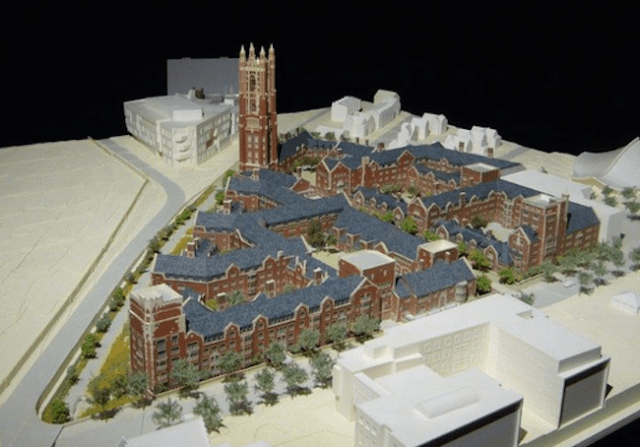
Hartford Courant architecture critic Duo Dickinson has written a fine piece on Yale’s two new residential colleges, under construction in New Haven. Yale’s expenditure of more than half a billion (b) to recapture the work of architect James Gamble Rogers’s eight pre-WWII colleges speaks well of the university’s public spirit, and adds to hopes that beauty is no longer verboten on the Yale campus or, for that matter, among the elite of the nation’s elite.

The work is of course by Robert A.M. Stern Architects, probably the world’s largest firm doing classical architecture. Stern himself recently stepped down as Yale’s dean of architecture, though one hopes that’s not exclusively the reason he got the job (RAMSA also does more than its share of modernist work). Dickinson seems to have spoken with Stern at some length, and with satisfying results. These are Yale’s first new colleges in half a century, making room for 800 more Yale students each year.

Though “Yale’s Edifice Complex: University Is Building a Modern History for its Future” contains an item or two of the obligatory architecture-critic snickers at revivalist classicism (the buildings are Collegiate Gothic), it is remarkable how straightforward it is in its admiration for this major project at Yale. Here is how he describes the design of the colleges’ exteriors:

The exteriors are equally sumptuous. The carefully scaled and shaped facades have hundreds of carved appointments and the kind of crafted stone and brick detailing that is unprecedented on this scale in any other facility built in this era. The landscaping lives up to the intricately burnished exteriors with generous plantings and trees.

Snicker though they may, university know-it-alls will someday come to realize that the donations their institutions receive from alumni ($250 million from alum Charles Johnson, the financier, toward the cost of these new colleges) will be generated by the feelings accrued over four years of study (and play) in what were once commonly called “these hallow’d halls.” They are rarely such memorable edifices anymore, and those colleges that understand the implications will go with the flow. Nobody ever accused Yale of stupidity.

Here is a RAMSA video of the plans for the two colleges that show the luxuriousness that Dickinson describes in splendid detail.

Screen Shot 2016-06-28 at 6.32.59 PM.png

Model showing detail and layout of colleges. (RAMSA)


Posted in Architecture | Tagged , , , , , | 2 Comments

Library of place in Newport

DSCN9165.JPG

Ronald Fleming’s library under construction in Newport.

Ronald Lee Fleming, an internationally recognized expert on placemaking, has a modest cottage on Bellevue Avenue that masks a series of interlocking gardens – each focusing on a “folly” or architectural toy, of no real utilitarian use but to set off the beauty of his grounds. I visited last year for a meeting of the Royal Society of the Arts, before Fleming had advanced far on his latest venture, a personal library of “place.” This year, the outside of the building – not large, and not a folly, really, as it boasts function – was almost complete.

Fleming has been working with Providence architect J.P. Couture (now president of the Providence Preservation Society) on its design and construction. The library and a partly done arcade reaching toward an existing greenhouse (not really a folly either) sit at one end of a long rectangular granite pool that runs by a cabana and concludes at a genuine folly – a domed octagonal temple.

Inside the library all is ahoo. But you can see how Fleming’s personal collection of perhaps 7,000 volumes about individual cities and towns – the kind of books, he says with a sort of self-deprecatory shrug, that nobody really wants to read, since either they already live there and know the place or they don’t live there and don’t care. I would beg to disagree. All places have visitors who want to learn of a place before they get there, or want to have a memento once they have left. Also, residents are often interested in what an observer has to say about where they live. And then there are those who might be interested in what the particular city or town contributes to the lore of cities and towns in general.

Fleming will have a little apartment upstairs, looking forward to the day when his children and their children take over the main house. A retreat. Makes sense – even without anticipating eviction by his descendants. Not that there aren’t other facilities on the grounds that might also serve!

The photo on top shows the exterior of the library seen from the temple. Below is an elevation of the library as seen from the point of view of someone standing behind the arcade. Below that is a view from a year ago, shot from behind the temple toward where the library would be built. Next is the view from the library to the temple, then a view over a pond toward the temple blocking the library beyond, then a close-up of the bow front of the library, and then a couple of interior shots that show how much work remains to be done. So I hope to supply readers with an interior shot of book-lined walls in the not-too-distant future.

Here is my post on last year’s visit to the grounds of Bellevue House.

DSCN7585.JPG

DSCN7636.JPG

DSCN9172.JPG

DSCN9150.JPG

DSCN9156.JPG

DSCN9170.JPG

DSCN9174.JPG

DSCN9173.jpg

Posted in Architecture | Tagged , , , , , , , , | 1 Comment