

Mormon temple in Philadelphia approaches completion. (Pinterest.com)
The Church of Jesus Christ of Latter-day Saints has put up a lovely new temple in Philadelphia, one whose traditional design has raised the eyebrows of the city’s leading architecture critic, Inga Saffron, who writes for the Inquirer. She praises the genuine quality of its forthright classicism, but readers may be forgiven for wondering if her plaudits are reluctant – that she feels a church in the 20th century has no right to look like a church.
Here, from “Mormon temple: Radical conservative upstart,” is Saffron’s lead, in which she takes my own line that new classical architecture is radical:
The new Mormon Temple on Logan Square may be the most radical work of architecture built in Philadelphia in a half-century. Clearly, that’s not because the gleaming classical tabernacle offers a fresh, 21st-century take on architectural form-making, or because the designers inventively use new materials, or because they stretch the limits of technology. It’s radical because it dares to be so out of step with today’s design sensibilities and our bottom-line culture.
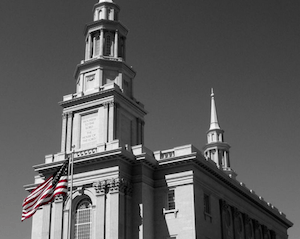
Temple front (Photo by Lizzy Gruber)
But really, Inga, this epitomizes the old saw that the it’s not Johnny who is out of step but the rest of the troop. Johnny is in step and in fact the rest of the troop is out of step. From the standpoint of any reasonable outlook on our built environment, not to mention the sentiments of the public, the Mormon temple is in step with what the times ought to be, and most of the clunkers nearby, seen in the picture on top, are out of step.
As Saffron points out, the temple was designed by a pair of firms better known for modernist buildings – or, as she puts it, “modern buildings” – as if a new building just erected were not by definition a modern building. Not modernist, necessarily, but modern. It is by such rhetorical flim-flam that the modernists maintain their stranglehold on culture. I wonder whether here Saffron is praising the two firms or chiding them:
The double-spired temple was jointly designed by two firms that generally are in the habit of making modern buildings, Perkins & Will in Atlanta and FKKR Architects in Salt Lake City, but they have gone all-in to make the Mormon sacred center a credible classical building.
Although I hold them in contempt of beauty for most of their work, I praise them here because they have courageously embraced real architecture, be it as an experiment, a sop to profit, or a joke. Any way you slice it, good for them! What the mainline architecture firms around the country and around the world don’t realize is that if they were to start designing buildings people liked, their profits would soar.
Classicists on the TradArch list have been mulling over this design, noting that the Mormons’ attempts at classical churches in recent decades give off more than a whiff of the McMansion. Here is architect Daniel Morales:
I see all the faults you see and more, but I also see them in many historical classical buildings. The pilasters are too crowded, the plinths unrelated, the entablature above the ground floor has a stunted cornice, and the spire seems to slump away from where it should have risen. More importantly though, I see an affirmation that this kind of attention to detail and the unapologetic attempt to create beauty from a tested language bodes well for us.
Those are the kinds of details I lack the erudition to pick up on, and so do most people, which is why they like classical more than modernism – the latter’s details are almost entirely obnoxious to normal, intuitive human sensibilities, while classical details need not be perfectly canonical (or perfectly noncanonical) to be perceived by most people as lovely.
But Saffron cannot move briskly along that archi-critical highway without her blinders on, so she concludes:
Some might wonder why the Mormons chose the early American architectural style. Many of their most beloved temples, like the one in Washington, are unrepentantly modern.
Most beloved of highfallutin critics like you, Inga, not most people. If the only Mormon temple in a community is modernist, it will be popular with its congregation, which has no choice in the matter. Like most congregations condemned to worship in the various versions of the Church of St. George Jetson, such ecclessiastical abominations only make it harder for believers to figure out the mysterious ways of the Lord.
Chapeaux off to Kristen Richards, who put Saffron’s piece on the entirely indispensable ArchNewsNow.com, which reminded me I should check out those TradArch emails.
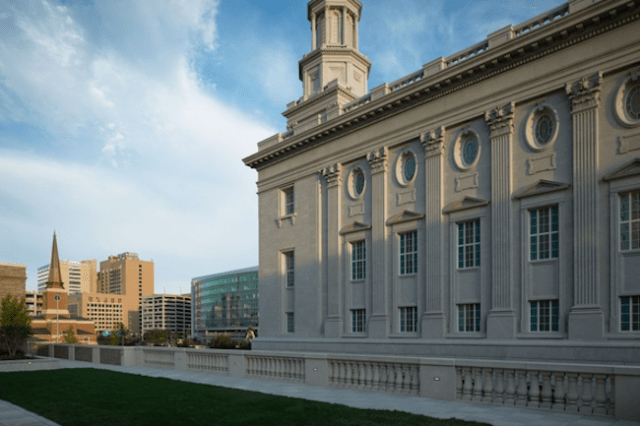
Side facade of temple. (phillymag.com/Intellectual Reserve Inc.)














 Architecture Here and There