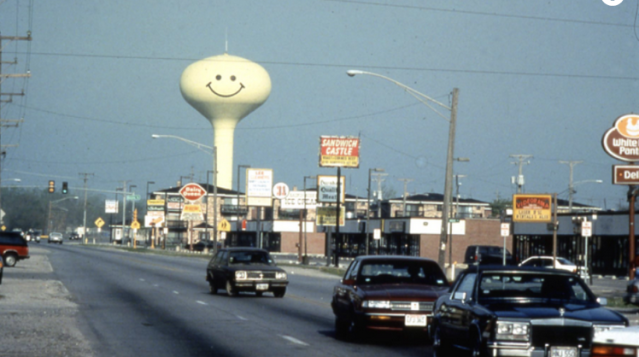
Suburban strip malls epitomize “The Landscape of Despair.” (Courtesy of Jim Kunstler)
In my post on Tuesday, “Alien spaceship in Alberta!,” author and iconoclast James Howard Kunstler tagged Edmonton’s new Deconstructivist library as August’s “Eyesore of the Month.” (The name pegs the style as accurately as that of Brutalism.) Well, as they say, ugly is as ugly does, and that building certainly does not stop at merely searing the eye.
“What you’re witnessing,” wrote Kunstler, “is western civilization incrementally losing its dignity, along with its heart, soul, and mind.”
It turns out that Kunstler had just that same day published “The Landscape of Despair: How Our Cities and Towns Are Killing Us” in the Daily Caller magazine. He paints a vivid portait of one possible explanation for the mass shootings in America: how ugly places destroy the human spirit. “[W]hat is uniformly overlooked about the current scene,” he writes, “is the physical arrangement of daily life on the American landscape, how it affects us in unreckoned ways, and what a tragic fiasco it has become.”
While the phenomenon Kunstler criticizes is destroying cities as well, here he aims his barbs primarily at suburbia. He notes that audience members at his frequent lectures wonder at how every crudscape boulevard, no matter how ritzy the surrounding suburbs, looks the same. The second complaint is always “It’s all so ugly!” Yes it is, he adds. But it’s even worse:
What you’re seeing out there in all those clownish burger sheds, unvarying big-box stores, office “parks,” and boring tract houses is not mere ugliness. It represents something much more profoundly malign. This immersive ugliness is entropy-made-visible. Entropy is the force in the physical universe that drives things toward stasis and death. Entropy is what you want to steer clear of as much as possible. Living in an entropy-saturated environment is not good for you. Your brain processes the message that it sends out — this way toward death! — if perhaps only subliminally … and the mind revolts.
He continues:
It is a powerful message. It must make Americans deeply depressed and anxious. Being immersed in suburbia, we barely register the pain it inflicts on us. It’s monotonous without being tranquil. The illegible cacophony of signage distresses your neurology. There is no reward in being there. The entire ensemble functions as a kind of uninvited punishment. It is literally disorienting in the sense that it might be anyplace.
Indeed, it is nigh on to everyplace! Kunstler notes that anyplace is an abstraction that lacks the required specificity of home.
This is what has disappeared over the past three-quarter’s of a century of modern architecture and planning, which has only recently experienced a burp of resistance as traditional building has struggled to reassert itself, with a huge assist from historic preservation – a mass movement that emerged suddenly after little more than a decade of urban renewal. Normal citizens were literally “scared straight” by the prospect of modernist houses and developments looming over neighborhoods in which they’d invested their lives and their fortunes. Kunstler describes what has largely been lost but could still be revived:
There are well-established methods for the design and assembly of human habitats that are worth living in, but you get very little of that in the USA. Even our “best” cities have become demolition derbies. What is especially absent, as I have averred to earlier, is artistry consciously applied to our surroundings. You can lay some of the blame for that on the dogmas of modernism, since the schools of architecture are marinated in it, especially the hatred of ornament, which means we’re forbidden a visual language to communicate our connection to nature (that is, everything in the universe). In fact, modernism has amounted to a campaign to explicitly denature the human project. …
The neurotic reaction is the wish to scrub any signs of dangerous human expression from the buildings we live among. Along with that, we have erased anything that might amount to charm, the quality of being grateful to be alive in the first place. A life without charm is a zombie existence spent in places not worth caring about.
The eyesore of the library in Edmonton, Alberta, darkening the spirit of its downtown square, is only the latest manifestation of this zombie culture in our cities. Only a few American cities have more than a smidgeon of cultured architecture remaining. My post of a few days ago, “City hall as happening place,” shows the same dark phenomenon as Edmonton’s library cavorting around in happyface. What of the public realm, indeed the very town halls where the public’s business is transacted? Kunstler keenly regrets that the typical town official can’t begin to imagine that it matters a tinker’s damn what town hall actually looks like.
But it does matter. Because every crummy town hall in America on a boulevard of chain stores damages the public realm and what it represents: the common good. The public realm is the physical manifestation of the common good. When you dishonor the public realm, you will dishonor the common good, and that is exactly how it has gone with us for the past several generations. And that damage has now manifested in grotesque crimes against the public in the public realm.
It’s not incidental that some of our worst buildings are the giant centralized schools, designed as if they were aircraft assembly plants or insecticide factories. They are ill-conceived in too many ways to count. Their size alone creates an alienating zone of estrangement in which students are ciphers rather than persons. This manner of supposed education sets off some of the worst tribal instincts in the kids, who desperately need to identify with something. And there is always a leftover cohort of kids who either can’t identify with others in such a bewildering setting, or are rejected by the tribes and cliques that self-organize as a defense against estrangement. … Is there more than a tiny chance that some of the kids subjected to this alienating environment, and these pressures, might grow homicidally enraged at those around them?
The only way I can hope to convey any real sense of the depth of sensibility that characterizes Kunstler’s description is to urge readers to read the whole essay. But he continues, getting down to the nub of the issue:
Then consider the milieu outside of school: a tract house in some dreary matrix of identical houses physically separated from the civic and commercial infrastructure of the “town” (if you can even call it that) by the zoning laws. If the two-parent household is intact (statistically unlikely), both parents are liable to be at work when that alienated kid is delivered home by the yellow school bus. He’s too young to have driver’s license, and anyway none of the family cars are available, so he’s stuck there. At home, the kid has access to movies and TV shows that valorize acts of extreme violence, or he can play video games in which he gets to play the “shooter,” which can amount to tactical training for mass murder. When that gets boring, he can divert himself with free online porn and self-pleasuring, which afterward only tends to re-emphasize his aloneness, lack of connection, and desperate longing for affection and meaning. He knows he did not create this socially impoverished environment and all its punishments. Perhaps the kid has been able to score drugs at school, another layer of reality distortion. After a dinner by himself of microwaved burritos — mom and dad have long commutes — he listens to some “death metal” music or some rap about being a violent gangster. He falls asleep immersed in grievances and fantasies about avenging them.
Aren’t you a little surprised that we don’t have more school shootings?
The question answers itself. But wait, there’s more:
We’re entering a new age of greatly reduced expectations and activities brought about by resource and capital scarcity. The colossal matrix of suburbia itself has three plausible destinies, none of them mutually exclusive: slums, salvage, and ruins. The furnishings and accessories of suburbia are already in trouble. The mortgage train-wreck of 2008 signaled the beginning of the end of single-family home suburbia. (The young generation, locked into the college loan repayment treadmill, may never be able to buy a house.) The collapse of “brick-and-mortar” retail is the next shoe to drop. Ultimately, Internet retail will follow, since it is based on the absurd proposition that every item bought in this land must make a long journey by truck to its destination. It seemed like a good idea at the time. Eventually, new systems of downscaled regional and local commerce will self-reorganize emergently. The next mall will be your old Main Street.
Kunstler sees this degenerative trend in retail (which may take longer to unravel than he sometimes seems to think) matched by our school systems, which will devolve into various systemic iterations of home schooling – and perhaps not a moment too soon.
This brings to mind Kunstler’s deft series of “World Built by Hand” novels, which depict our world – including the strangely enchanting aspects of its revival – after the pyramid scheme of crises he describes and deplores has already toppled civilization as we know it. They are a very effective sort of non-science fiction, all of which I have read and enjoyed.
I must not conclude without a shout-out to Prof. Nikos Salingaros, the mathematician and design theorist at the University of Texas (San Antonio), who addresses with equal vigor, from the perspective of neuroscience, how ugly modern architecture causes both sick cities and personal illness, physical and mental, among their occupants. Beauty is not just in the eye of the beholder, sez Mother Nature.
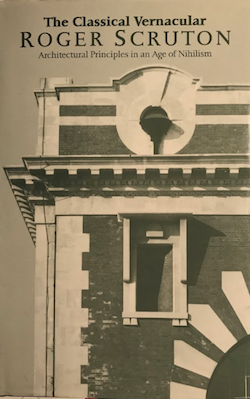
But I do want to end this extended blog post on Kunstler’s longstanding analysis of society’s miasma on a more positive note. This passage is from Sir Roger Scruton’s 1995 book, The Classical Vernacular: Architectural Principles in an Age of Nihilism – one of my bibles. He describes what societies across the globe have abandoned, which we can have back anytime we want, basically just by asking. But first we must realize that it is what we want:
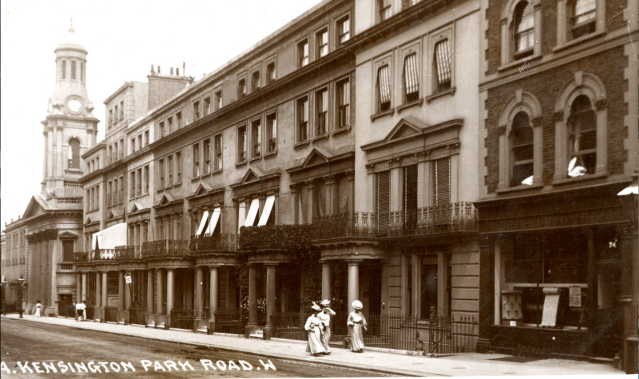
The classical idiom does not so much impose unity as make diversity agreeable. The London street in which I live contains houses of every shape and size, arranged behind façades that stand politely beside one another. The porticos are identical, as are the window frames – each being cobbled together from standard parts. No house obtrudes into the path of the pedestrian, but each meets the pavement with obvious signs of welcome. The windows, crowned by moulded architraves, have that kind of half-smiling look which permits you to glance into them; the flight of steps softens the approach to the door, and provides a useful area of neutral ground between the public and the private. … The classical wall, which is humanly proportioned, safe, gregarious, and quietly vigilant, constantly reminds the pedestrian that he is not alone, that he is in a world of human encounter, and that he must match the good manners of the wall which guides him.












 Architecture Here and There