Hardscrabble and Snowtown

Screen Shot 2019-11-23 at 4.46.38 PM.png

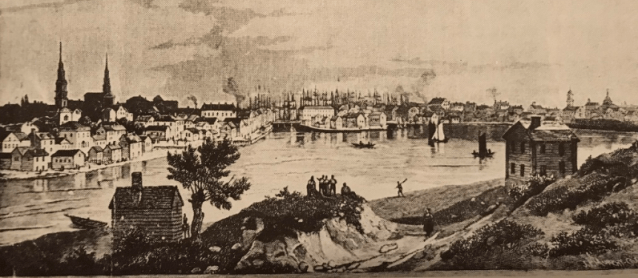
Town of Providence in 1827, with Snowtown-to-be in foreground. (engraving by J.P. Murphy)

Hardscrabble in 1824 was a poor hamlet of respectable families headed mostly by free black tradesmen, craftsmen and servants in the town of Providence. Blacks and others along Olney Lane (now Olney Street) lived cheek by jowl, however, with prostitutes, gamblers and others of low repute on the edges of society. On Oct. 18, an altercation arose over the right of precedence on local sidewalks, leading to an attack by a mob of tough whites on Hardscrabble that left seven houses demolished and four others damaged, but no deaths. The riot occurred two years after black suffrage (passed in 1784 and already eroded by intimidation) had been abolished by the Rhode Island General Assembly.

Many residents of Hardscrabble moved to the marshy land on the north edge of the Cove, beneath the bluff upon which the new Rhode Island State House would be opened in 1901. The settlement came to be known as Snowtown, which assumed many of Hardscrabble’s desultory characteristics and even suffered its own riot in 1831.

The following passage from my Feb. 24, 2005, column “Hardscrabble and Snowtown of yore” was taken from sources of the period, including the newly founded Providence Journal (my old employer), and I make no claim for its accuracy, but it reflects the story handed down since by established interests, whose characteristics are part of the discussion now arising about the lives of blacks in old Providence.

The Snowtown riots, on Sept. 21-24, 1831, were sparked by a saloon brawl. A white sailor was shot by a black; a mob then sacked houses on Olney’s Lane [that is, Hardscrabble]. The next day, it pulled down more houses. On the third day, the militia maintained calm. On the fourth, a thousand rioters crossed the Moshassuck to attack Snowtown, almost overwhelming the 140 members of the First Light Infantry. After rioters ignored warnings from the sheriff and Gov. Lemuel Arnold, the militia fired first into the air, with no effect, and then into the mob, killing four whites.

Most citizens of Providence today have never heard of Snowtown or Hardscrabble, or either of the two riots. This important interlude amid the growth of New England abolitionist sentiment in the run-up to the Civil War has dropped off the historical map around here. Some people are trying to fix that.

Thursday evening, at the Congdon Street Baptist Church on the East Side of Providence, I sat in on a meeting convened by associates of the State House Restoration Society. They were mostly young historians, art and design professionals and students eager to revive the memory of the village of Snowtown. It’s going to be a tough job, but advocates for a place harboring dens of iniquity from prostitution to gambling in a mixture of skin colors two centuries ago already know that.

The meeting followed by just a month the display of artifacts at the old State House from an archaeological dig of the Snowtown site in 1981. These items have been recatalogued by Heather Olson, of Public Archeaology Laboratory, in Pawtucket. Olson showed some of the dig’s 148,000 artifacts, mostly household items, some quite fancy given the status of the hamlet. She explained the difficult history of Snowtown. The restoration society and its friends are building on her work, and hope to draw other organizations into the rememorization for Snowtown.

To be successful at generating more institutional interest, the group might want to consider officially expanding the scope of the story beyond Snowtown to include Hardscrabble, whose existence and whose riot came first. Although what had been Snowtown is populated, in daytime, mostly by the people’s representatives and their offices, that community’s interest may well be better engaged if they hear from the current population of what was once Hardscrabble.

The neighborhood of Mount Hope takes in the vicinity of Olney Lane to North Main to Hope Street. University Heights, at the corner of Olney and North Main, designed by the nation’s leading midcentury architect of shopping centers, was an urban renewal project that displaced hundreds of families in the Lippitt Hill district of Mount Hope, during the 1960s, pulling down their homes with much more efficiency and perhaps more brutality than the rioters of 1824 and 1831.

Activist and bookman Ray Rickman has already been gathering their stories. He and other local community reservoirs of knowledge and interest – such as the Rhode Island Historical Society – can more effectively bear witness to lost history if the comingling of memories representing the ghosts of Snowtown, Hardscrabble and Lippitt Hill can all be given voice.

(A lengthy essay by Washington lawyer John Crouch, “Providence Newspapers and the Racist Riots of 1824 and 1831,” has fascinating quotations and details about local newspapers’ coverage of the two riots.)
Posted in Architecture, Providence | Tagged , , , , , , , , | 2 Comments

Save the Frick Music Room

Screen Shot 2019-11-18 at 10.37.26 PM.png

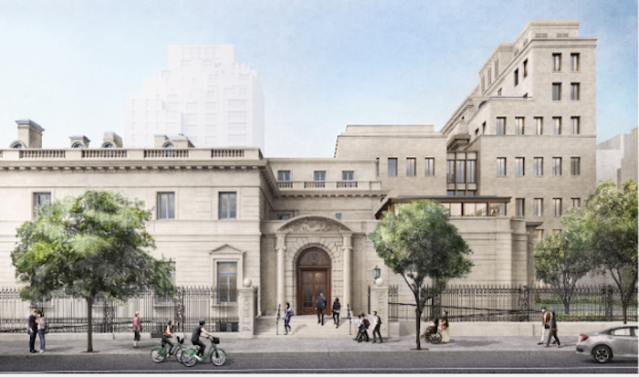
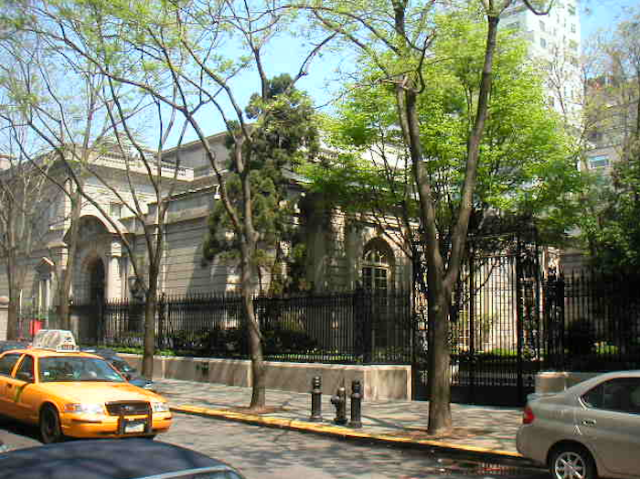
The Frick Collection, 70th Street facade. (ny-architecture.com)

Boards of institutions always seem to want to do more for the institution than the institution needs. And whenever a board proposes to do something, it is normally more than is judicious, often a lot more – a unwitting attack on the values of the institution itself.

Exhibit One: The proposal to stuff more stuff into the Frick Collection, the house museum cum art gallery on Fifth Avenue in Manhattan. The board of the Frick has proposed more than a few abortive renovations of late and finally decided to push one of relative modesty by modernist Annabelle Selldorf. Even I supported the Selldorf plan when it was unveiled, because Selldorf’s exterior revisions seemed to be at least minimally classical, not modernist as is invariably the expectation. It is important to show the public that new classical work of a high order can be done, and that beauty is not something lost to the past.

Such demonstrations are rare. My favorite is the 1990 classical addition to the 1904 John Carter Brown Library, on the Brown University campus in Providence. God, what a row that must have caused when first proposed! Its board deserves congratulations, as does the huge firm of Hartman-Cox, from Washington, D.C., which designed an addition slightly less rococo than the original, something virtually unheard of then. Beautiful!

Similar exterior changes were offered by Selldorf for the Frick, and approved last year by the city’s Landmarks Preservation Commission. Unfortunately, in attempting to shoehorn new space into the building, Selldorf proposes to demolish the circular Music Room, designed by John Russell Pope in the 1930s, and the Reception Hall, designed by John Barrington Bayley in the 1970s. Both were additions to the original 1914 mansion of steel magnate Henry Clay Frick on Fifth Avenue, designed by Thomas Hastings, but were so well conceived that the luxuriant domesticity of the house was enhanced.

Critic Catesby Leigh, writing in City Journal, the quarterly of the Manhattan Institute, describes in “Degrading a Masterpiece” the complex give and take supposedly needed to accomplish the expansion that the Frick board desires:

The plans have some positive aspects. It will be wonderful for visitors to climb the original mansion’s grand staircase to the second floor, where Pope converted family quarters into museum offices. These will now be used for the exhibition of small paintings, drawings, and works of decorative art. And the Frick has long emphasized its need for a larger auditorium, better conservation facilities, and better accommodations for school groups. But to degrade the existing house museum would be a terrible mistake.

Here Leigh, with his inimitable facility for painting architecture in words, describes why the Music Room must be saved:

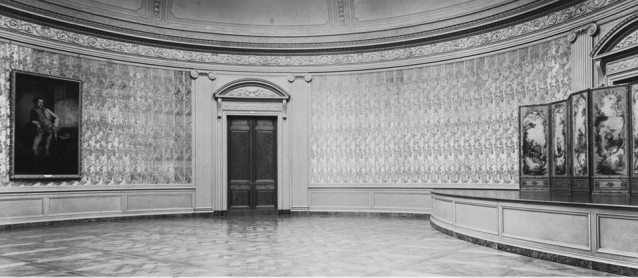
Pope’s Music Room—mainly used for film screenings and lectures but best known as a much-loved chamber music venue—opens off one side of the Garden Court by way of two handsome little lunette-shaped, wood-paneled vestibules that reconcile the court’s rectangular plan with the Music Room’s circular form. Such refined architectural sequences are one of the Frick’s glories. Above the wainscot, the wall of the Music Room is covered in golden damask enriched with a leafy sylvan pattern. A floral rinceau runs along the frieze above. Elegant doorways are framed by Ionic pilasters. The flat ceiling extends from a cove, with ornamented ribs extending from the circular skylight’s elaborately molded frame. This room would make an excellent special exhibition gallery, and in fact it was designed to serve as a gallery. It is an essential part of one of the most superbly orchestrated spatial ensembles America has to offer. Along with the rest of this ensemble, it should be left intact.

Leigh adds:

[Selldorf] and the Frick want to atone for the destruction of the Music Room and its vestibules by retaining the room’s original doorways. But great architecture, in a room as in a building, is like a great painting or sculptural work, in which every form reinforces every other form in constituting a whole that is not only greater than the sum of its parts, but that casts a spell—precisely because of its formal consistency. Where’s the magic in retaining beautiful doorways that simply point to the poverty of their new architectural setting? …

In informing the New York Times that she wanted her Frick renovation to “have its own identity,” Selldorf gave the Pope-Bayley precedent the boot and demonstrated that she is the wrong architect for the job.

Soon the board will take its plans to the city’s Board of Standards and Appeals, the last chance to pause before committing an unforgivable desecration. Let’s hope that board will read Catesby Leigh’s insightful assessment, which all viewers of this post should read in its entirety.

The Frick constitutes a single artistic entity that flows through Hastings, Pope and Bayley over six decades without a burp of aesthetic inconsistency. These sorts of architectural masterpieces are increasingly rare in New York, indeed in America. If the Frick’s board wants to stuff more stuff into the Frick, let it buy another building nearby and park its ambitions there.

Screen Shot 2019-11-18 at 10.43.58 PM.png

The Music Room in 1935. (frick.org)

Screen Shot 2019-11-18 at 10.35.21 PM.png

Rendering of proposed Frick renovation, 70th Street facade. (Selldorf)

Posted in Architecture, Preservation | Tagged , , , , , , , , | 2 Comments

A view of Providence in 1808

Screen Shot 2019-11-15 at 7.15.49 PM.png

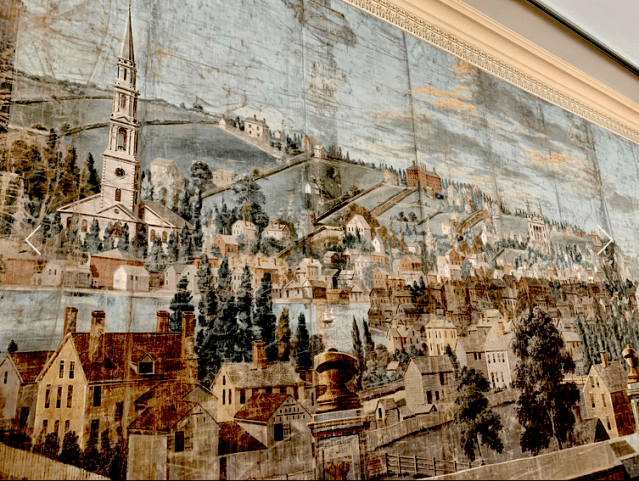
Partial view of the drop curtain at Rhode Island Historical Society. (Fox28Media.com)

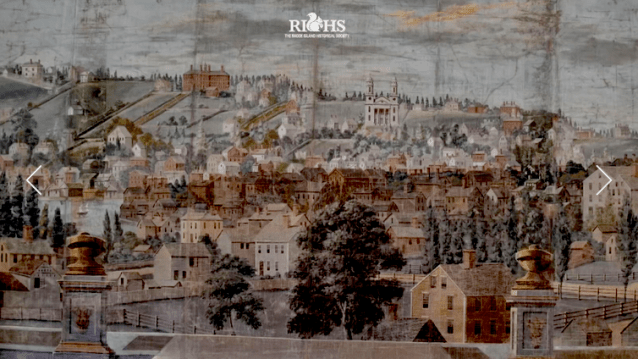
The Rhode Island Historical Society yesterday displayed its amazing 1809 drop curtain, owned by the society since 1833 and depicting the town as it appeared in 1808, twenty years before the Providence Arcade was built in 1828. It is thought to be the oldest curtain of its kind in America.

I dropped in to see it near the end of celebratory viewing hours of 1 p.m. to 5 p.m, and while I had long been familiar with its existence and had seen it in books on Providence history and architecture, one must see it in person to understand how fully it is charged with the energy of time and place.

John Worrall, a scenery painter and pantomime dancer at the first theater constructed in Providence, on the site of what is now Grace Church, seems to have daubed the curtain from a vantage point on Federal Hill. You can see the easterly edge of what was then still a residential area, the Providence River flowing beyond, and beyond that College Hill, then called “The Neck.” Brown University, founded in 1764, became Brown, named for the prominent family of donors, merely five years before the curtain was painted. University Hall, built soon after the college moved from Warren, R.I., to Providence in 1770, can be seen in the above image along a seam of the curtain, whose ten linen panels total 24 feet across and reach up 15 feet.

The curtain raises a number of questions for your architectural sleuth. For example, the road that proceeds downhill from University Hall (still called the College Edifice in 1809) must eventually have become College Street, at the bottom of which you’d think would be Weybosset Bridge, erected in 1663 and replaced five times before 1809. But the bridge cannot be seen, perhaps because it is behind a stand of trees on the near side of the river.

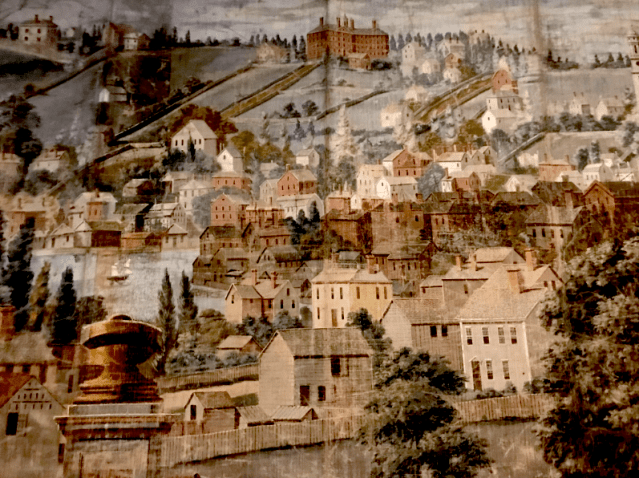
Where is it? The first image below is a closeup taken Thursday by me of that segment. It does not show in the minimal space between the trees. Perhaps the existence of the trees offered Worrall the opportunity not to paint the bridge. Or, perhaps, for the same reason, he painted in a stand of trees that did not exist. Hard to know, but fun to speculate! The bridge was destroyed seven years later in the Great Gale of 1815 and rebuilt twice as wide.

Or maybe the bridge that existed in 1808 is hidden behind houses along what seems to be the narrower southern stretch of the river, which seems to widen just right of the stand of trees. The six-map analysis of the changing banks of the river by John Hutchins Cady, which I discuss in Chapter 13, “The Widest Bridge in the World,” in my Lost Providence (2017), bears out that possibility. The third map in that progression shows the Cove (not the Cove Basin, built later on the Woonasquatucket River). So it was indeed those houses that excused Worrall from painting the bridge. Brilliant deduction, Sherlock!

(I have taken the liberty of enhancing the contrast of the images above and below. The conservation of the curtain, by Curtains Without Borders, did not attempt to erase the dimming effect of time but to fill in imagery rubbed by folding and wear, mostly along the seams of the panels. Marvelous as it is, this was not, after all, the restoration of Michaelangelo’s Sistine Chapel.)

It looks as if the western embankment of the river, nearest the observer, is more densely occupied than College Hill itself. Of course, unlike on College Hill, most of the early structures on the Weybosset Neck were torn down and replaced, maybe once or twice or more, by the structures that now make up today’s downtown. Some of the houses on the west side of College Hill that were there in 1808 still exist today. No doubt a few are on the curtain. It is hard to know whether the houses painted onto the far side of the river are accurate or artistic renderings of what houses there were like in 1808, so that Worrall could generalize the appearance of each house he drew. The truth is probably somewhere in between. It is even harder to ascertain the accuracy of the houses on the near side of the river, since they are certainly all gone.

If I come across an analysis of the drop curtain’s depiction of Providence that answers some of these questions, I will report dutifully to the readership. In the meantime, feel free to speculate based on the images above and below – better yet, visit the RIHS at Aldrich House, 110 Benevolent St. – and I will be glad to publish the most interesting speculations. (Below, the first three images proceed from north to south, with the fourth about three-quarters of the view, mostly to the north, and the last most of the view, including most of the southern portion, photographed by the RIHS.)

Screen Shot 2019-11-15 at 7.33.57 PM.png

Screen Shot 2019-11-15 at 7.33.41 PM.png

Screen Shot 2019-11-15 at 7.33.16 PM.png

Screen Shot 2019-11-15 at 7.34.38 PM.png

Screen Shot 2019-11-16 at 9.02.36 AM.png

Posted in Architecture History, Providence | Tagged , , , , , , | 7 Comments

Why the folks hate the mods

Screen Shot 2019-11-13 at 10.20.15 PM.png

Philip Johnson in front of his more famous glass house. (photo by David McLane)

Mark Lamster’s The Man in the Glass House continues to offer up examples of Philip Johnson’s dislikeability, many of which amount to reasons why people dislike modern architecture. The following passage comes after Lamster has described how Johnson struck out in his effort to join up with Huey Long, the governor and dictator of Louisiana. One of Long’s staffers urged Johnson (and his sidekick Alan Blackburn) to go back to Ohio and work for Long by organizing in Johnson’s home state. Johnson agreed, and moved to tiny New London, southwest of his hometown, Cleveland.

Upon arrival, Johnson’s first order of business was a renovation of his grandmother’s house, which sat in the center of town. The principle change entailed knocking out a large section of the front wall of the house and installing in its place a floor-to-ceiling plate-glass window looking out on the street – “the largest piece of glass anyone had ever seen in Ohio. …

Johnson and Blackburn quickly drew the suspicion of the town’s respectable citizens. Who were these bachelor interlopers, men of means from the big city [New York, not Cleveland], living together in a house with an unusual design of their own making?

I could not find a photo of the house. Why did Johnson inflict it on his neighbors? Maybe he was still sore at failing to latch on with Huey Long’s team. Maybe he decided to take it out on the citizens of New London. That’s just my guess. Lamster makes no such suggestion. But he does look into why Johnson wanted to hook up with Long in the first place:

The idea that Long might serve as a model for Johnson and Blackburn was born of [fellow activist Lawrence] Dennis. “It will take a man like Long to lead the masses,” he said. “I think Long’s smarter than Hitler, but he needs a good brain trust. … He needs a Goebbels.”

Even more provocative are the recollections of Johnson’s former secretary:

Secretly, Johnson had grander ambitions. He was not interested in just being a member of Long’s “brain trust.” When interviewed in 1942, Johnson’s former secretary Ruth Merrill told the FBI that Johnson believed “the fate of the country” rested on his shoulders, and that “he wanted to be the ‘Hitler’ in the United States.” His desire to join Long as an adviser was a means to that end. “By joining with Huey Long he could eventually depose Huey Long from control of the country and gain control of it for himself,” Merrill told the FBI.” Whether that meant assassination or a bloodless coup was unstated.

And in 1935, Long, by then a U.S. senator, was assassinated in Louisiana.

These years when Johnson went into American politics to promote fascism are not as well known as the time he spent in Germany following the Nazis. Most of these efforts came after his role in curating the famous International Stye exhibit at New York’s Museum of Modern Art in 1932. His fascist period lasted at least a decade. Then he refocused on architecture, after which he covered up his fascist sympathies and went into deep denial – with the help of the U.S. architectural establishment, which continues – though Lamster’s book should put a dent in it.

On a personal note, I was intrigued to learn of where Johnson got his wish to meet Huey Long after he was elected to the U.S. Senate. Johnson had been kept at arms length by Long’s staff during Johnson and Blackburn’s stay in Baton Rouge and then, after the election, on the train to Washington to set up the new senator’s office:

The two tourists [Johnson and Blackburn] finally got to meet the tousle-haired Kingfish [Long’s nickname] in Washington [D.C.]. The hallowed event took place at the Broadmoor, the Connecticut Avenue hotel that was Long’s base of operations in the capital. He received the two in pajamas, as was his wont (he preferred purple silk), and the conversation was brief.

When I was a young teen I delivered the Daily News, an afternoon paper absorbed in 1972 by the Washington Star (an afternoon daily I also delivered; the Post was a morning paper – not for me! – and, in those days, too fat for my skinny arms). A couple dozen of my customers lived in the Broadmoor, an over-the-top beautiful pile in a hybrid style that was an apartment building by the time I slid papers down its carpeted hallways.

Screen Shot 2019-11-13 at 10.07.00 PM.png

The Broadmoor, originally a hotel and later apartments in D.C. (vintprint.com)

Posted in Architecture, Architecture History | Tagged , , , , , , , , , | 4 Comments

Lessons of the Berlin Wall

Screen Shot 2019-11-10 at 10.07.26 PM.png

Berlin Wall on Nov. 9, 1989, prior to its physical demolition. (Wikipedia)

Yesterday was the 30th anniversary of the fall of the Berlin Wall. Many lessons have been learned, but this post will not, of course, comment on its geopolitical takeaways. Instead, and briefly, I hope a useful parallel can be drawn between the swift end of the Cold War and the possibility of such an end to the style wars of architecture. Modernism deserves a seat alongside communism on the ash heap of history.

The parallel has to do with timing. The Cold War came to an unexpected end at the end of the 1980s. Forty years of confrontation, then poof! – it was all over. The same might happen in architecture, with popular traditional styles suddenly coming out of nowhere to defeat officially dominant, intellectually vapid and arguably authoritarian styles of modernism.

Screen Shot 2019-11-10 at 10.11.05 PM.png

Reagan statue unveiled Friday. Note restoration of Brandenburg Gate. (dw.com)

Historians still argue over what brought an end to the Cold War. Many strands of history contributed. The magnificent collapse of Warsaw Pact dominoes probably would not have occurred, however, if President Reagan had not switched to offense. On Friday a statue was unveiled in Berlin to commemorate the 40th president. If he had not decided to replace three decades of “containment” policy with his hugely controversial hard line, the Cold War might still be with us.

Is there anything in architecture’s style wars that compares with the strategies Reagan used to win the Cold War?

Without the preservation movement, there would by now be little left of old buildings and neighborhoods on which to model a classical revival. Without the Congress of the New Urbanism, there might be no new towns, villages and city districts to teach the public that beauty remains a viable approach to our built environment. Without the Institute of Classical Architecture & Art, the principles that had created successful cities and towns for thousands of years around the world would have no soapbox to speak truth to the power of the modernist establishment. And yet, after years of major victories in the fight, all three venerable institutions display evidence of being pooped.

I have spent the last two or three hours trying to keep to a reasonable space the many permutations a comparison of possibilities might take. I have cut out more paragraphs than the number remaining in this post. I gave up and put off the heavy lifting for another day. Surely, sudden victory in the Cold War must have been harder to win than sudden victory in the style wars of architecture. It can happen – most likely, perhaps, if no one expects it.

Posted in Architecture, Architecture History | Tagged , , , , , | 14 Comments

Johnson’s risky functionalism

Screen Shot 2019-11-09 at 10.07.35 AM.png

Eddie Warburg’s Manhattan apartment designed by Philip Johnson. (USModern)

Philip Johnson, the modernist architect who tricked America into embracing modern architecture, was a nasty piece of work according to Mark Lamster’s book, The Man in the Glass House. But there are some humorous passages whose inclusion reflects Lamster’s ability to use modernist silliness to tickle the funny bone of his readers. Johnson’s first real commission as an architect, in 1933, was to design a Manhattan apartment for his wealthy friend, fellow libertine and son of a Jewish banker, Eddie Warburg. Of Johnson’s design for the small fourth-floor walkup on Beekman Place, Lamster writes:

Screen Shot 2019-11-09 at 10.06.59 AM.png

Risky desk chair at Warburg flat.

When he was done, the apartment was transformed into a statement of nearly clinical modern gravity, with whitewashed walls and an exposed radiator. The floor was linoleum, shiny and efficient, but the whole was not without luxury. A dividing wall of macassar ebony and space-defining floor-to-ceiling silk curtains brought a sense of material richness, borrowed directly from [Ludwig] Mies [van der Rohe]. Johnson designed much of the furniture, which was decidedly foursquare, as was his thinking. In the living room, two squared-off club chairs faced a squared-off sofa over a rectangular coffee table in black lacquer.

“The discipline was so violent,” Warburg recalled. “If you moved an object an inch it threw everything off kilter.” There was so little sound baffling that a dropped spoon sounded like a gunshot. Another problem surfaced when a dubious Felix Warburg climbed the four stories to inspect his son’s new digs. He sat himself at his son’s desk to make a phone call, and when he leaned forward his tubular chair clipped out from under him, slamming his chin into the desk. Eddie was mortified, but his father had a sense of humor. “That’s what I like about modern art,” he said. “It’s so functional.”

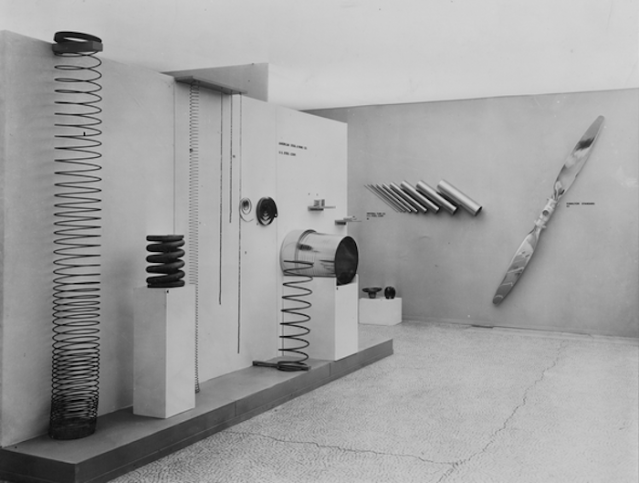
Speaking of functionality, Johnson had recently curated the famous exhibit on the so-called International Style at the Museum of Modern Art, and followed it up in 1934 with an exhibit at the MoMA on “Machine Art.” In its catalog, Johnson tried to persuade visitors to the exhibition that functional machinery shorn of decoration was inherently beautiful. Perhaps some of it is, but it must actually be, unlike the chair above, functional.

Screen Shot 2019-11-09 at 10.36.14 AM.png

“Machine Art” exhibition curated by Philip Johnson in 1934 at MoMA. (moma.org)

Posted in Architecture, Interior Design | Tagged , , , , , , , | 2 Comments

Philip Johnson’s MoMA flub

Screen Shot 2019-11-06 at 11.35.02 PM.png

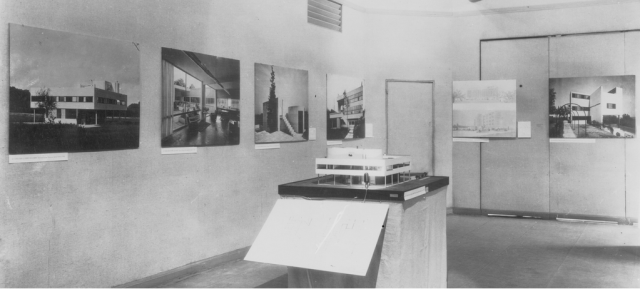
Exhibit at 1932 Museum of Modern Art. Model is of Le Corbusier’s Villa Savoye. (moma.org)

In his recently published biography of modernist architect and impresario Philip Johnson, Dallas Morning News architecture critic Mark Lamster has found so much to dislike in the man that I have been thoroughly enchanted – so far. But I want to quote a passage from The Man in the Glass House that threatened to soften me on Johnson. It is about how he muffed his speech proposing his and museum director (and close friend) Alfred Barr’s idea for an exhibit on the International Style to the board of the recently launched Museum of Modern Art. The trustees, it seems, were far more interested in modernist painting and sculpture than in modernist architecture, which was still very rare in America. Lamster writes:

Johnson had come before the trustees, at Alfred Barr’s request, to sell their planned exhibition of modern architecture. Barr expected his debonair protégé would charm with his wit and impress with his zeal for the subject that had been his veritable obsession over the past year. Johnson, he thought, would be a natural before the board. He was a product of the rarefied social world of the trustees, and he could speak to them in a suave but assured manner that would give them confidence.

But Johnson began fumbling the moment he was introduced. He had not prepared sufficiently, presuming that he could speak extemporaneously and that his knowledge and enthusiasm would carry the day. Instead he labored on, and as he did so he heard the sighs of board members who found their patience sorely tested. When he finished, there was silence. Then William T. Aldrich, [board treasurer] Mrs. [Abby Aldrich] Rockefeller’s priggish architect brother, a classicist of the old school, leaned over to advise her of his opinion: “It’s a lot of nonsense, my dear.”

Priggish or not, Aldrich was correct, uttering perhaps the understatement of the century. But Johnson soldiered onward, the famous exhibition was held in February 1932, and the rest is a very sad history for the world, much of it the fault of Johnson.

It must have pained the mod-symp Lamster to trash Johnson. His (Johnson’s) qualities as a first-class jackass shine through on every page, and I’ve only just reached the portion of the book that describes the opening of Johnson’s love affair with the Nazis. I’m sure those chapters will be a treasure chest of delicious passages. When the book begins to focus more on Johnson’s career as an architect, Lamster’s tone will surely become more forgiving. You can be sure I’ll let readers know if it doesn’t.

Posted in Architecture, Architecture History | Tagged , , , , , , | Leave a comment

Caretaker’s cottage is history

Screen Shot 2019-11-04 at 9.33.20 PM.png

Debris from demolition of the caretaker’s cottage at 315 Slater Ave. (Photo by author)

This photograph should shock you.

Shot this afternoon, it is what remains of the caretaker’s cottage (or carriage house) at the old Beresford-Nicholson estate on Blackstone Boulevard, in Providence. The address is 315 Slater Ave. It used to front on Slater, which curves round the rear of the grounds along a stone wall encased in ancient vines. Above the wall rises the cottage, which might have been the most romantic building in Providence – until last week, when it was razed.

Here is what the 1986 survey of Providence by the Rhode Island Historical Preservation & Heritage Commission says of the cottage:

315. William Beresford Carriage House (ca. 1909): Clarke, Howe & Homer, architects. A 1½-story, gable-and-hip-roof, stuccoed carriage house with servants’ quarters in the attic story. Designed in the English cottage mode of the early 20th century, it was later converted to a 1-family residence (see 288 Blackstone Boulevard).

The Beresford-Nicholson mansion was saved, and that was cheered as if Blackstone were somehow short of fancy mansions. Don’t get me wrong, I applaud the purchase, without which the mansion would be history, too. Does the new owner recognize what is likely to go up cheek by jowl on the six or eight residential parcels carved from the subdivision of the estate? In 1999, I moved from Benefit Street into the newly renovated Smith Building downtown across from the rollicking Met Café next to Lupo’s Heartbreak Hotel in the newly renovated Peerless Building. I’d heard at the time that applicants to rent a unit in the Smith were told that the Met was a coffee shop. Huh? What did the real-estate agent tell the prospective owners of the Beresford-Nicholson mansion was going to happen in their back yard?

Go look at what’s become of the Bodell estate nearby, which was subdivided recently into five plasticky spec “homes” while retaining its mansion. Even the last-to-be-built modernist house – seemingly designed to make those who bought their houses early feel like idiots – has now been completed, along with its inevitable undertow on neighborhood house values. Nicholson-Beresford’s new owner, behold your fate!

The fate of the caretaker’s cottage suggests the fate of Providence under the development policies that have hobbled the city for decades: Ignore the municipal zoning that protects the historic character of neighborhoods. Encourage developers to build whatever is most likely to mar the beauty of Providence. Erode the city’s most powerful but (alas!) delicate competitive advantage in its contest with other American cities. Undertake any proposal, so long as it is likely to undermine the city’s brand of historic beauty, even though steps to strengthen that brand would be cheap, popular with the public, and easy to implement.

Then watch the city go downhill, as it has for decades. We got a brief reprieve in the 1990s when the Providence River was uncovered and lined with lovely bridges, parks and walking paths that fit into our historic character. Our civic leaders predictably learned absolutely nothing from that, and today we are back on the downhill slide. Before long, Providence will reach a tipping point of no return, and will become just another typical themeless pudding of a midsized city. We are almost there now.

This is what the demise of the caretaker’s cottage means.

Screen Shot 2019-11-04 at 9.32.02 PM.png

Screen Shot 2019-11-04 at 9.35.28 PM.png

Screen Shot 2019-11-04 at 9.33.59 PM.png

Screen Shot 2019-11-04 at 10.56.12 PM.png

Screen Shot 2019-11-04 at 10.55.59 PM.png

Posted in Architecture, Development | Tagged , , , , , , , | 4 Comments

A “cauldron of perversions”

Screen Shot 2019-11-01 at 5.24.26 PM.png

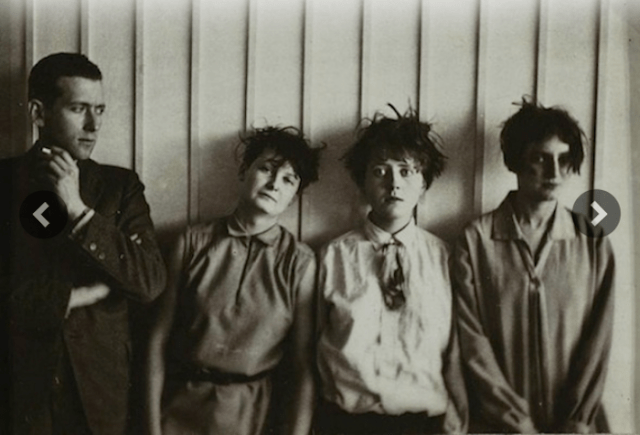
Caption by Metropolis: “Marcel Breuer and his “harem” (from left to right: Marta Erps, Katt Both, and Ruth Hollós-Consemüller), c. 1927. Stephan Consemüller/Photo: Bauhaus-Museum.”

I did a double-take when I saw, in Metropolis, the article “Far From Being a Temple to Rationality, the Bauhaus Was a Cauldron of Perversions,” by Beatriz Colomina. Of course, I knew that already, having read “Making Dystopia,” James Stevens Curl’s recent book on modern architecture. Professor Curl recounted the troubling history of the Bauhaus school, and deplored its perversions, leading me (for some demented reason) to expect more condemnation from Colomina.

She writes: “Bauhauslers were engaged with everything that escapes rationality: sexuality, violence, esoteric philosophies, occultism, disease, the psyche, pharmacology, extraterrestrial life, artificial intelligence, chance, the primitive, the fetish, the animal, plants, etc.” She piles on some more about Le Corbusier, who though not a Bauhausler was “arguably the single most influential architect of the 20th century”:

He was deeply into the occult, esoteric philosophies, sexual complexities, cross-dressing, scatology; he was also obsessed with the toilet, disease, nudism, body building, the animal, and the other.

Not to mention (which she doesn’t) adultery, dishonesty and fascism. Who could suppose that Corbu’s personal idiosyncrasies would be systematized at the Bauhaus?

Not what you’d expect of a school that developed a new architecture that emphasized rationality, honesty, worker housing and other high-flying principles. Far from deploring this history, however, Colomina greets the “deeply transgressive ideas and pedagogies” of the Bauhaus with celebration.

No doubt her article was written largely to get ahead of the curve on bad news that is emerging about the Bauhaus during the centennial of its founding in 1919. How, she must have wondered, can I give all that creepy stuff a positive spin? Well, Colomina is not a professor of architecture at Princeton for nothing.

She writes– but wait, there’s just too much really strange material in the article to go right into discussing Colomina’s spin analytics. So, please be patient. One more example:

The leather of Luftwaffe jackets used by fighter pilots and Berlin’s S&M and lesbian clubs made its way into the Bauhaus as a symbol of cultural rebellion and sensuality in clothes, both male and female. Chairs bound like corsets and leather straps lying around inexplicably in photographs suggest something illicit.

Okay, so let’s consider how she spins the Bauhaus school’s perversions:

Modern architecture is usually understood as having a normalizing function, establishing patterns that are stable, predictable, and to some extent standardized. The idea of architecture is intimately associated with the idea of the normal—perhaps it even sees itself as the caretaker of the normal. But the normal is not normal. It is a construction. There is a hidden tradition in architecture of the transgressive, work that crosses the lines of the normal, complicating these lines, threatening the limit.

Ah! The old French deconstructionist philosophy trick!

But first: No sensible reader can avoid quarreling with Colomina’s notion that modern architecture has “a normalizing function, establishing patterns that are stable, predictable,” etc. That may reasonably be said of the traditional architecture that modernism had evicted by 1950. Modern architecture is the opposite of all that, and has been recognized as such by almost everyone except its purveyors since the foundation of the Bauhaus.

Turning the abnormal into the normal (“normalizing” x, y or z abnormality) might be deemed the intellectual work of our modern culture this past half century. Inversion as a rhetorical tactic that can easily defeat itself. Colomina appears to have engaged in a triple inversion: she falsely associates modern architecture with stability and normality, then announces that “the normal is not normal. It is a construction,” and finally asks her readers to consider the abnormal normal. Whew! Jacques Derrida call your office!

In From Our House to Bauhaus, Tom Wolfe wrote that Corbusier’s logic “flies higher and higher in ever-decreasing concentric circles until, with one last utterly inevitable induction, he disappears up his own fundamental aperture.” Colomina, whose logic brings that quote to mind, adds:

Perversion comes from the Latin pervertere, “to turn away,” that is, turning away from normality. There is a relationship between the personal, often extreme, pathologies of Modern architecture and the call for a new normal. … [The Bauhaus school] was like a laboratory for inventing and intensifying perversions as a kind of pedagogical strategy. I am reclaiming here the term “perversion” from its pejorative use to a positive one, in the same way that the label “queer” was reclaimed in the 1980s by gay activists. In fact, inspired by my students at Princeton, I would like to make a call for a queering not just of the Bauhaus but of architectural history, starting with the way we read Modern architecture—what we see or choose not to see.

Actually, the Bauhaus and modern architecture were “queered” long ago, and no amount of tomfoolery over whether what we see is what we think we see can make it any more queer. (I hasten to add that I have used the word in its archaic meaning.)

This sort of spin might work on Colomina’s students or even the broader world of architecture-school faculty, but for most of them it’s carrying coals to Newcastle – esoteric matter that they internalized as students. It probably zooms over the head of most modern architects – who do what they learned in school and don’t give much thought to its philosophical origins, which give them a headache. The general public, who already have headaches from the prevailing dystopia, will never hear a word of it.

Sadly, Colomina’s project of normalizing the abnormal was accomplished decades ago. Modern architecture remains the default style of our time. Her mental gymnastics won’t prevent most people from being shocked by what was really going on at the Bauhaus, any less than they are irked by its impact on the built environment. Her thinking may be really fun and emit an exotic or even an erotic thrill, but that can’t prevent it from disappearing up her fundamental aperture, not to mention those of anyone whose thoughts about architecture still need to be “normalized” (that is, abnormalized).

I’d better end this post before it follows Colomina up where the sun don’t shine.

(Wolfe aficionados will note my stopping short before the end of the “fundamental aperture” quote, which concludes: “… and emerges in the fourth dimension as a needle-thin umber bird.” That was for a similar reason. To me it seems to risk gilding the lily. At least that’s not as bad as gilding the turd – or, shall we say, putting lipstick on a pig, which appears to be the academic specialty of Professor Colomina.)

Posted in Architecture, Architecture History | Tagged , , , , , , , , , | 7 Comments

Two fumbles in Providence

Screen Shot 2019-10-28 at 6.29.29 PM.png

The Homewood Suites Hotel, on Kennedy Plaza. (Photo by the author)

Among the eight or so new buildings erected in Providence with virtually zero opposition in the past two years are a pair that ought, by now, to have been reviewed here. And I will get to that. But first:

The Providence Journal last week ran an oped by local activist and bookman Ray Rickman titled “Say yes to new buildings.” His argument that Providence makes life difficult for developers drew a reply from Lew Dana (“Few oppose buildings that follow the rules“). Dana referred courteously to Rickman as “normally estimable”  but disputed his oped’s dubious claim. He wrote:

In the [Journal’s] latest damn-the-torpedoes, “build anything anywhere” blast, … the normally estimable Ray Rickman assures readers that opponents of new buildings are “disingenuous” and “vocal naysayers” with “inaccurate concerns.”

Look around at all the projects that have gone unopposed — because they follow the rules. They respect our city’s celebrated grace and human scale.

In fact, eight new buildings were completed in or near downtown since 2017. They are: the Wexford Innovation Center in the I-195 corridor, the River House apartments near the Point Street Bridge, the first of two proposed Edge College Hill residential towers on Canal Street, the low-rise Commons at Providence Station condos along the Moshassuck River in Capital Center, a Homewood Suites on Exchange Street, a Marriott Residence Inn on Fountain Street, a Woodspring Suites just outside of downtown on Corliss Street, and a large RISD dormitory near Prospect Street on College Hill. All eight of these had little or no opposition, let alone interference from city officials.

(Only the Fane tower, at a proposed six times the height originally passed into law for its parcel of land, has generated vigorous opposition.)

I would quarrel with Dana regarding the “grace” of these eight supposedly acceptable buildings and argue instead that all of them should have been opposed. All eight violate the city’s comprehensive plan and zoning, which require new buildings in downtown and in the Jewelry District to respect their historical character. That is a high bar and should be. It protects two entire districts, not just one parcel of land.

The two hotels that opened most recently are the best of the lot. They at least tried. They fumbled the ball: they did not betray the city by purposely running the ball in the wrong direction.

Both the Homewood Suites and the Marriott Residence Inn qualify as “bad trad” – that is, architecture that aspires to embrace Providence’s traditional character but fails. Neither hotel lives up to the standard set by an earlier but equally valid era. Both should have used more traditional features, including richer moldings on cornices and stringcourses, a deeper setting of windows into façades, piers or pilasters between ranks of windows to offer a greater sense of movement to façades, a gentler contrast in color between brickwork and precast stone, and the use of columns and statuary to animate exteriors and embellish entrances and other openings in the base of each hotel.

The Homewood hotel (top image) makes a better attempt than the Marriott (bottom) at living up to its pre-WWII neighbors, but both fall far short of the mark. Both look cheesy next to the old buildings that sit next to them: the Journal Building (1934) next to the Marriott; and, next to the Homewood, Union Station (1898) to its west and the Federal Annex (or Pastore) building (1940) to its south. More knowledge, not necessarily more money, could have served to fit both buildings more properly into their settings.

Providence has tried to market itself as different from other cities, even as it mimics other cities in creating the sort of architectural mish-mash that will never cohere into a legible urban character. Both advocates and opponents of new buildings in Providence fail to recognize the vitality of civic character. Buildings that build upon the city’s architectural heritage strengthen the city’s brand. Providence is losing its sense of place, which is its only genuine competitive advantage over almost every other city in America. Beauty is a key facet of the quality of life in a city with major problems that are much more difficult to solve than the architectural problems discussed here.

We may be thankful that the two “bad-trad” hotels tried to keep the city’s beauty in mind, and in so doing tried to leverage design to address larger crises. Their honorable attempt deserves applause, and a heartfelt program to increase developers’ and architects’ (and city officials’!) understanding of classical design principles and their validity even in our era.

***

I wrote this post assuming that Lew Dana’s fine letter would pre-empt the publication of my own letter or oped on the same topic (I submitted both a short and a long version). I just now [Monday evening] discovered that the oped was published online [and it was in the paper this morning]. Yay! It is called “Say no to ugly buildings.” A bit of this post cribs from the oped.

Screen Shot 2019-10-28 at 6.28.22 PM.png

The Marriott Suites Inn, next to the Providence Journal on site of old Fogarty Building.

Posted in Architecture, Development | Tagged , , , , , , , , | 3 Comments