Notre-Dame remains dicey

Screen Shot 2019-12-26 at 11.17.59 PM.png

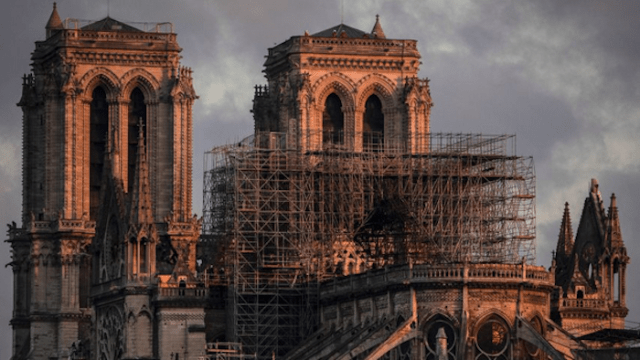
Scaffolding at Notre Dame; note triangular space where roof once stood. (Paris Muse)

It was recently reported that the annual Christmas mass at Notre-Dame de Paris will not take place for the first time since the French Revolution, and, by the way, the survival of the entire cathedral, most of which was thought to be saved, remains in doubt. The New York Times reports that:

[T]he most urgent threat to Notre-Dame is thousands of scaffolding tubes — remnants of renovation work from before the fire — that were welded together by the blaze, creating a mass of twisted metal of roughly 250 tons that is weighing down on the structure.

Workers are erecting new scaffolding so that the melted scaffolding, parts of which look like a pile of pickup sticks, can be gingerly removed. Officials do not know whether their removal will increase or decrease the stability of the stone structures that did survive the fire of last April 15.

Time magazine has a brief video tour of work to save the cathedral. There is a before-and-after video with the UK Guardian’s story on a spat over design.

That story regards continued uncertainty after months of back and forth over whether the toppled spire will be rebuilt to look as it once did (probably using advanced materials and techniques) or in a more modernist style, as many architects apparently desire. One proposal calls for a swimming pool on the roof. Months ago, the French senate passed legislation to mandate a traditional approach, but that’s clearly not the last word.

The project architect chosen by French president Emmanuel Macron insists that the new spire will be identical in appearance to the old spire. But, at a recent meeting, the general assigned to lead the project by Macron (both are open to a modernist spire) told the architect that he should “keep his mouth shut.” The general was reprimanded while the architect, Philippe Villeneuve, stood his ground, declaring: “Either I restore it identically [and] it will be me, or they make a contemporary spire and it will be someone else.”

This is an inversion of the typical form, in which politicians (and generals) support tradition, perhaps because that’s what most voters prefer, while the architects want some sort of modernist style. I suspect that the public will win this debate – but it will be moot if the scaffolding is not successfully removed. To pray for that should be part of all our new-year’s resolutions.

Posted in Architecture, Preservation | Tagged , , , , , | 7 Comments

Lost Providence still giftable

Screen Shot 2017-02-09 at 2.57.40 PM.png

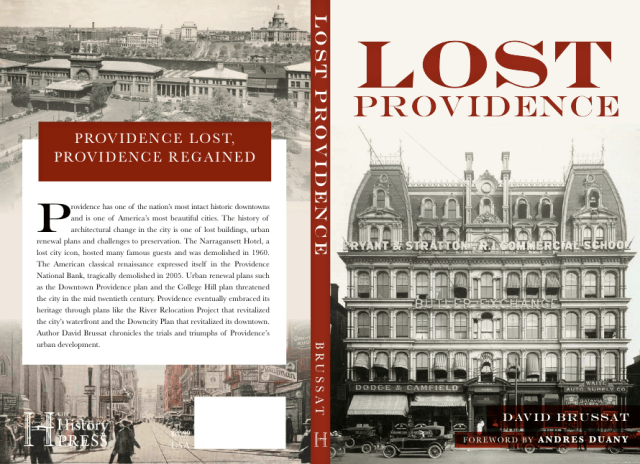
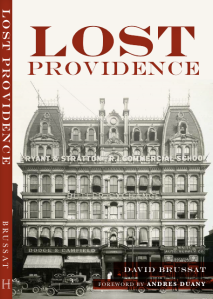
The front (right) and rear covers of Lost Providence. The front features the Butler Exchange.

Lost Providence, by yours truly, would make a great gift for anyone keen on the history of Providence, the blessing of traditional architecture, or the bane of modern architecture. Or, dear reader, get it for yourself.

Most bookstores in Providence and vicinity carry the book, I believe, and for those living outside the vicinity, it can be purchased through History Press or Amazon. Make sure you order the book, not the postcards, unless you want the postcards as well. Someone accidentally ordered the postcards through Amazon when she thought she was ordering the book (which can also be ordered as a Kindle e-book). Understandably, she was not pleased and (not understandably) gave my book just two stars. Boo-hoo!

That may have been a drag on sales and may still be, though some people who actually read the book have given it the maximum of five stars, along with reviews that actually have made me blush with pleasure. (Bless you all!). Still, if anyone wants to review it themselves, I will bless you, too. It does not need to be a lengthy or comprehensive assessment, just a positive one (only kidding!). You can do that through the Amazon link above.

Regretting any drag on sales may seem mercenary. Still, if a beautiful world may be said to be a better world, buying Lost Providence may be said to have a noble purpose. I am sure most people who used to read my weekly column at the Providence Journal for a quarter of a century and who have read this blog since its inauguration almost a decade ago feel the same sense of loss in their built environment as I do.

So if the book’s status as a rootin’ tootin’ good yarn (with a happy ending) doesn’t compel you to buy Lost Providence, then maybe this is your chance to chalk up your good deed for the day.

So, Merry Christmas and Happy Holidays to all of you.

Posted in Architecture History, Lost Providence | Tagged , , , , , , | 2 Comments

A new prize in architecture

Screen Shot 2019-12-22 at 11.23.15 PM.png

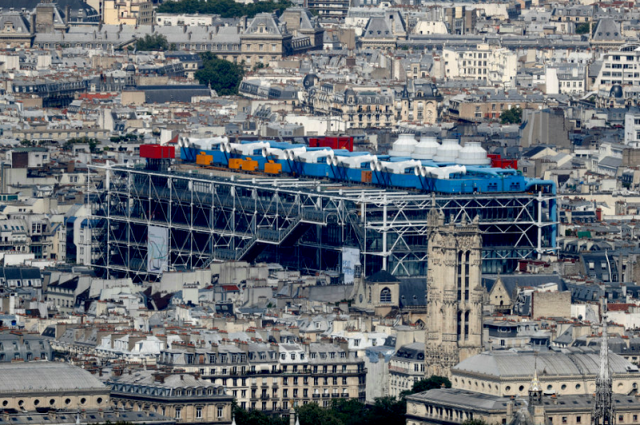
Centre Pompidou, by Renzo Piano and Richard Rogers, in Paris. (Christian Science Monitor)

ArchNewsNow.com – the indispensable source of architecture commentary from around the world – is running a series responding to a petition by British architecture students dismayed at the reluctance of architecture schools to become more involved in political issues, especially climate change. The articles suggest changes in architecture curricula, reform in architecture’s conception of itself, and just about every point between. The series is curated by Nikos Salingaros, a professor of mathematics at the University of Texas who lectures globally on such theories as how neurobiology suggests architecture’s close relationship to nature.

Perhaps the most provocative article among those run so far by ANN suggests that a new prize be instituted for students of architecture. Dr. Theodore Dalrymple, author of “An Implicit Rather than Explicit Model for Teaching Architecture,” is a retired prison doctor and psychiatrist. He opens his essay with some lines from Emily Dickinson, the final couplet of which hints at the curious nature of his proposed prize:

The Truth must dazzle gradually/ Or every man be blind.

Here is how Dalrymple describes the prize:

I would institute an annual prize, with substantial cash awards, for architecture students who would be given the task of designing a building that surpasses an iconic monstrosity in ugliness.

Huh? I did a double, no, a triple take on that. Design a building to surpass an iconic monstrosity in ugliness? I thought there must have been a mental typo in that description. Needless to say, Dalrymple’s string of trigger warnings and spoiler alerts went over my head. Yes, he does want students to be tasked with designing a new building even uglier than the one specified each year as the model, such as the Centre Pompidou in Paris.

But why? Dalrymple notes that “[j]ust as satire is dangerous these days because it is so easily transformed into policy,” the winning designs might end up actually being built. He then states his reasons why such a prize might nonetheless be useful:

[T]he student would have to think seriously about aesthetics and what makes a building graceful or hideous, what makes it adapted to its surrounding and adaptable to many purposes, what is human and inhuman, what is a proper scale, the inherent beauties or otherwise of various materials to be employed, and so forth.

All judgment is comparative, said Dr. Samuel Johnson, and the competition would force students to look about them and formulate at least rough-and-ready rules of the beautiful and its opposite. It has long been my practice to look closely at second-rate art, the better to appreciate the first-rate. And to design something worse than the Centre Pompidou – or the many other models one could name – would require real talent and imagination, not the terrible conformism of which I hear so much.

It may be objected that no student, knowing about architecture school and entering it nevertheless, could possibly be talented and imaginative enough to submit an entry. To which the natural objection is: if just a single such student exists and can be thus discovered, the prize would be worthwhile.

Dalrymple’s proposal for this prize may really be an exercise in irony. If so, it is deft beyond my ken. Leading up to his prize proposal, he proceeds through mounting levels of outrage at the asinine mentality of almost all architecture schools around the world, which, alas, generates the need for a prize of this sort. As expressed by Dalrymple, this tragedy is a comic masterpiece.

Students of architecture, take note! And notes – for your funnybone, at least, will demand that you read the whole thing.

Posted in Architecture Education | Tagged , , , , , , | 3 Comments

O starchitect house blues!

Screen Shot 2019-12-18 at 8.38.47 PM.png

Conn. house by Rafael Viñoly costing $25 million on market now at $9.75 million. (Sotheby)

A Bloomberg article, “Having a Home by a Star Architect Is Amazing – Until You Try to Sell It,” by James Tarmy, raised the hair on the back of my neck.

Among my favorite activities when I slip into one of my rare moods of masochismo is to drive around the East Side of Providence, up and down streets chock-a-block with lovely historic homes. I stop before the thankfully rare modernist houses, trying to figure out why anyone would inflict such a monstrosity on the neighborhood they have decided to move into. Sadism is the only plausible answer. Or masochism, perhaps, if they themselves are the intended victims rather than their neighbors.

Of course, if they are out in the woods like the Rafael Viñoly-designed house in Ridgefield, Conn., who cares? Except the local animal population. In fact, I love animals, but I would encourage every modernist architect to find clients who want monstrosities in the vast American outback. That will divert these architects’ energies away from cities and towns where their work does real damage to both the beauty of the civic realm and the property value of its neighborhoods. After all, if a modernist house goes up in a forest, no one sees its ugliness (except animals). The homeowners themselves, being insensate, are of little or no account in this calculation.

Speaking of calculations, the Viñoly house, pictured on top of this post, cost $25 million to design and build, but has been sitting on the market with an asking price of $9.75 million.

Given my opinion of modernist houses, let alone those built in traditional neighborhoods, it was gratifying to have my expectations confirmed.

Screen Shot 2019-12-18 at 9.30.47 PM.png

Y house by Steven Holl. (Alan Koppel)

Tarmy’s article refers to a house in the Catskills designed by Steven Holl and shaped like a Y. This reminded me of an episode of the television sitcom Wings about life at a small Nantucket airport. A famous architect who is a regular visitor to the island offers a free house design as a wedding gift to a pair of engaged airport employees. When they learn that the new house will be shaped like a 7, the two fight over who will tell the architect they don’t want it. The episode is “Frank Lloyd Wrong.” It’s fall-down funny.

Tarmy reports that the Y house, which cost $1.3 million to build back in the mid-’90s, has been placed on the market for a delusional $1.6 million, which, taking inflation into account, amounts to a markdown of about 20 percent below the original cost.

“If a local realtor [valued the Y house] by square foot, that house would be $400,000 at most, which is hilarious. It’s worth far more than that, but it has to be perceived value in the eye of the buyer.”

Kumar and the owners of the property are encountering the sobering reality of selling a “starchitect”-designed home: They might have gotten what they paid for in their house’s dramatic lines, luxurious materials, and prestigious pedigree, but when it comes time to sell, the market is often unforgiving.

I would argue that the owners got what they paid for only in theory. They misinterpreted their own desires. They thought they wanted a house they could brag on and show off. When that turned out, over time, to be weak tea, they realized what they really wanted after all was a house they could live in comfortably, and part of that meant a house that looked like a house – a house that might appreciate in value over time, and sell at a profit.

Too late.

If these agents truly believe that these modernist houses are “amazing” and should sell at a price that reflects what their owners paid to build them, they are delusional and ought to relocate to another industry. I just hope nobody leaps to the conclusion that these houses would sell better if they were nearer to civilization. I say build them all in the middle of nowhere.

Screen Shot 2019-12-18 at 10.46.09 PM.png

Scene from Episode 129, “Frank Lloyd Wrong,” in the 1990-97 sitcom Wings. (NBC)

Posted in Architecture | Tagged , , , , , , , | 6 Comments

A resurgence of murals

Screen Shot 2019-12-12 at 10.13.51 PM.png

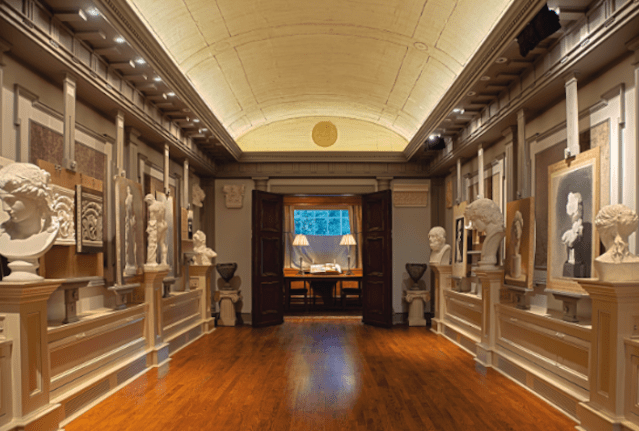
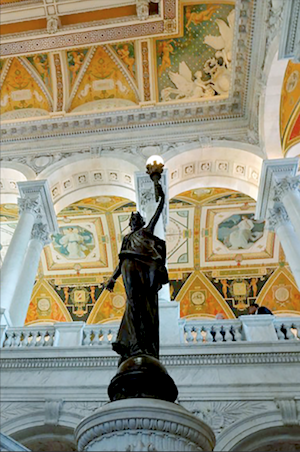
Cast Hall at the Academy of Classical Design, Southern Pines, N.C. (Classical Design Foundation)

Unlike modern architecture’s rejection of art as integral to building design, classical architecture welcomes painting and sculpture as part and parcel of a building’s beauty. Murals have embellished the world’s greatest buildings for centuries, but with modern architecture in control for all too many decades, muralists, along with sculptors and classicism’s other allied artists, have, along with their arts, struggled to survive.

Screen Shot 2019-12-12 at 10.15.17 PM.png

Library of Congress, Washington, D.C.

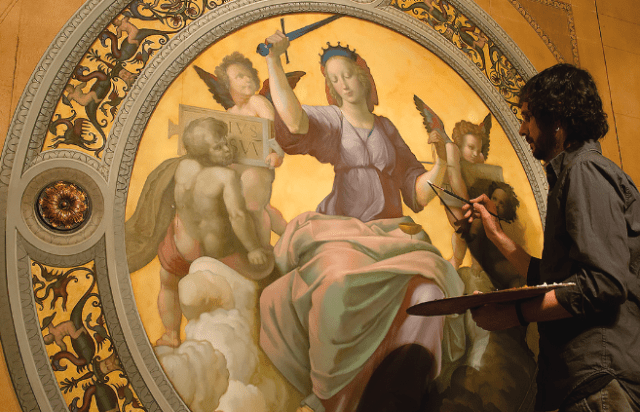
So it is exciting to learn that the Classical Design Foundation and its founding director, Jeffrey Mims, have announced the creation of the Mural Guild as a teaching tool among the Academy of Classical Design’s programs in classical art applied to classical architecture. The academy is headquartered in Southern Pines, North Carolina.

Steven Semes, director of Notre Dame’s recently established historic preservation program, describes the importance of this step:

Architecture cannot tell a complete story without the contributions of the representational painter and sculptor. The harmonious work of the architect, painter and sculptor is fundamental to the classical tradition today, just as it was in the greatest eras of the past. The Academy of Classical Design is the leading contemporary exponent of decorative art in that tradition. It deserves the support of all who seek to add new beauty to our buildings and outdoor spaces.

The first major project by the students of the Mural Guild will be to paint a fresco (a mural painted on freshly laid plaster) to decorate the vaulted ceiling of the academy’s Cast Hall, pictured atop this post. Look at the ceiling. It is quite attractive even in its unadorned state. Imagine, however, scaffolding erected with boards laid across the top, upon which student muralists, lying on their backs, reaching upward with paint brushes, channel Michelangelo painting the ceiling of St. Peter’s Sistine Chapel.

Wikipedia describes what Michelangelo had to put up with:

Michelangelo painted the ceiling of the Sistine Chapel, which took approximately four years to complete (1508–1512).[41] According to Condivi’s account, Bramante, who was working on the building of St. Peter’s Basilica, resented Michelangelo’s commission for the pope’s tomb and convinced the pope to commission him in a medium with which he was unfamiliar, in order that he might fail at the task.[42] Michelangelo was originally commissioned to paint the Twelve Apostles on the triangular pendentives that supported the ceiling, and to cover the central part of the ceiling with ornament.[43] Michelangelo persuaded Pope Julius to give him a free hand and proposed a different and more complex scheme, representing the Creation, the Fall of Man, the Promise of Salvation through the prophets, and the genealogy of Christ.

The muralists studying under Professor Mims and his instructors will not only learn to paint but how to maneuver in the life of the artist. They will be spared the connivings of a Bramante, one may suppose; yet, academia being what it is, there will be challenges enough in the teaching environment.

More and more cities are hiring muralists to paint on the sides of buildings, and this is wonderful if not always entirely artful. But in time as more new classical buildings are built, trained classical muralists will be required to bring this bold new architecture to the highest pitch of beauty. The Academy of Classical Design will provide the world with a dedicated stream of talent.

As Jeffrey Mims moves forward in setting up this new arm of his academy, those who want to help revive beauty in the world of art and architecture should support him by contacting Christine Herbes-Sommers at c.herbes-sommers@theclassicaldesignfoundation.org.

Screen Shot 2019-12-12 at 11.13.28 PM.png

Academy student copying a portion of a fresco by the painter Raphael.

Posted in Architecture, Art and design | Tagged , , , , , , , | 4 Comments

Romance and the style wars

Screen Shot 2019-12-08 at 8.39.56 AM.png

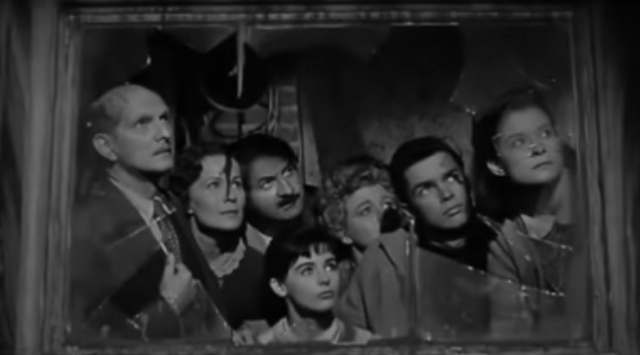
Scene from The Diary of Anne Frank, released in 1959. (ATSC TV)

On Sunday I saw the 1959 film The Diary of Anne Frank and, in its depiction of Anne’s friendship with the son of another family hiding with the Franks in the attic of a Dutch row house in Nazi-occupied Holland, I thought I saw another example of the difference between traditional architecture and modern architecture.

In one of the film’s subplots, Anne, played by Millie Perkins, and Peter Van Daan, played by Richard Beymer, are thrown together in the attic of the row house, serving downstairs as a spice factory. The two teenagers’ friendship turns romantic so slowly that it is barely apparent until near the end, when it is consummated with a gentle kiss shot by the camera in dark silhouette.

Screen Shot 2019-12-10 at 10.22.04 PM.png

Entablature. (David Darling)

That is the traditional progression into love. It can be speeded up or even slowed down further to reflect the personalities and circumstances involved. The more or less subtle steps along the way might perhaps be compared with the succession of classical moldings that mark the transformation of a wall into a ceiling by means of a cornice, or, on the exterior of the house, by the diverse levels of ornament – such as (in rising order) the astragal, cymba reversa, dentils, ovolo, modillions, fascia and cyma recta – that make up the entablature of an ornate classical roof cornice.

The previous sentence, in its representation of architectural progression and multiplicity of scale, might have been written by Palladio, Christopher Wren, or Charles Follen McKim, or, today, by Quinlan Terry or Robert A.M. Stern. So what sort of sentence might have been written by, say, Ludwig Mies van der Rohe, one of the founders of modern architecture?

“Wham! Bam! Thank you, Ma’am!”

I do not believe that is an exaggeration. And I don’t deny that Palladio might have felt the urge to WBTYM in his life. Many of us do, today and yesterday, but the urge is, shall we say, less frequently subdued in our modern world. Despite its pretense to an attention to fine detail, Mies’s Seagram Building (1959) cries out “Wham! Bam! Thank you, Ma’am!” It is a blockhead of a building that elbowed its neighbors (until most were replaced by Miesling copies) and poked its finger in the eyes of its observers, as it still does.

Screen Shot 2019-12-10 at 9.36.12 PM.png

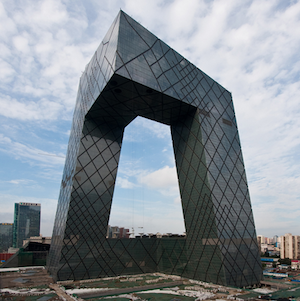
CCTV, by Rem Koolhaas. (skyscrapers.com)

The Beijing headquarters of China’s CCTV, by Rem Koolhaas (who is Dutch), is even worse. I have often depicted the building as stomping on the Chinese people. With less direct reference to its form, which looks like a pair of legs walking – China’s authorized nickname for the building is “Big Pants” – it might also be said to be engaged in rape. That act of violence is, of course, the representative evil of the 21st Century, as murder was in the 20th. Not very romantic.

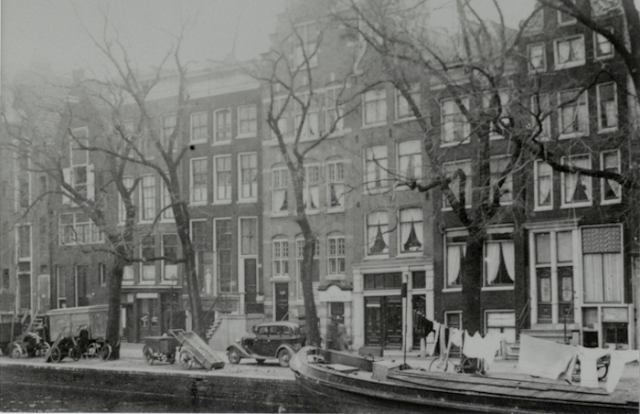
Of course the scene of Anne Frank’s diary is hardly romantic. It is set during World War II with Nazi concentration camps of the Holocaust just over the horizon of the daily lives of the Jewish families hiding out in the Dutch attic. Indeed, the horror of their situation is deepened by the elegant architecture of the Amsterdam street upon which it unfolds. The irony of Germany’s embrace (if it may be so called) in the 1930s of Hitler and Nazism is that it occurred in such an undeniably civilized nation. Notwithstanding the world war that was its end result, Hitler’s takeover of Germany was not quite a WBTYM event. It was more subtle, but it certainly was not romantic.

Am I comparing modern architecture’s takeover of the architectural establishment in Europe and America to Hitler’s takeover of Germany? Serious difficulties beset such a comparison, to say the least. But yes, I am.

The big difference (aside from what many will consider the outrageousness of the idea) is that Hitler was more subtle. The bastard first won an election and then maneuvered his way into a degree of authority that transformed Germany into a dictatorship. By comparison, the modernists’ takeover of the establishment in architecture between 1940 and 1950 seems like a rape. The droogs of A Clockwork Orange come to mind. The trads were unable to resist. Was it PTSD from two world wars and a depression? I don’t know. Anyhow, traditional architecture was the establishment for centuries.

(I hasten to add, as if it were necessary, that I am not comparing the horrors of Nazi Germany to the horrors of modern architecture. A shooting war is more horrific than a bloodless coup in architecture, however far-reaching and dispiriting the consequences.)

I’m sure there will be objections to the path this post has taken since it compared the attic romance of Anne and Peter to the WBTYM that is too often conventional today. Allow me to apologize in advance. A blog post often represents writing gone wild, and it is more like a one-night stand than the slow-motion enchantment of an erudite essay by Hazlitt. Still, I hope the stray, disruptive thoughts of this post will be appreciated by some.

Screen Shot 2019-12-10 at 9.24.57 PM.png

The hideaway was third from left on this Amsterdam block in 1930. (annefrank.com)

Posted in Architecture | Tagged , , , , , , , , , , , | 5 Comments

Comments on the style wars

Screen Shot 2019-12-08 at 8.40.00 PM.png

“Damn contemporary bullshit architecture!” (by Buck Brown)

My last post “Modern architecture as spin” drew a reply from architect Daniel Morales that, paired with my reply, deserves to be front and center on this blog, rather than stuck in the comment section. Dan and I have gone round and round on this issue of how to approach our mutual opposition to modern architecture. Although we disagree, his argument has considerable merit and, I imagine, widespread support among traditionalist and classicist participants in the style wars that engage the field of architecture.

So here is our exchange as it has progressed so far. First his reply, triggered mostly, I believe, by this passage in my post: “All modernism – not just in architecture but in art, in music, in philosophy – is spin. It is not all stupid, but it is all fatuous.” Dan wrote:

Do you really think all Modernism is ‘silly and pointless’? I’m hardly a defender of modernism, but it doesn’t seem rhetorically useful to insult with such a broad brush. Most of those who work within its precepts are not idiots, just like classicists or traditionalists. Imagine what the world of architecture might look like once this style war ends. Will it provide room for all types of thinking or will it be an absolutist system demanding fealty to tradition?

My reply:

Not all idiots, Dan, but fools.

A commenter, “Anonymous,” pokes at me for dodging Dan’s comment:

Thanks for the clarification.

To which I replied at some length, as Dan’s comment deserved:

You are right, Anon., Dan and I have been going back and forth on this for ages. Of course not all modernists are idiots, which I admitted in my post. But what Dan seeks, whether he recognizes it or not, is surrender. There will never be a blissful time when a thousand flowers bloom. The modernists will never permit it. Dan does not seem to understand that it is the mods, not the trads, who are propagating the style wars, and have from the beginning. It is they who rig the process so that major commissions, just about all except middle-class housing projects and mansions for the wealthy, go almost exclusively to modernists.

Modernists know that very few people actually like their work, and they know that there was almost no sound intellectual basis for having instituted modern architecture a century ago, and that its capture of the establishment in the ’40s and ’50s, and since then the defense of its power and authority, have been unfairly and unjustly manipulative. They know that design and construction practices they’ve promoted bake mediocrity into the system in ways that are now virtually impossible to evade or dislodge. They know that their place in the industry would collapse if the public had any say in the market for buildings, as would be appropriate in a democracy. So, no, I do not favor the “absolutist system” Dan seems to think I am calling for. I merely want the market for architecture to operate as it ought to in a free market political economy, reflecting democracy. Is that too much to ask? It would promote beauty and happiness among far more people than is the case today.

Yes, I do insult with a broad brush. Dan has the right to put it that way. But, compared to the flaws inherent in every other aspect of humanity and its fields of endeavor, the flaws of modern architecture are far and away more deleterious in their impact on the human condition than that of any other industry, profession or art group. Dan may call that an insult, but I call it the truth, based on the obvious facts of our built environment that are clear to all but those who refuse (as well they might!) to look or see.

Although obviously rather unpleasant, I think tradition should fight back against modernism. That is what I have tried to do by avoiding the “Can’t we all just get along” approach in my rhetoric. And, as I suggested in a recent post, “Lessons of the Berlin Wall,” I believe that mobilizing the public to agitate for what they want (and deserve) could have results far sooner than anyone might imagine.

Of course, Dan or anyone else should feel free to continue this discussion.

Posted in Architecture | Tagged , , , , , | 6 Comments

Modern architecture as spin

Screen Shot 2019-12-04 at 1.18.03 PM.png

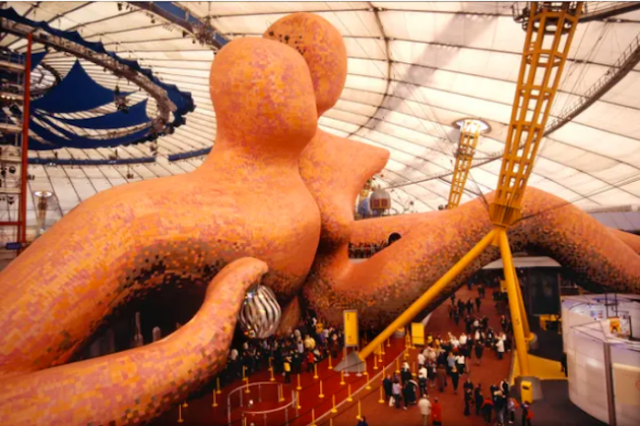
Inside the Millennium Dome. “Is this the arse or the elbow?” (Guardian)

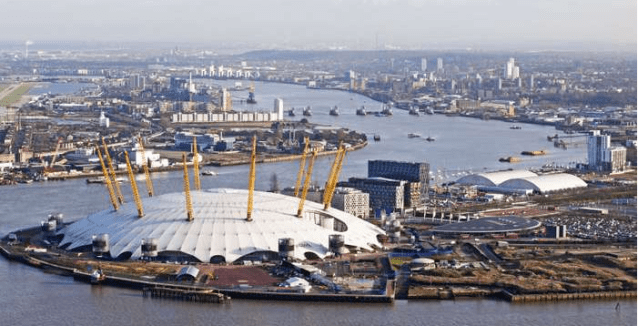
An article in the Guardian on the rise and fall of London’s Millennium Dome sums up much of what ails modern architecture. “20 years on, revisiting a very British fiasco,” by Rowan Moore, describes the pitfalls of treating architecture not as a place but as an idea:

[T]his spectacular container of not very much made an easy emblem of the government’s preference for style over content, its attachment to vacuous statements of modernity, its use of messaging and focus groups to deliver meaningless platitudes, its tokenistic approach to regeneration.

Here is one passage describing the attempt to formulate a spin during the period before the Dome (designed by Sir Richard Rogers) opened on Dec. 31, 1999, supposedly the last day of the old millennium:

From now on, as [critic Simon] Jenkins puts it, [the Dome] would be “a showcase for New Labour, for Cool Britannia.” [Prime Minister Tony] Blair had publicly aligned himself with a vision of Britain as a creative, dynamic country: food and furniture by Terence Conran, buildings by Richard Rogers, art by Damien Hirst, music by Oasis. The dome and its contents would be its expression. Major corporations would sponsor different elements – a process that had started under [former deputy P.M. Michael] Heseltine. This would show, as Jenkins puts it, “that New Labour was friendly to capitalism, that business was part of one big national family.”

I have nothing to say about whether the Dome epitomized the Labour Party or the leadership of Prime Minister Tony Blair. However you slice it, putting style over substance is to lead with one’s chin. It is certainly apparent that a place must have a function, but if the function is merely to express an idea, it is likely to fail, perhaps a lot faster than did the Millennium Dome.

To be more precise about the millennial “idea” behind the Dome, the new millennium started a year later, on Jan. 1, 2001, not at Greenwich, where the Dome was built but at Caroline Island in the Kiribati chain, just east of the International Dateline, on the other side of the world.

Moore describes the fiasco:

The contents were panned. They were described as underwhelming, compromised, communicating nothing in particular. The long queues to get into the star exhibits made front-page news. “Is this the arse or the elbow?” went a Private Eye speech bubble, coming from a visitor trying to enter an opening in the arm of a giant figure that was in a “zone” based on the human body.

I suppose this article must be placed on my long groaning shelf of analytical pieces by advocates of modern architecture that, in admitting the flaws of one undeniably regrettable work of modern architecture, describe the flaws of all modern architecture. There never has been a modernist building that does not put style over substance. Insofar as the style rarely if ever rises to the level of beauty, the substance must indeed be flawed. All modernism – not just in architecture but in art, in music, in philosophy – is spin. It is not all stupid, but it is all fatuous.

That may be one reason why the world, with all its scientific discoveries, its widespread economic advancement, its endless victories over disease, its profound technological achievements and its relentlessly idiotic architecture, remains such an unhappy place.

Traditional architecture is simple, modest, functional and yet almost effortlessly beautiful. Has the world become such a thoroughgoing idiocracy that nobody can see the necessity of ADVOCATING these values? Even if only in the realm of architecture and the built environment, where they would be so easy to implement? So sad.

Screen Shot 2019-12-04 at 2.14.08 PM.png

The Millennium Dome, in Greenwich, London, UK. (Dreamstime.com)

Posted in Architecture | Tagged , , , , , , , , , | 8 Comments

Imagine all the buildings …

Screen Shot 2019-11-29 at 10.30.55 PM.png

Image of Femopolis from graphic novel planned by an artist in Portland, Ore. (Paul Guinan)

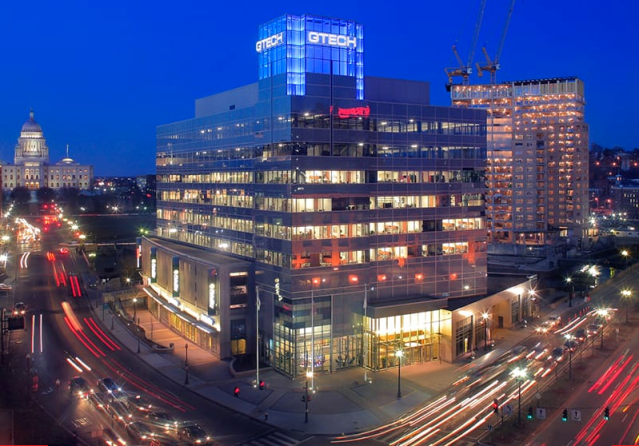
The other day, flipping through stacks of my old Providence Journal columns seeking a shot of a c. 1750 house in Providence’s old village of Hardscrabble (which I found), I came across a column inspired by a website’s image of a fictional place called Femopolis, scene of a graphic novel being written by Paul Guinan, of Portland, Ore. “Imagine all the buildings …” was written in 2004, when Providence officials switched design strategies in Capital Center from traditional (such as Providence Place, the Westin Hotel, the Marriott Courtyard) to modernist (the GTECH headquarters, the Waterplace condo towers). The column was an exercise in finger-wagging that did no good, and rerunning that column will surely do no good as the city continues to screw up its latest version of Capital Center – the I-195 innovation corridor. Still, give it a read anyway. Who knows what might happen. Here it is, followed by a couple of remarks on recent local development news:

***

Imagine all the buildings …

(April 8, 2004)

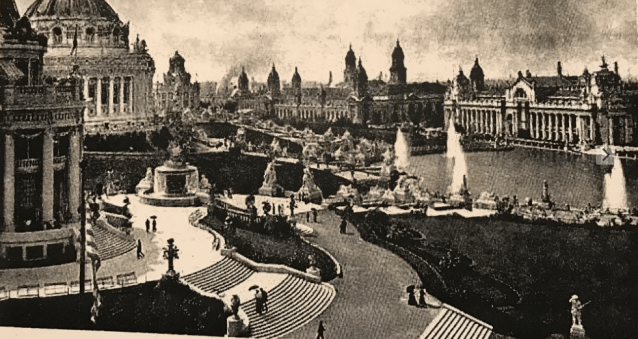
See that pond in the illustration above? That could be Waterplace. Imagine if the new buildings recently proposed to go on either side of the pond looked like the ones above – not exactly, but in that spirit. Providence would become the most popular middle-sized city in America. Instantly.

Something like that happened once, on a grand scale. Chicago built a classically inspired “White City” for the World’s Columbian Exposition [Chicago World’s Fair] of 1893, some 150 temporary buildings made of plaster and painted white. It opened a year late, but after word spread of its startling beauty, an extraordinary 27 million Americans went, about a quarter of the U.S. population then.

They returned home with the idea that their cities and towns could also be beautiful. Thus began the City Beautiful movement. Municipalities across the nation hired classically trained architects and planners to redesign civic plazas and other public spaces. Most of what elegance survives in the downtowns of today’s America hails from that period.

The City Beautiful movement was aborted by depression, war and the Modern movement. But just suppose that architecture had continued to evolve in the graceful manner it had over the foregoing 500 years. Imagine that every building erected in America since 1950 had been not a sharp break from the existing urban setting but a gradual addition to and strengthening of that setting – an architecture that moved into the future by building creatively on the past rather than rejecting it.

It is no stretch to imagine that American cities by now would rival European cities in beauty – especially since Europeans have been attacking their own cities with their own abrupt, sterile, chaotic, dysfunctional, ugly forms of modern architecture.

The image above is from a website about a fictional place called Femopolis, the setting for a “graphic novel” planned by Paul Guinan, of Portland, Ore. A friend directed me to it (www.bigredhair.com/femopolis), and when I saw the image I thought it might in fact be an old postcard of the White City.

It turns out to be the 1904 St. Louis World’s Fair. But give it a good look. Just suppose that the developers of Parcel 2 and Parcel 9 [the Waterplace condo towers and GTECH], on opposite sides of Waterplace, were proposing designs of a similar grandeur and magnificence. Imagine the tingling surge of excitement that would arise at such a prospect.

The Capital Center Commission’s design panel would wag its fingers, of course, and tut-tut about “copying the past.” But the public would love it. And because the public casts more votes than the design elites, political pressure to build it would be intense.

Alas, while neither project has progressed far enough to have even a tentative design sketch, their architects offer photos of buildings they like or have built – the usual glitzy, glassy stuff inflicted on most downtowns (Providence perhaps least of all).

The GTECH headquarters concept has been described as “contemporary,” “innovative,” yet “respectful of its neighbors” (see Journal staff writer Andrea Stape’s article “Designs on Providence,” Business, April 3). GTECH will reportedly reveal its initial design for Parcel 9 to the panel on April 27.

As for Parcel 2, [developer] Intercontinental’s ideas for what its project might look like wowed the panel at last week’s meeting. I think every member used the words “very exciting” to describe a relatively vague concept that I found very unsettling.

Perhaps I was unduly alarmed by an ominous exchange between two representatives of Intercontinental, who assured each other that “we are reacting to the client’s quasi-modernist tendencies.”

“What do you mean, ‘quasi’?” I wondered.

So far, based on the Stape article, last week’s design-review meeting, and Michael Corkery’s March 31 story on that meeting (“Capital Center panel hears new proposal”), neither project seems much interested in fitting gracefully into its surroundings, at least not in ways most of the public would understand. In fact, the panel members realized at the last moment, almost as an afterthought, that they had better urge Intercontinental to offer some idea of how its project will refer to the Capital Center’s context, most of which is traditional: Providence Place, the Westin, the Marriott, Union Station and Waterplace itself – not to mention the State House.

To be contextual, the designs need not reach for the heights of the White City, Femopolis, the State House or even the mall (much as that would please the public and, of course, you mild-mannered critic). But it would be nice if both project designs were at least as deferential to the best of Capital Center as the dead designs they hope to replace, both of which mixed the old and the new well enough – no tingling of the spine, but acceptable.

At Waterplace, Providence cannot afford to go ugly. If the latest projects don’t strengthen the city’s unique historical character, at least they must not undermine it. That is not too much to ask.

But suppose the developers had the courage to buck the design elites and build something grand, truly worthy of the place. Ah! Just imagine …

***

Just to take a few recent local news items, one can easily imagine that Providence Place would not have just traded down from Nordstrom to Boscov’s – the mall would have been trading up for years by now. Likewise, the proposal by a Washington developer to turn the old Journal Building (1906) into a swanky hotel would not have stalled out over the absence of a TSA (tax stabilization agreement) with the city. TSAs would no longer exist in Providence because beautiful architecture would have turned it into a more robust city at least a decade ago. The market would not require TSAs or other subsidies to goose projects forward, but rather the issue would be how to slow down excessive development. That’s what beauty can do.
Screen Shot 2019-11-29 at 10.36.15 PM.png

GTECH (now IGT) on Parcel 9 with Waterplace towers on Parcel 2 at right. (gilbaneco.com)

Posted in Architecture, Development | Tagged , , , , , , , , , , | 1 Comment

The Nightingale sings, so far

Screen Shot 2019-11-26 at 9.39.27 PM.png

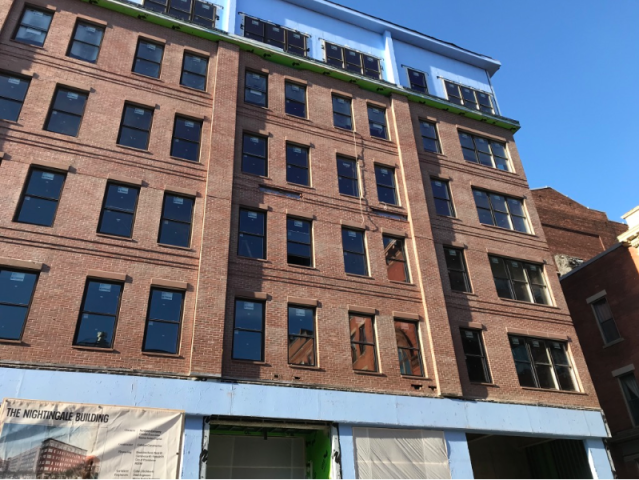
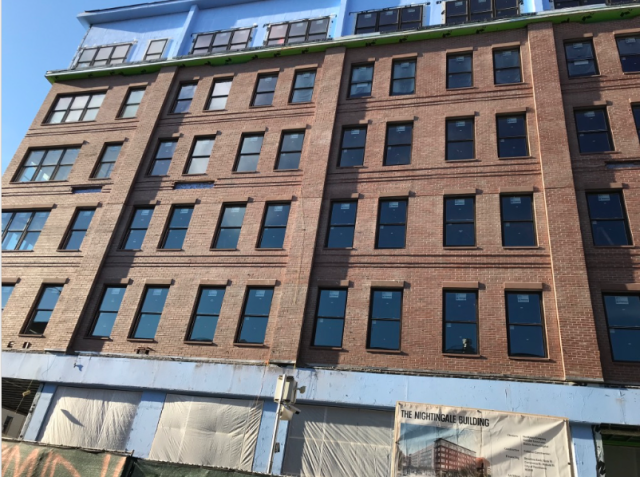
Brickword on the Washington Street facade of the Nightingale Building. (photo by author)

A large square extraordinarily promising brick building arises on the block downtown where hundreds of Providence Journal employees used to park. I just learned today that it will be called the Nightingale Building. Buff Chace, whose work has revived downtown Providence almost singlehandedly, comes from good family hereabouts. Is “Nightingale” a doff of his hat to the family linked by marriage to the mercantile Brown clan of this city’s early times? Or maybe it is meant to evoke poetry – to wit, the familiar songbird. Also, just to troll the news, the nightingale is the national bird of Ukraine.

Screen Shot 2019-11-26 at 10.00.15 PM.png

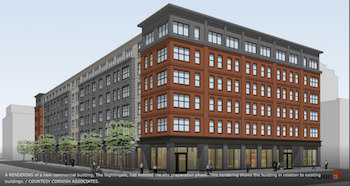
Rendering of Nightingale. (Cornish Assocs.)

Today I took a longtime friend, Mary Shepard, who moved to Providence from Aquidneck Island lately, on a tour of downtown. We drove past the Nightingale under construction on Washington Street. I had seen its pleasing brickwork at an earlier stage. Today, Mary and I saw that much of it was complete. Each rank of windows was set off by relatively deep piers, and the fenestration was set into the walls far enough to impart additional real strength to the appearance of its façades. Between each floor of brick was a stringcourse that added to the delight of the façades’ simplicity. (Simplicity mustn’t be confused with the blankness that afflicts much bad architecture.) With some trepidation, however, one waits to see how the architect – Cube 3 Studio, of Boston – has decided to set off the upper story, which seems as yet (one hopes) without its cladding.

Although quite large, the Nightingale fills the long-abandoned role in city planning of a background building – whose modest demeanor sets off the more ambitious qualities of so-called “iconic” buildings. That is how things were when designing cities was done with more care and elegance. Today, iconic buildings flap their wings to display the “creativity” of their design, usually at the expense of their beauty. Background buildings, when they are attempted, generally demonstrate the inanity of today’s iconic buildings.

The nightingale should not be confused with the peacock. It does not shout its beauty from the rooftops but sings of the beauty of the traditional city. It is part of the chorus of Providence that has been disappearing for decades, and its return after such a long absence is worthy of deep applause.

Screen Shot 2019-11-26 at 9.42.49 PM.png

Screen Shot 2019-11-26 at 9.41.12 PM.png

Brickwork on the Nightingale as first noticed by me several weeks ago.

Screen Shot 2019-11-26 at 9.43.08 PM.png

***

Screen Shot 2019-11-26 at 10.02.37 PM.png

Screen Shot 2019-11-26 at 9.47.47 PM.png

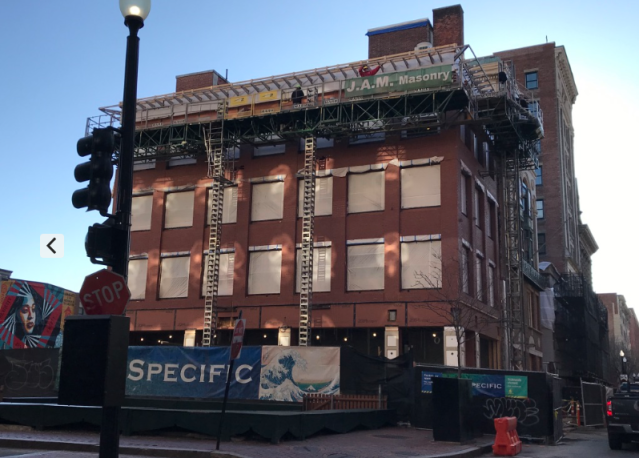
Above are a photo taken today and a rendering (taken from the Cornish website) of an addition to the Trayne Building, the easternmost of three buildings on Westminster Street being renovated by Buff Chace’s Cornish Associates. The Trayne addition could be another background building but its location suggests a more exalted status. It is really not an addition but a new building, just as separate from the Trayne as the Trayne is from the Wit and the Wit from the Lapham. Visit the Cornish website for more on this project designed by Union Studio across Westminster from URI’s downtown campus in the Shepard Building (whose name was so pleasing to my passenger today).

By the way, today, Thanksgiving Day, offers a wonderful opportunity to remind ourselves how very much Buff has done, in Providence, to deserve his Bulfinch patronage award of 2019 from the New England chapter of the Institute of Classical Architecture & Art. Thank you, Buff!

Posted in Architecture, Development | Tagged , , , , , , , | 10 Comments