Rebuild Penn Station, cont.

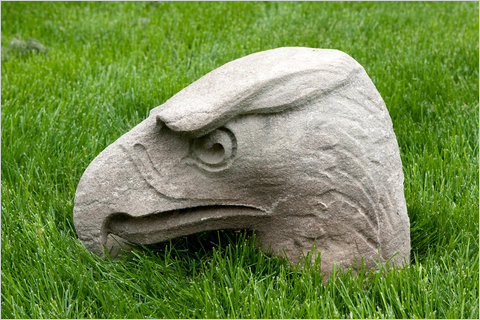
One of the Penn Station eagles, probably in the Meadowlands. (courtesy of orhan)

One of the Penn Station eagles, probably in the Meadowlands. (courtesy of orhan)

Archinect has reported Richard Cameron’s proposal to rebuild Penn Station in the original 1910 style of Charles Follen McKim, linking to Clem Labine’s excellent announcement in Traditional Building. Make sure you check out the mostly positive comments after reading “The new $2.5 billion plan to rebuild the historic Penn Station.” An interesting back and forth ensues about ethics and aesthetics. Yes, there is the idiotic “Why spend $2.5 billion rebuilding 19th century technology,” as if those who build it won’t make heavy use of 21st century technology (as traditional architects have incorporated innovation in design from time immemorial)? Someone even remarks that we shouldn’t rebuild Penn Station since we don’t use dial phones anymore. Another urges that we look instead at the a recent “good SHoP plan” – a contradiction in terms. Enjoy!

Posted in Uncategorized | 1 Comment

5th Ave., 8 BR, city view

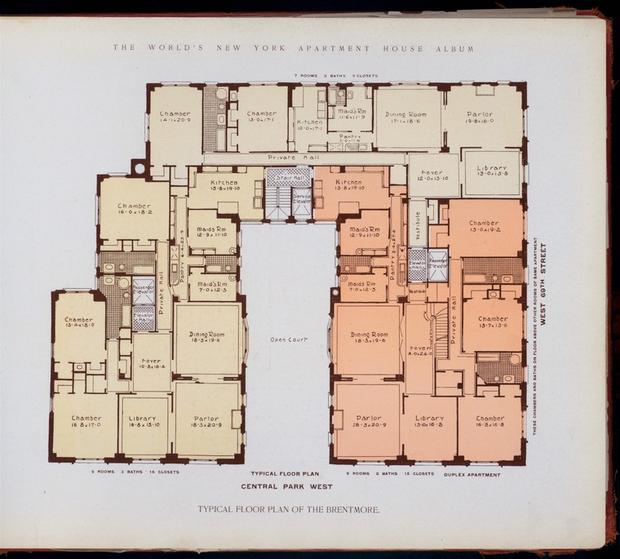
index_6A friend who used to be a big wheel in Providence development circles, Lee Juskalian, keeps tabs through me (and others) on development around here (though he has lived in California for years). Lee, who now travels and surfs, has long moaned and groaned at the timidity those who develop apartment complexes in Providence. He is talking bedrooms – you need to offer more bedrooms if you want people to live downtown, he would say, rolling his eyes (which I could hear over the phone) at the idea of apartments with just two or three BRs.

Well, except that they’re not in Providence, he’d like these places gathered by Hannah Keyser in a piece called “10 Elaborate Floor Plans from Pre-World War I New York City Apartments,” from a website called mentalfloss.com. (Check out the piece on “spite houses” too.) And not just bedrooms, either. No sniffing at these addresses. As they say: Location! Location! Location!

A tip of the hat to Ann Daigle for sending these to TradArch.

Posted in Architecture, Architecture History, Development, Providence, Urbanism and planning | Tagged , , , | 1 Comment

BIG kicks Foster off 2 WTC?

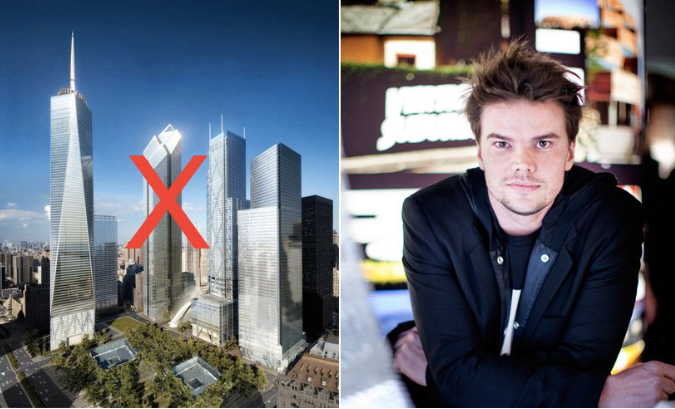
Norman Foster's 2 WTC design, left; Bjarke Ingels of BIG, right. (6sqft.com)

Norman Foster’s 2 WTC design, left; Bjarke Ingels of BIG, right. (6sqft.com)

The idea that the developers of the 2 WTC megalith – the last major skyscraper of the World Trade Center rebuild – might send Sir Norman Foster packing delights me. The idea of booting the architect even as his tower rises in early construction brings a hint of rose to my cheek. That Lord Foster may be swapped out for Bjarke Ingels Group (BIG) as recipient of the big wet money kiss makes it even better.

That, anyhow, is the speculation in “2 World Trade Center May Ditch Norman Foster’s Design for a Bjarke Ingels Skyscraper” on a New York website called 6sqft.com, which ruminates on Big Apple real estate. The matter appears to rest on whether Rupert Murdoch’s News Corp. and 21st Century Fox decide to take up residence there. (So why, if conservatives are so traditional, doesn’t Murdoch want Bob Stern?)

Talk about come-uppance! Foster is starchitecture’s greatest old fart. In this his chief rival is his fellow knight of the sceptred isle, Sir Richard Rogers. Both lag far behind Renzo Piano and Rem Koolhaas in the battle for the leading edge of cool. Both lack the latter duo’s kooky monikers, not to mention the kookiness of their architectural styles. But Bjarke Ingels has both the kook and the glitz.

If he (or it) knocks Foster off the WTC podium, it may suggest that the primacy of modern architecture’s most knowingly obtuse and thuggish cohort is on the wane. The founding cohort might have harbored thoughts of a new machine-age architecture benefiting mankind, but its successors, who took over the profession and turned architecture into the butt boy of pirate capitalism, can have had no such illusions, and have used totalitarian methods to maintain their dominance of the field.

Every phase of mankind and its activities cycles through changes brought on by how age reacts to time. Architecture is no different. I came across a most excellent rendition of this from Roy Lewis on the TradArch list yesterday:

We’re just witnessing the emergence of the first crop of cradle-classicists … , the ones taught by the self-taught. They are still setting roots. They have a facility that most of the older crowd lacks, sometimes accompanied by an unbecoming certitude and sense of mastery. For the most part, they are still young; in architectural terms we are still witnessing their juvenalia. At a similar age Aalto was still working in a classical idiom, and Corb was just completing the last of his early villas. The mature work of the current crop may be more exploratory, I don’t know. I think there is a generational aspect, and the time is right for branching out.

Of course, Roy’s thoughts track the growing nuance of traditional practice. Perhaps BIG, and certainly such reasonably decent modernists as Peter Zumthor, track the growing nuance of modern architecture. I’m not saying I think modern and traditional styles will – or should! – meet at some point in the middle. Yet it may be worth hoping that at some point the profession’s most powerful modernist practitioners will be more open to competition from traditional practitioners.

Not that Bjarke Ingels is anything but idiotic. He recently stated:

Architecture at its best is really the power to make the world a little more like our dreams. You take something that is a wild idea, like pure fiction, and you suddenly change it into hard fact.

In your dreams, Bjarke! – as the rest of us continue to suffer living nightmares fostered by the creations of your ilk. Still, having BIG knock Sir Norman off his ridiculous WTC feedbag is certainly a step in the right direction.

Hats off to Timothy LeVaughn for sending the 6sqft piece to TradArch.

Posted in Architects, Architecture, Architecture Education, Architecture History, Development | Tagged , , , , , , , , | 2 Comments

Classical cataclysm in Nepal

Palaces and temples of Patan's Durbar Marg, one of three royal squares leveled by the earthquake. (Photo by Philip Lieberman; courtesy of The Providence Journal)

In happier times: Palaces and temples of Patan’s Durbar Marg, one of three royal squares leveled by the earthquake. (Photo by Philip Lieberman; courtesy of The Providence Journal)

The death toll from earthquakes in Nepal have reached well into the thousands. Coverage of rescue efforts has understandably taken priority over news of the terrible cultural cost of the disaster. The Nepalese capital of Kathmandu and other ancient centers have seen much of their heritage destroyed, in ways that not only took more lives in collapse but left a population of suffering survivors all the worse.

The Providence Journal today published an excellent essay by Marcia Lieberman, “Nepal quake destroys priceless heritage,” that elucidates the loss. Lieberman, a Providence resident who spent years in Nepal sponsoring educational opportunities for Nepalese children, briefly describes the rise of Newar culture in Nepal and its relationship with other Asian societies, from which it clearly learned (and taught) a great deal.

But she focuses largely on the artistry of the Newar architecture. Here she describes how some of the ancient squares recently destroyed were decked out in ceremonial ornament for the people and for their gods:

The flowering of Newar genius compares to the European renaissance, especially to the glories of Florence. The Newars excelled at every art to which they turned their hands and minds: architecture, sculpture and metalwork. But perhaps the quintessential Newar art was woodcarving. They turned wood into lace. The Newar window became a thing of art, a vehicle for lavish display of the carver’s skill and imagination, so that instead of a rectangular hole poked into a wall, the window became a richly decorative, exuberant, even playful architectural element. Elaborately carved wooden roof struts were embellished with intricate figures of gods and creatures. Wooden lattices on the surface of brick walls created beguiling patterns of design and texture, much as Persians, Turks and others did upon flat expanses of woven carpet.

Pop quiz: What building in Rhode Island does this Nepalese temple resemble, and why? (sanjaal.com)

Pop quiz: What building in Rhode Island does this Nepalese temple resemble, and why? (sanjaal.com)

Tibetan architecture, largely influenced by Chinese and Indian cultures, reaches back centuries before first contact with Western European culture. Yet its civic buildings reflect the essentials of Greco-Roman classicism, with its reverence for symmetry and ornament. Both have deep roots within the biological makeup of the human genome. Decoration is as natural to mankind as procreation – and indeed, the development over time of architecture throughout the world bears more than just a resemblance to the procreative process. Love for beauty is part and parcel of that process. Decoration not only has utilitarian purposes such as the protection of joints from rain and weather, but arouses a veneration instrumental to the costly maintenance of buildings over the centuries. Classicism is the genuine international style.

It is unlikely that the Nepalese, who have an active political life, blame the style of Nepal’s buildings for the misbehavior of their rulers. (Slavery was abolished in 1924; monarchy in 2008.) No, that’s a purely Western phenomenon, and embraced here only by those with enough higher education in art and architecture to believe really stupid things.

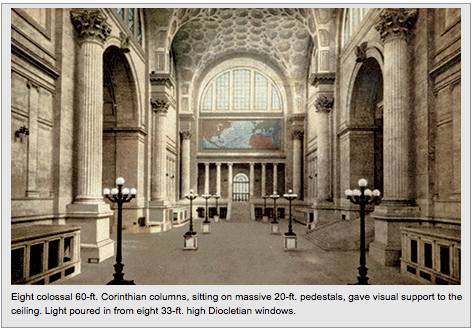
I hope that the destroyed monuments of Nepalese culture have been documented enough to be replicated. The hope of rebuilding the original Penn Station in New York is based in part on extensive documentation of the building as it was constructed. But, based on the extreme penchant among the elite for novelty over tradition, New Yorkers demolished Penn Station, and now some want to rebuild it with cockamamie new designs. Now that there is a serious plan to rebuild Penn Station as it was originally designed by Charles Follen McKim, those idiotic modernist proposals should naturally fall by the wayside as New Yorkers look to their future.

It is unlikely that the Nepalese have given even a moment’s contemplation to importing a hack like Frank Gehry to build shiny new objects for their worship. Americans who seek to help Nepal recover should focus at least some attention on reconstructing the beautiful places that helped to make them such a happy people.

[Here, in Carfree Times, is a much fuller account of the damage to Nepal.]

Posted in Architecture, Architecture History, Art and design, Other countries, Preservation, Urbanism and planning | Tagged , , , , , , , , | Leave a comment

Build McKim’s Penn Station

Screen Shot 2015-05-02 at 10.22.41 AMTraditional Building has published an important essay, “Rebuilding McKim’s Penn Station,” by the magazine’s eminence gris, Clem Labine, announcing a major plan to reverse one of America’s most egregious civic mistakes. The plan, by architect Richard Cameron, of Atelier & Co., in Brooklyn, would reconstruct Pennsylvania Station according the design of Charles Follen McKim, based on voluminous documentation of the original building, completed in 1910 and demolished in 1963. The article begins:

[The] visionary new plan not only rectifies an appalling act of architectural vandalism, but also radically improves passenger circulation at a critical transit hub, and creates badly needed civic space in a dreary part of New York City.

At an estimated $2.5 billion, the Cameron Plan would be far less expensive than the newly completed PATH transit hub at the World Trade Center, by Spanish starchitect Santiago Calatrava, and do far more. Calatrava’s facility cost $4 billion and serves 50,000 passengers a day, compared with the 560,000 that a new Penn Station would serve.

Some might wonder how a project as ambitious as that can be built. Labine writes:

Cameron makes a convincing case that rebuilding McKim’s Penn Station is both technically and economically feasible. For starters, architectural design development costs would be dramatically less than for a “blank slate” Modernist exercise in abstract geometry that is the current fashion. Archives at the New York Historical Society contain 353 original McKim Mead & White drawings of Penn Station that can be digitized and used to jump-start the design process. Unlike so many of today’s new sculpture-buildings, there would be no complex engineering issues to be resolved because the building is based on time-tested principles. Additional construction savings would be realized since the original excavations and foundations are already in place.

The project would also save by taking advantage of advanced material, fabrication and construction techniques unavailable in McKim’s time. Cameron adds that much of the $2.5 billion could be “covered by air-rights transfers and municipal bond sales.”

The plan also envisions vast new commercial opportunities inside and outside of the rebuilt station, which Cameron sees as “the centerpiece of a spectacular City Beautiful project” originally conceived by McKim, who died before it could be realized. Today that district is dismal indeed. “‘The time is right,’ Cameron declares, ‘to complete McKim’s glorious urban vision.'” This vision, in Cameron’s splendid rendition, would include a plaza north of the Penn comparable to Rome’s Piazza Navona.

The success of the High Line Park on Manhattan’s west side – with its subsequent spectacular increase in real estate values – has demonstrated how beautiful public spaces can trigger economic development. And the High Line Park has virtually no convenient public transit access as compared with the vast transportation network at the Penn Station transit hub.

A couple of years ago, New York’s Municipal Art Society hosted a ridiculous dog-and-pony show in which a few modernist proposals to replace today’s Penn Station strutted their stuff. They were uniformly unimaginative, unrealistic and uninteresting.That they were gathered under the auspices of the MAS shows how far that once great civic institution has fallen, along with so many others – including such former venerables as the New York Landmark Commission, which a few years ago had to be dragged kicking and screaming to approve a beautiful new Beaux Arts building on Park Avenue for Ralph Lauren.

Any new Penn Station would join a proposal by Amtrak to move its services down to the tracks and under the neighboring Farley Post Office (1912), also by McKim Mead & White. It would be renamed for the late U.S. Sen. Patrick Moynihan, an ardent advocate of trains. The massive colonnaded building would be restored to handle Amtrak’s 40,000 daily passengers at today’s dank, discombobulating station. But that plan would strand more than 500,000 passengers of the Long Island Rail Road and New Jersey Transit who use the existing facility. A new Penn Station would bring those passengers needed relief, and would fit into the infrastructure of the Moynihan plan. Incentives to relocate today’s ugly topper, Madison Square Garden, would also need to be enacted by the city.

Clem Labine closes his essay by referring to our civic duty:

We owe it to future generations to fill the hole in the physical and spiritual fabric of the city created by the barbaric acts of 1963. The plans are in place; all that’s needed is political will.

It should not be difficult, let alone impossible, to get this done once the public in New York and around the country comes to realize it can be done. If it can be done it should be done. To finally dismiss Vincent Scully’s famous aphorism – “One entered the city like a god. One scuttles in now like a rat” – would be a major step toward returning the nation to the path of greatness. As Winston Churchill said: “We shape our buildings; thereafter they shape us.” This applies majestically to Richard Cameron’s extraordinarily bold plan to rebuild Pennsylvania Station.

This year is the 100th anniversary of the birth of the late Henry Hope Reed, whose life’s work was to revive the classical architecture that did much to make America a great place. To begin a great project like this would be a great memorial to his memory.

Screen Shot 2015-05-02 at 10.21.57 AM

Posted in Architecture, Architecture History, Art and design, Development, Preservation | Tagged , , , , , , , , | 7 Comments

It’s a Wonderful Wall

A building facade of exquisite unorthodoxy. (Skyscraper City)

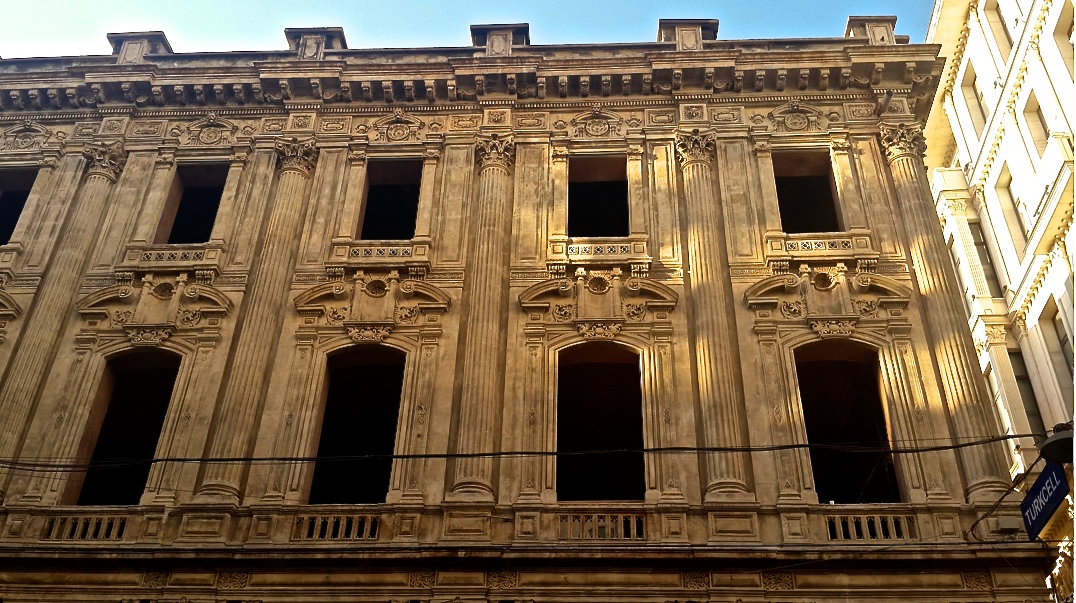
A  facade on Istanbul’s Emek Theater of exquisite unorthodoxy. Click to enlarge. (Skyscraper City)

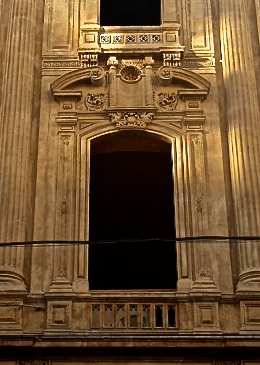
Here’s a wall that satisfies all of my demands for a fine façade. Hats off to Michael Rouchell, the New Orleans architect who sent the picture of the Emek Theater, in Istanbul, to the TradArch list. He added a comment so exquisitely rococo that I can barely understand it, let alone comment on it myself. Actually, by looking at the inset detail of the photo, the context of the lingo emerges, with clarity in its wake. Micheal’s deployment of refined classical jargon represents the highest level of literary architecture porn.

Detail of ornamentation.

Detail of ornamentation.

What caught my eye is the small miniature Ionic columns and niche located between the volutes of the broken pediments at the second level [the lower level in the upper photo].  The architrave cap of the broken pediment juts out over the cartouche keystone to form a sort of pedestal for the miniature Ionic columns.  A portion of the sill for the opening above becomes the corona and crown for the miniature Ionic’s entablature.

These are the kind of creative architectural devices that can be employed without compromising the overall beauty of the building.  The average person would never catch such a detail, which allows the architect his/her creative freedom.

Posted in Architecture, Architecture Education, Architecture History, Art and design, Other countries, Preservation | Tagged , , , , | 1 Comment

Follies at the CNU in Dallas

Dallas, site of CNU walkability congress. (doubletree3.hilton.com)

Dallas, site of CNU walkability congress. (doubletree3.hilton.com)

The big buzz at the annual meeting (the “congress”) of the Congress of the New Urbanism, under way in Dallas, is how lame Dallas Morning News architecture critic Mark Lamster was. Anyone familiar with his writing cannot have been surprised. Equally unsurprising though much more disappointing was the retreat by Steven Bingler from his pathbreaking article (written with Martin Pedersen) last December in the New York Times.

Bingler now seems to regret that either his piece in the Times, which castigated modernism for ignoring public sentiment, or his presentation yesterday on a CNU panel, has cast him publicly as a New Urbanist. Tell it to the CNU faithful! What a boor. Still, his piece is called “How to Rebuild Architecture,” and whatever his regrets, it is true and worth reading.

But as architects, Bingler’s firm was one of those that helped actor Brad Pitt prolong the pain of Katrina in New Orleans’s Lower Ninth Ward.  He helped Pitt put up new modernist housing there that didn’t fit in with the ward’s shotgun houses. Residents mostly dislike Pitt’s poor excuse for houses, some of which have roofs that look like they’re designed to be blown off in a hurricane. Someone who’d help with that must be dubious from the get-go.

Lamster … well, who knows why he was a speaker at the congress? His writing shows that he hates traditional architecture built today – hey, it’s modern times so only modern architecture should be allowed, right? Wrong, but that is the Kool-Aid that consumes the profession’s establishment today and for the past 50 years. Lamster is marinaded in it. He is a good writer but a bad thinker, and anything he writes or says from a podium has got to be regarded with suspicion.

I believe I have Mark Lamster’s number. My blog post “Dish Dallas kitsch” from last July took down Lamster so thoroughly that he should not have been able to rise up from the floor and write another piece of so-called architecture criticism.

But there’s no shame in architecture today, or in most writing about it, or how could we still be seeing the meme that modernist architecture is really classical? To be sure, some of the founding modernists like Corbusier and Mies were brought up as classicists, but they rejected it and abandoned it, and nothing modernist bears any actual resemblance to it – except that it has what passes for roofs, doors, windows and, sometimes, symmetry.

In spite of efforts to “invite” modernism into the New Urbanist framework, New Urbanism remains a distinctive and highly successful effort to undo the dysfunctional urban planning of the past half century or so. New Urbanism is really the old urbanism from before World War II. People like it because it looks traditional, and to the extent that CNU erodes that generally accurate perception under the guise of big-tent open-mindedness, to that extent the CNU is digging itself an early grave.

That project of self-immolation was criticized in a long “Is CNU Burning?” thread on the TradArch list begun by architect David Rau after last year’s congress in Buffalo. But people do not learn, and the project apparently is continuing, in spite of a change in topic this year to “walkability,” which exactly zero people are against.

Wow! Dallas! Now there’s a town that exemplifies walkability!

Posted in Architects, Architecture, Architecture Education, Blast from past, Development, Landscape Architecture, Urbanism and planning | Tagged , , , , , , , | 1 Comment

For Rhode Islanders only

Screenshot from the trailer for

Screenshot from the trailer for “Irrational Man.”

The trailer for Woody Allen’s movie Irrational Man, filmed on location in Rhode Island, is out. Here it is, released by Sony Picture Classics. Release date is July 24. Let’s see how many places we Rhode Islanders can identify!

(Don’t click on the photo above, which is a screen shot, but on this post’s second word, “trailer.”)

Posted in Architecture, Book/Film Reviews, Rhode Island, Video | Tagged , , , , , , | 2 Comments

A dream to soothe the breast

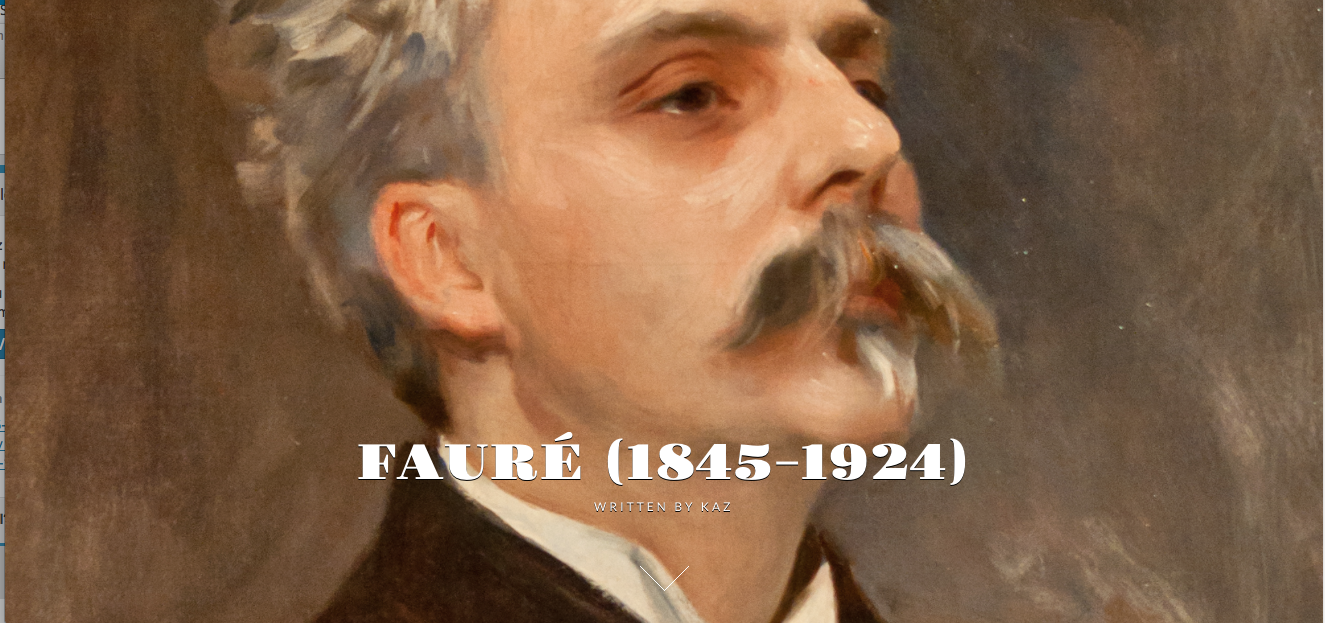
Screen Shot 2015-04-29 at 10.54.20 AMWho has not claimed to have said that architecture is music frozen in time? Perhaps music is architecture floating into our ear. Anyway, I was just now introduced to the French composer Gabriel Fauré (1845-1924). A blogger on music whose blog doesn’t seem to reveal his real name, beyond the moniker of “Kaz,” or whether he is a musician, has started following my blog. I went to see his blog. It was beautiful.

First off, Kaz introduces me to Fauré, with whose name I’m familiar among the pantheon of composers. I was not intimate with his music, though now that I’ve listened to it freshly I’m sure I have heard it. Well, Kaz’s intro suggested that Fauré might parallel in some way the classical architects whose work deviated from the canon enough to raise the eyebrows of those who protected it in those days. I am fascinated by that debate among today’s classical architects, so I decided to read on, and to listen.

“Fauré’s music,” writes Kaz, “is often thought of as bridging the gap between the Romantic and Modern eras of music, much like Beethoven’s was seen as heralding the end of the Classical period.” He adds:

Classic FM writes that “[Fauré’s] distinctive harmonies can be savoured like an exotic liqueur,” and indeed Fauré’s music is always of exquisite taste; perfectly balanced yet beguilingly sensual in its quintessentially French sound, it “flows effortlessly, magically combining Monet’s liquid cool with the warmth of a Pissarro landscape.”

The first piece Kaz links to is Élégie, Op. 24, played by the Zagreb Philharmonic Orchestra. It had melody so it was clearly not modernist atonal music. It was passionate, and eventually some notes of a slight discordance are introduced, but not in any offensive manner, just enough to make you wonder. The tune is sad, befitting an elegy I suppose.

Fauré was a romantic in that he liked to seduce women. One was the future wife of Debussey. Another, according to Kaz, broke his heart. His pain may be felt in his duet Après un reve for violin and piano, played by Janine Jensen and Itamar Golan, to a video of which Kaz links. It is lovely and sad, and tells a story that pulls at your heartstrings as if they were strung on a musical instrument and stroked by the teaze of circumstance.

I don’t know whether my comparison of Fauré to the heterodox classicists holds water. I do know that the architecture of, say, Louis Sullivan is not a bridge between classical and modern architecture. Modern architecture is a completely different beast, much as is atonal music. In both cases, the “bridge” was not used to span a natural progression in the evolution of an art form. No. The future was dynamited and is now, after years of loss in a dire wilderness, being reconstructed.

I trust that the excellent blog of Kaz and its beautiful music will add to efforts at reconstruction in his own realm. I will link to his blog.

[Update: Kaz is Karim Hakimzadeh, a London-born, New York-based “entrepreneur running a hedge fund specializing in disruptive technologies (I’ve invested in fields like gene-sequencing, life sciences, renewable energy and the like).” He says he is near launching an app for learning music.]

Posted in Architecture, Art and design, Books and Culture, Video | Tagged , , , , , , | Leave a comment

Boston’s spooky new T entry

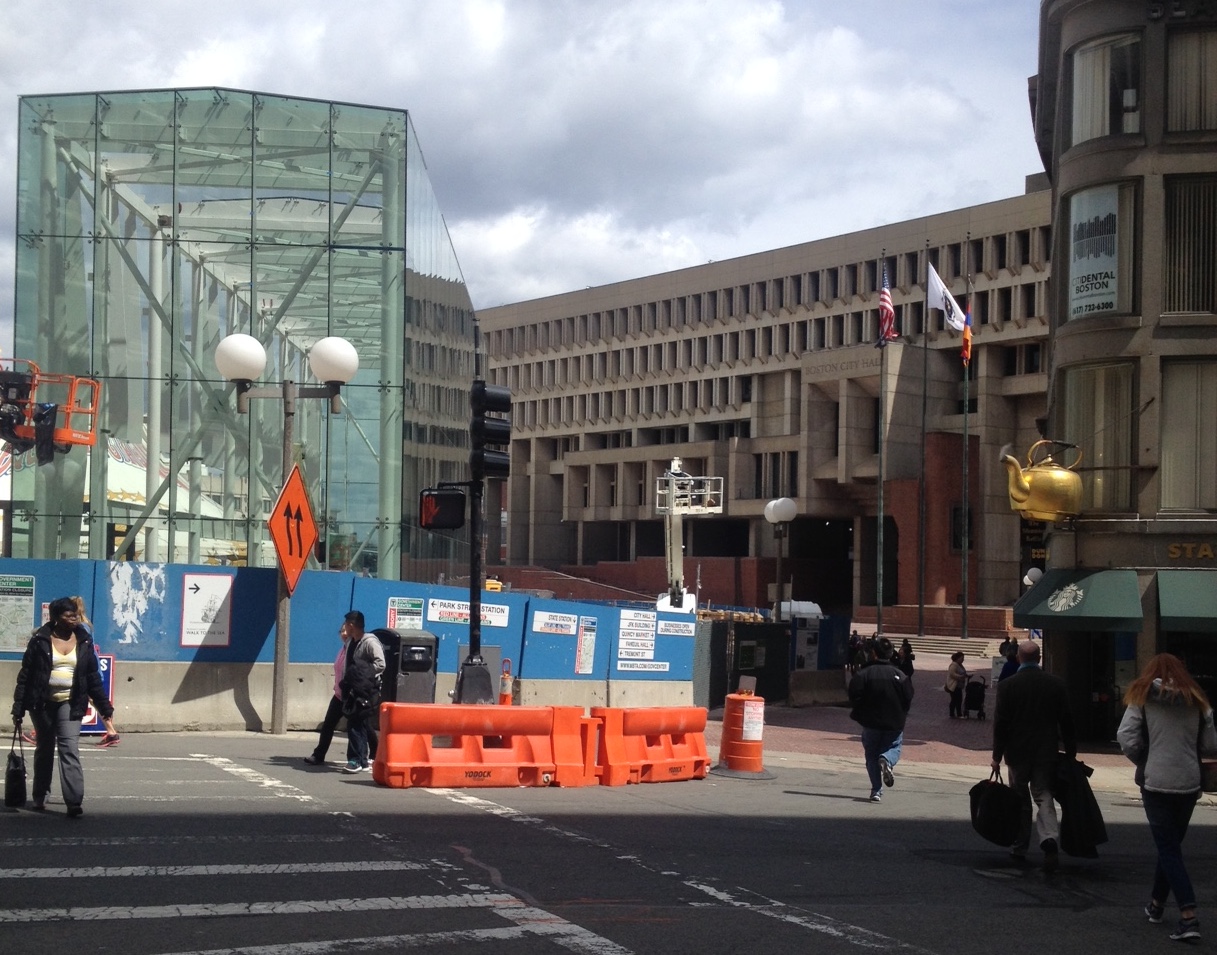
New T station entrance at Government Station.

New T station entrance at Government Station. (Photo by Operative 0054)

An undercover source in deep infrastructure sent me a surreptitiously snapped photo of the new T entrance at Government Center the other day. The photo was too hot to handle, too ugly even to look at, so I left it alone to cool down and also let time elapse so that my source could scurry back into the woodwork from which she – oops, I mean he – occasionally emerges.

My source sent notes on a tape that went up in smoke after I copied it:

  • no sense of context
  • overscaled
  • 32 feet tall (a subway entrance???!) hello!?
  • another box!!
  • will be covered w/ pigeon droppings in a week
  • no way to clean except w/ fork lift
  • architecture obsolete before complete!
  • designed by BSA president Tim Love – a GSD grad – [redacted]
  • poorly detailed – Foster on the cheap – you can’t do high-tech design on the cheap
  • looks like KMart does Renzo

It almost seems as if authorities in Boston want to scare off public use of the facilities they control. Each new item of infrastructure looks scarier than the last. This is not a matter of honesty in design. The structures – some needed to exchange the fetid air of the Big Dig under Rose Greenway – do not express the ugliness of their enclosed machinery on their exterior, like a sort of mini-Pompidou. It is decoration pure and stupid, decoration designed to create not love but loathing for Boston. On the other hand, situated next to Beantown’s famously ugly city hall, maybe its designer thought he could take a vacation. He did. But new ugly does not make old ugly better.

Posted in Architecture, Art and design, Development, Landscape Architecture, Urbanism and planning | Tagged , , , , | 3 Comments