Park or party at the Facade

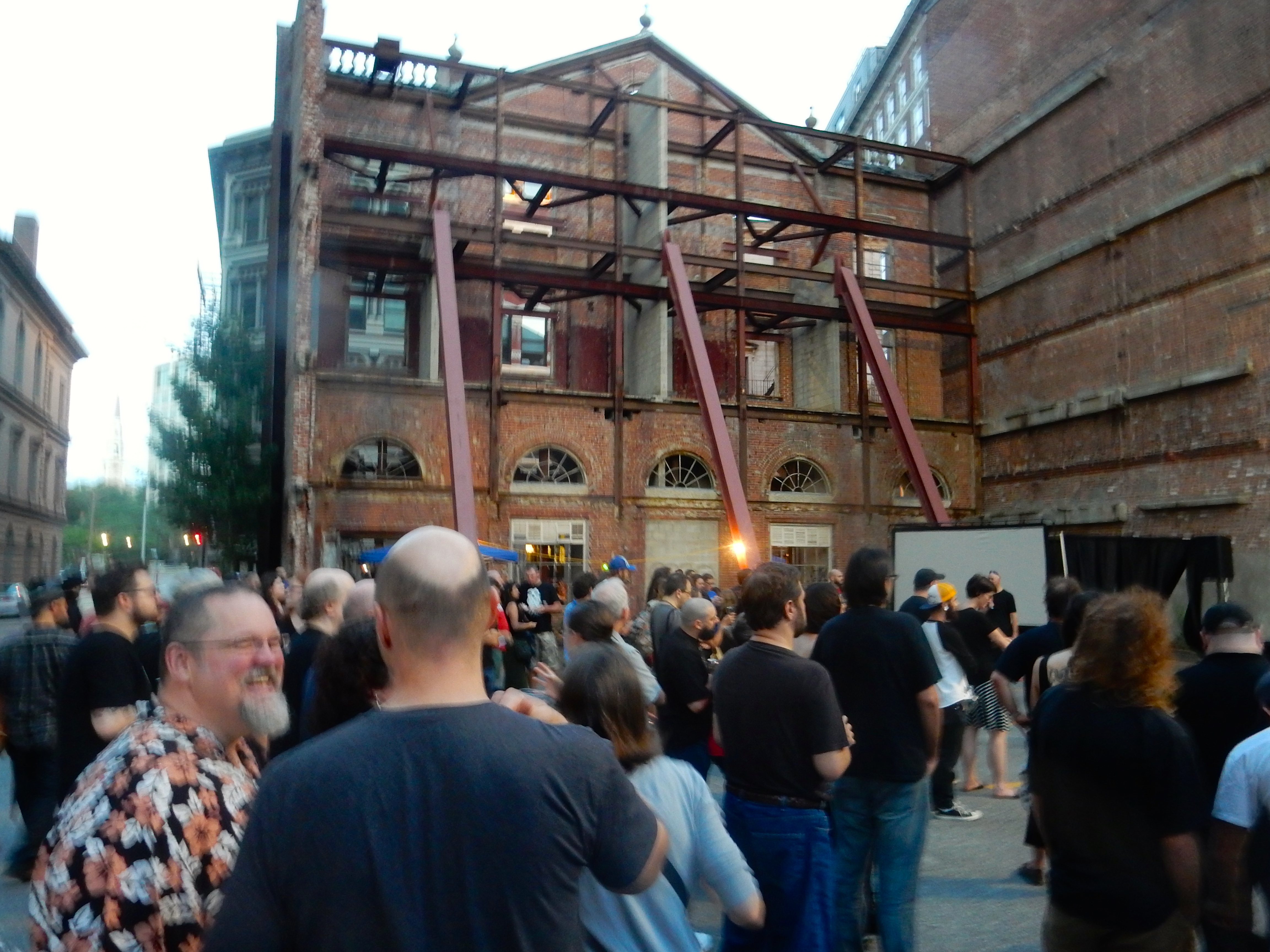
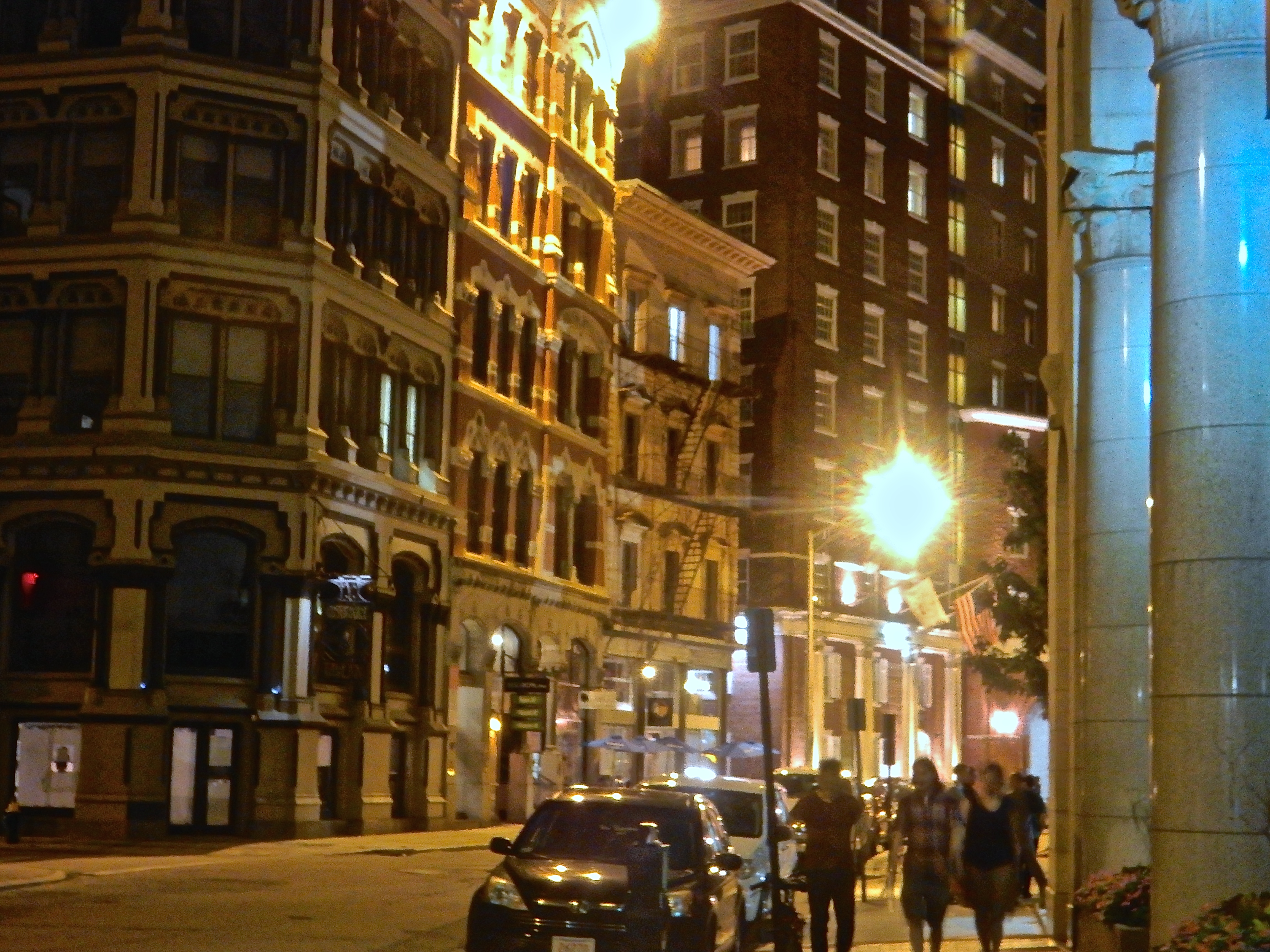
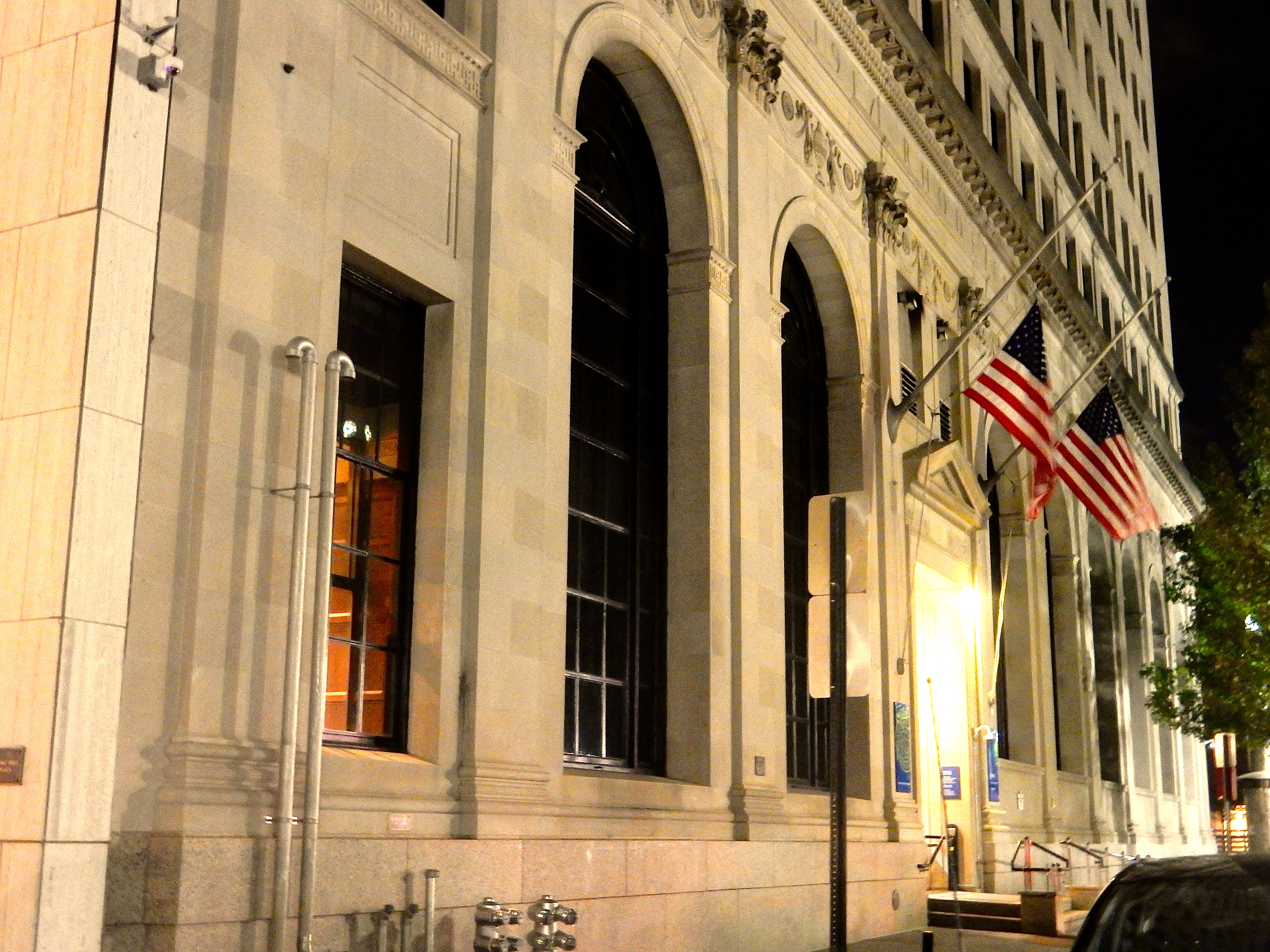
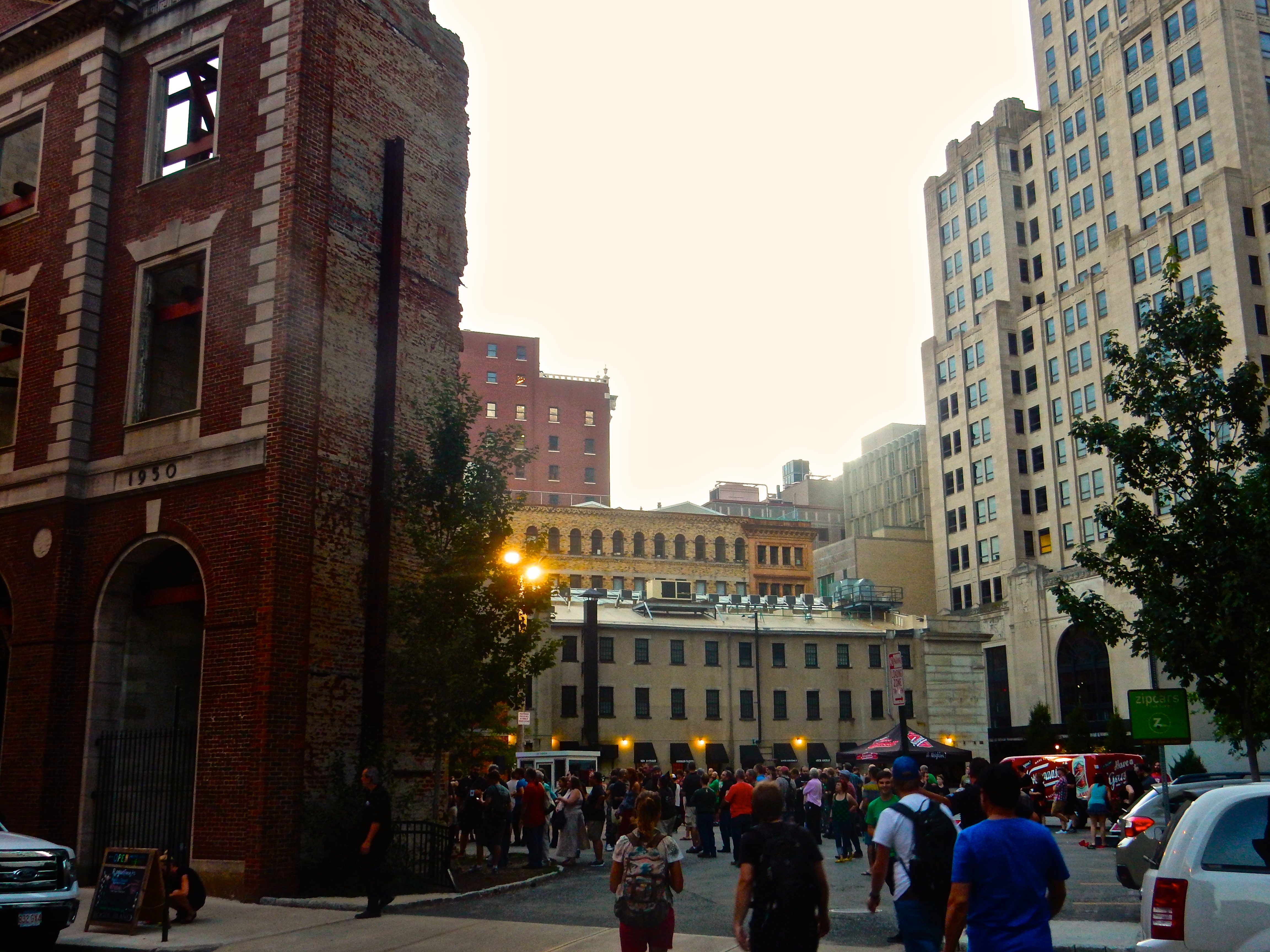
The Weybosset facade, all that remains of Providence National Bank. (Photos by David Brussat)

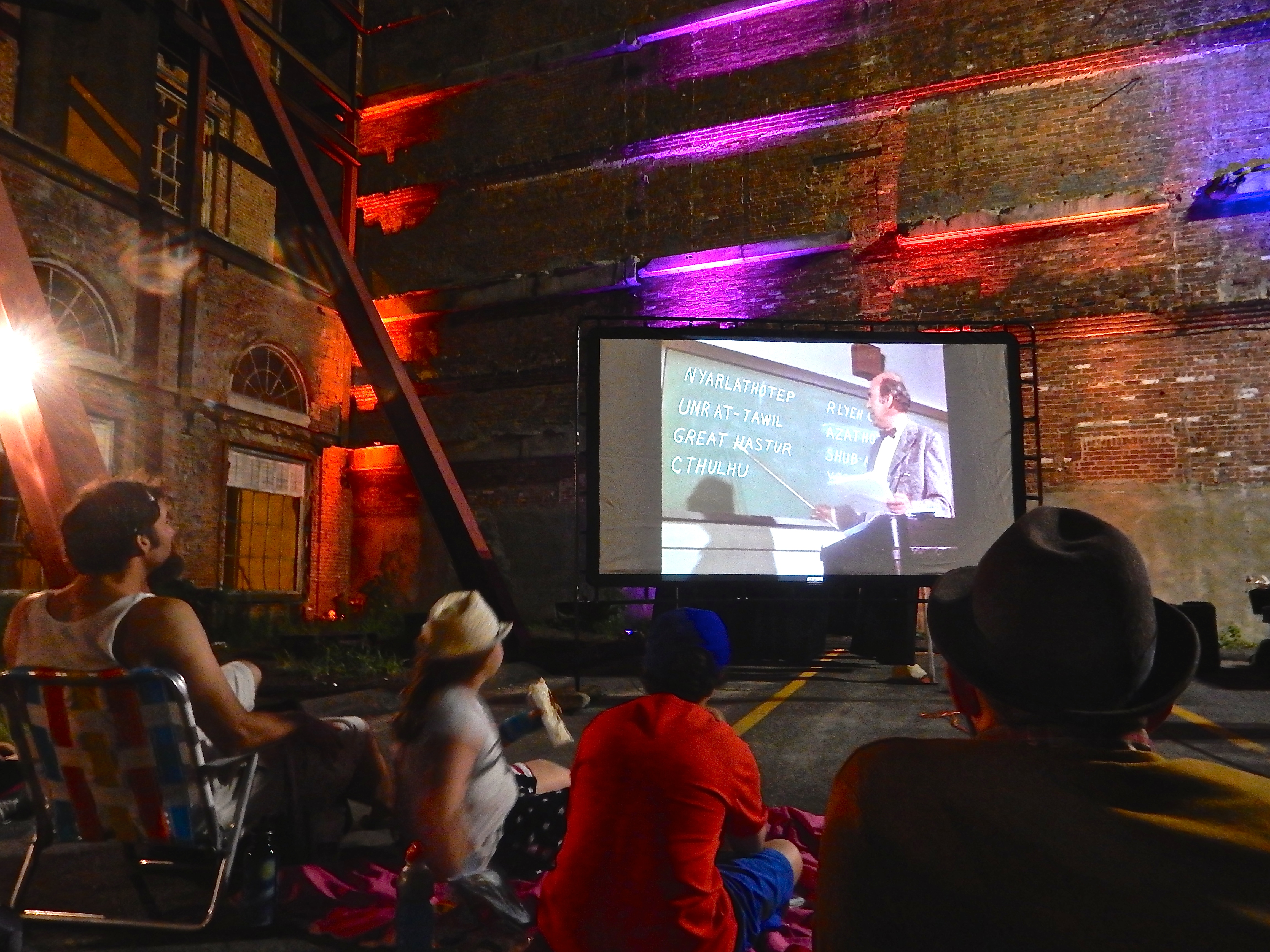
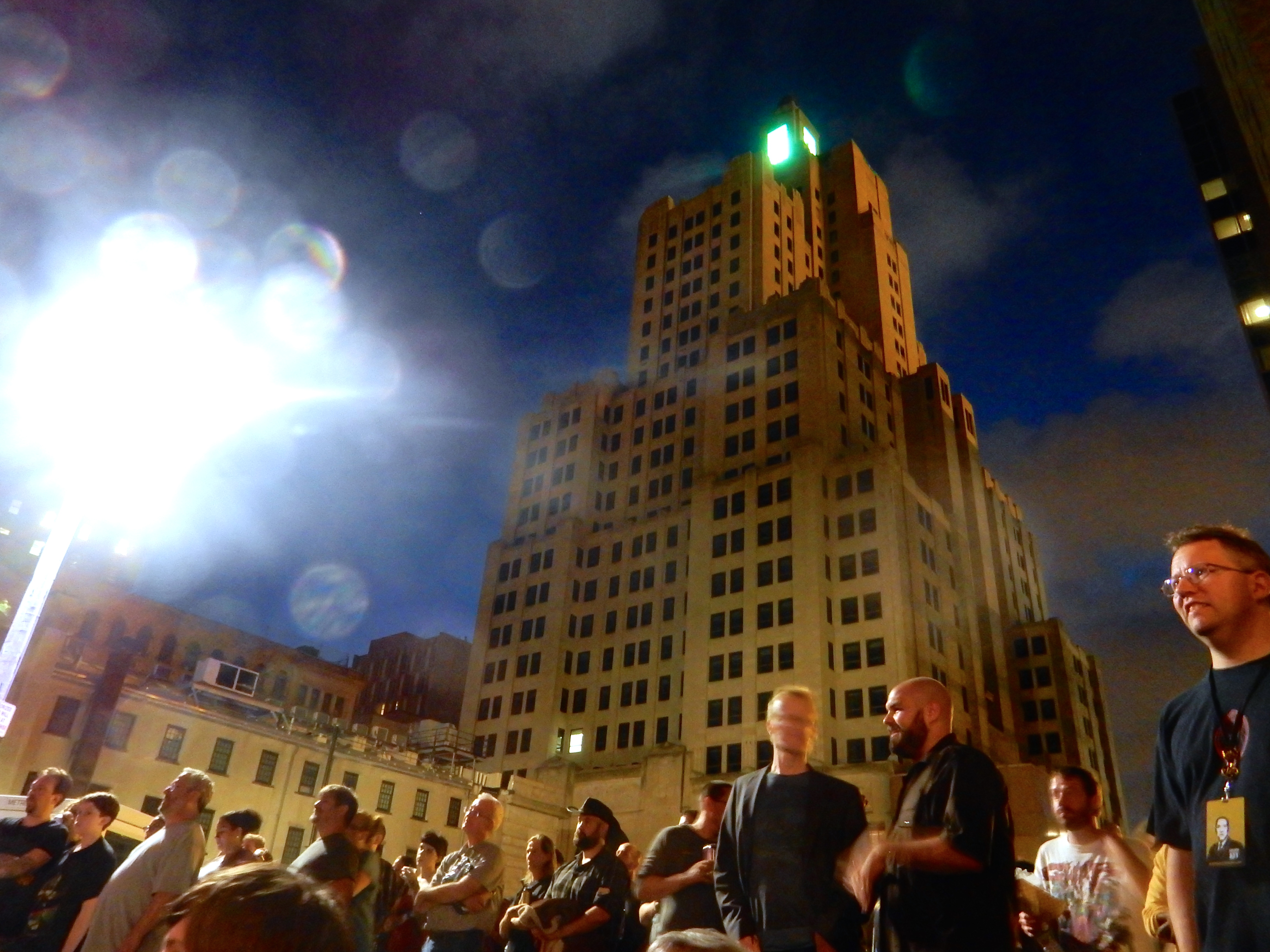
Lovecraft party behind the Weybosset facade, all that remains of Providence National Bank, at left. Industrial Trust (“Superman”) Building is at right. (Photos by David Brussat)

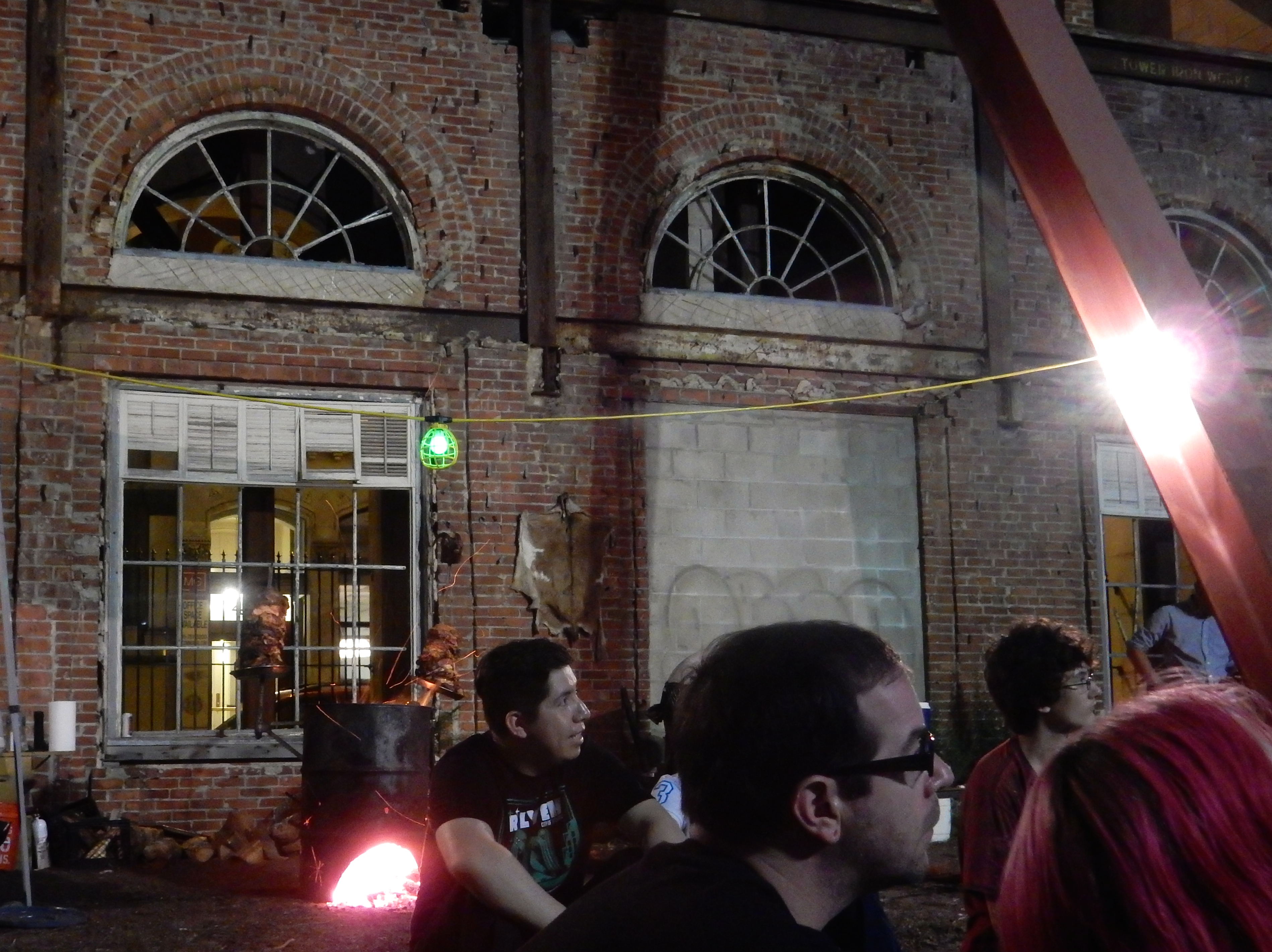
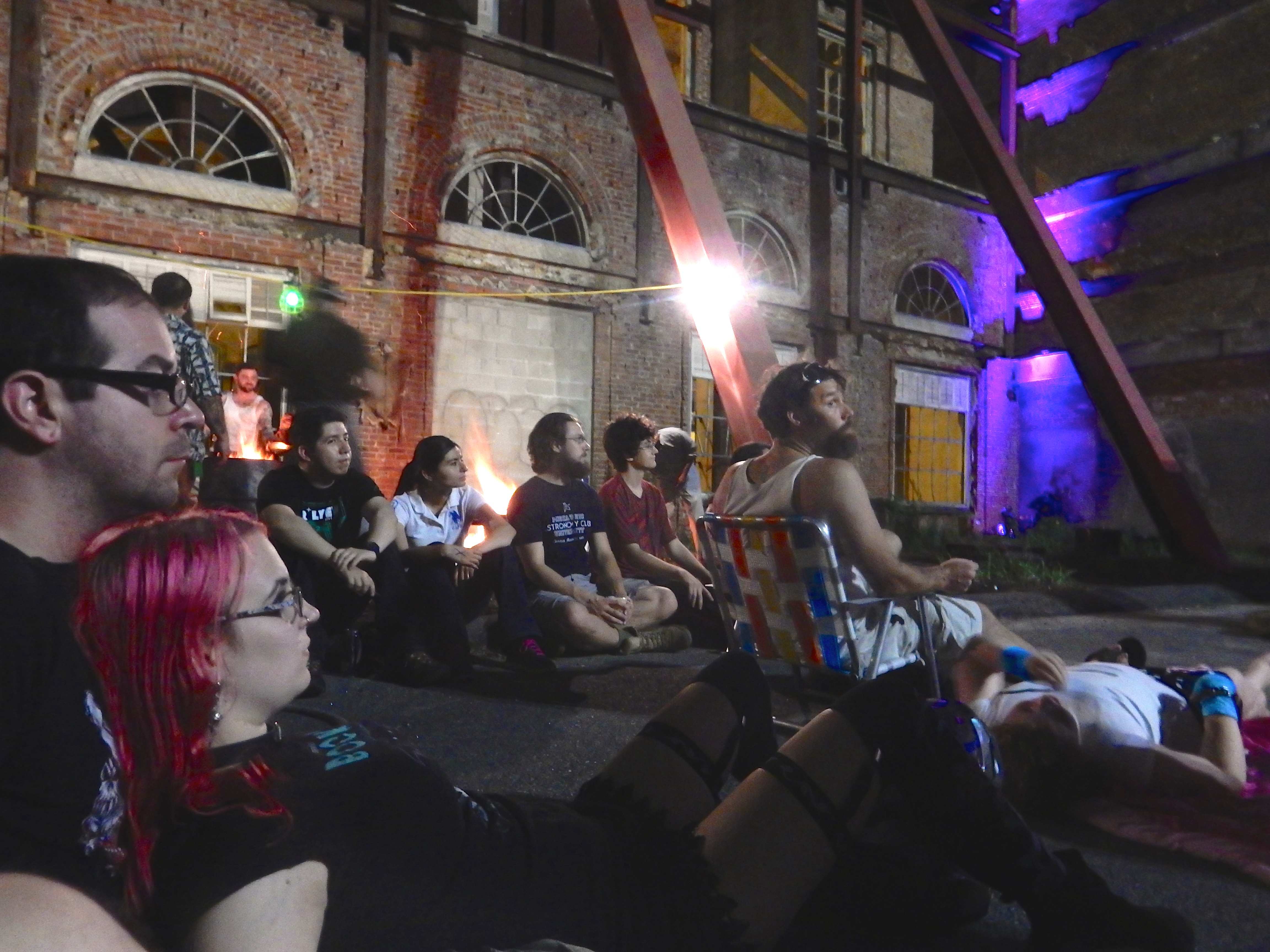
The convention celebrating the 125th birthday of, and all things relating to, H.P. Lovecraft hosted a party in the parking lot behind the naked façade, next to the Arcade, that is all that remains of the Providence National Bank Building. Built in 1925 on Westminster Street and extended in 1950 over to Weybosset Street, the bank was torn down, except for the 1950 façade, in 2005 to make way for a 40-story tower that fell through. Now it is a parking lot – owned by former Mayor Joe Paolino – and last night’s extravaganza put it back into real use again. It goes without saying that AGTWHBA.*

Parking is fungible. Partying is not. A party, if it has any balls, must be scheduled in advance, and so kudos to Paolino for letting that party go forward. Yes, the organizers paid a fee to use the lot, but spurning the gods of parking was nevertheless commendable. Let them park elsewhere!

And actually there was parking on the streets nearby, which is not entirely a good thing. I parked steps from the NecronomiCon event. And yet all smart cities invite the “problems” associated with finding a place to park: it means the city is popular and vibrant. Pending the erection of another building on the Providence National Bank site, parking should share the space with partying (weddings, concerts, dances, etc.) whenever possible.

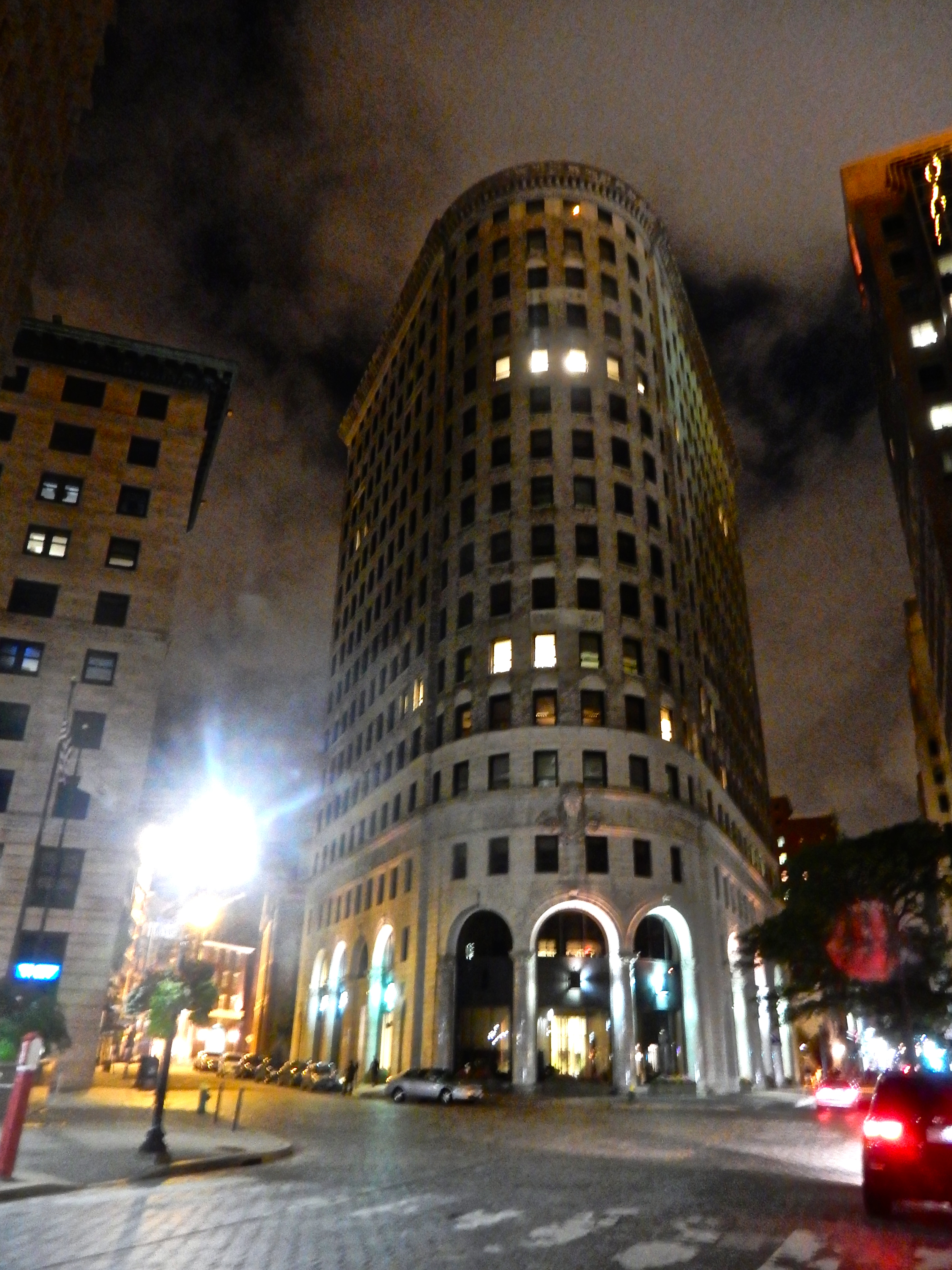
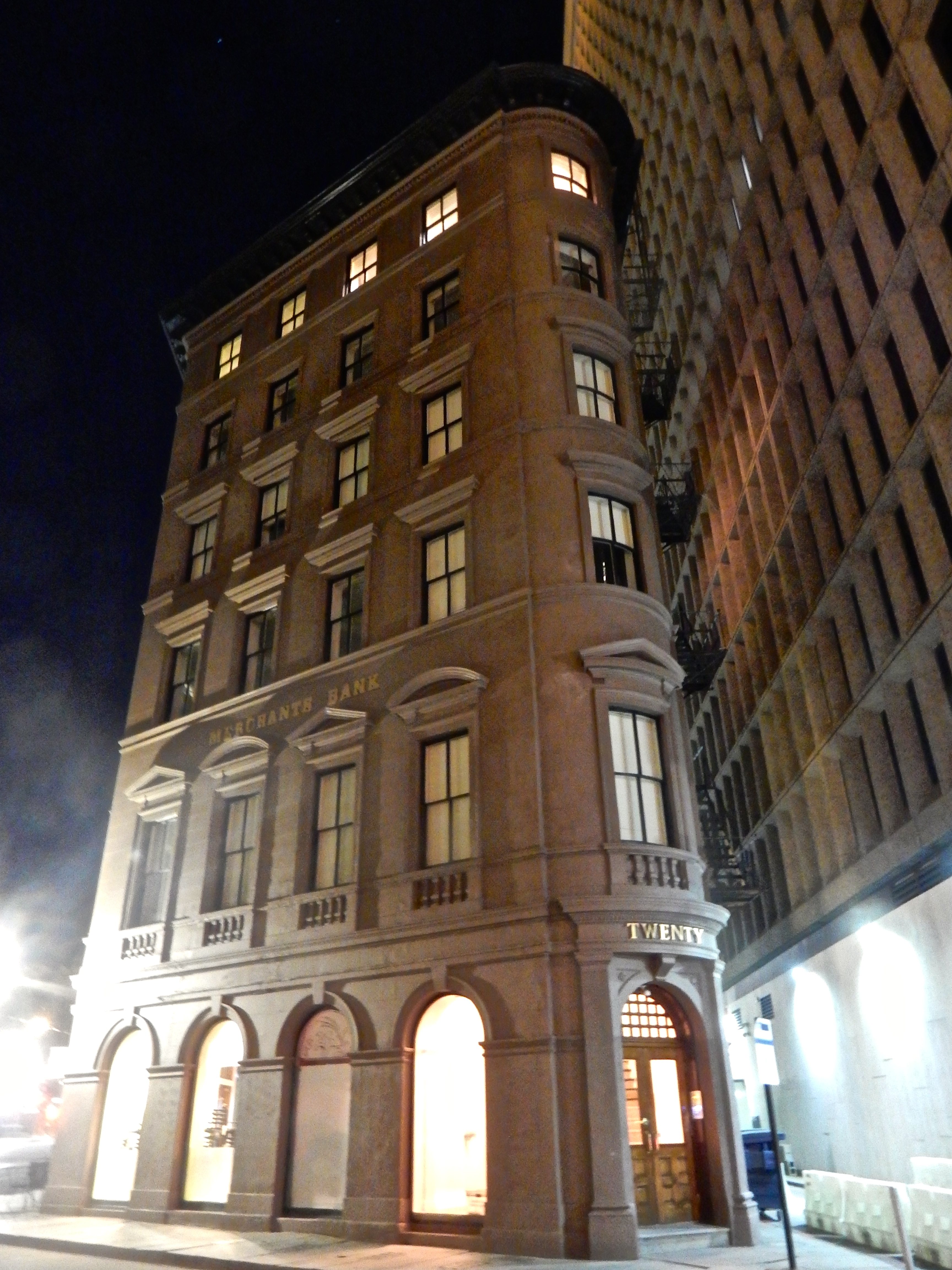
Anyhow, I enjoyed the event and had my camera with me, with results, from the party then walking back to my car on Weybosset, below:

DSCN8485

DSCN8490

DSCN8491

DSCN8492

DSCN8497

DSCN8501

DSCN8506

DSCN8533

DSCN8528

DSCN8530

* A Good Time Was Had By All.
Or maybe it should be “IGWS that AGTWHBA.”

P.S. Do any fotomaniacs out there know how to filter out those bright-light splotches in night shots without using an SLR camera?

Posted in Architecture, Books and Culture, Development, Photography, Preservation, Providence, Urbanism and planning | Tagged , , , , , , | 4 Comments

Green eggs and metaphor

WWI memorial design by Devlin Kimmel. (World War One Centennial Commission)

WWI memorial design by Devlin Kimmel. (World War One Centennial Commission)

A old Washington chum, Stevenson Hugh Mields, one of the most original unrecognized humorists of our time, sends me his reaction to the WWI memorial competition:

Cezanne (art-wallpaper.com)

“Pyramid of Skulls” (1901), by Cezanne (art-wallpaper.com)

I want to revise my entry. Instead of a pyramid of 1,000,000 artillery shells, the pyramid should be 1,000,000 skulls. Or an alternate version could be 1,000,000 spiked kraut helmets. Forget weepy poetry by Winfred Owen, too. Dr. Seuss’s Green Eggs and Ham could be tweaked into, say, Splattered Brains and Spam. The site should be ugly with no trees, shrubbery, or sissy waterfalls. The visitor must walk through mud. When you split, there will be stations where you can rinse off your feet, like on the boardwalk at the beach.

Have I got your attention now? The top classical entry among the five finalists in the competition to design a national memorial to World War I in Washington is by Devin Kimmel, an architect from Annapolis, Md., who is a member of the Institute for Classical Architecture & Art. In a recent post I played around with his proposal, wondering whether its centerpiece really wanted to be an arch rather than what he calls a tower. But the tower itself, as designed, carries the sort of symbolic message that only classicism has sufficient vocabulary to convey.

Devlin Kimmel's tower and grotto.

Devlin Kimmel’s tower and grotto. Click to enlarge. (WWOCC)

Notice how the tower degenerates in form from its top and its shaft, which are of a rather orthodox classicism, down to its base, which is formed of a rusticated stone wall that itself degenerates into mere rocks and boulders as it meets the grotto and pond that constitute its foundation. This metaphor may be read a number of ways, of course, but it surely can be interpreted as suggesting the debasement of human society that is involved, of necessity, in embarking upon war, regardless of the merits of its rationale.

Maybe Kimmel’s tower doesn’t really want, or need, to be an arch after all! And perhaps the eloquence of the transition from civility to savagery can be made even more effective by using more calibrated gradations to increase the subtlety of the devolution toward the grotto.

This reading does not require any particular academic degree or knowledge set – it emerges naturally into the consciousness of anyone who understands the horror of war. So Kimmel’s memorial will be able to communicate with almost anyone who happens upon it a century from now.

It is difficult to imagine a memorial designed in a modernist vocabulary (if you can call it that) speaking with such coherent subtlety. I looked at each of the 350 designs as soon as they were up on the website of the National World War One Centennial Commission. Of these, nine out of ten were modernist, and I’d say 70-80 percent of those were silly efforts to use a great but tragic victory as an excuse to indulge in a sort of goofball symbolism, at which modernism excels – and which is mandatory in the design of monuments nowadays. The form of those monuments says nothing about anything, indeed visitors to a majority of them would have a hard time figuring out what the memorial memorializes, or even that it is a memorial. This is why modernist memorials use so many words – they are required to convey a significance that modernist sculptural asininity cannot handle.

Except for its will to ugliness, Steve Mields’s entry might well have qualified, because of its pyramid form and its legible vocabulary (whether skulls or Pickelhauben), as classical. It certainly gets his point across!

Posted in Architecture, Architecture History, Art and design, Books and Culture, Urbanism and planning | Tagged , , , , , , , , | Leave a comment

Lovecraft at the Facade

Vew from under colonnade of Providence County Superior Courthouse. (Photo by David Brussat)

Vew from under colonnade of Providence County Superior Courthouse. (Photo by David Brussat)

Fans of H.P. Lovecraft’s tales of horror, most of which are set in Providence and elsewhere in New England, will want to be downtown at “The Facade” tonight at 7 for an event hosted by NecronomiCon Providence – the conference on all things Lovecraft under way right now.

Facade at Weybosset Street. (ricurrency.com)

Facade at Weybosset Street. (ricurrency.com)

The Facade is the remains of the old Providence National Bank Building mostly demolished back in 2008. It now fronts a parking lot next to the Arcade. Here is a Facebook schedule for the series of events there this evening, including a film and some “secret” film clips, along with music and various other tidbits of interest.

I first became aware of Lovecraft long ago when I learned that he had written extensively to the Providence Journal, circa 1927, calling for the Brick Row to be saved from being razed to erect a judicial archives next to the Providence County Superior Courthouse that was also in the planning stages then (and Lovecraft adored its grand Georgian design no less then than I do today). The Brick Row was demolished but the archives was never built. Memorial Park, built in 1996, occupies that space today, along with Paul Phillipe Cret’s WWI memorial.

The photo above was taken last Saturday as my son Billy and I, after attending WaterFire, decided to take in the colonnade of the courthouse (and its Guastavino tile) on our way back to the car. There was a freak shower and people crowded in to join us to get out of the rain. After it had stopped, Billy and I found that while the courtyard was wet the sidewalk in front of the colonnade was dry.

Crank up the theremin! (Oooo-eee-oooo!) H.P. Lovecraft, call your office!

Posted in Architecture, Architecture History, Art and design, Books and Culture, Providence, Urbanism and planning | Tagged , , , , , , , | Leave a comment

Finalists for WWI memorial

U.S. troops under fire in France. (coldwarwarrior.com)

U.S. troops under fire in France. (coldwarwarrior.com)

The jury in the design competition for a World War I memorial near the White House in Washington, D.C., has narrowed more than 350 entries down to a final five. One of them, arguably two, are classical, and already the cynics are in full conspiracy mode.

I consider myself one of the cynics. The structuring of design competitions to exclude traditional entries is ubiquitous. So I buy into the theory that one of the 26 classical entries was selected to be dumped in the second round after providing the jury plausible deniability in the fairness sweepstakes. Except that the best classical finalist is not the worst by a stretch. In fact, it is quite good. And the other arguably classical entry is not half bad.

With only 26 of 350 entries classical, it is hard to argue that the selection was rigged by the jury – 40 percent of the finalists are traditional. (Classical architecture is a category of traditional architecture, although the many types of traditional sprang from ancient classicism.) Still, all the judges were modernists after the one judge allegedly sympathetic to classicism, Laurie Olin, was replaced with another mod.

But let’s overlook the conspiracy theory, which is unlikely to be exposed even if it holds any water. This memorial is important to me because one of my favorite watering holes is the rooftop café of the Washington Hotel, from which you can look down on the current Pershing Memorial Park. It doesn’t look like much, and it would  be nice, while tippling, to have an imposing monument to look down on to the west when you are tired of looking down on the Treasury Building and its lovely colonnade to the north.

So let’s briefly analyze the finalists one by one, eyeballing the images on the website of the National World War One Centennial Commission. (Starting with the most classical finalist on top, I have ordered the images according to my assessment of their quality, best to worst. My opinion lacks the rigor of our thoroughbred classicists but is meant to bring my classical-tribune-of-the-public’s eye to bear on each entry. Click to enlarge, and then click again after placing your cursor over the part you want to examine even more closely.)

***

The most classical finalist. (All images courtesy of the World War One Centennial Commission.)

The most classical finalist. (All images courtesy of the World War One Centennial Commission.)

The best finalist, above, is a classical entry that wants to be a victory arch, but the arch seems plunged in a pleasant little grotto with a pond at the base of the arch that cries out to span a larger opening. This is the only proposal among the five that reads “memorial” and “monument.” All the others read memorial: one with dignity and the other three with a sort of vague symbolic mawkishness now mandatory for memorials today. Only this one also seems monumental – designed to commemorate a victory, soaked in sadness – that speaks a design language that will be legible a century from now. It does not need all the words etched into the arch’s abutment.

***

World War One Memorial Design Competition

The above finalist is a park centered upon a statue of Gen. John “Black Jack” Pershing, commander of the American Expeditionary Force, retained from the existing memorial and surrounded by way too much flat stone surface, sitting upon a raised platform within a stone wall lined with bas-reliefs of the war – some are quite good – outside of which wall are trees. This memorial lacks the monumentality of the more forthrightly classical finalist above. It is hard but gentle. But it also lacks the sheepish reluctance to admit to being a war memorial that sullies the next three.

***

WW1 Memorial References

The third best finalist’s memorial seems like a maze, or a miniature golf course, but its winding path through grass and trees may also be a metaphor that reflects the architect’s misunderstanding of that distinctive feature of World War I – the trenches. Who knows! But it seems like a nice place to take a walk without being overly reminded of the depressing fact that a bloody war (our side won, and long ago to boot) is the subject being recalled.

***

World War One Memorial Design Competition

The fourth finalist – I do not want to use the word “best” any longer! – is an array of sunken museum exhibits displaying old photos of families that saw their loved ones sent “Over There,” some of whom did not return (a fact that seems to have been overlooked in the presentation). Four exhibit themes feature Family, Brotherhood, Diversity and National Pride. This qualifies as the most mawkish memorial, but refuses to embrace the goofy sculptural modernism of the vast majority of the 325 or so non-traditional entries.

***

World War One Memorial Design CompetitionThe fifth and the oddest memorial proposes, in essence, a book rendered as a park. It consists of an allée of cast glass monoliths “inscribed with text that recollects a comprehensive historical account” of the war – through which text may be seen cascades of water pumped through this long series of glass features, which sit atop bronze plinths that reflect the metal of the deadly machinery of war. There are the obligatory grass and trees. This finalist, too, avoided the most extreme modernist tropes. Bravo.

***

And indeed so did they all. Acolytes of Frank and Zaha can take no joy from this selection of victors. The most classical entry is clearly the superior. Its only real competition the jury left on the cutting-room floor.

Here is an account of the five finalists, with judges’ notes, by the Associated Press.

Posted in Architecture, Art and design, Landscape Architecture, Urbanism and planning | Tagged , , , , , | 6 Comments

Guiding hand in Worcester

Worcester, Mass., (city.1-themes.com)

Worcester, Mass., (city.1-themes.com)

The city of Worcester, Mass., has adopted a set of design guidelines for developers and business owners seeking the city’s assistance to rehab old buildings or construct new ones in New England’s second-largest city. The purpose of City of Worcester Design Guidelines is straightforward: “[T]o protect and enhance the existing building stock while ensuring that new construction fits into and complements the surrounding setting.”

This is not exactly revolutionary, but it is contrary to conventional wisdom in planning and design in most cities today. Providence has similar language in its municipal code, but it is honored mainly in the breach. It has no design guidelines that set standards as directly as those of Worcester. The introductory text to the Worcester guidelines continues:

These Guidelines seek to minimize the reliance on highly subjective, individual tastes and preferences of permit granting authorities to consistently apply a clear, professional policy informed by the most up-to-date thinking on urban design and development.

And the guidelines have an exception:

In some cases, new civic buildings may be designed as an exception to the Guidelines, allowing these unique buildings to stand out within the urban fabric due to their role as landmarks for the community.

Still, that does not necessarily mean that exceptions must contrast with their setting, only that such contrast is permitted. A new building considerably more robust in its attention to the guidelines might also be considered such a permissible contrast.

The important thing is that Worcester has decided that part of government’s function is to guide the city back toward the beauty that once was a natural characteristic of its streets. Some may detect in such guidelines a whiff of the authoritarian, but political leaders there clearly see that the hodge-podge of new and old in the past half century has done little to promote the growth of Worcester. In the absence of a natural design civility, or neighborliness, on the part of developers, guidelines are as appropriate in civic design as in every other facet of government, where they are ubiquitous.

It is the quality of the guidelines that is important. There is extraordinary flexibility in Worcester’s guidelines. Creativity is not barred at all; rather, a more subtle and elegant form of creativity is encouraged. Following the guidelines is, moreover, not mandatory for applicants not seeking city government assistance – though the city certainly must hope that they will nevertheless provide a beneficial influence.

Mayor Walsh of Boston has undertaken to apply a guiding hand to civic design in the Hub, although he has urged developers to embrace architecture that flies in the face of Boston’s brand – if its brand may still be considered to be embodied by its famous old districts such as Beacon Hill and Back Bay, the places Bostonians and their guests think of when “Boston” comes to mind. But the mayor at least understands the value and the propriety of the bully pulpit in matters architectural.

Mayors of Providence and other Rhode Island municipalities, not to mention Governor Raimondo, should consider offering such friendly advice. If this takes the form of design guidelines, that would be good, but it may be late in the game for that in Providence. At the very least a personal phone call from the governor to developers is in order, urging them to build projects that strengthen rather than weaken the Rhode Island brand.

The idea, in Worcester, Providence and elsewhere, is not to revive a lost past but to engage the principles that produced historic beauty as part of the design strategy for a more attractive future. Is this too much to ask?

Hats off to Nancy Thomas, of Tapestry Communications, for sending the Worcester guidelines my way!

Worcester today. (wikipedia.com)

Worcester today. (wikipedia.com)

Posted in Architecture, Architecture History, Art and design, Development, Preservation, Providence, Rhode Island, Urbanism and planning | Tagged , , , , , , | 1 Comment

Psychitecture? Dig it, baby!

John Lautner's Sheat's Goldstein's House, diagnosed with apostrovitis. (Rachel Medvald.)

John Lautner’s Sheat’s Goldstein’s House, diagnosed with apostrovitis. (Rachel Melvald.)

Psychitecture is one of those coinages enabled by the word architecture. The word psychotecture springs immediately to mind, and there’s a blog called Architorture, which is brilliant, except that it is by a coed, Celina, at Cal Poly San Luis Obispo who is bored to death by her experience at its school of architecture. Don’t go there. (I mean the blog, which is kaput, not the school; to avoid the latter goes without saying.) Members of TradArch will be toying with psychitecture for the next several decades.

Rachel Melvald and her couch. (

Rachel Melvald and her couch. (R. Melvald)

Architect magazine, mouthpiece of the AIA, ran a piece in 2011 called “How Common Is Your Type?” about the psychological traits of architects. The introductory text ran: “When a leadership consultant reviewed the Myers-Briggs tests of 100 architects, he discovered there really is an ‘architect type’—and it’s not always an easy one.”

But that’s not psychitecture. Psychitecture is the name of a firm that combines the practice of psychology and architecture. It was founded by Rachel Melvald last year in (do I need to reveal this secret?) Los Angeles. Here is her description of the services provided by Psychotec– oops! I mean Psychitecture:

Psychitecture … approaches art and design consultancy through the lens of psychology. Based in Los Angeles, the firm uses psychotherapy techniques to uncover clients’ most desirous aesthetics in order to create spaces that are natural extensions of their lifestyle.  Rachel’s years of experience guides clients beyond body and mind well-being into sound investments.

I would like to sic Freud and Jung on Big Pants, the CCTV headquarters in Beijing by Rem “Kookhaus” Koolhaas, which looks for all the world like it is stomping on the citizens of China. Maybe Rachel Melvald can install Rem on her couch – but I’ve got it bass ackwards. Rachel puts you on her couch and determines whether Rem might fashion you a house that strums with your own deepest psychic rhythms. Sounds like fun, and maybe there’s something to it. I wonder what her fee structure is, and what vibes can be elicited to give rise to the desire for a Belgian Tudor mix, or whatever it is I live in.

Hats off to Gary Brewer for throwing this grenade into the TradArch foxhole.

Posted in Architects, Architecture Education, Art and design, Books and Culture, Humor | Tagged , , , , , , , | 7 Comments

Better hotel, but no cigar

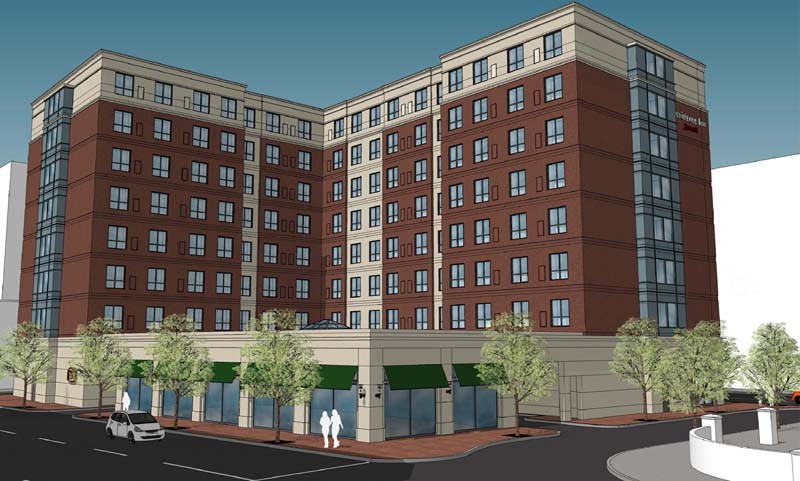
Latest design for the hotel on Fountain Street. (Providence Business News)

Latest design for the hotel on Fountain Street. (Providence Business News)

I have no way of knowing whether the folks over at the Procaccianti Group have been listening to my critiques of their eight-story extended-stay hotel proposal on the site of the Fogarty Building, but their latest version, above, is much improved.

The original version, below, was so bad that it would not have been worth razing the Fogarty Building for. If a new building cannot be said to improve upon an old one built in the modernist style known as Brutalism, then it must be really, really, really lame. In fact, it looked like it belonged on an airport access road.

Why replace a building we can blame on our fathers with one we would have no alternative but to blame on ourselves?

The new design has a much more distinctly traditional look, emphasizing its verticality, which is appropriate in a high-rise. It is mostly brick, with what the modernists like to call “punched” windows (instead of strips of horizontal fenestration, or glass curtain wall, which they prefer). It has a base, a shaft and a capital, as if it were a classical order. It has a cornice. It seems to have stringcourses. Bravo!

And yet it still seems quite cheesy – a good example of “bad trad.” The cornice looks too truncated, the windows are not “punched” far enough into the “skin” (oops, I mean masonry) to make the walls look strong. And please! Get rid of those extruded metal window slabs, clearly designed to propitiate the modernists on the commission.

But these features can be improved, and doing so would show that the Procaccianti Group understands what makes a city tick. I can hardly wait for the next iteration of this design.

Meanwhile, the First Bristol proposal for another hotel (also of eight stories) on Parcel 12, the triangular land where Memorial Boulevard curves to the south, has also been improved (albeit not perfected). Which hotel will reach the promised land first?

Ladies and gentlemen of the Downtown Design Review Commission, please do not give the Procaccianti design approval before it has been earned!

Earlier version of hotel proposed for Fountain Street. (Greater City Providence)

Earlier version of hotel proposed for Fountain Street. (Greater City Providence)

Posted in Architecture, Art and design, Development, Providence, Urbanism and planning | Tagged , , , , , , , | 9 Comments

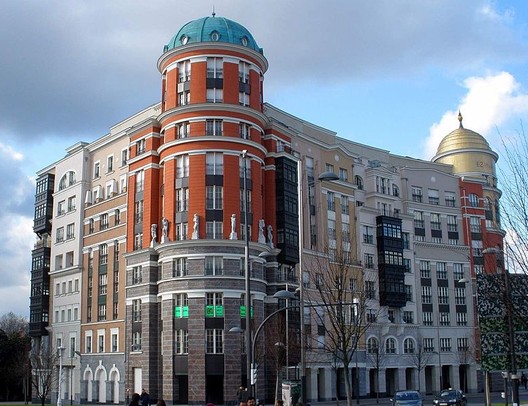
New classical in ArchDaily!

Edificio Artmann, in Bilbao, Spain. (

Edificio Artklass, in Bilbao, Spain. (Wikimedia user Zarateman)

ArchDaily.com has run a piece praising, if generally misunderstanding, six examples of new classical architecture. One applauds, and yet one would rather that it had appeared in Architect, the mouthpiece of the American Institute of Architecture. That would make it even more significant than the hit piece on modern architecture’s solipsism, “How to Rebuild Architecture,” published the oped page of the New York Times. Still, how can one not be glad to see it appear in today’s benighted architectural media!

The opening of “6 Classical Buildings that Are Younger Than You Think” sums up the importance of its appearance in this forum:

For the best part of a century, architectural discussion has been dominated by modernism and other related forms of futurism and functionalism. For some, this constant invocation of the radically new has begun to look quite tired.

No more so than its impact on the world’s built environment, I’d imagine! But how did those words get past the editor and into the first paragraph?

“Proving that New Classicism doesn’t haven’t to be backwards-looking,” Dario Goodwin assigns this quality to his six chosen buildings again and again, heedless that all human endeavor is backward-looking. Science, sports, fashion, automobiles, technology, cuisine, retail, crime, high finance, war, diplomacy, politics, agriculture, etc., all look backward for precedents useful to move into the future, as all architecture once did. Modern architecture and some of the arts are the only fields that bray fatuously that they do not look backward, even as they do so more-or-less slyly. (Many artists are beginning to join the classical architects in this brave new worldview.)

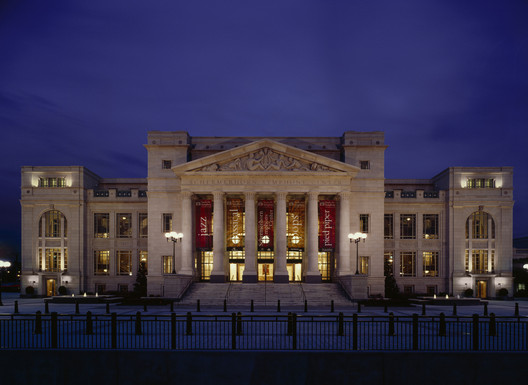
Architect David Schwarz has two buildings among the six, his concert halls in Las Vegas and Nashville. Of the latter, Goodwin writes:

The long history of classical form and Greek imitation in Nashville does soften the incongruity of the hall, but heavy reliance on imitating other concert halls from Vienna to Amsterdam does miss out on the sense of place that the Schermerhorn was intended to evoke.

Schermerhorn Hall, Nashville. (Hedrich Blessing/Steve Hall)
Schermerhorn Hall, Nashville. (Hedrich Blessing/Steve Hall)

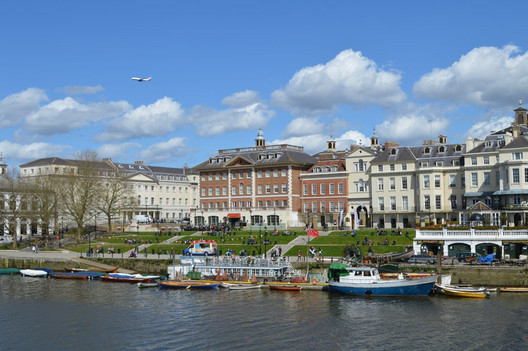
Richmond Riverside. (Flickr user Matt Brown)

Richmond Riverside. (Flickr user Matt Brown)

Frankly, I cannot figure out what he means. Although Nashville’s fine collection of old buildings helps the Schermerhorn fit in, the reliance in Schwarz’s design on past precedent causes it to “miss out on the sense of place” it was supposed to evoke? How so? Unless Goodwin means to suggest that it is regrettable that the new concert hall does not fit in with Nashville’s proponderance of relatively recent and ugly modern buildings, it is impossible to grok a plausible meaning to that sentence.

Later, describing British classicist Quinlan Terry’s Richmond Riverside – so beautiful that some tourist guidebooks describe the complex outside of London as a collection of historic buildings – Goodwin describes Terry as “a favorite of the establishment.” One can only roll one’s eyes and wonder which establishment? Certainly not the one that controls building in Britain. Perhaps he refers to the establishment of one known as the Prince of Wales. Terry may well be his favorite architect, but even the war Charles won against the real establishment architect, Sir Richard Rogers, was lost when an arguably less obnoxious but still modernist set of buildings prevailed in the battle of Chelsea Barracks. Favorite of the establishment indeed!

The only one of Goodwin’s six buildings with which I was unfamiliar is the Edificio Artklass, in Bilbao, Spain, designed by Robert Krier and Marc Breitman. What a lovely ensemble! A sublime blend of multiple styles! (Or “pastiche” in modernist jargon.) Goodwin describes it as “an attempt to echo the traditional style of the Ensanche district of Bilbao, resulting in a more local flavor without sacrificing modernity.” Duh!

Does he imagine that most new classical stuff is built with old-fashioned plumbing and other functional elements that were once cutting edge – but oh! the cutting edge of the past stopped at the edge of modernism! So many modernists like to exclaim that hiring a classicist to design a building would be like asking a doctor to bleed you, or to apply the four humours to the diagnosis of your ailment! Give me a break!

This is the level of conventional modernist argument against new traditional architecture. Goodwin’s many errors (too numerous to discuss here) suggest that he, too, sips the Kool Aid and is genuinely surprised that the buildings he writes about in this article are not as old as he assumed they were.

Who might the anonymous editor be who put the idea for this article in his head? Does ArchDaily have a fifth column operating in its offices? Or is some editor suffering the ennui of constant “futurism and functonalism” that Goodwin refers to in his opening line? Or is Goodwin himself so bored that he has decided to rattle some cages?

Don’t know the answer, but the mere question fills me with joy, and I rise to high-five the author, regardless of his motivation or fawlty erudition.

Posted in Architects, Architecture, Architecture History, Art and design, Development, Urbanism and planning | Tagged , , , , , , , | Leave a comment

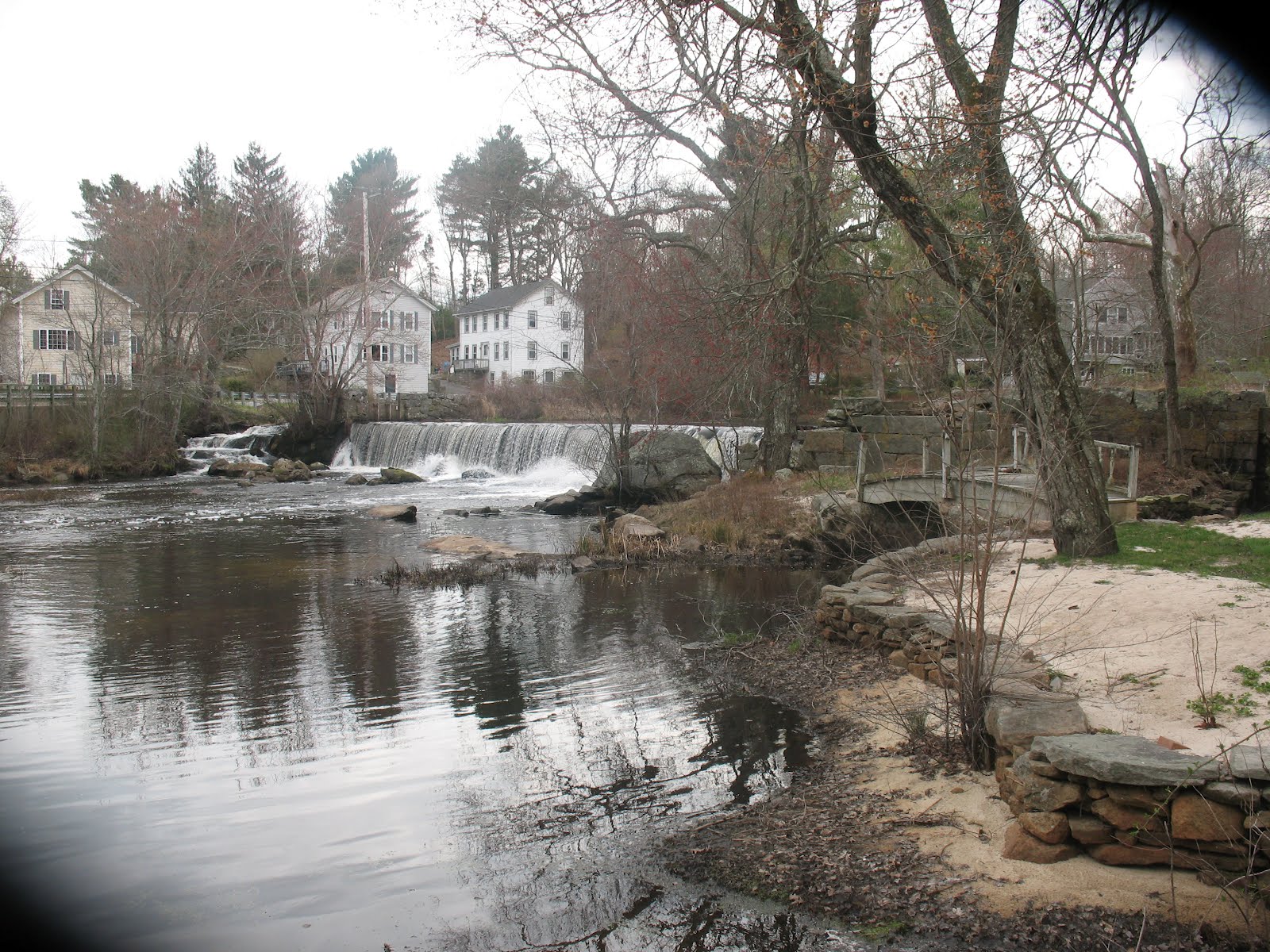
Fairly Rhode Island

Bucolic scene in Woodville, a village in Richmond, R.I. (snipview.com)

Bucolic scene in Woodville, a village in Richmond, R.I. (snipview.com)

Above is a shot of Woodville, a village in Richmond, R.I., not all that far from the five-day Washington County Fair, which concluded today. We had hoped to pop in on a few villages like Woodville, Shannock, Kenyon, maybe even Usquepaug, but we left Providence too late. Still, a mere half-hour drive took us to the fair, which as you’ll see is surrounded by woodland. Rhode Island is not just Providence, Newport, Watch Hill and Woonsocket, not to mention the beaches for which the Ocean State is famed. (Tallest peak: Jerimoth Hill, alt. 812 ft.) Far less drive time can get you from the urbanity of the capital to untold swaths of Ruritanian bliss to beat the band. The symphony of crickets and other beasties on the way out was worth the price of admission ($10). Why this state needs a tourism policy beats me. It is vacationbait.

Most readers will have missed the fair, but below you can cancel that omission. Have fun. We sure did.
Posted in Architecture, Humor, Rhode Island, Video | Tagged , , , , , , , , , | 1 Comment

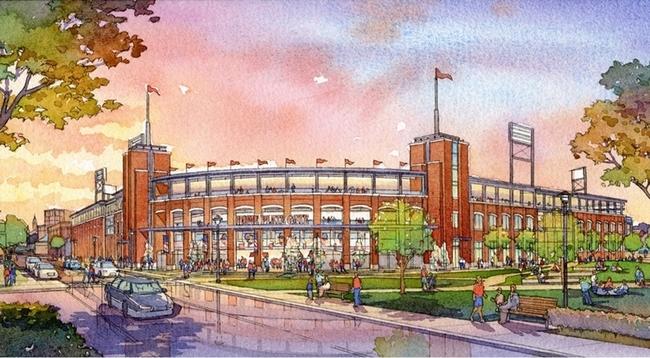
Water taxis for the stadium?

Rendering of proposed Providence stadium for PawSox. (Baseball Rhode Island)

Rendering of proposed Providence stadium for PawSox. (Baseball Rhode Island)

Belated news has it that PawSox participation in a parking garage planned for the state nursing center at South Street Landing has been dropped from the deal being negotiated for a new PawSox stadium in Providence. That opens the way for a water taxi system for fans run from ProvPort.

But wait a sec on that.

I never thought the stadium proposal should involve itself in a garage. There is plenty of vacant surface parking in the area for fans attending ballgames to be played in the evening or on weekends. And isn’t the state going to build a garage nearby at the Garrahy Judicial Complex? Didn’t voters approve that in a bond referendum last year?

Many opponents of the ballpark idea fear losing a proposed public park. But the river is already festooned with parks, another new park is now being built right across the river as part of the 195 corridor – and the proposed park that would be lost suffers from extraordinarily poor design, both from the aesthetic and the practical standpoints. They didn’t even think of how the river walks would be extended under the proposed pedestrian bridge (also ugly, and now possibly on the chopping block).

Anyway, bagging the garage part will reduce the cost of the deal – a cost that should be borne almost entirely (if not entirely) by the team owners, not Rhode Island taxpayers. Such a deal is now being described as either revenue-neutral or revenue-positive. The latter means that the state would earn money from its participation in the deal. I think taxpayers should remain wary of that. The devil of revenue neutrality, not to mention revenue positivity, is in the details. But it certainly sounds better than having the owners “volunteer” to pay for the stadium and then have the taxpayers pay them back for it.

That deal deserved to die a quick death, as it did. But let’s get back to the water taxis.

Literally decades ago, when I began supporting in my Providence Journal newspaper column the just-begun project to reopen the Providence River and line it with elegant bridges, parks and riverwalks, I applauded Bill Warner’s idea for a boat lock in the Hurricane Barrier and added my own twist. How about a water taxi service that would let commuters park on land at the Port of Providence and take ferries or water taxis as far into downtown as Waterplace Park?

What a great idea! Never happened, of course. Nor did another waterborne idea floated by former Rhode Island architect Paul Pawlowski that would have enhanced the Route 195 corridor by digging a canal – the Ship Street Canal – on part of the land opened up by the relocation of the highway. That would have made all of the development parcels more valuable, and more alluring to the target audience of potential high-tech developers.

The state rejected that idea, unwisely in my opinion. But now that a water tunnel may need to be relocated if the stadium deal goes through, perhaps the Ship Street Canal idea could be revived.

Well, probably not. But reminding readers of these sorts of things is part of the job of an online gadfly like me. Who else is going to do it? Which brings us back to the idea of ferries and water taxis taking baseball fans between ProvPort and the new PawSox ballfield. That prospect could add to the luster of the stadium idea and put a jetpack on its potential as a tourist amenity.

Others can figure out whether and how such an idea could fit into the proposal and into the financial deal that is supposedly to come. But two new garages are not needed, and a more intelligent use of the Providence River as a city amenity is.

Posted in Architecture, Art and design, Development, Providence, Rhode Island, Urbanism and planning | Tagged , , , , , , , , , , | 3 Comments