Brown attacks College Hill

Image 4 -New Building at Night.ursa-feature-image.jpg

Proposed new Engineering School building at Brown. (KieranTimberlake)

Four excellent old houses disappeared, poof!, from the Brown campus in recent weeks. In “New campus for Brown engineering?” I protested their proposed demise in a column in 2014. Now the design for what is to replace them has been released, a typically tedious assemblage by the Philadelphia firm of Justin Timberlake – oops, I mean KieranTimberlake (don’t forget, no space between the two names).

It is predictably boring but not as bad as it could have been. Brown has bought into modern architecture’s founding mistake, designing a building that is supposed to look like a machine. That was the Zeitgeist a century ago, with architects figuring that because the Machine Age had begun (actually, architecture was behind the curve on this by a couple hundred years or so, thankfully), buildings should be designed to look like machines. There was never any good reason for this. A building that looks like a machine does not, by dint of that, necessarily have the efficiency of a machine, and most do not. Architecture traded real beauty for the mere metaphor of efficiency. What they have now is ugliness, which is why so few people like them.

It is no surprise that Brown University has based so much of its campus architecture on such a fallacy over the past half a century. The profession of architecture as a whole has not had the wit to see the fallacy either. And it is even less of a surprise that engineers, many of whom make a living trying to ensure that architects’ errors do not fall down, would continue to accept the sloppy seconds from the plates of the architects. More fools they.

Just compare the buildings that are going up at Brown (with the exception of its new fitness center, of all places) to the buildings they are taking down to make way for this folly. The four buildings newly eradicated from College Hill, below, are good examples:

dscn3309.jpg

Ash_ENGN341Brookst_HunterLeeming-650x431.jpg

333-brook-street.png

DSCN3476.JPG

Screen Shot 2015-12-13 at 5.25.05 PM.png

The final shot, with the current engineering campus to the left, features Barus & Holley Hall, which should have been torn down to accommodate the new engineering building. But Brown just spent millions updating that piece of junk. Such are its priorities, sunk in error and fallacy.

***

[This post goes onto my blog but not out to my blog send list recipients until my email server quits intercepting my bulk posts under the suspicion that they are spam. I am sorry to say that for the time being those who want to read my posts will have to visit my blog, or get them on social media. I will see if I can send to TradArch and Pro-Urb lists without punishment. – David Brussat]
Posted in Architects, Architecture, Architecture Education, Architecture History, Art and design, Development, Preservation, Urbanism and planning | Tagged , , , , , , , , | 8 Comments

Henry Hope Reed at 100

henry_hope_reed_03.jpg

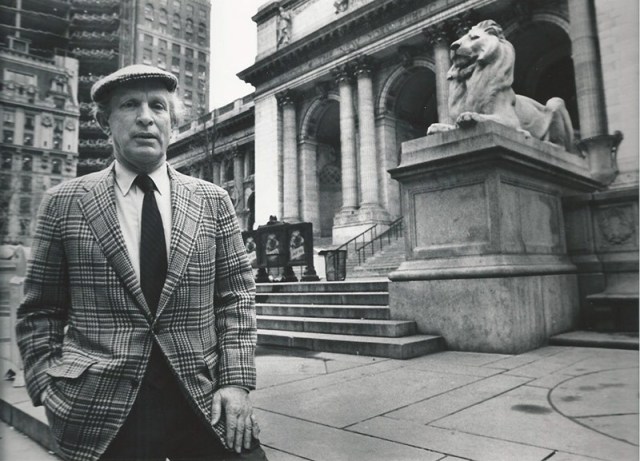
Henry Hope Reed before the New York Public Library, circa 1960. (archpaper.com)

Henry Hope Reed died three years short of his 100th year. He was born in 1915, but the fact that I overlooked his 100th birthday on Sept. 25 doesn’t mean it cannot be celebrated in a sufficiently timely manner today. And so, since his life and his leadership of the revival of classical architecture were gifts to America, ’tis the season to give Henry Reed his due.

In his memory I reprint an article by architectural historian Francis Morrone, “How Henry Reed Saved Architecture,” which ran in the old New York Sun in 2005. Here is a passage that highlights Reed’s pugnacious advocacy in the 1960s when he’d been hired by New York City Parks Commissioner Thomas Hoving as curator of Central Park:

Upon his appointment, Mr. Reed told the Times that his main responsibility was “the battle to keep things out.” (As for the Wollman Rink, alas, Mr. Reed said upon his appointment: “It’s there – how the devil can I remove it?”) Mr. Reed chastised Hoving over his allowing the park to be used for mass entertainments, specifically a 1967 concert by Barbra Streisand that turned the Sheep Meadow into “a pigsty.” Hoving retorted that Mr. Reed was a “fuddy-duddy.” Mayor Lindsay agreed with Hoving, but the New York Times editorial page smartly said that if Mr. Reed was a fuddy-duddy, then maybe we need more fuddy-duddies.

That was a couple of years before Reed helped to found Classical America, expressly devoted to reviving classical architecture and its allied arts, in order to do combat, mano a mano, with what he called “the anorexic” – that is, art and architecture stripped of embellishment. He had already published one of my bibles, The Golden City, which juxtaposed comparable works in the city of classicism with modernism. As Morrone points out, critics called it simplistic in order to cover up their horror at the power of its argumentation.

Classical America merged with the Institute of Classical Architecture, creating the unwieldy Institute for Classical Architecture & Classical America, which was its title when I joined, but which was streamlined a few years later to the Institute of Classical Architecture & Art – which, to look at it from another angle, is hardly unembellished.

I wrote a post last year, “A Henry Hope Reed chrestomathy,” that compared Henry Reed’s spirit with that of H.L. Mencken, the Sage of Baltimore and an indefatigable opponent of buncombe in America. He wrote an editorial, “The New Architecture,” for for the February 1931 issue of his magazine, the American Mercury, that assured readers that modern architecture would “provoke a great deal more mirth than admiration.”

Unknown to me then, my post linking these two was published on Reed’s 99th birthday, Sept. 25. Although a stickler for detail, I trust that he would not mind, much.

It is fair to say that if Henry Hope Reed had not set his boundless energy and erudition loose on behalf of an architectural tradition that seemed to have taken its last breath in America, it would be far less robust than it is today. So here’s to Henry Hope Reed, the savior of architecture.


Posted in Architects, Architecture, Architecture Education, Architecture History, Art and design, Books and Culture, Preservation, Urbanism and planning | Leave a comment

“Imitation and Innovation”

Screen Shot 2015-12-11 at 4.56.33 PM.png

Proposed house in Hampstead Village, London, by Robert Adam. (Adam Architecture)

Robert Adam has an essay in a volume of Architectural Design published in 1988 on the topic of “Imitation and Innovation,” filled with what I would call architectural pornography of the most extreme pulchritude. I was sent the volume out of the blue by Andrés Duany. “Please call Andrés to discuss the enclosed book,” said a note that came inside it. I have no idea why. Was it something I said? Is the book some sort of pre-emptive retort to something he thinks I might write about something he wrote in one of several very long and argumentative threads on the TradArch list, something he assumes that I’ve read? I have no idea. I have not read the threads but I will before I call.

I have no desire right now beyond placing before readers’ eyes a passage from “The Paradox of Imitation and Originality,” by Robert Adam, one of the best, and best known, of British contemporary classicists. The passage I quote below has little to do with what I suspect Andrés wants me to take away from “Imitation and Innovation”; rather, it has to do with modernist architects’ expectation, even hope, that most of the public will dislike the novelty of their work.

To say that direct borrowing from and a desire to formally emulate the past is in principle artistically invalid would remove Roman, Romanesque, Renaissance, Baroque, Palladian, Neo-Classical, Gothic Revival, Arts and Crafts, and debatably many more architectural epochs from serious artistic consideration.

Once this point is fully comprehended it is bound to create a considerable dilemma for all but the most extreme opponents of the use of historical inspiration and form in contemporary architecture. A rejection of most, if not all, of the architecture of the past as artistically invalid even at the time it was built is a very difficult attitude to sustain. The origin of this dilemma lies to a significant extent in the 20th-century project of the 19th-century idea of the avant-garde artist. The fact that much art, later commonly regarded as great, had not found immediate appreciation with the general public … led by an illogical extension to the view that in order to be great, art had to be unacceptable to the general public. This enabled and still enables artists (and architects) to feel safe in ignoring public opinion and has brought about the view that the key to being “of our time” (or slightly ahead of it) lies in the continuous search for a novelty that will surprise and astonish the common man by overturning all those things to which he had become accustomed.

Sometimes I think people don’t believe me when I tell them that most modernist architects consider the public’s dislike of their work to be a feather in their cap. So put that in your pipe and smoke it!

I doubt this is the particular passage Andrés wants me to chew on. After I’ve done the rest of my homework I will call and he will, no doubt, tell me, causing the scales to fall from my eyes!

(Trigger warning: I have helped Andrés edit the text of the first book of his upcoming treatise – Palladio, call your office! – entitled Heterodoxia Architectonica, even though or maybe because we disagree on some of the propositions that allegedly form the scaffolding of the work. This post is not intended to challenge his desire to ask me for more editing assistance.)

***

After seeing this post, Andres wrote: “I ran across this in my systematic re-reading of the post-modernist and early Fourth Recall [classical revival] texts. I purchased an old copy to send to David to provide him with a feel for the revolutionary ferment of the period. Before it settled down into what it is today. There was no other intent.”

***

[This post goes onto my blog but not out to my blog send list recipients until my email server quits intercepting my bulk posts under the suspicion that they are spam. I am sorry to say that for the time being those who want to read my posts will have to visit my blog, or get them on social media. I will see if I can send to TradArch and Pro-Urb lists without punishment. – David Brussat]
Posted in Architects, Architecture, Architecture Education, Architecture History, Art and design | Tagged , , , , , , | Leave a comment

ICAA chapter fetes 10th

5352242265_3c97fab101_b.jpg

The Algonquin Club, by McKim Mead & White, near its completion in 1888. (Boston Public Library)

A lot of water flows under a bridge, however ornate, in a decade. For the New England chapter of the Institute of Classical Architecture & Art, its first ten years have seen much success, and its board, on which I have had the pleasure to sit for, I think, eight of those years, threw a party for itself and some 90 or so other chapter members and supporters on Tuesday evening at the Algonquin Club, in Boston. What a blast!

education-intro-to-history-theory-200x200.jpg

Board member Sally Wilson, who organized the festivities, brought a photographer named Tara Carvalho to capture the revelers’ joy on film. Her photos are below.

Chapter President Sheldon Kostelecky welcomed the celebrants from behind a table filled with ICAA literature and lore. Then, after about an hour or so of hobnobbing with his guests, he introduced the chapter’s first president, Eric Daum, who presented a short history, with slides, of the chapter’s humble origin in 2005 and subsequent growth.

Eric engagingly recounted an early meeting at which he called for a volunteer to serve as the premier president. Eric believed Shel, the lead instigator, would of course be nominated. But – shades of that old Army joke – when Eric called for someone to step forward, everyone stepped back except him and thus was he “volunteered.” A legend is born.

GXB10086.JPG

Charles Bulfinch (David K. Stone)

Eric served brilliantly until 2009 when John Margolis was elected by the board, and during John’s tenure the chapter grew, holding more and more events (and more of them at the Algonquin Club, where his dear late mother Lillian was a member), and inaugurating the Bulfinch Awards in 2010. When he left to take a job at an architecture firm in Los Angeles, Shel stepped up and – after years of service as chapter vice president for education – was elected to fulfill his, and the chapter’s, manifest destiny.

Well, everyone enjoyed Eric’s remarks and then went back to chatting with friends and colleagues about classical architecture. I am sure that was the subject upon everyone’s lips. Everywhere I turned, someone wanted to talk to me about classical architecture and I was glad to oblige.

Everyone was excited about the upcoming sixth round of Bulfinches, with projects in New England solicited for the first time from entrants around the country. Although many of us on the chapter’s board will miss holding the awards celebration at the bottom of the Grand Staircase of the State House (designed by Charles Bulfinch), a first-time gala with sit-down banquet called for more space, so the festivities will be held in Harvard Hall at the Harvard Club. Pip-pip, cheerio! Sporting, wot?

Eventually the curtain must (and did) fall even on a celebration devoted to the broad sunlit uplands of classical architecture. Guests departed with hints ringing in their ears of great tours and lectures for the chapter’s upcoming year, and semesters of classical coursework in collaboration with the Boston Museum of Fine Arts, not to mention eager whisperings of more attention to the chapter’s activities from local media, an expanded membership for both chapter and board, and the very gratifying efflorescence of generosity on the part of benefactors who have taken the chapter under their wing.

It may never have been more true, even as the chapter’s history grows into its second decade, that a good and beautiful time was had by all.

***

Image-022.jpeg

Eric Daum and Sheldon Kostelecky, ICAA chapter founders

Image-020.jpeg

ICAA chapter board members Eric Daum, Sheldon Kostelecky and Kahlil Hamady, and friend Leslie-jon Vickory

Image-006.jpeg

ICAA chapter board members David Brussat and David Andreozzi, and Cheryl Andreozzi

Image-030.jpeg

Eric Hill, chapter board member Jason Harris, Lisa Harris and Susanne Csongor

Image-048.jpeg

Chapter board member Lee Reid, Anthony Sammarco, and chapter board member Stephen Payne

Image-008.jpeg

Anthony Sammarco, Megan Golterman, Joe Cedrone, and Richard Cheek

Image-036.jpeg

Megan Golderman, Ariane Rutt, and Nancy Sadecki

Image-013.jpeg

Alinka Amoroso, Dean Lahikainen, and Betsy Lahikainen

Image-058.jpeg

John Kruse, Greg Lombardi, Jeffrey Heyne, and Dorothy Avencamp

Image-010.jpeg

John Kruse, Eric Hill, and Joe Regan

Image-050.jpeg

Jacob Albert, John Tankard, and Judith Tankard

Image-018.jpeg

Eric Roth and chapter board member Aaron Helfand

Image-016.jpeg

Amy Ohman, Joan Berndt, and Ernie Berndt

Posted in Architects, Architecture, Architecture Education, Architecture History, Art and design, Photography, Preservation | Tagged , , , , , , , , , , , | 5 Comments

London’s fate, black & white

metropole-photography-London-lewis-bush-15-1-1.jpg

London at night, photographed by Lewis Bush. (Lewis Bush)

The British photographer Lewis Bush, using the technique of double-exposure, has been shooting scenes of highrise construction in London that might (at his suggestion) bring to mind the eternal night of scenes from the film Blade Runner. He describes his work as “less a symphony and more of a requiem, a funeral march for a city that might appear to be booming on the surface, but, inwardly, is facing an almost terminal decline.” In an essay for the British Journal of Photography, “How London’s new buildings show how the city faces terminal decline,” about an exhibit of his work, he writes:

Cities are places of constant change. It’s the nature of them, and it’s what makes them attractive. But not all change is equal; change can be organic, but it can be pernicious and abnormal.

London has always been a city in flux. But, for anyone living in London, the transformations of the past few years are impossible to ignore. Huge swathes of the city have been redeveloped, remarkable buildings demolished, long-standing communities displaced.

This current period of activity is unique, for it is is undoing many of the things that make the city unique.

My first visit to London was in 1979. Even then, long before my career writing about architecture, I was appalled by the infill buildings that had arisen since the war.  The Prince of Wales was right in 1987 when he said: “You have to give this much to the Luftwaffe. When it knocked down our buildings, it didn’t replace them with anything more offensive than rubble.” Britain never seems to have considered restoring what was lost to the Blitz, or even of respecting what was left. For London, that decision was the beginning of the end. With has camera, Bush documents a London that is living beyond its intrinsic demise.

Much of what made London uniquely beautiful remains but is pocked by modernist infill and overwhelmed by modernist towers. The fate of London demonstrates not the evils of skyscrapers but of modern architecture itself, which undermines the sensibility of London even without necessarily eliminating the historic artifacts of its beauty. I am not sure whether Bush would agree that the devil is less in the towers he shoots than in their modernism. If not, then he has evidently spent years documenting a phenomenon that he may not fully understand. Which does not take away from the power of his photography.

Bush’s photography of London, from a book he’s assembling called Metropole, can be seen until Jan. 15 in an exhibit at the the London Metropolitan University’s Sir John Cass School of Art, Architecture and Design.

Toppers doffed to Christopher Liberatos for sending a link to Lewis Bush’s exhibit to Tradarch.

[This post goes onto my blog but not out to my blog send list recipients until my email server quits intercepting my bulk posts under the suspicion that they are spam. I am sorry to say that for the time being those who want to read my posts will have to visit my blog, or get them on social media. I will see if I can send to TradArch and Pro-Urb lists without punishment. – David Brussat]

Posted in Architecture, Architecture History, Art and design, Development, Other countries, Photography, Preservation, Urbanism and planning | Tagged , , , , , , , | 4 Comments

A pause in Pawtucket

DSCN9868.JPG

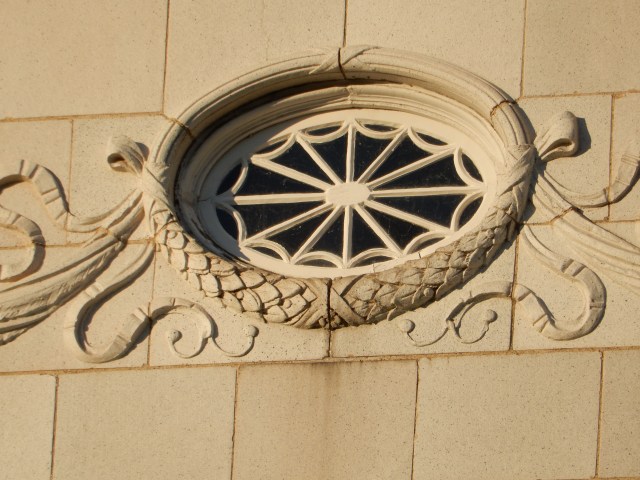
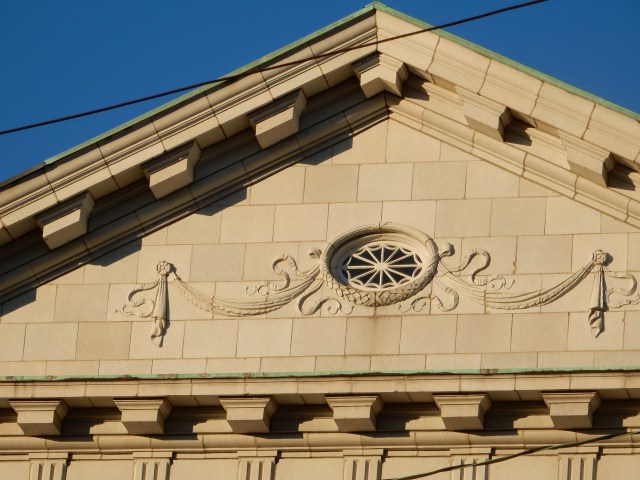
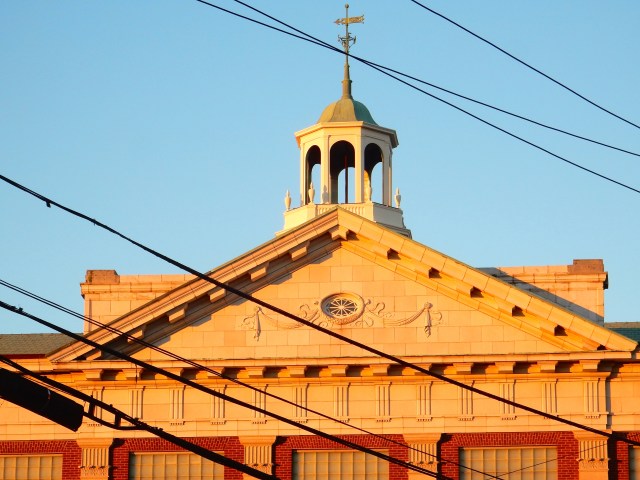
A window at Tolman High School, Pawtucket. (Photos by David Brussat)

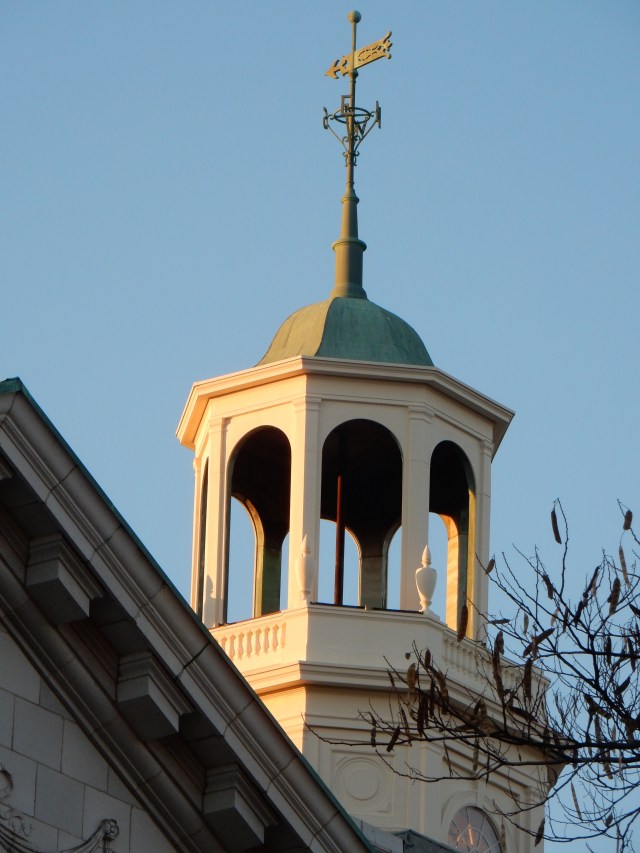
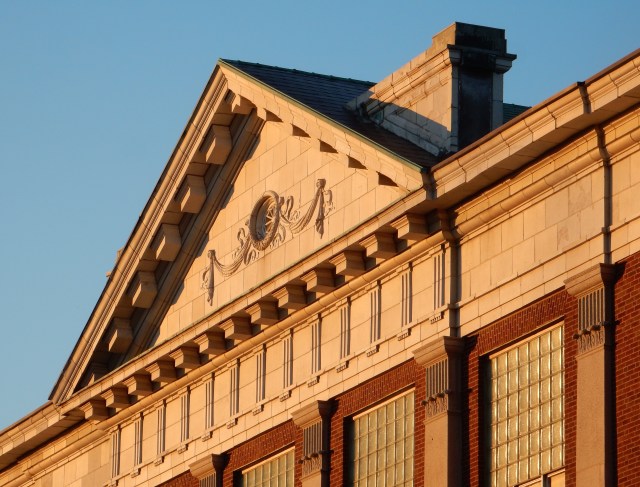
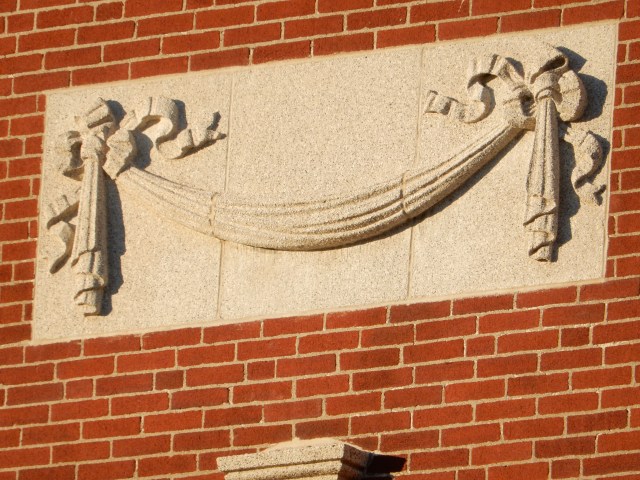
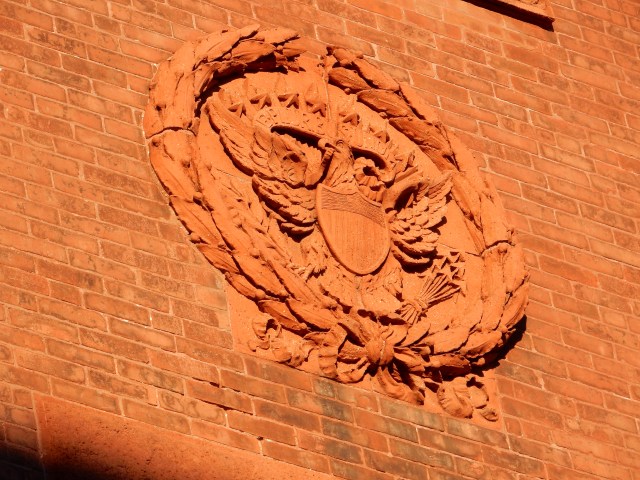
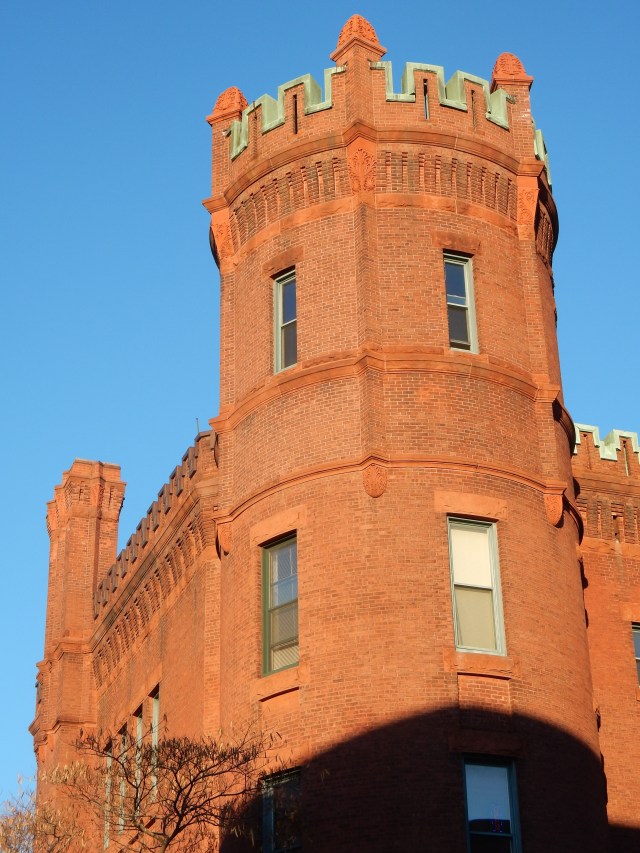
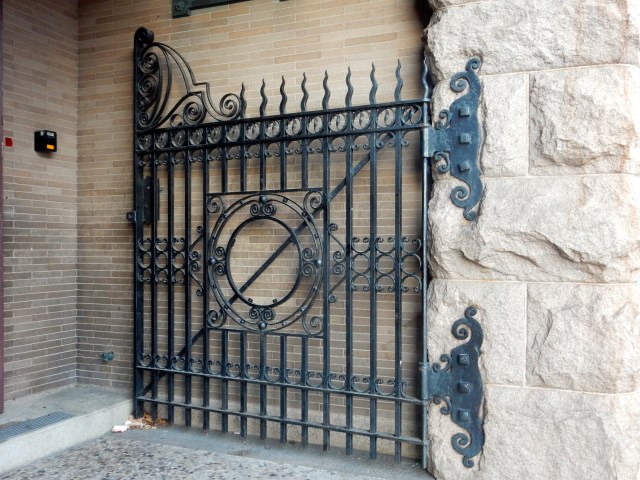
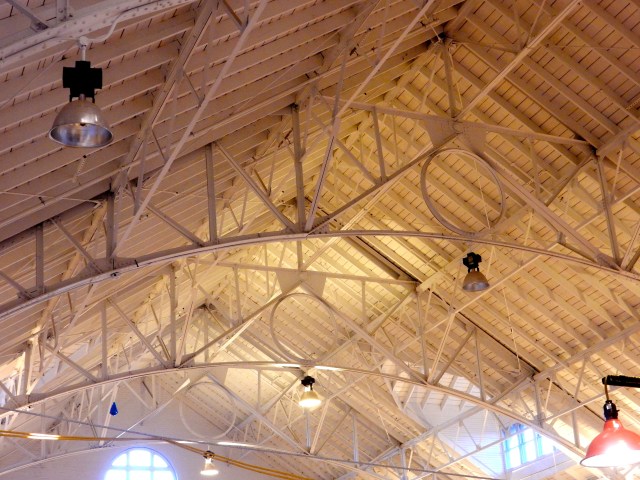
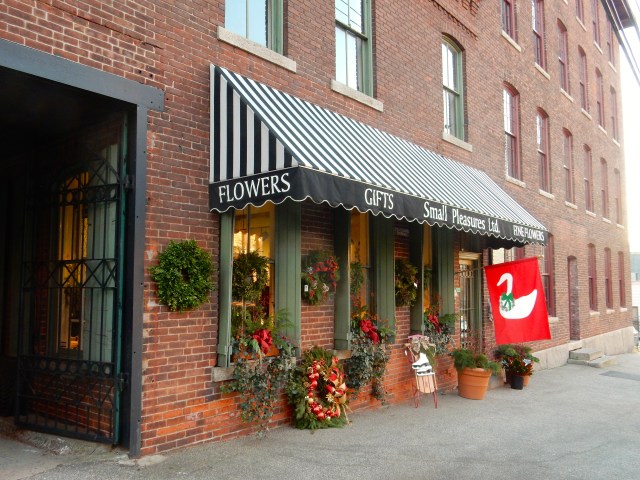
Last weekend we visited a lamp manufacturer who was having a sale on Victoria’s favorite lamps, by Tracy Glover. We then did the Foundry Sale at the Pawtucket Armory, next to Tolman High School. Both Tolman and the Armory inhabit imposing buildings, neoclassical and Gothic respectively, and across Exchange Street is a set of old mills rehabbed by the Pawtucket-based interior designer of restaurants worldwide, Morris Nathanson.

I had my camera and took some pictures. None of these buildings involve spectacular architecture. But that is whole the point. Classical, traditional and vernacular types of architecture use a combination of well known and beloved forms that may not always add up to great architecture but usually add up to great beauty. Beauty is not that hard to achieve if you know how to do it, and it does not take a genius to find novel ways to assemble its parts. It does not, for that matter, take a genius to realize that a novel composition is not necessarily the most beautiful composition.

What difference does beauty make? I suppose that’s for another day.

Anyhow, here are a set of photos that start with Tolman and then go on to the Armory and finally the mill complex across the street.

DSCN9867.JPG

DSCN9889

DSCN9902

DSCN9890

DSCN9886

DSCN9871

DSCN9874

DSCN9881

DSCN9875

DSCN9884

DSCN9885

DSCN9893

DSCN9892

DSCN9898

DSCN9901

[This post goes onto my blog but not out to my blog send list recipients until my email server quits intercepting my bulk posts under the suspicion that they are spam. I am sorry to say that for the time being those who want to read my posts will have to visit my blog, or get them on social media. I will see if I can send to TradArch and Pro-Urb lists without punishment. – David Brussat]

Posted in Architecture, Architecture Education, Architecture History, Art and design, Development, Photography, Rhode Island, Urbanism and planning | Tagged , , , , , | Leave a comment

Bulfinch entries due Dec. 15

bulberez1.jpg

Orangery, by Bereznicki Assocs., won early Bulfinch honors.

Entries for the sixth annual Bulfinch Awards, sponsored by the New England chapter of the Institute of Classical Architecture & Art, are due on December 15. This year’s Bulfinch program expands its ambitions, inviting participants from around the nation who have designed projects located in New England. Winners will be celebrated at the Harvard Club in Boston next April 23.

The sponsors hope to bring more attention to the awards, and hence to strengthen the legacy of Charles Bulfinch, whose classical work in Boston and elsewhere in the region has resulted in its status as the most beautiful of the nation’s various sections – no small accomplishment, and rivaled only by the South in the opinion of many.

The South has never given up on classicism, whereas New England’s efforts to maintain a viable and growing classical tradition have had to fight, to a far greater degree, the animosity of many professionals and academics in the field. So if indeed New England does merit the title of most beautiful region, it has also had to work harder for that honor. The Bulfinch awards celebrate that work and those who continue to bring their energy and creativity to bear in keeping the practice of classical architecture and its allied arts on the cutting edge of real beauty that you can see with your eyes.

The orangery pictured atop this post was, in my opinion, the best bit of work among the first batch of Bulfinch winners back in 2010. It was designed by Bereznicki Associates, of Cambridge. As the word suggests, an orangery was originally a greenhouse for growing oranges in cooler climates but has evolved, in its usage, to mean a cozy little getaway apart from a more substantial abode amid generally substantial grounds.

We members of the board of the ICAA’s New England chapter are waiting to see what sort of entries are sent in this year. Again, the entries are due by Dec. 15. The chapter website has all the necessary details.

Posted in Architects, Architecture, Architecture Education, Architecture History, Art and design | Tagged , , , , | Leave a comment

Is this tactical urbanism?

DSCN9904

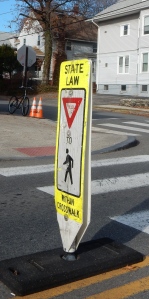
Sign at Fifth & Hope streets, Providence. (Photo by David Brussat)

Here is a street sign that seems to epitomize the fatuousness, and perhaps the corruption, of municipal bureaucracy. Warning signs just like this have been popping up in the middle of streets in Providence for the past year or so. They are worse than useless. First, you have to avoid them. Second, to avoid them you must pay attention to them. Third, paying attention to the sign distracts from the attention you should be paying to pedestrians themselves. Are any about to cross the street? You might not notice if you are looking at or, worse, trying to interpret a sign in the middle of the road that says “State Law: Yield to pedestrian within crosswalk.”

Well, duh! Isn’t that what the crosswalk conveys? Watch out for pedestrians crossing!

You can imagine some mayoral order proceeding down the ranks of the local city bureaucracy after a pedestrian is hit by a car. “Solve this problem, or at least do something that lets voters think I am solving this problem!” A committee of incompetents is named to address the problem, and eventually the idea of a redundant sign directing driver attention to crosswalks emerges, proceeds back up the ranks of the local city bureaucracy, where it is approved by the mayor, adding yet another line item in the municipal budget, to be paid for by taxpayers.

The result: an unnecessary sign, a sign implementation contract, a new job in the sign maintenance department, and a new city PR official to argue that the sign is not redundant (if anyone asks). Or worse, maybe the real impetus for the sign is a sign manufacturing company owner who has a friend on the city council. Or … well, the possibilities are endlessly predictable.

So where does “tactical urbanism” come in? Tactical urbanism is when locals go around the bureaucracy to solve problems or to implement intelligent ideas on their own. The greatest example is the tables and chairs that were deployed in Times Square, Madison Square and other busy but overly broad Manhattan intersections. This idea was so beloved by the public that it was immediately shanghaied by the local traffic and park authorities of New York City. (The mayor recently tried to take the tables and chairs away from Times Square but angry public response forced him to back down.)

Well, that pedestrian warning sign has been, as I say, popping up all over Providence. But recently they have been disappearing from Hope Street (and possibly other streets as well). I would like to think that this is an instance of tactical urbanism deployed to solve a problem caused by the city. Just take away the signs!

This is an example of why H.L. Mencken said he’d rather be ruled by citizens selected at random from the phone book than by the people voters elect. Local government is where the rubber of democracy meets the road, so obviously it’s too important to leave to elected officials and their chums.

[This post goes onto my blog but not out to my blog send list recipients until my email server quits intercepting my bulk posts under the suspicion that they are spam. I am sorry to say that for the time being those who want to read my posts will have to visit my blog, or get them on social media. I will see if I can send to TradArch and Pro-Urb lists without punishment. – David Brussat]


Posted in Architecture, Providence, Urbanism and planning | Tagged , , , , , , , , , | 14 Comments

Copyright your building!

4291.jpg

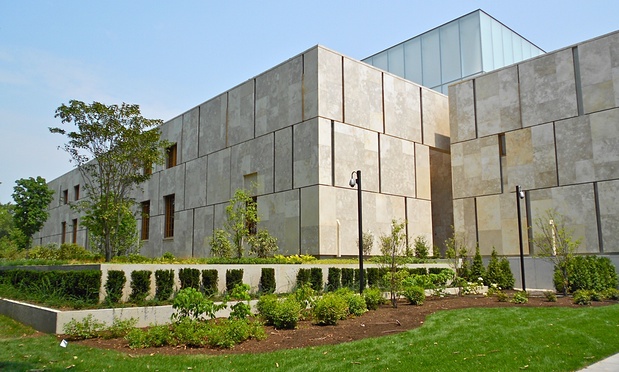
Illegally rectangular? New Barnes Foundation Museum in Philadelphia. (Almy)

A piece by Amelia Stein in the Guardian, “Does architecture need to be original,” raises some fascinating questions. She covered a symposium in New York that considered how the Architectural Works Copyright Protection Act – a 1990 amendment to U.S. copyright law – should influence architecture.

Must new buildings be sufficiently novel to avoid the tentacles of the law? If so, what does that mean?

I don’t think the symposium really got very close to a definitive answer. There was a lot of wallowing in various definitions of authenticity and imitation. Are traditional architects who base their designs on precedent more exposed than modern architects who seek novelty above all in their designs? Obviously (or so you would think) an architect is not exposed by using an I-beam or a vertical double-hung window. What if a postmodernist “references” a celebrated arch from a traditional building in his glass box festooned with cartoon classicism? I’d hate to be the jury in that trial!

Barnes-Foundation-8

Barnes interior. (yeow.com)

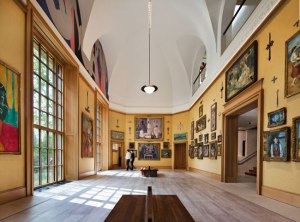
Some of the presentations at the symposium, called Law x Copy at the Center for Architecture, were kind of odd. For example, Williams & Tsien’s replication of the exhibition rooms of the old Barnes Foundation at its new building in Philadelphia was discussed:

Amanda Reeser Lawrence, an assistant professor of architecture at Northeastern University, asked how sameness could be thought of not as fearful, but as ambitious. Lawrence argued that the “non-verisimilitude” of rooms paradoxically preserved the intention of the original architecture at the level of aura.

She lost me, I’m afraid, at “at the level of aura.”

For me, I like the idea of copyrighting architectural novelty. Modernist architects would have to really be sure their designs were novel in order to avoid culpability under the law. No copying the recent past! No sham originality! No hiding behind the eight-ball of authenticity!

So while at first glance the law might seem more dangerous to the trads, the mods would find that their search for a new novelty was becoming more and more hectic. The result would be designs that would be more and more ridiculous, hence increasingly exposed to public criticism.

The fly in that ointment, of course, is that the public has become increasingly inured to ugliness and stupidity in architecture, and thus unlikely to raise a fuss at getting even more of it. Still, consider the coils within coils that would jump out if the law were ever taken seriously:

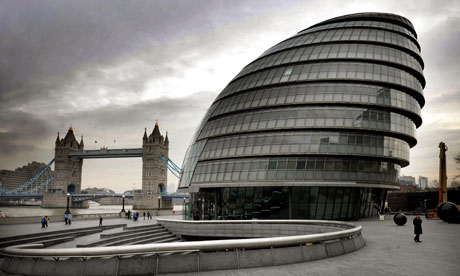
Below is a Chinese building said to have copied a building by Zaha Hadid. Just below that is a building that, if the charge were true, Zaha would seem to have copied herself. It is London City Hall, by Norman Foster. Go figure.

STR:AFP:Getty Images.jpg

Building in China said to be a copy of building by Zaha Hadid. (STR/AFP/Getty)

City-Hall-London-007.jpg

London City Hall, by Norman Foster. (The Guardian)

[This post goes onto my blog but not out to my blog send list recipients until my email server quits intercepting my bulk posts under the suspicion that they are spam. I am sorry to say that for the time being those who want to read my posts will have to visit my blog, or get them on social media, or hit “follow” at the top left of this blog, or be members of the TradArch or Pro-Urb listservs. Meanwhile, I am trying to solve this vexing problem. – David Brussat]
Posted in Architects, Architecture, Architecture History, Art and design, Development | Tagged , , , , , , , , | 1 Comment

Who’ll stop Branson hotel?

FullSizeRender.jpg

A block on Broadway in New York. (Photo by David Rau)

David Rau sent this nice photograph to the TradArch list in an email titled “Paris in New York.” He writes:

A string of Second Empire buildings along Broadway in the 20s. At center is the Ace Hotel (interiors by Roman & Williams), with the NoMad Hotel at right (interiors by French decorator Jacques Garcia). A converted coop apartment building sits far left. Maybe not exactly Rue de Rivoli, but I’ll take it. Richard Branson is constructing a Virgin Hotel, designed by VOA, just across the street.

37a5e374a8e946e3bce511507b1af07b8943ed3f

Proposed across the street. (Virgin Hotels)

The photo at left of the proposed hotel will break your heart.

Will the people in the rooms of the lovely hotels get a break in price because of the new view?

Construction on the hotel has apparently already broken ground. To rely upon the city’s Landmarks Preservation Commission to block this thing is to misunderstand the organization: Like so many other preservation organizations around the country, and indeed around the world, it is no longer what it purports to be but rather the agent of forces it was founded to resist.

Who today will stand up against such a monstrosity? The Institute of Classical Art & Architecture? You’d think. But the fact is that no organization exists to opp0se this crime by Richard Branson.

Stick to airplanes, Dick, or rockets if you must!!!

New York is a lost cause, as London has become. These are places that will only grow uglier. Beauty is spitting in the wind. There is still a chance that we might still always have Paris – but that chance is growing slimmer.

Posted in Architecture, Architecture History, Art and design, Development, Preservation, Urbanism and planning | Tagged , , , , , | 7 Comments