Haussmanhattan Paris

img_1_1447757861_a3103b596f8d1780740e3f60f4a5c2aa.jpg

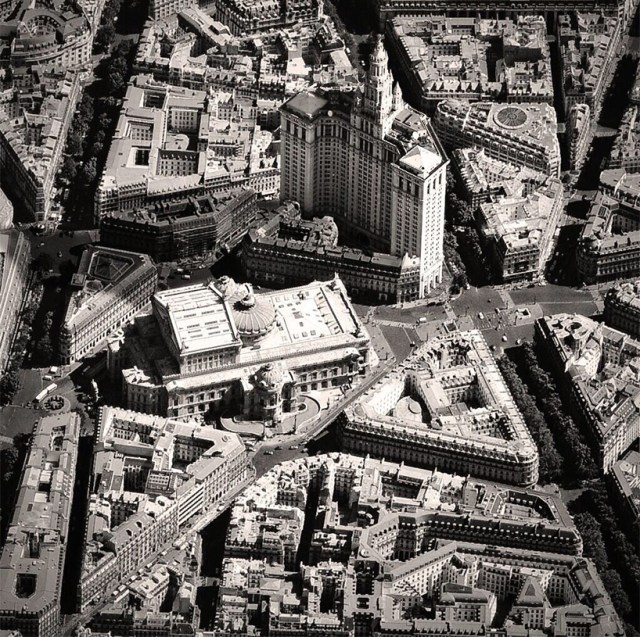
New York Municipal Building relocated to Paris. (designboom.com)

The architectural historian and urbanist John Massengale, author of Street Design, sent to TradArch a most provocative email, with a photograph of the Municipal Building of New York City superimposed on a photo of the district of central Paris near the Opera Garnier.

It looks almost as if it belongs there, but don’t be fooled. It was submitted to Designboom.com‘s open request for reader contributions, and it links to a site hosted by Tumblr called Haussmanhattan. I cannot find any name or attribution, but it has even more photographic transpositions that totally pique my interest and even adoration. But that is a dangerous thing.

Haussmanhattan takes New York buildings circa 1900-1930 and places them into the Parisian cityscape. On first inspection the towers seem not to harm the Parisian aesthetic but seem an outgrowth of it. The Flatiron Building, for example, looks quite at home on the Place de la République circa 1900. Some of the transpositions are more successful than others, and some attempts are literally stretchers. The site is extraordinarily provocative, as I said, because its initial enchantment masks a stark reality about the Paris we treasure today as it relates to the New York we’d treasure even more today if its architecture had not strayed so far from the architecture of yesterday.

For we mustn’t forget that in 1900 New York was not all that different from Paris. A mostly low horizon of architecture in New York City was ornate in much the same way as the architecture of Paris was at the same time and is today, mostly. Massengale and the creator of Haussmanhattan both note that Parisian authorities of a century ago looked across what the Brits call the pond at what was occurring in Manhattan, where skyscrapers were popping furiously out of the ground – and decided that Paris should not go there.

If it had gone there, Paris might have been as unable to resist the next step (the next historical step, not the next logical step) of permitting modernist towers to elbow aside its beauty just as New York has been unable to prevent modern architecture from elbowing aside the beauty of Manhattan. After all, Paris did entertain Le Corbusier’s plan to demolish much of central Paris and litter it with towers. Paris said no, but the fact that Corbusier was given a hearing at all suggests the degree to which Paris could be manipulated.

Now Manhattan, however extraordinary, and however beautiful in parts, is no longer a beautiful city. I fear that Paris might have suffered the same fate if it had permitted beautiful classical skyscrapers to refract the allure of the City of Light. Glad it didn’t happen. Hope it won’t happen now.

tumblr_nn3vghoawG1s5xigpo1_1280.jpg

Flatiron Building transposed to Paris. (Haussmanhattan.tumblr.com)
Posted in Architecture, Architecture History, Art and design, Development, Other countries, Photography, Preservation, Urbanism and planning | Tagged , , , , , | 1 Comment

My new TB and PH blog

MobileStudio_StyleWars_Chess_Game_Architecture_RoyalAcademy_07.jpg

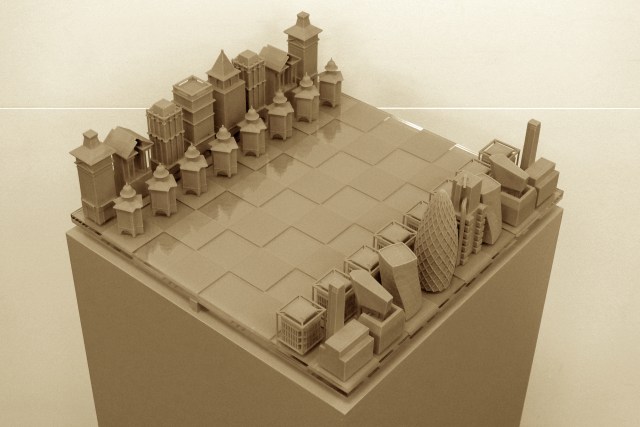
Classical versus modernist chess (themobilestudio.co.uk)

Starting on New Year’s Day my blog joins forces with the online website blogs at Traditional Building and Period Homes. Architecture Old and New will combine new essays with posts from Architecture Here and There. My monthly blog on the TB and PH websites will appear alongside blogs by a pair of my heroes, Clem Labine – founder of Traditional Building and its stable of trade journals for traditional builders, suppliers, customers and aficionados – and Steven Semes, director of the Rome program for the school of architecture at Notre Dame and author of The Future of the Past.

My first post on Jan. 1 (possibly up earlier) will introduce my new blog and discuss the ongoing conversation about architecture among traditional and classical theorists and practitioners, and the role that conversation plays in the world of architecture, especially alongside the conversation taking place among modernism’s theorists and practitioners, such as it is. I may throw some curves but I do not want to telegraph any punches.

For inviting me into the conversation, I am grateful to editor Martha McDonald and publisher Peter Miller, who has his own blog along with craftsmen Rudy Christian, Ken Follett and Ward Hamilton, and Judy Hayward, who leads the Traditional Building Conference’s several annual sessions around the country. Traditional Building and Period Homes are published by Restore Media, which is an arm of the Home Group of Active Interest Media.

Posted in Architects, Architecture, Architecture Education, Architecture History, Art and design, Preservation, Urbanism and planning | Tagged , , , , , , , , , | 5 Comments

Respite for an old hospital?

swpavilion_2010.jpg

Rhode Island Hospital’s Southwest Pavilion (Providence Preservation Society/Greater City Providence)

Providence’s City Plan Commission voted unanimously last week to reject Rhode Island Hospital’s plan to demolish the oldest remaining structure on the hospital campus, its Southwest Pavilion. That’s not the end of the story, unfortunately; the hospital (owned by the Lifespan hospital conglomerate) can appeal the decision to the city’s zoning board. But the Plan Commission’s decision to reject the demo of the 115-year-old building was also a decision to reject a recommendation of the city’s planning department.

That took some balls.

Coincidentally, the hospital recently bought a patch of land near its campus that it says it no plans to use, but which also just happens to be the old Victory Plating site – land thought by many to be a better place to build a stadium for the PawSox after its owners’ pitch for land on the I-195 Corridor struck out last summer. RIH also says it was not planning to build anything on the site of the Southwest Pavilion. Hmm.

Last month I wrote “SOS for lonely medical relic,” perhaps a somewhat overwrought jackhammering of the hospital’s desire to demolish the lovely old pavilion, designed by Stone Carpenter & Willson. Let’s hope the decision by the City Plan Commission (I love it’s archaic name!) stands.

Here is today’s Providence Journal story on the unanimous vote by the CPC, “Fate of Southwest Pavilion in the air,” by Patrick Anderson.

Posted in Architects, Architecture, Architecture History, Development, Preservation, Providence, Urbanism and planning | Tagged , , , , , , | 1 Comment

Flashmob lasers supertalls?

NYCSkyline2030.jpg

Skyline of Midtown Manhattan in 2030. (Curbed)

Screen Shot 2015-12-19 at 11.39.29 AM.png

432 Park Ave. (Curbed)

The rise of supertallsuperthins in Manhattan has driven upward the angst over skyscrapers, but who has given much thought to what it might be like to live in one – if anyone actually does. I see a run on the telescope market to facilitate voyeurism, with peeping toms popping in unannounced from distant windows to partake of the high life, especially among the supertall clusters encouraged by their Yes In My Back Yard (YIMBY) proponents.

More disturbing, perhaps, might be the run on pen lasers among the hoi polloi in lower buildings. If young rascals are pointing lasers at airline pilots, imagine the thrill of pointing them at the 1 percent in the glass towers rising above them, making them feel small.

Perhaps even more disturbing still, even in the wake of the international agreement in Paris, the climate promises to continue changing. Manhattan can probably handle rising sea levels but little thought has been given to what impact rising winds have on supertallsuperthins. Sick Building Syndrome caused by inoperable windows and recirculated air might be joined by Dizzy Building Syndrome as towers sway in the wind. All kitchens and offices will have to lay in a supply of easy-to-reach barf bags.

If builders are using practices imported from China, how safe will these structures be? Will their owners have to take out wind-insurance policies? What about the buildings below? Will their owners need insurance against being toppled on by their lofty neighbors?

Is it too late to try to think this through again?

As a New Society Climbs in Manhattan, it’s a Race to the Top” is an assessment of this building boom by Matt A.V. Chaban in The New York Times: “It’s like the Who song,” said Jonathan Miller, president of the appraisal firm Miller Samuel. “You can see for miles and miles and miles. Until you look into your neighbor’s building.”

Posted in Architecture, Architecture History, Development, Urbanism and planning | Tagged , , , , , , , | Leave a comment

Blackstone rebuffs bumps

Screen Shot 2015-12-18 at 11.09.09 AM.png

Blackstone Boulevard, in Providence. (blog.top-ten-travel-list.com)

Joan Slafsky sent me word this morning of a response by the city to the neighborhood’s expression of unified dismay at its plan to put speed bumps on Blackstone Boulevard. Here is part of the city’s letter:

The City Traffic Engineering Division studied a number of options to calm traffic on Blackstone Boulevard in response to concerns raised by community members. A public meeting was held on Monday, December 14, 2015 to solicit feedback and gauge public support for their recommendations.

After analyzing data and collecting feedback from community stakeholders during the public hearing, the City will not be placing traffic calming devices – such as ‘speed bumps’ or ‘speed lumps’ – on or around the Boulevard.

It diminishes the action by the boulevard’s defenders not a jot to note that the city’s very thin wallet probably had even more to do with the result than the work of the defenders. But no! The city is perfectly willing to waste money by the bucket; the very high level of civic activism probably notified the city that the expense would be measured not just in dollars but in aggravation and heartburn among the planners as well.

Good work!

This may be the quickest turnaround in policy since Napoleon invaded Russia. Congratulations to the boulevard’s many neighbors, who now have reason for an extra jaunt in their step this holiday season.

Posted in Architecture, Art and design, Development, Landscape Architecture, Preservation, Urbanism and planning | Tagged , , , , , , , | 3 Comments

Twisted Sisters Prize of 2015

escher_monument_valley.jpg

M.C. Escher (l.) and isometric dream structures of UsTwo. (Curbed)

Architecture Here and There awards its first annual Twisted Sisters prize to critics Mark Lamster of the Dallas Morning News and Alexandra Lange of Curbed for their pairing off to produce “Architecture in Review 2015: The Good, the Bad and the Potato Chips” in Curbed.

An “M.C. Escher Award” was won, for example, by UsTwo for its “isometric dream structures,” whatever they are. Art? Architecture? The Tantrum Cup was handed off by Frank “Flipper” Gehry to Jean Nouvel for his boycotting the opening of his own Paris Opera House. The Eff You Award was won by ISIS for its work in Palmyra.

I’ve been hard on Lamster, whose taste is execrable but his prose is charming, if not gracious. And I’ve not yet got around to reading Lange’s 2012 book on architecture criticism, Writing About Architecture (I intend to, really!). But they have assembled a set of 37 mock year-end architecture awards with considerable wit and verve – though being an architecture insider is a requirement to grok the wit of many prize titles (I’m not inside enough to “get” a lot of them). But the best thing is the profusion of links posted to articles, mostly depressing, about what they choose to razz or razzle.

Click it and weep.

Posted in Architects, Architecture, Art and design, Books and Culture, Humor | Tagged , , , , , , , | Leave a comment

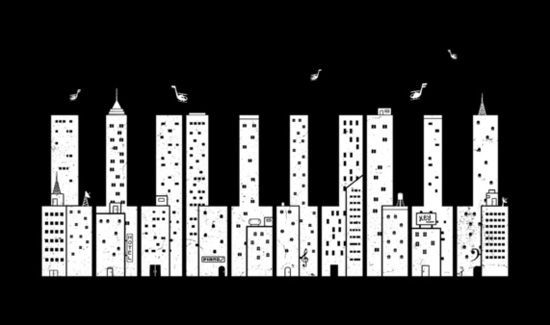
Beethoven’s architecture

7370a3855f71f9bfa2c90f07c19adedc.jpg

Beethoven’s birthday was yesterday. He would have been 245 years old. Today is the anniversary of his baptism, the day after his birth.

A vagueness of timing, however, did not fit into the architecture of his music. Goethe called architecture frozen music. The illustration atop this post is cute but does not rise to the level of the “Ode to Joy.” A great work of music achieves a crescendo. A great work of architecture achieves a crescendo. A great work of city building piles crescendo on crescendo, as Beethoven did in bringing his Ninth Symphony to a rousing conclusion. Whenever I hear that fourth movement I feel that it will never end.

Ancient Rome was not built in a day, but it was designed to grant its citizens an epiphany around every corner – the view, it is said, would grow ever more majestic as Romans approached the summit of the Eternal City’s civic center, Capitoline Hill. Symphonic is the proper word.

Anyway, this is my riff on architecture as frozen music in honor of the birthday of Beethoven, which I have missed by a day. To celebrate I offer a video of the master’s “Ode to Joy” – a flashmob just outside of Barcelona.

I have also added a video of Daniel Barenboim conducting the West-Eastern Divan Orchestra, at the Royal Albert Hall in London. They play the Fourth Movement only. It is half an hour of sheer beauty, perfection. A commenter writes, “How can the orchestra play so well when the conductor is so vague?” … Hey, I resemble that remark! (Or so I like to think.)

Posted in Architecture, Art and design, Books and Culture, Urbanism and planning, Video | Tagged , , , , , , | 4 Comments

Update on Parcel 12 hotel

Screen Shot 2015-12-16 at 1.07.25 PM.png

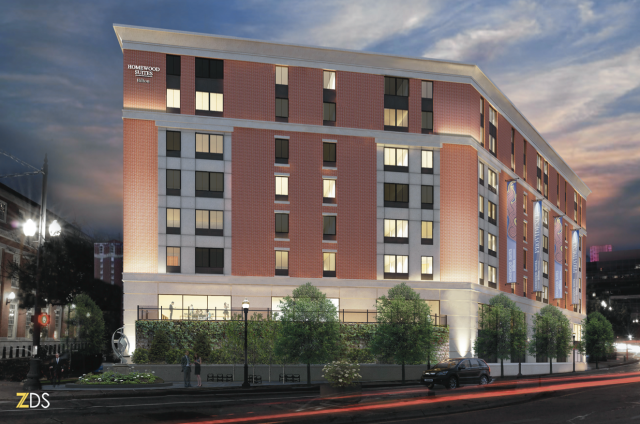
Homewood Suites proposal for Parcel 12, in Providence (ZDS)

The civic leadership of Rhode Island and its capital, Providence, is using taxpayer dollars to initiate a series of development projects that may or may not be economically viable but will certainly undermine the city’s beauty – one of the state’s extraordinarily few competitive advantages.

Amid this folly, a developer from Fall River, First Bristol, has proposed a traditionally styled hotel for Parcel 12, a prominent location at the corner of Kennedy Plaza downtown. I have written about it several times before, how its design has improved with the hire of a new architect, Eric Zuena of ZDS, in Providence. It was approved yesterday by the Design Review Committee of the Capital Center Commission. If city zoning also accepts several variances the project may begin construction next May or June.

Is this good or bad?

Considered alongside all the bad design being inflicted upon Providence, I think it is good. The design lacks excitement, and still does not reflect in its design the curve of Memorial Boulevard. But it is distinctly traditional rather than modernist, and so it will fit into its setting reasonably well. Most of the buildings now being proposed in the city are modernist, and since that style thumbs its nose at context on principle, they all are certain to degrade the beauty of our built environment. At least the Homewood Suites on Parcel 12 will do no major harm, except by pre-empting a better building, which is not likely in Rhode Island.

DSCN9934

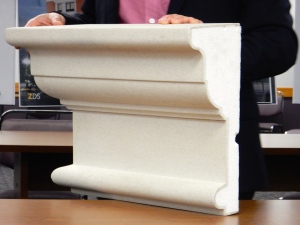
Eric Zuena showing prefab cornice. (Photo by David Brussat)

DSCN9940

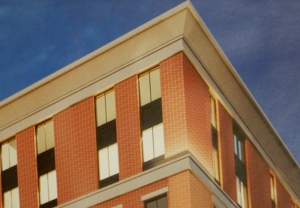
Detail of proposed cornice. (Brussat)

Small adjustments, permissible perhaps even though its design has been approved, could still raise it from an “Oh, well” to an “Ah, yes!”

For example, as I arrived late at yesterday’s design meeting, Zuena was showing a segment of cornice that was a vast improvement over the vroomy cornice of earlier iterations. Thus far the design has featured the sort of stark, jutting cornice that reveals a desire to be hip. The cornice Zuena showed us had lovely cymba mouldings with beveled edgework.

I asked him after the meeting whether this was to replace the cornices on the renderings he had shown to the panel. No, he replied, he had it merely to display the materials and the construction technique that would be used to make the vroomy cornice.

Very sad. And yet the better cornice – so vital to the overall quality of a traditional design – could be introduced at this stage of the process. In theory, the developer could make the substitution even amid construction. These are known in the industry as “change orders.”

Either way, classical purists are likely to look down their noses at the design. They do not understand that in places like Providence beauty is under continual assault. A modestly attractive traditional design is far better than any modernist design if the goal is to protect a historical setting.

For example, today we love the Post Office on Exchange Street, with its attenuated Neo-Federal design embellished by Art Deco bas reliefs just south of Parcel 12, built in 1940. We realize now that even then much worse might have arisen. But at the time it was surely considered an aesthetic step down from the robust Neo-Classical federal courthouse just to its south, built in 1908, facing City Hall across Exchange Place (now Kennedy Plaza).

The Homewood Suites should be considered in that light, fortified by the hope that architecture in today’s Providence has nowhere to go but up.

Screen Shot 2015-12-16 at 1.08.34 PM.png

Memorial Boulevard facades of proposed hotel design. (ZDS)

screen-shot-2015-06-17-at-9-21-59-am.png

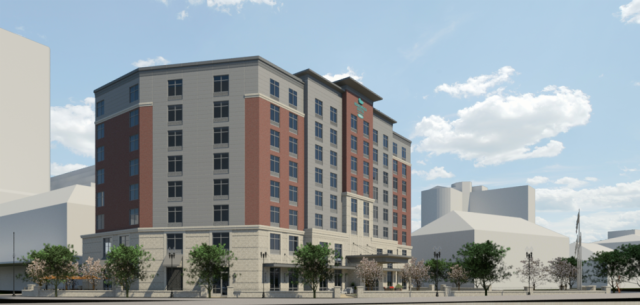
Previous architect’s proposed design for Homewood Suites. (First Bristol)

Posted in Architects, Architecture, Architecture Education, Architecture History, Art and design, Development, Providence, Rhode Island, Urbanism and planning | Tagged , , , , , , , | 9 Comments

Where eagles darechitecture

41-West-57th-Street-Midtown-West-Mark-Foster-Gage-Supertall-8.jpg

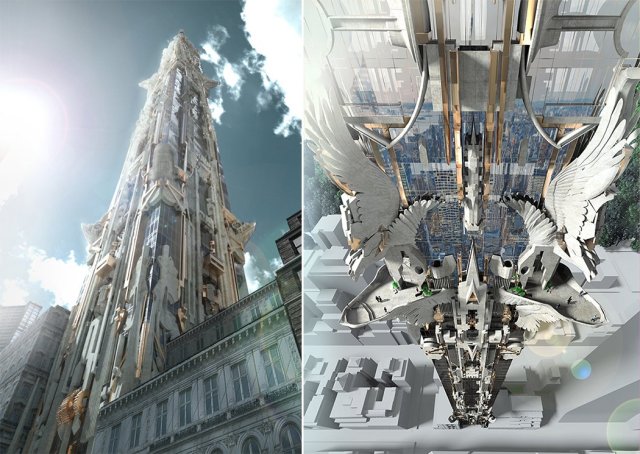
Proposed 102-story tower for Manhattan. (Mark Foster Gage Architects)

This startling proposal of a supertallsuperthin residential tower showed up on TradArch the other day, sent by David Rau, who objects to the machined element of its ornament. His email set off a long debate about natural and unnatural materials in architecture. A deeply interesting question, but some might be wondering what I, as dedicated as anyone on this planet to the sheer idea of ornament, think of the eagle-bedecked edifice. I have been biding my time, but at last I think I’ll dare to posit a reaction:

Ich schmeck dreck. Ridiculous, yes. But no, not boring.

At least the architect, Mark Foster Gage, is thinking along lines other than the usual glass box or goofball whirly-swirlygig highrise. Gage, a professor and dean at Yale’s school of architecture, is supposedly both a protégé of Robert A.M. Stern and a former drudge of Frank Gehry.

Talk about burning a candle at both ends!

The website 6sqft.com posted “Could This Otherworldly 102-Story Tower Covered in Ornaments be Coming to 57th Street?” by Ondel Hylton, with a profusion of illustrations – necessary because it seems Gage has tried to attach a bit of everything, not just eagles but gears, propellers, all but the kitchen sink, to the façade of his supposedly proposed tower in Manhattan. Ornament can be, as they say, overdone. Hylton writes:

Gage says constructing entire surfaces of ornament is entirely possible since by making things robotically you can create forms with an unlimited amount of detail at the same price as doing something flat.

Nice thought, perhaps, but this might push me even further toward what Andrés Duany – who considers the design’s mere existence a rebuke to “doctrinaire” classicism – calls the camp of the Palladiophiles. Palladio, the Renaissance architect, was not besotted by ornamentation. His palazzos do not swim in embellishment. He knew proportion. He knew propriety. Gage does not pretend to be Palladio, but he knows neither.

I have yet to see a set of rules of propriety that does not beg to be violated – Palladio himself violated his own rules regularly – or at least to be toyed with. Despite appearances, Gage’s tower is not toying with the rules, he is aiming a bazooka at them. Maybe there’s a bazooka somewhere in his design. More likely his design is a bazooka, aimed at the very idea of ornament, whether orthodox or heterodox. His proposal does not seem to have actually been officially proposed. It is merely out there in the blogosphere. Maybe Gage is modernism’s Saul Alinsky.

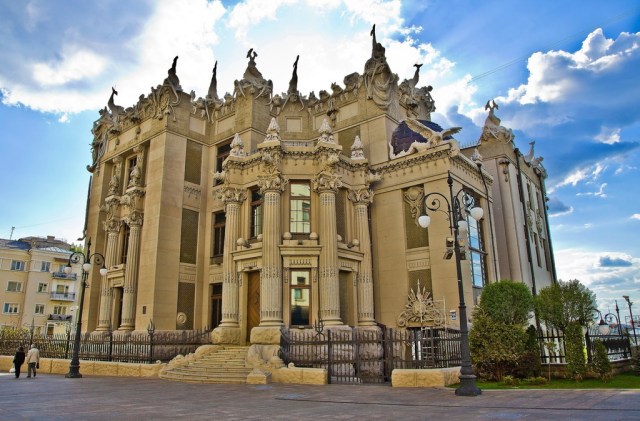
Below is a building with what some (not I) might call excessive ornament that does not come close to the sins committed by the Gage tower.

house of chimeras.jpg

Posted in Architects, Architecture, Architecture Education, Architecture History, Art and design, Urbanism and planning, Video | Tagged , , , , , , , , , | 1 Comment

Speed bumps on Blackstone?

tw-blackstoneshelter.jpg

Old trolley shelter on Blackstone Boulevard. (trailsandwalksri.wordpress.com)

Speed bumps punish the innocent for the sins of the guilty.

Most people do not speed down Blackstone Boulevard. I know. I’ve been behind many of them in my time. People who obey the law are the ones who suffer unjustly when a city enforces the law by making things difficult for everyone rather than by, say, ticketing lawbreakers.

Speed bumps and other tools of “traffic calming” have been proposed for Blackstone Boulevard, the long parkway between the Pawtucket line and the eastern precincts of College Hill. Twenty-four speed bumps and 19 raised crosswalks (wider speed bumps), 43 obstructions in all, are planned.

This is a bad idea. Speed bumps amount to state-sanctioned potholes. It’s a good example of nonexistent municipal expenditure seeking a nonexistent problem. The East Siders who are pushing this plan, when so many real problems bedevil the city, should be ashamed of themselves. They are expressing the hubris of activism.

An informational meeting is scheduled for this evening at 6:30 in the auditorium at the Nathan Bishop Middle School. “Battle Over Blackstone Boulevard Speed Bump Plan Heats Up” is Kate Nagle’s comprehensive report, with city illustrative maps, about the traffic-calming proposal.

If they put speed bumps on Blackstone Boulevard, many drivers, myself included, will take to the side streets. To block the bumps I would swallow all the other types of traffic calming, such as sidewalk bumpouts (which are also tedious but not as bad, and merely serve to reduce parking).

I would even accept a reduction in traffic lanes.

But wait a minute! Traffic calming was instituted on Blackstone seven years ago when its lanes were indeed cut in half, with the lost lanes given over to bike and parking lanes. I guess traffic calming didn’t work then, did it? So let’s rattle the cages of the innocent again, that’s the ticket!

***

[8:25 p.m.] About 200 people showed up at Nathan Bishop. To my surprise they were overwhelmingly against the city’s proposal. And they were angry about it. At the end of a shockingly unpersuasive presentation by the city and questions from the audience, a show of hands revealed that fewer than 10 people supported the plan as described.

Figures cited above from GoLocalProv.com about how many speed bumps there will be are more extreme than the figures cited by the city official. He said there would be a total of 25, not 43, “lumps” or “raised crosswalks.” The city’s numbers did not mollify the neighborhood, however. It now seems, if the city is serious about paying attention to public input, very likely to be abandoned.


Posted in Architecture, Art and design, Landscape Architecture, Providence, Urbanism and planning | Tagged , , , , , , | 11 Comments