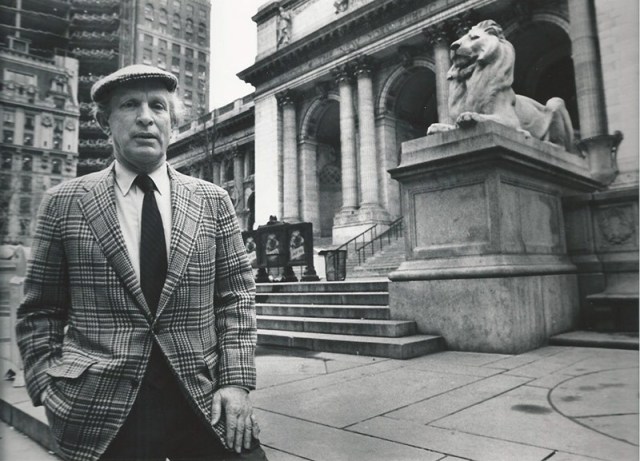
Henry Hope Reed before the New York Public Library, circa 1960. (archpaper.com)
Henry Hope Reed died three years short of his 100th year. He was born in 1915, but the fact that I overlooked his 100th birthday on Sept. 25 doesn’t mean it cannot be celebrated in a sufficiently timely manner today. And so, since his life and his leadership of the revival of classical architecture were gifts to America, ’tis the season to give Henry Reed his due.
In his memory I reprint an article by architectural historian Francis Morrone, “How Henry Reed Saved Architecture,” which ran in the old New York Sun in 2005. Here is a passage that highlights Reed’s pugnacious advocacy in the 1960s when he’d been hired by New York City Parks Commissioner Thomas Hoving as curator of Central Park:
Upon his appointment, Mr. Reed told the Times that his main responsibility was “the battle to keep things out.” (As for the Wollman Rink, alas, Mr. Reed said upon his appointment: “It’s there – how the devil can I remove it?”) Mr. Reed chastised Hoving over his allowing the park to be used for mass entertainments, specifically a 1967 concert by Barbra Streisand that turned the Sheep Meadow into “a pigsty.” Hoving retorted that Mr. Reed was a “fuddy-duddy.” Mayor Lindsay agreed with Hoving, but the New York Times editorial page smartly said that if Mr. Reed was a fuddy-duddy, then maybe we need more fuddy-duddies.
That was a couple of years before Reed helped to found Classical America, expressly devoted to reviving classical architecture and its allied arts, in order to do combat, mano a mano, with what he called “the anorexic” – that is, art and architecture stripped of embellishment. He had already published one of my bibles, The Golden City, which juxtaposed comparable works in the city of classicism with modernism. As Morrone points out, critics called it simplistic in order to cover up their horror at the power of its argumentation.
Classical America merged with the Institute of Classical Architecture, creating the unwieldy Institute for Classical Architecture & Classical America, which was its title when I joined, but which was streamlined a few years later to the Institute of Classical Architecture & Art – which, to look at it from another angle, is hardly unembellished.
I wrote a post last year, “A Henry Hope Reed chrestomathy,” that compared Henry Reed’s spirit with that of H.L. Mencken, the Sage of Baltimore and an indefatigable opponent of buncombe in America. He wrote an editorial, “The New Architecture,” for for the February 1931 issue of his magazine, the American Mercury, that assured readers that modern architecture would “provoke a great deal more mirth than admiration.”
Unknown to me then, my post linking these two was published on Reed’s 99th birthday, Sept. 25. Although a stickler for detail, I trust that he would not mind, much.
It is fair to say that if Henry Hope Reed had not set his boundless energy and erudition loose on behalf of an architectural tradition that seemed to have taken its last breath in America, it would be far less robust than it is today. So here’s to Henry Hope Reed, the savior of architecture.