Dupre’s 1 WTC on 9/11 15th

Screen Shot 2016-09-10 at 8.37.57 PM.png

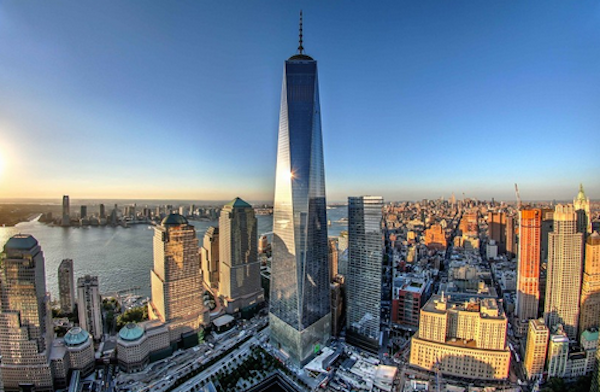
One World Trade Center. (bigmaven.com)

Today is the 15th anniversary of 9/11. The nation has handled poorly both the rebuilding of Ground Zero and the memorialization of the attack, its victims, its brave first responders, and the nation’s anguish, which has barely abated, or so it seems to me, though surely few of us ponder its significance every day. The nation was changed by the attack, but used predictable and even deadening tropes to honor it. Architecture has probably served America worse than any other institution involved in 9/11’s aftermath.

That includes the tallest building to emerge from the ground at the site in Lower Manhattan. One World Trade Center is modern architecture. Modern architecture is the brand of the 1 percent. Both modernism and the wealthy are viewed with skepticism by most Americans, but the media have not dared to take up the issue of the public’s dislike of modernism. The lead terrorist, Mohammed Atta, hated modern architecture, too, and that says something we are bound at least to notice, if not necessarily to respect.

Screen Shot 2016-09-10 at 8.38.27 PM.png

Judith Dupre

The best book, I’m sure, to come out about One WTC is by Providence native Judith Dupré. I do not say that because I have read other books about the same building. I have not even read One World Trade Center: Biography of a Building. I say it because Dupré is the best writer of books of this kind that there is. Her books about skyscrapers, bridges, churches and memorials were best of class, and I’m certain this one is, too. I will read it and I will let you know in a fuller report. This post merely brings attention to the book on the 9/11 anniversary following its publication last April by Little, Brown.

Biography of a Building is mostly about 1 WTC but it also addresses the process that led to the massive project to rebuild after 9/11, including the design competition won by Daniel Libeskind. The collection of architectural graphics assembled here is breathtaking. There are chapters on all the other structures that have arisen at Ground Zero – the memorial, the museum, the transportation center and each of the other towers. I’ve already described some of it in “Up up up in time and space,” “Calatrava’s dinosaur” and a host of posts dragging the Ground Zero megaproject through the mud.

Modern architecture is a soul-killing endeavor, but its hurtfulness would not be so difficult to resist were it not for the quality it has, at its best, to dazzle us. This quality is, alas, inimical to great urbanism, and it more frequently manifests itself in a tedious egoism. But it undeniably exists, and it may be best caught by Dupré in her chapter on the many feats of engineering that went into the design of 1 WTC. But the ability of 1 WTC to amaze is caught also, in this glossy coffee-table-plus of a book, by the superlative photographs that Dupré has selected from a range of artists and sources.

I hate to say it, and it is certainly not my excuse for not having read it yet, but I am almost afraid of this book, since Dupré might have produced such a powerful work that the dislike of modern architecture that I and many others feel could be at risk.

… Nah. But still, as you reflect today on 9/11, put time aside to get the book.

Posted in Architecture | Tagged , , , , | Leave a comment

Build the boulevard anyway

Screen Shot 2016-09-08 at 9.10.43 PM.png

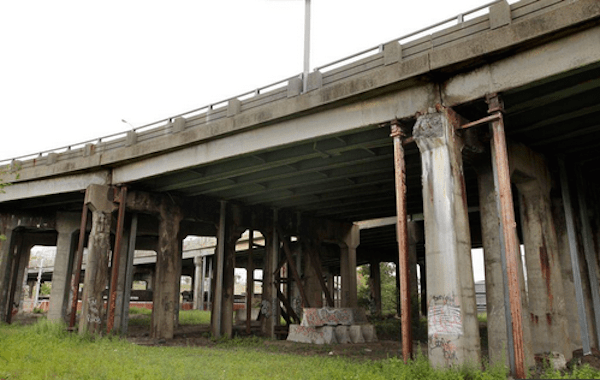
Proposed boulevard+plus to replace 6-10 Connector. (turnto10.com)

Governor Raimondo has stepped into the debate here in Providence over how to rebuild the aging 6-10 Connector, which carries traffic into downtown from parts west. The state originally wanted to build a complex version of Boston’s Big Dig, but lost a big wad of expected federal cash – yet may still ache to build it. Activists representing the down-at-the-heels Olneyville section of town, joining forces with advocates of more smartly designed roads in Rhode Island, want to drop the highway and build a boulevard instead.  Others support something in between. Now the governor has announced that the big ugly stupid thing will simply rebuilt the way it is now, minus the decrepitude but not necessarily the ineptitude.

The Providence Journal’s report in today’s paper, “State to fast-track 6-10 connector project, abandon surface boulevard + poll,” stated:

The order scraps a $595-million capped highway design the R.I. Department of Transportation unveiled in March and called an “innovative” approach indicative of a “new DOT” that would help knit disconnected neighborhoods back together while keeping commuters moving.

And it kills a proposal to replace the aging overpasses with a surface boulevard, an idea that drew overwhelming support from attendees of a public forum on the 6-10 held last week by the City of Providence.

Raimondo argues that the danger to life from the potential collapse of a part of the structure was sufficiently dire (though not imminent, we are assured) that sheer speed required the rebuild option, abandoning the more interesting options.

I’m no expert, but I believe that a boulevard can be built faster than the connector can be rebuilt in its current design. If you abandoned all the bells and whistles imagined for the boulevard, and just built a boulevard, period, like Blackstone Boulevard (or, for that matter, the Champs Élysées), without fancy high-speed bus lanes in the middle requiring bridges for bus riders to access bus stops (to name just one unnecessary fillip), it could be done. And if it can be done faster it would certainly be safer.

That’s a big if, though, because we’re talking a Rhode Island Department of Transportation that took eight years to build two smallish bridges connecting Barrington to Warren. It took a year and a half to build the Empire State Building. Have we come a long way, Baby, or what?

Seriously, a RIDOT that has led major projects to move railroad tracks, rivers and highways over the past three decades should be up to it. Should be. Should – a big if of a word to be sure. Still, that’s what ought to be done. Also, the land devoted to development, if any, should be primarily small parcels to avoid delays and bad projects that characterize Capital Center and, so far, the Route 195 redevelopment.

To his credit, the boulevard seems to be what Mayor Elorza wants to do, even though he stood beside the governor for her announcement. He has said he will continue planning for a boulevard in the face of the command from on high. Good for him.

***

Prof. Philip Bess of the (classicist) School of Architecture at Notre Dame is in town to hold a charrette about both the 6-10 connector and the redevelop- ment of land vacated by moving Route 195 out of downtown over the past decade. They are headquartered on the seventh floor of the Peerless Building and will be holding sessions there and at the Aurora Club, at 276 Westmin- ster St., this week and next. The sessions are free and open to the public.

Get a taste of the work he and his students have done over the last several years through the After Burnham graduate urban-design studio at the school. Call Professor Bess tel: 773-727-2754 or email him at pbess@nd.edu for more information about the charrette’s schedule. The first events are coming up very soon. Here is a partial schedule:

September 9 (F): Charrette Day #2 /
interim review #1 (5:15 pm / Peerless Building, 7th floor garden room)

September 11 (Su): Charrette Day #4 (beginning at noon)
interim review #2 (7:00 pm / Peerless Building, 7th floor garden room)

September 13 (T): Charrette Day #6
12 noon review, Aurora Club (276 Westminster St.)

Screen Shot 2016-09-08 at 9.12.49 PM.png

Existing 6-10 Connector in Providence. (providencejournal.com)

Posted in Providence, Urbanism and planning | Tagged , , , , , , , , , , | 6 Comments

Rethinking Homs’s future

Screen Shot 2016-09-06 at 7.45.40 PM.png

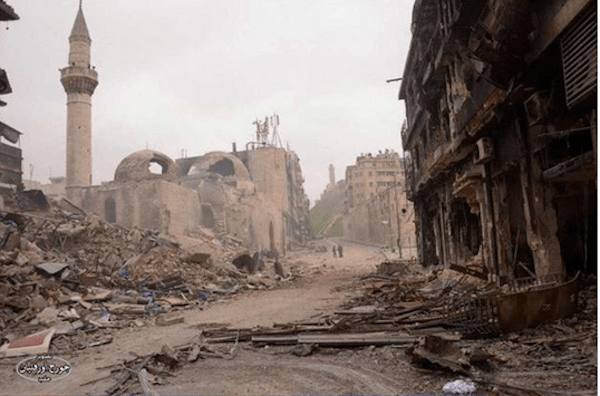
Wreckage of traditional district in Homs, Syria. (thewhy.com)

Last April, Roger Scruton wrote an essay on an architect in Syria who hopes to help plan her wrecked hometown’s future. I posted Scruton’s essay on my blog, titled “Scruton, Haussmann, Syria.” The reference to Haussmann, who is responsible for the boulevards of Paris, attested to the softening effect classicism has on what might otherwise be horrific incursions into the life of a city. Marwa al-Sabouni expressed regret that over the decades Homs had been modernized in ways that fostered the divisions that led to civil war. Now she expresses those feelings as the subject of a New York Times profile, “Trapped in Homs, Architect Imagines a New Future for Syrian Cities.” Here is a passage in which Timesman Stephen Heyman sums up Sabouni’s views on how poor design led to war:

In the old town [of Homs], these groups lived in relative harmony, a state which the local architecture reflected and reinforced. Sacred, residential and commercial sites occupied shared spaces. Mosques and churches sat side by side. The souk was a hive of economic activity that forced rival groups to deal with each other. Interwoven into the cityscape were squat houses of local basalt connected by twisting alleyways that provided shelter from the sun.

There was a human scale to these cities, a generosity to them, Ms. Sabouni writes, with water fountains, benches and “the cool shade of trees that gave joy throughout the year with their fragrances and fruits.”

But, over time, the classic architecture gave way to a succession of ideas imported to Syria under the banner of progress. These included colonial-era geometric street plans that tore up the traditional architecture, and massive apartment blocks that isolated their occupants from the city center. These errors, Ms. Sabouni says, were compounded by the corruption, mismanage- ment and thoughtless development projects of the Syrian state.

The Times mentions Scruton’s relationship as mentor to Sabouni. I had imagined that her connection to the famed British anti-modernist philosopher would render most unlikely a congenial profile of the Syrian architect in the Times, which rarely has anything nice to say about traditional architecture. Thankfully, I was wrong.

Hats off to Kristen Richards, who alerted me to the NYT piece, and to her irrepressible and irreplaceable websit ArchNewsNow.com, which ran it.

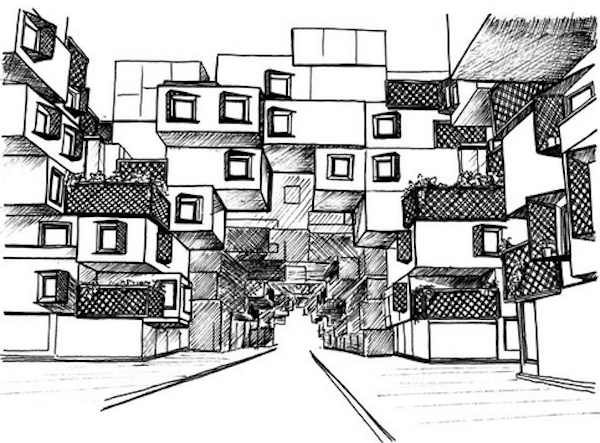
Below is Sabouni’s sketch of a more traditional residential style for Syrian buildings. To me it looks more like Moshe Safdie’s Habitat 67, stacked modular housing in Montreal. But maybe I am wrong about that, too!

Screen Shot 2016-09-06 at 7.46.45 PM.png

Marwa al-Sabouni’s sketch of a future traditional Syrian architecture. (NYT)

Posted in Architecture, Urbanism and planning | Tagged , , , , , , , , | Leave a comment

Mixing work with pleasure

Screen Shot 2016-09-05 at 6.10.55 PM.png

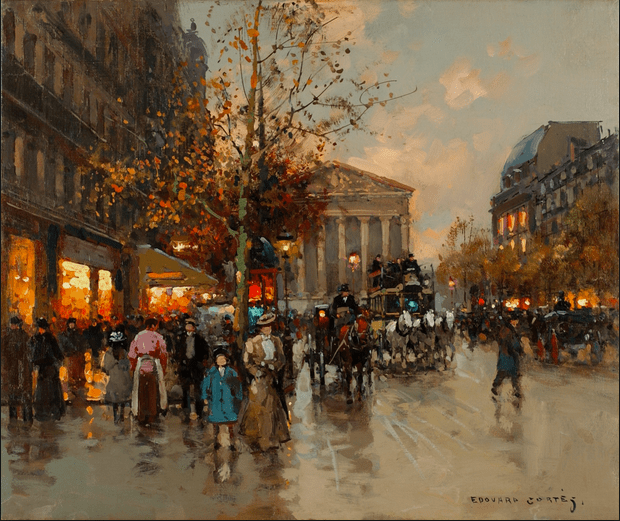
“Place de la Republique,” by Edouard Cortes. (odonwagnergallery.com)

It is Labor Day, so permit me to combine work with pleasure. What follows are lines from the experience of the bastard London bookbinder Hyacinth Robinson, who has just signed on to a vague role in a hazy future socialist uprising but, having recently met and enjoyed the society of a princess, finds his passion for active measures waning. After his mother dies, and with £30 from his mother’s friend, he travels to Paris (the pleasure part). Hyacinth is the protagonist of Henry James’s novel The Princess Casamassima. Paris only further erodes his commitment to (it is thought) pull a trigger of assassina- tion as part of a larger plan for a leveling revolutionary tomorrow in the grimy, corrupt London of circa 1880.

The boulevard was all alive, brilliant with illuminations, with the variety and gaiety of the crowd, the dazzle of shops and cafés seen through uncovered fronts or immense lucid plates, the flamboyant porches of theatres and the flashing lamps of carriages, the far-spreading murmur of talkers and strollers, the uproar of pleasure and prosperity, the general magnificence of Paris on a perfect evening in June. …

He knew about [the café] Tortoni’s from his study of the French novel, and as he sat there he had a vague sense of fraternizing with Balzac and Alfred de Musset; there were echoes and reminiscences of their works in the air, confounding themselves with the indefinable exhalations, the strange composite odour, half agreeable, half impure, of the boulevard. “Splendid Paris, charming Paris” – that refrain, the fragment of an invocation, a beginning without an end, hummed itself perpetually in Hyacinth’s ears; the only articulate words that got themselves uttered in the hymn of praise which his imagination had been offering to the French capital from the first hour of his stay. …

The pair [Hyacinth and the imaginary presence of his mother’s husband, a watchmaker martyred on the barricades] had now roamed together through all the museums and gardens, though the principal churches (the republican martyr was very good natured about this), through the passages and arcades, up and down the great avenues, across all the bridges, and above all, again and again, along the river, where the quays were an endless entertainment to Hyacinth, who lingered by the half-hour beside the boxes of old books on the parapets, stuffing his pockets with five-penny volumes, while the bright industries of the Seine glashed and glittered beneath him, and on the other bank the glorious Louvre stretched either way for a league. …

All Paris struck him as tremendously artistic and decorative; he felt as if hitherto he had lived in a dusky, frowzy, Philistine world, in which the taste was the taste of Little Peddlington and the idea of beautiful arrangement had never had an influence. In his ancestral city it had been active from the first, and that was why his quick sensibility responded; and he murmured again his constant refrain, when the fairness of the great monuments arrested him, in pearly, silvery light, or he saw them take gray-blue, delicate tones at the end of stately vistas. It seemed to him that Paris expressed herself, and did it in the grand style, while London remained vague and blurred, inarticulate, blunt and dim.

Posted in Architecture, Books and Culture, Uncategorized | Tagged , , , , , , , | 1 Comment

The saga of plaster casts

Screen Shot 2016-09-04 at 5.25.35 PM.png

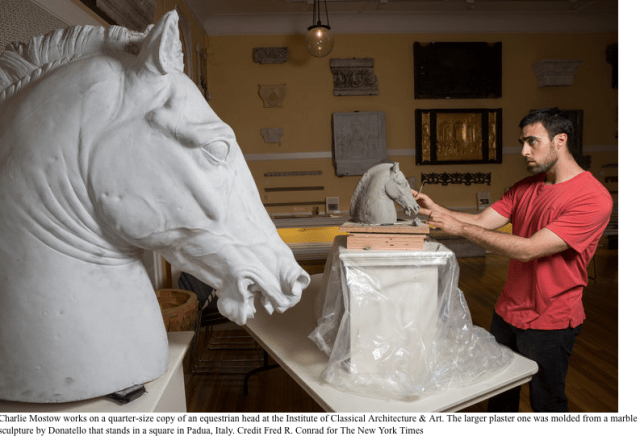
Andrew Reed, nephew of the late, esteemed Henry Hope Reed, the nation’s first bare-knuckled (yet elegant and erudite) opponent of “the Modern,” has sent in some remarks regarding a story in the New York Times, “Move Over Marble: Plaster Gets Pride of Place,” a good piece by Jane Margolies. It is about lost plaster casts that have been found and put back into use by artists learning technique through imitation. But note the snigger in the headline.

They cannot resist. They can never resist. (Besides, I’m sorry to learn that, according to the Times, the Institute of Classical Architecture & Art is not “fusty” anymore. Seriously, it was not fusty in Henry Reed’s time, when the organization was called Classical America. It was vigorous, even belligerent, in its fight to revive the classical way of building. But when did it stop being fusty? The word is a pejorative but merely means old – “stale and musty” by one definition but, says “old-fashioned in attitude or style” by another. Old is good. “It’s not good because it’s old, it’s old because it’s good” is one of my favorite concluding mottoes on email. But I wander from the point.)

So, no, as I say, they cannot resist. Well, I cannot resist running Andy’s remarks in their brief entirety, so here they are:

One of the things that greatly upset Uncle Henry was how many important museums in the country got rid of their plaster cast collections – sometimes throwing them out in the garbage. He often wrote and spoke about the importance of plaster casts in the training of the artist and reminded people that one of the original purposes of the art museum was to provide places where artists could come and sketch plaster casts of great works of art. For hundreds of years, copying great art works was considered de rigueur in the training of the artist. It was only  in recent times that this time-honored technique was jettisoned.

Personal anecdote: I have a close friend living on Cape Cod who is a talented landscape painter. He studied at an art school in NYC. He spent a couple of months copying a Rembrandt painting at the Metropolitan Museum of Art. (The process  requires that the copy must be of a different size than the original so as to prevent it being passed off as an original.) My friend said he learned more about painting in that period than in 2 years of art school. And this exercise in no way hindered him from developing his own unique and original style. There is truth in trusting in the wisdom of the ancients.

Margolies’ piece is an excellent description of the saga of the rescued plaster casts, their usefulness in learning to be an artist, and the diligence with which they have been repaired and restored. Here is the second paragraph of her piece, which has a lot more very interesting information about the ICAA, and mentions Peter Pennoyer’s role in rescuing the huge cache of casts from a dump where they had been (sorry) cast aside by modernists who don’t want to even begin to understand beauty and its importance:

But these and dozens of other plaster casts made in the 19th century from original works dating to antiquity have been pieced together, cleaned and, now, put on display in a newly created cast hall at the headquarters of the Institute of Classical Architecture & Art on West 44th Street in Manhattan. They’ve made a long and circuitous journey there from their original home at the Metropol- itan Museum of Art, where they once stood in for the real thing.

Too bad we can’t do the same for the plaster buildings of the 1893 World’s Columbian Exposition!

Posted in Architecture, Art and design | Tagged , , , , , , | Leave a comment

Krier on the people’s choice

Screen Shot 2016-09-02 at 1.03.41 PM.png

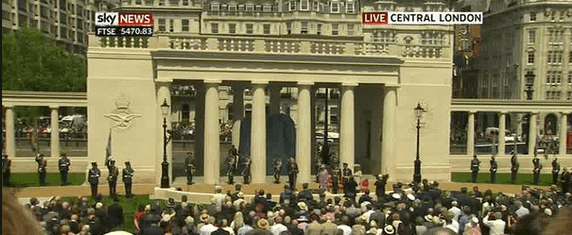
Bomber Command Memorial, in London. (Sky News)

Leon Krier argues that people should be permitted to prefer architecture they like, and dismisses modernists who browbeat the public for the alleged ignorance it expresses in disliking their work. His latest piece in BD, Britain’s building design journal, is “People have to be brainwashed to appreciate the Soutbank or Robin Hood Gardens.”

How true! Most architects, designers, artists, and critics in those fields, and their assorted camp followers, have had their appreciation of beauty purged by their educations or their careerism. Most people not involved in such fields, who allow their opinions of buildings to be influenced mostly by how they feel those buildings look, actually have a sounder basis for clear and penetrating judgment of architecture.  Krier writes:

Historical places and traditional aesthetics are endearing to people generally, not because of “history” – “culture” ­– “memory” – “power” but simply for their self-evident superior quality and the enduring values they embody. Human intelligence and sensibility is spontaneously seduced and convinced by objects that are meaningful and beautiful, without explanation or justification and independent of time, location and ideology.

To that I would only add that scientific research has found much evidence that traditional taste is reinforced by the deepest human biological  and neurological traits. It turns out that nature does have an opinion. I like Nikos Salingaros’s suggestion that in furiously resisting such evidence, let alone the public’s preference, modern architecture behaves like a cult.

It was difficult to choose which of his article’s nine paragraphs to quote. Beware, however, of the introductory line (not the headline), probably written by the BD editor. It says that “modernists have no right to judge” people’s taste. That is not so. Modernists have a right to oppose and even to ridicule people’s taste, but no right to prevent people from expressing their taste – which they attempt to do all the time.

Hats off to John Massengale for sending Krier’s brief essay from BD to the TradArch list.

Posted in Architecture | Tagged , , , , , , | Leave a comment

J&W’s engineering error

Screen Shot 2016-09-01 at 10.41.13 AM.png

New engineering building at Johnson & Wales University. (Providence Journal)

Johnson & Wales University is about to open up its new engineering facility, named for its chancellor, John Bowen. It will be the first building on land vacated by the relocation of Route 195 to the south of downtown. Providence campus president Mim Runey has a commentary piece in today’s Providence Journal, “First 195 facility points to future,” in which she identifies the ways that the school’s expanded attention to engineering and design education can help the city, the state of Rhode Island and the economy.

She is right about that, I’m sure, but in describing the place as “an attractive and welcoming environment” to learn, she continues to feed the beast that has made our built environment unattractive and unwelcoming – not only on the J&W campus but around the world.

She may be forgiven, of course, for thinking what elites in education, engineering, design and many other fields believe about the buildings they erect to house their activities. Modern architecture is a learned preference while the appreciation of traditional architecture is intuitive. While most people, including no doubt most of the students who will attend classes at the new facility, choose to live their lives in houses and buildings designed with more traditional appeal, bad ideas die hard.

The mistake J&W has made traces back a century to when founding modernists like Le Corbusier believed that the Machine Age required a machine architecture. It did not, but in the 20th century they saddled the world with buildings that unsettle the feelings of most people. While our built environment now serves as a nifty metaphor for high technology, the promised efficiency never materialized. Modernist thinkers and practitioners stuck with defending modernist ugliness have even sought to delegitimize the idea of beauty to maintain their power as the design establishment.

Even though scientific research is making progress at understanding why modern architecture fits poorly into nature, it is still difficult to prove that a beautiful place somehow ennobles the spirit. Most people assume that an attractive place is attractive and an unattractive place is unattractive, but that this is of little real importance to people in their everyday lives.

And yet Johnson & Wales spent the late 1970s and the 1980s renovating and preserving great old buildings in Providence for its downtown campus. This good work provided a vital initial kernel of evidence that downtown could be beautified and revitalized. In the 1990s J&W erected an academic quadrangle of considerable loveliness along Weybosset Street. Surely J&W built Gaebe Common, at no small expense, because its leaders thought beauty would benefit the school, its students, and the society it serves.

It is sad that in the 21st century the school has turned away from that wisdom. Brown is making the same error, and so is the city and state on the rest of the 195 land. But because of Providence’s extensive surviving fabric of beauty, it is still not too late to embrace a future whose allure will make its success all the more likely.

Posted in Architecture | Tagged , , , , , | 2 Comments

Decent guys as architects

Screen Shot 2016-08-31 at 10.22.09 AM.png

20K House by Rural Studio. (misfitsarchitecture.com)

Rural Studio is an architectural outfit in Alabama that strives to produce houses for $20,000. The website Misfits’ Architecture posted on Rural Studio recently, listing the small, affordable houses by major firms and architects that cost more, often much, much more. Even the excellent Katrina Houses, created after the hurricane by Marianne Cusato, are said by the misfits to be “deliverable at $70,000 including construction.” The misfits’ post ended up praising Rural Studio for its commitment to the housing needs of poor and minority communities.

The misfits’ post was filled with examples of how the firm uses iterative learning processes to ensure that each of their projects is founded on firmer design and construction principles than the one before it. Supposedly they are designed with more rigor than a jet fighter. So, as one will be driven to expect, there is a lot of fascinating “inside baseball” design stuff in the post – fascinating because it is so rarely encountered in journalism on architecture (no less rarely than on my own blog, I must admit).

Founded by Samuel Mockbee and Dennis Ruth in 1993 (who died in 2001 and 2009 respectively), the firm’s leaders seem to have the funny idea that Mockbee and Ruth might be appropriate candidates for the Pritzker Prize. They should aim higher. The Driehaus Prize brings in $200,000, twice the Pritzker dollop. However, the firm would have to try harder to design houses the people can not only afford but love. To judge by the post’s images, Rural Studio produces houses that have that “I wanna be practical but I also wanna appeal to Progressive Architecture’s editors” look. Their whole outlook on design and building suggests that they are above that. But they needn’t worry about getting a Pritzker (a downer for anyone with taste), because

  1. Mockbee died in 2001 and Ruth in 2009. The Pritzker Prize is awarded to a living architect.
  2. Not only that, the Pritzker Prize is awarded to a living architect who has produced a singular body of work. The output of Rural Studio is a singular body of work that has consistency and development and many other qualities that mark it as the output of a single consciousness. It is not awarded to a team, let alone an amorphous team that includes a ever-changing roster of students. This condition seems particularly unfair when starchitect practice figureheads routinely curate and claim authorship of ideas generated by an intern farm.

Actually, Rural Studio is not a practice or even a firm but an undergraduate program in the school of architecture at Auburn. So maybe it is not really allowed to produce a house that looks particularly like a house. Aside from that, Rural Studio reminds me of Union Studio, in downtown Providence, a firm that produces (among other things) affordable housing that looks really lovely. I can’t say costs are sufficiently low to be comparable to Rural Studio, but for a city practice they seem to have their hearts in the right place.

Anyway, readers should check out the post, and, along with me, doff their hats to Malcolm Millais, who sent it to me.

The 20K House Is Bullsh*t” is John Anderson’s rejoinder to my piece and others’ about Rural Studio. On his blog RJohnTheBad.wordpress.com, Anderson says required costs related to housing and code regulations, such as the cost of digging a required well, are improperly omitted from the studio’s figuring, and that $20,000 to buy a 20K House is “aspirational.” Rural Studio admits that it has not yet achieved a true 20K House, but is working toward it. I must leave it to others to judge this alleged gap between rhetoric and reality.

Posted in Architecture | Tagged , , , , , , , | 1 Comment

“Rear Window” trailer trash

Screen Shot 2016-08-30 at 12.38.27 PM.png

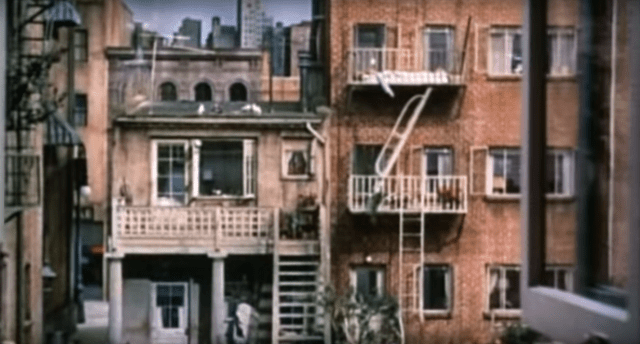
Screen shot from trailer for the movie “Rear Window.” (mentalfloss.com)

Here is a marvelous set of factoids from the website Mental Floss, called “12 Thrilling Facts about ‘Rear Window,” the 1954 movie starring Jimmy Stewart and Grace Kelly, who investigate a murder through his rear window. And I will assure you that thrilling is not an overstatement by author Kristin Hunt, who starts out with the fact that the scene espied when Stewart opens his blinds is a set built in Hollywood for a shocking … but read it yourself.

Screen Shot 2016-08-30 at 1.10.53 PM.png

Grace Kelly and Jimmy Stewart (blu-ray.com)

As a confirmed voyeur myself, I feel constrained by my current home in a house with no view into anyone’s rear window. I often wish I still lived in the old Smith Building, downtown, where I could keep tabs on the goings-on at the Plunder Dome (City Hall, right outside my window), and look all the way to the end of Kennedy Plaza, to the waterfront and up College Hill. But I have also envied those who live in the Peerless Building, with its Peyton Place- esque view across the atrium at who goes into who’s apartment with whom. The same phenomenon prevails, too, amid the Arcade’s microlofts.

Hunt’s “Rear Window” piece also has a video of the Hitchcock movie’s trailer, which is quite titillating.

Speaking of which, the last factoid explains the book Kelly is reading in the film’s final scene, called Beyond the High Himalayas, by U.S. Supreme Court Justice William O. Douglas.  Hunt calls this “a final wink” but then insists she is reading the book because it is an “ode to the great outdoors.” As opposed to the scene outside the rear window? I don’t think so. I think it is a wink at something else, or maybe two things. You be the judge.

Posted in Architecture, Books and Culture | Tagged , , , , , , | Leave a comment

Hellblog: To quoin a frieze

Screen Shot 2016-08-29 at 7.26.50 PM.png

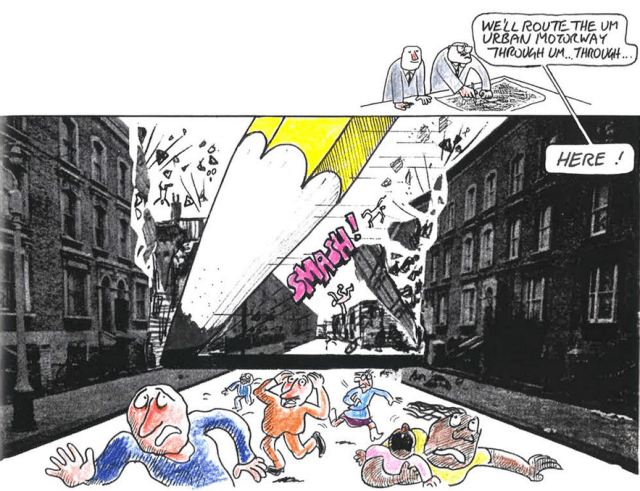
I am about to place a new blog on my “Blogs I Follow” list. It is the blog of the British architectural cartoonist Louis Hellman, called “Hellblog,” and comes to me from Malcolm Millais, the irrepressible author of Exploding the Myths of Modern Architecture (2009), which Andrés Duany called the best book he’d read summarizing the evils of modern architecture. I used a Hellman toon to illustrate my review of Exploding the Myths.

I just purchased a new microwave after my Quasar pooped out. It was over 30 years old. I got an LG, the tops midsize according Consumer Reports. Why am I telling you this? Well, read to the last line of “To Quoin a Frieze” and you will find out – explanation if not justification. Here is Hellman’s wry take on what someone called “frozen music.”

“Frozen music” is the most popular but most misleading definition of architecture around. It was coined by Von Schelling and typifies a 19th century German romantic formalist view of architecture as sculptural art. It was gently satirised in the 1950s by humourists Flanders and Swann as “music is defrosted architecture.” Von Schelling’s definition ignores architecture’s utiltarian functions. Nearer the mark and equally popular is “Commodity, firmness and delight,” Sir Henry Wotton’s 17th century take on Vitruvius, though it sounds disturbingly like a 60s bra advert. In other words, buildings must stand up, give pleasure and, in today’s parlance, be fit for purpose. The Greeks had a word for it, but did they? The only relevant Ancient Greek word is “architect” or “master builder,” so “architecture” is simply that which is done by architects. Clearly a case for the ARB to pronounce upon.

It was not until the Victorians that definitions addressed the social and political nature of architecture. For Ruskin it was “An art for all to learn because all are concerned with it” and Morris saw it as “The moulding and altering to human needs of the very face of the earth itself.” Participation and eco housing no less.

The modern movement masters provided their own definitions. Le Corbusier’s was “The masterly, correct and magnificent play of masses brought together in light,” a conveniently vague definition for an architect who would work for any regime, however unsavoury, no doubt echoed by today’s starchitects whose moral compasses are equally obscured. Mies’s portentous “The will of the epoch translated into space” also leaves plenty of room for political maneuvering. Hitler, of course, more demolition contractor than architect, understood that architecture was a political tool, “Stone documents, the expression of the utility and power of the nation.”

Today definitions seem to have gone out of fashion. Monumental architecture during the profligate period from the 1990s to 2008 was more “commodities, futures and deregulation” than Wotton’s sedate description. Or perhaps “frozen money” would be more apt.

Our current era’s obsession is with energy conservation and retrofitting, much loved both by politicians, who see it as a source of righteous taxation, and architects, who take it as a neo-function- alist opportunity to wallow in alternative technology. The best definition for this must be Ian Martin’s ironic “Architecture is frozen carbon.” Praise the Lord and pass the microwave.

Posted in Architecture, Art and design | Tagged , , , , , | 1 Comment