Towering towers in La Prov?

Screen Shot 2016-11-15 at 10.26.24 AM.png

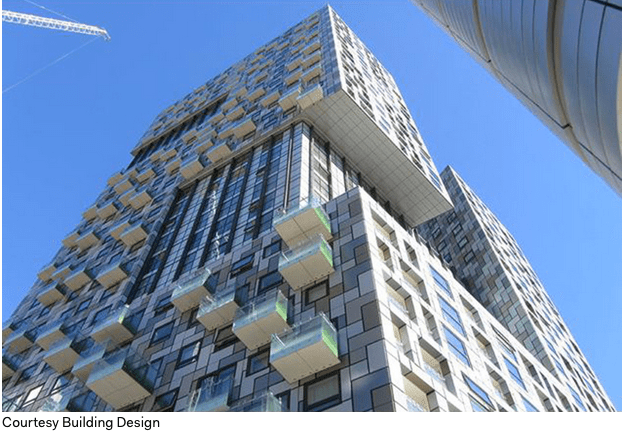
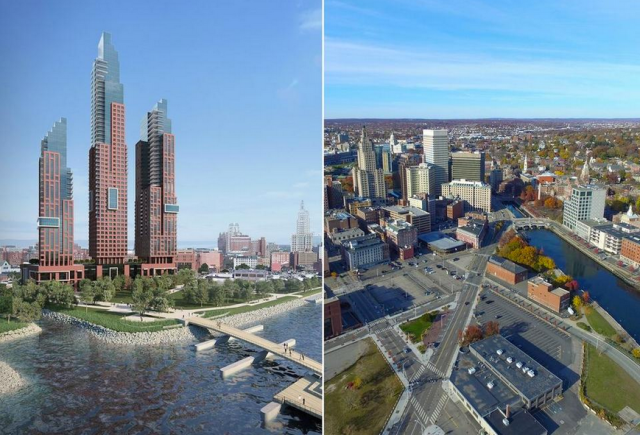
Proposal by the Fane Organization, left, for land next to proposed park. (Fane)

A New York development firm with offices in the Rockefeller Center has proposed to build three residential towers, in phases, rising 33, 43 and 55 stories up from the vacant Jewelry District land where Route 195 used to be. All three would be taller than the Industrial Trust Bank Building downtown (30 Rock is only 15 stories taller than 55). Zoning allows seven stories on Parcel 42, max ten under some circumstances. The Fane Organization says it will seek an exception to this, in addition to an as-yet-undetermined sack of city and state development incentives.

The Providence Journal ran in today’s edition a lengthy story, “Reaching for the sky in Providence,” about the proposal’s unveiling at a meeting of the I-195 Redevelopment District Commission yesterday. Quoting Jason Fane, it read in part:

“This will be an iconic project, and to succeed it’s got to be on a sufficient scale that it’s visible,” Fane told The Journal. “It’s changing Providence, and the commission will have to decide that they want something like this or not.”

If they want it, he said he wants to build it. And if they don’t, he said after the meeting, he’ll go away.

Except for the goofy-looking picture-window pods near the middle of each building’s east-facing façades, the architecture isn’t quite as abysmal as we have all come to expect. Each building mimics a postmodern wedding-cake skyscraper, with a degree of vertical attenuation in each. Each has what appears to be a brown masonry shaft rising from a five-story base (about the height of the average Jewelry District building) upon which all three would sit. Each shaft has what the modernists like to call “punched” windows, as opposed to the glass curtain wall with which each building’s upper stories would reach skyward. From left to right, the shortest building has a stepped roof, the tallest has a set of up-thrusting glass shards, and the middle building’s roof has a rounded element amid its pinnacles.

Being so far and away beyond the allowed height on the parcel – because it is right next to the public park – it is hard to see how the 195 commission can give Fane the go-ahead without essentially saying, “We have our rules, but who cares?” This trio of buildings should be downtown, or in the Capital Center. Capital Center has plenty of unbuilt land, and downtown cries out for more population density. The location of these three new towers will turn Providence’s already bifurcated skyline into a trifurcated skyline. The city may soon be able to boast the same scary cityscape whose isolated towers for the wealthy separate the haves from the have-nots in Blade Runner, Ridley Scott’s dystopian film.

The big question is whether this ambitious proposal is for real or some sort of joke, part of a cynical developer’s real-estate shell game involving players unknown to the commission. Does Fane actually see a market here for the as-yet-unspecified hundreds of apartments and condos they would build, perhaps from booming Boston, or do they take us for rubes holding out bags of tax money for anyone with a quasi-plausaible pitch to grab?

Of course, everyone wants jobs and investment in Providence. But these can be had without accelerating the unfortunate trends that have marred the city’s beauty over the past decade or so. Perhaps the commission can make it clear to Fane that we can do business with them without necessarily making Providence a worse place. Despite our experience since early in this century, development and ugliness are not, in fact, joined at the hip.

Posted in Architecture, I-195 Redevelopment District, Urbanism and planning | Tagged , , , , , , | 5 Comments

Tour of superior courthouse

DSCN0107.JPG

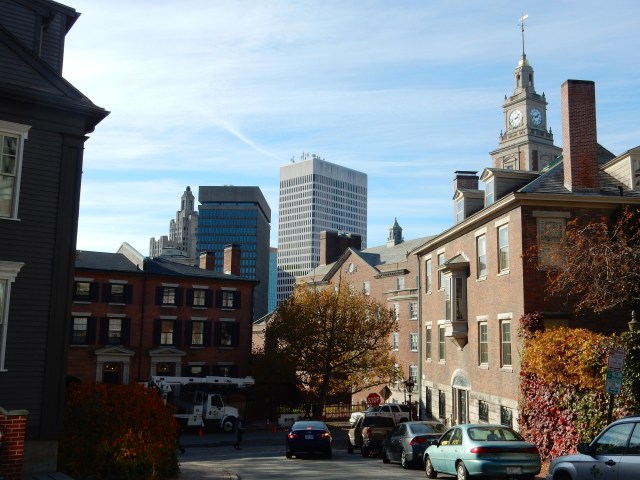
View down George St., courthouse center right, its tower upper right. (Photos by David Brussat)

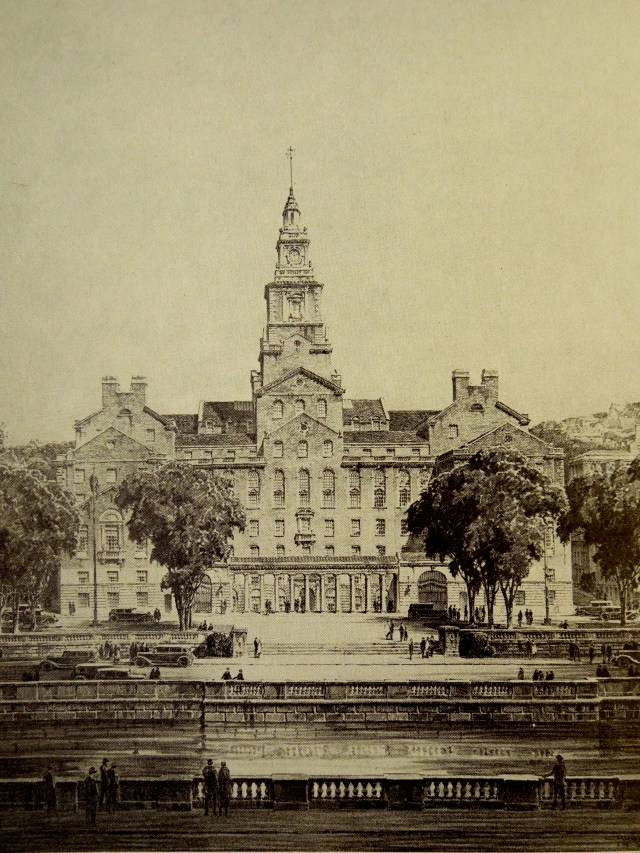
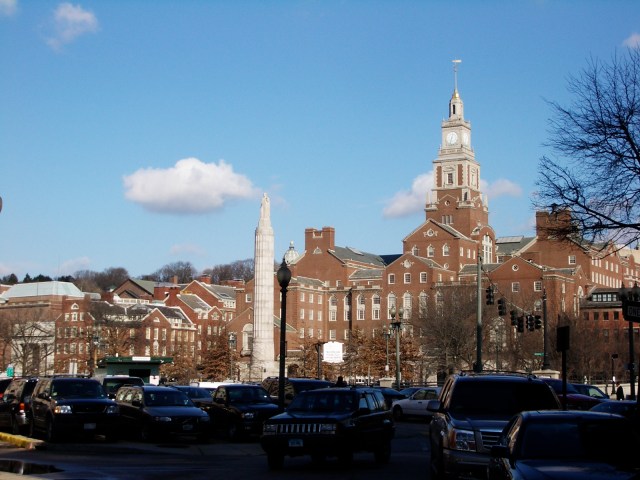
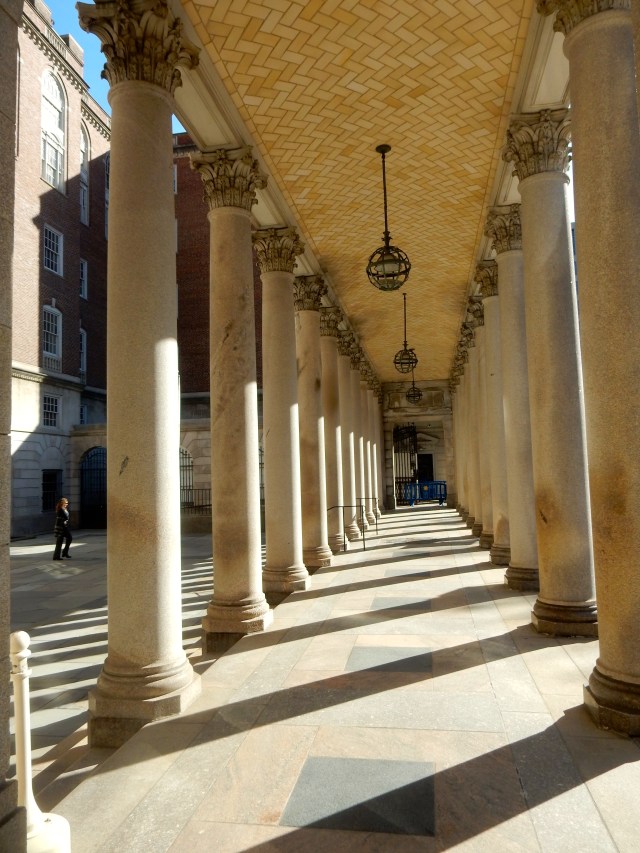
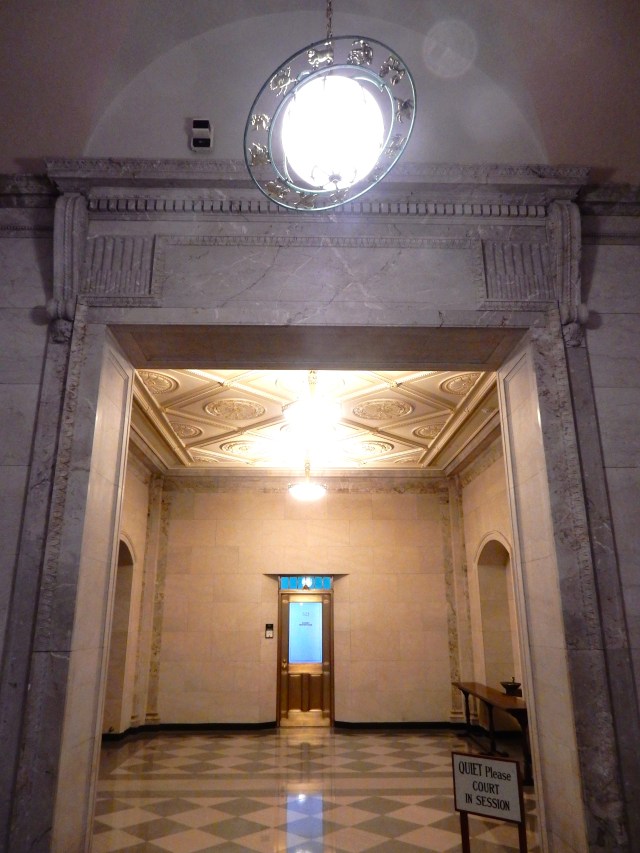
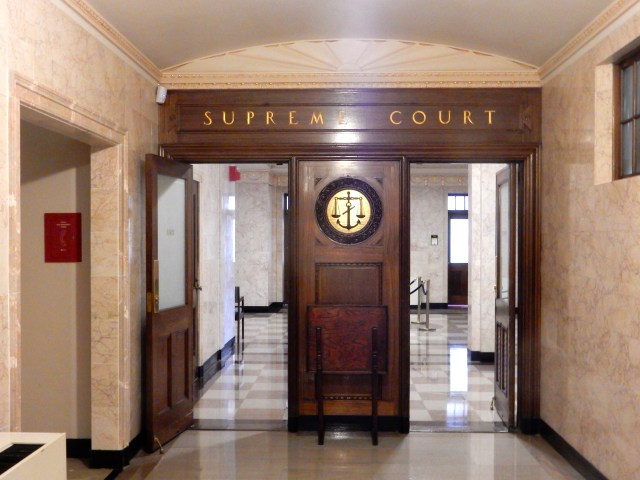
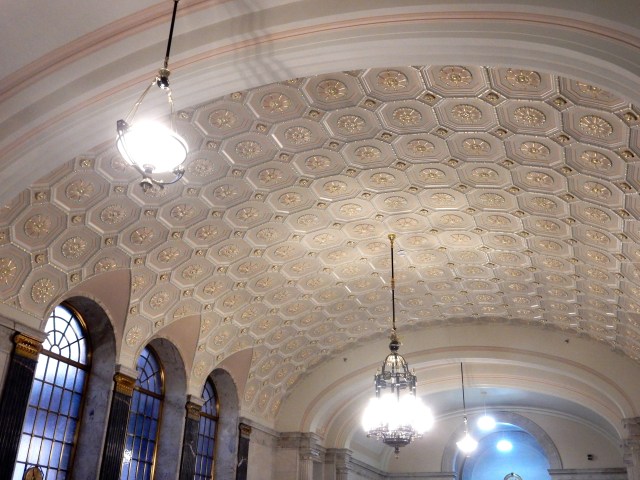
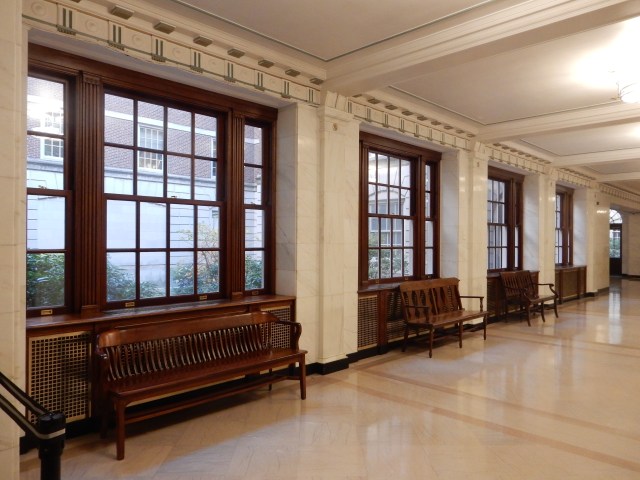
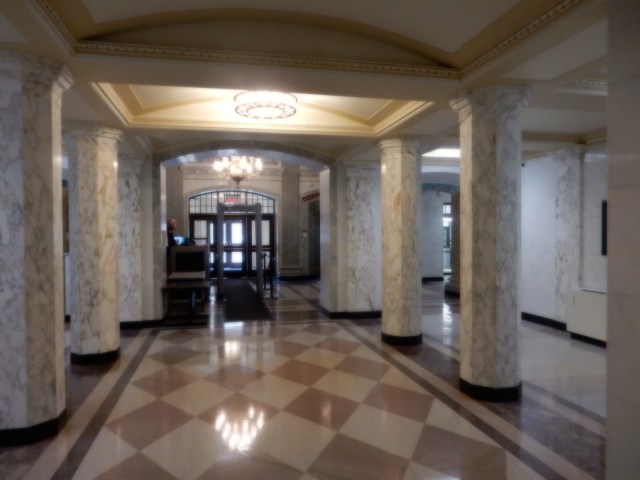
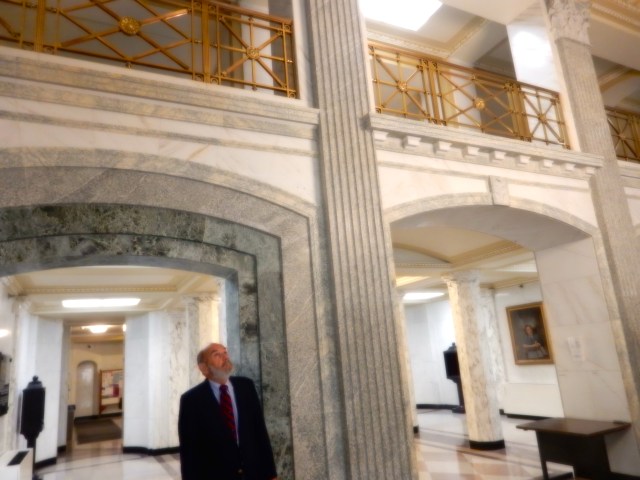
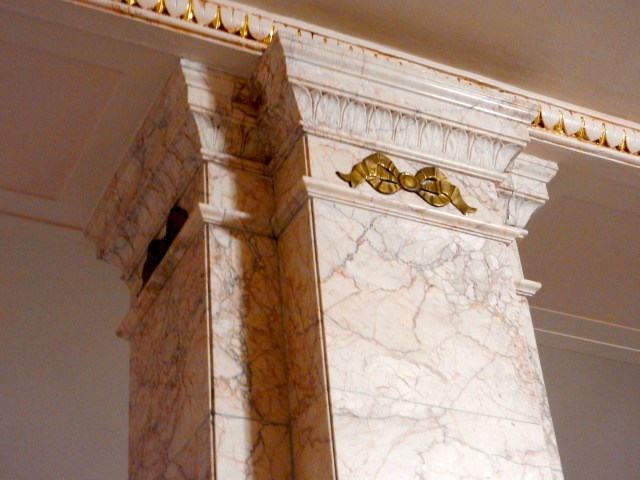
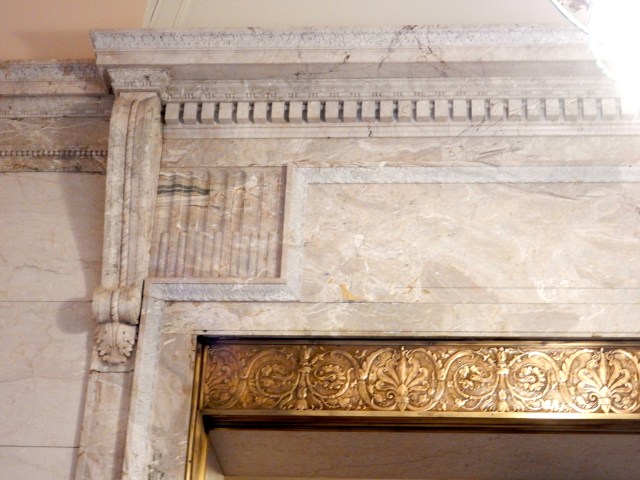
A while back, R.I. Supreme Court Justice Gilbert Indeglia, whom I’d met after giving a talk on architecture in Kingston, near URI’s main campus, a couple of years ago, invited me to tour the Providence County Courthouse. I’d been there before. I had a served on a grand jury – where I’d heard the gory details of, among others, a case in which the suspect ran over his victim with a car (back and forth, in her own driveway). And for my first 14 years in Providence, living on Benefit Street, I had frequently used the courthouse as an elevator from South Main Street to Benefit, five stories up. It is one of my favorite buildings in Providence, perhaps second only to the the Rhode Island State House on Smith Hill beyond downtown.

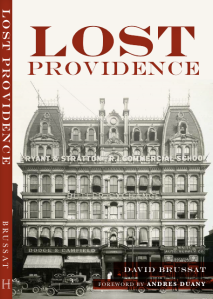
My tour was delayed by writing Lost Providence, in which the courthouse figures (even though it has not been lost). Before the manuscript came back to me today with copyediting suggestions, I had time to take the tour.

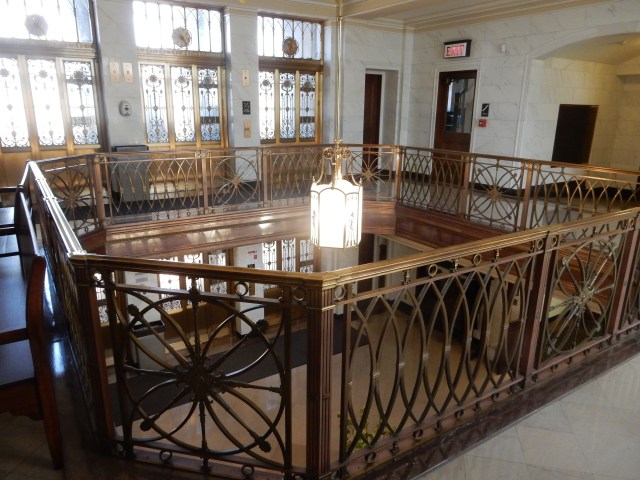
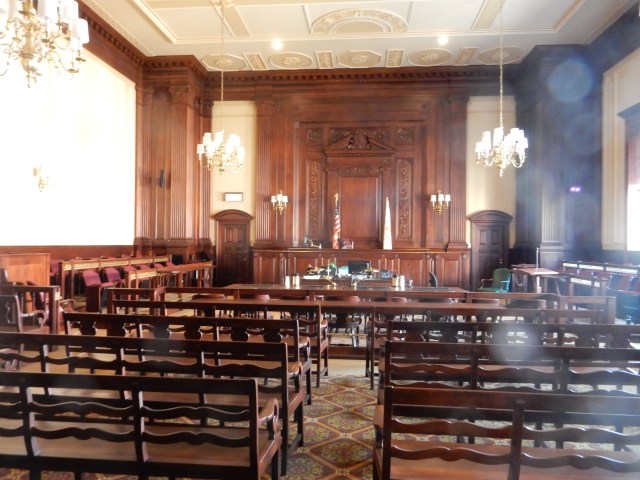
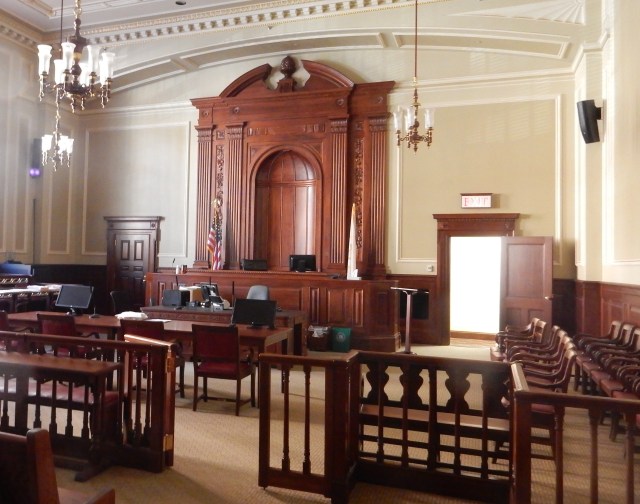
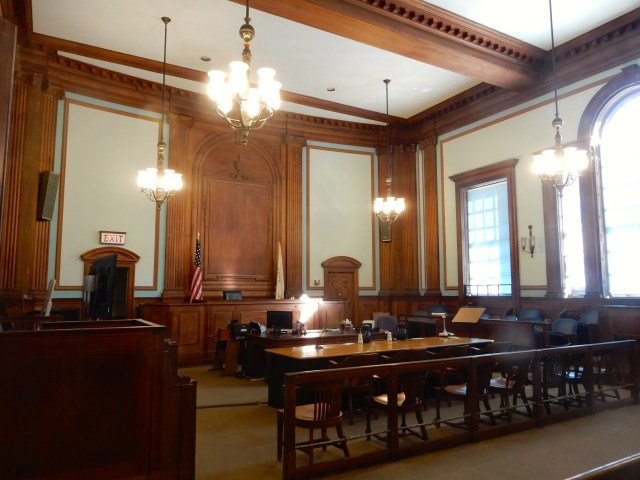
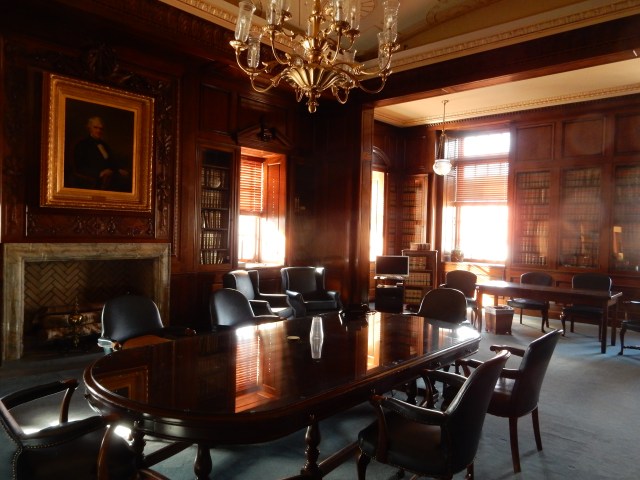
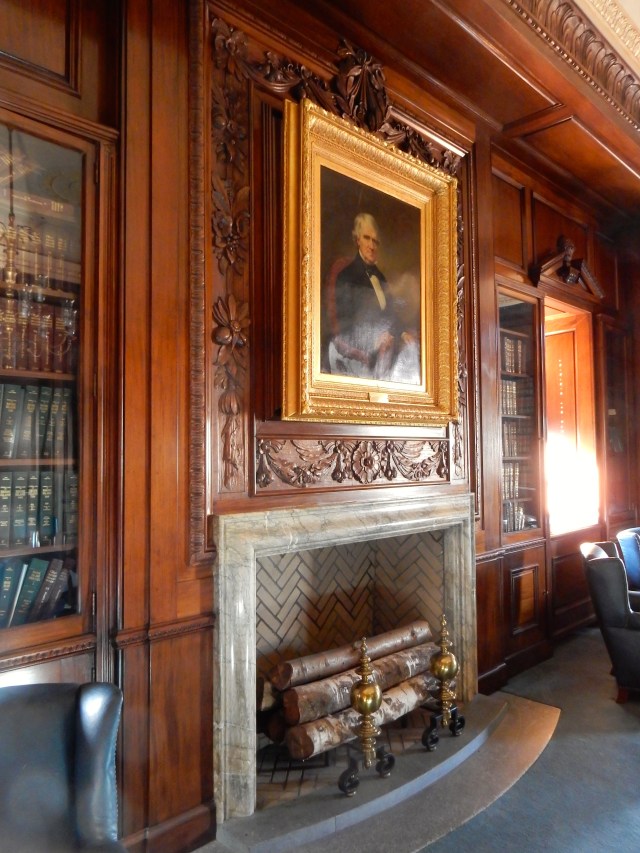
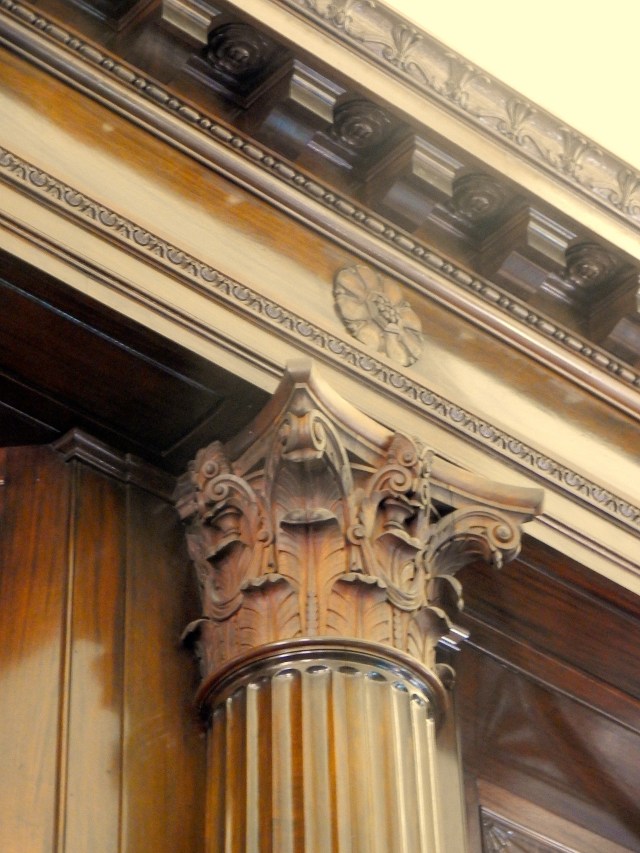
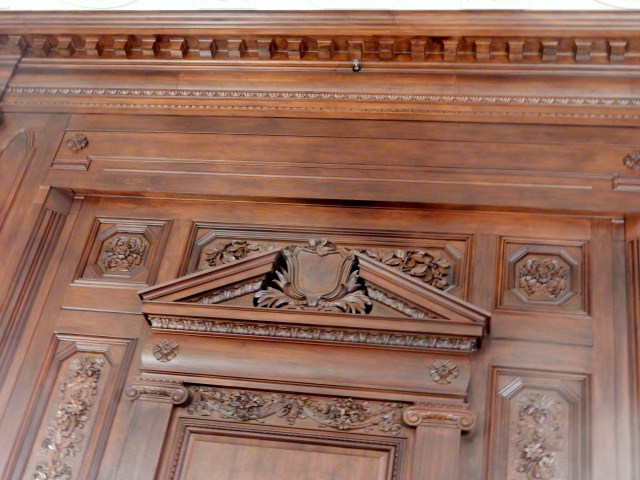
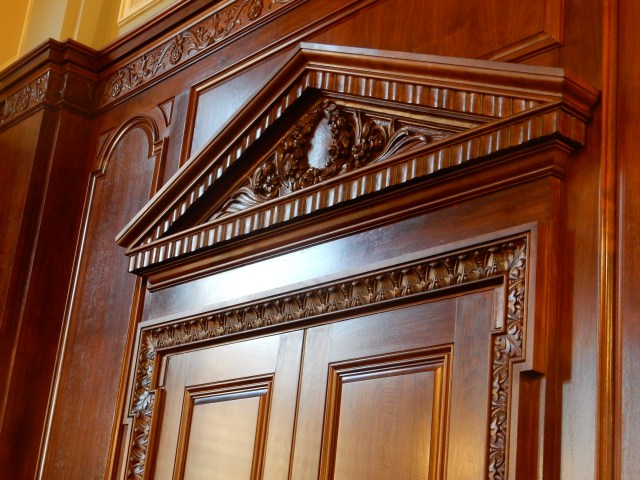
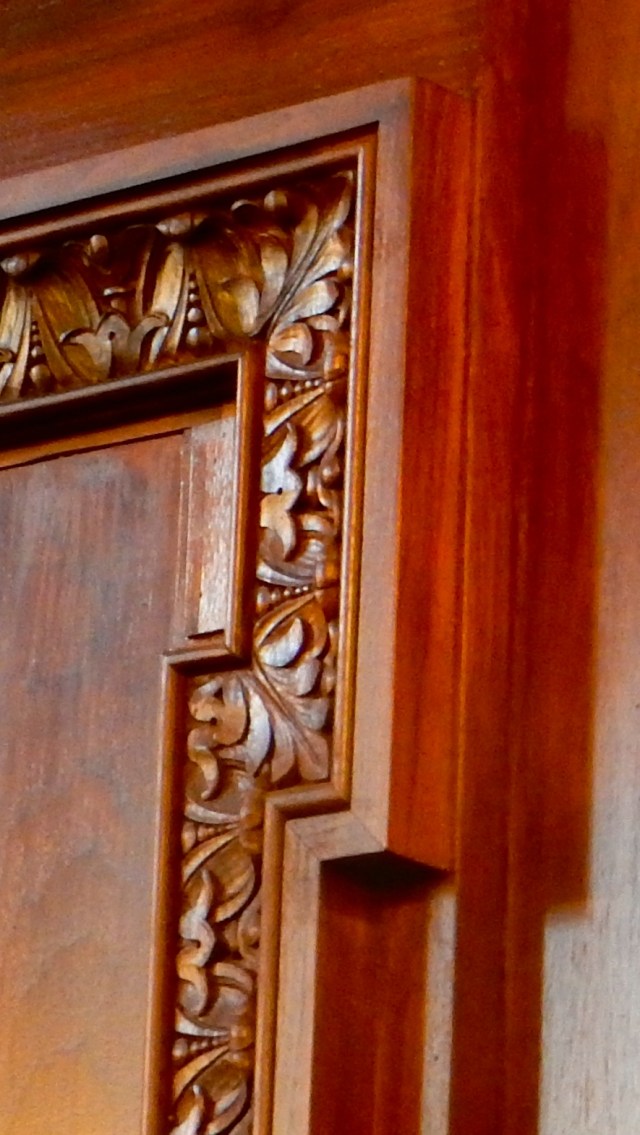
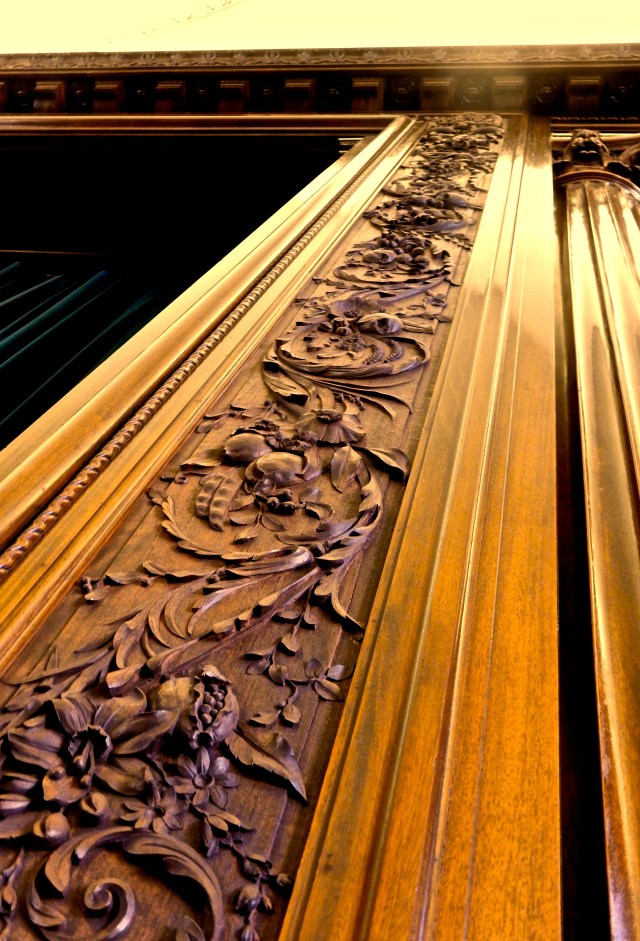
Justice Indeglia and Deputy Sheriff Everett LaMountain (now there’s a lofty moniker!) took me around the building, showing me a host of recently renovated courtrooms, from whose furniture was removed decades of penknifed signatures and other art, replacing old carpet and refurbishing some hundreds or thousands of square feet of mahogany. The original beauty of the courtrooms (in my opinion never really dimmed that much by time’s vicissitudes) has been restored by a craftsmanship still flourishing amid its supposed dark ages.

From one courtroom near the top floor of the courthouse’s nine stories we looked out a window to the north. The judge hinted that most workers in the groves of justice would have preferred a view of the State House more than the orange brick of the RISD Chace Center of 2008. They are fortunate, however, in that the view of the inside of their own workplace is sufficiently splendid to overshadow any disappointment of the outside view.

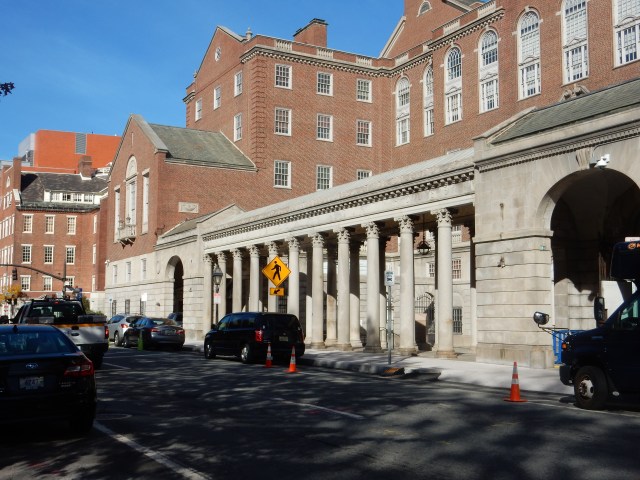
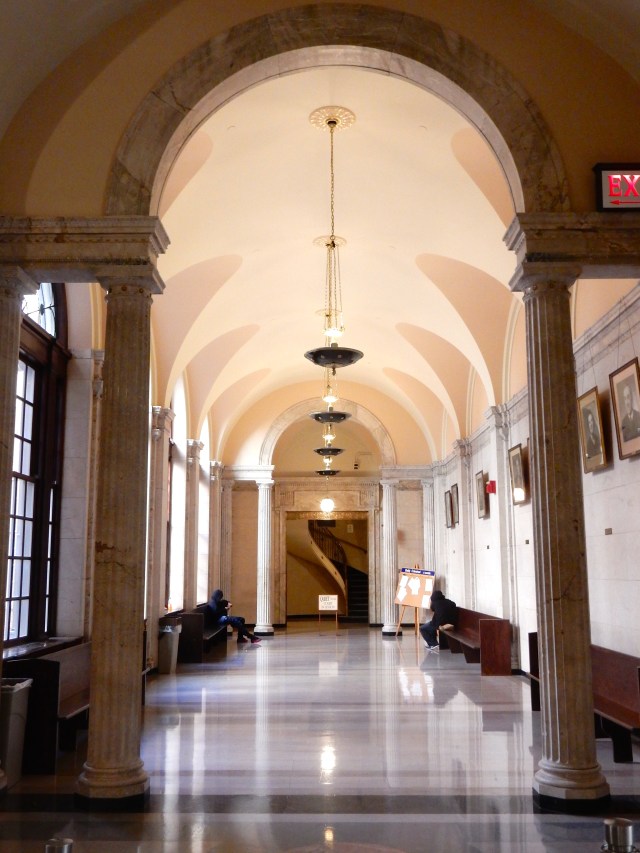
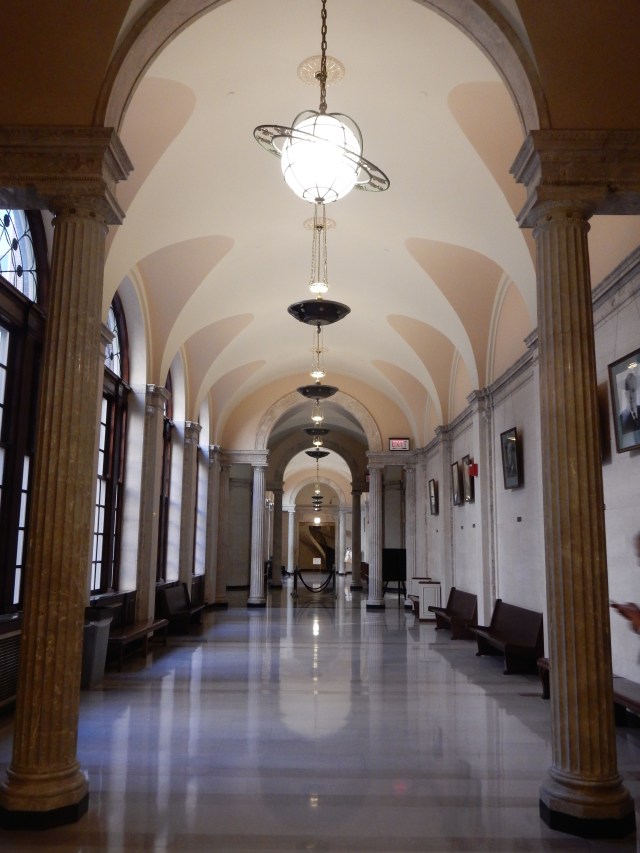
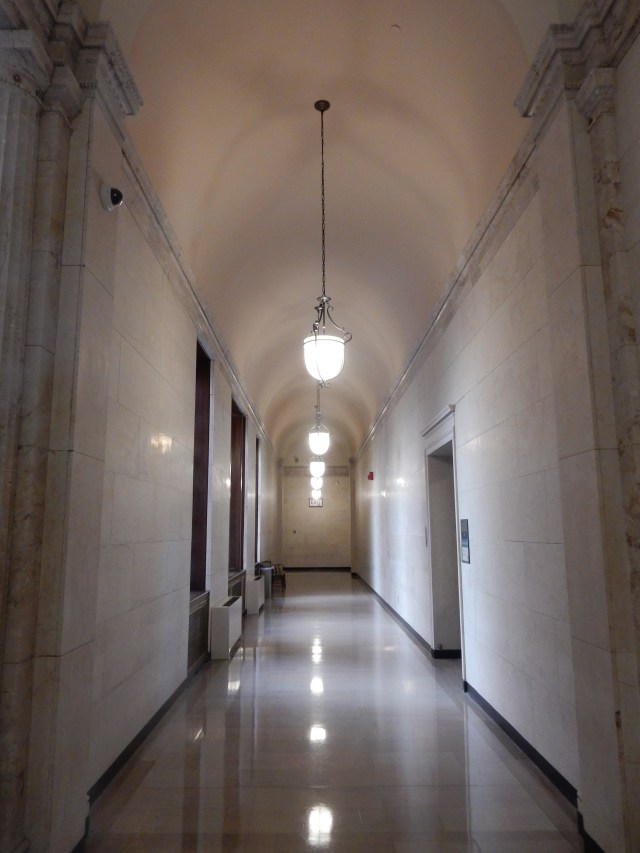
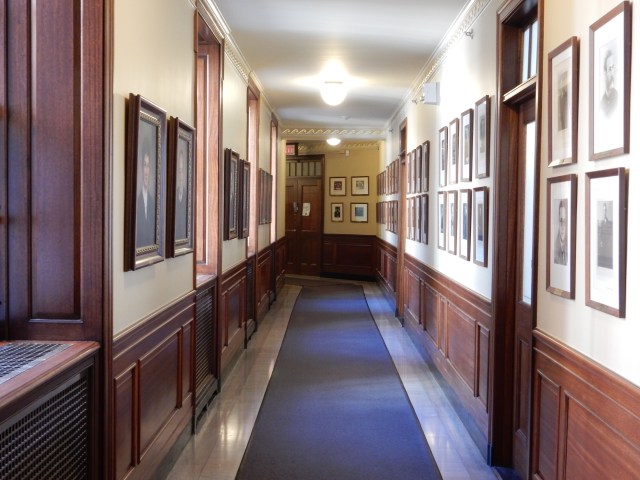
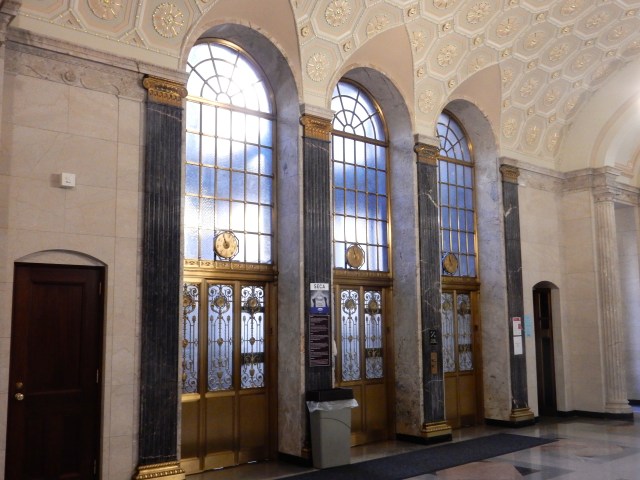
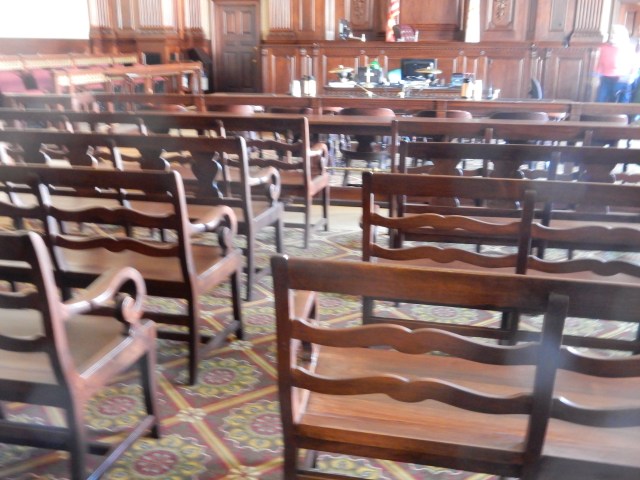
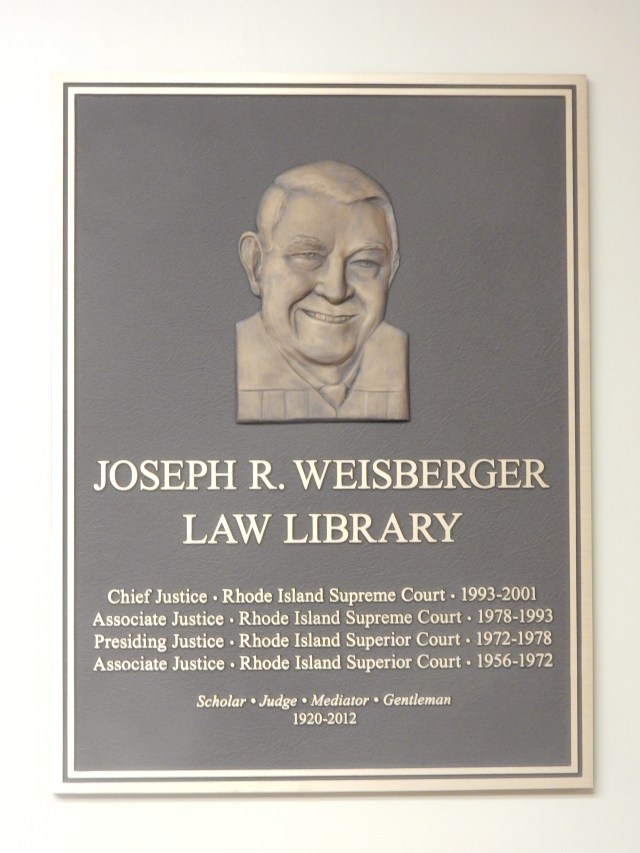
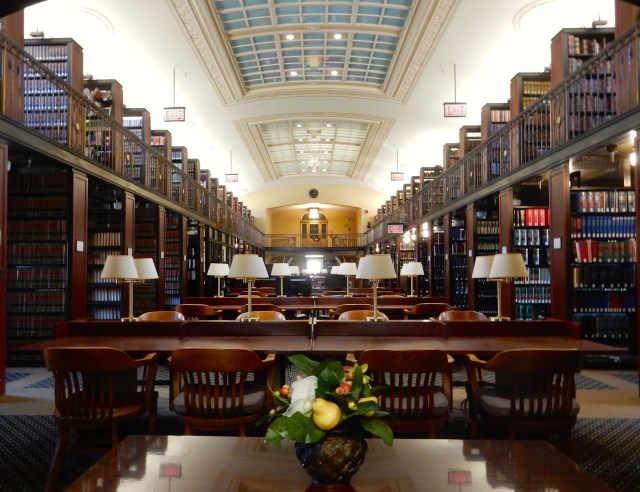
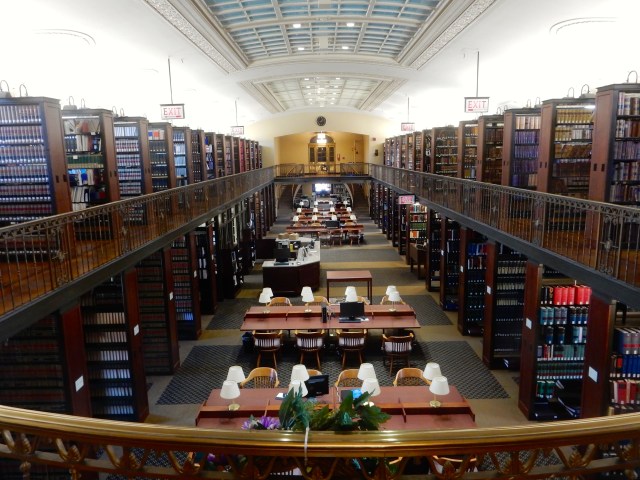
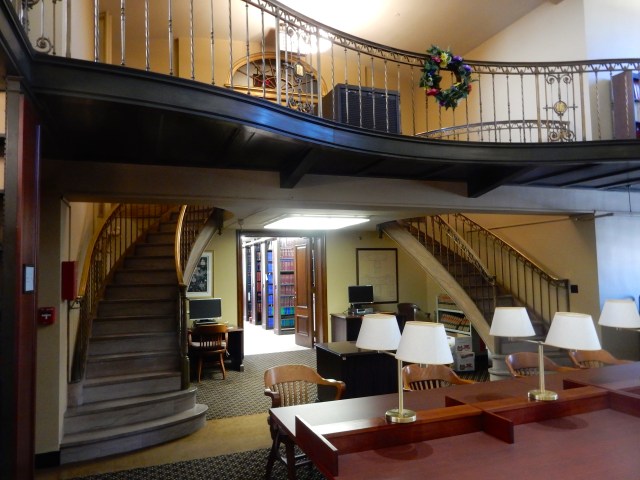
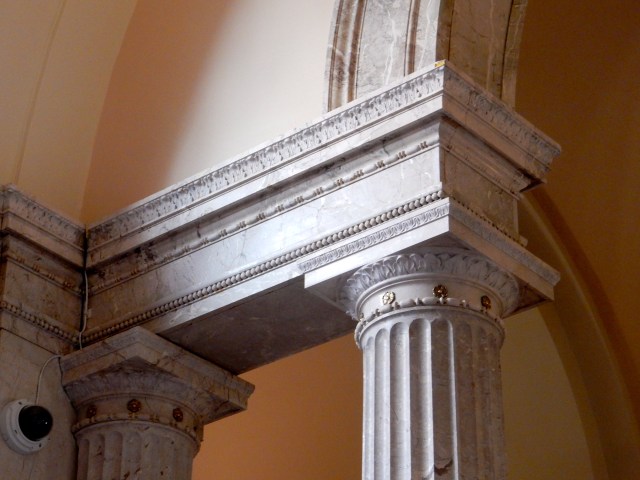
My patient guides kept me informed and entertained Monday afternoon as I shot a full “roll.” Sheriff LaMountain did double duty three days later after I found that I’d had the camera set to “Effects” rather than to “Auto” – no wonder those shots looked so fuzzy. He superintended my visit to retake them. I have arranged them not in historical order but in subject sets – hallways, public spaces, courtrooms and architectural detail, introduced by several outside shots. This masterpiece of architecture was built between 1928 and 1933 and designed by the firm of Jackson, Robertson & Adam, who also designed RISD’s Helen Adelia Rowe Metcalf Building across College Street. May readers appreciate it through this post rather than a visit under the exigencies of the law. In any event, the building may, for the most part, be freely examined by those whose appetites are whetted here.

DSCN7829.JPG

IMGP5838.JPG

DSCN0010 - Version 2.JPG

DSCN0013.jpg

DSCN0026.jpg

DSCN0047.jpg

DSCN0031.jpg

DSCN0035.jpg

DSCN0066.JPG

DSCN0090.JPG

DSCN0052.JPG

DSCN0051.JPG

DSCN0016.JPG

DSCN9993.JPG

DSCN9995.JPG

DSCN0054.JPG

DSCN0036.JPG

DSCN0040.JPG

DSCN0023 - Version 2.JPG

DSCN0030.JPG

DSCN0075.JPG

DSCN0080.jpg

DSCN0063.jpg

DSCN0060.JPG

DSCN0057.JPG

DSCN0061.JPG

DSCN0027.JPG

DSCN0067.JPG

DSCN0028.JPG

DSCN0071.jpg

DSCN0045.JPG

DSCN0018.JPG

DSCN0018 - Version 2.JPG

DSCN0074.JPG

DSCN0042.JPG

DSCN0043.JPG

DSCN0064.JPG

DSCN0058.JPG

DSCN0053.JPG

DSCN0059.jpg

DSCN0070.jpg

DSCN0049.JPG

Posted in Architecture, Photography | Tagged , , , , , , , | 3 Comments

Vote’s “style wars” tea leaves

Screen Shot 2016-11-09 at 11.32.20 AM.png

Trump Tower vs. Trump Building

It’s hard to say, to say the least, what, if anything, Donald Trump’s victory may mean for architecture. It is easier to imagine that a Hillary Clinton win would have meant more of the same for how we build. Trump is not just a reality show host: he is a real-estate developer who specializes in the big and glitzy. Are the “style wars” between traditional and modernism on his radar? Maybe. Maybe not.  Does Trump Tower, where the victor had his campaign headquarters, reflect his architectural taste? It probably does. Not good.

Nevertheless, like last night’s electorate, it is possible we could be surprised. The Trump property that got the most play in the campaign aside from his tower was his new Post Office hotel in Washington. It is a new hotel but a historic building. There is also the Trump Building, in New York, a classical tower completed in 1930, for a month the world’s tallest building, and one that reflects the heroic era of Manhattan’s skyscraper skyline culture.

I don’t know Trump’s inner circle well enough to identify anyone who might stand up for tradition in architecture. As a sometime Republican and sometime conservative, he surely must feel some sort of kinship with the idea of tradition. In the hope and expectation that surround his new job, let me suggest a couple of interesting possibilities for developer and soon-to-be-president Trump to consider.

First, granting the number of larger issues on his plate right now, he should at some point consider reviving George W. Bush’s nomination of Thomas Gordon Smith, or a classicist of equivalent eminence, as the chief architect at the General Services Administration. In that job the Notre Dame professor could help even out the playing field for traditional architecture in future federal buildings, which the GSA controls. It has been staunchly modernist for decades. Smith’s nomination in 2006 caused a firestorm of protest from the usual suspects, and Bush, showing uncharacteristic wussitude, withdrew the nomination. Let Trump put Smith up for the same post.

Second, Trump will have the opportunity to tap into the thinking of City Journal, the quarterly of the Manhattan Institute, as he develops his strategy for the nation’s inner cities. The City Journal is not just a fount of policy ideas; it is also a proponent of the classical revival, having run many excellent essays over the years on traditional architecture and classical architects.

Screen Shot 2016-11-09 at 12.37.16 PM.png

WTC plan by Franck Lohsen McCrery. (City Journal)

It is City Journal that weeks after 9/11 published the classical proposal for the World Trade Center rebuild, designed by the firm of Franck Lohsen McCrery Architects. Their excellent proposal never made any headway in the WTC design competition because that competition put its thumb on the scale for entries that were “of our time” – that is, which represented the chaos of our era. This is the same chaos that President-elect Trump has a mandate to reverse. The World Trade Center as it has emerged represents the taste, perhaps, of Donald Trump, but of the establishment for sure. Maybe Donald Trump will understand that architecture can be a symbolic indicator of his supposed desire to recast the establishment as a vehicle for making America great again, and, as he says, to heed, once again, the voices and the tastes of the average American citizen.

One more suggestion: The Donald should see to it that an early grave is dug by Congress for Frank Gehry’s Ike memorial design.

Posted in Architecture, Urbanism and planning | Tagged , , , , , , , | 10 Comments

Pix of Moran’s Samaritaine

Screen Shot 2016-11-07 at 10.05.54 AM.png

This image of his counterproposal and those below courtesy of Connor Moran.

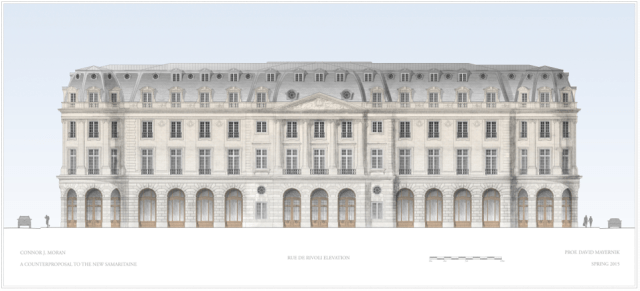
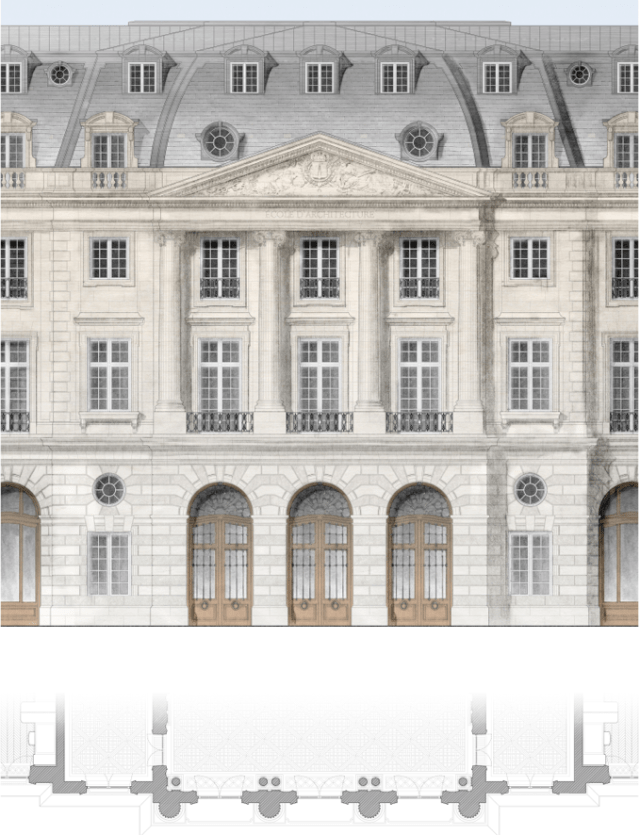
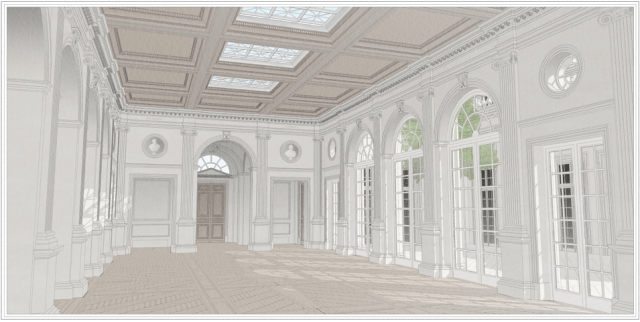
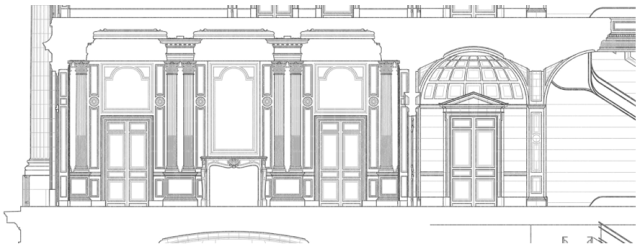
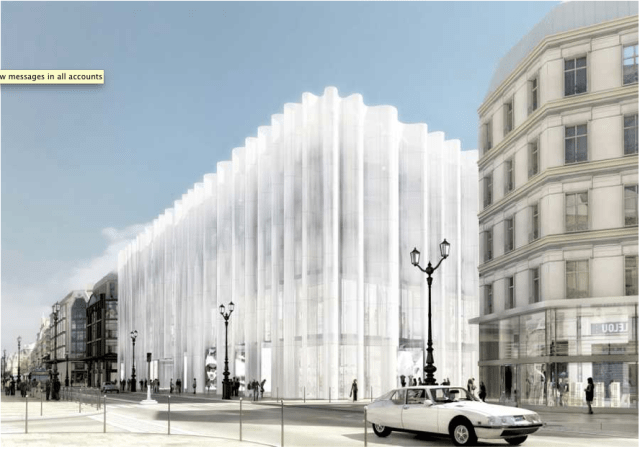
Last night I posted on Connor Moran’s elegant counterproposal for the Rue de la Rivoli side of La Samaritaine, the famous Paris department store. The Notre Dame grad, a native of Naperville, Ill., who now works for Ferguson & Shamamian, in New York City, has answered my request for more and larger images of his proposal. The third image has been used to illustrate a poster for this year’s Stanford White Awards, sponsored by the New York chapter of the Institute of Classical Architecture & Art. The SANAA proposal to which Moran responds and the Samaritaine facade now demolished are at the end.

Who can doubt what Parisians would prefer? What the world would prefer?

Screen Shot 2016-11-07 at 10.08.49 AM.png

Screen Shot 2016-11-07 at 10.09.47 AM.png

Screen Shot 2016-11-07 at 10.10.25 AM.png


Screen Shot 2016-11-07 at 10.11.39 AM.png


Screen Shot 2016-11-07 at 10.08.26 AM.png

Screen Shot 2016-11-07 at 10.11.19 AM.png


Screen Shot 2016-11-07 at 10.11.59 AM.png

Screen Shot 2016-11-07 at 10.29.28 AM.png

Posted in Architecture | Tagged , , , , , , , | 4 Comments

Which way will Paris go?

Screen Shot 2016-11-06 at 4.44.19 PM.png

Counterproposal thesis by Connor Moran in fifth year at Notre Dame. (Connor Moran)

Two items regarding the direction of Paris. First is a plea from architectural theorist Leon Krier that Paris’s Mayor Hidalgo find someone other than Dominique Perrault to redesign the portion of the Ile de la Cité (site of Notre Dame cathedral) from which French courts are moving. They are slated to occupy a tragic blotch by Renzo Piano on the edge of Paris. The city’s legal establishment fought in court to avoid the move into his cheesy tower, but failed. Perrault’s incompetence is affirmed by his design for the regrettable new national library a decade or so ago (see bottom image).

With all that’s going on in Paris, it seems like we won’t have it anymore, and damn soon, unless the city and its leaders reverse the direction of the future of the City of Light. The second item on this post shows the way.

It is a counterproposal by Connor Moran, a graduate of Notre Dame (the univesity, not the cathedral) now at Ferguson and Shamamian, in New York, for the Rue de Rivoli side of La Samaritaine (the other side faces the Seine, and seems out of danger, at least for now). The famous department store is being butchered by the Pritzker winning architecture firm SANAA. Moran’s elegant alternative for the Rue de Rivoli side is above. The leftmost panel is the insensitive (to use the gentlest word) proposal by (IN)SANAA (my own titular reinterpretation). Below is Leon Krier’s SOS. Both of these items come to me courtesy of Mary Campbell Gallagher, of SOS Paris and a founder of the International Coalition for the Preservation of Paris.

Here is Moran’s description of his project, which has apparently already won him (congratulations!) the Stanford White Award from the New York chapter of the Institute of Classical Architecture & Art:

The outcome of my study is ultimately to be determined by how the Parisian public receive my thesis project. I will be following in the footsteps of traditional architects such as Quinlan Terry in London and Leon Krier in Luxembourg, who have successfully crafted arguments against the modernization of such iconic traditional European cities. S.O.S. Paris hopes to use my project as a visual tool that will inspire more people to argue against the corruption of traditional Paris and ultimately aid in the creation of preservation laws that prevent future disregard for the city’s historical and artistic development.

Here is Krier’s “C’est an stitch-up” (a piece hopefully not behind BD magazine’s paywall), calling on the mayor, and France’s president, to rethink what seems likely to overtake Ile de la Cité. Below are Gallagher’s thoughts on the same subject:

The President of France and the Mayor of Paris have chosen the worst possible architect to plan the redesign of the ancient Ile de la Cité in the center of Paris, site of the Cathedral of Notre Dame. Dominique Perrault proved how perversely incompetent he is when he designed the new National Library in the Thirteenth Arrondissement, the Bibliotheque Mitterrand. Believe it or not, he placed the book stacks in glass-walled skyscrapers, literally cooking the books. The authorities rushed to install shutters. And that’s forgetting the deck outside, slippery when wet. Read what Leon Krier says about Perrault and the history and future of the Ile de la Cité.

Screen Shot 2016-11-06 at 5.09.54 PM.png

(Please excuse the confused structure of this post; I am being pressed to have dinner at my dear mother-in-law’s here in Providence. Gotta rush! Sorry!)

Posted in Architecture | Tagged , , , , , , , | Leave a comment

Comments on my PPS post

The Still Room.png

Photo similar to that shown by Max Page on Friday. (The Still Room)

Because many readers do not read the comments section of a blog, I am publishing two comments from eminent theorists who have read my blog post “Why preserve? PPS speaks.” They are from Steven Semes, a Notre Dame professor of architecture and the author of The Future of the Past, and Nikos Salingaros, a mathematician and author, with Michael Mehaffy, of Design for a Living Planet. (If I receive any comments from readers who disagree with my assessment of the direction of preservation, my thoughts about PPS, or of the opinions of Max Page, I will run them as separate posts also.) Below are their comments in the order they were received:

***

Max Page has many good points to offer and your hesitation is also understandable. Saving old buildings is the easiest and most effective path to sustainability. The solution to gentrification is to build new neighborhoods people want to live in (it’s simply a matter of limited supply and great demand). Issues of justice (environmental as well as social and political) must be in the forefront of preservation as they should be in every other aspect of public life.

Where I think the preservation community needs to look beyond “saving places” is that we must have a sense of what we are saving them for. Do we save everything old just because it’s there and someone thinks it is “part of our history”? Or do we have some criteria for judging what is worthy of preservation and what needs to go? (Consider the difference between the words “historic” and “historical.”) Do we preserve examples of environmental disaster (suburban sprawl, for example) simply to preserve “history”? Preservation must have an aim, and it must be to help build cities that are beautiful, sustainable, and just. In that way, Max Page is right. That does not in any way preclude saving specific buildings and places as a means to that end, but, I believe, that is not an end in itself.

***

Seen from the scientific approach (closest to my heart), preservation is a normal process of evolution. A design discovery that creates a healing environment needs to be preserved, and its DNA saved from destruction by random forces. It’s in our collective interest to repair certain older buildings from inevitable material decay so as not to lose their encoded design DNA. Those tectonic configurations help humankind move “forward” in leading our lives with as much positive environmental feedback as we can imagine.

At the same time, design discoveries that we find are unhealthy (i.e., that immediately repel the vast majority of common people), and which might actually make people sick in the long term, should be demolished and reconstructed. Wrong evolutionary steps need to be selected against. Nature does that. But when selection is based on a twisted sort of political ideology, we reverse human evolution: not our body’s evolution, but the evolution of human artifacts and the created built environment. The fervent desire of an elite group to preserve repulsive buildings or unhealthy urban configurations is part of this latter phenomenon. Their flawed education has sadly attached nonsensical “links” between the worthless object and desirable though abstract human ideals.

Posted in Architecture, Preservation | Tagged , , , , , | Leave a comment

In like a rat, out like Jonah

Screen Shot 2016-11-05 at 11.59.08 AM.png

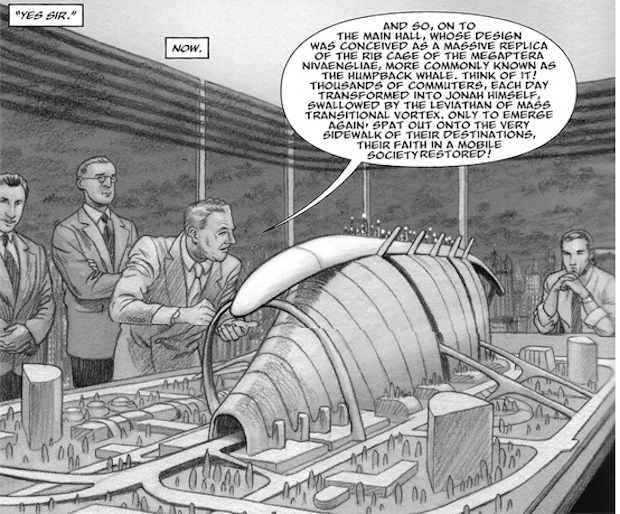
From “Batman: Death by Design.” (Drawing by Dave Taylor)

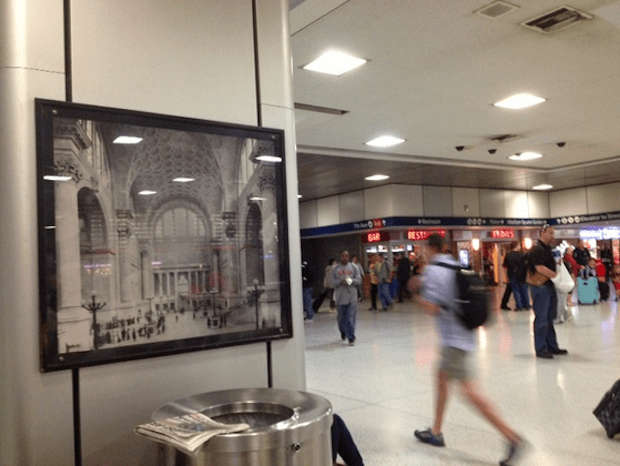
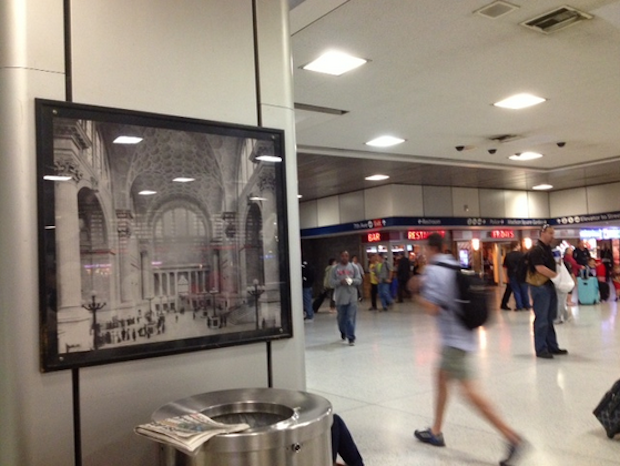
As I was searching for the original photo of old Penn Station hanging at the existing Penn Station, shown by Max Page at the Providence Preservation Society’s symposium on Friday, I stumbled across this hilarious cartoon on batmangotham city.net. It is from Chip Kidd’s graphic novel Batman: Death by Design, in which Batman plans to demolish Penn Station so he can build an auxiliary Batcave beneath a new terminal designed to resemble a whale. Read the dialogue bubble. It sounds just like the hogwash of a modernist architect’s presentation to a client. Very funny, if not downright poignant.

I am reading the post about Kidd’s take on Penn Station and here is a quotation where he describes his experience of the existing station:

[A]s somebody who takes Amtrak a lot, I’m always in and out of Penn Station and it’s an absolute travesty. Basically – for one of the most active travel hubs on the east coast of the United States – it’s more or less is a fluorescent-lit airless basement below Madison Square Garden, and it’s just horrible. And almost as a cruel joke, when you’re down there, up on the grimy tiled walls they have these pictures of the old Penn Station – this big, glorious space. They’re hanging around on the walls practically mocking you with how beautiful it used to be, as opposed to how shitty it is now.

I wonder whether he realizes there’s a serious and realistic proposal by architect Richard Cameron to rebuild the old Penn Station.

Don’t know whether Batman actually does demolish Penn Station in the novel. I am just now reading the post. I did not even come up with the photo Max Page showed, but I did find one like it at a website called The Still Room, way down in my Google search. It is below:

The Still Room.png

Posted in Architecture, Books and Culture | Tagged , , , , , , , , , , | 5 Comments

Why preserve? PPS speaks

DSCN9911.JPG

Max Page shows photo of the old Penn Station on display in the existing Penn Station.

I caught today’s “plenary” lecture by Why Preservation Matters author Max Page, and the “In the Moment” panel discussion that followed. Page kicked off a day of panels and tours for the Providence Preservation Society‘s “Why Preserve” symposium with an engaging talk called “Bending the Future.” You can see him in the photo above showing us a photo of a photo of the old Penn Station mounted underground at the new Penn Station.

Not all that funny, really, and I’m sure Page agrees. By the way, in the background that’s one of the arched windows of the Industrial Trust (“Superman”) Bank Building, the empty icon of 1928 in whose banking hall the symposium was held.

Page’s talk stressed new ways to make preservation relevant. Saving old buildings as a primary focus strikes some as overly elitist, so Page urged the Providence Preservation Society’s audience to “bend” preservation toward reducing society’s carbon footprint, fighting gentrification and redressing through design the wrongs of U.S. history. To give a flavor of Page’s thinking, here is a guest introduction of him on WBUR radio in Boston:

From the Public Gardens to the Old South Meeting House and the Quincy Market, Boston is a city of historic landmarks. We preserve these places for their architectural beauty, their historical significance, the impact they had on society.

But what if we preserved for sustainability? Or to stand against gentrification? Or to challenge societies to confront ugly pasts?

That’s the progressive preservation movement contemplated by Max Page, a professor of architecture and history at the University of Massachusetts. He says preservation is not just about the past — it’s about building the more just communities of the future. In other words, he says: “Not your grandmother’s preservation movement.”

And that pretty much sums up where PPS and most other preservation groups, from the National Trust on down, are headed. The three presenters on the “In the Moment” panel were generally of the same view. The only dissenting voice – if I may characterize it as such – was that of an audience member who wondered why these new directions for preservation might not be deemed equivalent to a library de-accessioning its book collection in order to go digital or engage in other efforts that, frankly, line up alongside what preservationists feel, with every good intention, they should be doing.

I am sensitive to the strong rationale for all of these goals, but I think preservationists are overthinking the question of “Why preserve?” and undervaluing what preservation as originally conceived already does to advance those three goals.

PPS’s annual list of endangered properties argues persuasively that there remains plenty of work to do in the old ways of preservation. What follows is an argument for retaining and even ramping up preservation’s focus on saving those buildings.

With each old building saved, the carbon footprint of its site remains essentially in the black. A new building would accrue a massive carbon debt that, according to Page, would probably not be paid off (with accruals from its “green” technology) until well after the building is demolished. Page expressed the same skepticism I feel toward conventional “gizmo green” strategies of carbon emissions reduction. Good for him, but does he favor erecting new buildings that use pre-Thermostat Age strategies to heat and cool buildings, such as windows that open and close, to name one of many? Not abandoning the conveniences we love, but offsetting their cost with age-old strategies of sustainability. I doubt it.

Neighborhoods of new houses traditionally designed would contribute to sustainability even as they reduce the pressure of gentrification on poor communities with increasingly shabby housing conditions. Gentrification certainly displaces the poor more slowly and gently than urban renewal. But if the goal is to eliminate gentrification altogether, why not try creating new neighborhoods built from scratch with new traditional architecture? That would give wealthier families a way to occupy homes amid beauty without gentrifying poor neighborhoods. Page did not seem to have any new ideas about how to stop gentrification – driven by market forces that see lovely old houses as a rare commodity. Without such an alternative as new traditional architecture, preservation is indeed just another word for gentrification.

Traditional preservation also does a better job of healing the wounds of this nation’s uncivil history. More so than new buildings, old buildings create a more civilized space for public discourse. Saving them pushes back against the incivility and the anomie that has increasingly characterized our built environment. This is important for all citizens, but most of all for citizens who have grievances that are much more likely to be addressed in settings that promote the kind of civility that breeds compromise, reconciliation and brotherly love.

This line of argument may seem tame, indeed lame, but I believe it is more firmly rooted in the better angels of our nature than some of the alternatives. Often there is no silver bullet.

Max Page argues that preservation should instead use design to remind citizens of the sins of our nation’s past. This important task is better left to books, libraries, museums and scholarship. My concern is that few architects or preservationists have the necessarily considerable sensitivity to accomplish such a daunting task effectively. A good example of what might go wrong is the stolpersteine of Berlin – “stumble stones,” bronze memorial cobblestones with names of Nazi victims that, as Page put it, “force you to trip a little bit.” Suppose someone falls and is hurt? Or imagine that someone who merely “trips a little” might recover his balance with the intended message angrily reversed inside his mind?

Our multiplicity of sins offers the opportunity to make an abundance of mistakes in every community. Will such “interpretive” interventions contribute to the healing of national scabs or to picking at national scabs? In a nation already raw with polarization, efforts to use architecture to address even legitimate grievances are leading with our chin. The effort may be even more challenging than attempts by architects to reflect “our era” in the relatively blunt shapes and crude materials of the construction trades.

Ultimately, the error being made by many preservationists today, more by the staffs and boards than the rank-and-file whose memberships sustain preservationist organizations, is to overthink. Most preservationists, let alone average citizens of whatever shade of diversity, do not believe that saving old buildings is elitist, or somehow directed at fostering continued suppression of legitimate aspirations. These are the effusions of preservationist theorists who believe saving old buildings is old hat. They want to be “relevant.” I understand the impulse, but I do not buy it. Your grandmother’s preservation movement is relevant now.

Our era is too complex. Every field of human endeavor is currently pushing beyond its ability to understand let alone control its own actions or their effect on human life and society. Preservation and architecture are two fields that have an outsized influence on whether the world can be made to work. Both architecture and preservation need to get back to basics.

Will the young people understand? They will if you trust them.

Steve Semes, perhaps America’s most carefully thoughtful preservationist, reading this post, adds: “Preservation must have an aim, and it must be to help build cities that are beautiful, sustainable, and just. In that way, Max Page is right. That does not in any way preclude saving specific buildings and places as a means to that end, but, I believe, that is not an end in itself.” I cannot agree more.

Modern architecture is the epitome of overthink, and has been since its beginnings a century ago. Preservationists could make more progress toward the three goals they have outlined – sustainability, fighting gentrification and healing the sad history of our imperfect union – by getting back to the basics of preservation’s heroic era. We could ramp up our effectiveness at all three by embracing new traditional architecture, building new buildings, new neighborhoods, new cities, new places that we can love. This should be the subject of the next annual PPS symposium. Such discussions are excellent but if at first we don’t succeed at understanding “why,” let us try, try again – try again on the beaches, try again in the streets. Eventually, preservationists will figure out what Winston Churchill (yes, yes, a dead white guy) meant when he said, “First we shape our buildings; thereafter, they shape us.”

Posted in Architecture, Preservation | Tagged , , , , , , , , | 7 Comments

Transport official on beauty

Screen Shot 2016-11-03 at 11.08.20 AM.png

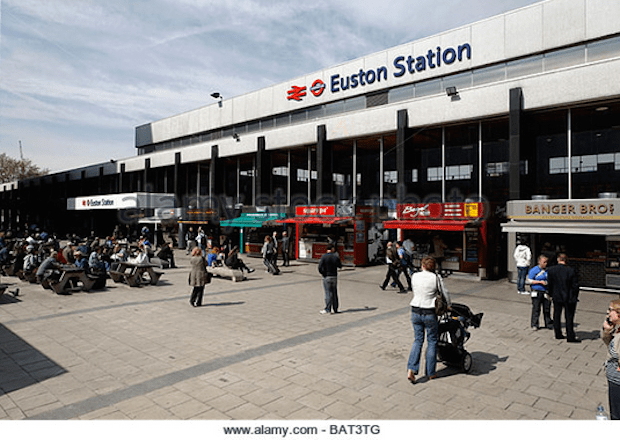
Painting of the original Euston Arch, entry to Euston Station, in London. (eustonarch.org)

On my ballot next Tuesday I will write in John Hayes for president.

Dammit! He is ineligible. He is a member of Parliament, and now Britain’s minister for transport, newly appointed by Prime Minister Theresa May, successor to David Cameron after the Brexit vote (to leave the European Union) in June.

Hayes gave a speech in London on Oct. 31 that must be read to be believed. His words and thoughts on beauty in public transportation infrastructure are not so much unusual as exceedingly rare from the mouth of a public official, in Britain or anywhere. In his remarks before the Independent Transport Commission, entitled “The Journey to Beauty,” he uses examples to evoke the decision a democracy must make about beauty:

Our busiest stations are used by millions every day.

Their design has a profound effect on the well-being of those who pass through.

The critic Richard Morrison is right about Euston station. He said:

Euston is one of the nastiest concrete boxes in London: devoid of any decorative merit; seemingly concocted to induce maximum angst among passengers; The design […] gives the impression of having been scribbled on the back of a soiled paper bag by a thuggish android with a grudge against humanity and a vampiric loathing of sunlight”.

For better or worse, transport hubs like Euston frame our working days, and punctuate our working lives.

When transport design is done well, it raises expectations.

As Roger Scruton has written about the “old stations such as Paddington and St Pancras…”:

The architecture is noble, serene, upright. The spaces open before you. Everything is picked out with ornamental details. You are at home here, and you have no difficulty finding the ticket office, the platform or the way through the crowds.

Many of us will recognise these contrasting experiences.

They prompt us to ask – why can’t all buildings be designed with concern for form and detail?

If we learn from this experience, and seek to replicate the best in our new infrastructure, we have great power to satisfy the people’s will for structures that enhance our sense of worth by affirming our sense of place.

Ours can be – must be – an age in which aesthetic quality of the public realm soars.

It surpasses belief that not just here in America and in Britain but everywhere this remains a matter still under discussion. Hayes says a revolution is coming. It needs to come quickly!

By the way, Euston Station is scheduled to be rebuilt, and an effort has been made to rebuild the Euston Arch as part of the project. Will the station be rebuilt as it was? I do not know, but the issue brings to mind the proposal to rebuild Penn Station, in New York, as it was originally designed by McKim, Mead & White.

(Caps doffed to Daniel Morales for sending word of this speech to the TradArch list.)

Screen Shot 2016-11-03 at 11.07.16 AM.png

Euston Station today. (Alamy)

Posted in Architecture, Urbanism and planning | Tagged , , , , , , , | Leave a comment

Betsky’s boo-hoo blues

Screen Shot 2016-11-02 at 2.22.54 PM.png

Aaron Betsky, the architecture critic for Architect, the journal of the American Institute of Architects, took to blubbering aloud this week that Americans don’t give American architects enough respect. In “Elevating the Discourse: Architecture Awards in the U.S. and the U.K.,” he wonders why. He looks across the pond to Britain, where the Stirling Award gets national attention. Even the Carbuncle Cup, which celebrates the worst building of the year, is widely acclaimed over there. Why not here, he whines. Maybe because culture is a “bigger deal” over there? He suggests that maybe the American awards don’t come with a big enough “prize.”
After describing the large number of architecture awards here, including the one handed out by the magazine he writes for, he complains:

Other than architects, who ever hears about these prizes? Occasionally an architect with a good communications consulting firm will manage to get a notice into a local paper, and our national newspaper of record, the New York Times, does mention at least the Gold Medal winner when she or he is announced. That, however, is about it.

In fact, the answer probably lies in the photograph atop this post. What is there to celebrate? Why would anyone care?

That photo is not the Stirling winner atop Betsky’s article. But that building is too boring to be selected as lead image of this blog post. Maybe rejection by the editor of this blog amounts to a sort of Carbuncle Cup. The building that did make it atop this post is … well, I have no idea. Architect’s editors do not identify the building. It is not boring but it is stoopid-looking. Shortly after that photo the article mentions the Carbuncle. Maybe that’s what it is, this year’s cup-winner. But here is precisely the problem with the Carbuncle: Unless you are told that it is the worst building of the year, you might think it is the best building of the year. How could you tell the difference?

Likewise, regarding the architecture award that does get the most attention in the U.S., which is called the Pritzker Prize, you have to wonder how its jury selects a winner each year. There is no set of principles by which good modern architecture is to be distinguished from bad modern architecture. So how do they choose? Is it just a popularity contest for the hippest firm? They do give winners $100,000, but the Driehaus Award gives its winners $200,000 for classical architecture. Classical architecture does have standards to which its juries must pay attention. And yet whether it is in spite of the rigor of the Driehaus award program or the generosity of its reward, it still gets very little attention in the media. So there’s no denying the validity of Betsky’s claim that architects in America don’t get much respect.

Aside from the Driehaus, the Palladio Awards of Traditional Building magazine, the Arthur Ross Awards sponsored by the Institute of Classical Architecture & Art, and various award programs sponsored by the ICAA chapters, such as the New England chapter’s annual Bulfinch Awards, there are very few awards in America honoring architecture that anyone can really appreciate or even understand. What is honored by the Pritzker and other modernist prizes, to quote Tom Wolfe, “makes their heads hurt.” Why celebrate that? Why pay attention to the doofusses who do think such buildings are worth recognizing?
And maybe that’s the real reason architecture awards don’t get much play in the U.S. Most of the architecture isn’t worth prizes for quality. Remember what Frank Gehry said? He was right: 99 percent of new architecture, um, bites. But that begs the question of why do these awards get attention in the U.K.? (If that’s actually the case.)

(Chapeaux off to Kristen Richards for running Betsky’s crie de coeur on her indispensible ArchNewsNow.com website.)

Posted in Architecture | Tagged , , , , , , , | 3 Comments