
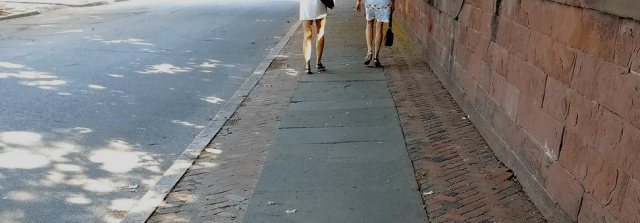
Sidewalk on Benefit Street, in Providence. (photo by Robin Williams during 2016 visit)
One of many fascinating narratives in Seven Ages of Paris was author Alistair Horne’s frequent return to the subject of how Paris’s streets evolved from muddy lanes awash in human waste to paved streets with gutters down the middle to guide sewage toward the nearest river. Eventually, sewers were put underground and streets were covered with increasingly elegant pavements. American streets evolved likewise, then saw a devolution in which variously characteristic paving techniques of the 19th century were ripped up or covered over with asphalt in the 20th century.
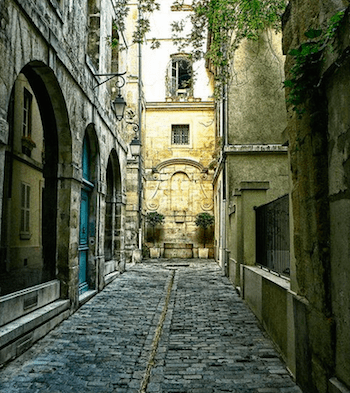
In Marais district of Paris. (Pinterest)
Asphalt offered a smoother ride or stroll, but it replaced stone and brick pavements on roads and sidewalks that spiced up the personality of the streetscape. Now there is pushback from Robin B. Williams, chairman of the department of architectural history at the Savannah College of Art and Design, who is working to preserve remaining historic pavements.
Williams, who has a doctor- ate in art history from the University of Pennsylvania, recently described his crusade in “Neglected Heritage Beneath Our Feet,” published on the website of The Cultural Landscape Foundation. Subtitled “Documenting Historic Street and Sidewalk Pavement Across America,” his essay begins:
While historic buildings have enjoyed the attention of preservation professionals for decades, the landscapes that are part of their physical setting have largely gone unprotected and undesignated, and are vulnerable to the whims of less sensitive decision makers. … It is concern for the fate of Savannah’s remarkable pavements that resulted into an ongoing national study and the launch of a dedicated new website, entitled Historic Pavement.
He adds:
Prior to the development of inexpensive modern asphalt in the 1920s, cities struggled to find affordable, durable, and available types of pavement suitable to their needs. Pavement was inherently local, with each city devising its own solution to the challenge of paving streets – resulting in unique regional paving “fingerprints.” The varying degrees to which historic pavements survive in cities further enhances this sense of identity.

Robin Williams (Brussat photo)
I recently joined Williams on a tour of Charleston with Nathaniel Walker, of the College of Charleston, who had invited us to sit on a panel discussing trends in historic preservation. When we happened upon a pavement of cobblestones or other material, Williams would reveal his method of documentation by leaning over to place a ruler on the ground and then photographing it to record the dimensions of the paving materials. He performed this ritual dozens of times.
I learned that he had visited Providence when I noticed that the photograph atop his essay – which I’ve chosen to put on top of this post – was of the sidewalk of slate flanked by herringbone brick running alongside the brownstone wall of the John Brown House (1786), and that of the Nightingale Brown House (1791), both on a two-block stretch of Benefit Street, near where I lived in three apartments on Providence’s Mile of History during my first 14 years here. (Those are the pretty legs of his wife and daughter walking down the pavement ahead of him in the photo.)
So Williams is probably aware of and may even have documented Friends Lane, on College Hill, the restoration of which received a preservation award from the Providence Preservation Society in 1999 and the R.I. Historical Pre- servation & Heritage Commission in 2000 – for obvious reasons their awards programs often overlap. The two awards recognize that places are venerable to the extent that their entire physicality, not just their architecture, contri- butes to beauty that translates into lovability. Williams may be the world’s greatest custodian of that part of a holistic truth that is hidden in plain sight, right beneath our feet.
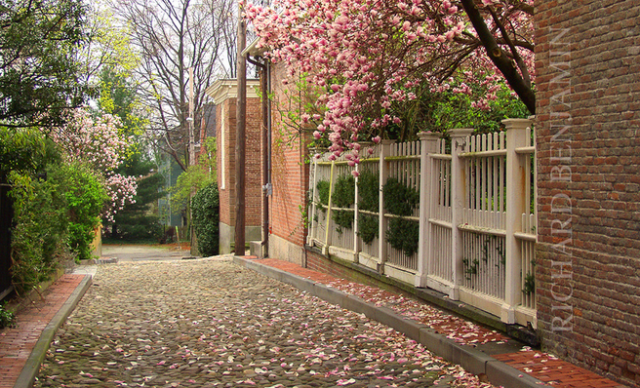
Neighbors Lane, on College Hill. (photo by Richard Benjamin, http://www.richardbenjamin.com)






 Architecture Here and There