
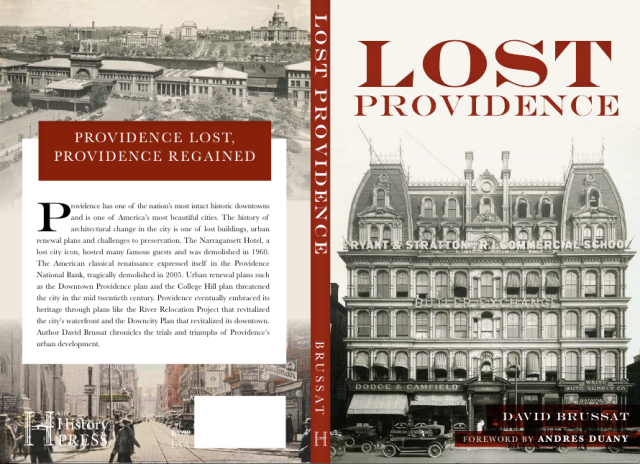
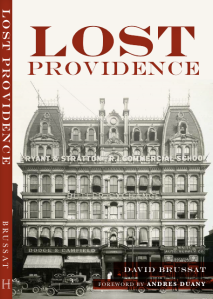
Front and back covers (right and left; text below) of “Lost Providence.” (History Press)
Feel free to hoist some suds, but this post is not the announcement for a pub crawl. No. Rather, it celebrates the announcement of the publication date for my upcoming book Lost Providence: Monday, Aug. 28. The news arrived this morning by email from my editor, Banks Smither, of History Press. A publi- cation date marks the starting point for book launches, readings, signings, lectures, etc., not to mention book sales, though books can be ordered before the publication date.
I have already got the ball rolling on publicity for the book, which will be managed by the publisher, who will have a ready assistant in the book’s author, as witness this and previous posts trying to whip up a frothy thirst among the public for the book.
As readers of those posts are aware, Lost Providence was conceived when HP editor Edward Mack called to ask me to expand into book form a column from The Providence Journal. “Providence’s 10 best lost buildings” listed each building, along with a brief description of its architecture, its history and its demise. The first ten chapters of Lost Providence add detail to each descrip- tion and take side trips to stories of the buildings that replaced them, remain on their sites, or are neighbors. The second half of the book goes beyond lost buildings to consider “lost plans” for Providence, such as the Downtown Pro- vidence 1970 plan and the College Hill Study – products of urban renewal in the third quarter of the last century that sputtered out before they went far enough to hurt the city. Finally, Lost Providence details the city’s response to the failure of urban renewal, which led to the Providence renaissance, an exercise in civic vitality that is, arguably, entering its third decade.
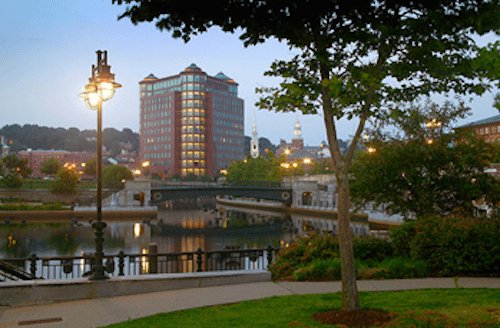
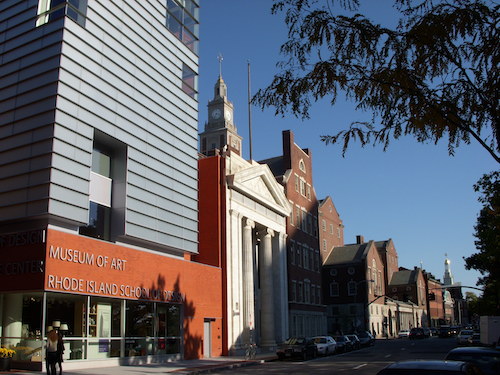
The book examines how the city of Providence has changed over almost four centuries, most particularly in the character of its buildings, mostly down- town, and other structures, for good or ill. There is a lot hooting and eyeball-rolling on the part of the author, and also a good deal of applause. For, after all, Providence has turned out quite nicely, and the lessons learned from its history are applicable to other cities as well. So the book seeks an audience not just from Rhode Island – of which Providence, founded in 1636, is the capital – but from anyone in the fields of architecture, architectural history, city planning and historic preservation around the nation and the world.
Writing Lost Providence was a lot of fun, but I think reading it will be even more fun, since the author has already done the work. Readers may learn something, too. In addition to the publicity campaign – and I invite anyone to contact me who wants to participate – a website will be developed to add illustrations beyond the hundred that are in the book itself.
Here is the back cover text from the illustration of the front and back covers atop this blog, which may be too small to read in the image:
Providence has one of the nation’s most intact historic downtowns and is one of America’s most beautiful cities. The history of architectural change in the city is one of lost buildings, urban renewal plans and challenges to preservation. The Narragansett Hotel, a lost city icon, hosted many famous guests and was demol- ished in 1960. The American classical renaissance expressed itself in the Providence National Bank, tragically demolished in 2005. Urban renewal plans such as the Downtown Providence plan and the College Hill plan threatened the city in the mid twentieth century. Providence eventually embraced its heritage through plans like the River Relocation Project that revitalized the city’s waterfront and the Downcity Plan that revitalized its downtown. Author David Brussat chronicles the trials and triumphs of Providence’s urban development.










 Architecture Here and There