Unwelcome Arnold House?

Alert: It appears that the agenda item for 21 Planet St. at the PHDC meeting mentioned below will merely be the house owner asking the commission for a continuance of his request for a permit to demolish it.

This Monday, 21 Planet St. is the first item on the agenda of the Providence Historic District Commission meeting at 4:45 in the Department of Planning and Development, 444 Westminster Street, across Empire from the old planning building. The agenda item published by the commission says there will be a public hearing on the fate of the house. The PPS News item on this meeting says there will not be a public hearing, at least not on the question of demolition, and is not clear on whether the item is still on the agenda at all. I will try to get a clarification on this as soon as I can.

David Brussat's avatarArchitecture Here and There

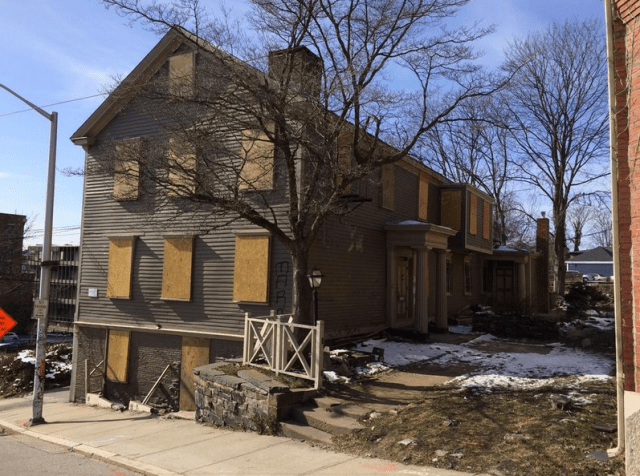
Screen Shot 2017-05-25 at 1.52.19 PM.png Welcome Arnold House at 21 Planet St., Providence (Catherine Zipf)

Is the Welcome Arnold House (circa 1785), on Planet Street in Fox Point, doomed to demolition by neglect? That’s the question posed by Catherine Zipf’s architecture column in today’s Providence Journal. She wonders whether its owner, Walter Bronhard, intends to let it deteriorate until it can barely stand. He has already applied to tear it down.

In “Will historic house face demolition?,” Zipf describes the history of the house and its current predicament, and explains how saving colonials in Providence has become old hat, almost a done deal as soon the plight of an old colonial house becomes known. “No one argues over saving 18th century buildings,” she writes. “We just do it.”

Good! But what about the Welcome Arnold House? Bronhard, who has not owned the house for as long as it has been deteriorating, “seeks permission…

View original post 600 more words

Posted in Uncategorized | 2 Comments

New Yale campus progress

Screen Shot 2017-07-22 at 4.22.09 PM.png

This photo and the first below were sent by RAMSA partner Gary Brewer.

Gary Brewer has sent two photographs of the work to date on the two new residential colleges at Yale, Benjamin Franklin and Pauli Murray. They are exquisite, to quote Elizabeth Moule’s assessment in an email to the TradArch listserv. Also to the list, Helen Gordon writes: “These sturdy, architecturally stunning and perfectly lovable buildings will endure through the ages.” She adds, “The low maintenance alone, compared to the usual high maintenance of signature modern buildings, will easily repay any up-front expenses due to excellent detailing and craftsmanship.”

These two photographs must do for now until Gary (who designed RAMSA’s Jonathan Nelson Fitness Center but was not involved at Yale) sends more photos, or indicates where I can get more. But wait! I checked on Yale’s website and there is a package that offers more photos, elevations, before-and-after shots and original project renderings, plus the rendering of a bird’s eye overview of the project. To show some detail work, I have added some of this down below the second of the two photographs from Gary.

Visiting the Yale campus last year after construction had been under way for maybe a year or two, I posted many shots of the work to date in “Work on new Yale campus.” Then your investigative pundit, wandering around near dusk, was unable to breach the security fencing. Perhaps next time I visit I will be able to invade the place as if I were an actual student – hordes of whom are vying to get in for next spring. Then you will see some shots!

Bob Stern, RAMSA and their architects for this project deserve a huge round of applause for the quality of their work on this project – appreciation of which, from this corner, will not end here.

Screen Shot 2017-07-22 at 4.20.50 PM.png

Screen Shot 2017-07-22 at 4.32.10 PM.png

Photo by Phil Handler, Fly on the Wall Productions

Screen Shot 2017-07-22 at 4.32.59 PM.png

Screen Shot 2017-07-22 at 4.15.12 PM.png

In this view, the top left line points to a “large courtyard” and the bottom three to “small courtyards.”

Posted in Architecture | Tagged , , , , , , | 6 Comments

Among ye olde Victorians

Screen Shot 2017-07-21 at 1.51.18 PM.png

Bestwood Lodge (1864), Nottinghamshire, designed by S.S. Teulon. (Destinia)

Victorian architecture, seen as the architecture of the long reign of Queen Victoria, shows the absurdity of those who claim that Victorian styles fell out of favor during the 1950s and ’60s, as many observers attest, modernist and otherwise. My suspicion, unprovable, is that Victorian architecture truly lost popularity only among architectural historians with a modernist bent. Many others who don’t disdain historical styles also say Victorian went out of style among the public. I think they say that because that’s what they’ve heard or were taught to believe in schools of architecture.

So now I am reading Victorian Architecture by Roger Dixon and Stefan Muthesius, published in 1978. Their account only deepens my suspicion that Victorian architecture has been steadily popular among most people from the Victorian era onward. Some who maintain the reverse are thinking of “painted lady” Victorians – after many of those old houses went without care and repair in America during the Depression and World War II. To argue that the broader Victorian age styles suffered a loss of esteem is to argue that every style that predates modernism suffered a loss of esteem. Not so.

Victorian architecture was a series of revivals of prior styles – Gothic, Georgian, Tudor, Baroque, Classical, or, casting a broader net, Vernacular, Picturesque, what have you. So to assert a widespread attitude against Victorian architecture in the midcentry-modern years is to play into the hands of modernists. Modernists believe that historical styles – especially contemporary architecture inspired by the past – are illegitimate because modern architecture alone truly reflects the modern era. It is clear that such an attitude cannot “get along” with any attitude classicists embrace.

There is a curious passage in the introduction to Victorian Architecture where the authors react to an earlier book about Victorian architecture:

Some critics argued that a new style could and should be “invented.” Terms such as “novelty,” “modern style” and even “Victorian style” were used, mainly in the 1840s and 1850s, when the discussion was at its height. However, these attempts were not considered intellectually respectable by the major practitioners. The relatively little-known architect Thomas Harris (1830-1900), when he published Victorian Architecture in 1860, was soon put in his place by critics who pointed out that his architecture was merely a mixture of known revival styles.

The authors of this Victorian Architecture probably smiled when they wrote that, because that’s precisely what they believe – at least up to page 53.

As you read through their book, you find that, layered into any honest description of Victorian architecture, is its deep relationship with tradition. The problem for architectural historians who classify historical architecture into “periods” is that each period has more in common with the periods it follows and those it precedes than the differences that historians like to pull their chins about. But architecture is a continuum of stylistic evolution, not a string of segregated styles. “Oh, this old building is important because it is a precursor to modern architecture!” they like to say, citing, perhaps, a large plate glass window – when in fact a lot of pre-modernist architecture had large windows, including some of plate glass. (See the photo above.)

I have not read very far into Victorian Architecture, but if authors Dixon and Muthesius turn out to be your standard-issue architectural historians, I will let you know, quoting chapter and verse.

Posted in Architecture, Architecture History | Tagged , , , , , | 2 Comments

Monty Python on architects

Screen Shot 2017-07-20 at 8.09.01 PM.png

Scene from Monty Python sketch mocking modern architecture (and Freemasonry)

In September of 2014 I posted the famous Monty Python sketch on modern architecture as a reward, so I said at the time to readers of this blog, for those who managed to make it through my several prior posts. Why a reward was appropriate I don’t recall. Today, I offer the same skit as a reward for making it through my past several days of postlessness.

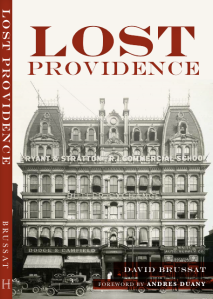
I have not posted because, first, I have done a job for a local institution that needed expert assistance (which they thought I had), and, second, because I have filled out a very tedious (but arguably necessary) form to help my publisher market my new book, Lost Providence, coming out on August 28 from History Press. Reading it will be its own reward.

It is, of course, my delusion perhaps that readers need to be rewarded for struggling through several days without any posts from AHAT (Architecture Here and There), but I will let that pass without comment so you can click on the Monty Python skit, “The Architect Sketch,” without further delay or obfuscation. Enjoy!

[A commenter, Lew Dana, notes the irony of this in light of the recent tower fire in London.]

Posted in Architecture, Humor, Video | Tagged , , , , , | 5 Comments

Just one crane in Providence

Screen Shot 2017-07-15 at 9.42.44 AM.png

Providence Station Commons, said to be the only local project using a crane. (tocci.com)

GoLocalProv.com has a story complaining about the paucity of cranes – not birds but rigs to lift heavy construction loads – in Providence compared with other cities. “Top 12 U.S. Crane Cities Have Nearly 300; Providence Has One” is the GoLocal headline on its story, based on a report by the construction industry consultant Rider Levett Bucknall. Go Local’s business team writes:

The cities range from the top crane city — Seattle, Washington, which has 58 active major crane projects, followed by Los Angeles with 36 and Denver with 35. One big surprise is that Portland, Oregon, a city much closer in size to Providence than Seattle or LA, has 32 cranes.

Whereas Providence has one crane up now, at the site of Providence Station Commons, a residential project next to Capitol Cove along the Moshassuck River where Canal Street crosses Smith Street near the State House.

The GoLocal story describes local projects that have been slow to get off the ground – for example, the Procaccianti hotel on the site of the demolished Fogarty Building. Its developer wants even more public money. The First Bristol hotel project on Parcel 12, at the northeast corner of Burnside Park, is one of several others, mostly hotels, whose slow progress toward breaking ground irks some observers of development in Providence. The Jason Fane proposal for three high-rises has been shown a cold shoulder, and has now been downgraded to one tower, if it survives at all. The innovation corridor’s relative abundance of high-tech proposals have also advanced through the process at a sluggish pace.

The RLB report describes a 43 percent increase in cranes operating in Seattle, which causes GoLocal to pout: “And if Seattle’s data is not depressing enough for Rhode Island, RLB’s report from Toronto, Canada is cataclysmic.” Toronto expects to see over 260 high-rises go up in the next few years.

In this city, the low crane rate may reflect the fact that developers here shoulder costs of construction equal to those in Boston but expect a return on investment only half that of Boston in terms of lease income, rent and other types of profit. On average, at least, it doesn’t pay to build here. The state’s generous development subsidies are meant to narrow the gap.

Providence also festoons its state and local development tools with all sorts of strings on construction by way of local hiring percentages, number of minority and female-headed contractors and other such well-meaning requirements that often add to administrative costs and delays. Not to mention the expensive and convoluted path that a project must travel through the design review and permitting boards.

Frankly, however, I would like to think that citizens of Providence, and elsewhere in Rhode Island, have a deep-seated recognition and regard, often inchoate, for the extent to which their quality of life is enhanced by civic beauty. Cranes often generate anxiety about whether that beauty is likely to survive the ravages of “progress.”

Providence has a far more than typical degree of historic fabric, built before modern architecture spurned beauty in favor of pure utility – abandoned now in favor of sheer goofiness. Because of its beauty, this city gets rave reviews from tourist and livability sites far beyond what its size suggests.

Since most projects no longer try very hard to maintain much of a pretense of adding to the beauty of a place, most people around here react to projects by shrugging their shoulders. Those who try to oppose insensitive projects do so in a bureaucratic environment that, in spite of the ingrained modernist proclivities of individual committee members and staff, may be a bit more mindful of citizens’  concerns, at least compared to other places. After all, their positions often depend on politicians, many of whom have some sense of what voters want.

This may slow the growth of jobs and population, but as Mark Motte and Francis Leazes say in their brilliant 2004 book Providence: The Renaissance City, reluctance to embrace a decade’s worth of unwise major development proposals in downtown and on College Hill in the 1950s and 1960s resulted in the preservation of the capital city’s unusual beauty:

The failure of the Downtown Providence 1970 plan to generate interest contains an important early lesson concerning renaissance activities: sometimes the decision not to do something is more important than actions undertaken. … It was a fortunate inattention to downtown renewal planning and the eventual demise of federal urban renewal that would mark the 1960s as a critical epoch in the future of renaissance Providence. Downtown Providence remained intact.

Maybe that is what is happening today in a more piecemeal fashion. Citizens are not wrong to cast a gimlet eye on what passes for civic improvement these days.

Once the top level of Providence and Rhode Island authorities starts to encourage development that strengthens rather than weakens the brand of the city and state, the chilly local attitude toward projects will defrost, and we will get development proposals that find it easier to make it through the permitting process because they come off as doing more to improve the quality of life in Providence and Rhode Island instead of just making it bigger. Yes, we want cranes, but not wrecking cranes.

Posted in Architecture, Development, Preservation | Tagged , , , , , , , , | 4 Comments

R.I. State House at risk

cdnassets.hw.net.png

Providence Station with State House at left beyond. (cdnassets.hw.net)

Rhode Island transportation officials want to spend millions in tax money to accomplish a goal achievable for mere thousands, and to do so in part on the State House Lawn. The Capital Center Commission, which has overseen the development district’s degradation for over three decades, seems suddenly reluctant to allow this latest desecration, which has mushroomed in cost and ambition, threatening views of the vintage 1901 State House in violation of the commission’s own bylaws.

The Department of Transportation first proposed a subsidiary bus hub to take pressure off the main bus hub at Kennedy Plaza and to provide a link to Providence Station, built in 1986. The work was to be done with $35 million in bond money approved in 2014, ostensibly to build the sub hub atop Amtrak’s rails as they emerge from beneath the station heading north. But now the plan has changed. The sub hub will be the main hub, replacing rather than relieving the hub at Kennedy Plaza. The proposal has grown to include private investment, which has morphed, at least partially, into space for state offices – that is, DOT was unable to locate a plausible private participant in the project. Last month, the state re-issued its call for developers to partner with the state.

This evolution seems to have taken place largely under the radar, with little input from the public. Either that, or coverage of the issue by the shrinking Providence Journal has been extraordinarily sparse.

Today’s story on the latest plan is “Grounds for debate: Capitol-area development project would be built on land including State House lawn, trees.” Written by Patrick Anderson, the article makes no mention of a proposed “skyline-altering” tower, mentioned in a June 12 story, the last one published on this topic. Troubles with the tower and other aspects of the proposal were noted in an April 17 story. The possibility of a tower was first mentioned in a Sept. 2, 2016 story. One can only hope it went unmentioned in the latest story because that part of the project has evaporated.

The original goal of the bond was mainly to provide a link for train and bus passengers who now walk a long three or four blocks between Kennedy Plaza and Providence Station. That could be achieved with a bus or trolley loop from the plaza to the station at a cost of mere thousands annually.

Instead, we now have the prospect of a major development project consisting of several new buildings in open space on either side of Providence Station, blocking views of the State House. Renovating Kennedy Plaza seems to be on the back burner, after changes that removed the beautiful Art Nouveau bus waiting kiosks in 2015. I have heard no word at all – or seen any mention at all on relevant official websites – of the lovely plan by Union Studio for Kennedy Plaza. Has it been “frog marched” out of the picture, as I said in a 2014 column, “Let’s ruin Kennedy Plaza“?

Buses will apparently still run through the plaza, but if it is not to be a major bus depot, what will become of the Intermodal Transit Center built there just a decade and a half ago?

At least one cynic fears that the whole charade has been intended to clear out the plaza’s homeless, panhandling or otherwise riff-raffy population, a suspicion that recently grew after the city passed legislation to ban tobacco smoking in and around the plaza. (I have spent years walking and taking buses in and out of the plaza without being troubled by this element.) Where will these people go? Will they remain blissfully unaware of where the buses are going? Will the city and state have to devise new social and legislative strategies to prevent them from migrating north to nearby Capital Center?

As an aside (but one that picks at one of my usual scabs), I note that today’s Journal story quotes DOT’s description of the new bus hub’s architectural program, which is to:

create a smart and enduring bus facility that from a design perspective complements the historically significant Rhode Island State House and surrounding Capital Center, but stands out with an aesthetically attractive design that alters the traditional perception of a bus terminal.

Huh? So it complements the State House and its setting but alters the traditional perception of a bus terminal? This smacks of the confusion that has driven development in Providence for decades, and more particularly those who oversee it. You can’t have it both ways, and if you try you will irk both sides. But the sentence does helpfully suggest that Ocean State design apparatchiks realize they must contend with two opposing forces around here – those who favor tradition (the public) and those who generally object to tradition (the design elite). Governor Raimondo should know which side her – and her state’s – bread is buttered on.

But alas, she does not. If she did, the process of economic development would become less cumbersome and enervating at the snap of a finger. Let’s hope she thinks for one minute about this. Development that strengthens Rhode Island’s natural brand of historic beauty instead of undermining it would save both time and money. Something has gone wrong in this new public/private project near the State House, and it would be easy to set it right. But is that likely to happen? Of course not.

Former Capital Center Commission chairwoman Leslie Gardner, who was at Tuesday’s design review meeting, was quoted by the Journal as calling the plan “a little bizarre.” She is correct, but it seems bizarre coming from  the same Leslie Gardner who, after she and the commission spent 1995-2000 approving for the district architecture of traditional style that does fit into its setting (such as Providence Place), then called on developers to instead offer something “different.” The GTECH (now ITC) building and other disasters near Waterplace Park were the result.

At the end of the article, she remarks: “When the rivers were moved, there was a hue and cry of what would be at risk, would it be compatible with historic structures, particularly the State House.” Good grief! Now she gets it?

I myself would be more inclined to support this plan if the new architecture along the east side of a newly realigned Gaspee Street were designed to pay homage to the old and new architecture along the west side of Francis Street. A view up Francis Street of the State House visible between two sets of classical buildings, as great buildings in Europe often pop into view suddenly, could well be worth losing the open space at risk today.

Screen Shot 2017-07-13 at 4.46.24 PM.png

Suggested buildings (in gray) on open space near State House. (RIDOT)

designcollective.com.png

Red lines show land contemplated for new buildings. (RIDOT)

Screen Shot 2017-07-13 at 5.24.45 PM.png

This is not the plan but a map from a charrette for the Providence 2020 masterplan, included here to convey the distance from Kennedy Plaza to Providence Station. (designcollective.com)

Posted in Architecture, Development | Tagged , , , , , , , , , | 2 Comments

A timeline of “authenticity”

Screen Shot 2017-07-11 at 12.38.52 PM.png

Bonaguil Castle in the Aquitaine. (eupedia.com)

Authenticity must rank near the top of the list of dubious words. Authentic has been split from its original meaning and used to brush a patina of merit upon many dubious ideas. A good example is its use by the late architecture critic Ada Louise Huxtable to distinguish genuine creative design from what she calls “copying the past.” Since almost every advance in every field in the sciences, technology and the arts has relied on previous advances, the idea of progress unattached to the past is the height of absurdity. And yet that is the conceit of most modern architecture today.

Here is a more useful take on the word from the novel Timeline, written by Michael Crichton in 1999, two years after the publication of Huxtable’s notorious (my word) book The Unreal America. In that book she seeks to show that new traditional architecture brands America as culturally wedded to inauthenticity. She equates all new traditional architecture with Disney theme parks. Huxtable’s notion that modernism represents genuine creativity and thus genuine authenticity turns truth on its head. Crichton’s passage below seems almost a direct rebuttal to Huxtable’s thinking.

Timeline tracks a corporation’s development of quantum technology that enables it to send a team of archaeologists back to the Middle Ages to rescue a colleague trapped in a French castle just before a major battle during the Hundred Years’ War. The company’s CEO plans to give a speech to investors describing the technology’s potential to help historians and archaeologists better understand and learn from the past.

In practicing his speech, the CEO, Robert Donziger, states:

“Authenticity will be the buzzword of the twenty-first century. And what is authentic? Anything that is not devised and structured to make a profit. Anything that is not controlled by corporations. Anything that exists for its own sake, that assumes its own shape. But of course nothing in the modern world is allowed to assume its own shape. The modern world is the corporate equivalent of a formal garden, where everything is planted and arranged for effect. Where nothing is untouched, where nothing is authentic.

Up to this point in the speech, Crichton seems to be channeling Huxtable. But he goes on:

“Where, then, will people turn for the rare and desirable experience of authenticity? They will turn to the past.

“The past is unarguably authentic. The past is a world that already existed before Disney and Murdoch and Nissan and Sony and IBM and all the other shapers of the present day. The past was here before they were. The past rose and fell before their intrusion and molding and selling. The past is real. It’s authentic. And this will make the past unbelievably attractive. That is why I say the future is the past. The past is the only real alternative to– Yes? Diane, what is it?” He turned as she walked into the room.

“There’s a problem in the transit room.”

Substitute for “the past” the words “architecture before modernism” and you have a call to move into the future by continuing to evolve according to the more authentic design principles that had shaped the previous two or three thousand years. This applies in all fields that have abandoned home truths and traditional practices – for example, cuisine, which has largely emerged from its Rice-A-Roni bout of midcentury modernism. Likewise, we ought to move beyond GMA – genetically modified architecture.

When, toward the end of the book, it appears to Donziger that flaws in the technology will be fixed and the stranded team of researchers will be rescued, he actually gives his speech. Only then do readers learn (surprise!) that he plans to apply the technology not to science, history or scholarship but to creating a new sector of the entertainment industry in which people will pay to travel to a historical period of their choosing.

So it appears that as far as authenticity goes, it’s the same old same old. New traditional architecture is clearly part of the alternative. Without it, modern architecture will lead to the fearful authoritarian world imagined by Orwell, Huxley and Bradbury or in films such as Ridley Scott’s Blade Runner. Those dystopian books and films were set in a fictional architecture of modernist machine sterility and inhumanity. Must we like it or lump it? Stay tuned! (Indeed, there is a movie. See Timeline trailer. Where’s my Netflix?)

Posted in Architecture, Video | Tagged , , , , , , , | Leave a comment

The cat and the bunny

Screen Shot 2017-07-10 at 6.00.13 PM.png

I shot this brief video earlier today in a state of astonishment. I had just returned home and saw our cat, Gato, sitting out on our front stoop with a strange bunny. They sat as I approached. I hoped to get inside and fetch my camera. I did so, left by the back door and came back around front, expecting they’d be gone by the time I returned. But they were there, and they stayed for a bit, as you’ll see. This video, unedited, is a minute and seven seconds.

I cannot think of any way to relate this to architecture, except perhaps by a recent post of mine, “Duo vs. the style wars,” in which I interpret a line from a piece by Duo Dickinson as wondering “Can’t we all just get along?” If Gato and this local bunny can get along, maybe so can classicists and modernists. Although it might be fun, I will not attempt to suggest which creature most closely represents which stylistic model. (Not that I necessarily think it would be a good thing if the two architectural camps were to get along; still, it is hard to be against comity.) The video is below:

Posted in Architecture, Humor, Video | Tagged , , , , , , | 14 Comments

Hamburg in the crosshairs

Screen Shot 2017-07-09 at 12.20.29 PM.png

Hamburg canals split off harbor. (wall.alphacoders.com)

The annual G20 conference of the world’s major economies met in Hamburg last week, with leaders convening in palaces and demonstrators rioting in the streets. It brought to mind the cheerful violence that greeted me and my brother, Tony, on a tour boat trip during our visit to the North Sea port back in, I think, 2003. We began on the city lake and ended up plying rivers with campgrounds and beer houses along verdant shores, from which groups in small boats would embark, approach, then launch attacks with hand-thrown water balloons at our boat. We would duck behind the gunwales. (Sorry, no shots of projectiles in mid-flight; the fotog was busy ducking!) Fun, but a bit edgy, given the scruffy look of most of our interlocutors. Some of them may also have been in launch mode at last week’s summit.

The video here is a German product. The weather is gray and Christmas is near. There is no narration (but a couple of musical interludes that may be zipped through). The video demonstrates very graphically how difficult it is to meld modern architecture into the architecture of history and tradition, of which Hamburg still has long stretches. But the Germans, too, are trying to find a middle way that works, such as seems to be on display in the long, curved, then sharp, mainly traditional building pictured in the screenshot below. Nah, turns out to be from the 1920s. Oh well. Beneath that is another shot of Hamburg’s canals. The shot on top of this post shows the same canal scene today lit at night. Finally are a few shots from our Hamburg visit a decade and a half ago, with apologies for the flawed photography.

Screen Shot 2017-07-09 at 11.55.02 AM.png

Screen Shot 2017-07-09 at 11.48.38 AM.png

Screen Shot 2017-07-09 at 12.36.57 PM.png

Screen Shot 2017-07-09 at 12.17.44 PM.png

Screen Shot 2017-07-09 at 12.41.06 PM.png

Screen Shot 2017-07-09 at 12.41.55 PM.png

Screen Shot 2017-07-09 at 12.16.47 PM.png

Screen Shot 2017-07-09 at 12.43.13 PM.png

Screen Shot 2017-07-09 at 12.15.50 PM.png

Posted in Architecture, Video | Tagged , , , , | 2 Comments

Tom Low’s village progress

Screen Shot 2017-07-04 at 1.09.34 PM.png

Photo of completed stage of Pocket Court Project near Asheville, N.C. (Tom Low)

Last February and before that, in December, I posted “Is this possible anymore?” and “Christmas card community” about village architecture. Both mentioned architect Tom Low’s plan for a village near Asheville, N.C.  At the time, the pocket neighborhood he had in mind existed mostly in his head. Maybe there was some beginning foundation work. There were drawings evoked, it seemed to me, by French villages that had piqued my interest in “Is this possible anymore?” (We can land a man on the moon, so why can’t we …”). Coincidentally, I am reading a 1999 novel, Timeline, by Michael Crichton that takes place in villages and castles along the Dordogne River, near the town pictured in the bottom photograph. Its protagonists find themselves transported to 1357.

Anyway, Tom has now posted to the TradArch list photographs of progress on the first phase of the village near Asheville he refers to as the Pocket Court Project. One is above and the others below are accompanied by a drawing of the original idea from above. So to the question I posed in “Is this possible anymore?,” the answer clearly is yes.

By the way, Low, whose excellent website is called “Civic By Design,” conveyed in an email to the TradArchers the product of a recent whimsical midsummer’s notion and gave me permission to pass it along to readers of this blog. He writes:

Regarding the next phases this is an open question. I have this idea to pitch that if we could attract 10 of the architects on this list to bring their client investors and commission one house each on the remaining lots, can you imagine the showcase we would have for traditional and classical architecture!? Each lot averages about 3500 sf. with some smaller and some larger with the option of including a carriage house.  If any of you are interested and capable of joining in on this group idea please let me know as I would love to pitch it to my partners.

Sounds good to me. He has received some positive feedback thus far. Maybe some architects not on the TradArch list might also be interested. Shouldn’t be too hard to give Columbus, Ind., a run for its money at a fraction of the cost.

Screen Shot 2017-07-08 at 3.16.03 PM.png

Screen Shot 2017-07-08 at 3.16.28 PM.png

Screen Shot 2017-07-07 at 3.21.13 PM.png

Posted in Architecture, Development | Tagged , , , , , , , , , | 6 Comments