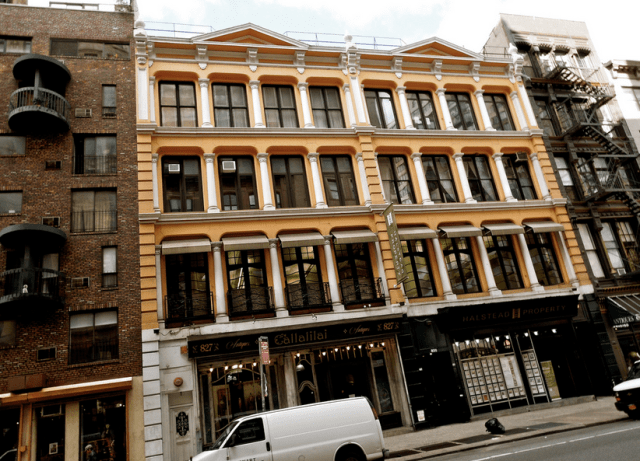
Save twin B’way cast-irons

staticflickr.com.png

Twin cast-iron buildings at 827-831 Broadway face demolition. (staticflickr.com)

In its length and breadth, Manhattan is a free art museum for all of those who will open their eyes, whether they are Knickerbocker heirs or hoboes from Hoboken. To walk down the street is to encounter museum-worthy works of art one after another laid right out along the sidewalk for all to see at a fee of $0. I have made this point so often that I am turning blue in the face. So imagine my joy at finding an ally in The New York Times.
dekooningexperts.com.png

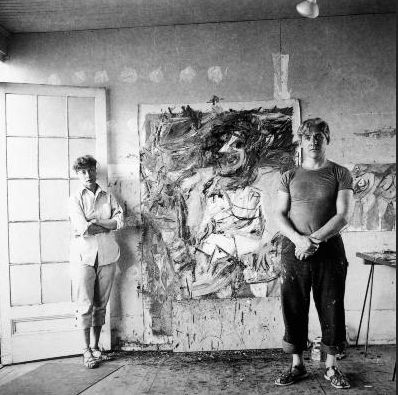
De Kooning and wife in studio. (dekooningexperts.com)

A Bit of New York History at Risk,” by Andrew Berman and Eric Rayman, describes the Lorillard Buildings on Broadway, paired iron-front structures of four stories, erected in 1866 and once hosting for a period after 1958 the penthouse studio of Willem de Kooning. The twins are now at risk of demolition to make way for a 14-story building.

After examining the history of the building, Berman and Rayman extol the allure of Manhattan in terms that seem more applicable to an art museum than a history museum. After all, while history in the form of the spirit of de Kooning and others may permeate the air of old streets, absent signage or guidebooks it is unlikely to be directly perceived. On the other hand, a streetscape’s sculpture, façade decor, garden flora, railing ornament and other embellishment are perceived directly and enjoyed without explication. Here Berman and Rayman express this happy feature of city life:

A joy of strolling the streets of New York is to see so many varied edifices. When you meander in the Village or Harlem or Chelsea or almost any other neighborhood, you are likely to stumble upon a unique and historic building.

We understand that New York is continually changing, but what makes so many people want to live or visit here is the sense of excitement and discovery in the streets. The Lorillard buildings add dignity and grandeur to the city. One does not have to be a student of architecture to admire the craftsmanship of artisans using hand tools a century and a half ago. These old buildings are like New York’s senior citizens and should be venerated as such, not cast aside.

Other cities create replica historic wharves or colonial markets to attract visitors. New York doesn’t have to create them — we have them, and for the health of the city, we should preserve them.

The city’s landmarks commission last year rejected appeals to list the Lorillard buildings, 827 and 831 Broadway. The reasons given smack of the curatorial, reflecting the precise opposite of the logical rationale for preservation. Here is how Berman and Rayman describe the decision:

In August 2016, the Landmarks Preservation Commission rejected an application to protect 831 Broadway and its next-door twin, 827. According to its director of research at the time, the commission decided that New York already had enough buildings with “earlier cast-iron façades” and that “there are buildings on Broadway of a similar date, type and style” to represent this era of development in New York.

Good grief! You mean there’s already enough beauty in New York? No need to save any more of it? The mission of the landmarks commission should not be to treat the city as some sort of playground for museum curators; it should be to protect civic beauty for those who visit and live or work in Manhattan.

Fortunately, the commission has been prevailed upon to reconsider. I hope they do. But what if they reject the application again? Is there any hope to maintain the beauty of the two cast-iron buildings?

Yes. But many preservationists, and other interested parties, will not like it. It is the construction of a new building behind the old Broadway façades.

rebusinessonline.com.png

Proposed 827-831 Broadway. (Rebusiness)

The word façadectomy evokes sneers from many, but if well done it can save a street from an insensitive architectural incursion without robbing a property owner of his or her right to redevelop the property. The possibilities on Broadway are clear. The façades should be saved and a taller building that reflects the historic buildings’ original design should go up behind them. Better that it be set back as far as possible – enough to insert a terrace, perhaps to retain the front rooms and maybe even add a hallway between the old and the new. The setback would, in theory, satisfy preservationists who believe an addition requires differentiation from the original. But it would also maintain the sense of the structures’ original massing for observers on the street and sidewalks.

Rebusiness Online has an article describing a loan in this proposed project as of May, and containing an image that could be either a façadectomy (of a lesser sort, erecting a modernist building behind the two cast-iron façades), or the situation as it is today, though the rear building, if it is now part of the property, must have been built recently based on other photos shown on my Google search for “831 broadway nyc” (the twin with de Kooning’s studio).

Preservation organizations have done excellent work over half a century and more to protect beautiful old buildings. That should remain their chief focus. Compromise can help rationalize a contentious process, in no place more so than Manhattan. Let’s hope these twin cast-iron masterpieces can be saved in toto – but if not, let’s hope that a useful and attractive compromise won’t fall victim to extremism on either side of the architectural and preservationist divide. Don’t let the perfect be the enemy of the good.

Posted in Architecture, Preservation | Tagged , , , , , , , | 6 Comments

Graffartists are not people

Screen Shot 2017-08-01 at 10.39.51 AM.png

Macaulay mural on wall near Saints Sahag and Mesrob Armenian Church. (Providence Journal)

Okay, if Brutalist architects are people (see previous post), then I must admit graffartists are, too.

Yet how sad and appalling to read in today’s Providence Journal that David Macaulay’s delightful mural near the State Offices exit from Route 95 has been painted over by state road crews to create a new blank canvas for the regrettable creatures who tagged the mural in the first place. That is called surrender. The perps should be shot and the mural repainted.

Screen Shot 2017-08-01 at 10.40.32 AM.png

Detail of Macaulay mural. (Providence Journal)

Of course, I hasten to assert that I speak with my tongue halfway in my cheek. Still, a well-placed machine-gun nest is an alluring response. But no, it would probably be too expensive and too dangerous to innocent people, and you can’t cover all the places the graffartists might want to tag.

Macaulay’s mural showed a lovely rusticated Greco- Roman stone wall with a line of niches, each containing a statue of a famous Rhode Islander – abolitionist Moses Brown, Civil War general (U.S. senator and first president of the National Rifle Association) Ambrose Burnside, and four others, including one waggishly toppled by a pooch chasing a pigeon. It was a brilliant work that brought beauty and joy into the lives of thousands every day.

Screen Shot 2017-08-01 at 10.41.00 AM.png

Recently, mural was tagged so hard that repair was deemed impossible. (Journal)

To erase the mural is to throw in the towel. The cost of repainting it should come out of the hide of the perps. Your money or your life sentence – or however many years justice demands. Or something like that. Aren’t there public funds for helping prisoners pay for cable TV or stock more barbells? Take it out of that, and let their stricken jailmates punish the the vandals in turn. No violence, of course. Or maybe Joe Paolino can find some unemployed denizens of Kennedy Plaza to do this work.

It is tempting to blame “society” for what these cretins inflict on buildings, walls – even on other art, as in this case – in any event, on every law-abiding citizen. But I must say, Kate Bramson’s Journal story, “Tagged for last time, Macaulay mural is gone,” offers a secondary target at whom to point the finger – even while keeping in mind that the chief owner of responsibility for a crime is the criminal.

David Macaulay, in addition to being a fine artist and author, is a member of this world and no doubt eager to be considered a nice as well as a good person. Only this can explain the line in the article that reads: “The other artists have now won, Macaulay said Monday as he talked good-naturedly about ‘the endless story’ of the beleaguered mural.”

This is not a direct quote of Macaulay’s own words but Bramson paraphrasing the artist. Still, she would not have used the term “artists” in place of “taggers” unless Macaulay had already used the term himself in the interview. Tagger is, however, Macaulay’s usual term. Either way, equating a tagger with an artist encourages vandals to assume somehow that their graffiti has society’s sanction. Not that I expect this is what they desire!

These are not artists and they do not create art. When they tag their own neighborhood or their own city, they are defecating in their own nests. They almost always damage or destroy architecture that may be a work of art. They often tag over the garbage of their fellow taggers. (Now and then the quality of a tag approaches the quality of art – but its hurtful intention leaves a vast gap between any graffiti and actual art.)

The loss of Macaulay’s mural recalls a mural nearby, along an exit ramp off Route 10 to Federal Hill. It is similar to Macauley’s – an aqueduct with frames for portraits (never executed) between its arches, whereas Macaulay’s has statues within its arched niches. But it has lasted since the Rhode Island artist Ronald Dabelle painted it in 1994. Maybe graffartists fear that people eating al-fresco at DePasquale Plaza will see them and call 911. I could not find Dabelle’s mural online, and it was too difficult to try to shoot it from across the highway (and of course I must not drive while operating a hand- held camera), so below is a photo of a photo from a column I wrote in the Journal on Aug. 18, 1994, entitled “Art out-of-doors in Providence.”

Since these miscreants sign their own vandalism (or “leave their mark”), you’d think they would be easy for the police to catch, even if nobody is watching. If only!

DSCN1107.jpg

Screen Shot 2017-08-05 at 11.20.16 AM.png

Commenter’s Street View shot of Dabelle’s mural beneath Depasquale Square.

Posted in Art and design, Urbanism and planning | Tagged , , , , , , , | 7 Comments

Brutalists are people, too

Screen Shot 2017-07-31 at 9.16.43 PM.png

This bridge at Thamesmead in London did not make it into my last post, on bridges. (m@)

Just very bad people.

How bad is detailed in an entertaining, if depressing, article on the Londonist website entitled “How Brutalism Scarred London.” The closest I can come to ripping off the veil of anonymity donned by the article’s author, who styles himself The Londonist, is that Will Noble is its features editor and Daniel Shore is its managing director. The Londonist website is the first global expansion of The Gothamist concept of websites about specific cities produced with wit. The Gothamist is about New York City.

In stating that the article is about “seven obscure men in suits [who] did more damage to London than the Luftwaffe,” The Londonist plagiarizes Prince Charles with the sincerest form of flattery. (In this case, the accusation of plagiarism as a form of imitation is an honorific.)

I expected to hear from The Londonist that Brutalists tended to live in nice old houses or apartment buildings. I did, but that’s widely known. And of course that they hold the occupants of their Brutalist buildings – many of whom are not there by choice – in contempt. That is true of almost all modern architects, of whom Brutalists are merely a subset.

I did not know that the British government gave Network Rail permission to tear down Euston Station, designed by Richard Seifert, in 2014. It has not happened yet, but we all know the wheels of justice grind slowly. I had not known that Seifert had “cynically littered London with over 600 low-spec variations on a shoebox.” Cynical may not be the best description of Seifert. The Londonist is being gentle. Worse words could be easily found. London is gigantic, so 600 concrete shoeboxes may not have wrecked the place single-handedly, but the deed may well entitle The Londonist to call him “the biggest offender of the seven” featured Brutalists. And that includes Ernö Goldfinger, who was so bad that Ian Fleming used his name for one of his most evil arch-villains in the James Bond novels and movies.

There’s plenty of bad to be spread around here, probably way further than the seven Brutalists in The Londonist’s bombsight. But for a start, readers will enjoy his tart descriptions.

Posted in Architecture, Uncategorized | Tagged , , , , , , , | 7 Comments

Hooked on bridges, are ya?

Screen Shot 2017-07-30 at 8.28.47 PM.png

Well, here’s a treat for you. This collection of 29 “Stunning Bridges From Around the World” has some real beauts, plus a few bummers thrown in to help you appreciate the beauts a little more. The group, from the website BabaMail.com, is entitled by its editor “These Stunning Bridges Are Where Strength Meets Beauty.”

Please let me quarrel just a tad with that. “Where strength meets beauty”? What does that actually mean? Many of the most beautiful bridges hark back to a time when the people who built bridges made them superstrong because they lacked the technological ability to measure precisely how much strength would be enough to keep them from collapsing. Nowadays, bridge engineers can determine that requirement with precision by computer, using the most aerodynamic of calculations. As a result, we can cut corners to save costs with supreme confidence that we are not stinting on necessary strength.

Or so they say. Sometimes bridges collapse anyway and we wish that the engineers had used the old-fashioned way: estimate the strength required, then multiplying it by two or three to make sure we have enough for any contingency. My engineer friends will know what I mean. And my architect friends will guess that I suspect the modernist bridges in this collection may not stack up, redundancy-of-strengthwise.

Still, by far most of these are lovely. Even a couple of the modernist ones are not so bad. Hats off to my wife Victoria for sending these spans to me from Facebook. It’s time for you to enjoy!

Posted in Architecture, Photography | Tagged , , , , , | 1 Comment

Crystal Palace of the mods

Screen Shot 2017-07-29 at 5.49.29 PM.png

The Crystal Palace of 1851 housing the Great Exhibition of London. (Pinterest)

[In seeking to confirm that former RISD Prof. Derek Bradford was, in fact, born in London I learned to my great dismay that he had passed away in January. Derek and I maintained a most friendly badinage for years from our opposite corners of the architectural discourse. For years, his was the most knowledgeable architectural voice on the design review panel of the Capital Center Commission. My columns over two decades were festooned with quotations from Derek, which I tried my best to rebut. He invariably responded to my criticisms kindly, if not quite gently. I convey my condolences to his widow Sara. The following post is exactly as written prior to my discovering the news.]

The construction in 1851 at Hyde Park, in London, of the Crystal Palace, designed by Joseph Paxton, is felt by many modernists to be the beginning of modern architecture.

My baptism by fire in the fervor of this belief came in a debate during the mid-1990s with RISD Prof. Derek Bradford here in Providence at Laurelmead, a living center for seniors the city’s East Side.  Bradford, raised in London, declared the Crystal Palace a turning point in architecture. With his elegant British accent, he basically mopped up the floor with me. But the audience remained on my side all the way, favoring tradition and staunchly upholding the idea that a house should look like a house. But since then I’ve heard all the hoo-rah about the Crystal Palace a million times.

Never mind that platforms at railroad stations had been covered with networks of glass and iron for at least a decade, that the development of glass and metal structure was just another in the succession of technical improvements in construction practice, or that the Crystal Palace itself featured fairly modest but clearly visible decorative embellishment inside and out. Somehow, the Crystal Palace was a turning point.

So my gratification was unbounded when I read in Victorian Architecture, by Roger Dixon and Stefan Muthesius, in a section entitled “Changing attitudes to iron buildings,” that “iron, which in the Early Victorian period had all the appeal of a new, daring constructional material, now became associated in the mind of the public with cheap utilitarian buildings.” Well, fancy that!

“Bishops refused to consecrate iron churches,” the authors write, adding that after the Crystal Palace’s success, a temporary museum of science and art was erected in Brompton, south of Hyde Park.

The exterior was faced with corrugated iron. The public reaction was not favourable: the building was dubbed the “Brompton Boilers” by George Godwin, editor of The Builder, and the name stuck. It was eventually moved to the East End of London, where since 1873, decently clothed in a brick exterior wall by J.W. Wild (1814-92), it has housed the Bethnal Green Museum. On the other hand, the court of the Oxford Museum, begun in 1855 by Woodward, shows an attempt by the Gothicists at a more ornate and “architectural” iron structure.

Where metal and glass buildings were constructed in the Mid-Victorian period they tended to become less stark, and to be overlaid with architectural decoration.

So when one hears of the public rejection of Victorian architecture, maybe it was this short-lived effort to minimize embellishment of structure that is being referred to!

Screen Shot 2017-07-29 at 5.51.36 PM.png

A London museum nicknamed the Brompton Boilers. (media.vam.ac.uk/)

Posted in Architecture | Tagged , , , , , , | 2 Comments

“Lost Providence” update

Screen Shot 2017-02-09 at 2.57.40 PM.png

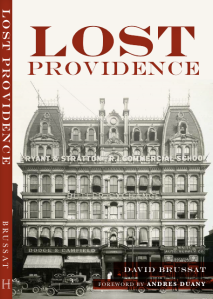
A month from today Lost Providence goes on sale. That’s Monday, August 28. In fact, it already can be pre-ordered. And, to revise and extend my book’s remarks (as they say in Congress), my publisher, History Press, and I are working to set up a slate of events at which the author will be present to describe the book, ruminate upon its meaning, and answer questions about whatever remains to be said, if anything.

Here is the most recent list of confirmed events. Others are in the works, including, I hope, a joint event with the author of Transforming Providence, Gene Bunnell, at the WaterFire Arts Center, followed by an appearance at WaterFire itself. What that date will be is, as they say, TBA. Probably either Sunday, Sept. 3 or Saturday, Sept. 30.

[Note: Some of the details of the  scheduled events remain to be determined, or may be subject to change (say, from lecture to reading or vice versa). Some of the venue calendars do not yet mention the event.]

Posted in Architecture, Books and Culture, Uncategorized | Tagged , , , , , | Leave a comment

More Hayes on beauty

Screen Shot 2017-07-27 at 7.58.42 PM.png

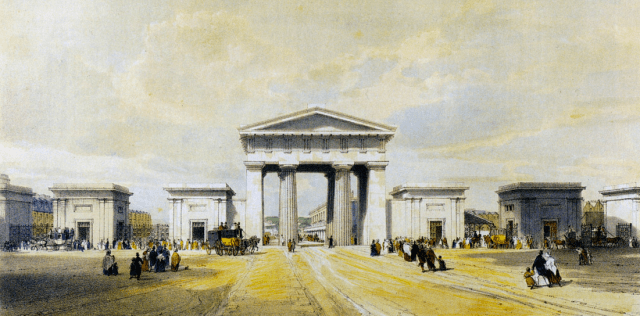
The arch at Euston Station, which could be restored. (cabinetroom.wordpress.com)

British Transport Minister John Hayes’s remarks about beauty and transit infrastructure were quoted on Tuesday in “Sic transit beautiful? Not!” It is brilliant, but I had intended to post instead the full text of “Hayes’s speech on beauty,” a different oration, in which he states the case for beauty in an era of nihilism. He notably asserts here that “most of what has been built in my lifetime could be demolished without aesthetic cost.”

How true. If anything, Hayes understates the case. But he certainly was not channeling Frank Gehry, who in 2014 shouted to a press gaggle in Spain that “98 percent of what gets built today is shit.” What Gehry had in mind was that 98 percent of what is built today is not by Frank Gehry.

So read Hayes’s speech in its entirety. Here are a couple of juicy passages:

This brings me to the third and final misconception that I want to challenge, that beauty belongs somehow to the past. For it is often considered, sometimes unthinkingly, that it is no longer possible to build beautiful buildings.

This is perhaps why increasing regard is given to the beautiful places and buildings that have survived intact. We have somehow, rather depressingly, come to believe that the supply of beauty is both finite and exhausted.  This is perhaps because people assume that it must be somehow dated or even kitsch to build according to the principles of classical architecture. Or because they assume that beauty comes at too high a price, and must be sacrificed for the sake of utility.

Both of these conceptions are false. … There are no good reasons why we cannot continue to build beautiful buildings and public infrastructure.

That is what I have undertaken to achieve as a Minister of State at the Department for Transport. To make it an uplifting experience to navigate the roads, stations and other public infrastructure in our country. We spend so much of our time traveling – to work, to see friends and family. We must not resign ourselves to being miserable as we get from place to place.

A doff of the cap to Robert Orr for alerting me to Hayes’s latest oration.

Posted in Architecture, Art and design | Tagged , , , | 1 Comment

Victorian hotel evolution

speel.me.uk.png

Sculpture on facade of Victoria Station, London. (speel.me.uk)

With the grand history of train station hotel design no doubt cavorting in the back of his mind, British Transport Minister John Hayes argues in yesterday’s post “Sic beautiful transit? Not!” that Britons do not need to put up with the ugliness that modernists have inflicted on Great Britain. As I read his speech “Beauty in Transit,” I thought of passages I had just read yesterday in Victorian Architecture about 19th century hotels.

Here is a passage in which the authors, Roger Dixon and Stefan Muthesius, hint at the churning that animated the evolution of building styles. They are writing about hotels, which in several decades of the third quarter of the 19th century had sprouted from inns and hostels to grand hotels (while dropping the s in hostel). But they could be writing about any building type in which the elements of style are interesting enough to generate thought, debate, emulation and creativity. In the 19th century this led to the creation of new styles or new wrinkles on old styles – as it had in earlier centuries, but which stopped in the mid-20th century when modernist styles proved too simple-minded to generate interesting thoughts about design. The modernist credo – do something completely different – has proved, on the contrary, to be a sure source of vapidity in the evolution of design.

But I am straying. Here is the passage from Victorian Architecture that intrigued me yesterday.

Only the very largest office buildings could compete with the later [train] station hotels in size and splendour. From the point of view of architectural style and elevational treatment there are many similarities. The most common modes of decoration were the Classical and Renaissance styles. The Great Western Hotel in Bristol relates to the post-0Georgian terraces of Clifton; Hardwick’s Great Western, with its stuccoed front, has many features in common with the largest terraces of Paddington. But by 1850 most architects were searching for new, hitherto unused historical styles, or combinations of styles. The Paddington hotel was called “Louis XIV,” referring to its flanking towers and mansard roof. They correspond closely to what was to be called the Second Empire style, after Napoleon III’s extensions to the Louvre – a somewhat impure and ornate version of palatial architecture, with a smattering of the Picturesque and French Renaissance in the use of towers and roofs.

The mind boggles at the idea of “an ornate version of palatial architecture.” Isn’t a palace the ne plus ultra in ornatitude? And don’t you just love that most architects were seeking “new, hitherto unused historical styles”? What mavericks! I am not kidding. Today, they would be called revolutionaries by the moss-backed modernist establishment. Off with their heads!

Dixon and Muthesius continue:

As in office buildings, the problem arose of how to squeeze the growing number of storeys into the traditional framework of the two- or three-storeyed Classical elevation. Knowles, at the Grosvenor Hotel, got round this by playing down the divisions between the stories and by having a very pronounced main cornice and a massive carved roof which dominates the building. Thus the proportions of a Classical building remained basically the same, although the whole is very much larger. In addition, Knowles was to some extent a follower of Ruskin and his theories on decoration, and provided a lot of carved vegetation as well as sculptured heads of famous politicians. The hotel was thus elevated into the realm of modern “art” architecture.

Hmm. Now there’s a possibility. Encourage classical architecture in today’s building market by promising that a politician’s mug might end up as statuary flanking the entrance portico of a grand hotel. This enticement could also serve as a threat: your mug as a gargoyle if you don’t give the public the architecture it wants.

Posted in Architecture, Rhode Island | Tagged , , , , , | Leave a comment

Sic transit beautiful? Not!

hiddeneurope-magazine.eu.png

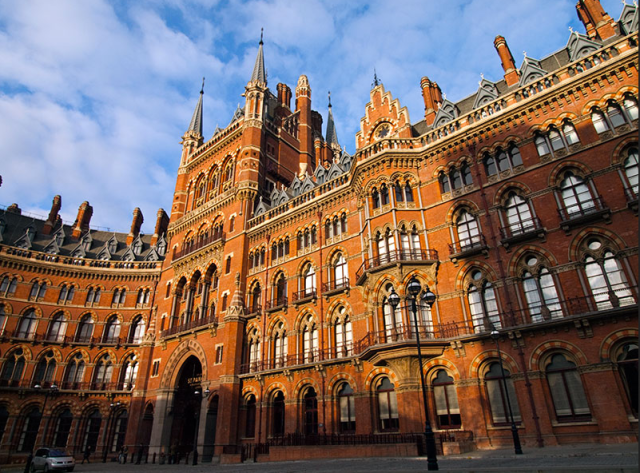
St. Pancras Station, London, its original hotel restored in 2011. (hiddeneurope-magazine.eu)

The race is on to see whether British Prime Minister Theresa May or American President Donald Trump will win the bilateral infrastructure beauty sweepstakes. At least we know Britain has entered. May’s Transport Minister John Hayes recently gave a speech, “On Beauty in Transport,” laced with a great deal of profundity in regard to what citizens of a civilized state deserve and by right ought to demand from their government, and not just regarding bridges, highways and train stations.

(Trigger Warning: Hayes is a member of a cabinet dominated by the prime minister’s Conservative Party. The reader is advised that any agreement with Minister Hayes’s remarks on beauty in no way requires or implies agreement with Hayes or May on any other matters.)

Hayes quotes the critic Richard Morrison describing Euston Station, which was once an elegant exercise in pedimental archways but is now … well, let Morrison tell the tale:

Euston is one of the nastiest concrete boxes in London: devoid of any decorative merit; seemingly concocted to induce maximum angst among passengers; The design […] gives the impression of having been scribbled on the back of a soiled paper bag by a thuggish android with a grudge against humanity and a vampiric loathing of sunlight.

Hayes then remarks: “For better or worse, transport hubs like Euston frame our working days, and punctuate our working lives. When transport design is done well, it raises expectations.” As for the “old stations such as Paddington and St. Pancras,” Hayes adds, quoting the philosopher and architectural theorist Roger Scruton:

The architecture is noble, serene, upright. The spaces open before you. Everything is picked out with ornamental details. You are at home here, and you have no difficulty finding the ticket office, the platform or the way through the crowds.

Hayes describes how beauty serves to aid utility. Today utility is conceived by most of our leading aesthetic theorists, and by modern architects, as untied to beauty, whereas the reverse is true: Utility without beauty eventually will lose its usefulness as ugliness and sterility erode our care for a structure’s maintenance. Eventually, as Scruton has pointed out, such a building will serve best as an opportunity to make way for a prettier building.

That is, if beauty ever wins its own sweepstakes with the muscle-bound iron horse of modernist utility – and who cares whether May or Trump leave the starting gate or reach the finish line first – as long as they get there. I see more and more reasons nowadays to hope that I needn’t warn readers not to hold their breath. In her transport minister May has a head start, but Trump could trump May by using his as-yet-unproposed infrastructure program to rebuild Penn Station in its original, classical McKim, Mead & White style.

Screen Shot 2017-07-25 at 6.36.19 PM.png

Euston Station today, give or take a remodeling or two. (Londonist)

Posted in Architecture, Urbanism and planning | Tagged , , , , , , , , , | 2 Comments

Many more shots of Yale

Screen Shot 2017-07-24 at 6.33.57 PM.png

Photos of Yale expansion by Phil Handler. (Fly on the Wall Productions)

My desire to post more photos of Yale’s expansion – two residential quads, Benjamin Franklin College and Pauli Murray College, designed by Robert A.M. Stern Architects – was answered yesterday by Phil Handler. He owns Fly on the Wall Productions, the industry leader in creating indexed video and photographs for construction, real estate and facilities management firms. To see hundreds of shots of the two campuses at Yale taken as recently as last week, go to Fly on the Wall and click on “My Photographs,” then “All My Photographs,” then select from a slew of sets devoted to Yale’s expansion, which are labeled “New Colleges.” Some are posted here. Enjoy!

Screen Shot 2017-07-24 at 6.34.54 PM.png

Screen Shot 2017-07-24 at 6.45.16 PM.png

Screen Shot 2017-07-24 at 6.37.57 PM.png

Screen Shot 2017-07-24 at 6.45.35 PM.png

Screen Shot 2017-07-24 at 6.43.37 PM.png

Screen Shot 2017-07-24 at 6.44.07 PM.png

Screen Shot 2017-07-24 at 6.42.23 PM.png

Posted in Architecture, Photography | Tagged , , , , , | Leave a comment