Is architecture charming?

Screen Shot 2018-10-20 at 9.34.29 PM.png

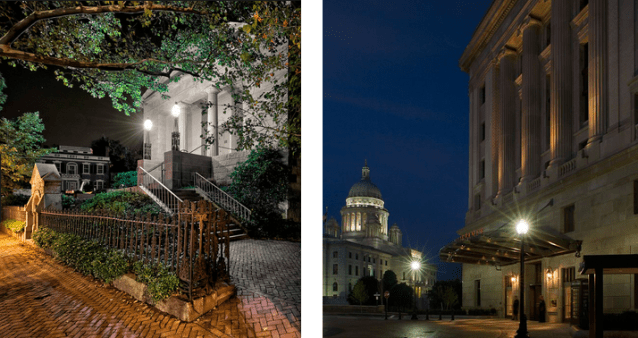
Rhode Island State House (1901), by McKim Mead & White. (Rhode Island Public Radio)

Although it says nothing of architecture, an essay by Joseph Epstein on charm causes me to wonder whether architecture can be charming. His essay, “Life’s Little Luxury,” in The Weekly Standard, is discursive, that is, it rambles round, making its point, or its several points, with a just-in-passing manner. Partly he tries to pin down charm by identifying what it is not. When he tries to define what it is, he waltzes gracefully around the difficulty of reaching conclusions about charm. As is his way – I have read his stuff since he wrote under the pen name Aristides, editing The American Scholar from 1974 to 1998 – Epstein finds exemplars from the past or passages from writers of yore, and then toys with them.

In this he is very like my favorite writer, William Hazlitt (1778-1830), whose essays wander around without reaching much by way of conclusion, and yet by the end of it you are filled with what might be called the sensibility of his topic. Although Hazlitt engaged in the vicious literary politics of his age, and would have been hooked by the #MeToo movement today (Epstein himself asked me more than 40 years ago for an essay about Hazlitt’s illicit romantic exploits), his writing was itself gentle, its punches muffled, most of the time, within the mittens of civility. It was charming.

Here is Epstein circling around his quarry:

If one cannot define charm with real precision, how, then, does one recognize it? One recognizes it, as one does its compatriots in inexact definability, pretty much case by case, instance by instance. One recognizes charm when one feels it, sees it. Charming is the song we don’t want to stop playing, the painting that won’t leave our minds, the piece of writing we don’t want to end, the man or woman we wish never to leave the room. Charm, when present, enlivens and lights up a room, makes the world seem a more enticing place. Not quite true that charm, like beauty, is in the eye of the beholder, for there are levels of sophistication in the realm of charm. Some charm is subtler than others; some more obvious. Not everyone is likely to be charmed by Noël Coward; most people are likely to be charmed by the Marx Brothers.

At a London party in the early 1950s, Noël Coward flirted with my father, which failed to charm my mother, whom, she said, the playwright ignored. I trust Epstein would not disagree that there is always a certain amount of flirtation in charm. It need not be the least bit sexual (indeed today it had better not be!). A charming individual generates an intimacy with his or her audience. In the same way, a charming piece of architecture enchants an observer, deploying the artifice of ornamental detail to beguile the eye.

Epstein snubs architecture, and no wonder. It is no longer charming. New architecture is too eager to argue. It is not relaxed, and it is not ingratiating. In fact, most architecture today is a rejection of what architecture used to be, which was, often, charming. Modern architecture has thrown out the tools tradition used for centuries to produce charm.

I have seen no example of modern architecture that tries to do anything along that line. Modernists prefer to trick the eye with bold masses poised to challenge the laws of nature. A deeply overhanging ledge, seemingly without support, appears to desire that its observers feel a peril, a reluctance to step under the precipice for fear it might collapse. Of course that trick has been tried so many times that people are used to it, and so one of the few aspects of modern architecture that is not simply boring has lost its punch.
Screen Shot 2018-10-20 at 9.30.50 PM.png

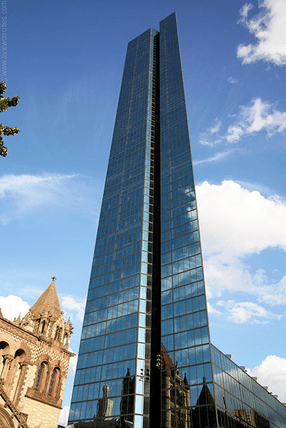
John Hancock Tower. (aviewoncities.com)

I can think of no modernist building in Providence that manages to trick a passerby, let alone flirt with him. In Boston, the John Hancock Tower has a nifty trick of turning into a vertical razor blade standing on end from a certain angle of view, at which angle it appears to entirely shed its three-dimensionality. But much classical architecture in Providence, Boston and other places evinces charm, such as balusters that could be a chorus line of breasts (or of noses, if you insist) – the Providence Public Library* – or a politician protected by a squadron of press agents, as might be seen around the dome of the Rhode Island State House surrounded by its four tourelles.

Epstein might protest that I am confusing charm with grace or even grandeur, to which I can only plead guilty. However you slice it, old buildings have more charm in their door knobs than modern architecture has in its whole beastly oeuvre. As Epstein says above, “Charm enlivens and lights up a room, makes the world seem a more enticing place.” That’s what traditional buildings once did almost by rote. It is a quality that was officially stripped from architecture in the first fifty years of the last century, much faster than it was lost by human beings in the second half. Too bad.

* See the illustration that sits atop this blog every day.
Posted in Architecture | Tagged , , , , , , , , | 1 Comment

Stop Fane tower on Monday

Screen Shot 2018-10-18 at 9.14.45 PM.png

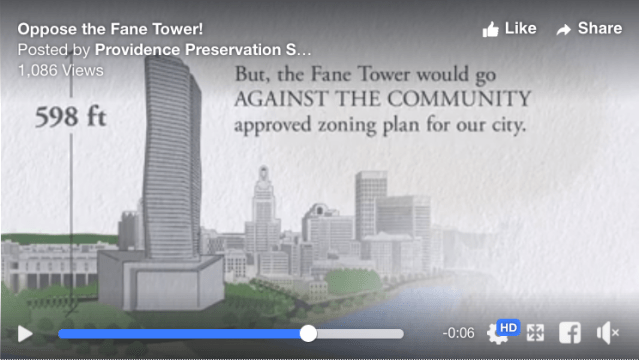
Short anti-Fane video by Providence Preservation Society. (GoLocalProv.com)

The good guys will have another opportunity to denounce the bad guys on Monday at a 5:30 p.m. public hearing of the ordinance committee of the Providence City Council.

I refer, naturally, to the proposed 600-foot Hope Point Tower by The Fane Organization. Its height would approach six times that allowed by zoning regulations, so obviously it is out of scale, and that’s without considering its style, which departs bigly from the city’s historic character. This may not be a problem for some people, only for those who understand what is good for Providence and what is bad for Providence.

After a public hearing, the Ordinance Committee recommended in July against lifting the current height limit on what is built on Parcel 42. On Sept. 6, the council, which was expected to vote on the ceiling one way or the other, instead sent the proposal back to the same committee for another hearing because – it was explained – Jason Fane was not able to testify on behalf of his own project. Yeah, right. And could not afford to send one of his employees, or hire a consultant to make the presentation? Give us a break!

Well, what has happened has happened. Why it happened may help predict what will happen in the future. If the council voted to send the proposal back to ordinance so its members would not have to vote on it one way or the other a week before September’s primary election, the fix is probably in and whatever is said at Monday’s hearing won’t matter. But we don’t know that to be the case. It may genuinely be up in the air.

So, going into the hearing, most people opposed to the proposed design and its height should feel confident that a recommendation against lifting the height limit is in the best interests of the city. Those who are squeamish about being seen as “opposing development” should rest easy, as should those worried that others might think they are “against” creating jobs and raising tax revenue for the city. How silly.

Squeamishness might have been reasonable two years ago, when there were no cranes on the Providence skyline. But now there are plenty. If the Fane tower is blocked, other developers will still want to build in Providence. And if they have better designs, more jobs and more tax revenue can be expected, because a lovelier Providence will generate more of both than an uglier Providence. A building that strengthen’s the city’s brand is better than one that contradicts the city’s brand. Anyhow, if the Fane tower is built, it might dry up the market for upscale tenants, and might also make the Route 195 corridor less attractive to developers whose buildings and tenants would be blocked by the Fane tower.

So feel easy speaking out against Fane on Monday. And lawmakers should feel easy urging the council to vote against raising the height limit – which would undermine the very idea of zoning. When even a major change in what the voters decided on a few years ago can be easily rammed through by a developer, zoning as a functional tool of urban planning ceases to exist.

The hearing at City Hall is expected to begin at 5:30. Providence is not against development, it is for better development.

Posted in Architecture, Development | Tagged , , , , , , | 3 Comments

North vs. South on Benefit

Screen Shot 2018-10-16 at 9.36.01 PM.png

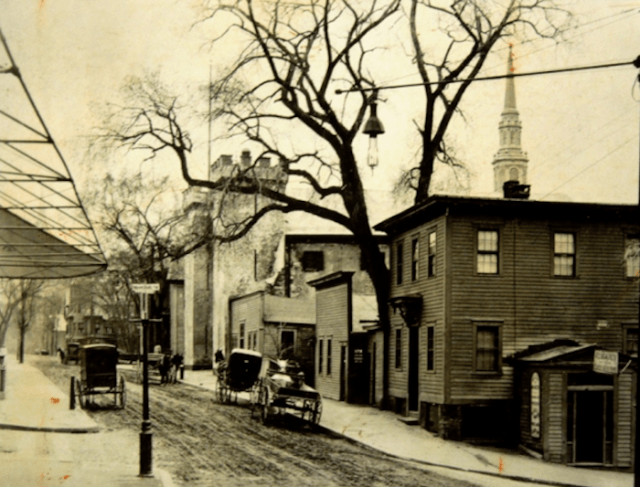
Benefit Street, Providence, circa 1900 (?); arsenal is at center-left. (source unknown … anyone?)

After a couple of centuries dodging various bullets, including the College Hill Study of 1959, Benefit Street has come under the wing of a new organization called the Mile of History Association. It held its first annual meeting Sunday in the Benefit Street Arsenal, designed by James Bucklin (of Arcade fame) and erected in 1839-40. In 1906, the arsenal was moved one lot northward to make way for the East Side railroad tunnel. Whether the photo above (whose source I wish someone could reveal to me) was taken before or after the arsenal’s relocation I cannot tell. (What good am I?)

Vincent Buonanno, formerly chairman of Brown’s facilities and design committee, opened the meeting with a question. How many in attendance were already members of MoHA? Almost every hand rose, but I could not recall whether I had joined or not. Maybe my invitation to the meeting meant I was a member. That’s my working theory for now.

The meeting proceeded as such affairs often do, with an invited speaker, Col. Michael Borg of the city’s department of public works, discussing matters of interest to members. He addressed snow removal, graffiti, streetlight repair, parking difficulties, utility repaving and potholes (often one and the same), trash recycling and trash removal. Between 1984 and 1999, I lived in three addresses on Benefit, all toward its southern end. I walked to work but had a car, so my concern was the ongoing rash of auto B&E’s. The car was a used Honda Accord hatchback from 1983, before Honda’s rise in the world. I left it unlocked so thieves wouldn’t need to break a window to enter. Occasionally I would discover the glove open and my classical tapes flung angrily into the back seat. Once a thief tried to pull my radio/tape player out but succeeded only in ripping the plastic front off. I left it hanging. My poor car was never “broken” into, let alone stolen. Colonel Borg was not asked by any MoHA members in attendance to address auto break-ins.

As I say, I lived in three apartments south of the “civic” middle blocks of Benefit, at (in order of occupancy) 283, 395 and 372. The square footage of all three did not add up to 1,000, but they were great addresses nevertheless. Just living on historic Benefit was a bit of a feather in my cap. Still, I have long wished that I had had a chance to live somewhere on the northern half of Benefit. That half has more of the feel of history. Most of the houses are smaller; most of them are indeed older (in spite of the fact that the street was built from south to north starting in 1756), and there are no grand mansions like the John Brown and Col. Joseph Nightingale houses to the south. (Not that there’s anything wrong with that.)

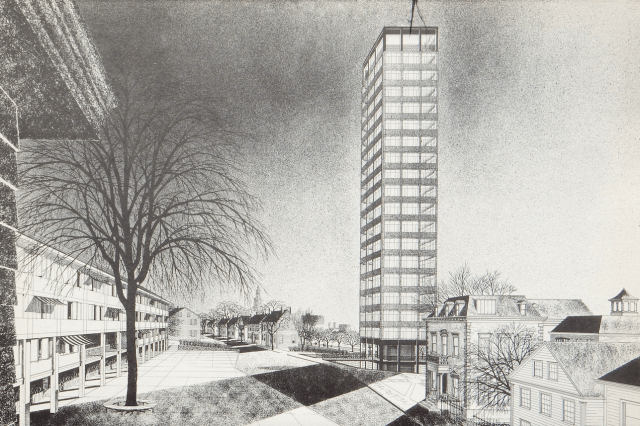
Most of the buildings on Benefit, including most of its residential properties, have been fixed up since the street was something of a slum through most of the first half of the 20th century. In 1959, the above-mentioned College Hill Survey was undertaken, with recommendations of demolition and urban renewal. Buildings on and near Benefit were assessed by “experts,” given scores, with many declared substandard and consigned to bulldozers to make way for modernist townhouses and a pair of glass residential towers of 19 and 23 stories, one at each end of Benefit. Fortunately, College Hill, including some of the city’s first families, experienced a slow burn at what the city had in mind. Several society matrons took the lead in buying some of the most decrepit houses, fixing up their exteriors and selling them to families willing to undertake interior renovations on their own. Eventually, property values skyrocketed, putting the lie to the experts’ assumption that demolition was the inevitable fate of old houses whose only need was love and attention.

Most of the earliest preservation activity took place toward the northern end of the street. The pavements were replaced by brick and beautiful faux gas-lamps were installed. Famous architecture critic Ada Louise Huxtable came to Providence to denounce these features as inauthentic. Huxtable would no doubt have preferred modernist cobra-head highway lighting and cheesy Cianci-grade el-cheapo hand-in-pocket brushed-concrete sidewalks. But the public loved the bricks and the gas lamps, and time has healed their alleged inauthenticity. Today, their upkeep is a major goal of the Mile of History Association, and rightly so. Good on them! Sign me up! (If need be.)

Nevertheless, even broken brick sidewalks and period lampposts sporting graffiti and busted glass are more beautiful and appealing, by far, than the sort of modernist crapola that would have fluttered the heart of the late Ms. Huxtable. MoHA must make sure that Benefit Street and Providence as a whole are protected from the current spate of bad architecture sprouting like pustules of acne on the face of the city. This vital advocacy should be its top priority, for Benefit Street will surely die if the city around it dies.

Screen Shot 2018-10-16 at 9.12.10 PM.png

Benefit Street with proposed tower recommended as part of 1959 College Hill Study. (author archives)

Posted in Architecture, Preservation | Tagged , , , , , , , | 2 Comments

Learn from Lombard Pozzi

Screen Shot 2018-10-12 at 8.37.14 PM.png

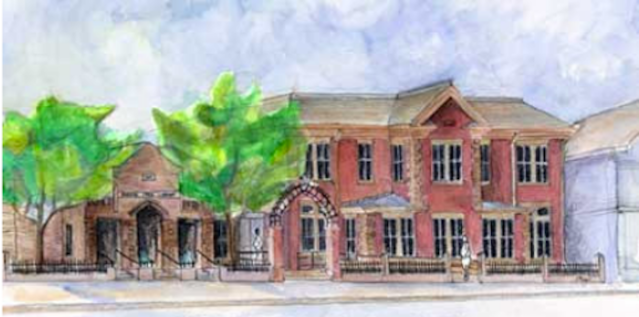
Renovated old Rogers Free Library at left, and much larger 2008 addition. (Town of Bristol)

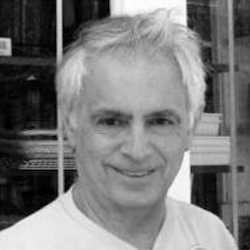
Thursday evening I attended a lecture on the late Bristol architect Lombard Pozzi, who died in 2013. Lombard Pozzi – what a great name! More than anyone else, Pozzi is responsible for Bristol’s having managed to remain true to its charming self. Pozzi was among that rare breed, an architect trained also in preservation. He was born in Bristol and lived in one house on Hope Street since 1949. His legacy may be viewed up and down Hope, from the Peaberry Block, completed in 1988 (I dined at Le Central Bistro before the lecture) to his sensitive – yet much larger – 2008 addition to the Rogers Free Library, where his longtime friend and colleague Kevin Jordan spoke, leading his audience by way of slides he had lately taken of Pozzi’s projects.

Screen Shot 2018-10-12 at 11.05.25 PM.png

Lombard Pozzi (patch.com)

Pozzi was unlike many professional admirers of historical architecture, who think a beautiful building a century or two old is a fine thing, so long as its features do not serve as inspiration for any building constructed today. His new buildings were designed to fit gently amid the townscape. News articles previewing last night’s lecture stressed (to quote one on eastbayri.com) that Pozzi “both loved new buildings and had a healthy respect for those we inherited.” I suspect the new buildings he loved were primarily those that respected the old buildings he loved. Jordan opined that Pozzi thought little of modernist buildings “designed not to be liked.” Are they thought provoking? More likely they are headache provoking.

I’m sure that I’ll hear from those, if any, who think I have misrepresented Pozzi’s attitude toward modern architecture, or the remarks made by the good professor (retired from Roger Williams University). No doubt he must have liked some of it. After all, even I like some modernist buildings.

None of us is perfect!

Jordan told some wonderful stories of Pozzi, including their dumpster-diving in Bristol and in locations as far off as London. Pozzi was well-known for rescuing and reusing abandoned architectural features such as window shutters, window frames, balustrades, columns, doors, slate shingles, bricks, stone slabs, old electrical boxes, modern light fixtures, tin ceilings and clocks. He rescued and restored over 200 time-pieces. He saved old architectural drawings. The Providence Journal architecture columnist Catherine Zipf wrote a piece last February on a cache of 300 moldy construction drawings of Newport’s Ochre Court by Richard Morris Hunt’s firm (“Hidden treasure in Lombard’s garage“). Of how they came into Pozzi’s possession, she wrote:

We think the drawings were left in Ochre Court until 1947 and rediscovered when it was converted into Salve Regina College. But no one cared to put them in an archive. Instead, we think that someone involved with the project took them home. Pozzi (who knew everyone) collected the drawings from that person some time later. To Pozzi, their value was obvious. He cared.

Delightful!

Bonnie Warren, who worked with Pozzi on and off throughout his career, rose to remind the audience (composed mostly, it seemed, of friends and clients) of the architect’s sense of humor and compelling prose style. The evening left me thankful that someone so full of love for old buildings and their details, and the intricacy of their construction and preservation, existed in Rhode Island.

I also feel no small twinge of regret at not having learned of Pozzi sooner. Certain Rhode Island architectural eminentoes as Norman Isham, Irving Haynes and others, I’m sure, have not received their due in my almost thirty years of columniating. I once noted the sad fact and pledged to rectify it, but so far have not. I hope this post on Lombard Pozzi will bring me to that duty.

Posted in Architecture, Preservation | Tagged , , , , , | 5 Comments

Nordstrom’s absquatulation*

Screen Shot 2018-10-10 at 8.54.42 PM.png

View of Providence Place, with Nordstrom at right. (photo by author)

Providence and its renaissance will survive the departure, announced yesterday, of Nordstrom from the Providence Place mall. Many local commentators are pulling their hair out in shock and dismay. Relax. Losing Nordstrom is a gut check, but hardly fatal.

It’s early, but the winning entry in the sweepstakes for the gloomiest reaction to the startling news may be GoLocalProv’s “The Death of the Providence Renaissance.” “The Providence Renaissance began in the late 1990s. … Two decades later, Providence is stagnant.” The evidence? “A new report of the fastest growing cities in America ranks Providence number 458 out of 515 ranked. The population of Providence has decreased over the past fifty plus years. Providence’s population in 1960 was 207,498 and today it is just 179,219. And now, the Renaissance seems to be morphing into the Dark Ages.”

To take these in order, the renaissance started not in the late 1990s but in the late 1970s, after Johnson & Wales started renovating old buildings and the city embraced an unofficial moratorium on the demolition of old buildings downtown (which lasted until 2005). To save old buildings became the order of the day, including the Biltmore hotel, which had closed in 1975, reopened in 1979, and the Ocean State Theater, whose application for a demo permit in the late 1970s was refused, leading to its eventual rehabilitation as PPAC. Work began on the Capital Center development project in the early 1980s, and in the mid-’80s the river-relocation project was added. In the early ’90s the convention center and Westin hotel joined the fun. Waterplace opened in 1994, the same year as the first WaterFire. Narragansett Electric Co.’s Manchester Street Station was renovated in 1996. The renaissance was well under way by the late ’90s, and went into overdrive when the mall opened and Buff Chace started rehabbing old buildings as lofts the same year.

Stagnation hit almost a decade ago, before the Great Recession, when most of Chace’s rehabs were done. Old buildings were being demolished again after a quarter of a century. (Thank you, Mayor Cicilline!) Five new buildings were proposed in 2005, including one that would have topped the Industrial Trust. None was ever built. But the mall had become a financial boon to the state, and a great “third place.” However, in 2011, Borders closed.

Under a string of owners, the mall has been poorly run, a fact that was evident years ago when management refused, in spite of repeated requests from this corner, to fix the glorious exterior lighting that had long washed up between the pilasters at Macy’s. The mall’s lunkheaded leadership reached its nadir when Borders was replaced by the umpteenth shoe store. The last upscale restaurant, the Napa Valley Grille, also closed in 2011.

If Nordstrom is so vital to the Providence economy and to the mall’s already tarnished upscale rep – and it is – the mall should have tried harder to keep it there, offering a lower and lower lease until Nordstrom could no longer refuse. Its replacement will be Boscov’s, a retail chain that offers much of what Nordstrom offers at – ahem! – a lower price point. Let’s not forget that Nordstrom, too, is a retail chain. Perhaps, however, Boscov’s will do a better job tapping the market of metro Providence at its true price point.

Naturally, we hesitate to embrace that idea. But look at the survey linked above by GoLocalProv as “fastest growing cities in America.” Look at it and one thing is clear: The places rated tops in “growth” may not rank very high in a list of “nicest places to live.”

Providence’s population has declined from 207,498 in 1960 to 179,219 today. In 1959 and 1960, the city proposed the College Hill plan and the Downtown Providence 1970 plan. Both plans recommended massive demolition and urban renewal, replacing old buildings with new modernist buildings. Both plans were largely abandoned in just a few years, and what little was built made Providence worse. Neighborhoods were already being bulldozed for new highways. A highway had been seriously proposed to shoot right up the Providence River. The status of downtown and College Hill today is a rebuke to the know-it-alls of yesterday. It is altogether possible that a large portion of the population that left after 1960 were people who felt queasy at the city fathers’ ridiculous, indeed horrifying idea of what Providence needed to stem the flow of residents and businesses to the suburbs.

Be that as it may, the failure of these two plans left Providence with extensive historic architectural fabric intact, more so than in most cities, whether bigger or smaller, many of which bought whole hog into urban renewal and modern architecture. Providence did not, and that is the basic reason there was a Providence renaissance at all. In the 1980s, civic leaders finally “woke” to the idea that beauty was this city’s major advantage (along with being between Boston and New York City) in vying with other cities.

Today, our city fathers seem to have forgotten that. They are transforming a beautiful city into a standard city, one that could be located anywhere. Look at what is being built in the Route 195 corridor. New buildings, yes, but, my god! Must they be so damn ugly? Has Providence learned nothing over its past very extraordinary 40 years? Were today’s leaders asleep during the city’s renaissance? It certainly looks that way.

The primary concern of a city’s leadership should be its citizens of today, not its possible citizens of tomorrow. Make Providence nice and beautiful for today’s citizens and people in other cities are much more likely to become tomorrow’s citizens of Providence. Yes, other factors that have nothing to do with beauty are vital to making a place livable. However, those factors are very hard to do right, whereas we already know how to bring beauty to the city because it has been done very well before. Beauty creates places where civility reigns, and under the influence of a civilized environment it may be easier to come together and solve the city’s toughest problems. We already have more of such an environment than almost every other city. Let’s build it up not tear it down. Let’s strengthen our brand, not shoot it in the foot.

Providence’s mantra should not be more and bigger but better and better. That should be the lesson we take from the departure of Nordstrom.

* Absquatulate means to leave abruptly, and usually has a connotation of tail between leg.

Posted in Architecture, Development | Tagged , , , , , , , | 12 Comments

Europe as museum for rich?

Screen Shot 2018-10-07 at 4.59.31 PM.png

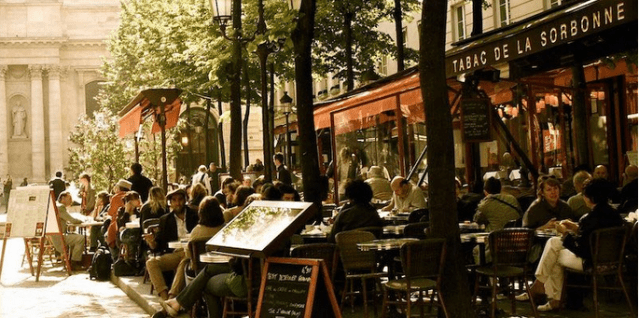
A bistro in Paris near the Sorbonne. (parisinsidersguide.com)

The late Walter Laqueur, who died last week after a long career cataloguing the sins of communism, terrorism and the Holocaust, was quoted in his New York Times obituary asserting that the “possibility that Europe will become a museum or a cultural amusement park for the nouveau riche of globalization is not completely out of the question.”

Alas, it is not. Fortunately, it still must be considered a possibility, not an actuality. Great thinkers and writers still live in Europe’s cities and towns. Laqueur lived mostly in London. One must assume that he was dismayed by the proliferation of ugly, sterile skyscrapers in what was once among the world’s most beautiful cities. Such towers are precursors to the eventual victory of totalitarianism in the West, which fought so hard in the last century to protect itself and the world from authoritarian rule.

We often hear the words museum and cities together in ridiculous claims that old cities will become “museums” if new architecture is built to fit into their historical settings. That is not what Laqueur was talking about, and I doubt he would subscribe to that fabricated modernist anxiety.

The Times obituarist, Sam Roberts, wrote:

Among Mr. Laqueur’s last books was Reflections of a Veteran Pessimist (2017). The title notwithstanding, he told Der Spiegel that he would have preferred to live during the belle époque, at the end of the 19th century, when hope sprang eternal. He then paused to reconsider.

“Hope springs eternal,” he repeated. “It’s one of the most frequently quoted verses of English poetry. The poet was Alexander Pope, a decidedly cautious man. He had many enemies, and we know from his sister that he never went out into the street without his large, aggressive dog, and always with two loaded pistols in his bag.”

Hope springs eternal that Europe will still be worth visiting after the next decade or more of modernist slab construction. Eventually, it must stop or going to Europe will no longer be worthwhile, nor will the rich have any reason to buy apartments there. In the late 19th century – the Belle Époque – the beauty of cities there and perhaps elsewhere reached its apogee. That may be why hope sprang so eternally. Is anybody a flâneur in a city that does not reward walking, that has instead submitted its future to the tender mercies of modern architecture? Certainly not.

British philosopher Roger Scruton, in The Classical Vernacular, wrote that

[Classical] streets are frequented in equal measure by the aimless and the purposeful, for they are bounded by surfaces that concede the vitality of civil life. The classical wall, which is humanly proportioned, safe, gregarious, and quietly vigilant [here Scruton channels Jane Jacobs] constantly reminds the pedestrian that he is not alone, that he is in a world of human encounter, and that he must match the good manners of the wall which guides him.

A few days ago I read in The Irish Times that a law to ban tourists from sitting on steps is being considered by the Venetian authorities. It is already illegal there to sit on the steps of monuments and on those of the portico of St. Mark’s Square. NBC Evening News had a segment last night reporting that 300 bistros had closed this past year in Paris, so ubiquitous have the fast-food merchants proliferated there. That’s terrible news, but I would rather be forced to pay for a seat on the Champs-Élysées or on St. Mark’s Square than be free to sit on a patch of hallowed ground surrounded by McDonald’ses, let alone skyscrapers.

Has the death of the European city already occurred? I don’t think so. But the death rattle can be heard.

Don’t even ask about American cities. A couple days ago I read an article (“What is developer Fane’s track record in Toronto?“) that defended The Fane Organization, which proposes a 600-foot tower in Providence’s Jewelry District, by bragging on Fane’s projects contributing to the towerization of Toronto. Utterly unconvincing, but it demonstrates sadly how thing are going that such claptrap gets serious attention even in Providence.

Posted in Architecture, Urbanism and planning | Tagged , , , , , , , , , , , , | 7 Comments

Big vote tonight on Edge II

Screen Shot 2018-10-04 at 12.40.21 PM.png

Edge College Hill II center, blocks most of Edge College Hill I. (upriseri.com)

Edge College Hill II, the follow-on to the nearly complete Edge I residential tower on Canal Street, goes before the Providence City Council today for a huge wad of city cash. Under a tax stabilization agreement (TSA) up for final approval tonight, its developer stands to save some $18 million over 20 years on property taxes. This development incentive is too much for too long. The council, which meets at 7 p.m. today, should give it another look. Citizens should converge there to make their views known.

The two Edge projects seem to have proceeded under cover of the public’s attention to the proposed 600-foot Fane tower in the Jewelry District, just beyond downtown. Which project (Edge or Fane) poses the greater harm to the city is debatable, but the Edge has hid nervously behind the smoke of the furious Fane flap to the south.

And it must be said that Edge II has improved in its design. It has shed four floors in height and its much shorter wings, along Steeple and North Main streets, appear to pay a bit more respect, after some tweaking, to historical context. North Main is the city’s oldest street – it was once called the Town Street. And while RISD has spat twice in history’s face (Museum addition, Illustration addition), and intends to do so again soon (infill of U at RISD Administration), the historical fabric remains strong. (RISD used to be good at fitting its growth into the city’s beauty. What happened?)

Edge II will serve to mask views of the considerably uglier Edge I, but does that means it deserves this Brobdingnagian TSA? No. The city should do more to direct TSAs to projects that better fulfill the original mission to promote affordable housing, inside and outside of downtown.

Again, council meets at 7 p.m. today in City Hall.

Meanwhile, it has been announced that a second public hearing of the Ordinance Committee on whether to let the Fane tower rise six times what zoning permits will be held at 5:30 p.m. on Monday, Oct. 22 at City Hall. Council ducked the issue after Ordinance issued a negative recommendation. Council says that Fane, having bunked the first hearing, deserves a second chance. It does not, but council members are sheepish about voting (before the November election) to sack the city’s zoning, which would be the practical outcome of a pro-Fane vote. (Pun intended.)

Little beads of sweat have been sighted running down the forehead of Jason Fane in recent days. Concerned that Providence can no longer be trusted to ram the 600-foot tower home, state senate president Dominick “Rubbers” Ruggerio has come to his aid, proposing to end what authority the city has in the corridor. Whether the cavalry will arrive in time is doubtful. (Whether Ruggerio deserves to retain his post, having been arrested for stealing condoms from a Cranston CVS in 1990, is another question.)

Reminder: Council meets today to vote on its second approval for the Edge College Hill II TSA at 7 p.m. in City Hall.

Posted in Architecture, Development | Tagged , , , , , , , | 4 Comments

Humanities in Providence

Screen Shot 2018-10-03 at 8.28.36 PM.png

Providence Athenaeum, left; Masonic Temple, State House beyond. (Pinterest)

Two of my favorite buildings will host humanities events on Thursday and Friday of this week. If you are attending the silent auction sponsored by the Rhode Island Council for the Humanities tomorrow, you will see the Masonic Temple, now a ritzy hotel, near the State House; if you are attending the next day’s sold-out lecture by Brown humanities professor Arnold Weinstein at the Providence Athenaeum, that is what you will see.

Architecture is not one of the humanities, but perhaps it ought to be. It is known as the Queen of the Arts. However, she might be a bit confused by architecture today, which refuses to speak in a language accessible to all. Modern architecture’s intentional obscurity seems to resemble the studied obscurantism that has overtaken the humanities in recent decades, so I feel obliged to push back against an idea upon which the professor of literature may well express himself. In favor? So I fear.

That is that established methods of teaching and engaging with art and literature are old hat and have been justly overtaken by academic theories that reject traditional meaning.

Weinstein is noted for a column he wrote in the Feb. 23, 2016, New York Times, “Don’t Turn Away From the Art of Life,” in which he states: “The arts can no longer compete with the prestige and financial payoffs promised by studying the STEM fields — a curriculum integrating science, technology, engineering and mathematics.” That’s certainly true, and thoroughly regrettable. But the humanities have only themselves to blame.

STEM disciplines actually retain just that – discipline – a value that has largely been expunged from the arts and humanities. Some educrats even add an A to the acronym, STEAM, so the arts do not feel left out. This merely exemplifies the extent to which the “softer” fields have embraced a spurious complexity so as to offer a superficial egality with more rigorous fields. This twisting de-emphasizes hard facts so as not to exclude or offend anybody.

The process gives rise to an obscurantism that has replaced serious academic thinking in most of the arts and humanities. So discombobulated is the result that it is obvious to most intelligent people in and out of the fields. The most talented obscurantists, perhaps including Weinstein, manage to carry off this reconceptualization of the humanities with no small degree of panache, so that some readers cannot tell they are being spoofed.

The professor, in his column, writes:

A humanistic education is not about memorizing poems or knowing when X wrote Y, and what Z had to say about it. It is, instead, about the human record that is available to us in libraries and museums and theaters and, yes, online. But that record lives and breathes; it is not calculable or teachable via numbers or bullet points. …

In that passage I think I hear Weinstein saying that scholars have uncovered many more things in Shakespeare than he ever dreamed of. Maybe so, but it is important for scholars to be clear about – and admit the importance of – what Shakespeare was intending to say versus what scholars invent and attribute to him in order to establish their analytical reputations. It is vital for future Shakespeare scholars to learn the bullet points of the Bard. Serious analysis is built on a factual foundation. Students who are not tasked to learn the result of centuries of Shakespeare scholarship or to memorize passages from his works may forgo a strength of mind that later will be crucial to analyzing him with any degree of academic rigor. But does anyone care about that anymore?

Professors who insist that students treat straightforward readings of creative works as unnecessary and unreliable social constructs are as bad as architects who reject beauty as vital to architecture. At least modernist architects can be momentarily forgotten under the enchanting influence of the Athenaeum (1838) and the Masonic Temple (1927, completed 2007).

I much prefer this simple and lovely thought from Weinstein’s column:

“How much do you know about Shakespeare,” I once asked a friend who has committed much of her life to studying the Bard. She replied, “Not as much as he knows about me.”

Posted in Architecture, Art and design | Tagged , , , , , , , , , , | 2 Comments

Shubow to U.S. arts board

Screen Shot 2018-10-01 at 8.48.08 PM.png

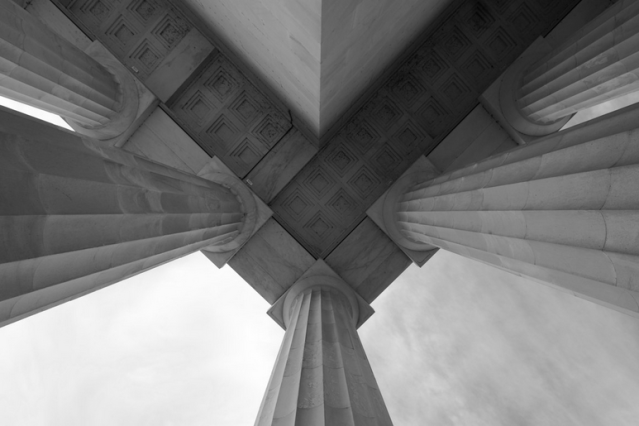
Lincoln Memorial (Power Line)

In a truly exciting appointment, President Trump has placed one of the nation’s most talented advocates for beauty on the U.S. Commission of Fine Arts. Justin Shubow, who heads and will continue at the National Civic Art Society during his official tenure, brings to the commission’s deliberations a refined eye for artistic revival in the nation’s capital, and that will include architecture. Maybe he can stop the Dwight D. Gerhy carbuncle.

Yes! Make America Beautiful Again!

Screen Shot 2018-10-01 at 8.38.41 PM.png

Justin Shubow (Power Line)

Maybe it is too much to expect Shubow, from his one seat on the seven-member commission, to do what the president could and should have done with a flick of his finger before the project broke ground last fall. On the other hand, Shubow may now be better placed to argue that the federal government should contribute hundreds of millions of federal dollars to the renovation of Pennsylvania Station only if the project is shifted to reflect the original 1910 design by Charles Follen McKim. That’s in New York City, of course, which is outside the boundaries of the commission’s authority. But Shubow has an even bigger policy voice now, and good policy is a very fungible jurisdiction.

Both the memorial to Ike and Penn Station projects have been taken up by the National Civic Art Society.

Before Shubow arrived at the NCAS back in 2011, it had sponsored a design competition for an alternative to the Ike memorial proposed by Gehry. Soon after he took over at the NCAS, he wrote a long paper against Gehry’s proposal called “The Gehry Towers Over Eisenhower.” Between these two events, I met Justin at a coffee shop across the street from where my father once worked at the federal Office of Management and Budget. Justin struck me as very bright, even philosophical.

Indeed, Shubow’s high energy and high mindedness transformed the group’s opposition to the Gehry design into a publicity steamroller that garnered constant media attention, drove the modernists nuts, and, partly through his testimony there, persuaded Congress to throw its weight behind blocking the Gehry design. And the society would’ve succeeded, I believe, if the Eisenhower family, long united in opposition, had not turned coat against their paterfamilias in favor of a monument to Gehry.

Allan Greenberg, who designed the diplomatic reception rooms at the U.S. Department of State, said of Shubow’s leadership: “When the National Civic Art Society began its Eisenhower Memorial fight, it was like Hans Brinker plugging a dyke all by himself with one finger. Now the National Civic Art Society is well on its way to becoming a Washington powerhouse.”

The Fine Arts Commission, an independent federal agency, was established in 1910. J. Carter Brown, scion of Providence’s leading family of merchants (yes, Brown University), served as its chairman for 31 years, from 1971 to 2002, years during which the commission’s unseemly dedication to modern architecture did much to edge classical beauty out of favor in Washington’s monumental core. Thereafter, the commission’s rulings continued get under my skin. Its insufficient ardor for art was on full display in the strange case of Gehry v. Eisenhower. Shubow is sure to take a different tack.

In bending the arc of art in the proper direction, Shubow has his work cut out for him. But if anyone can do it I am sure he can. Congratulations, Justin! The world of classical architecture, allied with the intergalactic universe of beauty, will be pulling for you.

Posted in Architecture | Tagged , , , , , | 1 Comment

Architecture’s Three Stooges

Screen Shot 2018-09-30 at 11.05.15 PM.png

Le Corbusier’s Unite d’habitation (1952), in Marseille, France. (mimoa.eu)

Theodore Dalrymple, a British physician, psychiatrist and theorist of society, culture and design, has written a review of James Stevens Curl’s new book Making Dystopia for the New English Review. Dalrymple calls the book “essential, uncompromising, learned,” and especially devastating in its comprehensive critique of modern architecture’s founding lunatics – oops, I mean theorists: the Swiss/French Le Corbusier, and the Germans Ludwig Mies van der Rohe and Walter Gropius.

In like fashion, as [Dystopia] makes beautifully clear, the modernists were adept at claiming both that their architecture was a logical development of and aesthetic successor to classical Greek architecture and utterly new and unprecedented. The latter, of course, was nearer the mark: they created buildings that, not only in theory but in actual practice, were incompatible with all that had gone before, and intentionally so. Any single one of their buildings could, and often did, lay waste a townscape, with devastating consequences. What had previously been a source of pride for inhabitants became a source of impotent despair. Corbusier’s books are littered with references to the Parthenon and other great monuments of architectural genius: but how anybody can see anything in common between the Parthenon and the Unité d’habitation …, other than that both are the product of human labor, defeats me.

But of course nothing will come of nothing: architectural modernism has a pre-history just as it has its baleful successors. Professor Curl traces both with panache and erudition and shows that the almost universally accepted history of modernism is actually assiduous propaganda rather than history, resulting not merely in untruth but the opposite of truth. Thus both William Morris and C.F.A. Voysey were claimed by apologists for modernism as progenitors of it, though this is fantastically unlikely to anyone with eyes to see, and Voysey explicitly detested modernism, among other things saying that it was pitifully full of faults and vulgarly aggressive. Nevertheless, [Nikolaus] Pevsner, the great architectural historian, who once called for architecture to be called totalitarian, insisted that Voysey was a precursor of modernism, thus implying that he knew better what Voysey was about than Voysey himself knew.

The widely accepted narrative of modernism a la Gropius is that it was some kind of logical or ineluctable development from the Arts and Crafts movement. This seems to be utterly fantastic: it is like saying that Mickey Spillane is a logical or ineluctable outgrowth of Montesquieu. … Moreover, claiming respectable ancestors is somewhat at variance with equal claims to be starting from zero (as Gropius put it), but such a contradiction is hardly noticed by the grand narrative history of modernism that Professor Curl attacks and destroys.

(Both the professor and his reviewer are far too kind to the modernists. I have taken the liberty of referring to modern architecture’s three leading founders as its Three Stooges. I could not resist, though arguably the Stooges were far more intelligent, would have designed far better buildings, and certainly wrecked far less havoc on the world. I make no apology for using the word lunatics to refer to the three founding modernists.)

Making Dystopia will be available in the U.S. on Oct. 23, though it may be purchased elsewhere, including online through its British publisher, Oxford University Press.

Posted in Architecture | Tagged , , , , , , , , | 6 Comments