Mourning the Duck & Bunny

The Duck and Bunny, a snuggery at 312 Wickenden St., no longer exists. (GoLocalProv)

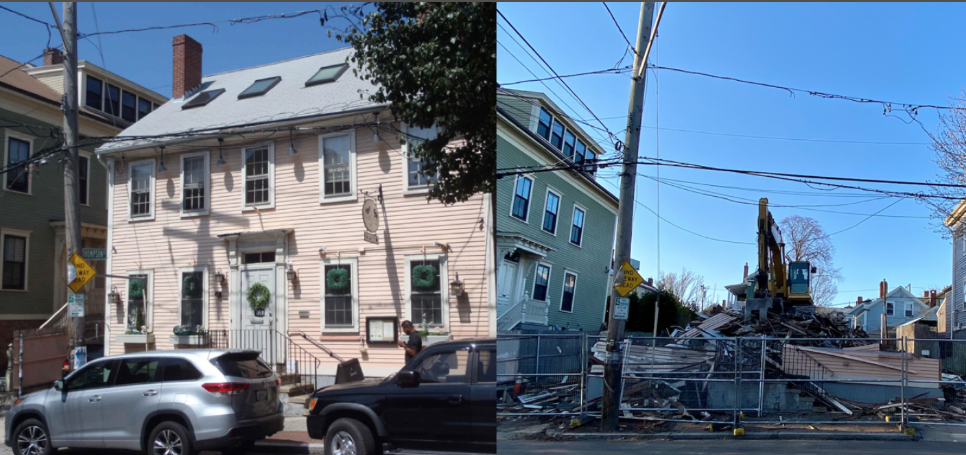
The day before Easter Sunday the Duck & Bunny snuggery, in an elegant colonial on Wickenden Street. was torn down. By definition, a snuggery is “a cozy place.” The Duck & Bunny was that and more, a sweet salon for tea, crepes, cupcakes, cakes and other delights, intimate rooms with comfortable chairs, a leafy rear garden of exquisite charm, and pleasant young people serving quiet, gentle, civilized customers. It was even painted light pink. Not any more. Gone.

Detail of Duck and Bunny. (patch.com)

The colonial housing the Duck was among the most pleasingly classical buildings on Wickenden, with an embellished doorway surround, a set of four wrough-iron light fixtures, a slender entrance railing, a sign with duck and bunny silouettes hung from an antique frame, and soft façade lighting at night, not to mention its pinkish hue.

Now there is a pile of wood behind a chain-link fence. Perhaps soon there might be a parking blacktop. At least this would raise the intriguing possibility of a reasonably decent building to fill the parking lot rather than the immediate certainty of a degraded Wickenden. The imagination inevitably opens the door to pain. Even a new colonial is unlikely to live up to the Duck & Bunny’s design standards, outside let alone its highly classicized inside. At best maybe a new “colonial” by some bad-trad firm might resemble the new four-story colonial that went up a couple of years ago two houses west of the Duck & Bunny.

Aqua-Life being razed at Hope and Wickenden. (Brown Daily Herald)

More likely is the fate of the old Aqua-Life Aquarium at the corner of Wickenden and Hope, where a charming building with an aquatic mural populated by fish came down for a quasi mod/trad abomination too big and too lacking in soul. Frank Gehry is unlikely to be given a commission here, or anywhere in Providence.

The Duck & Bunny was born in 2010 but has been lodged in a house born in 1900. Ascendancy has not been the direction of architectural evolution here. Architects today cannot be relied upon even to copy the past. Which is harder than it sounds.

I had heard over a year ago that the Duck & Bunny was at risk, yet also that its owners had closed for renovations but expected to reopen in 2021. I am abashed at being caught by surprise. The Duck & Bunny’s demolition must have been okayed by the Historic District Commission, the City Plan Commission or some other agency. How could they? Why was I not informed! Harrumph!

If Providence is to avoid the seemingly inevitable erosion of its historical character, the redevelopment process must be renovated to exclude all but restorations or new buildings erected to the design standards of 1900.

Update: A correspondent (not a commenter) has emailed me to say she heard on tonight’s news that “the building needed to be brought to code and wasn’t stable. They are rebuilding and kept a lot of items to put back in and will reopen the same restaurant when completed.” That’s great news, if true. (10:04 p.m. Monday)

Update of update: My correspondent sent the segment from the WJAR evening news, in which one of the Duck & Bunny owners clarifies that they expect to rebuild. In the segment it is more clear that they expect to install the restaurant much as it was but less clear that they will rebuild the building as it was (with upgrade to code, of course). Still, viewers, such as myself, who hope for the latter have every reason to be optimistic. If the reconstruction turns out to be a full restoration (with upgrades for HVAC and other internal systems), that may be a first for Providence, possibly for Rhode Island. (11:07 p.m.)

In some blocks, the character of Wickenden hangs tough. (William Morgan/GoLocalProv)

Posted in Architecture, Development, Preservation | Tagged , , , , | 6 Comments

Not an April Fools post

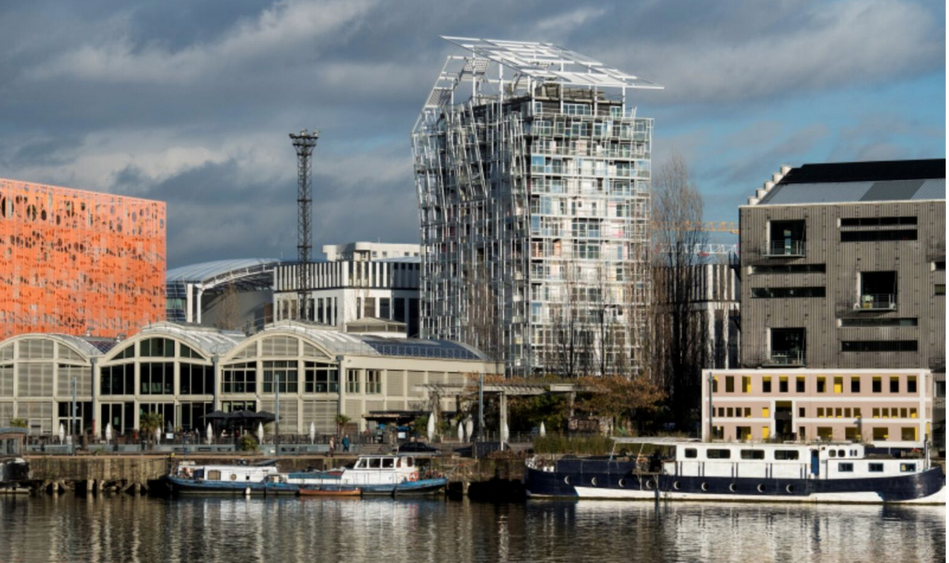
Residential building called Ycone, at center right, by Jean Nouvel, in Lyons, France. (Nouvel)

A few days ago a correspondent asked me whether I’d seen modernist architect Jean Nouvel’s latest building in Lyon, France’s third largest city. Finished in 2019, it is an apartment building called Ycone, and looks like a work in pickup-sticks. The instigator of our conversation about Ycone, Anthony Daniels, pointed me to Jean Nouvel’s writing about it and asked, “Do such people actually have thoughts that correspond to their words?”

The link from a website called aasarchitecture.com, whose text is taken directly from Nouvel’s website, answers Daniels’ question with a resounding no. Here are some of the more obtuse (probably meant to be abstruse) passages:

[W]e’re not making sense for today, but for a programmed future – with all the risks that that implies: in urbanism, things that are programmed can vanish without a trace from one day to the next. What I’ve tried to do, then, is develop positive features.

How can this possibly represent what Nouvel’s really thinking? “We’re not making sense for today”? Things can “vanish without a trace from one day to the next”? Is he warning that this may happen to his building? Still, he’s developing “positive features.” Will they exist one day, then maybe not the next day? So who is he planning to sell the units to? Other figments of his imagination?

I tried to turn the building round a bit, to push it to one side, then push it to the other side, to work out how I could set off a positive conversation with the neighbouring buildings.

This is archispeak boilerplate. Nothing to see here, except for the neighboring buildings, which look incapable of positive conversation with anything. Fortunately, Ycone will be surrounded by tall trees to block views of the neighbors, no doubt preserving their ability to converse politely.

We need to preserve the distant landscapes, and several apartments will be able to enjoy them; and we need to preserve the close-up landscapes too.

So the distant landscape for those living atop Ycone will be preserved, but for those who live in the distant landscape the view will be wrecked by the Ycone. Perfect! And let’s preserve the close-up landscapes, too. You can see them in the photo atop this post, but since any of them can (and should) disappear on a day-to-day basis, you’d better look quickly or they may be gone.

The first creature comfort is not to be at the mercy of your neighbours. Everything that goes towards protecting privacy, private life, is paramount. With that in mind, you don’t just create façades that residents can draw the curtains across. We need to find ways of living under the watchful eyes of others. We also need to create features that allow us to say I’m at home here and everything’s different because I’m at home.

By neighbors this time Nouvel means not the neighboring buildings but your actual next-door neighbors. But don’t draw your curtains. You need to open yourself to the watchful eyes of others – so that they’ll know that “everything’s different because I am at home”!

In another passage about living in Ycone, Nouvel writes:

There’s a way of projecting yourself into a depth that means telling yourself: maybe I could live here and have an impact on this chosen spot.

Does that mean spending more time in the bathroom or in a closet so that your neighbor can’t keep track of you? What does having “an impact on this chosen spot” mean? Does that mean tidying up a bit? Or using your apartment as a bomb factory? That would probably mean closing your curtain, but closing your curtain might mean that your neighbor might not fall in love with you (you, not your apartment; this is not the Soviet Union, after all). Choices, choices!

Regarding the look of the building, Nouvel writes:

Ycone plays down similarities and creates differences – in light, feel, and of course, planes – even if the differences are slight; above all it plays on differentiation, at the level of each objective element.

More archispeak. Nothing to see here. In fact, this whole exercise has become a bit tedious, like shooting fish in a barrel, and no doubt trying the patience of readers. When am I going to get to the April Fools part, where I reveal that this is only a joke. Except that it’s not a joke. Ycone really exists, and the above recorded absurdities are actually what Nouvel has said about it – no telling what he really thinks. So in a sense this is an April Fools joke, but true. Ycone and Nouvel are jokes that keep on giving beyond April 1. But at least Ycone was built amid a setting of almost equally ridiculous buildings. Lyon seems to have kept Nouvel away from the old city center, which may be viewed below.

The old central district of Lyons; Ycone is in a development district beyond the city center. (Wikipedia)

Posted in Architecture | Tagged , , , , | 6 Comments

Rebuild Penn Station update

Relocated Madison Square Garden, center, near rebuilt Penn Station, beyond. (Cameron)

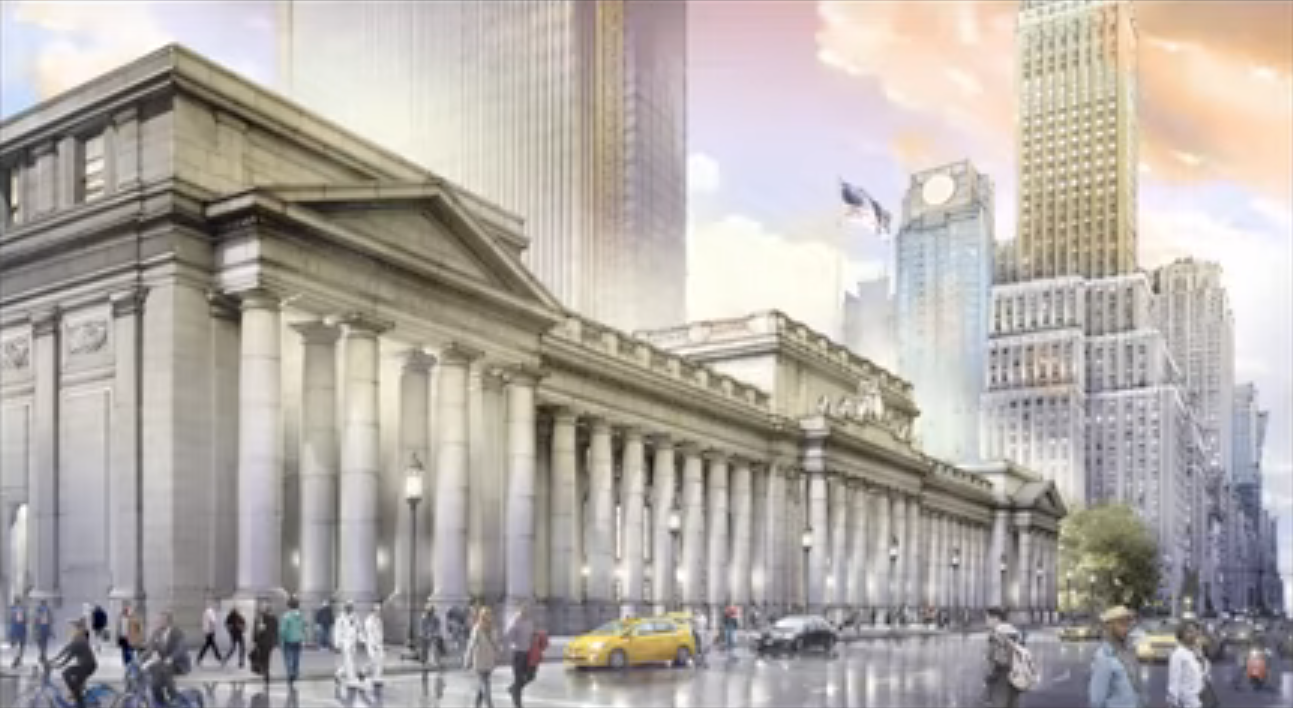
First voiced publicly by architect Richard Cameron, the plan to rebuild New York’s Pennsylvania Station as conceived by the firm of McKim, Mead & White remains in the chaotic mix of plans to renovate the existing station. The beauty and profundity of Cameron’s idea springs from the power of the memories and hopes of every American who ever passed through its classically grandiloquent waiting hall, or who has seen photos or Hollywood films displaying its grandeur, and who yearn to behold it once again.

Penn Station was completed in 1910 as designed by Charles Follen McKim, and demolished in 1963-67 in an act of cultural desecration unequaled before or since in the U.S. Millions of travelers suffer its tawdry, cramped replacement. “One entered the city like a god,” said the historian Vincent Scully, “now one scuttles in like a rat.” The historic preservation movement in America may be traced to the travesty of Penn Station’s demise.

Cameron was recently invited to update his project for guests and members of the New England chapter of the Institute of Classical Architecture & Art. His lecture, entitled “Miracle on 34th St.,” after the old holiday movie, was hosted by chapter president David Andreozzi, delivered on Zoom, recorded, and is now available to be viewed, along with an extensive Q&A at its conclusion.

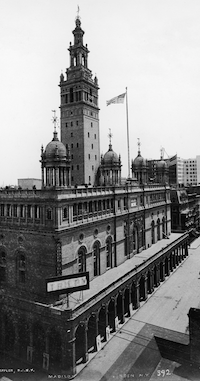
Madison Square Garden of 1890-1926. (MSG Networks)

The vision has expanded to deal with the vexing question of what to do with Madison Square Garden arena, which squats atop the station’s ticketing and waiting areas, beneath which are the boarding area, tracks and the infrastructure that remains from the original. Cameron has worked along with ReThinkNYC on a broad, systemic reconception to bring the train lines entering and leaving Penn Station into the 21st century. Part of that would be to relocate Madison Square Garden to one of three sites. The best is half a block from Penn Station. You would exit the station, cross Seventh Avenue, enter Hotel Pennsylvania to reach the Garden, all underground. Beyond the Garden would be Greeley and Herald squares. Today the site is occupied by a host of uninspired commercial buildings. The new Garden, with a retractable domed roof, could be rebuilt in a form inspired by the 1890 design of Stanford White, also of McKim, Mead & White, which was razed in 1926. (White was murdered by a former lover’s husband during a musical event at its roof garden in 1906.)

Imagine a district with the rebuilt Penn Station, the Moynihan Train Hall next door, a new Madison Square Garden (these last three all originally designed by McKim, Mead & White), a Bryant Park-style space across 35th Street from the station, flanked by a new pair of matched classical towers, the Hotel Pennsylvania and the many traditional and classically styled commercial buildings that survive in the immediate area, not to mention the Empire State Building. The scene would be set for a new Manhattan district, harking back to the popular World’s Columbian Exposition of 1893 in Chicago, which drew 26 million visitors in a nation of 63 million (before air travel), and the City Beautiful movement sparked by the classical urbanism of that famous world’s fair. The new district might be christened Empire City or Empire Station – the greatest entertainment and transportation complex in the nation if not the world.

Cameron’s plan, if carried out, would be the project of the century, and could revolutionize American attitudes toward how cities are built for popular appeal. But powerful interests want to goof up the already regrettable train station with modern architecture – some of it so absurd that you can’t tell up from down – and line nearby streets with commercial glass towers that will throw shadows over the station and block views of the Empire State Building down 34th Street. That would transform even more of the city into sterile gulches of the inhumanitarian ugliness that would tilt Manhattan toward a metasticizing Hudson Yards of the future very few people would actually like to see.

It has been estimated that rebuilding Penn Station by itself would cost $3.5 billion, less than the $4 billion PATH station at Ground Zero – the dinosaur skeleton designed by Spanish architect Calatrava – that serves a tiny fraction of the riders that use Penn Station. Part of that money and the money to redevelop the district would be raised by selling the air rights in the vicinity. Property values would soar near Penn Station as if it were a new Central Park of land speculation. Surely the $3 trillion infrastructure bill in Congress would tip its hat to President Biden, a noted lover of trains and mass transit, including Amtrak. For a project that could very well unite a divided country, and reform the linchpin network of rail lines on the Eastern Seaboard from Boston to Washington: perhaps it’s time to set up a meeting with Biden’s transportation secretary, Pete Buttigieg.

First, however, Cameron and his associates need to promote his plan to the hilt, pedal to the metal. He has already put it in front of many New York decision-makers. More of that will be required. Social media must play a role. It has been said that a tweet by someone with millions of followers such as Beyoncé or Oprah can strap booster rockets on any proposal, let alone one so obviously, intrinsically sensible as this. Who’d be best came up in the Q&A after Cameron’s lecture. Or, better yet, try them all. Anybody with one name. Barack, Michelle, maybe even the Donald, with his experience as a developer. To rebuild Penn Station is a global ambition. The sky’s the limit.

Speaking of the sky, did you know that the entire Grand Central Terminal could fit inside the waiting room of McKim’s Penn Station?

That one fact sold me.

Rebuild Penn Station. Rebuild New York City. Rebuild America.

Graphic of Grand Central Terminal fitting inside Penn Station waiting room. (Reddit)

Rendering of the proposed rebuilt Penn Station. (RPS/Jeff Stikeman)

Posted in Architecture, Development | Tagged , , , , , | 17 Comments

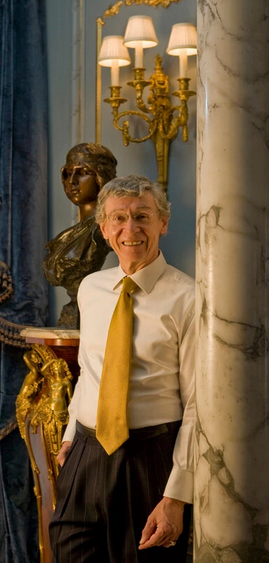
Richard H. Driehaus, R.I.P.

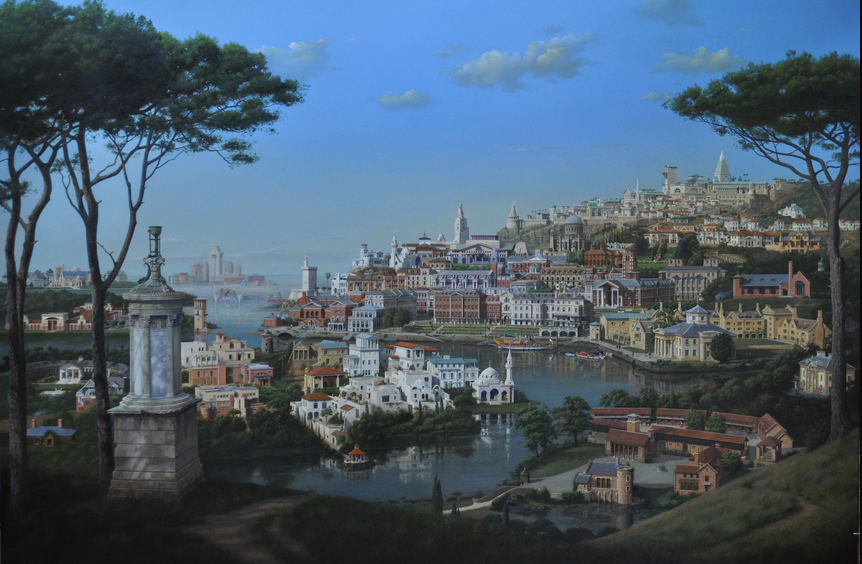
“A Classical Perspective” (2012), capriccio by Carl Laubin. Click to enlarge. (Driehaus)

Richard Driehaus, who died suddenly at age 78 of a cerebral hemorrhage at home on March 9, was beloved among architects and historic preservationists for his stewardship of old buildings, especially the relatively unsung treasures of his native Chicago. The Windy City is over-celebrated for its modernist buildings, and yet in their dark shadows survive many historic structures, no small number of which have been preserved by the prodigious Driehaus generosity.

Richard Driehaus (NYT)

He is most well known for having founded the Driehaus Prize, which yearly since 2003 awards a single architect for a lifetime of work in the classical and traditional languages of architecture. The modernist Pritzker prize, often called the Nobel of architecture (a misnomer, as Alfred Nobel intended to reward work that benefited society), comes with a stipend of $100,000. Every year critics like me take joy toying with the fun fact that the Driehaus stipend is twice as valuable (in sheer monetary terms): $200,000. A Pritzker prize can make a career more lucrative in today’s world than a Driehaus prize, but each individual Driehaus laureate could make the world more beautiful than the entire slate of Pritzker laureates all rolled together in one.

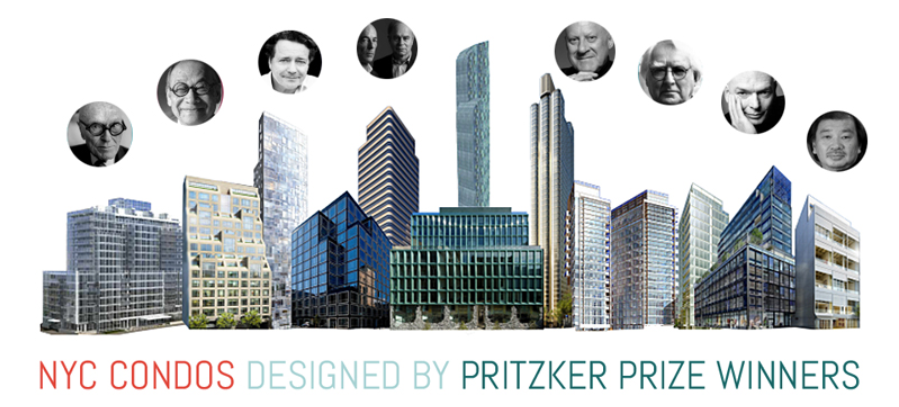
To prove it, the painter Carl Laubin was asked by the folks at Driehaus and at Notre Dame, whose school of architecture administers the Driehaus program, to do a capriccio of the work of the first ten Driehaus laureates. That painting sits atop this obituary. At the bottom is a collage of work by Pritzker prize laureates. Although you can compare them to each other, there is simply no comparison. Period.

I saw Laubin’s painting at the 2013 Driehaus celebration of the prize for Thomas Beeby. There, on an unforgivably rare trip to my native city of Chicago (we moved to the District of Columbia when I was two), I met Driehaus after the ceremonies for Beeby and David Watkin, the British historian who won that year’s Henry Hope Reed award ($50,000 for a non-architect who has cultivated the traditional city, its architecture and art through writing, planning or promotion). We had a very brief conversation.

He was clearly a gentle and civilized person, even if he was (or maybe because he was) a financier. By age 13 he had parlayed money from a paper route and his boyhood coin collection (noted in an excellent NYT obit by Sam Roberts) into his own stock portfolio, and from there over several decades he grew a fortune in mutual funds. (His firm now oversees $13 billion in assets.)

Here are several quotations from the Book of Driehaus as set forth by Timesman Roberts in his obituary:

“I believe architecture should be of human scale, representational form and individual expression that reflects a community’s architectural heritage,” he told the architect and urban designer Michael Lykoudis in an interview for the Institute of Classical Architecture & Art in 2012.

Asked whether he considered modernist buildings designed by Ludwig Mies van der Rohe, for example, to be appropriate, he told Architectural Record in 2015: “They’re mechanical, industrial, not very human. It’s like my iPhone, which is beautiful, but I wouldn’t want the building I live in to look like that.” He added: “Architects build for themselves and build for the publicity. They don’t really care what the public thinks.”

“The problem is there’s no poetry in modern architecture,” he said in an interview with Chicago magazine in 2007. “There’s money — but no feeling or spirit or soul. Classicism has a mysterious power. It’s part of our past and how we evolved as human beings and as a civilization.”

It is, naturally, too early to tell whether the Driehaus prize program, or the many other charitable, preservation and art organizations that he has helped over the years, will enjoy support from the Driehaus organizations going forward. The good work already done by the great philanthropist on behalf of beauty in the world stands head and shoulders above that done by most individuals.

But it is not too early to recognize that citizenship does reflect hierarchy, no less in human society than in classical architecture. Citizens are ranked, naturally and inevitably, for the good they do – as a building or the virtuosity and placement of its decorative elements do for the beauty of a street or a city. It is perhaps easier to view this hierarchy on the face of a building. Among citizens, Richard Driehaus must certainly rank up near the apex of the hierarchy of those who strive to bring enlightenment, in the form of beauty, to our human race. May he rest in peace.

Collage of NYC condos by Pritzker prize winners. (6ftsq)

Posted in Architecture | Tagged , , , , , , | Leave a comment

Save secret park in Lisbon

The Tapada das Necessidades, in Lisbon, at risk of perilous renovation. (Wikipedia)

One of the worst things that can befall a dear old municipal park and garden is for “preservationists” to ride to its rescue. First, it may not be in need of rescue. Second, the preservationists are likely to want to “update” it in ways completely averse to the park’s native personality. That is, if preservationists in Lisbon are anything like preservationists in Providence. (Though that regret is belied by recent, excellent work to renovate Prospect Terrace here.)

“Luncheon in the Grass” (1863), Edouard Manet

Things look bad for Lisbon’s Tapada das Necessidades, which originated in 1742 as a hunting preserve for royalty, and is now the grounds of the Portuguese Ministry of Foreign Affairs, housed in the Palacio das Necessidades. The Baroque palace was built after the 1755 earthquake and tsunami that wrecked a lot of the old city, including the original palace. In its heyday, the royal garden is said to have inspired Manet’s “Dejeuner sur l’Herbe” (1863), “Luncheon on the Grass,” which is considered by many the first descent of the Expressionists into modernist painting. Or at least that’s what some experts say, though I can scarcely see how by looking at it.

Today, the park is considered a hidden paradise unknown even to Lisbonites (Lisboetas). Here’s a passage from a brief article on a droll website called “Where tto go to,” with the two t’s in the second word rendered as stick people:

As soon as you step inside, you will be greeted by ducks, gooses, abandoned beautiful buildings, exotic plants and trees, and a large playground, picnic area where everyone is at ease.

Elegant bench, with moss, in garden.

Anyway, it does not seem that the Portuguese have done all that much to keep up the park (which may be for the best) and it has fallen into disrepair. But that is no excuse to wreck the place. My correspondent in Lisbon has now furnished me with details of the proposed renovations on its 24 acres, and since part of the plan consists of a tedious modernist building (designed by the regrettable Pedro Reis), a big tot lot to distract children from the park’s natural wonders, and the demolition of the old zoo, it is easy to imagine a host of smaller unnecessary upgrades. For example, renovation of gorgeously articulate park benches bearing such flaws as delicate moss that would need to be expunged, or perhaps replacing the benches altogether with the typical graceless, sterile items, and don’t forget to add arms to prevent people from lying down on them. I am reminded of the Art Nouveau bus kiosks of downtown Providence, now long gone. There are dilapidated little buildings of no discernable use throughout the grounds of this Lisbon park that beg to be left alone. Only the graffiti should be gently extirpated.

Maria Isabel Rocha sums it up beautifully:

As we have seen in other cases, after a time of prolonged neglect, there is an unbridled fury of redoing, instead of recovering and requalifying, for fear of appearing old-fashioned, in the impulse to make modern. The desire to erase the wrinkles of the past, this sterile pretentiousness of change for change’s sake, undoes the sense of belonging and identity. All that remains is the fatuous shine of a few vanities and the nastiness of greed, while nostalgia advances like a shadow over the city, which is increasingly cosmopolitan, increasingly artificial.
.

The Lisbon city council has received and approved the plan but it is possible that popular dissatisfaction could thwart bringing this misadventure to fruition. Portugal is no longer a monarchy, or so I gather. There is a petition that has gathered some 6,200 signatures in just two weeks. As with many cities in the United States (including Providence), Lisbon seems to be unaware that citizens begging for relief from covid do not need their governments to spend extravagant amounts on unneeded projects of use mainly to architects wanting to burnish their portfolios with work that only their mothers could love.

Let Tapada das Necessidades be Tapada das Necessidades!

Park in foreground with Lisbon spread out in distance.

Posted in Architecture, Landscape Architecture | Tagged , , , , , | 5 Comments

How architecture evolves

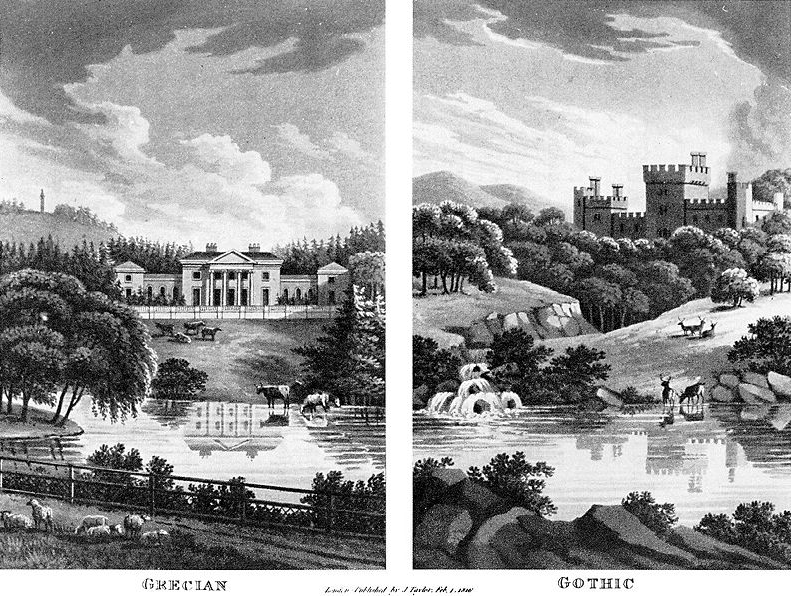
“Grecian and Gothic” – a charming description of this engraving is at the end of this post. (Wikipedia)

Here is a quotation about the evolution of architecture from “The Biological Fallacy” of Geoffrey Scott’s The Architecture of Humanism (1924):

Decadence is a biological metaphor. Within the field of biology it holds true as a fact, and is subject to law; beyond that field it holds true only by analogy. We can judge an organism by one constant standard – its power to survive: a power that varies in a known progression, a power of supreme importance. But even here – where the sequence of immaturity, prime and decay is a fact governed by predictable law – the power to survive is no test of aesthetic quality: the fragile unfolding of a leaf in spring, its red corruption in autumn, are not less beautiful than its strength in summer. And when we have to deal, not with a true and living organism but with a series of works of art, the tests of evolution are even more misleading. For here we ourselves define the unit which we estimate. We have to be sure that our sequence is really a sequence and not an accidental group. We have to be sure that there is a permanent thread of quality by which the sequence may at every point be judged, and that this quality is at each point the true centre of the art’s intention. The mere power of an architectural tradition to survive – could we estimate it – might be a permanent quality but hardly a relevant one; for the successive moments of an art are self-justified and self-complete. To estimate one by reference to another is a dangerous method of criticism.

His next chapter, “The Academic Fallacy,” begins:

“There are in reality,” says architecture’s principal historian, “two styles of Architectural Art – one practiced universally befoe the sixteenth century, and another invented since.” To the former belong “the true Styles of Architecture,” to the latter “the Copying or Imitative Styles.”

Renaissance architecture is imitative. It is more imitative than any style of building that preceded it.

To better understand Scott, let’s recall that he was writing in 1924, or prior to it, during which period there was very little modern architecture on view anywhere in the world. It is considered axiomatic, even today, that architecture evolved to its current modernist inanity by steps that each forecast its increasing alienation from traditional forms that Scott and many others say were already imitative, but that prior forms were less imitative: until we arrive at the complete rejection of imitation represented by modernism. Here is the problem with that:

Almost no architecture is strictly or exactly imitative. It does not “copy the past,” unless as a reconstruction or restoration. Architects may decide to diverge from past forms, and have done so both previous to and since Scott’s line of separation at the Renaissance. At that time, architects imitated the classical architecture of the ancients, using ruins and Vitruvius as their guides. But what about Gothic? What about Romanesque? Did those architects and builders have pattern books to look at, or did they use drawings of earlier buildings so as to copy them? No. Every architect used creativity of one degree or another to build structures that accomplished a set of intended practical purposes, and shaped them or decorated them following their own response to previous forms, which may have hewed near or far from what architects built before them, depending on their genius.

At some point allegedly connected to the so-called Picturesque or Romantic or Baroque period(s), it is said that architects began to incorporate meaning into their forms in ways they allegedly never did before. It seems difficult to point to some work of architecture whose designer actually did this. In every case he can be said to have copied buildings of greater or lesser similarity to the one that he contemplated, or conjured them up in his own mind, inspired by memories of buildings he had seen before, both as to their form or their decoration. Until late in this period, there were almost no schools of architecture.

In no case would any architect, forced by his sense of the purity of form or by a sense of the size of his budget, strive to pare its embellishment in a manner that architectural historians (looking backward) have imagined as looking forward to even more simplicity of form.

Apart from features ordained by the proposed use of a building, including decor that symbolized the user, no meaning adheres to any building that springs from the intention of its architect. Architecture evolves, but only in retrospect, and that retrospective view has raised many fallacies in the study of the history of architecture. Scott’s biological fallacy tells us that the rise and fall of architecture is not the same as the rise and fall of a leaf upon a tree. There is less intent in the latter (except perhaps in the eye of God), but the human intent in architecture is subservient to practical considerations, and the embellishment of its form copies the past but does not predict its future.

However, Scott is wrong that imitation is a sign of decline in architecture (if indeed that is what he is saying). Only with modern architecture did meaning gain an ascendancy, and, in a paradox, that ascendancy represents a notable decline in the quality of architecture as properly judged. This decline was accompanied by a retreat from imitation, from inspiration. It is properly called “anti-architecture,” in the formulation of Nikos Salingaros. It is easy to see in modern architecture the poverty of art and of human imagination that was abundant before its rise. But we can forgive Scott because he would hardly have been aware of architecture’s doom in 1924.

I think I am wandering out into the tall grass here, and I assume readers will kindly identify what I am missing.

***

Here is Wikipedia’s description of the image atop this post:

A Feb. 1st 1816 print (published J. Taylor, London) which exemplifies the contrast between neo-classical vs. romantic styles of landscape and architecture (or the “Grecian” and the “Gothic” as they’re termed here). This engraved plate accompanied Humphry Repton‘s 1816 book Fragments on the Theory and Practice of Landscape Gardening.

Marianne Dashwood in Jane Austen’s Sense and Sensibility is a famous proponent of the romantic aesthetic, while Edward Ferrars in the same book says “I like a fine prospect, but not on picturesque principles. I do not like crooked, twisted, blasted trees. I admire them much more if they are tall, straight, and flourishing. I do not like ruined, tattered cottages. I am not fond of nettles or thistles, or heath blossoms. I have more pleasure in a snug farm-house than a watch-tower–and a troop of tidy, happy villagers please me better than the finest banditti in the world.”

Posted in Architecture, Architecture History | Tagged , , , , , , , | 4 Comments

Providence on suicide watch

Proposed mist ring above Waterplace; image does not show raising river walks by 11 feet. (Arup)

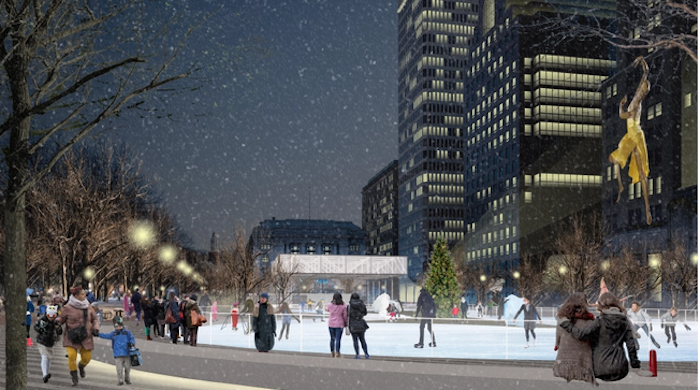
Each time news emerges of another plan to renovate Kennedy Plaza, Waterplace Park or other sites in downtown Providence, it gets worse and worse. Now there are plans costing upwards of $140 million to reconstitute Kennedy Plaza, remake Waterplace and demolish the skating rink, using cartoon architecture to suggest that the entire downtown be dedicated to children (as they say) of all ages. Many riders of the city bus system, however, would need to walk farther to bus stops and transfer at two new downtown bus hubs to reach their destinations.

That was the gist of “Splash park, mist ring part of plan for reimagining Kennedy Plaza, Waterplace Park,” an article on the front page of last Thursday’s Providence Journal. “And when WaterFire returns,” it reads, “you’ll gaze up at a giant ring suspended over the basin that sprays mist down upon spectators.”

WaterFire is often cancelled if there is rain. What if the performance stage at the center of the basin leaves too little room to maneuver for the boats that fill the burning braziers of WaterFire with wood or the tour boats and gondolas? Suppose visitors to the park don’t want to get wet? (See image above.)

The plan would raise the river walks around Waterplace by 11 feet to avoid floods in case sea levels rise, leaving the river in a deep gulch likely to reduce its safety and allure. It would link Waterplace to Kennedy Plaza with a “mini-High Line” bridge over the old Capital Grille parking lot. But you would still have to cross Memorial Boulevard because the two pedestrian tunnels from Waterplace to the skating rink – considered unsafe by experts – would be closed. The rink and its turreted pavilion would be demolished for a skateboard park and basketball courts. The rink would be moved to the plaza and rebuilt in a “serpentine” shape. The intermodal terminal would remain but the Soldiers and Sailors monument would apparently be relocated. A café, stage and visitors center with a box roof similar to those over gas station pumps would occupy part of the plaza.

The only admirable part of the plan is that Washington Street between the plaza and Burnside Park would be eliminated. Traffic would circle around existing streets. Alas, instead of extending the park and its greenery to the plaza (a step I urged in 1992), creating a sort of mini-Central Park, the plaza’s hardscape would be extended to the park.

All of this is too much, with too little thought given to how the pieces would fit together, or whether any of it is desirable, let alone necessary at a time when the city’s budget is terribly constrained. But Mayor Jorge Elorza is gung ho:

“We know that the Kennedy Plaza space has been the center of our city geographically, but it has never fully been the center of our city culturally,” Elorza told reporters at a Wednesday briefing. “In our mind’s eye, we have never had that city center in Providence that the other cities that we have all fallen in love with throughout the world have.”

Both halves of the mayor’s statement are wrong. Kennedy Plaza, Burnside Park, Waterplace Park and the skating rink have been the cultural center of Providence for nearly three decades. Thousands go there to enjoy themselves at festivals, concerts, ethnic celebrations and other events throughout the year. The mostly traditional buildings that surround our civic square, the pair of traditional buildings sited inside of it, and the classical statuary scattered within it, provide citizens with a grand place to gather akin to London’s Trafalgar Square, the Piazza Navona in Rome, and the Piazza San Marco in Venice. We could raise it toward the aesthetic level of those places, but instead we seem eager to distance our central square from those and other lovely models shaped by history.

My family and I ran into candidate Elorza in 2014 when he first ran for mayor at a carnival of the Holy Ghost School on Federal Hill. I asked him if he would favor development projects that fit into the city’s historical setting. He said yes. But he has not. So the city grows uglier. Now he wants to make it even worse. He should ask his planning director to resign, and cancel the city’s contract with Arup, the nutty London-based engineering firm that has produced this travesty. Many plans don’t die, they just fade away, like the uber-modernist Downtown Providence 1970 Plan. This one should, too, and the sooner the better. Or poor Bill Warner may never stop spinning in his grave.

Kennedy Plaza with relocated skating rink proposed cafe with gas-station style roof. (Arup)

Posted in Architecture, Development | Tagged , , , , , , | 30 Comments

St. Florian switches on cottage

Latest design of cottage and additon, top, and, bottom, design as recently as Dec. 14. (St. Florian)

Last night’s special meeting of the Providence Historic District Commission to consider the dear little cottage at 59 Williams St., off Benefit, shows that the city’s process for development projects can work.

Last year, a developer proposed moving the 19th century Italianate cottage closer to Williams Street to enable two or three townhouses to be built behind it, facing John Street, threatening a longstanding wooded area. Residents of the historic neighborhood on College Hill opposed moving the cottage. The commission urged the developer not to move it. It will not be moved. That was the first victory of the neighbors, led by resident Lily Bogosian.

The developer also proposed an addition to the cottage unsympathetic both to it and to the historical character of the neighborhood. The commission sought revisions. Providence architect Friedrich St. Florian revised the addition, adding to its disconsonant appearance. The neighbors and the commission pushed back. St. Florian made it even worse. The commission sought more revisions, and again St. Florian made it worse. The commission sought more revisions. This time, St. Florian changed his approach and submitted not just revisions but a new design for the addition much more sympathetic to the historical character of the cottage and the neighborhood. This was the second major victory of the opponents.

Gone was almost every modernist touch. On the addition, the slant roof gave way to a gabled roof. The single-pane windows gave way to four-over-four windows similar to the cottage’s six-over-six. The addition’s vertical-slat siding gave way to horizontal clapboards similar to those of the cottage. The massing seemed less suburban and more in line with how house owners historically added to their domiciles bit by bit over time. The major changes can be summed up in few words, but their visual impact was compelling.

The switch must have been difficult for St. Florian. While he made his reputation and fortune* with traditional designs for the Providence Place mall and the National World War II Memorial (in Washington), he started his careeer as an academic modernist at RISD with mostly unbuilt abstractions in his portfolio. Since scoring big with his popular downtown shopping mall and his national memorial, he has done some modest local work, mostly modernist in style.

Why did he reverse course on the cottage addition? The pushback from both the neighborhood and the commission was not clear or strong. The neighbors were hesitant to challenge the celebrated St. Florian and reluctant to demand that the addition fit into its setting. Some neighbors were not necessarily uncomfortable with a modernist style, others were worried more about saving the woods; they seemed unaware that introducing ugliness would tend to undermine their own property values and degrade the charm of the woods – which were slated to be eliminated anyway to make way for the townhouses at a later date.

Some members of the commission may have had similar views, but as a body the HDC seemed content to kick the can down the road with minor objections.

Given the lack of clarity in the stance of both the neighbors and the commission, why did St. Florian not keep ramping up his modernism until the commission cried uncle? I would like to think he had a “road to Damascus” moment, but the developer probably was growing tired of the expense. “I’ve never had to go to five commission hearings” for one project, St. Florian exclaimed. The commission gave the project final conceptual approval, pending a subcommittee pondering members’ concern for certain important details.

Almost every commission member had listed major improvements they would like to see in a design whose new direction they all generally approved. These included restoring rather than re-siding the cottage clapboards, including roof brackets; restoring rather than replacing the cottage windows; changing the roof shingles on both cottage and addition from black to an earlier reddish/brownish color; restoring rather than replacing the cottage’s pair of chimneys; keeping the original windows in the cottage’s south façade rather than replacing them with a pair of doorways; replacing the single-pane door with side lights to something more sympathetic to that of the cottage, to name the most important. I would add making the wider clapboards on the addition narrow to match those of the cottage. But the revisions had already come a very long way.

Commission chairman Michael Marino mouthed a conventional modernist piety, saying “I don’t want the addition to have a fake sense of history.” Then what is this exercise all about? Preservationists should emphasize continuity, not contrast, because continuity respects the original architect’s work and preserves the setting in which it stands. Which is what preservation is all about.

The extent of the changes that return the project to continuity from its recent perilous approach to contrast can be seen in the two drawings atop this post. As preservationists, the commission has done its job. But the neighborhood should not rest on its laurels. The townhouses proposed by the developer are still early in the permitting process, but under St. Florian they have gone through the same increasingly discordant versions. Let the commission and the neighbors gird their loins for more good work. Let them be inspired by the photograph below.

*See comment by Stanley Weiss below.

The gracious, modest cottage at 59 Williams St., said to be from circa 1870. (PHDC)

Posted in Architecture, Development, Preservation | Tagged , , , , , , | 8 Comments

After Biden nix Trump E.O.

Harris poll on American architectural tastes. Humphrey Building (l.); National Archives. (Harris)

Architecture is a huge field of human endeavor. Along with the planning of cities and towns, and the arts and crafts that enter into civic beauty, it forms the stage on which the human comedy is performed. For millennia, our dear species has botched most of what it has touched with its failure to solve or alleviate many of its problems, from poverty to war to disease and beyond. But until a century ago, few would have argued that the stage upon which these failures unfolded was part of the problem.

At least suffering humanity could look around and see beauty, lots of it and for free. Architecture may be said to have uplifted the soul. Now the queen of the arts has joined the long list of human failures, and the stage set has been taken over by architecture based not on nature or humanity but on machines. Much of the old beautiful world has been replaced by a cockamamie sterility that neglects old problems and inspires new ones. At worst, the new architecture seems to beckon humanity toward an authoritarian future, if not planetary extinction.

With its generally tedious qualities, modern architecture has caused people to turn away from their built environment as a sort of defense mechanism. Local efforts to enable participation in development projects, fostered from above or below, have largely failed to arouse much interest from the public, so our local environments continue to go from bad to worse.

Are we doomed to remain on this path? So it might appear. Donald Trump signed an executive order on Dec. 18 to mandate a return to beauty, at least in federal architecture. His successor, Joe Biden, revoked it on Feb. 24.

But beauty is a widely approved commodity, and even its erosion in recent decades has boosted its premium. Scientific research and academic studies have fortified centuries-old anecdotal evidence that most people prefer tradition over novelty in how we build the civic realm and our own private domiciles. Most recently the Harris Poll showed that classical architecture is favored by almost 75 percent of the public in every demographic category surveyed. The human brain is hard-wired to prefer the characteristics of architecture that have evolved over centuries by natural processes that reflect the reproductive patterns of species in human neurobiology. On the other hand, skepticism of architecture that “starts from zero” is widespread.

Biden’s revocation of the Trump mandate to prefer classical and traditional design for federal courthouses and offices in Washington, D.C., and around the nation does not mean a halt to efforts to bring beauty back into the ambit of architecture. Pressure toward that end remains strong. No party has a lock on beauty or how it can be returned to our built environment. Architecture can and should be a bipartisan or even a nonpartisan issue.

After details of Trump’s draft executive order leaked to the press a year ago, many classicists opposed it out of dislike for the president or for its design mandate, not realizing that it merely switched the existing mandate from architecture that is widely disliked to architecture that is strongly preferred by the public – a factor you’d think would be important in a democracy.

Classicists who opposed Trump’s order suggested alternatives, almost all of them quite reasonable, politically and programmatically. For example, an anonymous source at the time wrote me that the official principles that have mandated a modernist approach to federal design since 1962 could be transformed into a mandate for a level playing field for major commissions – which exists almost nowhere today. He identified a mere three changes in the language of the principles that would be required to do so.

Steven Semes offered a suggestion for a body modeled on the Building Better, Building Beauty commission in Britain that has just issued a set of mandates that, above all, engage local publics officially in the processes that vet and approve local development projects according to local ideas of beauty. The various suggestions for some new body of individuals experienced in the field of architecture to hash out a way forward probably appealed to most attendees at the recent Traditional Architecture Gathering. For example, TAG 4 featured a presentation by Rhode Island traditionalist David Andreozzi, who argued that combining cultural and contextual sustainability would produce an architecture of design resilience regardless of style. New Jersey architect Mark Alan Hewitt, who was also at TAG 4, has, in his upcoming column on the Common/Edge website, a long list of suggestions for the Biden team on the way forward in architecture.

All of these proposals might figure into a rumored effort to engage the Biden administration through a committee that would, above all, bring science to bear on reforming federal architecture. Nikos Salingaros, a mathematician at the University of Texas, has developed many of the neurobiological theories that support the affinity between humanity and traditional architecture. He would be involved in this committee with Mark Hewitt and others. Both were at TAG 4, which was run by Nir Buras of the Classic Planning Institute and author of The Art of Classic Planning. Buras was the anonymous source who suggested the changes, noted above, for the existing mandate on federal architecture. He has produced an extraordinary plan to turn the banks of the Anacostia River, sister of the Potomac in Washington, D.C., into a classical paradise that would serve some of the largely neglected black neighborhoods of the capital.

President Biden himself is a longstanding lover of trains and pitchman for public transportation, including Amtrak. Perhaps, as he seeks to unify the nation, he might be interested in another idea from TAG 4, to rebuild New York City’s crumbling, inhumane failure of a Penn Station in its original 1910 classical style, before it was demolished in 1963. That was the year after the 1962 mandate for modernist federal buildings. Such a project would teach millions of people a day that beauty is not lost to the past but is possible today. Now is the time to harness science to bring beauty and architecture together in the 21st century.

Posted in Architecture | Tagged , , , , , , , , , , , , | 13 Comments

TAG 4: Classical gears up

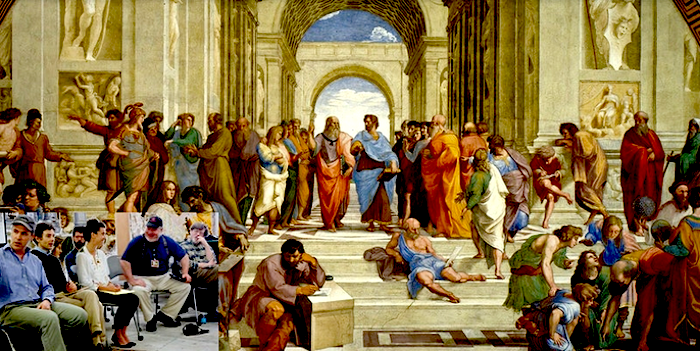
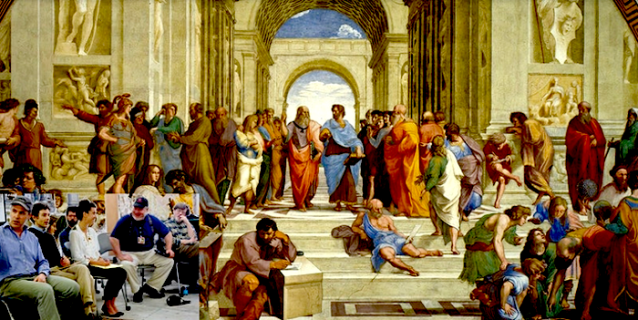
Raphael’s fresco of his colleagues as ancient philosophers. TAG 1 participants cut in at lower left. (museivaticani.va)

TAG 4, the fourth Traditional Architecture Gathering since the first, held in in Charleston, S.C., in 2015 for members of the TradArch listserv, happened on Zoom this past Friday, Saturday and Sunday, sponsored by the Classic Planning Institute. Some 600 signed up, of whom about 275 attended, including many from atop the fields of traditional architecture, urbanism, art and craft around the world, to discuss the revival of classical and traditional architecture.

From its roots in ancient Athens and Rome, classical architecture has bred a global set of traditions around the world, rising over hundreds and thousands of years. Within this profusion, the classical language now ranks as both the origin of and grand subset of tradition. Modern architecture, a mere century old, arose not only to challenge but to reject tradition, basing its worldview on the culture of the machine as opposed to tradition’s basis in nature. As many predicted, modernism has been a failure, and unpopular to boot, but it maintains a stranglehold on the field’s establishment.

The TAG 4 conference was a rollicking success, somewhat to my chagrin as a devoted hater of Zoom. I sat through almost all of it, staring at the screen till my bum was sore. Zoom presents problems that shine light on the problems of architecture: facial cues are minimized in Zoom; ornament is minimized in modern architecture. How do we join conversations on Zoom without rudely butting in? How do we add new buildings to the conversation of the street without elbowing nearby buildings? Classical and traditional architecture learned how to do this eons ago; modern architecture has yet to even acknowledge the need to fit in, to be polite, neighborly.

“The classical idiom,” wrote the late Sir Roger Scruton in The Classical Vernacular, “does not so much impose unity as make diversity agreeable.”

TAG 4 was funded by the Driehaus Foundation and run by its founder, Patrick Webb, with Nir Buras and Jaydean Boldt. They enforced a strict set of rules to ensure fairness on Zoom, and yet audience interaction with the panelists was not excessively robust, though the “after sessions” ran up to three hours each. Zoom may be here to stay, but upgrades are necessary. How to revive the sacrosanct courtesy of tradition, in architecture as well as on Zoom, was the underlying and often unstated theme of each panel in the conference.

This recollection of TAG 4 will be a hazy first draft of history. I have no recordings of the sessions and took no notes. In my struggle to join Zoom, I missed the great Léon Krier’s keynote address. I missed Ann Sussman, Don Ruggles, Mark Alan Hewitt and Michael Mehaffy on city beauty in a breakout room because I was afraid of logging off accidentally while switching “rooms” away from a panel on the future, which was, inevitably, inconclusive. Still, I found Zoom logging off on its own several times, and I used a link in an email from Ryan Stephenson to log back on each time. Since I am a monotasker, I did not use the chat room to chat for fear of missing insights from the flow of panelists’ presentations.

So I stayed in the main Zoom room and heard many scintillating discussions of the practice of tradition over generations and the growing body of neurological research that places science at the center of love, so to speak: the public’s natural preference for tradition. On the first day, Catesby Leigh, Bill Westfall, Robert Adam, Steve Bass, Lucien Steil, Nikos Salingaros and others wove together strands of theory that suggest why people prefer tradition and why, unlike modernist buildings, traditional buildings become more interesting the closer you get. Why? Because the nestled scales of generative form produce a wide variety of surfaces and detail-within-detail that characterize traditional buildings and urbanism. Even the doors and windows of houses that seem to mimic the human face bond our neurological synapses to traditional architecture. Eye tracking shows that our brains seek embellished surfaces and avoid blank surfaces. For modernists to reject tradition is akin to rejecting science – a rejection they would fiercely deny but which is obvious and undeniable.

On the second day, Michael Diamant, who runs the blog New Traditional Architecture, described his posts that continually update traditionalists all over the world with photographs of new work around the globe. His online map of new traditional projects is vital, as is his list of traditional architecture firms in scores of countries, with their websites. The information he provides has fueled architectural rebellions against the status quo in Sweden, Finland and elsewhere in Europe, and he has participated in creating a nonprofit to push that rebellion, called Arkitekturupporet or Architecture Uprising. Later that day, several young people in a panel of students and postgrads from abroad cited Michael Diamant’s influence on their decisions to switch coursework from modern to traditional architecture, or to learn architecture without architecture school.

Nicholas Boys Smith, who replaced Roger Scruton on Britain’s Building Better, Building Beautiful Commission (and then was joined by Scruton when the latter was reinstated after his ouster by cancel culture), described his organization in London. Create Streets promotes mandating community involvement in vetting local development projects, following up on efforts toward that end by Prince Charles. Boys Smith and Sir Roger made that the centerpiece of the final report of the BBBBC, Living with Beauty. (I was remiss to not include Boys Smith in my recent post on institutions working to return tradition to architecture and urbanism.) In importance, Living with Beauty might be the equal of the Trump mandate on classicism had it not been canceled by President Biden.

Absent that, to jumpstart the classical revival in the U.S., it is vital to build some new traditional structure of metropolitan scale to teach that beauty is available in our era, not a feature of life lost to the past. The most audacious plan is that of Nir Buras to entirely classicize both banks of the Anacostia River, sister of the Potomac. The plan was proposed dozen or so years ago. Later in the second day, day, architect Richard Cameron discussed his plan to rebuild New York’s 1910 Penn Station (demolished in 1963) in its original classical style by Charles Follen McKim. Yale recently built an equally ambitious pair of new classical (or rather, collegiate Gothic) campuses, designed by Robert A.M. Stern Architects. It offers a whole new immersive environment of stunning beauty, but in New Haven it is seen by a pitifully small number of people on any given day. A new classical Penn Station, used by hundreds of thousands of people from the around the region and the world on a continual basis, could be a game changer.

(The panel became distracted from the Penn Station plan by a looming threat to nearby Grand Central Terminal – a proposed modernist hotel of 80 stories designed by Skidmore Owings & Merrill intended to remind us of the Twin Towers. ArchDaily.com describes the design as “an interplay of solids and voids that reflect Grand Central Terminal’s iconic design to create visual harmony and cohesion between the two structures.” Huh?! That’s a perfect example, familiar to everyone at TAG 4, of the reality-challenged quality of modernist architectural discourse. The hotel must, of course, be blocked.)

It is possible that the recently rebuilt Frauenkirche (Church of Our Lady) and its civic vicinity, in Dresden, and the recently restored Berliner Schloss or Berlin Palace (in spite of its single ridiculous boring modernist façade) are giving new traditional architecture the sort boost in Germany that a rebuilt classical Penn Station would give to the classical revival in the United States. The two glorious German restorations were described by Bertram Barthel, co-chairman of the German chapter of INTBAU (International Network of Traditional Building, Architecture and Urbanism). Many architects are doing fine traditional work in Germany, including Sebastian Treese, the latest Driehaus Prize laureate, who with his wife and partner Julia closed TAG 4 on a very optimistic note.

To close the second day of TAG 4, we saw a documentary to be released this spring, “Built Beautiful,” based on Don Ruggles’s book, Beauty, Neuroscience and Architecture. Both the book and the film thoroughly denounce modern architecture from the aesthetic and scientific viewpoints, but engage in a sort of Stockholm syndrome, reaching out to modernists in the hope that together we can all rise above the style wars to achieve an architecture that solves the world’s problems. The third day’s TAG 4 featured presentations by architects David Andreozzi of Rhode Island and Daniel Morales of the Kentlands, a traditional town in suburban Maryland designed by Andres Duany, the guru of the New Urbanism. Both Andreozzi and Morales took approaches similar to that of the film. Both displayed a deep and eloquent skepticism of modernist work but deplored the style wars, hoping that modernist architects, who hold the whip hand in the field, will put aside their animosity and lie down biblically with the traditionalist lambs in a heartfelt new age of architectural kumbaya.

Not gonna happen, guys – and it need not happen because the key features of their approach are already embedded in the classical/traditional discourse. As demonstrated by the global scope of TAG 4, an expanding segment of the public is already capable of fitting their skepticism toward modernism into the context of both aesthetic and scientific explanations of that skepticism. Only confusion will result from such inside-baseball concerns as rejecting the word “modern” in favor of the more accurate “modernist.” It’s time to move on, and instead of trying to undo modernism’s dastardly theft of the word almost a century ago, use it instead to jujitsu the false discourse of modernism. We mustn’t surrender when the inevitability of victory is in clear sight.

We don’t want Henry Hope Reed – the late author of The Golden City – to spin in his grave. His book, published in 1959, was the first truly forceful riposte to what he called “The Modern.” Reed led the first effort to organize a determined opposition to modern architecture. His movement seems to be in the hands, for now, of the TAG – which sits at the nexus of so many people and groups devoted to reviving beauty in the world. I can feel his smile.

TAG 5 will continue to address these issues. By that time, Zoom will be more user-friendly. By that time, too, the Classic Planning Institute hopes to set up a structure called a Stoa, after the Greek word for marketplace. The final day of TAG 4 was devoted in part to planning the Stoa, debating whether its “stalls” should be arranged not only by subject matter and by organization, but, in view of the many international participants, whether languages beyond English can be more engagingly facilitated. TAG today, tomorrow the world.

Posted in Architecture | Tagged , , , , , , , , , , , , , , , | 9 Comments