Column: “The Rise and Fall of Penn Station”

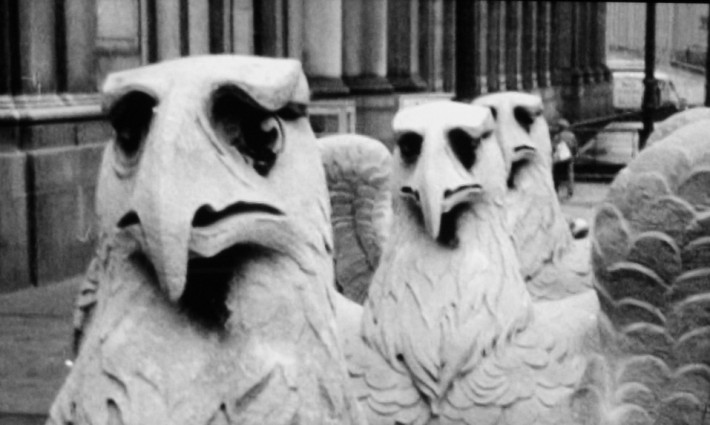
Eagles removed from Penn Station sitting on a flatbed truck, 1963. ("Rise and Fall of Penn Station")

Eagles removed from Penn Station sitting on a flatbed truck, 1963. (Courtesy of photographer Norman McGrath)

Before Pennsylvania Station opened in 1910, travelers headed for New York on the Pennsylvania Railroad, owned by the largest company in the world, had to debark in New Jersey and cross the Hudson River by ferry to Manhattan. It’s hard to imagine travelers brooking such inconvenience today. It’s just as hard nowadays to imagine the grandeur of the original Penn Station.

Inspired by the ancient Baths of Caracalla, in Rome, the project filled 28 acres (eight for the station itself) of the city’s Tenderloin: 500 buildings were purchased, one by one, in secrecy, to keep costs low before the depth of the pockets involved could become known. Designed by Charles Follen McKim of McKim, Mead & White, the station consumed 500,000 cubic feet of granite, 27,000 tons of steel, 83,000 square feet of glass window panes and 17 million bricks. Its main waiting room compared in size and in splendor to the nave of St. Peter’s. The entire station was intended to voice the grandeur of the city, the nation and the railroad.

“The Rise and Fall of Penn Station,” a PBS documentary by Boston’s WGBH, will run at 9 p.m. on Tuesday, Feb. 18. It was written, produced and directed by filmmaker Randall Mac-Lowery. The fascinating program focuses most of its attention on what arguably was the most dramatic aspect of the project: not the station but the tunnels, and especially the effort to dig them under the Hudson and East rivers.

To read the rest of this column, please visit The Providence Journal.

Posted in Architecture, Architecture History, Book/Film Reviews, Preservation, Urbanism and planning | Tagged , , , , , , , , , , , , , , , , , , , , , , | Leave a comment

Past blast: Video homage to Penn Station

Pennsylvania Station. (nycvintageimages.com)

Pennsylvania Station. (nycvintageimages.com)

Tonight I watched a PBS “The American Experience” presentation on the rise and fall of Pennsylvania Station, which I will preview for Thursday’s column and which will broadcast to the public next Tuesday. To gin readers up for that, enter the ol’ Wayback Machine. On March 14 of last year, my column discussed David Galbraith’s amazing video collage of clips of scenes from Hollywood films made at Penn Station before its infamous demise in 1963. The video is here. My column on it, courtesy of The Providence Journal, follows:

Video homage to Pennsylvania Station
The Providence Journal
March 14, 2013

This year marks the 50th anniversary of the demolition of New York’s Pennsylvania Station and the 100th anniversary of the opening of Grand Central Terminal. The crime of tearing down Penn Station – now widely acknowledged to be “an act of monumental vandalism,” as an editorial in The New York Times put it – may have helped preserve the life of Grand Central.

The new Penn Station, built underground and capped by the equally uninspired Madison Square Garden, should be ripped down and a new Penn Station built as a literal copy (with updated technology) of the old Penn Station by the great firm of McKim, Mead & White.

After the depressing new Pennsylvania Station opened in 1968, the architectural historian Vincent Scully wrote that “one entered the city like a god; now one scuttles in like a rat.” Unless one commutes in from the ‘burbs to Grand Central, where one still enters like a god.

So perhaps it was kismet that a few days ago, exercising my new iPod Touch, I found a video on YouTube called Penn Station, But Deliver Us From Grand Central.

The video, produced in 2008 by David Galbraith, lasts six minutes and 18 seconds, comprising 61 clips of scenes shot at Penn Station and sliced from old Hollywood movies made before its demise in 1963, then knit together with a style that evokes film noir. I found it so engaging that I posted it on my Journal blog, Architecture Here and There.

But having dispatched it to the Web masses, I could not stop looking at it myself. With each viewing its genius seemed to grow. It mesmerized me as effectively as any crowd scene.

But wait! There’s more! You also get Hollywood stars doing their thing – looking happy, puzzled, alert, pensive, worried, bored, hurried and, occasionally, mesmerized by the crowd.

On Monday, I asked my [then] colleague Froma Harrop to help me identify the movie stars. On Tuesday, before beginning to write this, I jotted a brief description of all 61 snippets, from the opening shot of the grand concourse, followed by the entry of Gregory Peck with Ingrid Bergman, who glances nervously over her shoulder in Spellbound (1945), and concluding with a shot of . . . but I will not give it away.

The film clips are spliced with such dexterity that one constantly detects a plot line emerging. Two different people in two different films run in the same direction along the identical stretch of concourse. A shot ends with a man glancing to his left, and in the next shot a woman from a different movie returns his glance. A scene of two station detectives suddenly turning around is followed by a shot of a man with that hunted look. This sort of thing continues almost to the end of the video, with no dialogue at all until . . . well, I won’t give it away.

Running like a leitmotif are clips of a man with a cigarette waiting for . . . something. He is in eight scenes in the video’s first half. Most will not recognize him. He is Jamie Smith as boxer Davey Gordon in Stanley Kubrick’s second film, Killer’s Kiss (1955).

Claudette Colbert, Judy Garland, Cary Grant and other stars show up along with Bergman and Peck. At first I thought Colbert was Lucille Ball. Froma corrected me. The man running down the stairs in a fedora, his overcoat collar turned up, looked like David McCallum from The Man from U.N.C.L.E. Probably not. We could not identify the woman with the luggage, or the sexy gal in a feathered hat ogled by a line of men as she jiggles on by. For some reason I thought she might be Ida Lupino. Nope.

Toward the end of this carnival of cameos, dialogue emerges when Bergman urges Peck to “act as if we’re taking this train.” They plot to sneak off, grab a cab to Grand Central for the train to New Rochelle. This gives Galbraith an excuse to splice in some shots near the end from Grant’s escape from New York via Grand Central in North by Northwest (1959).

The video concludes – I cannot resist telling – with four penguins discovered hiding behind a newspaper (“We’ve been ratted out, boys!”) and a zebra missing his train.

In these six blessed minutes of video the late Pennsylvania Station grants power to each scene. It is clear that one train station by which to enter Gotham like a god is not enough. Great as it is, Grand Central, which was born when Penn Station was 3, could use some brotherly assistance, yet again, to uphold the greatness of New York City. Rebuild Penn Station.

David Brussat is on The Journal’s editorial board (dbrussat@providencejournal.com). This column, with more illustrations, is also on his blog Architecture Here and There at providencejournal.com.

[After running the column and posting the video a year ago, many readers wrote in to fill in the blanks with the names of stars who appeared in the clips. Those emails vanished with the famous Brussat Journal blog. Feel free to do that again.]

 

Posted in Architecture, Architecture Education, Architecture History, Blast from past, Book/Film Reviews, Old Video, Preservation | Tagged , , , , , , , , , | 8 Comments

Old videos: Two from 1940s Rhode Island

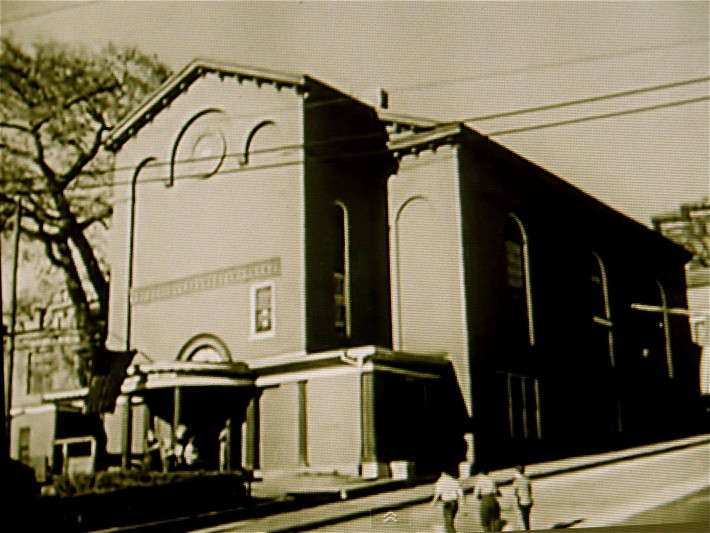
From "xxx," made in, I think, 1944.

From “Report From Rhode Island,” made in, I think, 1944. (YouTube.com)

Two old film clips of Rhode Island take viewers on tours of the nation’s smallest state – the smallest but not the least significant! The first is a propaganda film focusing on the home front and its values; the second is a historical tour of the state. Both lack the intrinsic fascination of the film of a San Francisco cable-car ride in 1906, but they both put old attitudes on display in ways today’s viewers will find, um, charming. For example, the first film’s segment on Newport displays an undisguised classism – that’s class-ism, not classicism! – that will raise some eyebrows.

The 1944 “why we fight” film is here. The “smallest state” film, from 1947, is here. Both are about eight minutes long.

By the way, can anyone identify the building seen at 3:07 minutes into the first film? It looks like it’s at the base of or farther up College Hill. A church? A former church? A school?

Posted in Architecture, Architecture History, Old Video, Preservation, Providence, Urbanism and planning | Tagged , , , , , , , , , | 3 Comments

No lampooning Lampoon Castle

Here is Hammersmith Studios' restored cartouche. (Photo by Susan Close)

Hammersmith Studios’ repousse cartouche on Lampoon Castle balcony. (Photo by Susan Close)

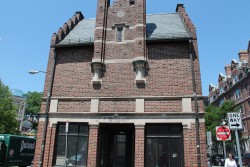
Lampoon Castle. (wikipedia.org)

Lampoon Castle. (wikipedia.org)

Among the most charming and beloved buildings in Cambridge is the old Lampoon Building (Lampoon Castle), where Harvard’s famous yuk-yuk club, the Harvard Lampoon, graduated, years ago, the founders of National Lampoon magazine. The building, designed by Edmund Wheelwright, a relation of one of the original Lampoon’s founders, opened in 1909. Its newspaper mocked everything and was, much like Jonathan Stewart’s The Daily Show today, the source of news for many young Americans. That may be a joke, too, but for our purposes it is neither here nor there. (But first let me add that in the photo at left, it is smoking one of those e-cigarettes. Naughty, naughty!)

The National Lampoon Building is a good example of the wit of classical architecture. But as with every building worthy of being called a building, let alone architecture, there is a serious side of the Lampoon. It was listed No. 5 on a list of ridiculously phallic buildings. (Oops, that sentence would be better off elsewhere.)

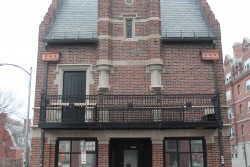
Before Hammersmith restoration.

Before work by Hammersmith.

Time may have aged it gracefully, but time also plays tricks, and the Lampoon Building needed a stay in the hospital. It hired the Boston firm of Albert, Righter & Tittmann for the work, and ART hired Hammersmith Studios, the forge run by Susan and Carl Close, who until recently were my fellow board members of the Institute of Classical Architecture & Art’s New England chapter.

After Hammersmith restoration.

After work by Hammersmith.

Susan has sent me news of their work in modifying the building to create another exit, which included work on the railing of the balcony of the Lampoon. The picture on top is of one of the open-book cartouches on its balustrade. Part of the job required fabricating the cartouche, which is an ornament designed to bear an inscription.

A book makes a fairly witty cartouche, an architectural use, you might say, of litotes – a term in rhetoric that means emphasizing something by understating it. For example, a lovely woman might be referred to as “not unattractive.” This is something that might be considered a species of jargon by the inhabitants of the castle. Humor requires knowledge, hence the book. Here is Susan’s description:

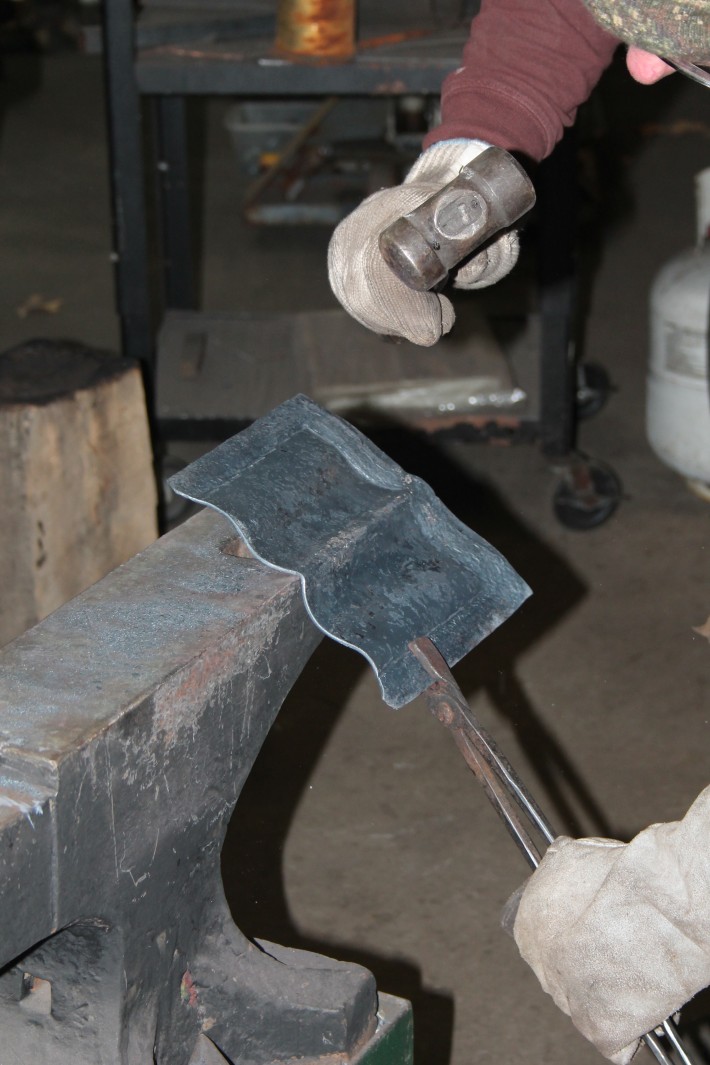
To make the cartouche we used a process called repousse, a French term that means to work the metal from behind then flip over and work from the front. By hammering from behind it will raise the metal on the front, then, working the metal on the front, you hammer the form back in and start to get the curve shape of the book’s pages. This process is done over and over again before the metal is worked into the shape shown. To bring out the lines of the book on the front, a process called chasing was used – pushing the metal back in – basically the opposite of repousse.

Obviously, as you can tell from the top photograph, the result of the work below lends a sort of impish natural grace to the balustrade.

Part of the process of recreating the Lampoon cartouche.

Part of the process of creating the Lampoon cartouche.

Posted in Architecture, Architecture Education, Architecture History, Art and design, Humor, Preservation | Tagged , , , , , , , , , , | 2 Comments

Sneaky review of “The Monster-Builder”

Now that the play “The Monster-Builder,” by Amy Freed, has opened – indeed premiered – at the Artists Repertory Theatre in Portland, Ore., here is a theater review. The writer, Richard Wattenberg, is not identified other than as, I presume, a regular reviewer. His review is much more interesting than the one I last posted. He, at least, has had the advantage of having seen the play. The headline is “Amy Freed’s ‘The Monster-Builder’ at Artists Rep entertains but also dishes up lots of food for thought.” Too bad the reviewer doesn’t really chew on that food. He has alluring things to say about the performance of the actors but little about the ideas in Freed’s play. It is a comedy. He says that Freed “eschews the serious in her attack on the Modernist world view.” What does that mean? Well, here’s another quote, immediately beforehand, that may shed some light:

[H]e [the protagonist/modern architect] does not design buildings for people but instead imposes environments on them. In short, he exemplifies an intellectual elite that hides its hunger for power behind jargon and a fraudulent faith in a clean, clear, unified and pure vision – a vision free of the emotional baggage and nostalgia that supposedly muddies the waters of traditional culture.

As I say, for whatever it’s worth. Am I finding a refusal among critics to directly address the ideas of Amy Freed that (based on her interview in my first post about this play) criticize modern architecture, or am I interpreting these critics as saying what I expect them to say? That’s something I occasionally criticize others for doing. Any thoughts?

Posted in Architecture, Art and design, Book/Film Reviews, Books and Culture | Tagged , , , , , , , , , | 19 Comments

Column: Driving down Market Street in 1906

San Francisco's Market Street seen from cable car, April 14, 1906. (youtube.com)

San Francisco’s Market Street seen from cable car, April 14, 1906. (youtube.com)

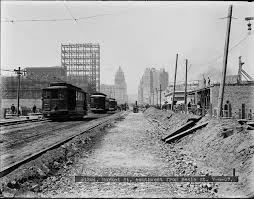
San Francisco before the Great Earthquake of 1906 was a lively city, to say the least. We are lucky to have a moving picture of it from a camera hand-cranked by filmmaker Harry Miles. His Bell & Howell was on a cable car headed down the city’s main street at 10 miles per hour.

The film runs just under 12 minutes, but seems like an eternity, as, in a way, it is.

The film was dated by the Library of Congress at September 1905, but silent-film historian David Kiehn grew suspicious of puddles in the street at a time when newspapers reported no rain for weeks. Tracking the registration of license plates on cars in the film and the angles of shadows cast by the sun, Kiehn pinpointed the date of the filming — not seven months but just four days before the earthquake.

That adds even more poignancy to the sight, a century later, of citizens going about their business on a sunny day, unaware of the shadow descending upon their lives. The film negatives were put on a train to New York the night before the quake, which destroyed the Miles Brothers’ film studio on Market.

To read the rest of this column, please visit The Providence Journal.

Posted in Architecture, Architecture History, Old Video, Urbanism and planning | Tagged , , , , , , , , , , , , , , | Leave a comment

How vulnerable is Gehry’s Ike?

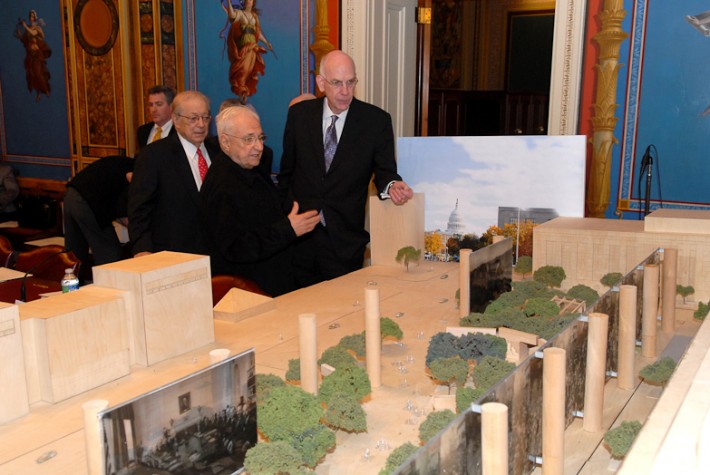
Frank Gehry shows memorial design to members of Eisenhower Memorial Commission in 2011, when confidence in its prospects was still very high. (beloblog.com)

Frank Gehry shows memorial design to members of Eisenhower Memorial Commission in 2011, when confidence in its prospects was still very high. (beloblog.com)

The industry journal that rules on Capitol Hill is not the Washington Post but Roll Call. Here it publishes “It’s Time to Bury Gehry’s Eisenhower Memorial Design,” an assessment of the prospects for Frank Gehry’s not just ridiculous but sinister proposal for a memorial that, above all, disrespects the memory of President Dwight D. Eisenhower.

The author is Justin Shubow, who heads the National Civic Art Society that has led opposition to the Gehry design. Shubow points out that Congress has essentially defunded the memorial commission pushing Gehry’s design (its chairman’s a Gehry friend going way back – to three jobs for Gehry). How do you spell conflict of interest? Congress has stripped all but a million of the commission’s budget. It not begin construction until it has raised 100 percent of the private funding it needs – of which it has very little, the taxpayer thus far being its major “donor.” The memorial design and review process is heading in reverse – the U.S. Commission on Fine Arts seems about to back away from an earlier okay of the design, and the National Capital Planning Commission has not yet voted in favor of it. The Eisenhower family is four-square against it, as Ike would be if he were alive.

And finally (though the above certainly does not sum up the Gehry design’s process woes) there is Shubow and his NCAS plugging away, marshaling a dreadnaught of opposition to torpedo the obnoxious design. His piece in Roll Call suggests that the death of a thousand cuts is well under way.

Huzzah!

(I wrote above that Gehry’s design is sinister. By that I mean that his design is intended to take down the tradition of classical beauty that characterizes the past monuments that have made Washington so beautiful, great and ennobling. Here is my first of, I think, four or five columns standing athwart that ignoble endeavor.)

Posted in Architecture, Architecture History, Art and design, Blast from past | Tagged , , , , , , , , , , | 2 Comments

Honey, I’m home (after 70 years)!

239446-original1-0k31yNazis occupy Paris. Lady fed up and leaves for south of France. Never returns but keeps paying rent. Dies at 91. Nobody goes into her apartment until recently, when it was found untouched since her departure 70 years before. A photo shoot of her apartment as she left it in 1942 elicits one word. Wow!

Madame de Florian, its owner, was an actress and socialite. A painting of her by Giovanni Boldini, her lover, was sold for millions after its discovery in her apartment (which she owned but paid rent on, or association fees, until she died) in 2010. It is the only thing that was dusted off. It remains a mystery why she never returned to the apartment. Ah! … the painting!?

Here is a description of the apartment after it was found with all her decoration intact. I enjoyed especially seeing, several photographs down in the story, her Mickey Mouse because we recently got an identical item for our son Billy, 4, to help him recover from his recent tonsillectomy. No ostrich, though, son!

Posted in Architecture, Art and design, Blast from past, Other countries, Preservation | Tagged , , , , , , , , | Leave a comment

Old video: San Franscico after the quake, 1906

More material on the pre-quake film, originally thought to have been made in September 1905, shot just a week before the disaster. “60 Minutes” did a segment on the film in 2010.

David Brussat's avatarArchitecture Here and There

Here is an old video from YouTube of San Francisco after the earthquake. It gives rise to the suspicion that maybe the video I posted yesterday was a later video, with more types of automobile and with time to have rebuilt much of Market Street. When I posted these on my old Journal blog a debate broke out among readers when the respective clips were shot. I cannot recall whether anyone issued a definitive pronuniciamento.

Update: Tom Hayes of TradArch notes that automobiles were selling well by 1906 and that ladies’ fashions, as seen jaywalking back and forth along Market, support the pre-earthquake time frame. Any dissenters?

Further update: A commenter, Dan Zack, writes that “60 Minutes” did a segment on the “mystery” of the pre-quake film of SF, originally thought to be shot in September 1905 but subsequently discovered to have been shot in early April the next year…

View original post 68 more words

Posted in Uncategorized | Leave a comment

Old video: San Franscico after the quake, 1906

San Francisco after quake of 1906. (etc-magazine.com)

San Francisco after quake of 1906. (etc-magazine.com)

Here is an old video from YouTube of San Francisco after the earthquake. It gives rise to the suspicion that maybe the video I posted yesterday was a later video, with more types of automobile and with time to have rebuilt much of Market Street. When I posted these on my old Journal blog a debate broke out among readers when the respective clips were shot. I cannot recall whether anyone issued a definitive pronuniciamento.

Update: Tom Hayes of TradArch notes that automobiles were selling well by 1906 and that ladies’ fashions, as seen jaywalking back and forth along Market, support the pre-earthquake time frame. Any dissenters?

Further update: A commenter, Dan Zack, writes that “60 Minutes” did a segment on the “mystery” of the pre-quake film of SF, originally thought to be shot in September 1905 but subsequently discovered to have been shot in early April the next year, just a week before the earthquake. The film itself was sent to New York by its maker the night before the quake, which destroyed his studio. I will discuss this in Thursday’s column, which I’ll write tomorrow morning. Next week: a column on a PBS documentary about Penn Station, which will air on Feb. 18. To see the “60 Minutes” segment, click on link in Dan’s comment below.

Posted in Architecture, Architecture History, Old Video | Tagged , , , , , , , | 2 Comments