Monty Python’s skit on architects

Picture-1-600x465As a reward for making it through the last few posts I offer this skit, from YouTube, of Monty Python making fun of architects by speaking truth of them, perhaps – since humor does after all require at least a grain of truth – more than they were aware. (image above courtesy of dayall.com)

It is here.

Posted in Architecture, Architecture Education, Humor | Tagged , , | 2 Comments

Sad, glorious history of the Fogg

Original Fogg Museum (1896), by Richard Morris Hunt. (epodunk.com)

Original Fogg Museum (1896), by Richard Morris Hunt. (epodunk.com)

Here, before I unveil a bit of the sad Fogg history, is an intriguing comment from Eric Daum, whose lengthy and erudite essay on the Gloria Dei Swedish Evangelical Church, in Providence, graced this blog several weeks ago:

I love the quote from the Harvard Magazine article: “Instead of a single main entrance to the museum, there are now two: the old one on Quincy Street; and a new, more welcoming one on the Prescott Street side, as Lentz explained.” This implies that the lovely, human-scaled Georgian door surround of the Fogg with its baroque split pediment is somehow less inviting than the industrial-sized Moulinex chopper through which museum visitors will pass and hope they are not Julienned.

I also have serious concerns about the grey wood siding, a material which has no precedent in Harvard Yard of the immediate neighborhood. Architects in Boston run in fear from brick, considering it limiting and boring and deliberately attempt the novel. One day, perhaps, they will learn that best solution is the simple solution, the obvious solution, the straightforward solution.

Entrance to the Fogg viewed through gate of Sever Quadrangle, at Harvard. (britannica.com)

Entrance to the Fogg viewed through gate of Sever Quadrangle, at Harvard. (britannica.com)

The Fogg defaced by Renzo Piano and discussed in my earlier post is seen in the photograph to the left. In 1925 it replaced the original Fogg, seen in the postcard reprinted atop this post. It was completed in 1896 in a Renaissance style designed by William Morris Hunt. It may be supposed that the replacement was due not to any mere change in stylistic preference but to a need for more space at a growing institution. The museum relocated to the new Shepley Bulfinch Fogg; the Hunt Fogg was used and neglected for another half a century. It was demolished in 1974 to make way for student dorms, assuredly of an ugly modernist style. That’s sad, too, but arguably preferable to the insult represented by the Piano abomination.

“One day, perhaps, they will learn,” Eric hopes. I do not think so. They will never “learn.” They will be evicted by an exercise of democratic power. I believe the return of beauty and common sense in architecture must await a rising in the public, putting pressure on civic leaders, developers and design professionals to build in a way that treats people not like lab rats in a perverted “scientific” experiment but like the citizens of a democracy.

Posted in Architecture, Architecture History, Preservation | Tagged , , , , , | 1 Comment

Shoe slips on other foot

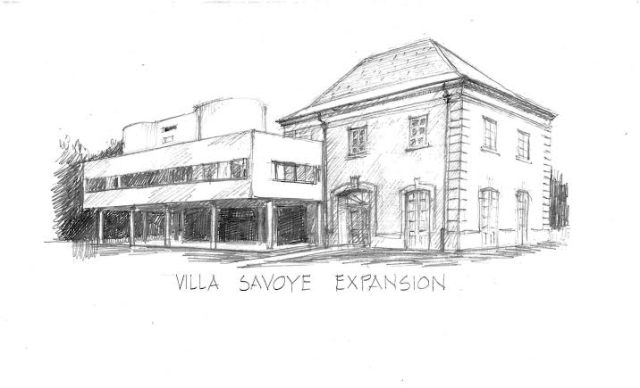
villasavexpMichael Rouchell sends to TradArch a wonderful sketch of the new addition to the Villa Savoye, Le Corbusier’s pathbreaking modernist house of 1931 in suburban Paris. As intended, the addition raises interesting questions. Modernists are wary of additions to their work in contrasting styles. When the Dulles International Airport terminal by Eero Saarinen was doubled in size, the additions (extending the building at each end) were identical to the original style – verboten for traditional buildings. But when a compatible addition to Frank Lloyd Wright’s Guggenheim Museum on New York City’s Fifth Avenue was proposed, modernists went nutso.

Real-world solutions to design problems inevitably paint modernists into an uncomfortable corner. In the case of the Villa Savoye, the concern, as one TradArcher pointed out, is that the uninitiated might imagine that the Villa has been added recently to the original traditional house.

So, here’s mud in your eye!

Posted in Architecture, Architecture History, Humor, Preservation | Tagged , , , , , , , | Leave a comment

Column: The secret to making great streets

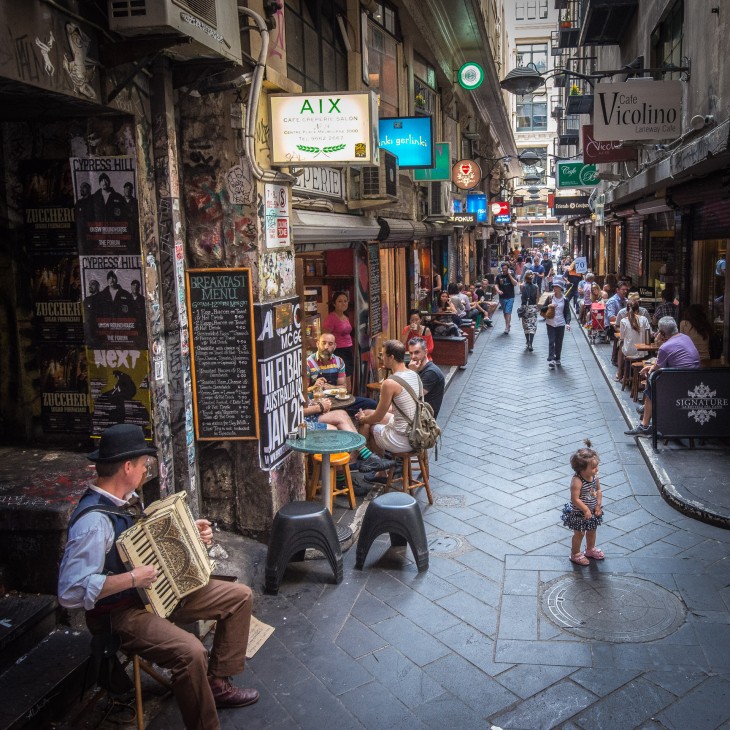
Centre Place, in Melbourne, Australia. (By Joseph Ip. This and all images courtesy of John Wiley & Sons, Inc.)

Centre Place, in Melbourne, Australia. (By Joseph Ip. This and all images courtesy of John Wiley & Sons, Inc.)

The secret to great streets is that there is no secret, that great streets were once the norm, that making them is easy, and that we can have them again, even in America, if we want them.

This is the message of a new book, Street Design: The Secret to Great Cities and Towns (Wiley), by Victor Dover and John Massengale. But while streets that generate active cities are not hard to build, they are against the law in many places (in America, especially).

Getting around those laws is what makes it difficult to maintain or regenerate great streets, turn poor streets into great streets and build great streets anew. All are possible by following the instructions in Street Design.

To read the rest of this column, please visit The Providence Journal.

[If you get a “not found” page, scroll down to and click on Opinion “columns” and this will be at the top. If you get a subscribe page, click “x” to bypass.]

Posted in Architecture, Architecture History, Art and design, Book/Film Reviews, Other countries, Preservation, Urbanism and planning | Tagged , , , , , , , , , , , | 1 Comment

Proposed for Benefit Street

DSCN0547

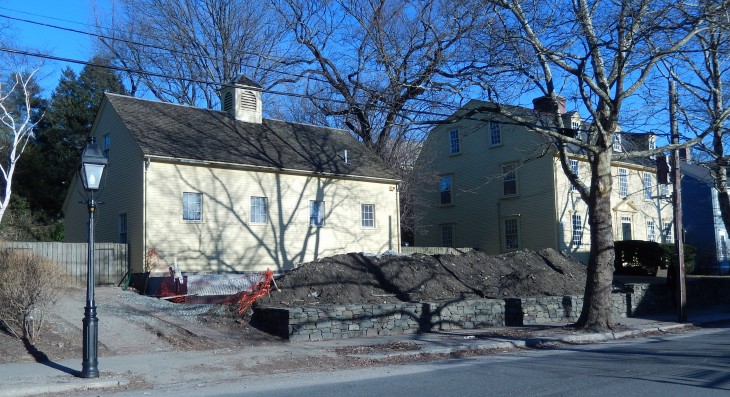
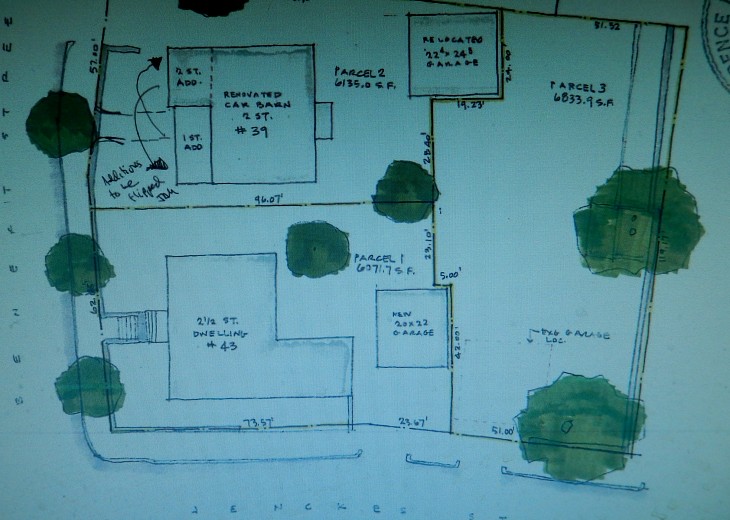
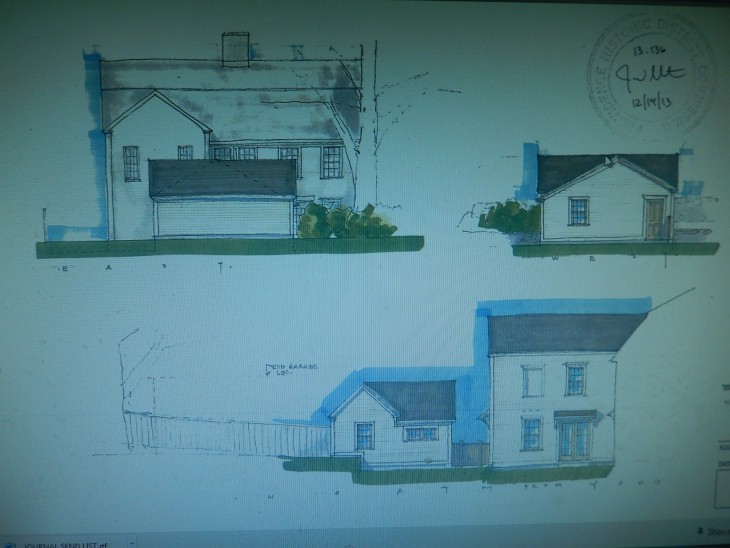
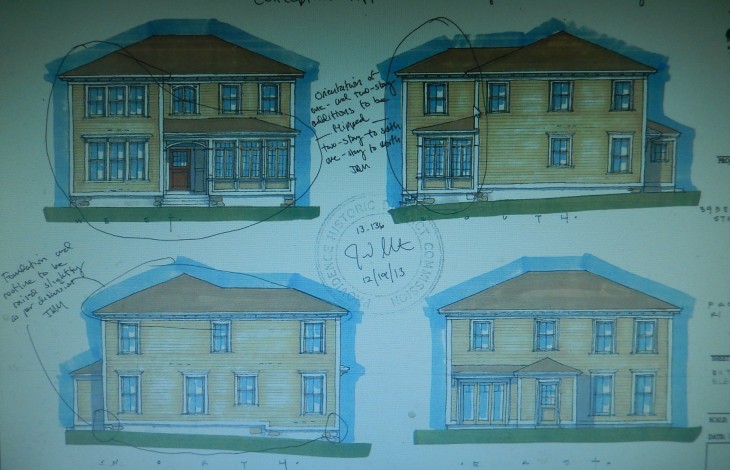
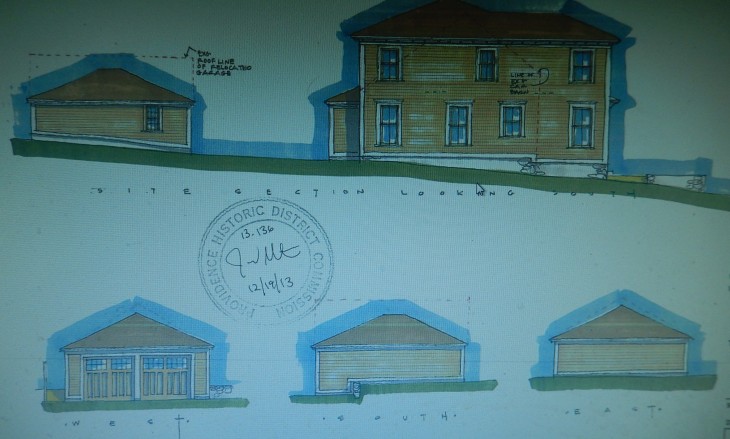
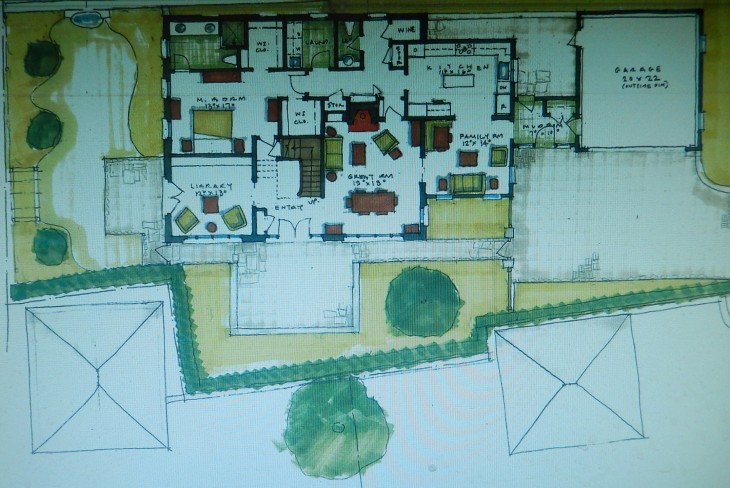
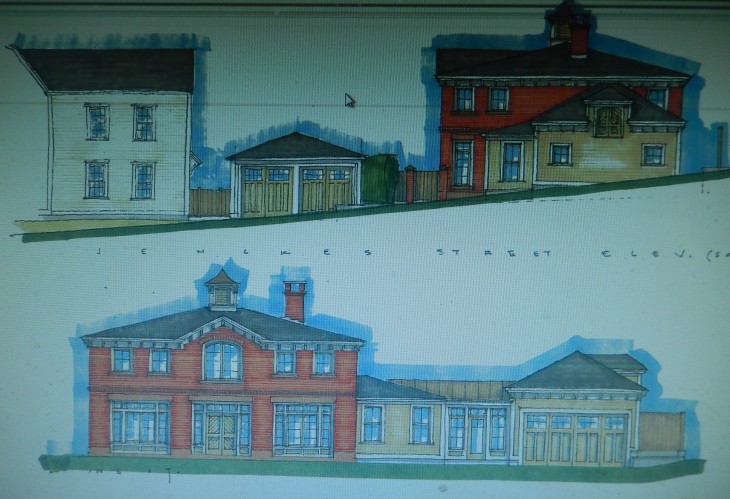
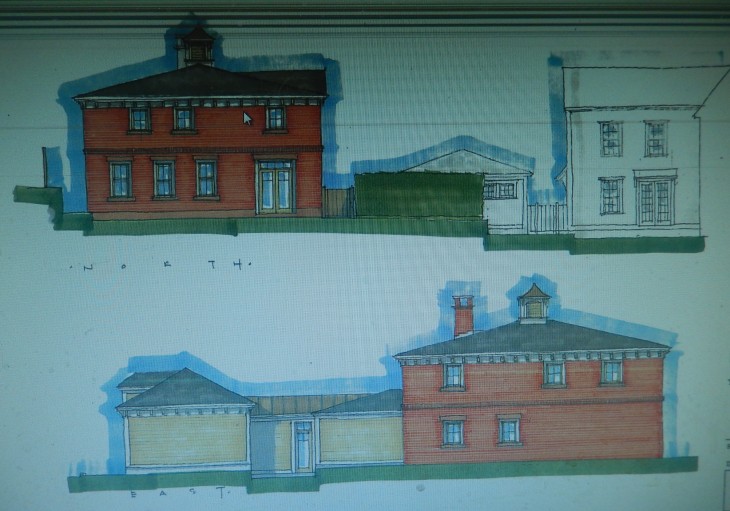
Yesterday I posted about several projects in Providence, including an excavation of a front yard at 43 Benefit, the Joseph Jenckes House. I talked to Jason Martin of the city’s planning office and he sent me PDFs of the project, of which I post several, begging the reader’s forgiveness for the poor quality of the screen shots. However, the subject of the PDFs, which are a new house just north (left in the photo above) of the Jenckes House, expanded from a car barn designed relatively recently by Bill Kite, and two rear garages, designed by Arris Design, of Providence, seem reasonably attractive. If part of a lawn facing Benefit must be sacrified to show people that beautiful houses don’t have to be 100 years old, the sacrifice may be worthwhile. The Jenckes House itself will be modified slightly. The applicant for permission before the Historic District Commission is Frank Scotti. I am open to the proposition that this project should not go forward, but haven’t heard the case yet.

The site is above. Below are Jason Martin’s PDFs. The first, a plan of the entire project, would be turned 90 degrees counter-clockwise to square with the photo above.

DSCN0600DSCN0601DSCN0602DSCN0603DSCN0604DSCN0605DSCN0606

Posted in Architecture, Preservation, Providence, Uncategorized, Urbanism and planning | Tagged , , , , , , , , , | Leave a comment

“Screams art museum”!

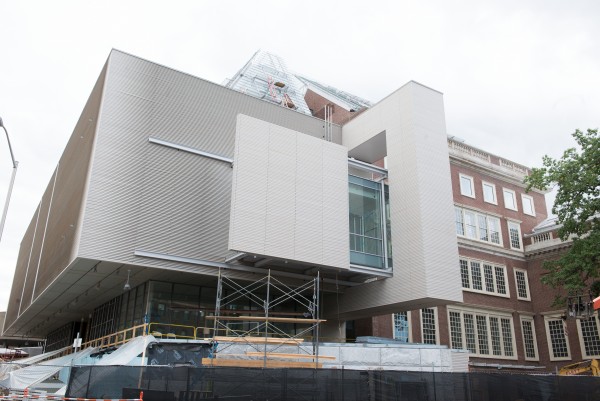
Addition to Fogg Museum of Art, at Harvard, designed by Renzo Piano.

Addition to Fogg Museum of Art, at Harvard, designed by Renzo Piano.

It sure does. That’s a direct quote from Thomas Lenz, head of Harvard Art Museums, intended as praise. The top comment after Harvard Magazine’s article about the Renzo Piano addition to the Fogg Museum of Art was “Is this really the best that Harvard could do? Is Renzo Piano really the only architect who is capable of doing a museum addition?”

The answers are “No” and “No.” Indeed, Piano is clearly not capable, except that like most modern architects he is a capable assassin of beauty.

A source, aware of my masochistic attraction to museum additions, passed word that Fogg had committed the ne plus ultra of museum additions, and bade me go online to look at the abomination, to wallow in its ugliness, to immerse myself in the perversion of its attitude toward humanity. I did. He called back to assure me that there were better (that is, worse) shots than the one atop the Harvard Magazine article. I looked for it but have not found it yet.

The addition, which will be completed later this year, manages to slime the building from every direction. Even though it is on the far side of the building from Sever Quadrangle, you can see its cackling hideous crown bulging out from the roof. The original Georgian edifice was designed by Coolidge, Shepley, Bullfinch and Abbott back in 1897. How sad. How very, very sad. Nay, how criminal.

I have a softness in my old heart for the Fogg, partly because of its wonderful name, also because an old and elegant friend used to work there while I was at Emerson College in ’73-74. I wonder whether he keeps up with the doings at the Fogg. If he is there yet, he is probably spinning in his grave. He had the best taste, at least when I knew him.

Posted in Architecture, Art and design | Tagged , , , , , , | 9 Comments

Two to watch in Providence

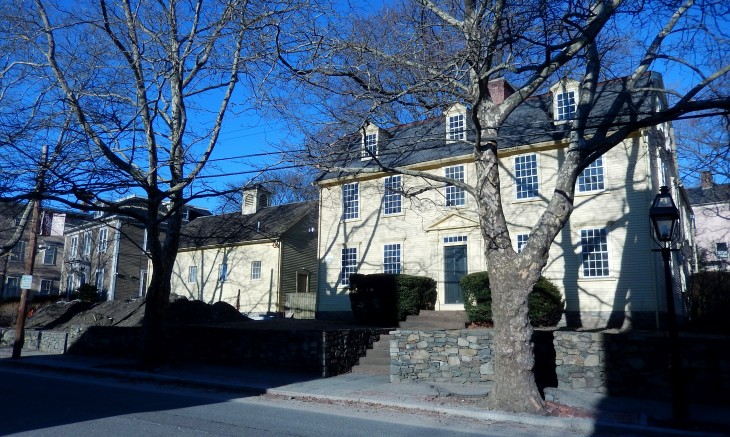
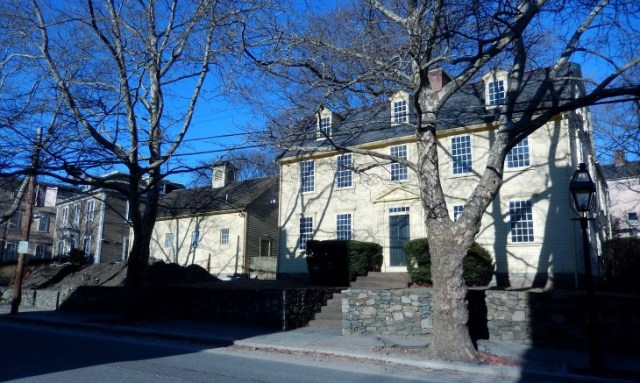
The Joseph Jenckes House, 43 Benefit St., today, with digging in front of its barn at left.
The Joseph Jenckes House, 43 Benefit St., today, with digging in front of its barn at left.

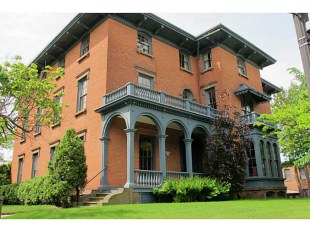
Henry Lippitt House I (1856), 200 Hope St. (

Henry Lippitt House I (1856), 200 Hope St. (realtor.com)

While some people in Providence are upset that the owner of a big house at 200 Hope Street, by Russell Warren, across from the Wheeler School, is to be broken up into apartments, and with no intent to alter the exterior, two projects of more concern, I think, may be passing under the radar.

First is the digging up of a front lawn at 43 Benefit St., which is the Joseph Jenckes House, completed in 1773 or ’74. A friend called up to warn me about it last week. I drove by and sure enough, the digging was clearly more intense than a (pre-seasonal) resodding of grass. Today I got the meeting agenda for the Providence Historic District Commission, and there, Item 3, was “Case 14.018, 4 Jenckes Street, vacant lot (College Hill): The applicant is requesting the new construction of a single family residence with attached garage.” I’m not sure why the discrepancy between the two addresses. That is a rare and cherished extent of street-facing lawn whose demolition (a sort of reverse demo) will probably not sit well with many. Pending some idea of what the owner – Frank Scotti, at least, on the sign in front – wants to build, my opinion is mixed, but mostly skeptical.
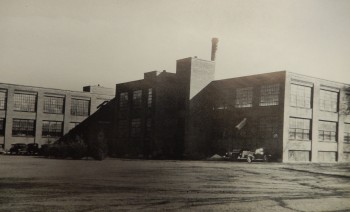
General Electric Base Factory, 586 Atwells Ave., from 1939 book by Henry-Russell Hitchcock.

General Electric Base Plant, 586 Atwells Ave., from 1939 book by Henry-Russell Hitchcock.

Then there is Item 2, Case 14.013, 586 Atwells Avenue, General Electric Base Plant, c. 1910. This, unlike some utilitarian structures whose demolition has raised concern around here in recent years, is an elegant old mill of exactly the sort, and in exactly the sort of location, that would be great for artist lofts (and not just artists, either). This seems to be exactly what the city wants to save. In fact, it is already a famous place: The architectural historian Henry-Russell Hitchcock (friend of Philip Johnson) wrote a book called Rhode Island Architecture in 1939 in which this mill was the second last in its collection of photographs. The caption reads: “Low, cleanly composed brick plant of the post-War type but not of the latest design.” Ironic phraseology for a photo shot in 1939, ja?

Posted in Architecture, Architecture History, Books and Culture, Preservation, Providence | Tagged , , , , , , | Leave a comment

Hyperphotography of Jean-Francois Rauzier

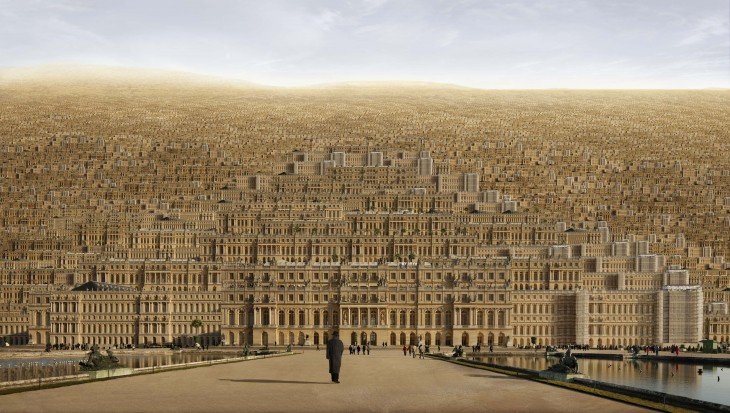
"Versailles" (2009), by Jean-Francois Rauzier

“Versailles” (2009), by Jean-Francois Rauzier

Consider this an ad, gratefully posted, for the photographic work of Jean-Francois Rauzier, who once gave me permission to use his “Versailles” (above) with a column. Here is some of his wonderful “hyperphotography,” a sort of detailed architecture montage of beautiful repetition. He currently has an exhibition in Brussels. His work can also be seen (and purchased) at the Waterhouse & Dodd Gallery, in London and New York. Some of my favorite examples are below, and more can be seen online:

Jean-Francois-Rauzier-yatzer-24hyperphotos-jean-francois-rauzier-13preview

Posted in Architecture, Art and design, Humor, Photography | Tagged , , , , , , , , | 2 Comments

Excuse my bro’ bias, but …

"Versailles" (2009), a montage by Jean-Francois Rauzier. (Waterhouse & Dodd Gallery, New York, London)

“Versailles” (2009), by Jean-Francois Rauzier. (Waterhouse & Dodd Gallery, New York, London)

Here is a comment from my brother Tony. It is a remarkable insight about architecture that might otherwise be embedded (that is, hidden) in an exchange between him and me after my post on Aaron Betsky:

Dave, yes, cat’s out of the bag — it’s me. Beautiful afternoon here, couple a beers, and I’m publicly replying (ritualing) to your post! I guess all architecture is a mask, of sorts, by which governments and other wealthy entities present themselves to the world. They once disguised themselves in ideals (classical motifs, heroic statues, and wisdom etched in bas relief), but now they wear mirrors. The mirrors speak the lie “look, we are you, we are the people” while the ideals said “at least we are trying.”

Tony’s initial comment, with the subject line “Qualiafy Yourself,” is in my last post, which for readers on this blog now is but a click away. It was unsigned, and I only guessed it was Tony after I went back to it a second time to answer it and noticed that “qualify” had been misspelled. It was not misspelled, it was a sneaky way to reveal his identity to me only. He might not like this shout-out, but he deserves it! (By the way, the illustration above is one that he included on his post that I fell in love with and used with a column last year.)

Tony lives in Oregon, in the southwest corner of the state near the coastline recently named a national park and beautifully photographed by a National Parks Service employee whose name I will add to this post when I find out. He (the NPS worker) was featured on CBS Evening News last week. My brother is the author of the blog “Conscious Ritualing” that is on my list of Blogs I Follow. His blog is filled with remarkable insights.

By the way, my reply is … couldn’ta said it better myself, bro!

Posted in Architecture, Art and design | Tagged , , , , , , , , | 2 Comments

Aaron Betsky sees the light?

The Robert Gould Shaw and the Massachusetts 54th Regiment Memorial in Boston (lanida/flickr.com)

The Robert Gould Shaw and the Massachusetts 54th Regiment Memorial in Boston (lanida/flickr.com)

It was a remarkable admission to appear under the byline of an architecture critic of the stature of Aaron Betsky, in Architecture Magazine, the mouthpiece of the American Institute of Architects. His piece is called “A Place for Grief and Greed,” and is summed up thusly: “Experiences at the airport demonstrate that we no longer have grand spaces for rituals and significant cultural events that happen in our everyday lives.”

Betsky saw the light, but did he know he saw the light? A key quote:

It was the appearance at such close proximity of these exceptions — these reminders of our mortality and the rituals with which we surround them, as well as the confrontation with plain and simple money — that made the blankness and lack of definition in most of our public spaces all the more obvious.

Betsky was referring to a pair of instances in which the demands of ritual seemed to be slighted – the coming home of a slain warrior and the experience of church seats set up for worship in the public space of a shopping mall. This caused the light bulb to pop up over the critic’s head. But by the end of the piece he seems to have lost any hint that an epiphany had taken place in his mind. Here is what he says toward the end:

The easy answer would be to throw a classicist cloak over everything, squirreling daily life away into the poché while marking and framing important events with columns and colonnades. The opposite of the (rather expensive) traditionalist strategy would be to abstract everything, retreating into complete fluidity, limbo, and loss of meaning. We need something in-between.

But do we really need something in between? Here Betsky’s response is a classic cop-out. Can’t we all just get along? Well, I would ask wouldn’t a return to traditional design, with its innovative evolution continuing into the future, be good enough – indeed, wouldn’t it be (to quote Tony the Tiger) just great! (And I’d challenge his assessment of its expense compared with the likely alternatives.) Please tell me what you think, readers.

Posted in Architecture, Art and design, Urbanism and planning | Tagged , , , , , , , | 3 Comments