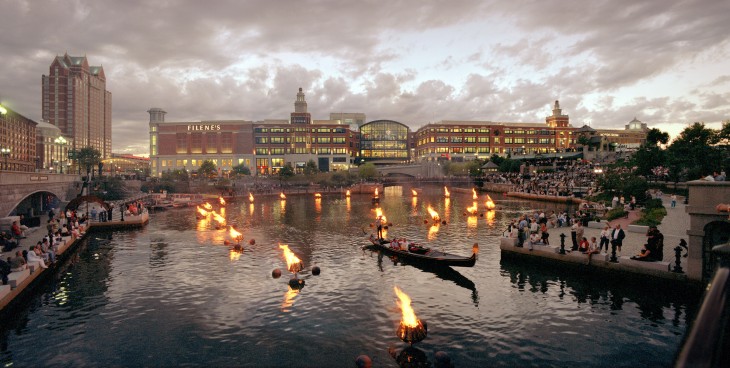
Column: The easy way to build on R.I.’s assets

WaterFire at Waterplace Park, in Providence (Photo by Richard Benjamin, RichardBanjamin.com)

WaterFire at Waterplace Park, in Providence (Photo by Richard Benjamin, RichardBanjamin.com)

Almost all cities and states have policies intended to strengthen their economies by building on their assets. Most fail because they reject easy strategies and embrace difficult strategies.

Two recent Commentary pieces in The Providence Journal address this issue: “Wise of R.I. to retain its character” (Feb. 28), by U.S. Sen. Sheldon Whitehouse and WaterFire impresario Barnaby Evans, and “Now is the time to capitalize on Providence’s assets” (March 7), by former Providence Preservation Society president Lucie Searle and Steve Durkee, an architect involved in downtown development.

Whitehouse and Evans quote author Gertrude Stein’s famous lament for her native Oakland, Calif.: “There’s no there there.” They add that some places have “succumbed to the mindless development crawling like a virus across the United States.” Others “hold onto their deep roots — their history and character. . . . That’s Rhode Island. There’s lots of there here.”

Searle and Durkee list the bold projects of recent decades — the relocation of railroad tracks, rivers and Route 195. Then they add: “And through all this the historic character of our downtown core has remained intact.”

They then cite Jennifer Bradley, co-author of The Metropolitan Revolution, who urged in a recent lecture here that “cities need to find their own unique assets and strengths and build upon them,” and that “those who will drive the future economy . . . are choosing where they want to live and work. And where they want to be looks a lot like Providence.”

Both articles are filled with references to historical fabric and character as the “unique asset” of Rhode Island and its capital city. Neither article answers the question of how to build on that asset, but the answer is obvious. We must build more architecture similar to that which is responsible for our unique character.

To read the rest of this column, please visit The Providence Journal

Posted in Architecture, Architecture Education, Architecture History, Preservation, Providence, Urbanism and planning | Tagged , , , , , , , , , , , , , , , , , , , , , , | Leave a comment

Cinematic paradise isles

James Bond ends "You Only Live Twice"  in a raft (a sort of island) with Mie Hama.

James Bond ends “You Only Live Twice” in a raft (a sort of island) with Mie Hama. (bond-girls.net)

Financial Times architecture critic Edwin Heathcote offers readers a delightful romp island hopping down the halls of film history. Not every island paradise is paradise island, as you shall see. My own fascination with the architecture of evil in celloid futures is given full attention. Cinematic villains seem to prefer modernism, whether landlocked or surrounded by succulent seas. Not all of my balloons escape unpunctured from Heathcote’s history. And let’s not forget the subterranean subgenre of James Bond island hideaway control rooms, or of Bond and friend ending movie in raft. Enjoy.

Posted in Architecture, Art and design, Book/Film Reviews | Tagged , , , , , , , | 1 Comment

Mr. Hublot’s urban future

Mr. Hublot sits at his window overlooking the future of Paris.

Mr. Hublot sits at his window overlooking the future of Paris. (Zeilt Productions)

Here is Mr. Hublot, a short animated film that charmed me no end. The animator’s idea of a sort of tinpot gizmoid future of urban life will pull at your heartstrings. As for the quality of the future envisioned, well, things could certainly be worse. There is a Parisian air to the whole thing that ramps up its charm immeasurably, even if the vision is not quite to your taste. I thought Mr. Hublot killed the dog but then … well, better not let the end out of the bag. And then I learned it the won the Oscar for the best animated short film just a week or so ago. Written and directed by Laurent Witz. A shout-out to Gary Brewer for sending it to the TradArch list.

Posted in Architecture, Art and design, Humor, Old Video, Urbanism and planning | Tagged , , , , , , , , , , , | 1 Comment

Holl the Horrible

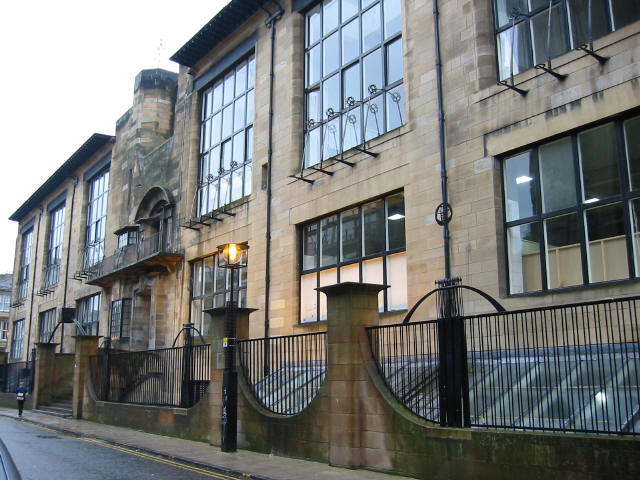
Glasgow School of Art (1892-1909), designed by Charles Rennie Mackintosh. (

Glasgow School of Art (1892-1909), designed by Charles Rennie Mackintosh. (mackeyinc.com)

After describing as “tripe” Hugh Pearman’s piece on Steven Holl’s Seona Reid Building, part of and across the street from the Glasgow School of Art, I feel obliged to say why, as if it were not obvious. The building is not the first and perhaps not even the worst insult to the school’s main building, completed in 1909 and designed by Charles Rennie Mackintosh, the great Scottish architect.

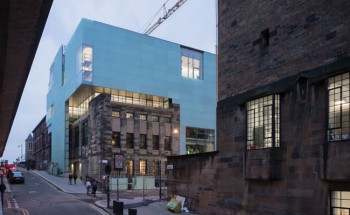
Seona Reid Building, Glasgow School of Art, by Steven Holl. (Iwan Baan)

Seona Reid Building, Glasgow School of Art, by Steven Holl. (Iwan Baan)

Pearman points out that Holl’s building replaces several awful (“unsuitable” is the word Pearman uses) buildings owned by the school. One was a Brutalist tower. Their disappearance seems to have caused little fuss, though some mossbacks wanted to preserve them. Pearman also refers to Holl’s decision to preserve a lovely old building on the corner across from the Mackintosh building so that his new building could eat it as an act of generosity. The English language remains a tool of cynicism for modernists.

“The new building is clad in translucent pale-green, laminated glass with open joints and concealed stainless-steel brackets,” writes Pearman, “and is as reticent as any building of this considerable bulk could be.” Again, the building is no more reticent than an H-bomb.

Pearman refers to Holl as a Mackintosh “enthusiast,” and describes his aim as to “make a building that is the negative of its famous, finely detailed neighbor and that defers to it aesthetically.”

Defers? The building makes no attempt to rival the detailing or the elegance of the Mackintosh building, but this is hardly deference: It is an attack – an attack on a building by a man who claims to be an “enthusiast” of its famous architect. What balderdash!  Modernists like Holl do not understand – no, they understand too well, and embrace – the role their buildings play in the appearance of a street and its buildings.

Modernists seek to challenge, or, to use an even more benign word, to contrast the work of art that confronts them when they are contemplating the design of an unbuilt work of architecture. They claim that this affirms the “authenticity” of historic buildings. In fact, modern architects are like graffartists who scrawl what they consider art on the wall of an actual work of art – the collaborative accretion of beauty over time that used to be the aesthetic purpose of architecture in great cities.

The only argument I can come up with to defend a work like that of Holl in Glasgow, or for that matter Rafael Moneo’s appalling addition to the RISD Museum of Art, in Providence, is that by diminishing the beauty of a street they bore drivers who might otherwise be dangerously distracted by a street’s beauty, or bored pedestrians who might otherwise intersect with cars driven by distracted drivers. Yeah, I know: lame.

I can attack the architecture of Holl and Moneo with words until my face turns blue, but the proper response is a wrecking ball, or a stone well placed by an angry citizen of  Glasgow or Providence. A stone heaved at them would truly be architecture criticism with clout and, alas, courage. You would think that defense would be the official response of any city, from the mayor on down, to an attack on that city. But no, in a world turned upside down (now often almost literally), such attacks on civitas are considered welcome.

Posted in Architecture, Architecture Education, Architecture History, Other countries, Preservation, Providence | Tagged , , , , , , , , , | 3 Comments

Hollible, just hollible

Seona Reid Building, addition to Glasgow School of Art (photo by Iwan Baan)

Seona Reid Building, addition to Glasgow School of Art (photo by Iwan Baan)

Steven Holl’s addition to the Glasgow School of Art, whose 1909 original by the Scottish architect Charles Rennie Mackintosh is an icon of architects of every school, expresses the most profound disrespect for its neighbor. It eats one building and then trashes the old dear by mere proximity. The new building has been called “criminal” by commenters on the TradArch list, and my outrage only begins with that word.

Hugh Pearman’s review of the addition is the sheerest tripe.

The thing should be pilloried by locals who understand that this form of architecture is designed to belittle them and make their lives worse. Yes, designed to do so. Modern architects have so internalized wearing the dislike of the public as a feather in their caps that they go out of their way to disoblige what Roger Scruton called the “disenfranchised majority of building users,” who walk by it, look in its direction, and pray for their eyes to be plucked out.

So I say yes, Glaswegians, pillory the building literally with stones. You will be heroes. I say this with considerable chagrin, having not heaved a stone at the GTECH Building in Providence, which deserves the same treatment. Words apparently have no effect on the reprobates who design this sort of criminal architecture. They are proud to be bastards. If their actions were denominated by society in blood or treasure, they would already be in jail.

I’ve subsequently posted an addendum on “tripe.”

Posted in Architecture, Architecture Education, Architecture History, Other countries, Preservation | Tagged , , , , , , , , , | 3 Comments

Alex King lets it all hang out

From Alex King's blog, which is linked below

From Alex King’s blog, which is linked below. I think it riffs off the blog that riffs off Dwell.

Here is an interesting rant from the architect Alex King:

I like what [James Howard] Kunstler says about ‘the new urbanism’ in his TED talk but think that part of the problem is not just with architects not appreciating the past but planners procrastinating until the project “falls out of bed.” I attach an image board of a scheme [see below] that we have spent eight months trying to get through planning and in the end the elderly Client will probably just walk away. Then the site will be sold to a developer and as there are 5 very tall buildings in close proximity, the developer will try to maximize the profit on the site by going up.

Our design might not be the best design in the world, [but] it is very low key and, yes, we have tried to introduce what Kunstler calls “nature band-aids” as the planners would not accept our offer of planting trees along the street edge as it might ruin sight-lines for cars. But at least we maintain the historic scale within one urban block and the little courtyard – with existing tree retained – which gives some respite from the hard concrete facades along the street.

It is not a design likely to get the architect’s name published in a magazine and it doesn’t scream “look at me, I’m exciting,” and yet 8 months and no decision when the legal period should be 8 weeks! I think that there could be a good post written  about how the planning process does not necessarily deliver a well-balanced human environment, but through procrastination encourages maximum profit options as perseverance will be linked to how much the developer has to gain.

You’ve got it, Alex! And here, readers, is a link to a short column Alex sent from his blog a while back that I wanted to post and now have done so. Then at the bottom of that post follow the link to his “The Naked Architect” post. Very stimulating!

Here is the image board Alex refers to above. Alas, it is worse than hopeless. Not only is it a pdf but when you finally open it, it is sideways. Still, here it is. I am asking Alex to send me a “not pdf” version, which I will add on when it comes in.

belmont more visuals

Posted in Architecture, Urbanism and planning | Tagged , , , , , , , | Leave a comment

Brown moves Green

Peter Green House being moved in 2007. (brown.edu)

Peter Green House being moved in 2007. (brown.edu)

Brown University moved the Peter Green House, an 1868 Victorian, out of the path of The Walk, a process that is captured in this entertaining video from, I think, 2007. As the comments reveal, Brown sought to erect a number of buildings on either side of The Walk – a sort of pedestrian mechanism for Thayer Street (Main Street of Brown) avoidance. So far only the horrid Granoff Center for the Creative Arts has gone up (in 2012). The delightful little Urban Lab has been spared, at least for now. A brain research center has been canceled and incorporated into other buildings. A great old gas station is gone, a loss to convenience if not aesthetic pleasure. Here is a video of the house on the move.

The house was moved 450 feet to the west and was twisted 90 degrees. I’m afraid I cannot report that its “context” was improved. The moving job took three days. This video does not, I promise you, last three days.

Brown is said to have paid $5 million to move the house rather than tearing it down, so it says much of the institution’s commitment to preservation, whatever its commitment to ugly new architecture may be. One may hope that stopped with the Nelson Fitness Center, completed in 2013, but I don’t recommend holding your breath. [After research I find that no one at Brown is saying how much it cost, but one official estimated $500,000.]

Posted in Architecture, Architecture History, Old Video, Preservation, Providence | Tagged , , , , , | Leave a comment

Column: An elegant guide to Brown’s campus

Brown University's Quiet Green. (Photo by RichardBenjamin.com)

Brown University’s Quiet Green. (Photo by RichardBenjamin.com)

This week marks 250 years since the General Assembly passed a charter to found Rhode Island College, as it was first called, in the town of Warren, where it was first located. With a change of place in 1770 and a change of name in 1804, it became Brown University. Brown was the sixth school founded in the Ivy League.

The Ivy League was unknown as such until talk of an athletic conference for the eight storied universities arose in the 1930s. Seven of their eight student newspapers ran a joint editorial calling for “an Ivy League in fact, not just the one in the minds of sportswriters.” Only the student newspaper at Brown refused to print it. The idea stuck anyway.

So most of the buildings at Brown that might make one think of the Ivy League, cloaked in a hoary Hedera helix or not, were up by the time the phrase Ivy League was coined. Brown still retains much of that Ivy ambiance, thanks to its excellent preservation program.

To read the rest of this column, please visit The Providence Journal.

Posted in Architecture, Architecture Education, Architecture History, Book/Film Reviews, Preservation, Providence, Urbanism and planning | Tagged , , , , , , , , | Leave a comment

Leon Krier’s tale of post-carbuncle London

The dome of St. Paul's Cathedral takes center stage in this effort to imagine what London must have been like centuries ago.

The dome of St. Paul’s Cathedral takes center stage in this effort to imagine what London must have been like centuries ago.

Here is Leon Krier’s piece, “Sustainable Architecture and the Legible City,” just published in Britain’s Architectural Review. Krier recalls the atmosphere in London architectural circles after Prince Charles’s speech denouncing an addition to the National Gallery as “a carbuncle on the face of a beloved friend.” This caught the design community by surprise. A surprise to me was that the reaction was not entirely negative, and in its wake Krier received a number of masterplanning offers, including, at last, an official, nay, a royal invitation to assess a recent competition for, and then to offer an alternative masterplan for, Paternoster Square, next to Wren’s St. Paul’s Cathedral, which had been surrounded by plain modernist buildings after World War II.

What happened to Krier after the invitation is a story that, so far as I know, has not been told, at least not at this length publicly. His tale or something like it could probably be told by American traditional architects on this side of the pond, and, as in Britain, right up to this very day.

By Leon Krier

By Leon Krier

It reminds me of what happened back in 1999 when one of Prince Charles’s favorite architects, classicist Quinlan Terry, agreed, at my request, to consider designing a project at Capital Center, in Providence. He would have designed buildings for the remaining undeveloped parcels. The most recent projects at that time had been traditional in design. Providence Place was just about to open. Former Mayor Joseph Paolino Jr., who earlier in the ’90s had been Rhode Island’s economic director under Gov. Bruce Sundlun, agreed to serve as middleman between Terry and the major landowner at Capital Center, Capital Properties, of East Providence. But Capital Properties wasn’t interested.

I never learned the details of what Capital Properties told Paolino, but it must have been akin to a very miniature version of what happened to Leon Krier. Insiders must have rallied against the idea, already taking shape, of a classical solution in Capital Center. Had the tide already turned in the Capital Center Commission against the likes of Providence Place in the years after its approval? Or perhaps there were major practical objections to the idea of having a world-famous classicist design something in Providence. I cannot say. It all seemed very fishy to me at the time.

Anyhow, read the Krier piece. After telling his story he then goes on to describe why London has come a-cropper, and how traditional design could save the day, not only for London but for a world facing the disruptions of unsustainability under the modernist design and planning regime that has the world by the throat. And the essay is spiced with Krier’s profound and yet lighthearted cartoons about urbanism.

All in all, this is an extraordinarily important essay.

Posted in Architecture, Architecture History, Other countries, Providence, Uncategorized, Urbanism and planning | Tagged , , , , , , , , , , , , | 1 Comment

David Andreozzi’s report

The convention center and annex as designed by unnamed contemporary architect.

The convention center and annex as designed by unnamed contemporary architect.

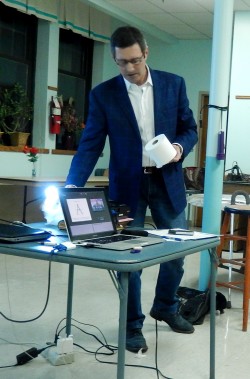
DSCN0515_2David Andreozzi, architect, replied to queries from those who missed it how his talk went last Wednesday evening at the Barrington Preservation Society. His reply, unedited, follows:

The top five things you missed last night …

5. My introduction started with a new roll of toilet paper and a “show and tell” on how architects use it today … literally.

4. My scathing review of Vitruvius’s incomplete ideology, and announcement that I will be writing the eleventh book of De architectura with a respect to local vernacular of place, scale and culture.

3. Now, confirmed as an ICAA board  member, I came out of the closet with a celebrated modern house design of mine based on Villa Stein.

2. A Italian celebration back at my office after the lecture that included family, friends, patrons … with unending music, charcuterie, and cases of Montepulciano D’Abruzzo

And the number one thing you missed last night was … me dressed in a Barney the Dinosaur costume.

Other than that it was a pretty boring night.

This reporter can, of course, attest that it was anything but that, and that the office party that followed was delightful. But the answer to the question posed by this blog, as to how the architect hobbled by his RISD education has been able to design beautiful houses, remained elusive. Only the fact of the fine architecture remains, but it remains unexplained. However, I will do everything I can to scotch the rumor that, notwithstanding his round black spectacles, David Andreozzi is not Le Corbusier separated at birth. The photograph here of the nude Corbu will prove that, at least to his own and his lovely wife’s satisfaction. Fact is, the rumor scotches itself.

Posted in Architecture, Architecture History, Humor, Preservation | Tagged , , , , , , , | Leave a comment