(Repost) Waterplace wig-out

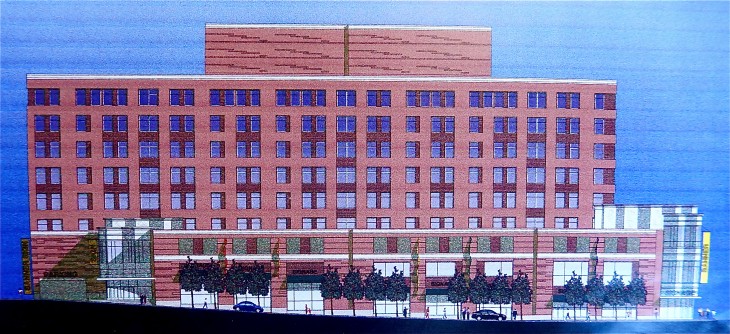
Original proposal for Parcel 6, along the Mosshasuck River. (Brussat archives)

Original proposal for Parcel 6, along the Mosshasuck River. (Brussat archives)

A couple more examples of initial design proposals for buildings in Waterplace Park should suffice to nail down the veracity of the idea that a perverse hand was directing the Capital Center Commission and its design review panel in the first decade of this century. After a decade of reasonably high design quality for buildings produced in the Capital Center, such as Providence Place, the Westin Hotel and the Courtyard Marriott, initial proposals were brought to review for Parcel 6 (above) and Parcel 2 (below). Instead of these relatively appealing proposals we got Capitol Cove (whose sales were so poor that the developer leased it to Johnson & Wales as a dorm) and the Waterplace Luxury Condominium towers, whose units took so long to sell that the developer leased them out. They are now selling, but one must wonder at the size of the price penalty for condos whose view is of the GTECH Building on the other side of the basin.

DSCN0630

Original proposal for Parcel 2, next to Waterplace Park. (Brussat archives)

Below is the original post giving some of the history of Parcel 9, on the west side of  Waterplace Park, opposite Parcel 2 on the basin’s eastern edge. At the end of this post, beneath the description of early Parcel 9 proposals that were superceded by GTECH, are two photographs representing Waterplace circa 2000, and a decade later, after the unfortunate incursion of modern architecture. I will also add, at the bottom, a map of the parcels drawn up after River Relocation (Bill Warner’s new riverfront) was grafted onto the original Capital Center Pan.
The façade of Parcel 9 facing the Providence Place mall. (Brussat archives)

The façade of Parcel 9 facing the Providence Place mall. (Brussat archives)

I am always (and justly) complaining that Waterplace Park was trashed by the architects, developers and Capital Center commissioners who in the first decade of this century let ugly modernist buildings squat on the beautiful new waterfront created for downtown Providence by the late architect and planner Bill Warner in the 1990s. Here is some of the evidence.

I will add other proof, including the more traditional initial proposals superceded by modernism for Parcel 2 (now the Waterplace Luxury Condos) and Parcel 6 (now a dormitory), at the end of today [tomorrow morning, it turns out] and repost.

Worst, of course, was the GTECH building, on Parcel 9. The first proposal, in the late 1990s, was an ugster designed by New York starchitect wannabe Hugh Hardy. It got uglier and uglier as you went around its four different sides. Mayor Buddy Cianci called for its redesign on The Truman Taylor Show (Channel 6, I believe), and Hardy, with a degree of regret he later admitted, did the redesign, with most of the actual work by Rhode Island architect Kip McMahan of Robinson Green Beretta. His design appears at the top of this post. It is not great, far from it, but it does a much better job than GTECH of fitting in, especially with the Providence Place mall (then open just a year or so), but also on the cove side (below).

The façade of Parcel 9 facing Waterplace Park. (Brussat archives)

The façade of Parcel 9 facing Waterplace Park. (Brussat archives)

View of Waterplace looking toward Providence Place on a WaterFire night, circa 2000. (Photo by Richard Benjamin, RichardBenjamin.com)

View of Waterplace looking toward Providence Place on a WaterFire night, circa 2000. (Photo by Richard Benjamin, RichardBenjamin.com)

View of Waterplace from first level of Providence Place mall's Wintergarden.

View of Waterplace from first level of Providence Place mall’s Wintergarden.

Map of Capital Center District showing numbered development parcels.
Map of Capital Center District showing numbered development parcels.

Posted in Architecture, Architecture History, Providence, Urbanism and planning | Tagged , , , , , | 1 Comment

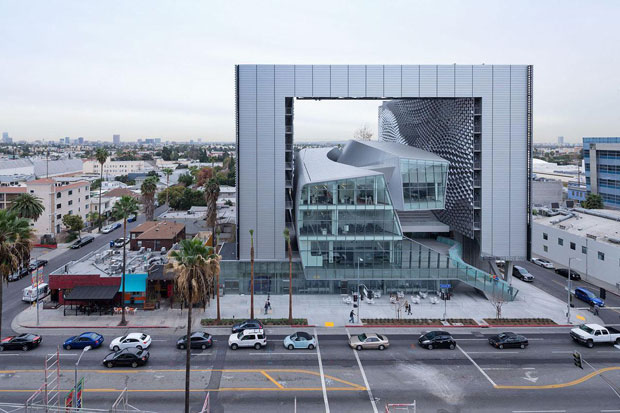
My alma mater

Guess. More tomorrow.

morphosis5

Posted in Uncategorized | 1 Comment

(Repost) Waterplace wig-out

Original proposal for Parcel 6, along the Mosshasuck River. (Brussat archives)

Original proposal for Parcel 6, along the Mosshasuck River. (Brussat archives)

A couple more examples of initial design proposals for buildings in Waterplace Park should suffice to nail down the veracity of the idea that a perverse hand was directing the Capital Center Commission and its design review panel in the first decade of this century. After a decade of reasonably high design quality for buildings produced in the Capital Center, such as Providence Place, the Westin Hotel and the Courtyard Marriott, initial proposals were brought to review for Parcel 6 (above) and Parcel 2 (below). Instead of these relatively appealing proposals we got Capitol Cove (whose sales were so poor that the developer leased it to Johnson & Wales as a dorm) and the Waterplace Luxury Condominium towers, whose units took so long to sell that the developer leased them out. They are now selling, but one must wonder at the size of the price penalty for condos whose view is of the GTECH Building on the other side of the basin.

DSCN0630

Original proposal for Parcel 2, next to Waterplace Park. (Brussat archives)

Below is the original post giving some of the history of Parcel 9, on the west side of  Waterplace Park, opposite Parcel 2 on the basin’s eastern edge. At the end of this post, beneath the description of early Parcel 9 proposals that were superceded by GTECH, are two photographs representing Waterplace circa 2000, and a decade later, after the unfortunate incursion of modern architecture. I will also add, at the bottom, a map of the parcels drawn up after River Relocation (Bill Warner’s new riverfront) was grafted onto the original Capital Center Pan.

The façade of Parcel 9 facing the Providence Place mall. (Brussat archives)

The façade of Parcel 9 facing the Providence Place mall. (Brussat archives)

I am always (and justly) complaining that Waterplace Park was trashed by the architects, developers and Capital Center commissioners who in the first decade of this century let ugly modernist buildings squat on the beautiful new waterfront created for downtown Providence by the late architect and planner Bill Warner in the 1990s. Here is some of the evidence.

I will add other proof, including the more traditional initial proposals superceded by modernism for Parcel 2 (now the Waterplace Luxury Condos) and Parcel 6 (now a dormitory), at the end of today [tomorrow morning, it turns out] and repost.

Worst, of course, was the GTECH building, on Parcel 9. The first proposal, in the late 1990s, was an ugster designed by New York starchitect wannabe Hugh Hardy. It got uglier and uglier as you went around its four different sides. Mayor Buddy Cianci called for its redesign on The Truman Taylor Show (Channel 6, I believe), and Hardy, with a degree of regret he later admitted, did the redesign, with most of the actual work by Rhode Island architect Kip McMahan of Robinson Green Beretta. His design appears at the top of this post. It is not great, far from it, but it does a much better job than GTECH of fitting in, especially with the Providence Place mall (then open just a year or so), but also on the cove side (below).

The façade of Parcel 9 facing Waterplace Park. (Brussat archives)

The façade of Parcel 9 facing Waterplace Park. (Brussat archives)

View of Waterplace looking toward Providence Place on a WaterFire night, circa 2000. (Photo by Richard Benjamin, RichardBenjamin.com)

View of Waterplace looking toward Providence Place on a WaterFire night, circa 2000. (Photo by Richard Benjamin, RichardBenjamin.com)

View of Waterplace from first level of Providence Place mall's Wintergarden.

View of Waterplace from first level of Providence Place mall’s Wintergarden.

Map of Capital Center District showing numbered development parcels.
Map of Capital Center District showing numbered development parcels.
Posted in Architecture, Architecture History, Providence, Urbanism and planning | Tagged , , , , , , , | 1 Comment

More best lost buildings

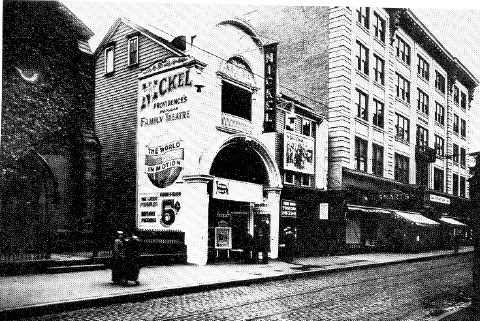
The Nickel Theater.

The Nickel Theater.

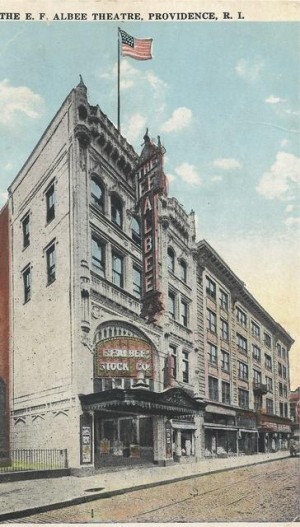
The RKO Albee, successor to the Nickel and predecessor to the Grace Church parking lot, on Westminster.

The RKO Albee, successor to the Nickel and predecessor to the Grace Church parking lot, on Westminster.

A correspondent regrets that my list in this morning’s column (“Providence’s 10 best lost buildings”) did not contain the Albee Theater on Westminster Street. I think he might have meant the Nickel Theater, which was demolished to make way for the Albee, which was demolished in 1970 or thereabouts to make way for the Grace Church parking lot, which exists today. Any number of sumptuous movie houses could have been put on the list, but I like the Nickel best. A real jewel box of a theater. It looks as if its lobby might simply have been cut into an old house built many years earlier when the area was a residential district, not a commercial district, possibly even before the Arcade was built in 1828.

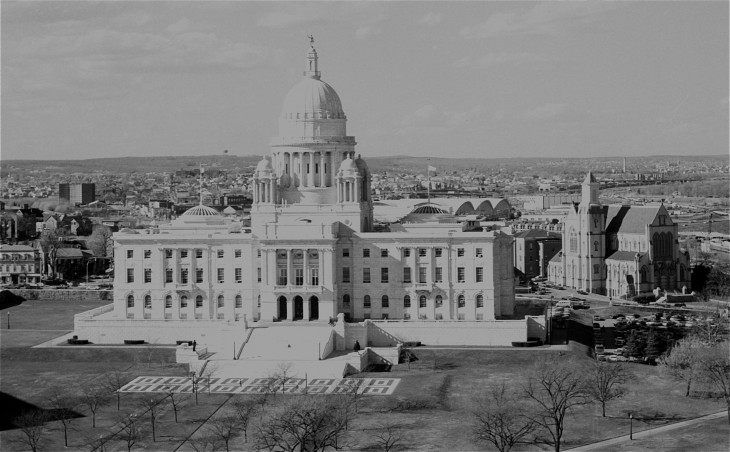
Another, which caused pause on my way to work this morning, was whether I should have included St. Patrick’s Church, across the street from the Rhode Island State House, which was demolished probably sometime in the late ’40s (just a guess*) to make way for the State House annex, now primarily the Department of Transportation. Its picture is below. However, I have concluded that St. Patrick’s was not really eligible to be on a list of buildings that used to be downtown. (It is not included in the survey of downtown architecture published by the Rhode Island Historical Preservation & Heritage Commission in 1981.)

[*My guess of the late ’40s was about as far off as a guess of mine has (in my recollection) been. A friend in California who used to live in Providence, Lee Juskalian, phoned to say he thought it came down much later, and I find that he is correct. It came down in 1979. My error arose from my faulty assumption that it was replaced by the Transportation Department right across Smith Street from the State House, which was clearly built before traditional architecture had gone completely out of style.]

I hope readers will nominate their own buildings that I should have listed.

St. Patrick's Church was to the northeast, or the right, of the Rhode Island State House.

St. Patrick’s Church was to the northeast, or the right, of the Rhode Island State House.

Posted in Architecture, Architecture History, Preservation, Providence | Tagged , , , , | Leave a comment

Providence’s 10 best lost buildings

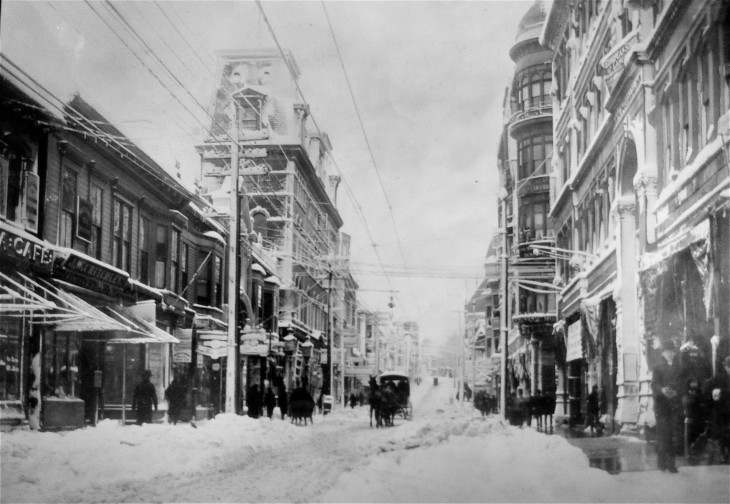
View up Westminster Street, circa 1890, past Hoppin Homestead Building, at right. (Journal archives)

View up Westminster Street, circa 1890, past Hoppin Homestead Building, at right. (Journal archives)

Providence has no Penn Station, no lost building whose absence wounds deeply to this day. Union Passenger Depot, designed by Thomas Tefft and completed in 1848, was replaced by Union Station in 1898, arguably its equal in beauty. The Depot’s absence is sad but not irksome.

Nevertheless, the city’s 10 best lost buildings (or 10 worst building losses) can be identified. The pictorial record tends to focus any such effort on downtown, for, while fine architecture has vanished elsewhere in town, fewer illustrations remain to measure its loss.

For example, between 1984 and 1990 I lived next to the Hope Club’s parking lot at Benefit and Benevolent, on College Hill. But what was there before? It vexed me until I saw a corner of it on a postcard of the Hope Club. The Edward Pearce House (1853), also by Tefft, lost in 1960, is one of a very few lost houses whose memory has not vanished in the fog of time.

Many of the long gone fall into the sad but not irksome category because they were replaced by better buildings, something that was once normal. Until the middle of the last century, even a rare replacement by something worse was often only marginally so. Today, some lost buildings rank higher because their replacements poke our memory in the eye.

Such considerations make it difficult to rank the worst losses. Indeed, I’m still quarreling with this selection. But, happily, the chief difficulty of identifying the city’s 10 best lost buildings is that so very many are not lost at all but survive to grace the streets of our fine downtown.

Still, here is an attempt, in reverse order:

10. The Butler Exchange (1873), a Second Empire pile of mansards, was demolished in 1925 and replaced in 1928 by the Industrial Trust (or “Superman”) Building. The Union Depot might have just as much claim to this spot, but I have already mentioned it above.

9. The Outlet Co., built in stages between 1891 and 1914, was a rambling series of lightly colored brick and terra cotta structures that fell victim to fire in 1986 while awaiting renovation as an apartment complex. With one exception (see No. 4 below), its replacement by the pleasing quadrangle of Johnson & Wales University substantially diminishes our regret.

8. The Second Universalist Church (1849), by Tefft yet again, was torn down unnecessarily after a fire in 2006, and is today a parking lot. The popular Downcity Diner (as it was called) soon relocated down Weybosset to the only remaining Tefft building in downtown.

7. Westminster Congregational Church (1829) was designed by Russell Warren in the Greek temple style with eight massive Ionic columns. In 1902, it was transformed into the Rialto Theater. Its portico was demolished and its nave retained to seat its audience. The crest of the old church’s gable survives and is visible from the parking lot across Mathewson.

6. The Providence Police & Fire Headquarters (1940), an austere but lovely stripped-classical building, was demolished unnecessarily in 2007. It is now a parking lot.

5. The third Howard Building (1859), designed by James Bucklin, replaced the first two Howard Buildings, built in 1847 and 1856, both designed by Tefft and destroyed by fire. Damaged by Hurricane Carol in 1954, Howard III was replaced by Howard IV, whose ugliness has only been exacerbated by efforts to tart it up.

4. The Narragansett Hotel (1879) hosted many famous guests, including the Providence Grays baseball team that won the first World Series in 1884. Demolished in 1960, it was a parking lot until Broadcast House (WJAR Channel 10) was built in 1979. Nicknamed the East German Embassy for its sinister mirrored blank walls, it mars the east end of the J&W quadrangle.

3. The Providence National Bank (1929) was demolished unnecessarily along with an equally fine 1950 addition in 2005 to make way for an unbuilt skyscraper. The Weybosset façade survives, partly masking a new parking lot.

2. The Hoppin Homestead Building (1875), at Westminster and Snow, designed by Bucklin, was an early site of both Bryant and RISD. In 1979 it was razed, the last major downtown building demolished for a quarter of a century, until a decade ago. It remains a parking lot.

1. The Benjamin Hoppin House (1816) was a beautiful twin bow-fronted residence. It dated from the era before the Whitman Block (1825) — where the Turk’s Head was built in 1913 — and the Arcade (1828) signaled a shift of commerce across the river from Market Square and Cheapside. The Hoppin House was razed in 1875 for the Hoppin Homestead Building.

Photos of Westminster before 1900 reveal how many buildings have gone missing, and how their successors’ beauty helps us bear the loss.


Posted in Architecture, Architecture History, Preservation, Providence | Tagged , , , , , | 4 Comments

Past blast: Lost house found

2 Benevolent  St. Photo

2 Benevolent Street, c. 1958, Providence. (Historic American Buildings Survey)

Here, a blast from the past to whet readers’ whistles for my upcoming column listing the best lost buildings in downtown Providence. This, however, is about a lost house on College Hill, whose ghost I lived next to for six years. Here is its story.

Lost house found & other news

September 4, 2003

FOR YEARS, your intrepid investigative pundit had been baffled in his bid to learn about the building that once existed at Benefit and Benevolent streets, next door to 283 Benefit St., where he spent his first six years in Providence.

I knew only that a building had been demolished so that members of the Hope Club, on Benevolent, could park right next to their precious building. The Hope Club was applauded in this corner for the elegant round addition it is erecting in part of that parking lot (“The way to go on College Hill,” July 24), and I applaud the club for its decision to exalt architecture above asphalt, in the face of almost everyone’s lust to worship the God of Parking.

Now that I’ve learned what the Hope Club demolished in 1960, I must retract a big chunk of that applause. Tearing down the Edward Pearce House (1853), one of Providence architect Thomas Tefft’s loveliest buildings, rates among the great crimes against beauty committed here in the last century.

For years, my modus operandi in seeking to uncover the identity of what had been demolished has been to examine old photographs of the First Unitarian Church, across Benevolent from the club and its beloved parking lot. I found photos of the church in which part of the house was visible, but never enough to determine whether it was attractive.

In a coincidence of which I was unaware until last Thursday evening, my next residence in Providence, at 395 Benefit St., where I spent eight years, was right across the street from another house by Thomas Tefft, the Tully Bowen House, designed by Tefft the same year he designed the Pearce House. The house I lived in, the Thomas Peckham House (c. 1820), had been designed by equally famous Providence architect John Holden Greene, but except for its Italianate cornice, it is boring – as if he had designed it with a hangover. The best thing about the Peckham House is that when you step outside and look to the right, you see the Tully Bowen House.

But on Thursday evening, I visited the website of HABS, the Historic American Buildings Survey, which has been documenting buildings since the Depression. Many of the buildings photographed by HABS no longer exist. When I saw “2 Benevolent St.” on its index, a chill ran up my spine. And when I called up the photograph, I discovered that it was no shack that came down in 1960, but a masterful edifice whose transformation into a parking lot should make the Hope Club hang its head in shame.

* * *

The Bruner Award goes annually to the project that best exemplifies civic cooperation in the creation and use of urban space. This year, Providence won second place, in recognition of city, state and federal officials’ working with civic leaders, architects, artists and planners to restore the Providence riverfront and put it to use. Architect William Warner, WaterFire creator Barnaby Evans, Convergence Festival director Bob Rizzo, Providence Foundation director Daniel Baudouin and many others, including a host of politicians, cooperated over the span of a quarter-century to piggyback a beautification project on top of a transportation-infrastructure project – an achievement of Promethean creativity that continues to revitalize the city and the state.

Winning a second-place Bruner would be a feather in anyone’s cap. First prize went to the Camino Nuevo Charter Academy, in Los Angeles, a project described by Journal staff writer Karen Lee Ziner (“City aglow with pride over excellence award,” news, Aug. 24) as “a charter school [that] reused space formerly occupied by a vacant mini-mall in inner-city L.A.”

Did its students discover penicillin, or what?

Providence was second. Who was third? God?

* * *

Motorcyclists whose motorcycles do not offend the ear wrote me e-mails objecting to my proposed “motorcycle-free zone” (“Ask Dr. Downtown,” Aug. 21). They have a valid point. Punishing a whole group for the sins of (I hope) a minority would be wrong. On the other hand, when will the good motorcyclists finally stand up to the bad motorcyclists, whose illegally chopped exhausts terrorize peaceful communities? My guess is that they will stand up only when their own rights are threatened.

The bad motorcyclists already bedevil the good ones, who are lumped together by most of the public with the morons, misfits and reprobates (so-called doctors, lawyers and dentists!) whose Harleys rend the air. Many good motorcyclists abet the confusion by donning Hell’s Angels garb.

Motorcycle bans are being legislated in other communities. If the good motorcyclists don’t want a ban in Providence, then they must help to confront the bad motorcyclists. Perhaps a boycott of Harley-Davidson until it stops selling gear to illegally chop its motorcycles’ exhaust pipes would be in order.

I might even buy a motorcycle, a noisy one, and spend evenings revving my engine in front of the houses of our 15 city councilors and counting the days till the passage of a motorcycle-free zone!

David Brussat is a member of The Journal’s editorial board. His e-mail is: dbrussat@projo.com.

Posted in Architecture, Architecture History, Preservation, Providence | Tagged , , , , , , , | Leave a comment

New date, time for Pennoyer talk

Fawlty information! Oops! Here’s the new, correct information on Peter Pennoyer’s talk in June at the Boston Athenaeum. Sorry for any confusion:

Thursday, June 12 – Lecture by Peter Pennoyer, classical architect in New York City and national board member of the ICAA, along with co-author Anne Walker, at 6 p.m. in the Boston Athenaeum, 10 and a half Beacon St., Boston. More info on this event is here.

Posted in Architecture, Architecture Education, Books and Culture | Tagged , , , , , | Leave a comment

Upcoming classical architecture dates

Here, briefly, are a number of upcoming events sponsored (or not) by the Institute of Classical Architecture & Art. Details and registration, where applicable, are here.

Wednesday, March 26 – The inaugural Boston Design Week, beginning the 20th, features a panel moderated by ICAA President John Margolis on “Creating Timeless Homes in New England.” The panelists will include David Andreozzi, who has appeared in this blog on several occasions recently, plus other ICAA board members, including Sally Wilson, of Wilson Kelsey Design (interiors), of Salem, Mass., and Gregory Lombardi, a former ICAA board member, of Gregory Lombardi Design Landscape Architecture. (Try to register at the above link to make sure event is not sold out.)

The panel, 10:30 a.m. – 1 p.m., Suite 147, 1 Design Place, Boston, is free.

Saturday, March 29 – Guided tours and sketching at the Museum of Fine Arts, in Boston. There are two tours, 11:15 a.m. and 12:45 p.m., costing $20 for ICAA members and $25 for nonmembers. The two tours are identical and conducted by the MFA staff. The drawing will be your own. Please bring your own sketching materials.

Wednesday, April 9 – Design Talks: Progressive Classicism, with Aaron Helfand, of the ICAA New England board, and Boston architect and former ICAA New England board member John Tittmann. The Design Talks event runs from 4:30 p.m. to 9 p.m. at the Boston Architectural College.

Saturday, May 3 – Symposium on the architecture of Richard Morris Hunt, at the Newport Casino (Tennis Hall of Fame). Speakers will include Richard Guy Wilson, UVa., John Grovsner, of Northeast Collaborative Architects, and Paul Miller, curator of the Newport County Preservation Society. 8:30 a.m. to 4:30 p.m., reserved seats $110. Call 401/849-3990 to register.

Thursday, June 12 – Lecture by Peter Pennoyer, classical architect in New York City and national board member of the ICAA, along with co-author Anne Walker, at 6 p.m. in the Boston Athenaeum, 10 and a half Beacon St., Boston. More info on this event is here.

Posted in Architecture, Architecture Education, Architecture History, Preservation | Tagged , , , , , , , , , , , | 2 Comments

L’Abattoir d’unité!

L'Unite d'habitation, by Le Corbusier, in Marseille. (thisistotaltrash.blogspot.com)

L’Unite d’habitation, by Le Corbusier, in Marseille. (thisistotaltrash.blogspot.com)

Malcolm Millais, author of Exploding the Myths of Modern Architecture (2009), has some interesting comments picking up on the skit by Monty Python posted Saturday:

Although mainly about Freemasonry, in the skit the John Cleese architect designs an abattoir instead of an office block. You may be amused to learn that, according the H. Allen  Brooks, Le Corbusier did something like this. Here’s what I wrote about it:

For many writers the idea that the Unité has ocean-liner-like characteristics persists. According to Tzonis’ Life in a building is a journey on a liner, it appears to be the metaphor implied by the scheme of the Unité d’Habitation.   Jacques Sbriglio thinks the building resting on its pilotis “compel the onlooker to constantly gaze upwards as if standing before the hull of an ocean liner,”  and Jenkins thinks the Unité looks “as if it were waiting on a slipway in preparedness for its Mediterranean launch.”  Jencks saw it as “a gigantic ocean liner ploughing through the choppy seas of verdure and haphazard urban sprawl”  – not quite Le Corbusier’s vision, one imagines.

Maybe the liner is not the genesis of the Unité; H. Allen Brooks suggests something altogether more chilling – an abattoir. Shortly after his arrival in Paris in 1917, Le Corbusier was involved in the design of several unbuilt abattoirs. The one proposed for Garchizy looks uncannily like the Unité. As further evidence for the abattoir provenance of the Unité, Brooks notes that in early editions of his Oeuvre Complète, Le Corbusier devotes two pages to his abattoir designs; in later additions they are omitted. These were the only pre-1920 pages to be altered or omitted. “As a person who frequently covered his own tracks, was he concealing the source of the Unité d’Habitation design, even though it derived from his own early work?” Brooks asks pointedly.

Posted in Architecture, Architecture Education, Architecture History | Tagged , , , , , | 1 Comment

Vote: “Happy” or “Stayin’ Alive”

Pharrell-Williams-First-24-Hour-Long-Interactive-Music-Video-Happy-Pharrell-WilliamsThe American Institute of Architects has announced its basic lack of seriousness as an organization by announcing that the artist who recorded “Happy” will be the keynote speaker for its upcoming convention.

Now, I just watched/listened to “Happy” for the first time just now and found it much more enchanting than I had expected. As a guy who never claps along, I almost clapped along. I don’t know what it is to feel like “a room without a roof,” but I don’t think that this line gives Pharrell Williams the authority to address a convention of architects, however existentially silly they may be (and indeed are).

But if I were going to commit institutional existential silliness, I would prefer instead to hear what the artist who put together this clip has to say. It is a video of scenes of Rita Hayworth dancing in movies stitched together into a rhythmic beat to the BeeGees’ “Stayin’ Alive.” It is even more fetching (and much more beautiful), I think, than the Pharrell Williams video. The virtuosity with which the Hayworth clips were assembled to keep time with the song suggests that of the best architecture.

But, reader, feel free to vote: Happy or Rita?

(That reminds me of the great video stitching together film clips of scenes at Penn Station before its demolition. I posted it here. AIA, call your office!)

Posted in Architecture, Art and design, Humor, Old Video | Tagged , , , , , , | 2 Comments