By the book on the 195 land

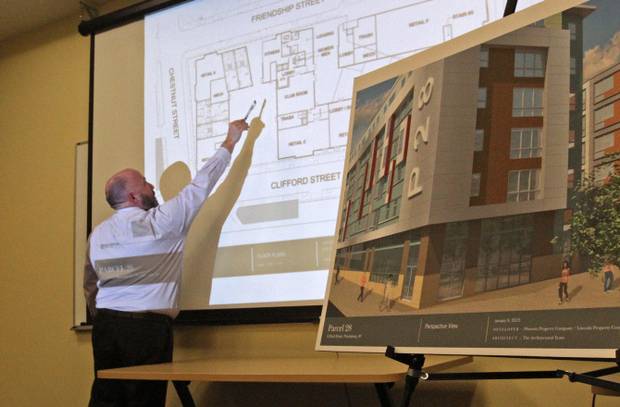
Developer's architect explains design of proposed student housing on Route 195 land. (Providence Journal)

Developer’s architect explains design of student housing on Route 195 land. (Providence Journal)

The front page of the Providence Journal today shows an architect with a pasteboard rendering of the new student housing he has proposed for the Route 195 Redevelopment District. It could have been swiped right from the 195 commission’s Toolkit for developers. If the commission aims to drive the city and state even deeper into the economic pits, the proposed six-story dormitory design could not be better suited for the job.

http://www.providencejournal.com/business/content/20150112-student-housing-project-in-providence-could-expand-on-former-i-195-land.ece

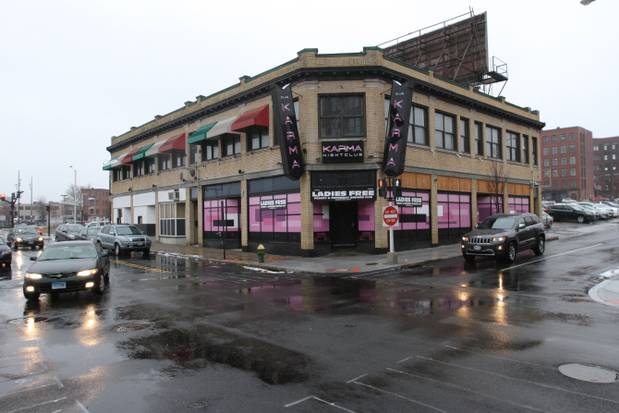
Building slated for demolition. (Providence Journal)

Building slated for demolition. (Providence Journal)

But wait! There’s more! The developer announced that he is interested in buying land just across the street from the dorm parcel (No. 28) and intends to add another dorm of six stories on that site. But that site contains a nice old building that would have to be torn down. The building is one of those gently elegant background buildings noticed by few but which give old cities their abundant charm and air of neighborly comfort. (Providence Preservation Society, call your office!)

As for the proposed dorm, it looks like a traditional brick building trapped in a girdle of thick concrete slabs. It is intended to startle and yet to still put on an air of compromise with those who want architecture on the 195 land to fit into the setting of the downtown and the Jewelry District on either side of the corridor. Examples of such compromise buildings, which look cheap and satisfy nobody, are cheek by jowl in the Toolkit.

http://www.providencejournal.com/opinion/columns/20140220-david-brussat-digging-into-the-route-195-toolkit2.ece

The 195 corridor of vacant land, created by the relocation to the south of a swath of Route 195 that sliced through downtown in the late 1950s, is a great opportunity for the city to embrace a truly unorthodox strategy of urban planning. Instead of suburban “edge city” modernism, the 195 commission should urge developers to reknit the severed parts of downtown together. That was in fact a large part of the stated agenda for relocating Route 195 to begin with. But aside from reconnecting several old streets, they are ignoring the more important idea of restitching the historic fabric shredded long ago.

City planning in the U.S. has been driven by an ideology that considers the idea of building in styles that please most citizens as beneath the dignity of architects. Planners have begun to move away from this sort of arrogance but they often remain eager to show their artistic mettle by encouraging urbanism that insults the community. As with many engineers, they seem satisfied with the sloppy seconds of architects’ celebrity.

This may explain why such an ugly building has been proposed for the 195 land, and why the commissioners are drooling with glee over not just this travesty but the expected demolition of a nice old building to make way for yet another travesty.

Governor Raimondo and Mayor Elorza can turn this around, I think, merely by expressing their displeasure. Developers do not want to do battle with governors and mayors. They already have enough on their plate with commissioners and bureaucrats. Raimondo and Elorza are smart enough to recognize that what is on tap for 195 is not what people want. This is not a choice between jobs and beauty; the beauty will make it easier to create even more jobs by selling the new district as part and parcel of the heritage of the city and state within which it exists. Let our public officials step up and lead on behalf of the public.

Posted in Architecture, Development, Preservation, Providence, Urbanism and planning | Tagged , , , | 6 Comments

Providence’s ‘renaissance’

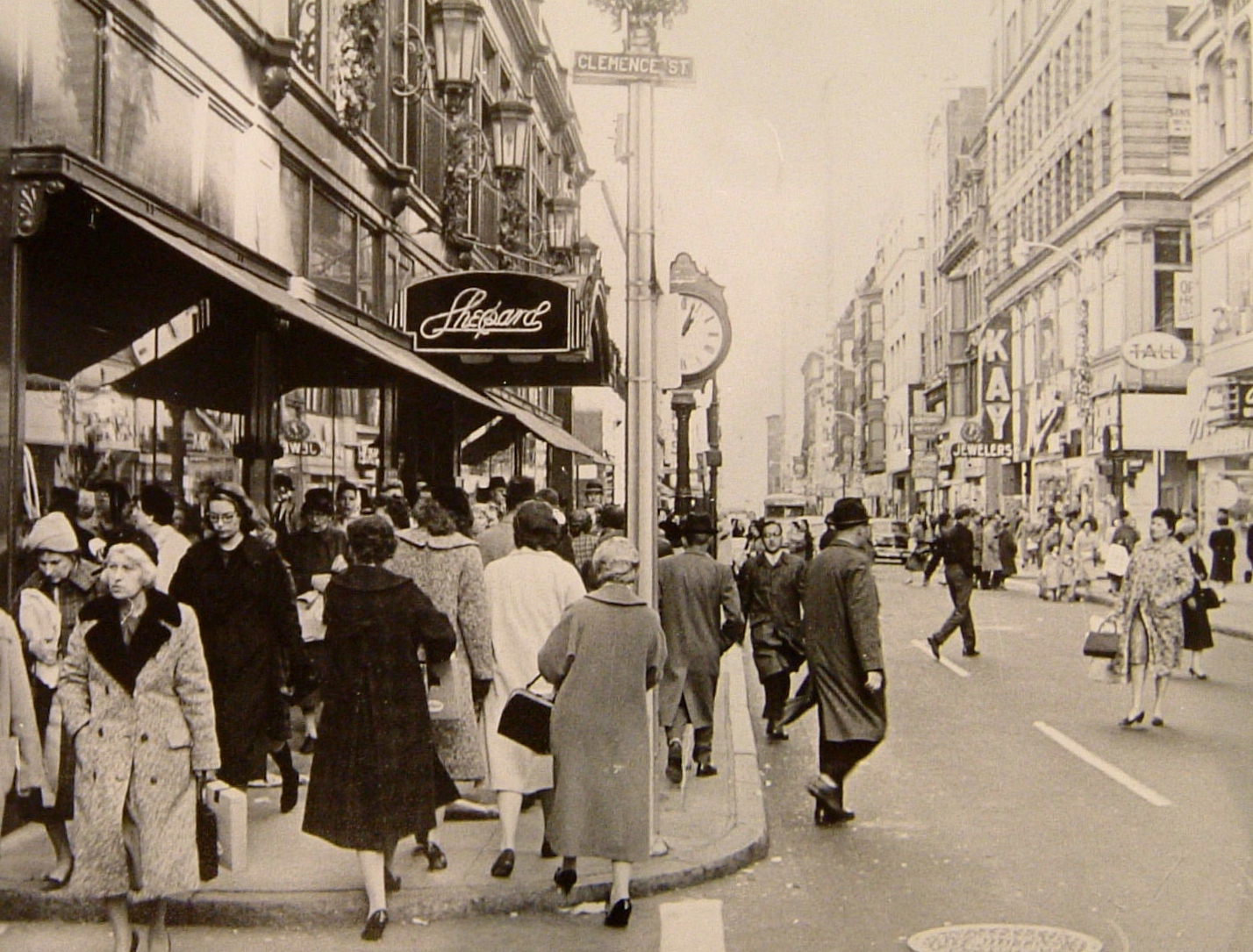
Shephard's on Westminster at the rear end of the lunch hour, circa 1960. (Providence Journal)

Shephard’s on Westminster at the rear end of the lunch hour, circa 1960. (Providence Journal)

The scalawag bugbear of an agitator Mary Ann Sorrentino on Sunday deplored downtown Providence in her Journal oped, “Walking through our moribund ‘renaissance’ city.” She describes strolling through town describing its former delights to her granddaughter. You can see the tears roll down her cheeks as she writes, “On this recent Saturday, in a near vacant downtown, ghosts of Providence’s glory hovered above my commentary.”

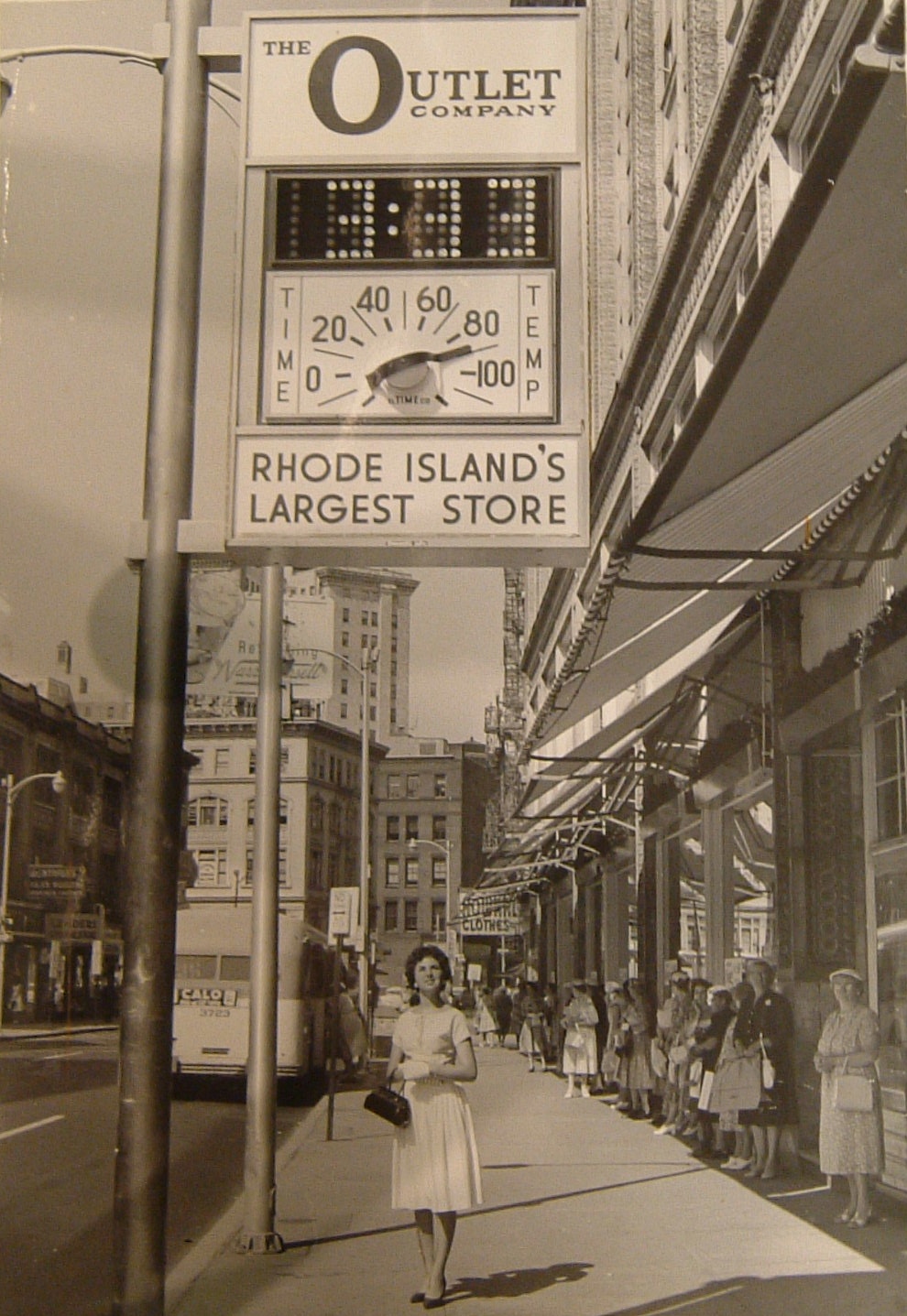
Woman stands at bus stop near the Outlet Company, circa 1965. (Providence Journal)

Woman stands at bus stop near the Outlet Company, circa 1965. (Providence Journal)

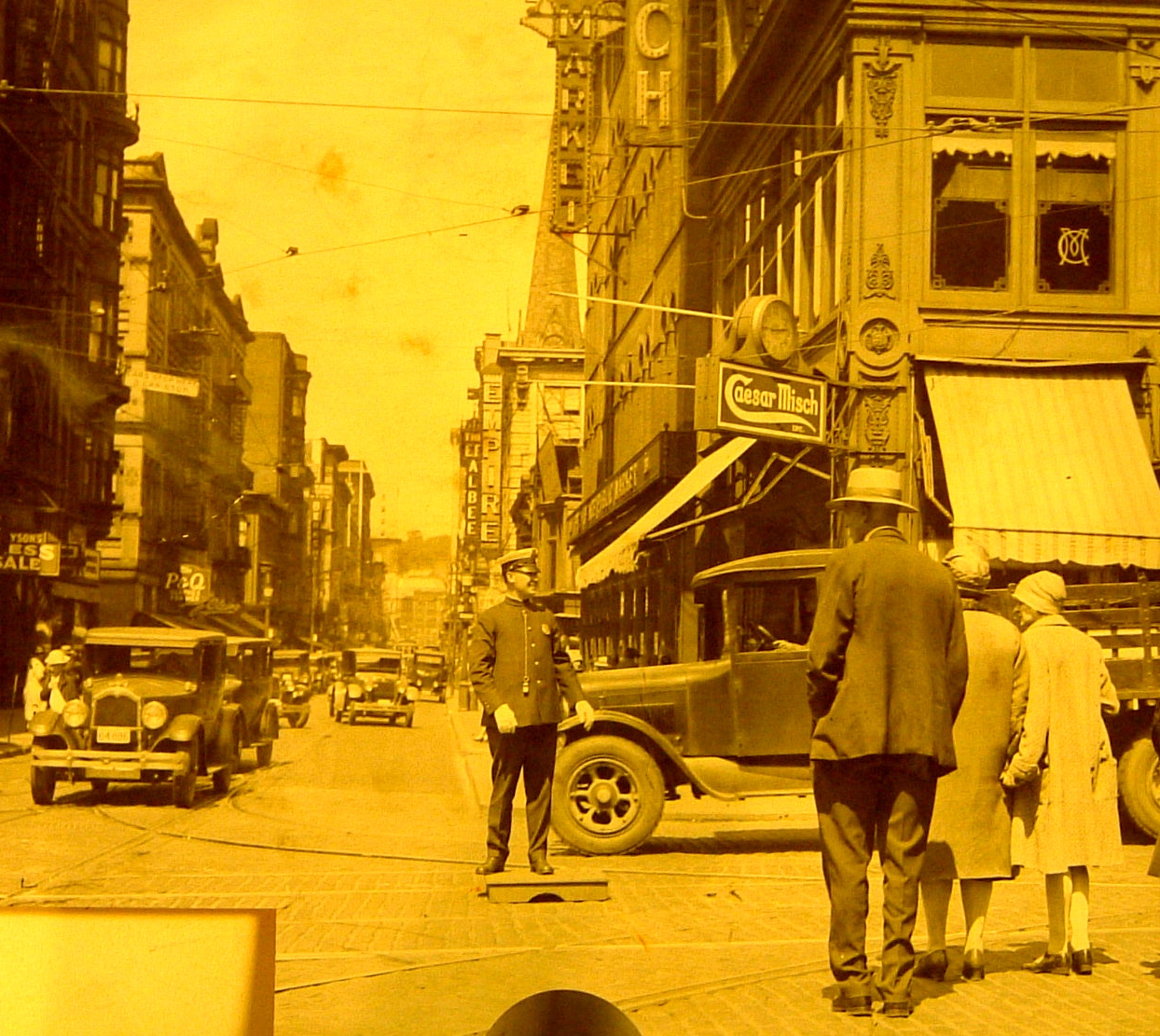
Policeman directs traffic at Westminster and Empire, circa 1925. (Providence Journal)

Policeman directs traffic at Westminster and Empire, circa 1925. (Providence Journal)

She is not incorrect about the difference between Providence today and Providence yesterday. But she is unfair. Nowhere in her piece does she describe why the city went downhill. Most of the big corporations left the city decades ago, and its big retailers closed shop and joined the rush to the suburbs. And she is deeply clueless about how much has been done to bring it back.

“Politicians take credit for Providence’s ‘renaissance,’ ” she adds after describing all the shops and tea rooms she used to go to that no longer exist. “They moved rivers and railroad tracks, but real rebirth never happened.” She seems to believe that the only crowds in Providence are “club-goers” who “spill into the streets in the wee hours in assorted stages of intoxication.” Not that Mary Ann has ever adventured out and about at such an hour, or analyzed how many drinkers quaff with civility and responsibility.

Lunkheads are not the only downtown nightlife, not by a long shot. Plenty of living goes on by night and day. There are people eating and drinking genially and peacefully, there are theater goers and audiences for live musical events and sporting events. There are outdoor cafés and street musicians, free bocce and free films. There are poetry slams, live/work lofts, and art galleries. (We just need more strolling bards!) And unlike the times Sorrentino recalls, today there are thousands of downtowners who live in the upper stories of buildings on Westminster and other downtown streets. People living in apartments don’t tend to “spill into the streets” at any hour, as club-goers do when the clubs close. But they are just as much in downtown as if they did.

A quarter of a century after it opened, thousands of people daily visit Providence Place. To be sure, most do not venture into “Downcity.” But they are in downtown nonetheless. The existence of crowds on the streets does not necessarily prove what is or isn’t happening. I’m sure the crowds that Sorrentino recalls were not out there at every hour of every day. She is unfair to judge downtown’s vibrancy by visiting on a Saturday afternoon in the dead of winter. Not a good time to stick a thermometer down downtown’s throat. She does not mention the tens of thousands who go to WaterFire every other week or so from May through October. The reopened rivers lined with beautiful bridges, parks and river walks that form the setting for WaterFire are part of downtown and its renaissance, too.

Providence isn’t Manhattan or Boston, but the key to judging our renaissance lies not in that comparison, or in comparison with Providence before the corporate and retail exodus of the ’50s and ’60s. But compare Providence to cities of similar size in New England, cities like Bridgeport, New Haven, Springfield and Worcester, cities that have not done as well as Providence. And although it cuts both ways, it is fair to note that Providence has far less modern architecture and urban renewal. I believe that one fact explains a good deal of why people like to live downtown and in the rest of the city, and like visiting it from elsewhere.

So yes, Providence today is not Providence yesterday. In some ways it is better. In some ways worse. But given half a century of modernity’s degenerative trends, and compared with other cities’ failure to cope, its renaissance is an undeniable success.

Posted in Architecture, Development, Preservation, Providence, Urbanism and planning | Tagged , , , , , | 5 Comments

Film of Charleston in 1934

Tradd Street in Charleston, circa 1910. (shorpy.com)

Tradd Street in Charleston, circa 1910. (shorpy.com)

Here is a film of Charleston, S.C., taken three years after the city passed its landmark preservation law, first of its kind in the world. Its streets today are much more as they were then than in the recently posted film of Chicago in the 1940s (not in 1940 as I’d falsely stated). Both films feature quaintnesses of the era that are, to say the least, cringeworthy today. Threads of comment about the Chicago film have enlivened my inbox in recent days. For the Charleston film I feel obliged to insert a warning of the sort common these days in American university curricula to alert the more palpitatious of hearts to upcoming potential offenses to delicacy. Early on, the film pictures a musical troupe of – if history’s hardnesses and calumnies render you faint, do not read the next word! – “nigras” singing in a Charleston garden. The next sentence will surprise you! (I refer to the next sentence in the film, not the next sentence in this post, which is innocuous.) I doff my topper and genuflect slightly from my waist to Charleston architect Christopher Liberatos, who posted the film to TradArch.


Posted in Architecture, Architecture History, Old Video, Preservation, Urbanism and planning | Tagged , , , , | 1 Comment

Mr. Hublot’s urban future

David Brussat's avatarArchitecture Here and There

Mr. Hublot sits at his window overlooking the future of Paris. Mr. Hublot sits at his window overlooking the future of Paris. (Zeilt Productions)

Here is Mr. Hublot, a short animated film that charmed me no end. The animator’s idea of a sort of tinpot gizmoid future of urban life will pull at your heartstrings. As for the quality of the future envisioned, well, things could certainly be worse. There is a Parisian air to the whole thing that ramps up its charm immeasurably, even if the vision is not quite to your taste. I thought Mr. Hublot killed the dog but then … well, better not let the end out of the bag. And then I learned it the won the Oscar for the best animated short film just a week or so ago. Written and directed by Laurent Witz. A shout-out to Gary Brewer for sending it to the TradArch list.

View original post

Posted in Uncategorized | Leave a comment

News on teaching beauty

Historic jail from which American College of the Building Arts will soon escape. (Charleston Post and Courier)

Historic jail from which American College of the Building Arts will soon escape. (Charleston Post and Courier)

The American College of the Building Arts, in Charleston, S.C., has announced it will be moving from an historic jail in that city to an old trolley barn. The ACBA instructs students and pros in the almost lost arts, crafts and techniques that informed the construction of buildings for centuries. These include stoneworking, carpentry, forged architectural ironwork, plaster working, preservation masonry, timber framing and other traditions of long standing. Congats to Patrick Webb and his colleagues at the college for their upcoming move. When an institution devoted to teaching the ways of beauty in the creation of America’s built environment seeks more space, that is damn good news.

http://www.postandcourier.com/article/20150104/PC1002/150109810

Doubts being raised about the modernist establishment of architecture, especially the New York Times’s recent oped by Stephen Bingler and Martin Pedersen, suggest that classical and traditional architecture are on the upswing. Colorado University’s new Institute for Contemporary Traditional Architecture Initiatives at the Denver College of Architecture and Planning is another piece of evidence. Its director, Christine Franck, is beginning to roll out initiatives that will include research on public preferences in architecture. The study will be one of the early initiatives of the institute’s new Center for Advanced Research in Traditional Architecture. Can’t wait!

As Andrès Duany often suggests, however, the effort to recapture territory – almost all architecture programs at the university level are re-education camps designed to inject the modernist cult in young minds – does not progress evenly or inevitably.

For example, the Boston Architecture College last fall threw out its new online classical curriculum before it even got under way, although the courses were full. Developed by Sheldon Kostelecky, a founder of the New England chapter of the Institute of Classical Architecture & Art and now its president, the courses are seeking a sponsor elsewhere. The decision by the BAC to jettison the classical courses was described as part of a financial retrenchment. The BAC’s top leaders had reached out to the chapter in recent years, but given the college’s reluctance several years ago to even host an ICAA exhibit in its lobby, it’s difficult to know the truth. The correlation of forces at the BAC is retrograde.

Still, turmoil in the world of modern architecture, amply described by Justin Shubow, of the National Civic Art Society, in his recent Forbes.com piece on the furor sparked by the NYT oped, suggests that the overall direction of change in the field is positive. However stuck in the mud most architectural education still is, the fact is that more and more people want to learn more about how to design and build the sorts of places that people have always preferred to inhabit. (The link below to Shubow’s article contains links to the NYT article and other sources as well.)

http://www.forbes.com/sites/justinshubow/2015/01/06/architecture-continues-to-implode-more-insiders-admit-the-profession-is-failing/


Posted in Architecture, Architecture Education | Tagged , , , , , , , | Leave a comment

Kismet, but not in Mecca

Je suis Charlie. I repost this column, which has attracted constant attention since its publication in September, in a spirit of solidarity with France and Charlie Hebdo. Islam today, in its radical wing and in the relative silence of its dominant populations, is a rebuke to its own history and the supposedly peaceful sentiments of the Koran.

David Brussat's avatarArchitecture Here and There

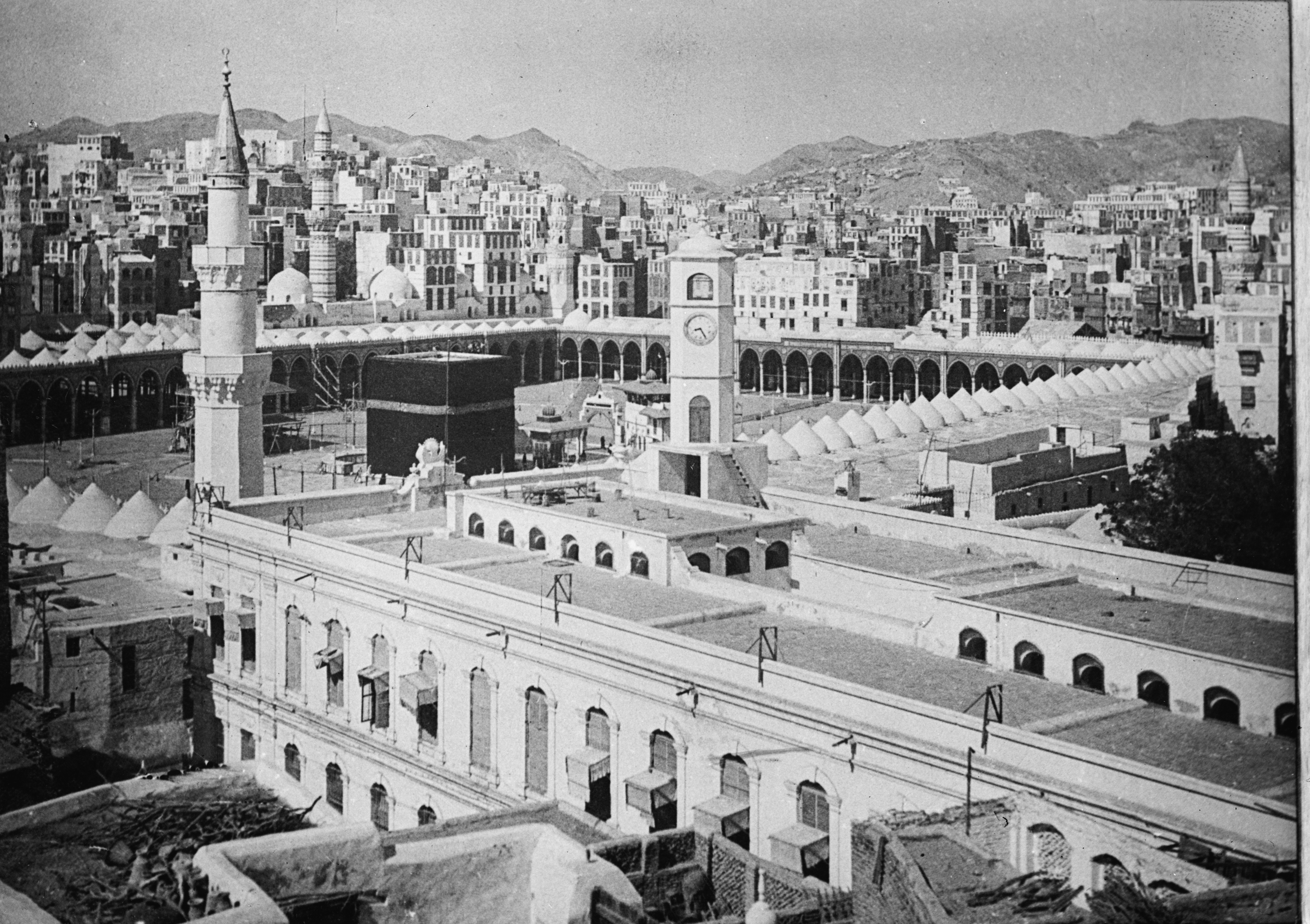
Mecca, Saudi Arabia, in 1951. (mic.com) Mecca, Saudi Arabia, in 1951. (mic.com)

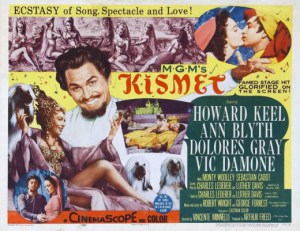
Poster for 1955 musical "Kismet." (stevelensman.hubpages.com) Poster for 1955 musical “Kismet.” (stevelensman.hubpages.com)

Makkah Clock Tower Hotel. (evaser.com) Makkah Clock Tower Hotel. (evaser.com)

Clock Tower Hotel on chart of tallest buildings. (aaviss.com) Clock Tower Hotel on chart of tallest buildings. (aaviss.com)

The Kaaba at Mecca. (universalfreepress.com) The Kaaba at Mecca. (universalfreepress.com)

Mecca in the early '60s. (aswjmedia.com.au) Mecca in early 20th century. (aswjmedia.com.au)

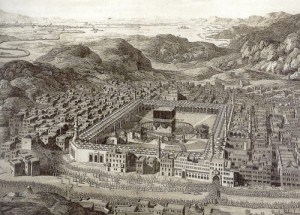
Mecca in ancient times. (socialappetizers.com) Mecca in ancient times. (socialappetizers.com)

Mohammed Atta. (judicial-inc-archive.blogspot.com) Mohammed Atta. (judicial-inc-archive.blogspot.com)

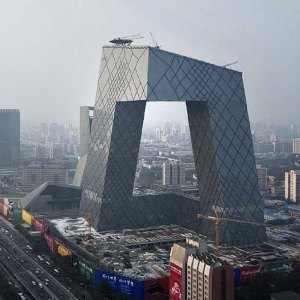
CCTV, by Rem Koolhaas. (e-architect.co.uk) CCTV, by Rem Koolhaas. (e-architect.co.uk)

Stadium in Qatar by Zaha Hadid. (dezeen.com) Stadium in Qatar by Zaha Hadid. (dezeen.com)

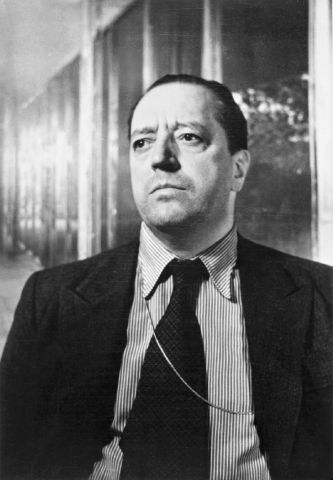
Ludwig Mies van der Rohe. (bauhaus-online.de) Ludwig Mies van der Rohe. (bauhaus-online.de)

Le Corbusier. (terrar.io) Le Corbusier. (terrar.io)

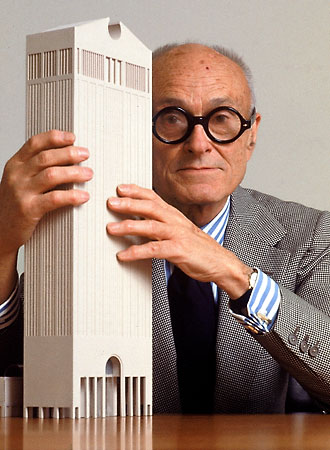
Philip Johnson. (hulshofschmidt.files.wordpress.com) Philip Johnson. (hulshofschmidt.files.wordpress.com)

Kismet. A useful word. Taking a break yesterday from the authorship of a blog post on the destruction of Mecca by modern architecture, I went downstairs, made myself a peanut butter and jelly sandwich, and turned on the television.

I had no plan to address this Thursday column to the calamity in Mecca. But …

Just beginning on TV was Kismet, a musical filmed in 1955 and set in Baghdad. A poor poet is kidnapped after being mistaken for a…

View original post 803 more words

Posted in Architecture, Books and Culture, Other countries, Uncategorized | Tagged , , , , , | Leave a comment

Nathaniel Robert Walker: Architecture and food

Courtesy of the Both illustrations courtesy of Maison d'Ailleurs, Yverdon-les-Bains, Switzerland

Illustrations courtesy of Maison d’Ailleurs, Yverdon-les-Bains, Switzerland

My friend Nathaniel Walker, who got his doctorate at Brown last spring and now teaches architectural history at the College of Charleston, has contributed this essay.

* * *

From the Ground Up: How Architects Can Learn from the Organic and Local Food Movements

By Nathaniel Robert Walker

As a supporter of traditional urban design and a believer in the contemporary relevance of traditional architecture, I cannot count the number of times I have heard generally well-meaning, otherwise reasonable people say the words: “Well, we cannot pretend that we are building in the nineteenth century.”  This statement envelops within its svelte hide a veritable swarm of debatable assumptions, many of which lie at the heart of global architecture culture’s current malaise.

I find it is usually useless to attack these assumptions directly by asking complicated questions such as “What is it about symmetry or ornament that makes them the exclusive property of any particular historical period, considering the fact that they are found almost everywhere, in almost every era?”  Instead I have lately taken to nursing the argument from another, indirect angle — an approach that has, to my surprise and delight, enjoyed some success in pubs and classrooms around the world.  I ask the Modernist: “May we pretend that we are eating in the nineteenth century?”  The initial response is a quizzical stare.  I follow up: “What I mean to say is, is it progressive or backwards to eat locally sourced, organically grown food?  What about heirloom tomatoes?  And how about cuisine inspired by traditional recipes drawn from local cultures?   Is any of this acceptable for modern people?  Is that a lemongrass curry on your plate, by the way?  Rather old-fashioned, that.”
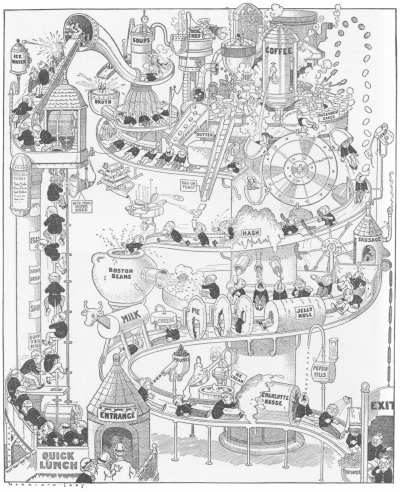
CadyQuickLunchIt is fun to take this line of questioning further.  What would our dinner tables look like if culinary culture were half as hung up on the rigid rulebook of progressive aesthetics as architecture culture is?  Would we be allowed to eat bread or rice, or would they be forbidden due to their unspeakable antiquity?  Would regional fare using locally harvested ingredients be celebrated as part of a rich, diverse, interconnected world of unique traditions, or would it be condemned as provincial nostalgia?

The histories of food and modern architecture have, actually, long been intertwined, on many levels.  By the early 20th century, many people in the Western world assumed that no aspect of our lives would go untouched by the rise of industry, including the way we eat. (See adjacent cartoons!)  Prominent architects such as Adolf Loos argued that simplicity in architecture should be matched by simplicity in cuisine, because truly modern people had no need for ostentatious ornaments either on their façades or on their dinner plates.  By the late 1930s, high-tech, industrialized domestic kitchens had been formulated as a cornerstone of national (and often racial) progress by everybody from Good Housekeeping to the Italian fascists.  Famously, many technology gurus predicted that the irrational, animalistic pleasures of eating would be abolished altogether when nutrition came in pill form.

After World War II, Americans in particular were enthusiastic about the cheap and convenient edibles that industry was bringing to the table. TV dinners, synthetic factory foodstuffs like BAC-Os®, SPAM® and Velveeta®, monosodium glutamate and eventually microwave-radiation, push-button cooking were all rolled out as triumphs of the age, tokens of modernity to be embraced alongside automobiles, rockets to the moon and, of course, modern architecture.  What backwards fool would attempt to hold their ground against the inexorable forces of evolutionary destiny by slow-roasting a free-range chicken with homegrown herbs — let alone insisting that the bird be gently raised without steroids or antibiotics and humanely slaughtered?

And then the tide turned. Many of today’s young progressives — many of whom were raised in the TV glow of suburbia absorbing luminous, corn syrup-based “fruit snacks” — have whole-heartedly rejected industrially processed, chemical-infused products in favor of foods only their great-grandparents would recognize.  And remarkably, such organically produced victuals are not ridiculed as the product of nostalgic reaction, but lauded as the fuel of cutting-edge progress!  What would you expect to see, after all, on the plate of a black-frame bespectacled, elegantly disheveled Modernist architect: a goosh of Cheez Whiz®, or a wedge of Adirondack chèvre?  More to the point, while most of us would, of course, allow someone to consume Cheez Whiz® if they desired it (especially on a Philly cheesesteak), what tyrant would insist that only Cheez Whiz® be offered to the public due to its privileged status as a lovechild of industrial modernity?  And who among us would today abstain from the “unnecessary” ornaments of saffron, cinnamon, nutmeg, black pepper, habanero, etc., in the service of rationalist minimalism?

When our thoughtful Modernist architects shop for food they are generally open-minded about traditional growing and cooking practices — I believe they should be equally open to traditional architectural ingredients such as locally sourced natural materials, organic symmetry, humanistic proportion, craft production and “applied” ornament.  As we can see in our farm fields and pastures, old things are not invalid simply due to their age.  Indeed, many of the modern promises about the future of food have turned out to be hollow, and one of the chief challenges of our times is figuring out how to undo some of the damage of industrial agricultural practices.

That said, I also believe that our more conservative traditional architects have something to learn from modern food culture: good vegetables may be grown according to ancient methods, but food processors are really, truly useful for turning them into decent soup!  Even more importantly, we can and we should revive local agricultural and culinary cultures, but we must also seize the blessings provided by our globalized, Internet-sourced recipe collections, most of which draw from a world’s worth of traditions, and rightly so!  Would we willingly go back to the days when Western palates were ignorant of the joys of injera, bibimbap, and ghee?  The old must be synthesized with the new, the local with the global, and the traditional with the modern, if a living cuisine or a living architecture is to prosper.  We must reject the simplistic monoculture of orthodox Modernism, and we must continue to relearn and revive lost ideas and practices, but we must not fall back on a myopic, limited traditionalism that refuses to look outward and onward in search for good ideas.

If all of our architects were as liberated as our local farmers and chefs, our cities would be designed and built from the ground up, cultivated in the fertile, living soil of our shared cultural resources, past, present and future. The main job of architecture is not to convey history but to make it, ideally by being beautiful, useful, and sustainable — a timeless feast, at the common table.

Nathaniel Robert Walker is an assistant professor of architectural history at the College of Charleston, in Charleston, S.C.

Posted in Architecture, Art and design, Humor | Tagged , , , , | 94 Comments

Mayors and modernism

The Ara Pacis Museum, in Rome. (nytimes.com)

The Ara Pacis Museum, in Rome. (nytimes.com)

Here is a column I wrote back on May 22, 2008, just after Boris Johnson’s election as mayor of London. At the time there was good news coming from the mouths of mayors in Italy and Czechoslovakia as well. Rome and Italy have done a better job of protecting their historic character since 2008. In London, it hardly seems to matter.

Mayors shake modernists’ cage

MAYORS, at least foreign ones, are rattling the modernist cage. That’s good news for how tomorrow’s world might look. Maybe the future won’t look like Blade Runner after all.

Ridley Scott’s sci-fi masterpiece of 1982 depicted Los Angeles circa 2019 as a metropolis of sinister gated towers for the rich shooting into the sky far above the vaguely Hispano-Asiatic mob of proles jammed by the millions into shabby mid-20th Century urban crudscapes far below. Scott’s vision, followed shortly after by Terry Gilliam’s 1985 dystopic futurist comedy Brazil, was among the first to turn away from the streamlined sterility that long typified Hollywood’s vision of the future.

In George Lucas’s Star Wars films, those intergalactic species that needed rescuing – that is, the good guys – tend to live in communities of a vaguely organic, almost historicist architectural vernacular, whereas the bad guys always seem to rule from the sorts of places you’d expect – various architectural manifestations of Darth Vader.

Perhaps filmgoers by the millions have internalized this dichotomy. Perhaps this was a factor that fed into last year’s survey by the American Institute of Architects, which showed (no doubt to the horror of the AIA leadership) that the public likes traditional buildings more than modernist ones (“America’s favorite architecture,” March 1, 2007).

That’s one theory. Another theory is that people internalize a preference for traditional architecture less through the media than through their own eyes, since architecture is the only art form they see day in and day out their whole lives. That is, people are naturally astute critics of buildings. It’s not the fault of the public that the architects themselves have, in recent decades, gone totally nuts.

Anyway, some mayors seem to have internalized the taste of their constituents. In Rome, Prague and London, three European mayors have taken brave stands against modern architecture.

Rome’s new mayor, Gianni Alemanno, has said of the Ara Pacis Museum that it “will be removed.” [Not yet.] The new museum, by superannuated modernist Richard Meier, houses only one item, a 2,017-year-old sacrificial altar – the Ara Pacis, or altar of peace – that honored Emperor Augustus for pacifying Gaul and Spain. With its signature plate glass and rectangular white steel, the museum is the first major modernist building to vandalize central Rome since Mussolini.

When it opened two years ago, Meier’s museum was so predictable and so offensive to its surroundings that even New York Times architecture critic Nicolai Ouroussoff – whose good opinion of anything modern may be reliably assumed – panned it as “a flop.” His critique was penned more in sorrow than in anger. Perhaps if Meier had not designed the same building he has designed for decades, Ouroussoff would have slobbered over it.

Of its location Mayor Alemanno said: “There is a problem of compatibility. The structure is surrounded by Baroque buildings and, in that part of the city, any intervention must be in the same style.” He promised to move it to the suburbs, to which modernist buildings are mostly shunted. Later, he backed off a bit and said that a referendum would be held. [Not yet.] Meier, in a snit, said he would return to Rome to defend his monstrosity. (Not his choice of words.)

Possession being nine-tenths of the law, the survival of Meier’s museum is more likely than the construction of [now deceased] Czech architect Vaclav Kaplicky’s proposed Czech National Library. It is widely vilified in Prague as “The Blob” or “The Octopus.” Last year, I denounced its design (“sad joke on the Czech Republic,” March 29, 2007) after it was unveiled. I even called the Czech Embassy, in Washington, to make sure it was not a prank. Since then, Prague Mayor Pavel Bém has come out against the proposal, as has Czech President Vaclav Klaus. Today it seems very unlikely to be built as designed. Kaplicky is not amused. I enjoy his angst. His library would turn a beautiful city into the laughingstock of the world.

Boris Johnson, London’s new mayor, takes office in the new City Hall he calls the “Glass Testicle,” not far from the office tower that many Londoners call the “Gherkin” or the “Crystal Phallus.” In his campaign, he accused his opponent Kenneth “Red Ken” Livingstone of “wrecking London’s skyline.” The flamboyant Johnson lines up with the late Ian Fleming, who hated modern architecture so much that he named his most infamous James Bond villain after the Hungarian-born designer who built it, who specialized in residential high-rises in the Brutalist style.

His name? Goldfinger. Ernö Goldfinger. His Trellick Tower is a place only Darth Vader could love.

Unlike Rome and Prague, London’s already sunk deep in modern ugliness. But at least Johnson might halt as many as 14 new skyscraper proposals now in the works. He intends to consult with local councils that “Red Ken” was accustomed to override.

Let us hope that mayors on this side of the pond will start to poll their constituents’ taste, too.

Posted in Architecture, Blast from past, Development, Other countries, Urbanism and planning | Tagged , , , , , , , , , , | Leave a comment

Film of Chicago in 1940s

lead_large

Screen shot of 1940 film of Chicago discovered by Jeff Altman.

Here’s a wonderful film of Chicago from the 1940s, discovered by film editor Jeff Altman at an estate sale on the South Side of the Windy City. A good portion of the film was taken from their air, courtesy of United Air Lines. It is in color. It is a promotional film for the city, but better than most. I have not seen the video because my computer is dying in so many ways (it is a MacMini purchased in 2006; last night I purchased an iMac with so much more capacity sheerly through the dint of time; problems like halting video and, let’s hope, the loss of my link tool on WordPress, and the eternally revolving beach ball, just to name a few, will go away as soon as the new machine is installed). I hope to see Chicago, the city of my birth, later today or tomorrow. But here it is for you, free of charge courtesy of Jeff Altman and Architecture Here and There (the name of this blog).

[Update, days later, with my new iMac installed, I have finally seen it.]

Hats off to John Hooker for posting this on the Pro-Urb listserv. It is below:

http://www.citylab.com/tech/2014/03/mysterious-canister-film-transports-you-back-1940s-chicago-color/8676/


Posted in Architecture, Architecture History, Old Video, Urbanism and planning | Tagged , , , | Leave a comment

Shubow on the march

National Civic Art Society President Justin Shubow testifies against Frank Gehry's Eisenhower memorial design at the U.S. Commission of Fine Arts. (shubow.com)

National Civic Art Society President Justin Shubow testifies against Frank Gehry’s Eisenhower memorial design at the U.S. Commission of Fine Arts. (shubow.com)

Justin Shubow has posted his second excellent essay at Forbes.online. His first, last month, analyzed Frank Gehry’s finger. His second analyses the flap aroused by the New York Times when it published an oped Dec. 15 twitting architects for ignoring the public. Shubow must have a sizable research staff to whittle the knives he plunges into the gut of the AIA’s house critic Aaron Betsky’s response to the NYT essay by Martin Pedersen and Stephen Bingler. Betsky’s reply is in Architecture, the mouthpiece of the American Institute of Architects. Shubow’s piece in Forbes (with a link to Betsky) is here:

http://www.forbes.com/sites/justinshubow/2015/01/06/architecture-continues-to-implode-more-insiders-admit-the-profession-is-failing/

Shubow notes that the AIA is feeling the heat of the public’s disdain for architects. It did a survey to confirm those results, hired a gang of PR guys and has initiated a “repositioning” of its organization. Someone seems to have read Shubow’s piece and sent out an alarum to AIA, which pulled its web page about its repositioning. But Shubow’s staff – I’m only kidding; I’m sure he has no staff – managed to grab the page from another source before it disappeared. Good for him! He links to it in his essay. I link to it here:

https://web.archive.org/web/20140401224831/http://www.aia.org/about/repositioning/aiab099720

The AIA replied quickly, putting up a new web page that describes its repositioning campaign as a “redesign.” Here is the link to that:

http://progress.aia.org/

Just a few days ago, driven by a post on TradArch, I visited the AIA website and noticed that a lot of its “promotion” activity involves lobbying for bills in Congress. I didn’t look at any of the specific legislation, but now that AIA has shown its willingness to play footsie with its effort to reposition itself, I am going to hurry up and check it out.

Maybe the AIA hopes to shift even more costs from clients to government (that is, taxpayers). Maybe there is an effort to gird up whatever federal policy exists at, say, the General Services Administration or other agencies to make it harder to build federal courthouses and other civic structures in the classical language. Maybe they want to insert an “of its time” clause into the procedures for this or that federal review process, or maybe they will try to reverse the trend toward sensible analysis in the documentation of the U.S. Secretary of the Interior’s standards for preservation in federal historic districts or other sites controlled by other levels of government when doling out historic preservation tax credits, etc. Or maybe the lobbying is more innocent. If so, the AIA may want to hide that from its members.

I commend Justin for his great work. Since taking over as president of the National Civic Art Society, he has come closer than anyone thought possible to derailing Frank Gehry’s ridiculous design for an Eisenhower memorial. Now his organization may be taking up the fight to protect the Smithsonian quadrants of the national mall. I hope so. His comments on TradArch have always been on point and insightful. His posts for Forbes are filled with incredibly useful information and tart quotes and sharp penetration, and are linked up the wazoo to every source imaginable. Good work!

Posted in Architects, Architecture, Books and Culture | Tagged , , , , | Leave a comment