Simon Jenkins contra Boris

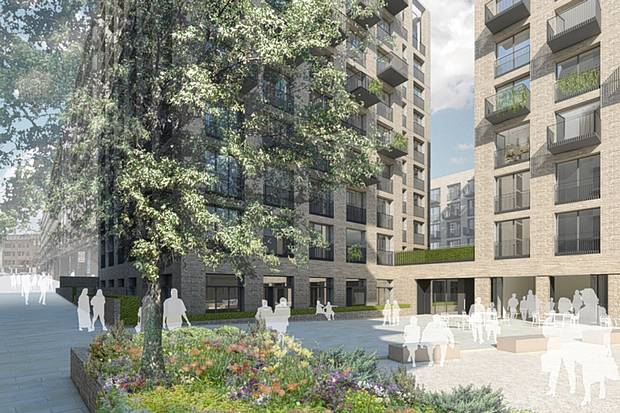
Royal Mail proposal for blocks of flats in London. (Evening Standard)

Royal Mail proposal for blocks of flats in London. (Evening Standard)

This piece in London’s Evening Standard by Simon Jenkins may lack the flair of Rowan Moore’s denunciation of the Walkie-Talkie in the Observer (I assure you that Jenkins is quite capable of summoning that flair). But Jenkins takes aim at London Mayor Boris Johnson in a way that I doubt Moore would think of doing.

http://www.standard.co.uk/comment/comment/simon-jenkins-must-these-ghastly-slabs-be-boriss-legacy-to-london-9779767.html

When Boris Johnson came into office in 2008, he eviscerated predecessor Kenneth “Red Ken” Livingstone for “wrecking London’s skyline.” Johnson turned out to be even worse, at least for the skyline. Jenkin’s criticizes Johnson’s “bland aesthetic of glass towers and rectangles for foreigners to buy-to-leave. … Parliament should be warned: this mayor is a pushover for any lobbyist with a feather.”

In 2008, when Johnson took over from Red Ken, London had 14 skyscrapers in the works. Today there are some 250 skyscrapers of 20 stories or more in the works.

The scheme of residential blocks criticized by Jenkins, to be developed by Britain’s Royal Mail (its USPS) and which Johnson intervened to support, is far less odious than what was proposed by Richard Rogers for Chelsea Barracks – the proposal toppled by Prince Charles. One can imagine replacing its clunky fenestration with dual sets of horizontal, mullioned windows and adding ornamental balconies, a cornice, and a set of string-course moldings every two or three stories. It could be a traditional set of buildings. But that is unlikely, and a better set of buildings has been proposed by a London institute called Create Streets. It has 50 more flats than the 681 proposed, in buildings of seven rather than up to 15 stories. The Create Streets proposal has beaten the Royal Mail proposal by a nine-to-one ratio in local polling. (Imagine that, giving the neighborhood a say over its future!)

Among the leaders of Create Streets, by the way, is Paul Murrain, who back in the 1990s lived in Providence and helped Andres Duany create the excellent Downcity zoning layover plan that has, it seems, so ably blocked modern architecture from being inflicted upon our beautiful downtown. But then came Mayor David Cicilline, who screwed things up in the downtown’s new Capital Center district. But at least by then the old downtown was safe. The city was rescued when Little Cic was booted upstairs to Congress, where he can do little harm to our streetscapes. His successor, Angel Taveras, has had little opportunity to continue Cicilline’s will to ugliness, given the ugly economy. Let us hope that his successor, Jorge Elorza, with an improving economy, has more opportunity to uglify Providence’s skyline – but turns it down. A mayor can grow a city without being so ugly about it. Cicilline did not want to. Boris was aware of that possibility, or so it seemed, but fell prey to the blandishments of foreign billionaires (does he have a Swiss bank account?).

Let us hope Jorge Elorza loves his city better than David Cicilline did. Meanwhile, Simon Jenkins – excuse me, Sir Simon Jenkins – should run for mayor of London.

Posted in Architecture, Development, Other countries, Providence, Urbanism and planning | Tagged , , , , , , | 3 Comments

Rowan Moore’s confusion

The new tower at 20 Fenchurch St., London. (The Observer)

The new tower at 20 Fenchurch St., London, seen through Tower Bridge. (The Observer)

Rowan Moore’s tart critique in the Observer of London’s newest tower since the hideous Shard – the Walkie-Talkie-Scorchie Building (20 Fenchurch) – is a joy to read. His sallies against the building that no longer burns cars on the streets below, because it now wears shades, are spot on and suggest that Moore actually is one of the few architecture critics who understand.

http://www.theguardian.com/artanddesign/2015/jan/04/20-fenchurch-street-walkie-talkie-review-rowan-moore-sky-garden

Especially pleasant for Rhode Islanders is Moore’s defenestration of the designer of Brown University’s Birdshitcatcher Building, the Watson Center, on Thayer Street in Providence. (Its out-slanting windows perform an unintended function.) Moore’s dripping contempt for the many spectacles of Rafael Viñoly (that is, his glasses; does he wear several pair at once?), who with the Walkie-Talkie has achieved his coveted starchitect status, is to die for. (Moore neglects to mention that the Walkie-Talkie is not Viñoly’s first “death ray” building. His hotel in Las Vegas’s City Center complex, the Vdara, focused more than merely tanning rays on guests using its pool.)

Alas, Moore’s look askance at the Walkie-Talkie is merely illusion. He spouts against the word iconic but the concept of modern architecture continues to hold him in its thrall, despite clear evidence that he realizes how bad it is for the city of London, its people, its skyline, its everything. Or at least in the case of this one building. The aha moments mount delightfully as one by one he puts down the pusillanimous jargon of the developers and architects. But they add up to nothing. He does not understand.

Read it, laugh out loud, and weep.

Posted in Architecture, Development, Other countries, Providence, Urbanism and planning | Tagged , , , | 1 Comment

Browbeating Boston’s brand

Adds link to Boston Globe’s story on Mayor Walsh’s architectural advice to developers.

David Brussat's avatarArchitecture Here and There

View toward Prudential Center and 111 Huntington Ave., with the tiara. (worldradiomap.com) View from Christian Science Center toward Prudential Center and 111 Huntington Ave. (center left), with “tiara.” (worldradiomap.com)

Marty Walsh has taken over as Boston mayor after 20 years of Tom Menino, who used to decide what sort of hat new buildings would wear – most famously, the “tiara” of a glitzy tower called R2-D2, near the Pru. That’s how closely the late Menino was said to have micromanaged development in the Hub. Walsh, who once ran the city’s building trades union, told a business roundtable on Wednesday that “too often, new buildings have been merely functional.” He wants developers to “reach beyond their comfort zone.”

http://www.bostonglobe.com/opinion/2014/12/10/marty-walsh-boring-architecture/aI86hSWSR5FmV9XrePhadI/story.html

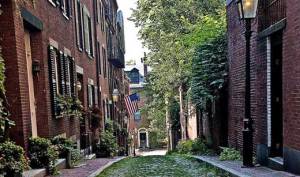
Beacon Hill. (dguides.com) Beacon Hill. (dguides.com)

Back Bay. (content.time.com) Back Bay. (content.time.com)

South End. (boston-discovery-guide.com) South End. (boston-discovery-guide.com)

Financial District. (wikipedia.org) Financial District. (wikipedia.org)

Seaport District. (bostonmagazine.com) Seaport District. (bostonmagazine.com)For an infinitesimally brief moment I interpreted his remarks, which I read in Boston Globe columnist Dante Ramos’s piece on Thursday, as positive. The new mayor wants beautiful buildings, not…

View original post 711 more words

Posted in Uncategorized | Leave a comment

Another Chelsea Barracks?

Hyde Park Barracks design by Quinlan and Francis Terry. (Courtesy of the architects)

Hyde Park Barracks design by Quinlan and Francis Terry. (Courtesy of the architects)

According to Robert Booth’s piece in The Guardian, it appears that the next battle in the style wars of architecture will take place in London’s Hyde Park. Booth’s piece, entitled “Architects’ vision of London takes inspiration from 19th-century Paris,” describes the effort of Quinlan Terry and son to push back against the onrush of some 250 skyscrapers of 20 or more stories already proposed there.

http://www.theguardian.com/artanddesign/2015/jan/02/architects-vision-future-london-inspired-by-paris-skyscraper

Chelsea Barracks designs compared. (creoncritic.wordpress.com)

Chelsea Barracks designs compared. (creoncritic.wordpress.com)

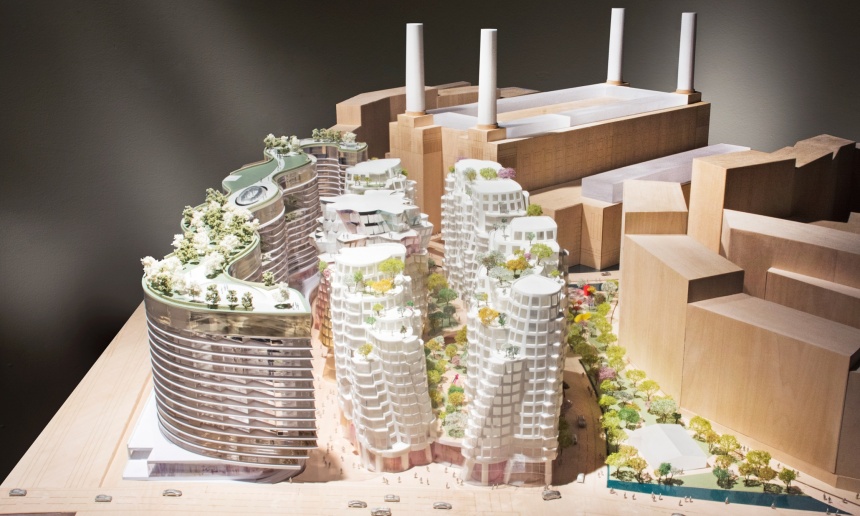
Battersea proposals by Norman Foster and Frank Gehry. (Gehry Partners)

Battersea proposals by Norman Foster and Frank Gehry. (Gehry Partners)

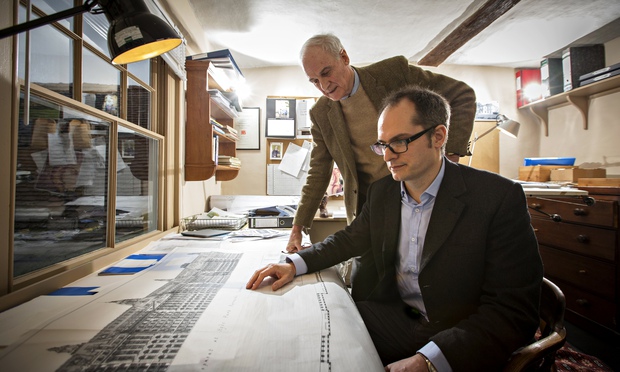
Quinlan and Francis Terry at their studio in Dedham. (The Guardian)

Quinlan and Francis Terry at their studio in Dedham. (The Guardian)

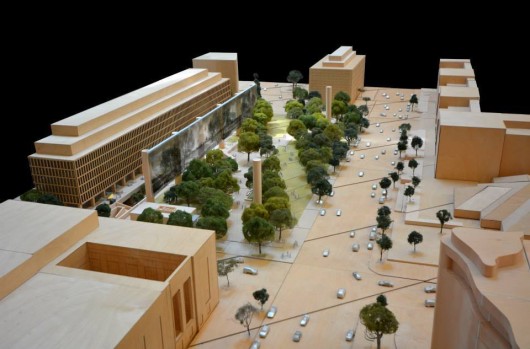
Latest version of Frank Gehry proposal for Eisenhower memorial. (archdaily.com)

Latest version of Frank Gehry proposal for Eisenhower memorial. (archdaily.com)

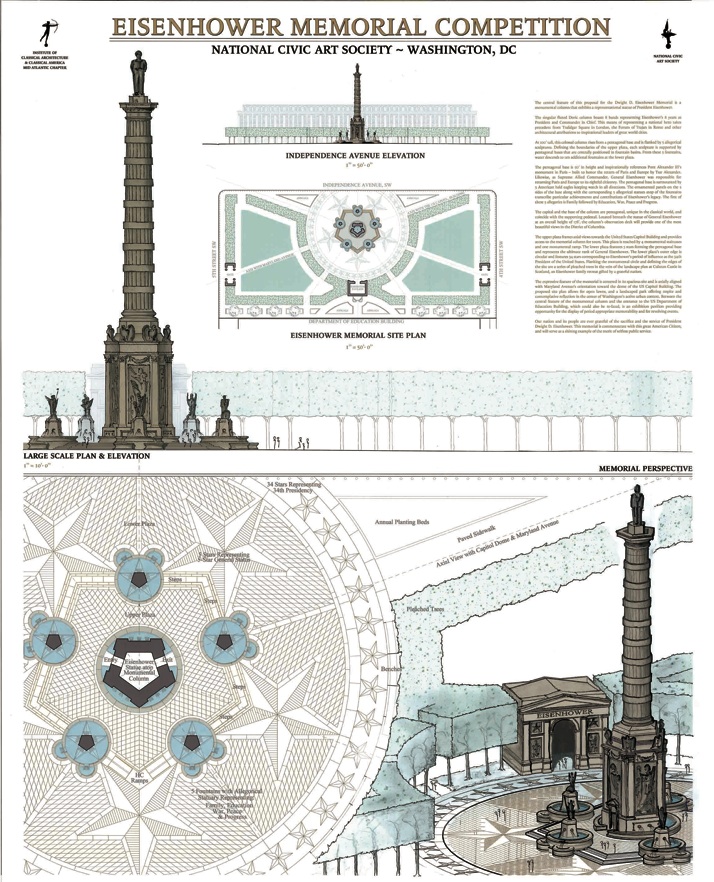
A counterproposal to Gehry design from competition sponsored by the National Civic Art Society. (theclassicalartist.com)

A counterproposal to Gehry design from competition sponsored by the National Civic Art Society. (theclassicalartist.com)

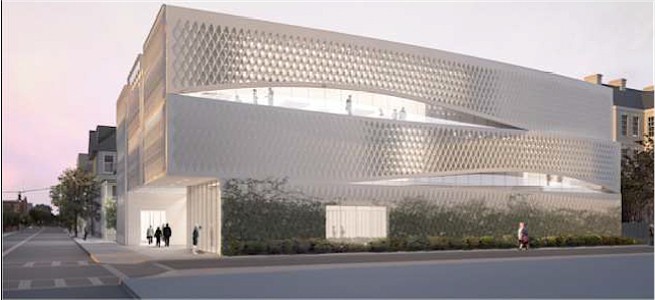
Clemson proposal for new architecture school in Charleston. (charlestoncitypaper.com)

Clemson proposal for new architecture school in Charleston. (charlestoncitypaper.com)

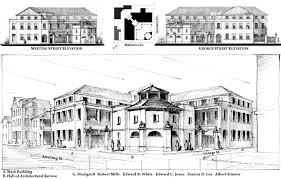
Counterproposal to Clemson proposal by Jenny Bevan and Christopher Liberators. (Courtesy of the architects)

Counterproposal to Clemson proposal by Jenny Bevan and Christopher Liberators. (Courtesy of the architects)

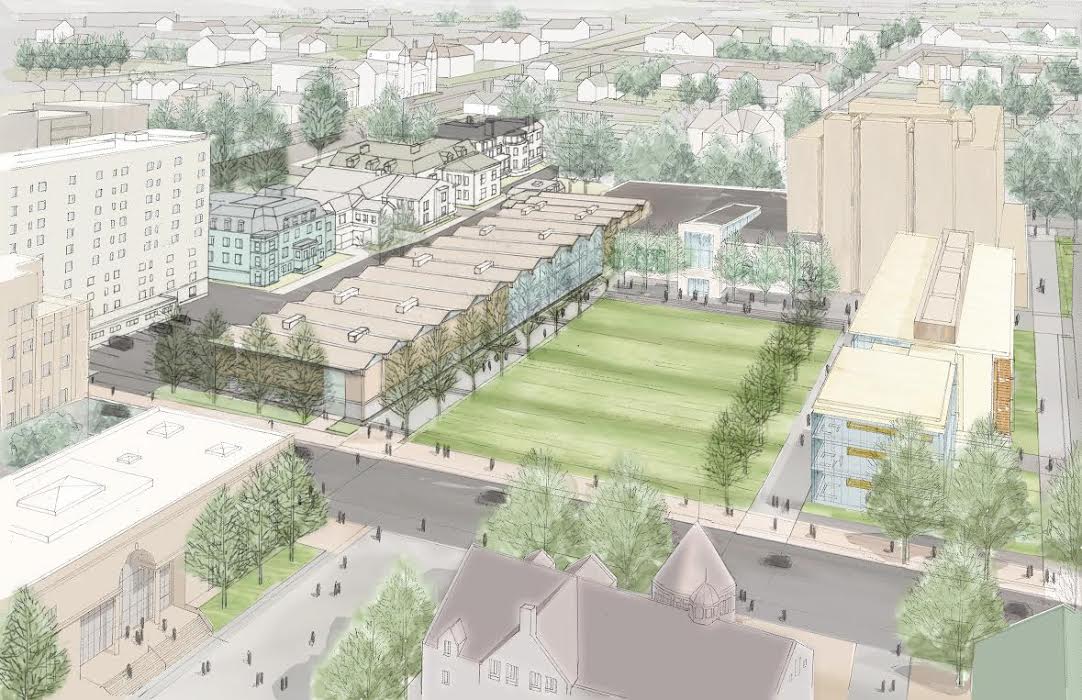
Nearest we have to an image of new Brown engineering campus. Proposed building to right of Manning Walk, involving demo of four lovely old hosues. (brown.edu)

Nearest we have to an image of new Brown engineering campus. Proposed building to right of Manning Walk, involving demo of four lovely old hosues. (brown.edu)

This project reminds me of the Chelsea Barracks imbroglio that did so much to put the idea of new classical architecture front and center in London several years ago. Quinlan Terry’s insurgent proposal for apartment blocks was a frontal attack upon Richard Rogers’s modernist scheme. After Terry’s design trounced that of Rogers in a slew of polls, Prince Charles called upon the landowner to sack Rogers and, and indeed the royal family of Qatar gave the latter a proper heave-ho.

Booth quotes Terry getting to the essence (as I suggested in my last post, “The granularity of cities”):

I think we have the hearts of ordinary people on our side every time, but not the politicians or the architects. That is sad because we have right on our side. Steel and glass don’t produce useful buildings that last more than 25 years. We are trying to create density in a grain rather than with a tower of 20 storeys and space all around it. If you look at Rome, Paris and Milan you have that dense urban grain.

Let us hope that this pere/fils proposal does follow the pattern of Chelsea Barracks by striking a chord in the media and giving rise to comparisons between Hyde Park Barracks (coincidental moniker!) and whichever creepy modernist competitor arises. Pit the design for the barracks imagined by the Terrys against not just modernist proposals for the Hyde Park site but for modernism anywhere in the city – such as the twinned proposals of Norman Foster and Frank Gehry that will deface historic Battersea Power Station. Allow the public to make its preference known. Tradition will deal a setback to modernism, and the tipping point that will level the playing field after half a century of modernist domination (achieved by generally unscrupulous tactics) will come closer.

The closest thing to this sort of a battle in America is the fight over a proper memorial for Gen. Dwight Eisenhower. The official proposal by Gehry has gathered hardly any supporters (a fundraising campaign actually cost more than it brought in), has seen Congress hack away at its federal funding, and has raised hackles among the public and even among many architecture critics, who are baffled by Gehry’s inability to slam-dunk a supposedly done deal.

But in this case, although there was an excellent counterproposal competition hosted by the National Civic Art Society, the public was not and has not been offered the sort of side-by-side comparisons, let alone a poll to vote on, that Brits got from the media in the Chelsea Barracks fight. Prince Charles was involved in that fight, and he is also involved in the fight against more London skyscrapers. True,  nobody of Charles’s prominence is fighting the good fight on our side of the pond, but maybe we do not really need royalty (Brad Pitt is on the wrong side) to win our battles.

In Charleson, a pair of young architects, Christopher Liberatos and Jenny Bevan, fought, alongside an angry public, a new modernist school of architecture proposed by Clemson University in the city’s historic district. They sketched brilliant classical counterproposals that were published and, one thing led to another, and Clemson withdrew its proposal. That scenario could in theory unfold over and over again throughout the United States.

Soon, for example, Brown University in Providence will (I trust) be announcing a design for two new buildings on and near Hope Street. Four lovely old houses are to be demolished. Ground has already been broken for the Applied Math building, with no announcement yet for a design, though a mockup shows shingles apparently intended to keep restive neighbors calm. A new building for Brown’s School of Engineering is being designed by KieranTimberlake. Insiders suggest it will also be modernist.

I challenge traditional architects in Rhode Island – and there are plenty – to come up with an alternative proposal. That’s assuming Brown ever does publicize its designs, which it probably wants to delay as long as it can. I will put them side by side. Let’s see what happens. (The Providence Preservation Society should come out hard on this, since the widely advertised “done deal” in this case is apparently not quite chiseled in stone.)

They shall not pass!


Posted in Architects, Architecture, Development, Other countries, Providence, Urbanism and planning | Tagged , , , , , , , , | 3 Comments

Welcome to Warwick? Ha!

The Elizabeth Mill, in Warwick, R.I. (Providence Journal photo by Sandor Bodo)

The Elizabeth Mill, in Warwick, R.I. (Providence Journal photo by Sandor Bodo)

The city of Warwick has made a big mistake permitting a developer to tear down the Elizabeth Mill near T.F. Green State Airport, in Warwick. Warwickers are always miffed that airline captains say “Welcome to Providence” upon landing in Warwick. But Warwick is very much a placeless place, at least compared to Providence, which is the state capital and the official destination for all flights coming into Rhode Island.

Proposed to rise over site of demolished mill is a mixed-use building near airport. (Integlia Development)

Proposed to rise over site of demolished mill is a mixed-use building near airport. (Integlia Development)

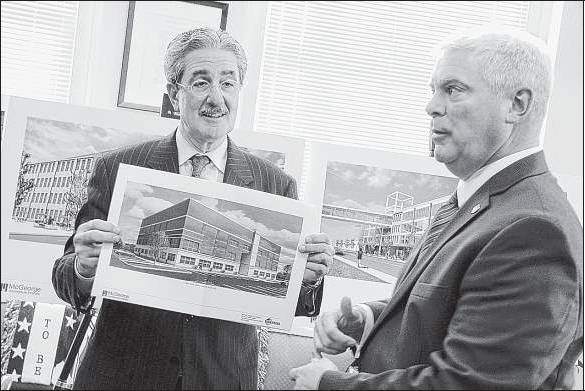
Warwick is trying to turn the area around the airport into a destination for intermodal mixed-use development, but in letting a developer who said he would save the Elizabeth Mill instead tear it down for something like the illustration at left, the city is getting off on the wrong foot. I’m not buying that the mill was not salvageable. Michael Integlia says he will market apartments in the new building for people who find its “funky” aesthetic appealing. But this is not funky, it is merely fucked up.

If Warwick wants pilots to say “Welcome to Warwick,” the city must do more to prevent places like the Elizabeth Mill from being torn down to make way for places that increase the city’s increasingly famous placelessness.

Developer Michael Integlia (holding illustration) and Warwick Mayor Scott Avidesian. (Journal photo by Sandor Bodo)

Developer Michael Integlia (holding illustration) and Warwick Mayor Scott Avedisian. (Journal photo by Sandor Bodo)

Posted in Architecture, Development, Preservation, Rhode Island, Urbanism and planning | Tagged , , , | 8 Comments

The granularity of cities

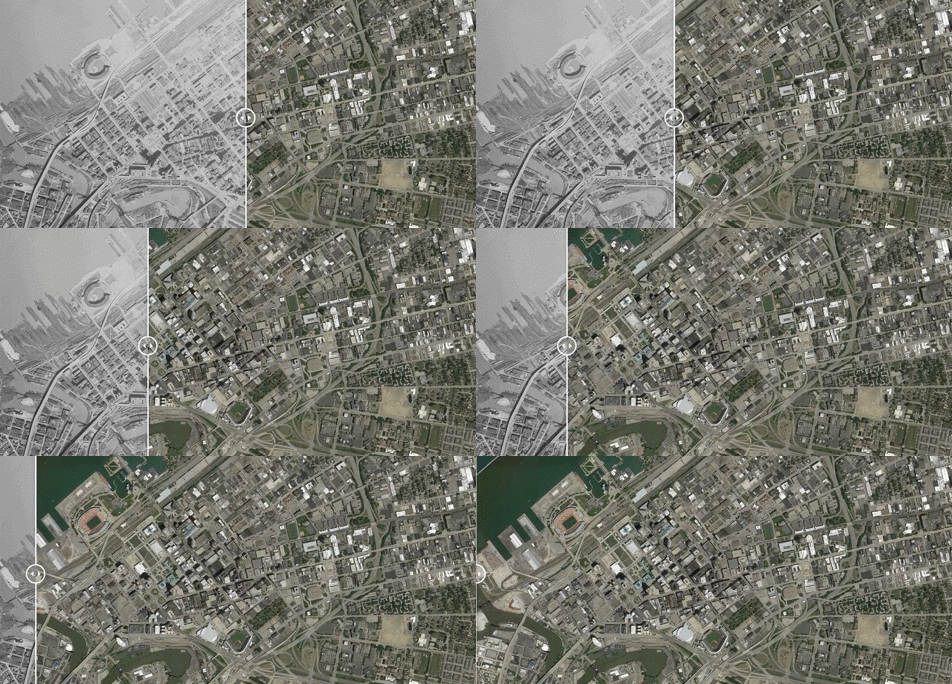
instructions

These superimposed maps of Cleveland now and then are easily used. (University of Oklahoma)

The University of Oklahoma’s Institute for Quality Communities has developed a website that offers superimposed maps of major American cities. The maps cover identical territory in each city, and you can slide a line in the middle to reveal the difference between now and then, then being 50 or 60 years ago at the height of the onset of urban renewal.

60 Years of Urban Change: Midwest

It is said that the phenomena of major highways cutting through cities, combined with the elimination of finely grained neighborhood fabric and its replacement with urban renewal and superprojects, has ushered in progress. I think that is debatable. Jane Jacobs, in her Death and Life of Great American Cities, makes a compelling argument that many of the changes were to the detriment of progress, at least in the livability of cities.

Small blocks – granularity – are among the requirements Jacobs identifies for superior economic activity, civility, mobility, walkability and safety in cities. Given what granularity implies, a bounty of beauty would also have been a boon of its retention in cities.

The United States during the period of the early maps benefited hugely from being the only economy left standing after World War II, and to the extent that we avoided the socialist economic policies of our competitors, to that extent our nation would probably have been able to expand upon that postwar economic advantage – as to a great extent our society did as a whole, but with cities paying a steep and unnecessary price.

(It is fair, nevertheless, to wonder whether the relative stagnation of socialist societies in Europe helped them retain the small grain of their famously beautiful cities.)

Our economic power and its resulting riches and social benefits certainly did not depend on embracing the sort of urbanism foisted upon cities by Robert Moses (in New York) and his ilk. Superhighways punching through city neighborhoods; commerce, industry and community splitting into different quadrants of cities; not to mention urban renewal and subsequent superblocks and megaprojects stomping on city life – these were not required to sustain economic progress. They were a mistake pure and simple, based on modernist planning and design ideology that was not thought through adequately prior to implementation.

Over time, the mistakes revealed so searingly by these maps can be reversed, if we have the wisdom and the courage to make the effort. In the meantime, I hope the folks at the Institute for Quality Cities  at Oklahoma will add some eastern cities to their absolutely fascinating collection of slide-over paired maps from the 1950s and our time.

Posted in Architecture, Development, Landscape Architecture, Preservation, Urbanism and planning | Tagged , , , , , | 7 Comments

“Modernism in Vienna”

Secession House, in Vienna. (wien.org.uk)

Secession House, in Vienna. (wien.org.uk)

Here’s the column on my 2005 trip to Vienna linked to in my last post:

Modernism in Prague and Vienna

June 16, 2005

IN VIENNA AND PRAGUE, built before the divorce of art and architecture, where buildings are encrusted with ornament and statuary, Victoria and I hunted for modern architecture.

In Vienna, on our recent trip, an early modernist building led us on a wild goose chase. We had an hour to kill before seeing Mozart’s “The Magic Flute” at the Staatsoperhaus, so we decided to visit Secession House (1898), by Josef Maria Olbrich, of the Jugendstil movement, which spurned historical styles for Zweck (purpose, as opposed to mere form).

There was a tiny picture of the Secession House in my guidebook, but I kept forgetting what it looked like. We found a building with huge cartoon-like parrots at each corner. Its architect might have been trying to simplify his approach to ornament.

But I checked the guide. After realizing this wasn’t it, we continued down the street. We happened upon a set of bollards that looked more phallic than even bollards normally do. On we walked, but the image of Secession House had again slipped from my mind. When we saw an odd church down the street, we thought that might be it.

It wasn’t. And now we were lost. We abandoned our search for Secession House to find the opera house. Just before we found it, we saw the Secession House — with no time to double back.

Now that I could see it, my serial misidentification of the Secession House seemed remarkably silly of me. It reminded me of the time when I couldn’t find the Seagram Building, in Manhattan. I did not feel silly then, however, because on that stretch of Park Avenue all of the glass boxes looked just like Ludwig Mies van der Rohe’s prototypical glass box.

Even from a distance, the Secession House was a striking building, crowned by a gilded bronze dome of laurel leaves. As an early modernist, Olbrich clearly had a hard time abandoning ornamentation.

His effort to do so was supremely idiotic. The production of “The Magic Flute” we saw was also idiotic, and for similar reasons. It was staged in a severely modernist fashion. A huge revolving cube that changed color and belched fire and smoke dominated the set. Actors entered through square holes in the cube and in the walls and floor of the stage, and were attired so as to confuse the sexes. In short, the cues needed to figure out the plot of an opera in another language had been eliminated.

Likewise, modern architecture has purged all the cues that tell people what a building is for and how to use it. At least the producers of “The Magic Flute” didn’t mess with the music. You could close your eyes and still enjoy it. Try that with architecture and you might walk into a lamppost, or worse.

On the train to Prague, I suddenly realized that I’d totally forgotten to visit another early modernist building in Vienna. Its architect, Adolf Loos, wrote Ornament and Crime — a criminal act in and of itself, it seems to me, for which he was not imprisoned. But it was his Looshaus (1911) that got him in trouble with Emperor Franz Josef. With its naked walls and frameless windows, it seemed to moon the imperial residence from across Michaelerplatz. Yet Loos was still not thrown in jail. And in fact, by modernist standards, Looshaus is quite attractive. When I realized that I’d forgotten to visit it, I cried out in dismay. (We were in a private compartment, but Victoria will verify my account.) It took me several seconds to recover my equanimity.

One day in Prague, we walked from the Old Town up the Vltava River, looking for a building by Frank Gehry known as the “Dancing Building,” or simply as “Ginger and Fred,” after Rogers and Astaire. We found it easily enough, but not before passing blocks of sumptuous Neoclassical and Art Nouveau apartment buildings that faced the river across Masarykovo Nabrezi. With their over-the-top decoration and dream-world balconies, they seemed to look down their noses at Gehry’s tipsy confabulation.

But try as I might, I could not bring myself to dislike the “crushed can of Coke,” as critic Wilfried Dechau called it after its erection, in 1996.

We saw far worse examples of modernism here and there in Prague, but I recall none in the Old Town. Prague escaped World War II without major damage. Vienna suffered more destruction, but far less than Berlin. In fact, much of Vienna today resembles prewar Berlin. And there is nothing in Vienna like the preening sterility of Potzdammerplatz, in the former East Berlin. After the Cold War, the once glorious plaza, demolished by bombs and left vacant by the communists, was rebuilt by a sinister cabal of the world’s most famous modernists.

Perhaps there are horrifying modernist stretches in Vienna and Prague. Victoria and I certainly did not seek them out, and are glad, if they exist, to have escaped Europe without their finding us.

David Brussat is a member of The Journal’s editorial board. His e-mail is: dbrussat@projo.com.

Copyright © 2005. LMG Rhode Island Holdings, Inc. All Rights Reserved.

Posted in Architecture, Architecture History, Art and design, Blast from past, Books and Culture, Other countries | Tagged , , , , , | 3 Comments

Ornament and Crimehaus

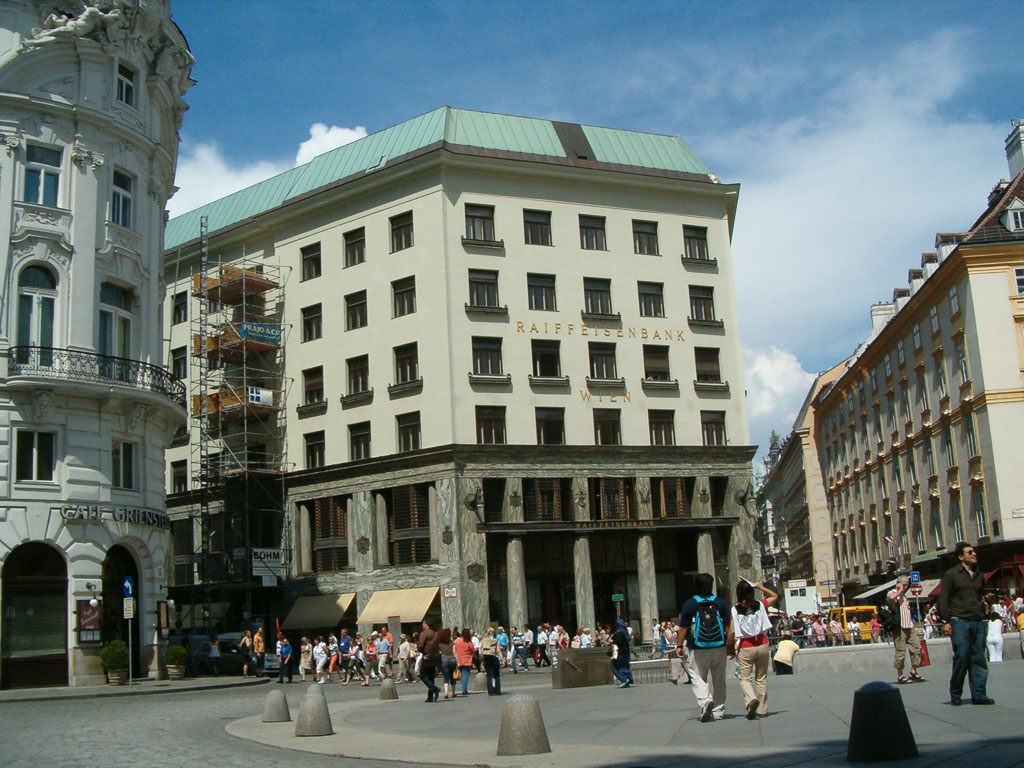
Looshaus (1910), by Adolf Loos, author of "Architecture and Crime" (also 1910). (eikongraphia.com)

Looshaus (1910), by Adolf Loos, author of “Ornament and Crime” (also 1910). (eikongraphia.com)

Recently, after several contributors to a TradArch discussion of Adolf Loos and his famous building in Vienna, Andres Duany pointed out that the windows in the upper floors don’t align with the building’s ground-floor features. Earlier comments had referred to the lush quality of the marbling on those ground-floor features as amounting to ornament.

And of course it is – notwithstanding that Loos is most famous as the author of Ornament and Crime (1910), a bible of modernist ideology. By the way, the building is on the Michaelerplatz and directly across from the palace of the Austro-Hungarian emperor, Franz Josef, who hated the Looshaus and refused to exit onto the plaza so as to avoid seeing the building. Indeed, as lovely as it might strike us these days compared with most iconic modernism, it is definitely several rungs down from the level of ornamental encrustation of its neighbors.

Anyhow, after Duany’s comment about the window alignment, Joel Pidel wrote the following, which strikes me as a most enchanting classical discourse on a supposedly modernist icon of a building. It is pure wonkitecture – almost archiporn in prose:

Just the in-between windows don’t align.  But this “mis-alignment” is not an unusual classical feature, as we’ve pointed out in the past (Pantheon, S. Maria Novella, etc). It gives the elevation some tautness and rhythm by not aligning “everything.”  But it needs the points of consonance (alignment at middle and ends) to resolve the “dissonance” or tension created by the intermediary windows not aligning.  Especially since there is no intermediary plinth or platform between the upper stuccoed portion of the building and the lower stone portion of the building.  Having  such a “restated ground” above the entablature would possibly allow even greater flexibility in arrangement of the upper windows if it was desired. And, of course, he does the same pattern of “alignment/misalignment” on the side elevations.

After I asked Joel whether I could post his comment, he added:

Sure. With the caveat that this is with regard to the sliver of Loos’s oeuvre that we are discussing.  Loos understood all of this because he was classically trained, and such “deviations” were part of the milieu of that education.  The point is that dissonances can’t be arbitrary, but find their meaning subsumed within a greater resolution.  Later, Loos deviates more fully from the classicism exhibited in his earlier work.

Personally, I’m no Loos scholar and have only seen his work in Vienna, but I would wager that the disparity between his polemic and his built work is simply the result of a call for something that he himself was not allowed to build at the time (based on his clients’ tastes and civic locations), and thus his work exhibits a gradual evolution and decreased ornament, in line with his polemic, as the taste for greater minimalism and experimentation allowed, particularly outside of civic contexts.

Below is a link to a column I wrote on a visit to Vienna, during which, much to my later chagrin, I forgot to go see the Looshaus.

“Modernism in Vienna”


Posted in Architecture, Architecture History, Blast from past, Other countries | Tagged , , , , , | Leave a comment

AP fotog in Toyland

Bern, Switzerland at dusk after a snowfall. (AP photo by Peter Claunzer)

Bern, Switzerland at dusk after a snowfall. (AP photo by Peter Klaunzer)

Who would not want to live in this photograph? It is Bern, Switzerland. The photo, shot by Peter Klaunzer for the Associated Press, was published in today’s Providence Journal. Don’t ask me why I’ve taken two lovely city shots from the Journal in recent days. I am flabbergasted that they ran at all.

It reminds me that even in the era before it began shedding photographers as if they were water off a duck’s back, the paper’s photo stylebook seemed to nix any pix that caught the setting of an event. I remember searching through the entire fat file of Brown graduation photos; none showed the Benefit Street setting of the annual parade of graduates. Only the people mattered. If an aircraft carrier were to sail up Narragansett Bay, enter Providence and dock in the river between downtown and College Hill – an impossibility, but stay with me here – the Journal wouldn’t run a wide-angle shot of the carrier backdropped by skyscrapers but a zoom of two Navy seamen holding hands on the flight deck (or some other people-centric detail of interest to the Journal’s photo desk).

It’s not that people don’t matter, it’s that the Journal never seemed to have any sense of balance in its photo selection. So maybe these two recent seasonal pictures in the Journal (including one of GUM in Moscow) were not shot by Journal photographers, but suddenly shots of places are actually showing up in the paper for a change. Good work!

Posted in Architecture, Other countries, Photography, Providence | Tagged , , , , | 3 Comments

Quack troops invade capital

DSCN4870_2A friend and I drove through the swath of redevelopment land where Route 195 used to be. We wanted to view the new street infrastructure. We were yukking it up over the “art” when we had to stop to review the troops. They were crossing the road. Geese from Canada. At least they’re called Canada geese. Hundreds of them. We waited until they had reached their objective and then drove on. I took the picture above under duress – my camera was not cooperating. Its autofocus is haywire and the first shot was dead white. I spun the f/stop gear and the next shot was dead on, except off kilter a bit, so I shot again and got “Out of Memory.” Seems I’d reached the end of my rope, or my camera’s, which was at 4,870 shots. The shot above, snapped after wrestling for a couple of minutes with my camera, caught the last squad of quack troops. Okay, I guess the joke phrase is usually applied to ducks – geese don’t quack, they honk, right? So we had coffee. (Me and my friend, not me and the geese.) He dropped me off home and I returned to The Thin Man, by Dashiell Hammett, which I’m reading.

Posted in Architecture, Development, Humor, Landscape Architecture, Providence, Urbanism and planning | Tagged , , , | 2 Comments