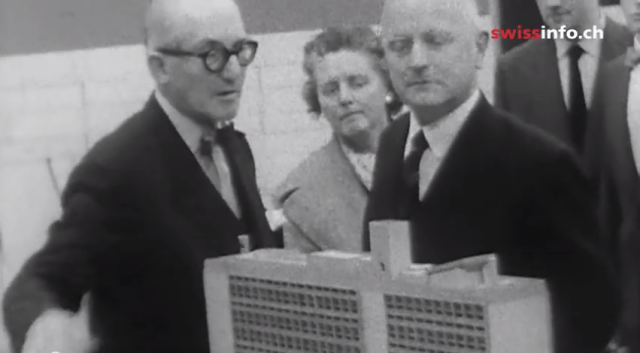
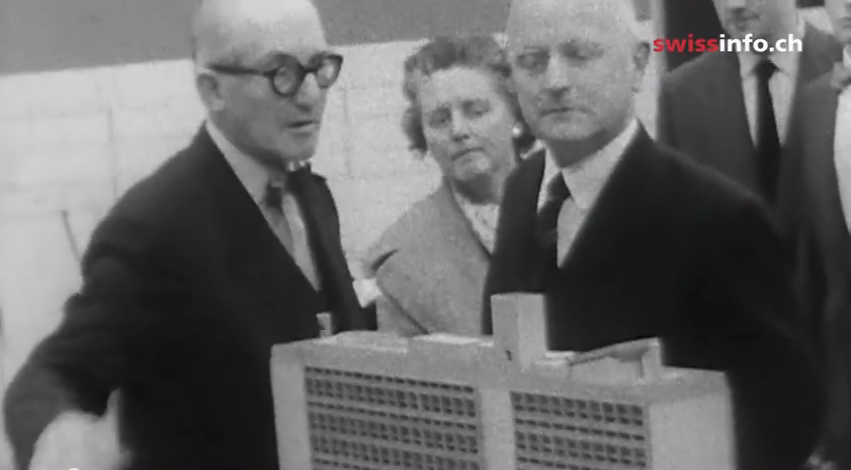
Le Corbusier promotes new building. (swiss.info.ch)
I am at this moment watching a Swiss video called Le Corbusier: Why he is adored and detested. The screenshot from the video atop this post captures his pitch to build another of his machines for dying in (yes, that’s what they look like), and also the curl of his lip as he pushes it on a gullible group of design mavens. A few scenes later, the narrator notes that the architect opened a studio in Paris. Then she describes his Plan Voisin, proposing the destruction of the Marais district in central Paris. “He wants,” she asserts, “to improve living conditions for the residents of the crowded city.” How can she tell? I can’t wait for the video to get to why he is also “detested.” …
I enjoyed the video’s interview with the German curator of an exhibition in London dedicated to Corbusier. Arthur Ruegg wears a diminished version of Corbu’s distinctive round black spectacles. Funny. But then, with dark music in the background, the narrator intones that Corbusier’s “political allegiances have cast a dark shadow over his architectural achievements.” She notes his collaboration with the Vichy regime set up by the Nazis, and quotes one of his letters to his mother, in which he states his belief that “Hitler and Vichy rule would bring about what he called ‘a marvelous transformation of society.’ ” Indeed, he was hired under Vichy as a city planner but his proposals, such as his plan to destroy Algiers, reminiscent of his plan to destroy Paris, were rejected. (Ah, the protective cloak of the total state!) She then declares that he later denounced the regime, and adds that some say he was merely “cozying up to those in power in order to win commissions.” The video cuts to architecture critic Deyan Sudjic saying that Corbusier tried to get audiences with Mussolini and Stalin.
But no worries! Great architecture, Sudjic adds, has always depended upon a close relationship between architects and the occasionally unsavory rich and powerful. YouTube’s description of the video reads: “Le Corbusier was an internationally influential Swiss artist, architect and designer. His dubious associations with totalitarian regimes have failed to diminish his reputation as one of the most inspirational artists of the 20th century.”
Indeed, alas, they have. So does it do any good to raise questions about Corbu’s political allegiances, or those of Mies van der Rohe, the Bauhaus leader who tried to persuade the Nazis that modernism would make a good design template for the Third Reich; or Walter Gropius, who merely sought commissions from the Nazis but who, after emigrating to the United States, set about purging architecture education at Harvard of traditional themes; or the American architect Philip Johnson, who accompanied the Wehrmacht into Poland and set up his own pro-Nazi organization in America after, not before, he had curated the Museum of Modern Art exhibit that introduced modernism – the “International Style” – to his country’s intellectual elite, and admitted that architects were “high-class whores”?
Since Corbusier is the most revered of this set of founding modernists, attacking him is at once the most rewarding and the most perilous of strategies in the fight against modern architecture. With the centennial of the great master’s birth coming up in August, against the backdrop of a Corbu protectorate in full drool, two books will by then be published in France that focus on his totalitarian bent. A review of the two books in the London Times by Matthew Campbell, “Critics demolish Le Corbusier as an anti-Semite,” quotes one of the authors making a most salient observation: “The most shocking thing is not that the world’s best-known architect was a militant fascist. It’s the discovery that a veil of silence and lies was thrown over this reality.”
Malcolm Millais, the British writer and resident of Portugal whose excellent Exploding the Myths of Modern Architecture was published in 2009, has written Nothing But Lies: The Shocking Truth About Le Corbusier, soon to be published. I am in the midst of reading it. It may be the most comprehensive assessment of the architect’s many flaws, not only his political allegiances but the extent to which voluminous internal contradictions mar the record of his achievements and the validity of his own thinking on architecture, planning and cities. Brutal stuff. To say the least.
The goal of this literature, which carries forward a line of march that causes even some classicists to blanche, is not to persuade the establishment and the practitioners of modern architecture that Corbusier was evil and hence modernism is wrong. They live in a bubble. There are many examples of how shifts in attitude have resulted from attacks over time on the conventional wisdom and established practice. Smoking is a great example. Wearing seat belts and driving drunk are others. Take the rise of Hush Puppy shoes from fusty to fashionable and the sudden drop in the sky-high crime rate of New York City – to cite two examples from Malcolm Gladwell’s Tipping Point. Change is a cumulative phenomenon. A host of factors are always contending to put the last straw on the camel’s back.
A majority in most nations already doubts the validity of modern architecture. The shift away from modern architecture and back to a more beautiful, sustainable and popular architecture has already begun. When it will reach a critical mass is unknowable, but direct action can speed it up. Indifference will slow it down. A shift in the correlation of forces is already such, it seems to me, that attacking Corbusier can only help. Those who find it beneath their dignity can leave the dirty work to others.
Challenging the Corbusier hegemon is just one tactic in a strategy that can and will lead to the victory of beauty over ugliness, conservation over waste and affection over disdain. The AIA, on the run and crouching in its Corbu Corner, says “Look Up!” I say “Look It Up!” The facts about Le Corbusier are out there, and they are as damning as they can possibly be. In any other field, someone with such transcendant flaws would be frog-marched out of the profession. Happy birthday, Corb. Your time has come.















 Architecture Here and There