Catesby Leigh’s WWI faves

Screen Shot 2015-08-29 at 5.45.38 PM

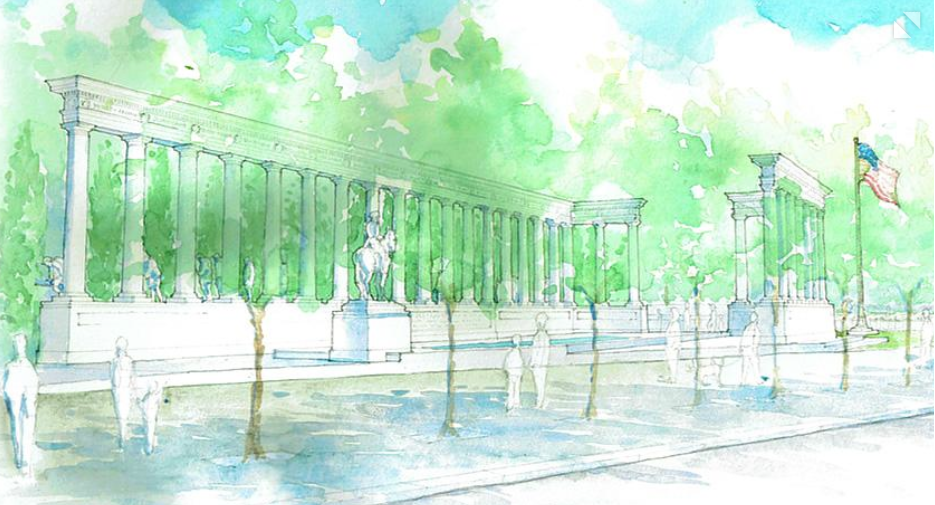
The Washington critic Catesby Leigh has an excellent write-up of the World War I memorial designs in the National Review, “National World War I Memorial: The Judges Got It Wrong.” He mentions two proposals that were entered but for various technical and/or rules reasons did not make it into the first round’s more than 350 entries. Both designs are by major classical practitioners and, as Leigh suggests, it is helpful to take note of them and, possibly, learn from them.

Leigh also discusses the heterodox entry by Roy Lewis that didn’t make the second cut that left five finalists standing – he says it should have – and also the classical entry (a second was traditional but arguably not classical) that did make that cut, by Annapolis architect Devin Kimmel, which features a tower of some 50 feet, with too much writing on its walls. Leigh does not think Kimmel’s design should have been the one classical entry to make the cut, but he does say “we can learn from Kimmel’s design,” adding:

Like Lewis, but in a very different way, he’s trying to rework canonic architectural elements into a new synthesis. That’s what’s so important about the tradition. It provides objective criteria as well as an enduring formal vocabulary that allow the architect’s body of practical knowledge to expand with every solution to a particular design problem. The tradition thus builds on itself rather than continuously disintegrating into a theoretical miasma.

Leigh’s remarks about the flexibility of classicism and its ability to learn identify the vital core of this ancient architecture’s modern-day superiority.
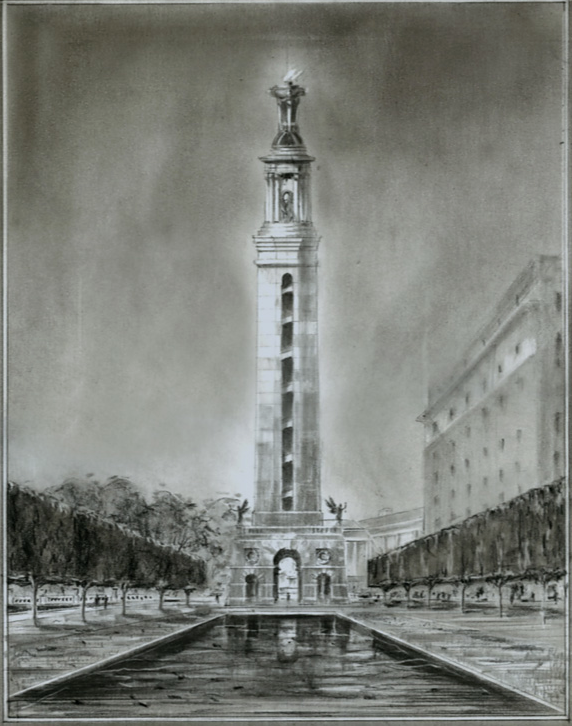
WWI memorial design by Richard Cameron and Michael Djordjevitch. (NR)

WWI memorial design by Richard Cameron and Michael Djordjevitch. (NR)

I like Kimmel’s design, and have written that the tower’s symbolic descent toward the physical and moral savagery of war could be improved. (Kimmel, I should say, read that and then phoned me to ask me to write his press releases.) But maybe the tower should also be taller. Leigh liked Lewis’s design partly because its own tower, of 92 feet, presents a more monumental contribution to this segment of Pennsylvania Avenue. One of the two entries he brings into the discussion, by Richard Cameron and Michael Djordjevitch, features a 225-foot bell tower. The other, by architect James McCrery and sculptor Chas Fagan, features a pair of L-shaped colonnades without any monumentally vertical element – but with lots of excellent orthodox classical pizzazz.

Leigh’s thoughts on these and other entries into the memorial competition are, as one might expect from the nation’s most erudite analyst of classical architecture, well worth reading in their entirety. But he has the most fun with the modernist entries (one of which I would consider traditional if not classical). One wishes he’d allowed his literary cat more time to toy with these poor mousy creatures.

Meanwhile, I hope the entries by Roy Lewis, architect Michael Imber and sculptor Sabin Howard, plus the Cameron/Djordjevitch, McCrery/Fagan entries, and other fine classical entries (or even non-entries) become the core of an exhibition of alternative proposals not unlike the one sponsored by the National Civic Art Society and the Mid-Atlantic chapter of the Institute of Classical Architecture & Art to rebut the Eisenhower memorial design by Frank Gehry. Devin Kimmel must win this competition if excellence plays any role in the judging. The caveat argues for a Salon des Refusés.

Posted in Architects, Architecture, Architecture History, Art and design, Landscape Architecture, Urbanism and planning | Tagged , , , , , , , , | 1 Comment

Behead the Islamic State

Baalshamin Temple, at Palmyra, just blown up by the Islamic State. (

Baalshamin Temple, at Palmyra, just blown up by the Islamic State. (BBC)

It may have been the beheading of Khalid al-Asaad, known as Mr. Palmyra, a retired professor and protector of antiquities at Palmyra, that pushed me over the edge a few days ago, and I’ve been mulling the idea with further intensity ever since. Now, with the destruction of the Baalshamin Temple at Palmyra, concluding an apparent truce protecting at least some ancient sites under IS dominion, treasures that belong to the world and to history are at even graver risk. Behead Isis, I say. America must lead the way.

Khalid al-Asaad. (NYT)

Khalid al-Asaad. (NYT)

No writing or argumentation from this corner can pretend to marshal the case for sending young Americans into the fight. More thinking on a much deeper level has been done by others for and against. This is my gut feeling and no more, with no more validity than the gut feelings in the other direction. But America is already there, in the fight, with one or maybe even both hands tied behind its back, leading from behind in a way that permits the rest of the civilized world to follow from behind – that is, do nothing. And maybe doing nothing really is the best policy. Let Araby bleed itself into even greater inconsequence.

But the result of shirking the responsibilities of world leadership has in the past generally been a greater and bloodier tragedy. I am reading William Manchester’s magisterial The Last Lion: Winston Spencer Churchill, Vol. 2, “Alone, 1932-1940.” Churchill was almost the only voice arguing against the appeasers of Hitler. The parallels are very uncomfortable.

This post will not win me a lot of goodwill, I’m afraid. As a man nearing retirement age my standing to call for war is reasonably pathetic. My voice means nothing but to myself, however, and as I see what’s happening in the Middle East, I must at least be true to my own feelings, such as they are. The classical revival, which is my lodestar, looks on with dismay at the crimes of the Islamic State. Behead Isis.

Scroll to bottom of this BBC link for brief but gorgeous presentation on importance of Palmyra, which is a World Heritage Site.

Demolition of Baalshamin Temple. (BBC)

Demolition of Baalshamin Temple. (BBC)

Posted in Architecture, Architecture History, Books and Culture, Other countries, Video | Tagged , , , , , , , , , , | 4 Comments

The R.I. Holocaust Memorial

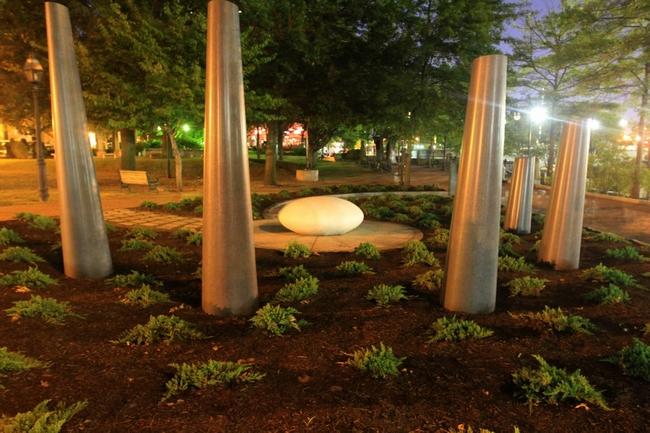
Rhode Island Holocaust Memorial in the evening after its dedication on Wednesday. (Bob Thayer/Journal)

The Rhode Island Holocaust Memorial in the evening after its dedication on Wednesday afternoon. (Bob Thayer/Journal)

Yesterday saw the dedication of the Rhode Island Holocaust Memorial, remembering the more than six million Jews murdered by Hitler and the Nazis, plus the many who escaped, including those who moved to and made a new life in Rhode Island.

The memorial was created by the Jewish Alliance of Rhode Island and the Holocaust Education and Resource Center of Rhode Island.

The above lovely photo by Bob Thayer of the memorial ran in today’s Providence Journal with a moving story of the dedication, “Providence’s Holocaust memorial a place to remember and reflect,” by Paul Edward Parker. He wrote of survivor Alice Dreifuss Goldstein, 80, who spoke to an audience of about 200 at the event:

“It’s amazing how many people don’t know about it,” Goldstein said … “The main thing that’s important is that we keep teaching this story.” Speakers at the dedication of the memorial said it would accomplish just that, while also being a place of quiet reflection for people to contemplate the horrors of the Holocaust and the strength of those who endured it.

The memorial, designed by Brown and RISD-based sculptor Jonathan Bonner, sits just south of the World War I Monument by architect Paul Philippe Cret, erected in the 1920s and moved from the demolished Memorial Square to the new Memorial Park in 1996.

Bonner’s design, chosen from 12 entries in a competition, features a crescent of six tapering black granite pillars, perhaps smokestacks, from three to ten feet in height that embrace a curving brick walkway inscribed with railroad tracks leading to a large white granite stone that suggests the memory stones placed by loved ones atop the gravestones of their ancestors.

By Thursday afternoon, about 20 small stones had been placed atop the ovular shape at the center of the memorial. The design strikes me as overly literal but maybe that is why it is so moving. It was a beautiful day. My son Billy and I sat on a bench nearby and watched people walk to and through the space. Some sat near it, perhaps in contemplation. Then we went away. It was sad. It was supposed to be sad, in spite of the feeling of hope embodied by the white stone. But the memorial’s existence here, finally, spoke volumes for hope in the state that bears the word as its motto.

Posted in Architecture, Art and design, Landscape Architecture, Providence | Tagged , , , , | 5 Comments

Corbu, Paris and Pinceau

Corbusier, his wife, Yvonne, and their dog, Pinceau (Paintbrush). (pinterest.com)

Corbusier, his wife, Yvonne, and their dog, Pinceau (Paintbrush). (pinterest.com)

Today is the 50th anniversary of the death of Le Corbusier, founding villain of modern architecture and to this day still its leading hero. He died in a swimming accident off the Mediterranean coast where he had vandalized the seaside villa of his friend, Eileen Gray, who severed their friendship when she found out. Corbu’s life was sinister and his work was ugly. He submitted a plan to destroy central Paris that Parisians rejected, bless their hearts. In World War II he held a post in the Nazi puppet government at Vichy, in occupied France, where he submitted a plan to destroy Algiers. All heartless, brainless experimentation on the housing of the poor in beastly towers with minimal amenities may be traced back to Corbusier. He was the father of the worst aspects of urban renewal. When his schnauzer, Pinceau, died, he used the dog’s skin to bind his copy of Don Quixote.

Here is a grim passage from Le Corbusier, by Nicholas Fox Weber:

After Pinceau died, Le Corbusier, at great expense, had the dog’s body skinned and tanned. He also had his skull preserved, with a spring mechanism in the jaw. The services were provided by “naturalists” with offices a short walk from Le Corbusier’s old digs on the rue Jacob. This was probably the skin used to cover his old copy of Don Quixote – extant to this day – but what he did with the skull is unknown.

What a man. RIP.

Posted in Architects, Architecture Education, Art and design, Books and Culture, Urbanism and planning | Tagged , , , , , , , | Leave a comment

Why we fall back on parks

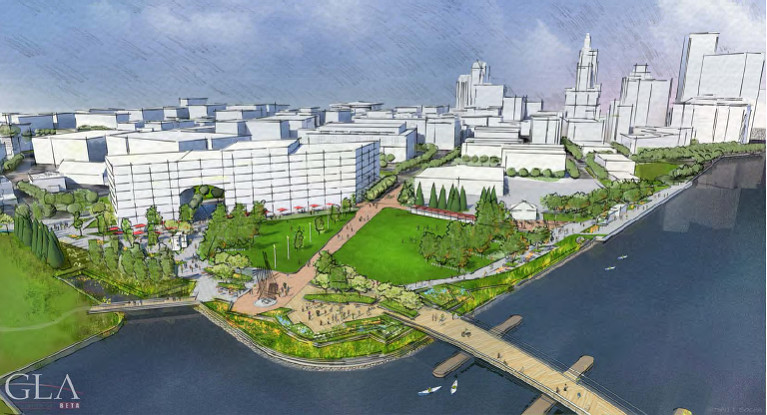
Rendering of proposed park on I-195 land west of Providence River. (gcpvd.org)

Rendering of proposed park on I-195 land west of Providence River. (gcpvd.org)

My post yesterday after the debate in Providence between proponents of a park or a ballpark along the Providence River, even though the waterfront is “festooned” with parks, elicited this eye-opening response from James Howard Kunstler, the celebrated critic of suburbia, theorist of “peak oil,” author of many excellent books and coiner of the word “crudscape”:

The reason that parks are the default remedy for mutilated urbanism is because the public has no faith in buildings. The architects have been delivering horrifying objects for 70 years. And dishonoring the street in the process. So the public cannot imagine public hardscape worth being in. So “nature” is the default remedy. It’s really hard to overcome this.

This explains everything, and it also argues why state government in Rhode Island should advocate for architecture that strengthens rather than weakens the R.I. brand.

By the way, the debate, sponsored by Leadership RI, was a hoot. The audience was heavily opposed to the stadium but the stadium proponents, Patti Doyle and Cyd McKenna, did a great job and got the better, I think, of opponents Sharon Steele and Ethan Kent. Still, only releasing the details of the negotiated deal is likely to change any minds. See my post from last night, “River ‘festooned with parks.'”

Posted in Architecture, Architecture History, Art and design, Development, Landscape Architecture, Providence, Urbanism and planning | Tagged , , , , , , , | 1 Comment

River “festooned with parks”

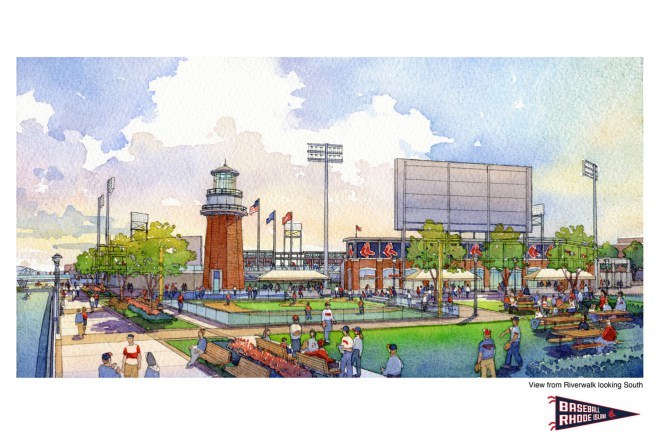
Rendering of linear park between stadium and river bank. (PawSox)

Rendering of  proposed linear park between stadium and Providence River. (PawSox)

I attended tonight’s panel discussion, sponsored by Leadership R.I., on the Providence waterfront – park vs. ballpark – and was startled to hear myself quoted in the first question from the moderator. He cited the “blog by David Brussat, who I see is in the audience,” and wondered how stadium opponents would respond to my assertion that:

[T]he river is already festooned with parks, another new park is now being built right across the river as part of the 195 corridor – and the proposed park that would be lost suffers from extraordinarily poor design, both from the aesthetic and the practical standpoints.

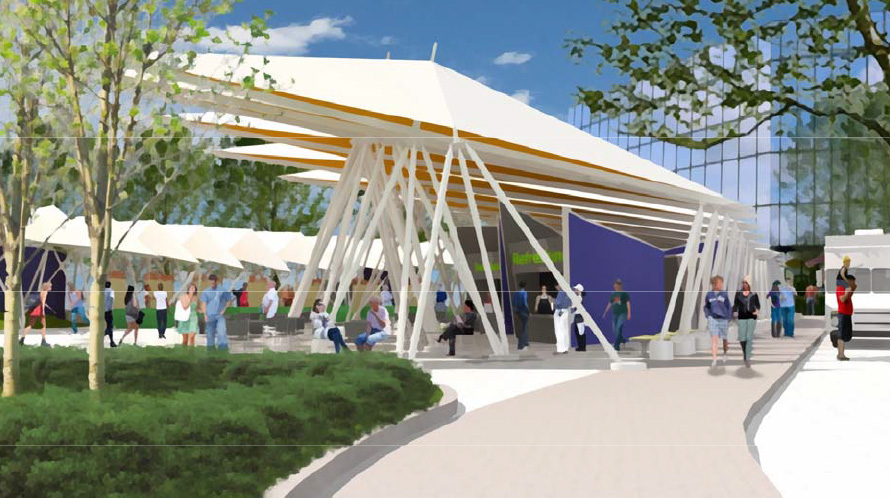
I refer to the image at the end of this post, which depicts some sort of jiggety-jaggety bandstand or whatever that contraption is that architects Epstein Joslin paraded before the I-195 Relocation District Commission’s public space subcommittee. The design was criticized by members of the subcommittee, and it may not still be part of the park plan, which is running way behind. But this is what you risk when arguing for a public park these days.

The poor practical design has to do with the failure to bring the river walk under the west end of the pedestrian bridge. That’s not the only flaw but others can be read in my post “Hard to build an unnatural park,” written well before the stadium issue emerged.

The panel did not address the issue raised by my quote. Much to my relief, Sharon Steele, the against team leader who is also a very sharp rhetorician, ignored it, allowing it to twist slowly in the wind. A little while later, Cyd McKenna pointed out that the linear park along our reopened rivers would run between the river bank and the stadium. And the stadium would come with a new park just to its north. (See top image.)

But a waterfront that boasts Roger Williams Memorial Park, State House Park, Memorial Park and nearby India Point Park – not to mention the park being built right across the Providence River from the park/ballpark site – is not a waterfront in need of more parks. Parks we have aplenty – festooned, as I wrote in “Water taxis for the stadium?” – but we have no sites for public or private outdoor meetings, rallies, concerts or other bread-and-circuses entertainment.

To swap out one public park for one such useful facility – useful beyond the provision of sport – seems like a good deal to me. That is, if it can be done without public subsidies heaped on the back of the Rhode Island taxpayer.

Proposed structure for 195 park west of the Providence River. (gcpvd.org)

Proposed structure for 195 park west of the Providence River. (gcpvd.org)

Posted in Architecture, Art and design, Development, Providence, Urbanism and planning | Tagged , , , , , , , | 7 Comments

Latest projects in Providence

Providence, with maps of before and after Route 195 relocation. (slideshare.net)

Providence, with maps of before and after Route 195 relocation. (slideshare.net)

Above are two maps of Providence before and after the relocation of Route 195, opening up about 40 acres for development between downtown and the Jewelry District. Toward the top of the map you can see the Providence River curve toward Waterplace Park and the huge (and elegant) Providence Place shopping mall in Capital Center. These are the major development areas in Providence. Between them is the old commercial district with many loft rehab projects developed over ground-floor retail that is changing the tenor of life in Rhode Island’s capital city.

Below is a pictorial summary of the latest major development projects in Providence, within the I-195 Redevelopment District, near it, and in the more central districts of downtown not far away. Rhode Islanders should be aware that if all of these projects are completed, the state will receive a strong economic boost. But if they are completed according to the latest designs proposed, that boost will face a strong undertow in design that would undermine rather than strengthen the state’s brand.

***

What follow are illustrations and some details of the projects:

Axionomic plan of Wexford development. (Greater City Providence)

Axionomic plan of Wexford development. (Greater City Providence)

The Wexford consortium project shown above represents a very preliminary rendering of what would exist upon completion of the project’s three phases over several years in the I-195 Redevelopment District. These are parcels 22 and 25, nearest the proposed public park (or a traditional Triple A PawSox stadium if that proposal moves forward). Here are links to the LINK, as the overall development is known, and to its Developers Tool Kit. The developer has described the proposed design as “modern with an international flair.”

***

Two private dormators proposed for I-195 corridor. (gcpvd.org)

Two private dormators proposed for I-195 corridor. (gcpvd.org)

Plan of two private dorms on Parcel 28. (gcpvd.org)

Plan of two private dorms on Parcel 28. (gcpvd.org)

The two dormitories shown above in renderings are to fill the first parcel sold by the 195 commission. The structure in the upper right quadrant of the plan involves demolishing a very nice background building erected in the 1920s. Part of the rationale for spending over $600 million to relocate Route 195 in 1990-2010 was to reknit the old Jewelry District to downtown. The design conception for the 195 corridor, not to mention the demolition of a historical building, undermine vital parts of the rationale for the highway relocation.

***

Two private dorms next to Beaux Arts power station. (gcpvd.org)

Two private dorms next to Beaux Arts power station. (gcpvd.org)

Plan of South Street Landing project. (gcpvd.org)

Plan of South Street Landing project. (gcpvd.org)

Above are renderings of preliminary designs for two dormitories that are part of the South Street Landing project, which involves renovating a Beaux Arts power station as a state nursing school sharing space with some Brown University offices. Added would be two private dorms and a private parking garage, as seen in the plan of the entire project, which is right next door to the I-195 corridor and, possibly, a new stadium for the PawSox.

***

Rendering of Johnson & Wales engineering and architecture departments. (JWU)

Rendering of Johnson & Wales engineering and architecture departments. (JWU)

Above is the rendering of the Johnson & Wales University engineering and architecture department’s building now arising, the first new construction under way in the 195 corridor. It is still girders. It may not be feasible but it would be nice if there were time to give this building a façadectomy to make it more congenial to its neighbor specifically and to its neighborhood.

***

Initial design for proposed downtown hotel. (Procaccianti Group)

Initial design for proposed downtown hotel. (Procaccianti Group)

Latest design for hotel on Fountain Street downtown. (Procaccianti Group)

Latest design for hotel on Fountain Street downtown. (Procaccianti Group)

Above is an initial and a later rendering of a proposed hotel on Fountain Street downtown, next to the Providence Journal building and atop the site of the Fogarty Building, an example of unpopular Brutalist architecture. As you can see, the design for the hotel has already taken a sharp turn from modernist to traditional, even though there remains plenty of room to improve the latest design.

***

Initial rendering of proposed downtown hotel on Parcel 12. (First Bristol)

Initial rendering of proposed downtown hotel on Parcel 12. (First Bristol)

Recent design for proposed Parcel 12 hotel. (First Bristol)

Recent design for proposed Parcel 12 hotel. (First Bristol)

Above is an initial and later rendering of a proposed hotel on Parcel 12 of Capital Center, a triangular parcel near Kennedy Plaza whose shape causes problems and has yet to be adequately addressed. The initial design was traditional with very much room for improvement. The latest design moves further toward a traditional, even classical, motif, but it can still be substantially improved.

***

These are the major development projects moving forward downtown. All but the J&W building are in very early development stages. Most have not even begun to enter the long, winding, costly and confusing Providence design and permitting processes. Maybe there is time to reverse the worst of these designs, and there is certainly time to greatly improve the best of them – the two hotels.

Improving Rhode Island’s business climate and solving its structural problems in finance, education and other areas involves selecting from policy choices that each involve special interests and political fights that might never be won or lost. On the other hand, improving the character of Rhode Island’s built environment involves, comparatively speaking, a few changes in some squiggles on some pieces of paper. Thus, the easiest way to start to bring Rhode Island’s economy back is through design.

Posted in Architecture, Art and design, Development, Landscape Architecture, Preservation, Providence, Rhode Island, Urbanism and planning | Tagged , , , , , , , , | 2 Comments

Visiting beautiful Guatemala

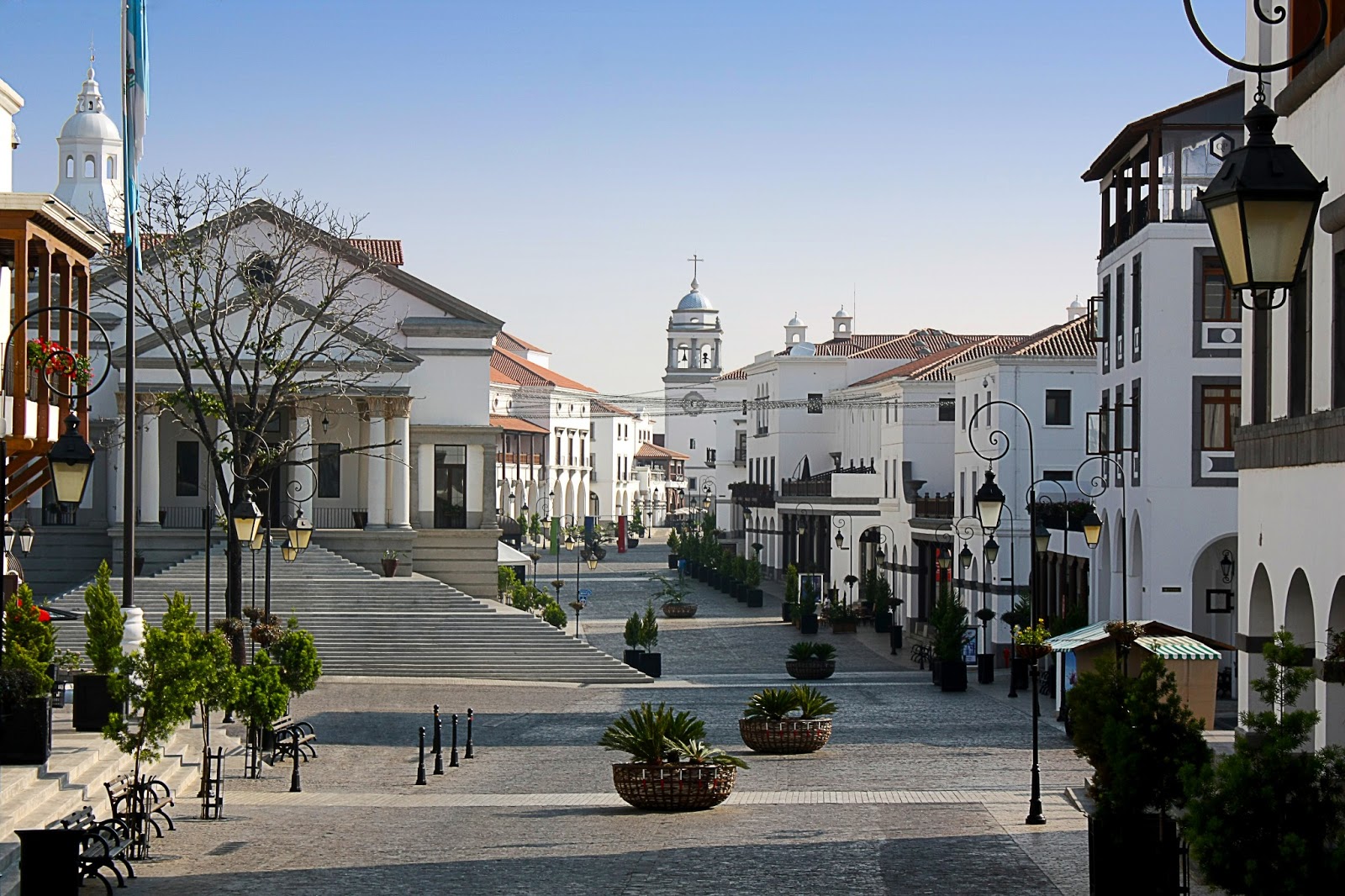
Paseo de Cayala, in Guatemala City. (premiorafaelmanzano.blogspot.com)

Paseo Cayala, in Guatemala City. (premiorafaelmanzano.blogspot.com)

Providence Mayor Jorge Elorza recently visited Guatemala at the invitation of the Central American nation’s commerce secretary. Elorza – whose family hails from Guatemala – hopes to have persuaded the national airline to schedule regular flights to T.F. Green State Airport. This sort of active pursuit of business for their cities is precisely what mayors are expected to do.

Providence Mayor Jorge Elorza. (rifutures.org)

Providence Mayor Jorge Elorza. (rifutures.org)

Of course, it goes without saying that Mayor Elorza has been unjustly criticized for the trip. No improprieties have been discovered, but why didn’t the mayor invite all citizens of Providence to fly down with him to such a beautiful place? Don’t’ we all need a vacation?

Seriously, I hope the mayor was able to tour Cayalá, a new town on the edge of Guatemala City that I wrote about in 2012. It mixes classical Spanish and Mayan influences. He would have found it alluringly beautiful, and he will be doing an impressive job if he imports not just an airline but some of the lessons of Cayalá’s beauty to help Providence.

Before Elorza won the Democratic mayoral nomination, my family and I attended a festival at the west end of Broadway and had the opportunity to speak with the candidate about the importance of beautiful architecture to the city. His thoughts seemed simpatico with my own, and I voted for him partly on that basis. I wonder if he remembers the conversation.

Here is my column from 2012 about Cayalá. Its now-famous market area – the Paseo Cayalá – is the center of a community, allegedly “gated” [see correction below], whose apartments above shops are far beyond the means of most citizens of Guatemala. But that nation’s drug-fueled crime rate is far, far and away higher than what we in Providence can imagine, and those of means can be expected to try to protect themselves. Cayalá has been criticized for this, and perhaps with some justice, but its beauty transcends that issue. Its lessons are no less appropriate in Providence than they are in Guatemala and throughout the rest of the world. I hope Mayor Elorza understands this.

***

Correction: The original version of this post stated that Cayalá is a gated community. It is not, but is open and accessible to all. And while the average income of Cayalá is higher than that of Guatemala City as a whole, residents of the partially completed community inside the boundaries of the capital will be drawn from a range of income groups.

A new classical flower in Guatemala
February 2, 2012

A classical city is being built anew in the degraded modern shadow of two great merged civilizations from the distant past. Steeped in Spanish and Mayan tradition, Ciudad Cayalá may be the first Central American town to renew its embrace of the proud cultures that created historic Guatemala – a nation that once also included El Salvador, Nicaragua, Costa Rica, Honduras and the Chiapas region of Mexico.

Guatemala City was founded in 1776, centuries after the apogee of classic Mayan civilization in 900 A.D., but only half a century after Guatemala established its independence from the conquistadors of New Spain. Its predecessor, the colonial capital of Antigua, was founded in 1541 after a previous capital was flooded from the collapse during an earthquake of the lagoon-filled crater of a mighty volcano. That capital was itself destroyed by a string of earthquakes in 1773-74, and was moved five miles east to the site of today’s Guatemala City.

So what, in the modern era, becomes of a capital city born of such natural violence? Following colonial rule, independence ushered in a long string of dictators – elected, “elected” and unelected, including those deposed or installed by the United Fruit Co., eventually with help from the CIA. At last, following a civil war that concluded only in 1996, a genuine democracy seems to have taken root.

By then, Guatemalan society, mimicking so many other more recently enfranchised elites of the Third World, had already embraced the Nuevo Conquistadors of modern architecture. They surrounded the capital with high-rise office and residential towers, and encircled these with gated suburbs for the nation’s corporate elites and burgeoning middle classes.

Meanwhile, the other old capital, Antigua, was rebuilt, and in 1979 was named a World Heritage City by the United Nations.

Now, with Antigua among its mentors, a classical flower has just bloomed outside Guatemala City’s modernist cacophony.

Ciudad Cayalá is a new town being built on open land beyond the city center but within the city’s broad boundary. Developed by the landowner, Grupo Cayalá, and masterplanned by Léon Krier, who spearheaded Prince Charles’s new town of Poundbury (outside Dorchester, England), Cayalá’s Phase I was finished in November. It incorporates Mayan ornamental detail amid a robust Spanish classicism. Streets and squares are lined with colonnades. A monumental set of steps ascends to the Athenaeum, designed by Notre Dame Prof. Richard Economakis, forming a pyramid of Mayan descent, topped by a Spanish temple. Photos hint at the glory of ancient Rome, whose classical buildings mounted to an urban epiphany with a seemingly natural, unplanned grandeur.

How did Cayalá come to pass? The developer, Grupo Cayalá, originally imagined the project as a continuation of Guatemala City’s suburban theme. But then, apparently dissatisfied, Grupo held a charrette – a brainstorming session to which international architects were invited to consider alternatives. Krier’s classical concept emerged triumphant.

Two graduates of the architecture school at the University of Notre Dame, María Sánchez and Pedro Godoy, of Estudio Urbano, played a crucial role in guiding the design. As the project advanced in the aftermath of subsequent charrettes, the two architects shepherded construction planning away from conventional practices that treat classical ornament as arbitrary decorative add-ons toward a proper classical recognition of the vital role that decoration plays in the logic of load-bearing structure. They saved the project.

I was unaware of Cayalá (pronounced ky-ya-LA) until I asked the TradArch list – an online classical discussion group – to suggest nominees for the 2011 “world roses & raspberries.” So far as I know, Cayalá has few if any peers in the ambition of its classicism. The Prince of Wales’s Poundbury is gloriously unpretentious. So is Seaside, Fla., a tourist village that is the founding project of New Urbanism.

If classical proposals had not been frozen out of the 2002 competition to rebuild the site of the World Trade Center, Cayalá might now be part of a well-established trend returning beauty to our world. How curious that so pacific a trend is getting such a boost from a new town set in a Guatemalan cradle rocked by mankind’s bloodshed and nature’s violence.

***

Copyright © 2012. LMG Rhode Island Holdings, Inc

Posted in Architects, Architecture, Architecture History, Art and design, Development, Other countries, Providence, Urbanism and planning | Tagged , , , , , , , , , | 6 Comments

Figurative statue at Loyola

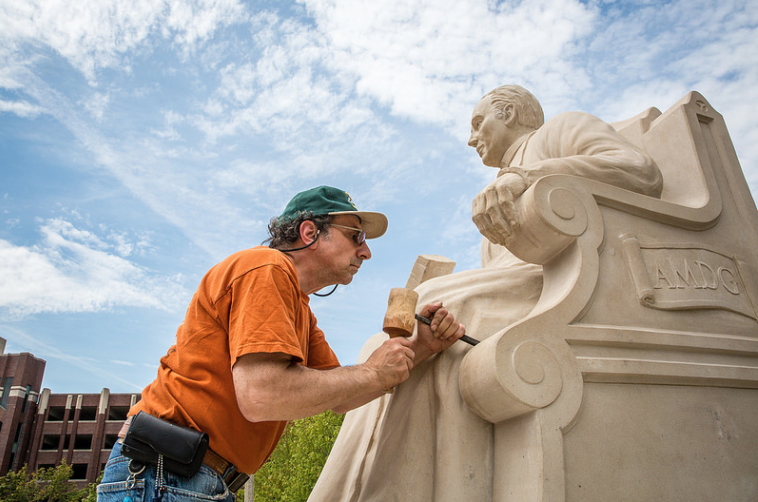
Father Arnold J. Damen, S.J., sculpted by Walter Arnold, of Chicago. (Unversity of Loyola)

Father Arnold Damen, S.J., sculpted by Walter Arnold, of Chicago. (Loyola University Chicago)

Walter Arnold’s sculpture of Father Arnold Damen, S.J., has just been installed at Loyola University, in Chicago, and the sculptor reports that returning students are already taking selfies with it, which he considers a sign of a work’s success in this day and age. In the series of photos released of the sculpture by the university, Walter seems to be applying some touch-up chiseling toward the end of the photo essay. I have asked him for details of what he is doing and will report back as soon as he supplies an answer.

I also asked Walter for guidance on difference between the words sculpture and statue, and he replied to that, too, as follows:

On a piece like this, carved indoors, there are always things that show up when it is out in the sunlight. I needed to rent an extra large forklift to move it out of my shop and load it on the truck, so I had the forklift delivered a day early. That way I was able to spend a day doing final touches outside my studio, with the piece oriented in the correct direction.

Still, once it was on site and properly elevated on its pedestal, I could view it from different angles, and see how the sunlight hit it. I saw things that needed to be cleaned up, a few rough spots, a few changes in shadows, and so forth. Just minor details.

As to statue/sculpture, mostly interchangeable, but they don’t overlap completely. Sculpture is more generic and non-specific, in my interpretation statue is more specific to a larger figurative, representational work. This one also can be referred to as a monument, since it is large and representing someone from the past. (monument could also represent something, for example an historic event).

It is most delightful to see this lovely, engaging statue for the people of Chicago to look at. Maybe there is hope for the rest of us.

Posted in Art and design, Books and Culture | Tagged , , , , , | 2 Comments

Children and architecture II

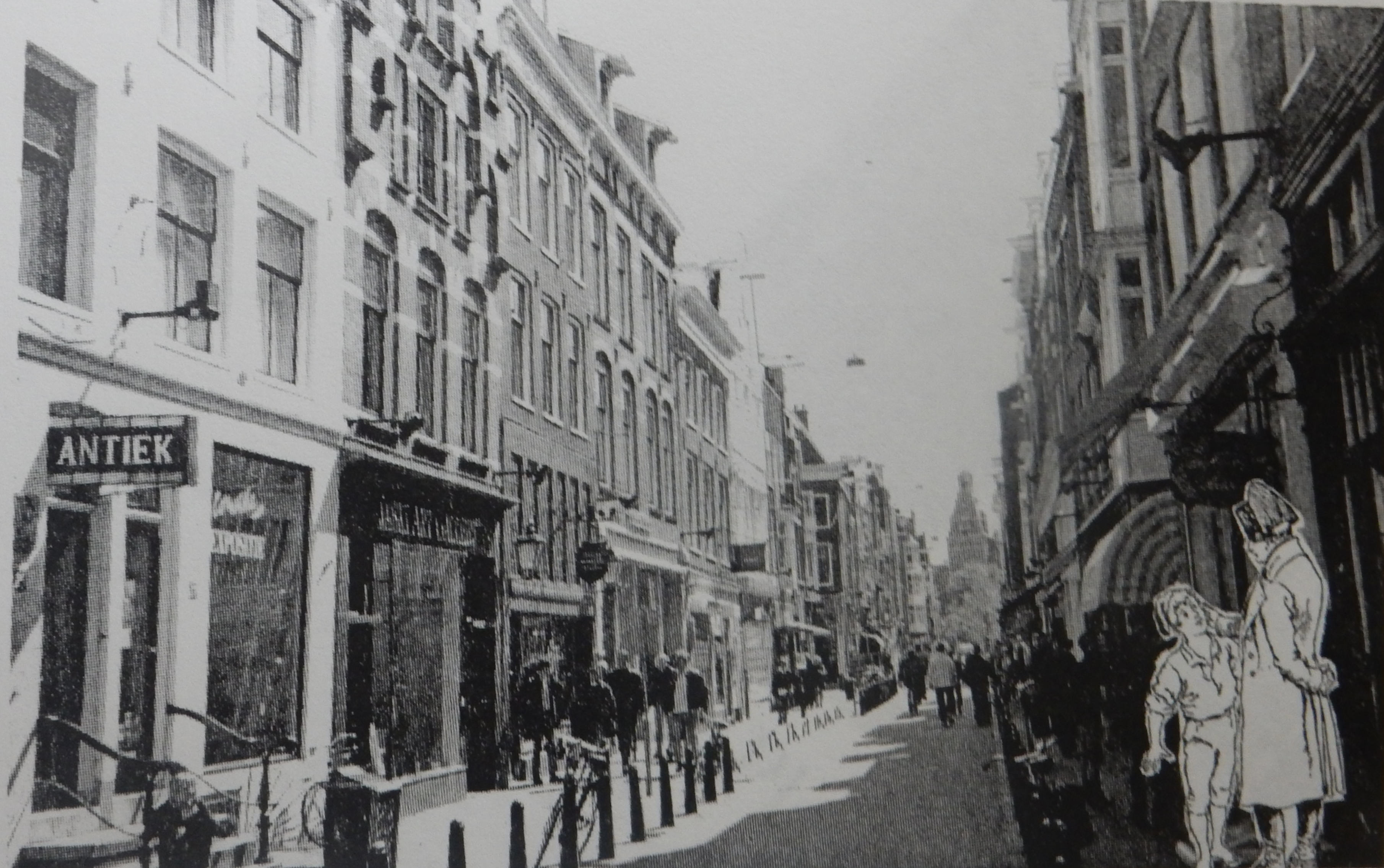
Parent and child on street in Amsterdam. (Photomontage by David Brussat)

Parent and child on street in Amsterdam. (Photomontage by David Brussat)

A commenter, reading in a recent post (“Children and architecture,” Aug. 8) on this blog an excerpt from a column I wrote for the Providence Journal in early 2001, asked to see the rest of the column, so here it is.

Children as experts on architecture
March 8, 2001

IMAGINE A MAN and his son, or, if you prefer, his daughter, walking along a street. It’s a street in the center of a city in Europe. As American tourists, they have been admiring a streetscape that has evolved over centuries into a set of buildings as remarkable for its variety as for its unity of ornate, lively, urbane architecture. Then they come upon an abstract thud of glass and steel built, obviously, in the last few decades. The boy (or girl), who is nine, stops short and says:

“That building sticks out like a sore thumb.”

“It’s modern architecture, son.”

“I don’t like it.”

“I think the architect was making a statement.”

“I thought architects were supposed to make buildings. Can’t they pass a law against architects who make statements?”

The father takes his pipe from his mouth, smiles, and they continue walking. He explains that “each building has to reflect its era.”

“Its error?”

“No, son, its era, its period in history.”

“Oh. Well, I guess you must be right, dad.”

They round the corner and disappear from view.

Let’s analyze their conversation. The father has just revealed to his son the conventional wisdom of architecture. The boy’s simple attitudes about buildings have just become a bit more complex, mature, nuanced, subtle – in short, a bit more confused.

Like his father, the son has more experience of architecture than of almost anything else. The boy has seen buildings from his earliest days, as soon as he was able to perceive, even before he knew what a building was, or how to spell it. Every time he steps outside, everywhere he goes, he sees buildings, and his attitude toward them has developed along with his attitudes toward everything else in his life: adults, siblings, food, animals, friends, cars, teachers, strangers, television, etc.

The earliest architectural distinctions in the life of a child probably arise from the houses of relatives and friends – a rich uncle lives in a large Georgian Revival; a school chum lives in a modest ranch.

But the clearest distinctions probably come from family trips. Many tourist sites feature a sense of place created by architecture. San Francisco’s Nob Hill, Boston’s Beacon Hill, Newport’s Bellevue Avenue, Providence’s Benefit Street, San Antonio’s Paseo del Rio, Florida’s Key West, Hollywood’s celebrity homes, Canada’s Québec City, Disney’s Main Street, many old, intact American town squares, almost anyplace in Europe: Most buildings, historic houses, museums, etc., that parents take the kids to see are of traditional design.

The message is not lost on children. As they grow older, a subconscious, inchoate, simplistic belief forms in their minds, without exactly being installed by adults, that the old buildings with gables, balusters, cornices, pediments and other quaint details are prettier than most new buildings, which are glitzy and yet sterile.

This is the intelligent attitude toward architecture that almost all children, I suspect, carry into adolescence, only to be baffled and contradicted by most of what adults seem to believe, what they build, and what the experts proclaim to be worthy of respect.

A week ago, at the Rhode Island Foundation, I attended a fascinating seminar sponsored by the Dunn Foundation, which promotes awareness of community character and appearance, especially among children. Spurred on by this week’s Brown/Journal conference on “The Dignity of Children,” my own largely undeveloped ideas on children’s attitudes toward architecture unfolded as you have seen above.

You may carp that those ideas fit in too snugly with my belief that the vast majority of adults, unless taught otherwise, prefer traditional to modern architecture. Frankly, I can’t see how childhood attitudes toward architecture might otherwise evolve to become adult attitudes. Adult attitudes toward architecture are increasingly important as the public takes, as it should, a greater role in the design of buildings and public spaces. Unlike arts that we may choose to view or not, like poetry, painting or drama, architecture is in our face all the time, from childhood to old age. The public – with more of its childlike good sense intact – is a better judge of architecture than most experts.

But all children, as they grow up, find it difficult to resist the conventional wisdom that surrounds them. Many go to college and become adults steeped in confusion, afraid of the feelings that call to them from childhood. Many become experts, trained in schools of architecture or urban design to confidently assert the obviously not true. Among these are the architects, planners, developers, design-review panelists and critics who brought us to where we are today.

Even the imaginary kid described up above knew enough to roll his eyes at his father’s foolishness.

***

Copyright © 2001. LMG Rhode Island Holdings, Inc. All Rights Reserved.
Record Number: MERLIN_99333

Posted in Architects, Architecture, Architecture Education, Art and design, Blast from past, Books and Culture, Providence Journal, Urbanism and planning | Leave a comment