
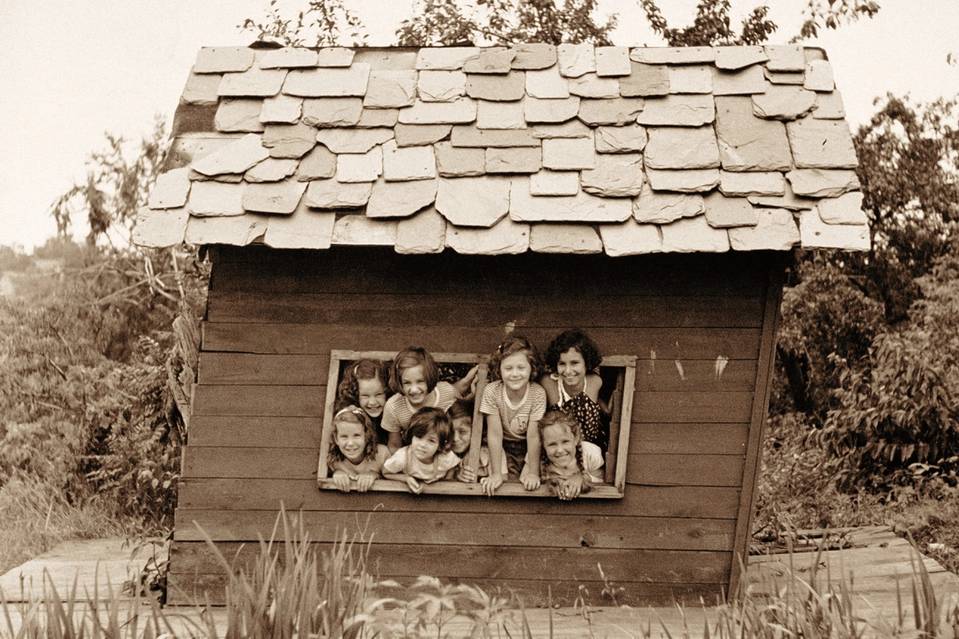
“Girls in a midcentury playhouse only slightly more architecturally distinguished than the author’s.” (WSJ/Getty Images)
Andres Duany has sent to TradArch a charming article, “Why Children Need Playhouses,” in the Wall Street Journal. Dale Hrabi describes his ramshackle playhouse behind his boyhood home in Alberta as a place to get away from his parents, how his parents cooperated with that, and how that contributed to his stability and maturity. The piece describes, comments on and pictures in a slideshow five contemporary playhouses.
I enjoyed the bit where Hrabi reacts with astonishment at a description of one of the playhouses on sale for $5,599 that has the option of an additional door sized for parents, who supposedly are invited to join together in play with their children. “Hold on. Together?” Hrabi says that as a child he would have “instituted stricter security policies.”
This gives me a convenient opportunity to quote from an old column of mine, from March 8, 2001, “Children as experts on architecture,” that for the first time unpacked what has become one of my favorite hobby horses. It begins with a conversation between a boy and his dad about a street in Amsterdam, where they are on vacation:
The boy (or girl), who is nine, stops short and says:
“That building sticks out like a sore thumb.”
“It’s modern architecture, son.”
“I don’t like it.”
“I think the architect was making a statement.”
“I thought architects were supposed to make buildings. Can’t they pass a law against architects who make statements?”
The father takes his pipe from his mouth, smiles, and they continue walking. He explains that “each building has to reflect its era.”
“Its error?”
“No, son, its era, its period in history.”
“Oh. Well, I guess you must be right, dad.”
They round the corner and disappear from view.
Let’s analyze their [fictional] conversation. The father has just revealed to his son the conventional wisdom of architecture. The boy’s simple attitudes about buildings have just become a bit more complex, mature, nuanced, subtle – in short, a bit more confused.
The column goes on to explain why children have more sophisticated views on architecture than adults, and why the vast preponderance of adults, who do not have an advanced degree in the design fields, have more sophisticated views on architecture than most architects and other design experts. I will try to find the column and post it.





 Architecture Here and There
Pingback: Children and architecture II | Architecture Here and There
Hello David. This post is a very good teaser for your 2001 article. As the father of a young daughter (and an interest in such matters) I hope you can find your original column and (re)post it.
Best
Mark
LikeLike
I have just posted the entire column under “Children and architecture II.”
LikeLike
Excellent. Many thanks David.
Best
Mark
LikeLike