Comedia della postal mod

DSCN0005.JPG

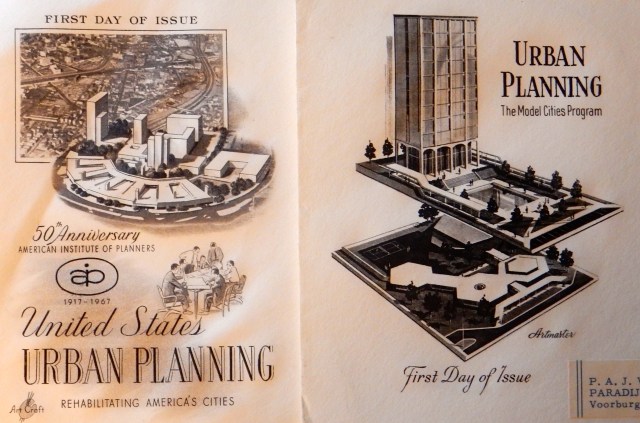
First planners’ engraving (l.); second planners’ engraving (r.)

The humorist and fenestration cleanliness engineer Stevenson Hugh Mields has sent along another First Issue envelope with an engraving of not one but two proposed modernist plans, which he has named “Optical Illusion,” and which I have placed for readers’ amusement next to his earlier First Issue engraving from January.

The latter envelope was evidently sent to a Dutchman: “P. A. J. Van Der Loo/Paradijsstraat 63/Voorsburg, Holland.” What did he make of it?

“Close examination reveals,” Steve writes, “that the 10-story office building pad is floating over the high-tech one-story reduced-F.A.R. [floor/area ratio] office of the future. Or perhaps a lab for biological WMD?” I laugh. You laugh. We all laugh. WMD has officially entered the realm of sit-down comedy. But let us not forget that this was 1967. WMD as we know it today was still not yet even a figment of our collective funny bone.

One shudders, and not just at the designs. The leftmost engraving shows planners around a table planning a project to be inflicted upon an actual site, also depicted. The second engraving shows no planners planning but two plans, one hovering over the other. In neither case is an associated site depicted. Maybe the top plan is about to land on the bottom plan. Place them side by side and they could duke it out. Maybe neither plan really exists – ha ha! – recapitulating WMD en avance! Or, worse, maybe they do.

The committee that designed these two examples of the U.S. Post Office’s responsibility to stroke America’s elites and their earnest designs upon our future apparently used two different engravers for the job: Art Craft (l.) and Artmaster (r.) It would be unfair to blame either engraver for the manifold flaws of the three plans. Were they competing for a more lucrative job within the postal administration? Let’s hope the job went to the Art Craft. Artmaster seems to have produced a study in awkwardness.

We are invited to compare the two plans. Recalling that the envelopes were issued in 1967, it is curious that my favorite of the two, the one with the 10-story building, the swimming pool and the little people walking about, features a ground-floor arcade with graceful arches. How did that get in? Was this early-onset PoMo? Go figure!


Posted in Architects, Architecture, Architecture History, Art and design, Development, Humor, Landscape Architecture, Urbanism and planning | Tagged , , , , , , , | 1 Comment

Scott Merrill’s Driehaus

seaside-1.jpg

Chapel at Seaside, Fla. designed by Scott Merrill. (bettercities.net)

Scott Merrill, an architect best known for his work in Seaside and other New Urbanist communities, has won this year’s Driehaus Prize, annually awarded by the school of architecture at the University of Notre Dame. Named for Chicago philanthropist and entrepreneur Richard H. Driehaus, the award comes with a stipend of $200,000, twice that of the more noted (but less notable) Pritzker Prize.

Merrill’s most celebrated building is his chapel at Seaside, pictured above, and completed in 2001. It typifies his work, if that can be said of the wide portfolio of the firm he started in 1990, Merrill, Pastor & Colgan Architects, headquartered in Vero Beach, Fla., for which he still does most of the design work. His “style” is a sort of stick classical, with an inspired vernacularity of tone, spare but unafraid of classicizing tendencies.

To judge by his chat with Archinect magazine soon after being notified of his laureateship a couple of days ago, Merrill does not like to pigeonhole himself. He dodged constant invitations by the Archinect interviewer to comment on any distinctions that might reveal his opinion about classical architecture. But he is willing to assert that he puts people at the center of his designs. To those of us who consider modern architecture to be, all too often, an exercise in the marginalization of people (to put it gently), that may stand as a declaration of his classicist tendencies.

Curiously, a couple of days ago, before I became aware of this year’s Driehaus winners, I cited Léon Krier’s town hall at Windsor as a good candidate for the “left edge,” so to speak, of the classical revival. Scott Merrill’s work arguably falls into that category, and in fact Krier’s town hall is listed as one of the projects in Merrill’s firm’s portfolio. Not too long ago, Andrés Duany, whose firm DPZ (Duany Plater-Zyberk) masterplanned both Seaside and Windsor, informed the TradArch list that Merrill was one of a small host of traditional architects, mostly from the South, who had recently dabbled in modernism. Well, no sin in that – though it apparently is a sin for modernist architects to design classical architecture (if not to live in it). So Merrill remains a trad in good standing.

After all, Krier masterplanned Poundbury, belly of the beast (along with Seaside) to the modernist critical elite! The nomenclatural debate fostered by Duany (also, with Krier, a Driehaus laureate) is a quagmire and a half. He tries to irk trads by claiming that this or that design is PoMo (postmodern). In the past he has called Merrill’s work postmodern but now, aware of the term’s inadequacy as a descriptive, describes Merrill’s work as “heterodox.” Notre Dame gave a real postmodernist, the late Michael Graves, a Driehaus in 2012, but has not made that mistake again since. To pigeonhole traditional architecture of any stripe in today’s anything-goes classical discourse and practice is clearly a tough job. Who can blame Merrill for refusing to take Archinect’s bait?

So, congratulations to Scott Merrill for winning this year’s Driehaus, and also to the winner of its partner award, the Henry Hope Reed Prize, Havana’s city historian, Eusebio Leal Spengler, for his role in preserving the Cuban capital’s classical architecture. The classical revival marches forward.

Posted in Architects, Architecture, Architecture Education, Architecture History, Art and design, Urbanism and planning | Tagged , , , , , , , , , , , , , , , | Leave a comment

Bowdlerizing Mozart

DSCN0004.JPG

Mozart and (?) his cousin Basle. (Book cover art: Maurice Sendak/Farrar Staus Giroux)

In a passage from Wolfgang Hildesheimer’s biography, Mozart, the author discusses posterity’s attempt to sanitize the composer, including his operatic music, some of which sang out in the sort of joy that stuffed-shirt guardians of society’s morality can’t abide. But some of the most compelling instances of “bowdlerization” spring, it seems, from the irrepressible ability of Mozart’s musical sense to uplift the lower aspects of the librettos which, high or low, he cloaked so elegantly in music. [Trigger alert: Naughtiness ahead.]

Wherever his words lack the appropriate tone, his music corrects them. In these opuscula growing out of a good-natured, mindless, or vulgar mood, the spirit and elegance of the musical thought usually softens the intended shock of the theme. This is especially true of those canons whose texts deal with – so to speak – fecally immanent imperitives, like “O du eselhafter Martin” (Oh, Martin, you jackass), K. 560 (1788) (given by Herr  Breitkopf as “Are you yawning, lazy fellow” in order to divert the phrase “Aufs-Maul-scheissen” [Shit on the mouth] into other channels), or “Leck mir den Arsch fein recht schön sauber” (Lick my arse until it’s nice and clean), K. 233/382d (1782?), in Härtel’s version “Nichts labt mich mehr” (Nothing comforts me more), or Breitkopf’s bowdlerization “Lasst froh uns sein” (Let’s be happy) for “Leck mich im Arsch,” K. 231/382c (1782). … Here, too, the music does not reproduce the unsublimated text. The slightest touch of vulgarity is alien to Mozart’s music, even where the words seem to dictate it; here he has composed aainst his own text. We wonder if the seeming evidence about even ignoble things deceives us, too.

In other words, Mozart always composed against his own texts – against the text of his letters, his notes; against appearances, his bearing, his behavior. Or vice versa: his true language, music, is fed from sources unknown to us; it lives from a suggestive power which rises so far above the object of its suggestion that it evades us. Its creator remains unapproachable.

Classical architects are always, likewise, rushing to the defense of their buildings from the uses put to them by their occupants. In one sense they ought to worry because idiots are always on the lookout for evil – Nazism, for example – to supply the guilt by association that modernists apply to all but their own style. In another sense, however, the defenders of classicism need not worry because the architecture can and does do a fantastic job of defending itself. You really have to have to have a long stretch of nose to peer down in order to believe that Hitler’s evil can be blamed on the loveliness of a column, a pediment, an architrave or a balustrade.

Vulgar classicism doesn’t exist and we might wonder what it would look like. Cathedrals decked with the monstrosities fashioned into rainspouts are no less beautiful for that. They are not vulgar. Bad trad is out there, of course, but that’s different. For vulgarity in architecture we must turn, alas, to the modern architects – not all of them, I hasten to add – who have beshat the built environment of the modern world by banning all that is beautiful from their “art.”

Posted in Architects, Architecture, Architecture Education, Architecture History, Art and design | Tagged , , , , , , , | Leave a comment

BBC on Mont Saint-Michel

Mont-Saint-Michel.jpg

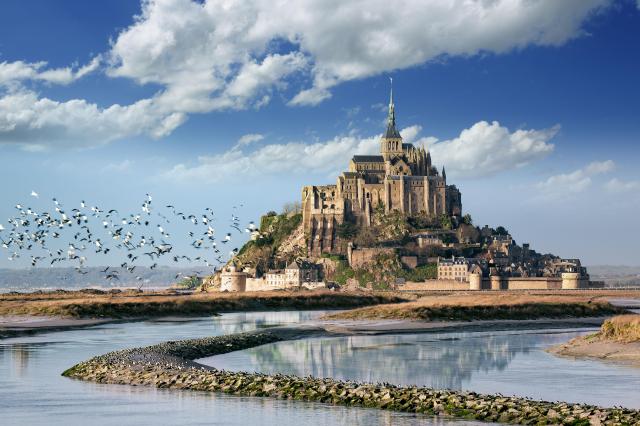
The abbey at Mont Saint-Michel, off coast of France. (roule-co.org)

Yesterday, I got an email from the author and director of a documentary on Mont Saint-Michel being produced for BBC France. Denis Sneguirev asked me whether I could provide him with information about the development of the abbey just off of the Norman coast of France – in particular, “building techniques of ancient times as well as all the practical details of such a construction (finance, working force, masters and skills, etc.)” in three periods of its early history:

– Roman Abbaye (Xth century)
– La Merveille (Gothic period, XIII century)
– Defensive architecture (XIV-XV century).

I wrote him back saying I had no information – that he somehow had mistaken me for some sort of expert. I thanked him for his pleasing error and volunteered to write a post about his project and send it out in the hope that someone among my readers, on TradArch or another architectural discussion group, would see it and either provide Denis with the information or direct him to someone who could.

Denis must have seen “Mont Saint-Michel of old,” my recent post posting postcards of Saint-Michel acquired by the parents of my old friend John Bernot, an engineer in Washington, D.C., and a longtime aficionado of the jazz combo Sun Ra, really an ensemble, which Sun Ra called his Arkestra, and in our youth we’d travel up from the District to Baltimore to hear it.

Denis informed me that he was seeking English-speaking voices to provide the film with “some international aura.” After noting that, he added: “I have also to say that I believe nobody’s better than Anglo-Saxons in story telling. I [already] have some contacts in Reading and York universities with some specialists of Gothic architecture and 100 Years’ War.” To give me a better idea of the scope of the documentary, for TV RMC Découverte, Denis then listed the chapter topics of the script, thus far conceived:

1) Creation of the first Sanctuary and Saint-Aubert’s legend.
2) Norman’s expansion and role given to Mont Saint-Michel by the Normandy’s rulers in the 10th-11th century.
3) How was built the Roman abbaye on the Mount? Reasons and technics. Where does the prestige of the place come from?
4) Building Saint-Michel’s empire. Second monastery in Cornwall. Role of the monastery in local politics; reasons of its rising.
5) Building of La Merveille. Technics of the Gothic construction. All practical details of such an entreprise.
6) Mont Saint-Michel during 100 Years’ War and organisation of its defense.
7)  Natural disasters in Mont Saint-Michel and the damages they caused.
8) “La bastille of the seas.” XVIII-XIX century when Mont Saint-Michel becomes a prison.
9) Restoration work in Mont Saint-Michel in XIX-XX centuries.
10) Benefits and problems caused by mass tourism.
11) Technical challenge of recent project in Mont Saint-Michel (2009-2015)

Mont Saint-Michel’s extraordinary beauty and its romantic location half a mile off the Norman coastline enthrall me to no end, and getting there is on my bucket list. But even if I never do, I hope to see Denis’s documentary when it airs.

If anyone can help him out with information or source referrals, I will refer you to him or you can email him at snegff@gmail.com.

Posted in Architecture, Architecture History, Art and design, Books and Culture, Development, Landscape Architecture, Other countries, Preservation | Tagged , , , , , | 11 Comments

Out-of-country Cianci tale

Malta_monuments1.jpg

Fortified Valletta, capital of Malta. (no-limit.info)

Buddy Cianci. RIP. Everyone in Providence has a Buddy story, and many will be told fondly following the death of Vincent A. Cianci Jr. yesterday.

My Cianci story – this one, at least – involves a trip to Malta as guest of U.S. Ambassador (realtor and former Providence mayor) Joe Paolino Jr. Paolino and Cianci were political rivals and, so far as I could tell, personal enemies. Paolino had taken over Cianci’s mayoral office in 1984 after the latter plead no-contest to assault. Paolino had served honorably and effectively even as Cianci the radio talk-show host fired daily brickbats at Paolino. When finally eligible to return to office, Cianci succeeded Paolino in 1991 after the latter ran unsuccessfully for governor. Paolino was appointed U.S. ambassador to Malta by President Clinton in 1994.

In 1996, Paolino invited me to visit and write about Malta’s extraordinary architectural treasures. I did not report the following story in the last of my three Malta columns for the Providence Journal.

Ambassador Paolino, his friend U.S. Supreme Court Justice Antonin Scalia, several of the ambassador’s other friends and colleagues and I were seated in the U.S. ambassador’s residence in the suburbs of Valletta, Malta’s capital. I joined these eminent Italian-Americans in a favorite pastime of the tribe – watching The Godfather and calling out favorite lines known by heart to (almost) all present. And then, surprise of surprises, the front door opened and in walked Paolino’s enemy, his predecessor and successor as mayor of Providence, Buddy Cianci, who sat down and joined in the fun. End of story.

***

Malta: An Ocean State cabal?
February 29, 1996

MALTA IS A ROCK of limestone 50 miles south of Sicily and 200 miles north of Tripoli. Its land area of 122 square miles, which includes the island of Gozo, is a tenth that of Rhode Island. With a population of 356,427, just over a third of the Ocean State’s, its density is 2,934 residents per square mile, compared with the Ocean State’s 814.

So, in Malta the likelihood of running into somebody you know is even higher than it is in Rhode Island. For example, once in the medieval city of Mdina and once at the Courts of Justice near my hotel in the capital, Valletta, I ran into Justice Antonin Scalia of the U.S. Supreme Court. Justice Scalia was in Malta as a guest of the U.S. ambassador, Joseph R. Paolino Jr., as was I. But as a Marylander, he seemed quite the outsider, for in Malta that week, Rhode Islanders were thick as . . . er, thick on the ground.

In addition to me and the former mayor of Providence, his wife Lianne, and their four children, the crowd from the Biggest Little included: a former candidate for mayor, Andrew Annaldo; a former lieutenant governor, Thomas DeLuglio; his daughter and a friend; pollster Tony Pesaturo; and the current mayor of Providence, Vincent A. “Buddy” Cianci.

Oddly enough, with none of these visiting Rhode Islanders did my path cross unexpectedly in Malta. I saw them only at the U.S. ambassador’s residence, in suburban Lija, where they seemed like characters in the opening chapter of a Joseph Conrad novel, waiting around on the veranda for the plot to begin.

But let’s pause for a word from our sponsor.

(A man in a pith helmet stands on the roof of Development House, in the suburb of Floriana, where the U.S. Embassy is situated. He is peering south through binoculars. A narrator speaks in a British accent.)

“Here in Malta, U.S. Amb. Joseph Paolino Jr. maintains a vigilant watch, alert for terrorists from Libya. The ferry from Malta links the island to Tripoli. From Tripoli, the dictator Moammar Ghadafi sends spies, bombers and emissaries of hatred on missions against the Western World, much as Sulieman the Magnificent did centuries ago. In part as a bulwark against this threat, the ambassador has worked to bring Malta into NATO’s Partnership for Peace. But he has also worked to bring development into Malta, and jobs for the Maltese people. For example, the U.S. Navy may use Malta’s dry docks for repair work, and McDonald’s has a new franchise in Valletta. No wonder Joe Paolino is a household name on this island. ‘Ambassador Paolino and the people of Malta.’ ”

This information, although delivered to my readers in the form of a [fictional!] political advertisement, accurately reflects what was gleaned by this correspondent from the ambassador, his family, Mr. Pesaturo and an interview with Deputy Chief of Mission Charles N. “Pat” Patterson, a career diplomat who is not from Rhode Island. (This correspondent had intended to keep politics and diplomacy out of his dispatches, and did in his first two. But rumors of an “alliance” between former and current Providence mayors, and of a house purchased in Narragansett – in Rhode Island, not in Malta – have eroded his resolve.)

Feb. 9, a Friday, was my most curious day in Malta. With an introduction from the ambassador, I had breakfast with the Marquis de Piro and his wife before touring their house, Cassa Rocca, the only mansion in Valletta inhabited by Maltese nobility since the age of the Knights of Malta. I then visited Patti Richards, whom I’d met at a state dinner on Tuesday. With her, I toured the villa that her employer, Demajo Co., has rehabbed as its office in Valletta. Afterward, she called Magistrate Dennis Montebello (who was also at our table Tuesday evening) and asked him to give me a tour of the Courts of Justice, in a fine neo-classical building erected in the 1970s).

The magistrate invited me to lunch, phoning Ms. Richards to join us. He then received a call obliging him to investigate immediately the death of a German tourist at the Blue Grotto, a lovely place on the southern coast. While we waited for a cab, Justice Scalia and his entourage swept into the courthouse for a meeting. Finally, the magistrate, Ms. Richards and I got a cab and headed south. The magistrate’s investigation found that a middle-aged German woman had ventured too close to a ledge, had been swept away by a wave and, despite a daring rescue attempt, had drowned. Judge Montebello joined us, and we ate at a restaurant overlooking the hearse parked high above the rocky shore.

Whew! And then, that evening, I attended a reception for Justice Scalia at the ambassador’s residence. I saw a lot of drinking, dancing and smoking of Cuban cigars. But the good cheer exchanged by Messrs. Paolino and Cianci, however startling, may have reflected more diplomacy than politics. I returned to Rhode Island none the wiser as to who will run for Congress in the First District this year.

***

Copyright © 1996. LMG Rhode Island Holdings, Inc. All Rights Reserved.
Record Number: MERLIN_457892

Posted in Architecture, Architecture History, Blast from past, Other countries, Preservation, Providence Journal, Urbanism and planning | Tagged , , , , , , , , , | 4 Comments

Plymouth after World War II

Screen Shot 2016-01-28 at 10.35.41 AM.png

Narrator of documentary confronts citizens over plan for Plymouth.

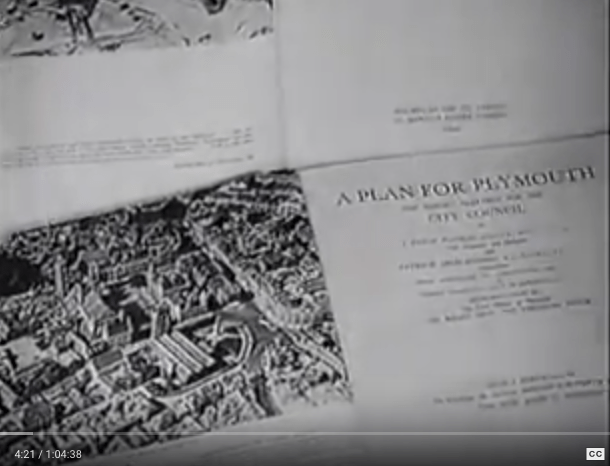
Mark Motte, author with Francis Leazes of Providence: The Renaissance City, urged me to view an old documentary on video called “How We Live Now,” filmed in 1946, about the effort to rebuild Plymouth, the most heavily bombed city per capita in Britain, after the war. It is a great example of propaganda. I include some screen shots above and below.

It is a fascinating romp through a postwar of pessimism-tinged optimism. The argument for a new beginning for Plymouth via a big government plan conceived by Sir Patrick Abercrombie. Is pushed by a narrator who, in the film, portrays a writer seeking answers. All the answers seem to sound really great, but the public is not so easily convinced. This comes out in the film. It is an hour but very much worth watching – very amusing in how it seeks to rope in the average family, and very frank in how the average family has the narrator grinding his teeth.

Here are some lines from the film. Expert planners, led by Abercrombie, are brought in to “fix” Plymouth, and one of them plays a film of the plan for the public. It describes the need for better roads and more integration with outlying areas (to preserve them). Then the presentation of the plan gets down to the nitty-gritty, what it will look like.

“Nor is there any need for petrol stations to become eyesores,” says the expert as a rendering of a sleek modernist gas station appears on-screen.

“In the home, we don’t try to eat in the bathroom or sleep in the kitchen. All we’ve tried to do is to plan a city as we might try to plan an idea home.” Here the expert seems to be setting up the single-use zoning that became the bane of cities in the postwar era, pre-ordaining the constant need to drive in order to do anything.

The expert’s pitch reaches a crescendo with this: “Right down the centre, we’ve allowed for one monumental feature – a vista.” (Swelling instrumental music as images unfold, grander and grander!) Sketch after sketch of what Plymouth could look like rolls onto the screen, each featuring sleek (its designers would say) blotches of God’s wrath on cities.

Then the expert intones: “The key bit is that you, the citizens, must own the land. Mr. Baker, Mr. Watson and I propose the vista as as victory memorial for those who lost their lives in the Blitz. The symbol of a standard of living with spaciousness and beauty for all!”

The presentation ends to applause, but in the audience is the family that is the focus of the documentary’s effort to reach down to the little guy.

“This sounds all right, but who’s going to pay for it?” says the father. “We paid for the war,” says the daughter. “We paid for the war and we’ll pay for this.” replies the father. “But it’s worth it, Daddy!” she rejoins. “If we get it,” adds the mother.

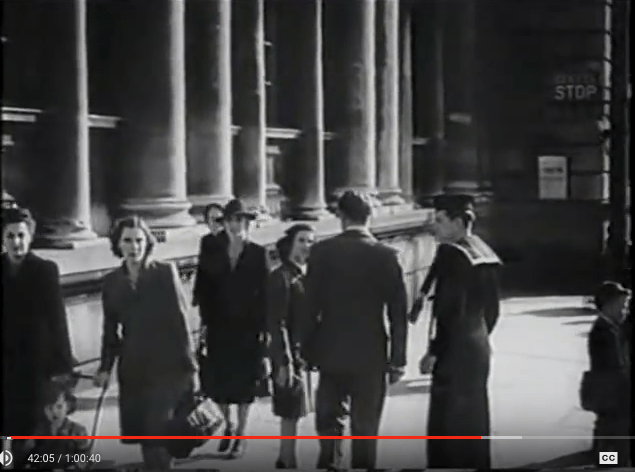
Shortly after this, the narrator is walking down the street and sees the daughter, named Alice, with her boyfriend, a sailor. He catches up with them, intending to deploy his strategy for getting average people to talk about the plan. He invites them into the Museum of Natural History that they happen to be in front of in downtown Plymouth, and where the city happens to have a model of the plan on display for the public to see.

“They seemed quite eager to go into the museum,” says the narrator. “I doubt they’d ever been here before. Alice seemed to know all about the plan but she’d never seen the model.”

They step into the model room. The camera pans the model, ending with a focus on the girl’s face. The music gulps, reflecting her skepticism.

“I don’t think there’s anything in it,” Alice says.

“But aren’t you interested in your own city?” replies the narrator. (Huh?!)

“Yes. But not this.”

“They’ll never do it,” says the sailor.

“But what makes you say that?” replies the narrator.

“They’re not sufficiently go-ahead,” says the sailor. “Now if this were America it would be different.”

“Don’t you understand? ‘They’ means ‘you.’ If you want it enough you’ll get it.”

“I don’t know if I want it or not,” says Alice. “I don’t think it matters much.”

“Now that we’re here,” says the sailor, “let’s go and look at the fossils.”

The narrator grumbles to himself: “Not interested. They just don’t understand. That’s how ideas are killed. So much easier to kill an idea than look into it.”

In the next scene the city council debates legislation to support the plan but a councilor proposes an amendment to slow things down and consider a more modest plan.

“In the interests of the ratepayers,” he states, “in whose minds there is uneasiness at the great size of the plan, and the fear that they would have to carry an intolerable burden, with heavy rates. In the plan, imagination has been allowed to run riot. I am informed that to acquire the land for the city centre will cost 20 million pounds. On top of that there is this gross extravagance, this boulevard from the North Road Station to the Hoe [the waterfront area].

Another councilor replies: “I view the amendment offered by Mr. Taylor, my Lord, with grave misgivings. For whom does Councilor Taylor think he is speaking? Where there is no vision, the people perish. And I cannot help thinking that Councilor Taylor is speaking for the people with no vision. His illustration of the traveler coming to Plymouth and unable to drive his car through the picturesque highway that has been the dream of Plymouth citizens for years. To what does it amount? If he goes on foot it is the shortest route to the city centre. If he goes by car, he can but add two minutes to his journey. The argument is a ridiculous one. The opportunity of raising the city, magnificent in proportions, and affording glorious opportunity for all its citizens, is an ideal for which we should happily aim.”

(You add to your journey by taking a car instead of going on foot? That is to the plan’s advantage?)

Soon there is footage of Michael Foot, the perennial Labour P.M. wannabe, here quite young, arguing for the plan. The name of his opponent, Leslie Hore-Belisha, appears in a shot of the ballot for the upcoming parliamentary election as a sometime Churchill ally during the war. He is often cited in the great biography by William Manchester.)

The narrator takes a stroll to think things through and, regarding the new homes that he passes that look like Philip Johnson’s Glass House, he says, “And the new houses looked horribly reminiscent of barracks.”

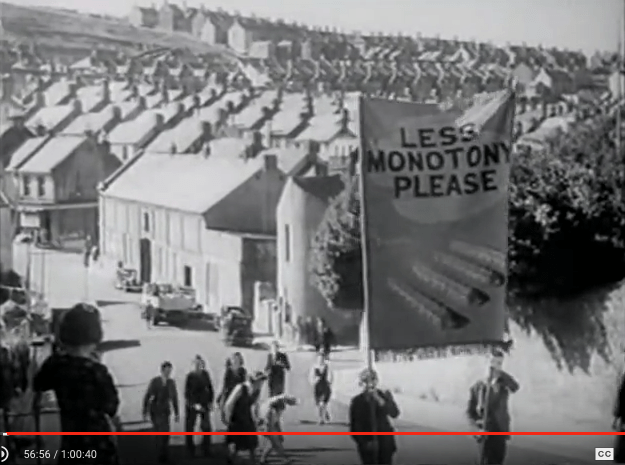
Then he sees a parade with young people calling for their elders to do something: “Youth. I’d forgotten the impatience of youth. Will they help bring the plan to fruit?”

Here is the documentary’s final lines spoken by the narrator:

“In a country where every shade of opinion is allowed, almost anything is possible. Cities of tomorrow: What will they be? Who can tell? For their story is still being written by the citizens of today.”

As I say, watch the film. It’s a trip and a half. Of course, I think the doubtful citizens were smarter than the experts, and what happened to Plymouth – which we now know – bears me out.

Screen Shot 2016-01-28 at 12.26.25 PM.png

Screen Shot 2016-01-28 at 12.27.34 PM.png

Screen Shot 2016-01-28 at 12.30.17 PM.png

Screen Shot 2016-01-28 at 12.28.44 PM.png

Screen Shot 2016-01-28 at 12.24.30 PM.png

Screen Shot 2016-01-28 at 10.12.52 AM.png

Screen Shot 2016-01-28 at 10.19.18 AM.png

Screen Shot 2016-01-28 at 10.38.18 AM.png

Screen Shot 2016-01-28 at 11.15.28 AM.png

Screen Shot 2016-01-28 at 10.34.08 AM.png

Screen Shot 2016-01-28 at 10.35.41 AM.png

Screen Shot 2016-01-28 at 11.19.18 AM.png

Screen Shot 2016-01-28 at 11.27.57 AM.png

Screen Shot 2016-01-28 at 11.20.20 AM.png

Screen Shot 2016-01-28 at 11.26.25 AM.png

Posted in Architects, Architecture, Architecture Education, Architecture History, Development, Other countries, Urbanism and planning, Video | Tagged , , , , , , , , | Leave a comment

More on the WWI winner

imrs.jpg

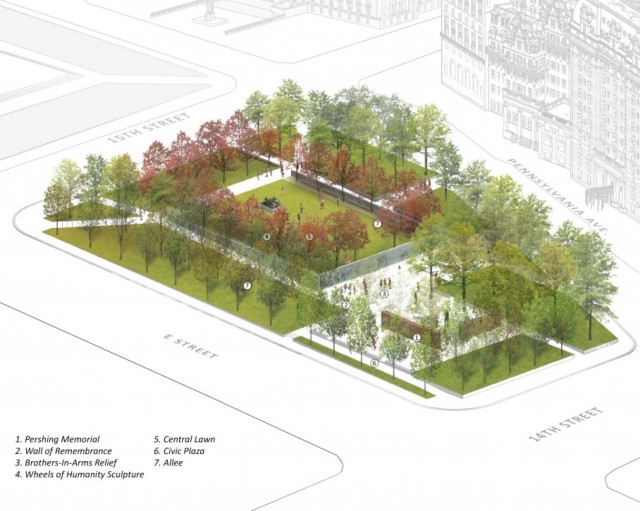
Winning entry in competition to design a national WWI memorial in D.C.

Yesterday’s announcement of a winner in the open international competition for a national World War I memorial sent me rushing to find out how it had changed since its selection as one of five finalists. And the winner is Joseph Weishaar, a 25-year-old graduate of the architecture school at the University of Arkansas at Fayetteville. He had never been to Washington, D.C. – where the memorial is to be erected – before his selection as a finalist in August.

The image accompanying a New York Times’s story, “National World War I Memorial Proposal Is Unveiled,” looks little different from when it was a finalist (and it may be an image taken from Phase I of the competition). For Phase II, Weishaar hired the prominent sculptor Sabin Howard, of New York City, which caused some traditionalists to suppose that, with Howard aboard, the Weishaar design, called “Weight of Sacrifice,” might join the Annapolis architect Devin Kimmel’s classical “Grotto of Remembrance” design as worthy of the support of traditionalists.

Based on the images I have seen, I cannot tell. For now, “Weight of Sacrifice” seems little more than a sculpture in a rectangular lawn upheld by walls of bas reliefs of soldiers and other WWI imagery interspersed with engraved quotations from politicians, generals, common soldiers and folks back home. Without the figurative sculpture,  the architect’s submission would resemble Maya Lin’s dark wall of names of the dead from the Vietnam war … but, oh yes, they did add statues of soldiers to that, too. And in this memorial, we’re informed that its number of cubic feet will record the number of Americans who died in the European “war to end all wars.”

I’m sure that sculptor Howard will improve on what Weishaar wrought. But the jury’s choice was clearly an exercise in caution, with forces supporting preservation of its proposed location, Pershing Park, near the White House, threatening to sue to block the new memorial. Pershing Park, deteriorated over the years, was designed by the modernist landscape architect M. Paul Friedberg and opened in 1981. Citizens of Kansas City, where another WWI memorial anointed “national” by act of Congress, are gnashing their teeth as well. It doesn’t look as if the winning design has survived its final battle, even though it preserves more of Friedberg’s park than any other finalist.

The Washington Post’s architecture critic, Philip Kennicott, wrote “America Is Chock Full of WWI Memorials, So Why Build Another?” It is a silly question. Most of those are local or regional, such as the elegant bandstand near the Reflecting Pool of the Washington Monument, or commemorate a lofty historical figure from WWI, such as Gen. John “Black Jack” Pershing.

The last thing Kennicott wants, or that the jury wanted, obviously, was to give the nod to a classical design that would have stood in apposition to the controversial Eisenhower memorial proposal designed by Frank Gehry. How awkward it would have been for the modernist establishment if the public had finally got a gander at what classical architecture can do. A project that the architectural media would have been unable to cover up, as they did the Franck Lohsen McCrery proposal, published in the Manhattan Institute’s quarterly City Journal, to rebuild the World Trade Center back in 2002.

Such a design as Kimmel’s “Grotto of Remembrance” would have struck such a chord with the public, would have made its way – for that reason – so easily through the approval process, that modern architecture would have received a black eye unlike it had ever got before in recent design history. Kimmel’s design touched all of the bases. It was heroic, legible with ease to the broad public, sufficiently grand to reflect history’s judgment, sufficiently somber to balance the glory of a war memorial, appropriate to its place in the pantheon of war memorials in the nation’s capital, sensitive to the context of its site near the White House, faithful to each of the United States World War One Centennial Commission’s ten goals and, not least, beautiful.

(By the way, and perhaps apropos of nothing, the Centennial Commission’s “founding sponsor” is the Pritzker Military Museum & Library, in Chicago.)

Immediately after the five finalists were named, I wrote a post, “Finalists for WWI memorial” (click on the link in my last post, “WWI jury’s memorial error“) that described them all. Even then I was certain that Kimmel’s design deserved to win. I regret that it didn’t, and not just because I was later asked to join his design team. It leaves the classical revival without its next major positive project (as opposed to negative opposition to Gehry’s Ike).

On second thought, in fact, the classical revival’s next major positive project is rarin’ to go. Justin Shubow, president of the National Civic Art Society, just yesterday published his latest piece for Forbes: “It’s Time to Rebuild New York’s Original Penn Station.” … Good timing, Justin!


Posted in Architects, Architecture, Architecture Education, Architecture History, Art and design, Development, Landscape Architecture, Urbanism and planning | Tagged , , , , , , , , , , , , , , , , , | 1 Comment

WWI jury’s memorial error

Screen Shot 2016-01-26 at 8.41.01 PM.png

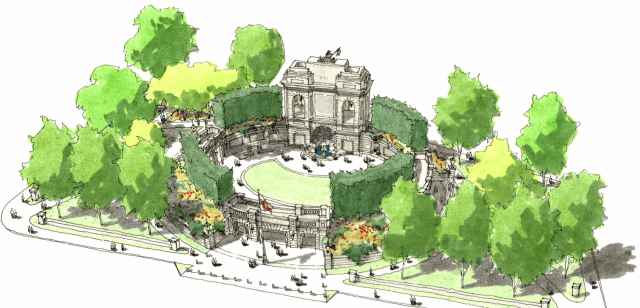
A nearly final rendering of Devin Kimmel’s WWI memorial design. (Kimmel Studio)

The jury of an international competition to design a national memorial for World War I has made its choice, overlooking a beautiful classical proposal in order to select a more modest proposal that, perhaps, will ruffle a lot fewer feathers. The jury may be applauded for the intestinal courage required to deep-six all of the three more overtly modernist proposals. That is small consolation for not selecting the clearly superior design.

In lieu, for now, of writing more extensively this evening on the decision, I here link to my first post about the finalists, which describes and illustrates them all. The winner is the second design I described. But first I described the design of Devin Kimmel, of Kimmel Studio in Annapolis. That post and another in the next day or so caught his eye. He asked me to write some press releases. He later asked me to join his design team in order to write a lengthy description of the proposal, its evolution in Phase II and its purpose for his final presentation to the jury on Dec. 9. He paid me for my work.

I have placed a rendering of the near-final design atop this post because the top is the place it deserved to own in the competition’s final round. I had hoped he’d win for obviously selfish reasons in addition to those having to do with my objective opinion of his design’s merit. I believe that one look at his design and the other finalists’ designs, including the winning entry, will absolve me of any hint of bias in preferring his over theirs. For a classicists such as me there could have been no other choice.

More tomorrow on this. Meanwhile, check out a piece by Philip Kennicott in the Washington Post, “America is chock full of World War I memorials, so why build another one?” published a few days before the jury made its choice. It is chock full of absurdities, so I commend it to readers’ entertainment.

Posted in Architects, Architecture, Architecture Education, Architecture History, Art and design, Landscape Architecture, Urbanism and planning | Tagged , , , , , | 4 Comments

Mittell: “Why I love Lviv”

lviv-skyline-raskalov-2.jpg

Lviv. (travelshopgirl.com)

David A. Mittell Jr., of Boston, has visited Lviv 22 times, some of them while he was on the editorial board of the Providence Journal, where I first met him. He now writes independently, after a stint as editor of the Duxbury (Mass.) Clipper. He is back in Boston, home from reporting on the war with Russia and on the nation’s bitter politics since the collapse of the Soviet Union. In land, Ukraine is now the largest nation in Europe. Mittell has, it seems, a second family of friends in Lviv, to which he returns as if to a lover.

Mittell’s email is damittell@gmail.com. He says he will send me some his own photographs of Lviv. I will devote a separate post to them. Here is his recent column on Lviv, published on January 22:

***

Why I love Lviv

by David A. Mittell Jr.

Lviv in Ukraine is the least-known most beautiful city in Europe, maybe in the world. Built over eight centuries it was never seriously bombed. It is forgotten today because it fell almost exactly on the Curzon Line – British Foreign Secretary George Curzon’s 1919 attempt to create a Polish-Russian border far enough from Moscow to be stable, and also to allow a Polish-German border far enough from Berlin to be stable. In its last throes British imperialism had its good intentions.

Lviv was taken by Stalin in 1939 and bandied at Yalta before being assigned to the Soviet Union in 1945 as a sign of Anglo-American good will, in the hope of Stalin’s reciprocation in Poland. Ha!

When the Soviets moved in for good Lviv disappeared as a known city. Its row houses of Austrian, Polish, Armenian, Jewish and Ukrainian construction were occupied but not cared for by Soviet officialdom. By 1991, when communism abruptly ended, water had worked its way into the elegant masonry of every style of folk and bourgeois genius.

The city’s treasures today are divided into a sort of tryka – three horses – forming a continuum. In the lead are structures that have been restored so well that one needs a blueprint or a chisel to be sure one is not being taken in by new construction.

In second place are buildings that have been partially repaired – for example, their essential downspouts replaced; or their being given new sash with the sturdy mullions typical of Lviv’s most common traditions; or perhaps their being restored at the first-floor retail level but not above.

Third are dwellings suffering a further quarter century of neglect. In my 22 visits to Lviv each arrival has swelled the first and second orders and reduced the third, which is most pronounced outside of Lviv, in the countryside.

Lviv is a city of steep hills around the valley of the now mostly unseen Poltva River. Highest is Visoky Zamok (“High Castle) – so exactly pyramidal that I suspect the mound-building Scythians shaped it in prehistoric times. (All history isn’t known; that one is for the future to go figure on.)

Near Svobody (“Freedom”) Boulevard – a great mall predating the Champs Elysees and Commonwealth Avenue in Boston – the city’s buildings seem distinctly Elizabethan. Their arched gateways cut under second stories into courtyards with open balconies of two or three stories, behind which families lived. One pictures children, laundry, cooking above, and horses and ordure below – except on afternoons when one can vividly imagine Shakespeare being performed in his lifetime.

Today, some of these courtyards remain as they were built. Others now open onto back streets, restaurants, shops and a number of new hotels.

The Austrian era, which ended with World War I, comprised many styles. They marked themselves to the untrained eye with elaborate stone or masonry balconies, and faux stone façades over bricken bases – the last, unfortunately, visible after 75 years of water working in.

Under Austrian rule Lviv was Lemberg, and Poland served as a sort of political proconsul, to the displeasure of the rural Ukrainian majority. In the interwar period Poland ruled outright. Lviv was Lwoow.

Architecturally, Polish rule produced a treasure trove of Art Deco buildings – thousands of them. Today, these closely resemble the older Austrian buildings in that their state of repair ranges from exquisitely restored to decrepit. Contemporary architects show Art Deco’s influence, especially in reviving the look of the curved metal railings enclosing nearly all Art Deco balconies.

For the tram lover Lviv is heaven-sent. Trams run on straight or winding cobblestone streets, they join with each other and separate, and they cross each other at right angles. The effect is like being on the set of Dr. Zhivago or a Sherlock-Holmes remake putting the imagination into lost London. I am a well-known poet, but with an overcoat, a briefcase and a black homberg hat I am anonymous! People share their small talk in Ukrainian, nominally, but really in the language of our common humanity.

I love it here.

Posted in Architecture, Architecture History, Art and design, Other countries, Preservation, Providence Journal, Urbanism and planning | Tagged , , , , , , , , , | 5 Comments

Architecture and Mozart II

Screen Shot 2016-01-26 at 12.07.11 PM.png

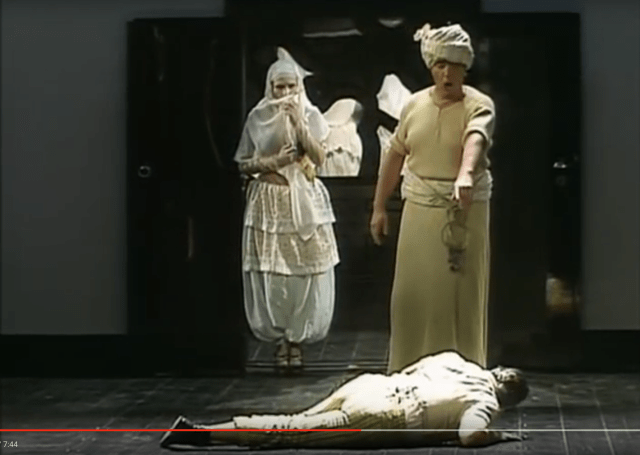
Screen shot of Osmin in a rage in Mozart’s opera Die Entfuhrung.

Here is a passage from a letter by Mozart in Wolfgang Hildesheimer’s 1982 biography, Mozart, in which the great composer, who was apparently not given to theorizing about music, theorizes about music. The passage might be read with profit by architects. Mozart is writing to his father about the composition of Osmin’s F major aria in Die Entführung:

For just as a man in such a towering rage oversteps all the bounds of order, moderation and propriety and completely forgets himself, so must the music too forget itself. But as passions, whether violent or not, must never be expressed in such a way as to excite disgust, and as music, even in the most terrible situations, must never offend the ear but must please the hearer, or in other words must never cease to be music, I have gone from F (the key in which the aria is written) not into a remote key but into a related one – not, however, into its nearest relative D minor, but into the more remote A minor.

The way Mozart modulates between the way Osmin expresses his rage and the way the accompanying score expresses it speaks to how architects must seek propriety in fitting a new building into its setting. Even if your building is meant to express an idea at odds with its neighbors, it should nevertheless seek to fit in rather than to stand out – and yet without suppressing its idea so far as to mimic its neighbors. This sort of negotiation among old and new buildings of a setting is precisely what modern architecture neglects to perform – in deference to both modernism’s egotistical principles and to its having long ago abandoned the tools of architecture that enable any such negotiation of this sort.

To modify Goethe’s notion that “architecture is frozen music,” modern architecture is a frigid bitch. … But calm down! Put a stopper in that towering rage! … No! Architecture must never cease to be architecture!

Here is a YouTube clip from the opera, with Osmin’s towering rage muted somewhat in the performance, perhaps even more than in the music, or so it seems to me, if indeed this is the aria about which Mozart writes. And yet it is Mozart, so it is worth listening to even if the performance does not live up to the composer’s theorizing about it. Please, readers, let me know if I have the wrong clip.

Posted in Architecture, Architecture Education, Architecture History, Art and design, Books and Culture, Video | Tagged , , , , , , | Leave a comment