Trying to like this building

AR-160129876.jpg

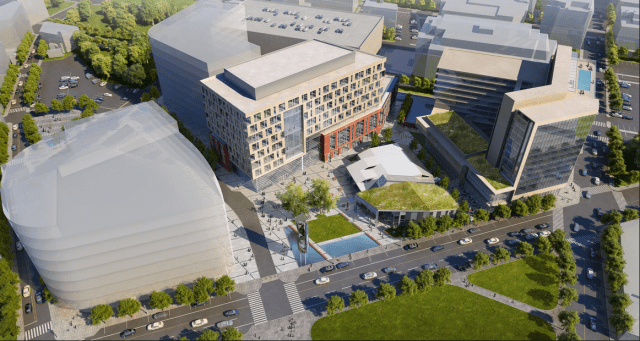
Capital Properties has proposed and the Capital Center Commission has apparently approved the design above for the parcel next to the almost supernaturally ugly Capital Cove, on land at Canal and Smith streets along the Moshassuck River. Here is what Kate Bramson wrote about it in her Jan. 20 story, “Commerce Corporation panel to consider incentives for Providence projects,” in the Providence Journal:

Seeking the other Rebuild RI credit for a $54-million residential development is John M. Corcoran & Co. LLC, and Trilogy Development.

That project, the Commons at Providence Station, has already won approval from the Capital Center Commission, said Todd D. Turcotte, vice president of Capital Properties Inc., which owns undeveloped parcels in Capital Center. A 247,850-square-foot project at Smith and Canal streets, it’s expected to consist of 169 apartments and about the same number of enclosed parking spaces.

I am striving to like its look. It is among the few amalgams of the old and the new, of traditional and modernist design, that seems to speak to me with civility rather than, as usual, looking daggers at me. I like its seemingly syncopated massing (at least from this angle) and the pilasters that grace the brick portions of its east-looking pavilions. They almost seem as if they want to refer to the State House, or at least to the old Transportation Building across Smith from the State House – but without the slightest idea how to do so. That might be considered damnation of the design by faint praise, but next to its closest neighbor, Capital Cove, it is a masterpiece. Perhaps my liking for the new proposal is wishful thinking, driven by my intense dislike of Capital Cove (below) – which started out very elegantly (bottom) but was destroyed by the “advice” of the Capital Center’s design panel.

I want to give this building a pass, even a nod. But would that be wrong?

(I’ve posted some TradArch answers to that question below the two photos, plus read comments by readers who did not get the post via TradArch.)

capitol-cove-street-view.png

Capital Cove, to left of site of proposed new building. (gcpvd.org)

dscn0629-e1396097568322.jpg

Originally proposed design for what became Capital Cove. (Brussat archives)

***

Here are some comments from TradArch list members:

From Sara Hines, in three emails:

If there is a style that will be immediately recognized as “of the second decade of the 21st century” this is surely it. I think it is economically driven and also due to the general lack of aesthetic interest by the architectural community, particularly at the mercy of commercial developers. The façades are fairly flat and the “rainscreen” design – they no longer talk about façades or skins in the same way, it’s “rainscreen” and it has specialists who study it. There are few choices that fit into the economic number-crunching so the level of invention is limited to odd compositions of available cheap materials, arranged in stripes and blocks and using the spectrum of brick veneer, EIFS, and maybe some metal panel stuff plus the big areas of glass. With a bunch of money you might get some thin terra-cotta tiles.  The concept that a parapet design addresses how a building terminates against the sky seems to have vanished, and the idea of how a building meets the ground is usually bluffed with bad shrubs.  The focus is on the abstract composition of the impoverished choices for the façade.

The main improvement I see is that the building surrenders to the blanding of new architecture rather than aspiring to the bizarre and twisted. …

Revit is a lobotomy for architects, and unfortunately those in school are learning it faster and sooner. The defaults of this system give you pork-chop eave designs, really bad stairs, and in the end a heavy dependence on downloadable commercial products, made by corporations who are big enough to get their products produced as plug-in “smart” objects. If you want to create custom details or even just better details, you have to create a lot of nested “families.” This is the program that AutoDesk has used to proclaim that they are reinventing architecture.  Yes, so it seems, they have. …

I should add that architects are victims as well as perpetrators in this system.  It takes ingenuity to work around the limitations on materials and what a contractor will do without jacking up the prices just because he feels intimidated by a different idea.  Ingenuity doesn’t figure into a business that is run for profit these days.

From Andres Duany:

This is a hideous hick design job that could only pass approval in a culturally clueless city or one insecure about its own value. A beggar of a city. Which Providence is not.

Posted in Architecture, Art and design, Blast from past, Development, Providence, Providence Journal, Urbanism and planning | Tagged , , , , , , , | 7 Comments

Architecture and Mozart

Lincoln_Cathedral_by_DBM92.jpg

Lincoln Cathedral, built 1185-1311

It would have been difficult for Geothe’s line “Architecture is frozen music” not to float into mind after I stumbled across this passage in Mozart, by Wolfgang Hildescheimer, another fabulous Christmas gift from my friend Steve, who I forgot to mention is also a musician, playing the clarinet, bassoon and other winds. Hildescheimer writes:

Classicism and Romanticism introduced subjective feeling into music as a conscious element of expression. … Previously, objectivity had prevailed, concealing the creative impulse (Bach’s fugues = mathematics, etc.). Although this objectivity has not been elevated to a preclassical principle, or ascribed to to a more primitive stage of music’s expressive capability, the idea of a greater individual expression persists as an implied truth even into this century. It serves to encourage a viewpoint by which we are to see music history as a large building, like a Gothic cathedral, on which different masters have worked at different times, knowing that they would not live to see the crowning climax, and compelled to reconcile themselves to one part in the work. The high point is generally thought to be Beethoven. Now, we know that his music would not be possible without Haydn and Mozart – he knew it himself – but we are not prepared to accept the idea of Beethoven as the fulfillment of what Mozart began and, because of that, on a qualitatively higher level. For we do not believe that the history of music is the conquest of new territory, making earlier conquests worthless or even slightly less worthy. If that were the case Dufay would surpass Orlando di Lasso, and Sweelinck would replace Dufay, etc. One would succeed the other, up to the crowning glory of High Classicism, aftert which, as most people still agree, everything goes downhill.

So the history of music is the history of architecture? Well, it is a thought. It brings to mind architecture’s succession of increasingly refined advancements on the art of building. It recalls ancient Rome’s conception as a set of fine buildings erected over hundreds of years to display an increasingly imposing sense of Rome’s ambitions as a state. In either case, we reach a stage where “everything goes downhill.” And in the history of architecture there was recovery in the Renaissance and beyond, and then another pitch downhill, which continues. Rome, at least, has managed to keep the Vandals almost entirely outside the gates since 1950. In any event, the lines from Mozart’s biography are a lesson in how greatness may be achieved – or lost. But at least we still get to choose to listen to Mozart and Beethoven.

Posted in Architects, Architecture, Architecture History, Art and design, Books and Culture | Tagged , , , , , , , | Leave a comment

Wexford, save 195 corridor

Screen Shot 2016-01-23 at 11.00.26 AM.png

Newly released design concept for Providence research park. (Wexford)

Coincidentally, I read that Wexford Science + Technology signed the dotted line on its purchase of land in Providence’s I-195 corridor just after I’d read the final passage in the conclusion of Brent Brolin’s The Failure of Modern Architecture. Brolin wrote:

By using what exists as a stepping stone for what is to come, the architect can reinforce rather than undermine the character of neighborhoods and cities every time a building is added. If each new building retains something of the old at the same time that it brings something new, the desirable character of a specific place need not be lost.

The extensive “pre-modern” cityscape that still remains is not historical refuse, to be tolerated until it can be bulldozed and replaced by something modern. It is an asset that should be used as a bridge to the future.

Those final lines of Brolin’s book were written in 1976. Forty years later they apply equally well and are yet equally ignored by the design establishment. As you can see from the architectural rendering above, Wexford has chosen to design its research park so as to undermine the character of the Jewelry District rather than to strengthen it. So it will look like every other research park in the nation – which is fine, sort of, in Houston or in Charlotte. But in Providence such design misses the opportunity to differentiate the city from competitors, including Boston, in the development of research parks.

Screen Shot 2016-01-23 at 11.13.41 AM.png

Rhode Island Hospital campus.

In fact, been-there-done-that applies here: The Wexford project looks virtually identical to the ugly Rhode Island Hospital campus just down the road.

All research parks and development projects of that sort base their designs on outmoded concepts that have failed for at least half a century in America. Modern architecture is based on the idea that the Machine Age requires Machine Architecture. But what we got instead was a metaphor for machinery without its efficiency. Modernism is not sustainable, and it has been a contributing factor in the decline of U.S. cities. Architecture of that sort will remain a threat to urban living as long as this idea lasts. Even when individual projects thus designed succeed financially, they often do so at the expense of what is most loved – and most competitive – about their host cities. Charleston, S.C., is doing the same thing. Little by little, Charleston and Providence risk losing what makes them attractive.

Brolin and others understood this decades ago but architects will not listen. And yet the Wexford project is early in its development. If the firm wants to help Providence build on its competitive advantage of beauty and character, and at the same time boost its bottom line, it can easily change its design to work with rather than against the brand of beautiful Rhode Island.

Posted in Architecture, Architecture Education, Architecture History, Art and design, Development, I-195 Redevelopment District, Providence, Urbanism and planning | Tagged , , , , , , | 1 Comment

Brolin on vandalizing Yemen

juanherrerophoto.jpg

Yemen’s capital, Sanaa. (juanherrorophoto.com)

I have raised this subject many times as modern architecture works to wipe out indigenous cultures around the world. In his 1976 book The Failure of Modern Architecture, Brent Brolin provides a vivid account of the arrogance of modern architecture’s assault on Yemen. I quote it at length because it is a relatively early record of what modernism inflicted on Third World countries that threw off or were freed from colonial rule only to turn around and invite the First World’s vandals back to destroy their new nations.

Events in today’s Yemen are tragic but entirely predictable. It would not surprise me at all to learn that the angst produced by modern architecture contributes to radical Islam and terrorism. One is not sympathizing with the devil to note that Mohammed Atta hated modern architecture as a symbol of the evils of the Western democracies.

During centuries [Yemen’s] seclusion from the West, the whole country, and particular its capital, Sanaa, evolved a uniquely practical and sophisticated urban architecture. In the decade following [its 1962] revolution, these traditions were nearly obliterated. …

After a passage detailing the difficulties faced by foreign modern architects working in Yemen, who refused to acknowledge the country’s architectural wealth, and the high cost of importing both modern materials and modern experts to carry out rebuilding plans, and the dangers of using reinforced concrete in a climate whose daily temperature swings caused expansion cracks in mere months, Brolin writes:

All of these problems might have been tolerable if the final product had been better than what was already there, but it was not. …

The traditional materials, on the other hand, have few problems with regard to the temperature change. As an example of the general durability of Yemeni construction: When the Yemeni Jews moved out of the Jewish Quarter of Sanaa in 1948, the other Yemenies expected them to return, and for nearly ten years the houses in that quarter were unoccupied. When it was clear that they would not come back, the Yemenis began moving in. After ten years of neglect most of the houses needed only a new coat of mud plaster on the roof. The job requires no exceptional skill. You can do it yourself, or if you do not have the time, skilled people are readily available. Materials are not a problem either: the earth comes from the backyard, the water from the well.

flickriver.com

(flickriver.com)

DSC_7139

(travel-tour-guide.com)

The modern buildings suffered from another problem too: as the temperature changed outside, it also changed inside. The buildings became ovens in the day and refrigerators at night. In a short time the wealthy Yemenis, who had wanted the status of a modern house, moved back into their traditionally built houses and rented the modern ones to visiting foreigners.

The temperature problems could have been solved by heating and air conditioning, but the high cost of the units and fuel and maintenance are obvious. Furthermore, our concept of climate control was foreign to the Yemeni, who had been using a much more sophisticated method since the time of the Queen of Sheba. The method is still used, but the foreign experts never considered it.

The walls of a traditional Yemeni house are thick, usually eighteen inches. One- or two-story houses are usually made of mud bricks, whereas taller ones (up to eight floors in Sanaa) have their foundations and first stories made of stone and the upper ones of fired brick. There are three types of windows in the Yemeni house. The first, which is ornamental, consists of one or two carved plaster screens inset with stained glass and is placed above the second type, a normal casement window. The third type is a small hole – as small as 4″ x 12″ – with a door. Several of these may be put in each room at high and low points on the walls, and opening and closing them controls the air circulation. The combination of structure and ventilation is efficient. In a test made in a one-story mud-brick home, the inside termperature varied by only two degrees Fahrenheit over a twenty-four-hour period while the exterior temperature changed by thirty degrees. The interior remained around 69 degrees Fahrenheit.

Most important, Sanaa is not an architectural museum. Its extraordinary architecture is being added to daily. The skills that built it are not gone, though they were nearly lost due to the insistence on being modern that dominated the country for nearly a decade. Fortunately for Yemen, its architectural traditions are now in less danger of being destroyed because of the work of a United Nations planner named Alain Bertaud. During the three years – 1970 to 1973 – that Bertaud worked in Yemen he reacquainted the Yemenis with the technical and aesthetic values of their own architecture.

The most successful tactic he used was to build his own home using mud brick in the traditional Yemeni style. The fact that Bertaud and his family would live in a local house, and that other foreigners came and approved of it, was a revelation to the Yemenis. For the first time a foreigner who had come to tell them how to live had told them that they were doing fine by themselves. The psychological impact of this unusual occurrence cannot be overestimated. Soon members of government and other influential Yemenis were admitting that they had never really liked the foreign houses. They had been made to feel ashamed of their own and had been afraid to risk the foreigners’ ridicule be choosing their old ways over new ones.

… When the experts came to Yemen, the country offered them a remarkable gift of practical and inexpensive local materials and the skilled craftsmen who could use them artfully. Yet the sensitive, knowledgeable professionals failed to take advantage of this rare natural resource.

I have quoted this passage at length not just because it highlights the crime committed by modern architecture against an indigenous culture – although Yemen’s leaders were more to blame than the besotted foreign modernist practitioners. I also want to remind readers that what foreign modernists did to Yemen is what our own modernists have done – and continue to do – to our own “advanced” Western cultures. The past offers a sustainable way to evolve the built environment into the future. Modernists sponsor seminar after seminar on sustainable architecture while ignoring – and suppressing others’ recognition of – the lessons of sustainability that the past has to offer to the future.  Modern architecture may not be killing people but it is killing cultures to this day. Why is this not a crime of a magnitude worthy of Geneva?


Posted in Architects, Architecture, Architecture Education, Architecture History, Art and design, Books and Culture, Development, Other countries, Preservation, Urbanism and planning | Tagged , , , , , , , , | 1 Comment

Happy design, happy toaster

brave_lil_toaster_by_cyprusbeetle-d7eucne.jpg

“Brave Lil Toaster,” by CyprusBeetle. (deviantart.com)

We are all critics of product design. Recently our toaster bit the dust and we bought a new one. Our old Cuisinart gave way to a shiny new Hamilton Beach. But we soon realized that our bagels were no longer tasty. Or so it seemed. We asked Eastside Marketplace whether they had changed bagel brands; no, they had not. Could a pair of different toaster brands really toast bagels so differently? Finally, we went on eBay and sent away for a “factory reconditioned” version of our original Cuisinart.

DSCN9977

This morning, after it came by post, I rushed out to get bagels, returned to toast one in the new toaster, spread the cream cheese and ate the result. It was delicious, entirely superior to the Hamilton Beach bagels, which had seemed dull and heavy, as if they’d been toasted in a cardboard box factory. The Cuisinart bagel was crisp and cheery, with a rich bagel smell.

The Cuisinart toaster is a chubby white machine with soft edges that seems to smile at us from the counter. The Hamilton Beach was made of reflective silvery steel. It seemed to revel in its bogus functionality. It didn’t even offer a numerical “brown” meter, as the Cuisinart did. The toasters’ personalities were diametrically opposed. You could tell just by looking at them.

DSCN9978

So what were the product design boys up to here? It would be just as easy to manufacture a toaster that looked friendly but acted badly. It’s hard to say that the inviting toaster was more likely than the uninviting toaster to do a better job toasting bagels. After all, to have bagel halves jammed into you, and to get all hot and bothered without being allowed to eat them, is a dirty job – and thankless to boot. One might equally imagine that a nasty-looking toaster looks nasty because it has a dirty job to do, works hard at its job, and understandably frowns at the sweaty labor involved.

It is also not hard – certainly not for me – to put a pro-traditional, anti-modernist spin on this entire affair. Just like architecture, we experience product design day in and day out. And so we trust our ability to judge good and bad design. But isn’t the taste of a bagel a matter of … well … of taste? I throw up my hands and scurry back to my architectural watchtower.

Posted in Architecture, Art and design, Humor | Tagged , , , , , , , | 2 Comments

Adele C-T at PPS in Prov.

aar_mmw_post.jpg

(sofaarome.wordpress.com)

Adele Chatfield-Taylor will speak at tonight’s annual meeting of the Providence Preservation Society. It will be at 5:30 p.m. this evening in the Providence Public Library. Last night, trying to finally decide whether to attend or to train up to Boston for a chapter board meeting of the Institute of Classical Architecture & Art, I listened to C-H’s speech accepting the 2010 Vincent Scully award at the Building Museum in Washington, D.C.

Screen Shot 2016-01-20 at 11.29.46 AM.png

Adele Chatfield-Taylor in 2010 at the National Building Museum.

I will be at the PPL tonight. Chatfield-Taylor’s talk was marvelous. For a quarter of a century she headed the American Academy in Rome, headquartered in a mansion designed by McKim Mead & White for the Academy. She was a force for decades in American and international preservation circles. Her talk was a string of pearls on the subject, primarily, of historic preservation.

Although she herself at 70 remains a paean to the preservation of personal pulchritude, one of her overriding concerns was for the patina of age in buildings, which she said should not be blasted away by the desire to spend as many millions as possible putting a gloss on faded beauty. Preservation need not be so ambitous, and she noted that we often lose more than we suspect when we restore a building with too much vigor. Some of my favorite cities – such as Rome, Venice and New Orleans – are famous for respecting the process of growing old. They are cities down at the heels, to a degree, and that is good. Her words reminded me of why. Here is a passage from Chatfield-Taylor’s discussion of age in architecture:

A continuing worry for some of us was that once a building was rescued, those in charge seldom considered anything but a full-blown, multi-million-dollar restoration or reconstruction as a way to preserve it. And to this day it is, more or less, our favorite model of what to do. There were reasons for this – building codes, a lack of architectural elements available that fit old buildings, etc., etc. – but there was always also, it seems to me, a psychological factor, which was that as a culture we were still threatened by anything old. Old people, old buildings – that actually look old. We can accept old buildings that look brand new, but as a society we do not do well with things that are faded, wrinkled or decrepit.

Chatfield-Taylor made no mention, except perhaps by implication, of insensitive modernist renovations of or additions to these old buildings. Her speech contained no direct expression of dismay regarding the sort of architecture that has filled the space between beautiful and historic old buildings in the past half century. Yet much of what she said can hardly occupy the same sensibility with an approval of such things. Sure, one can shoehorn the lines into a text, but not speak them with authenticity.

So I will be interested tonight to hear what she has to say about preservation in Providence – which seems so concerned with saving Brutalist structures like the Fogarty Building and the Produce Terminal, and expresses so little interest in assuring that the spaces between the buildings PPS has saved are filled with new architecture that respects their setting and might be worth saving a hundred years from now (if they last that long).

Chatfield-Taylor said that “knowledge of Rome must be physical, worked up into the brain through thinning shoe leather. When it comes to knowing, the senses are more honest than the intelligence.” I would say that the senses are often more intelligent than the intelligence, so to speak. This is why people prefer the sort of buildings that historic preservationists used to devote most of their energy to save. That preference turned the antiquarian roots of preservation into the mass movement of today. Preservationists in Providence should keep that in mind as they listen tonight.

(Reservations are free but require registration via the Providence Preservation Society.)

Posted in Architects, Architecture, Architecture Education, Architecture History, Art and design, Development, Preservation, Providence, Urbanism and planning, Video | Tagged , , , , , , , | 2 Comments

My new blog at TB and PH

Screen Shot 2016-01-19 at 1.09.46 PM.png

Eagles after removal from Penn Station in 1963. They illustrate my first post.

My new blog is now up on the remodeled websites of two leading trade journals, Traditional Building and Period Homes,  published by the Home Group of Active Interest Media. The blog is called Architecture Old and New, a recasting of the title of this old blog, Architecture Now and Then, which was founded in 2009.

My first post on the new blog, which will appear monthly, and on this blog a month after appearing in TB and PH, is “New Blog, Old Conversation.” It introduces the blog and dives into the discourse, the conversation among architects about architecture, by characterizing segments of the discourse.

My new blog (and my old one) are intended to foster discourse not only by offering platforms for my own need to spout off but by triggering responses, yea, nay or huh?, from readers. I hope that readers of my new blog will visit my old blog, and that readers of my old blog will use the opportunity offered by my new blog to visit blogs by the two journals’ stable of bloggers. One of them, Clem Labine, whose blog is a monthly masterpiece, founded this set of journals devoted to the building traditions and the classical revival.

I am familiar with his work and am looking forward to getting to know Judy Hayward, Peter Miller, Rudy Christian and Ken Follett. Their blogs address a range of subjects regarding the nuts and bolts of traditional practice in the building arts and crafts, preservation of historic homes and buildings, and dissemination of information about those fields through journalism and gatherings of practitioners and theorists.

Not least among the charms of TB and PH is their profusion of ads for firms that sell products and services for architects and builders. Most of these are lusciously illustrated and are as alluring to readers as the journals’ reportage, book reviews, forums, opinions and other features. Believe it or not, there is even an index to advertisers in each issue!

The Home Group, which publishes the building-oriented journals under the Active Interest Media umbrella, is responsible for a wide range of activities to assist practitioners revive beauty in the building arts. They include: the Palladio Awards, the Traditional Building Conference series, the Historic Home Show, and a host of popular journals, including Old House Journal, Early Homes, New Old House, Arts & Crafts Homes, Old House Interior Design Sourcebook. All have websites that can be clicked on from the bottom of any of the above websites.

I hope readers will click on any of the links above to read the offerings and join the discussion.

Posted in Architects, Architecture, Architecture Education, Architecture History, Art and design, Books and Culture, Development, Preservation, Urbanism and planning | Tagged , , , , , , | 2 Comments

Is that moss on the roof?

st-peters-007.jpg

St. Peters Seminary, near Glasgow in Scotland. (Alamy)

Above is an aerial photo of what some consider Scotland’s most significant modernist building. Is that moss on the roof? What’s left after water seeped (or gushed) in, sparking problems that led to the almost obligatory debate between owner and architect over who to blame for the building’s flaws?

One flaw is that from above it looks like a discarded engine housing that has been sitting in the woods for two decades, gathering whatever stuff tends to gather on things left in the woods.

Well, look at it! It is the St. Peter’s Kilmahew Seminary, near Glasgow. Malcolm Millais sent me the photo, no doubt to lift my spirits. I looked for the photo on Google and found that it linked to a year-old story in The Guardian by Rowan Moore, “A Second Coming for Scotland’s Modernist Masterpiece?” Turns out that it was completed in 1966 but abandoned in 1980. One thing you can’t deny of Brutalism is its physical strength and staying power. (In 1989, dynamite failed to budge Hartford Park, a public-housing tower; actually it did budge, just a bit, and was called “The Leaning Tower of Providence” until it was taken down piece by piece.)

A year ago, Moore wrote approvingly of plans to resurrect the seminary as a venue for avant garde art installations, musical concerts and philosophical bloviation, and began his essay with a genuine bout of poetry, purring upon the subject of time and architecture:

There is no place like [St. Peter’s], on these islands, for the mutual battery of multiple forces, for the thumping, pummelling and attrition of creation and destruction, the incessant beating of weather, vandals and arson against rocks of obstinate architecture. It is like watching medieval knights club each other to death yet stay standing. It is a mud-wrestle of culture and nature.

Even old Brutalism can find itself partaking of a rough natural beauty if people will only refuse to maintain it, eventually abandon it, and leave it to the ravages of time. But I think Moore doth protest too hard. Classical architecture ages gently. Brutalism and other modern architecture that’s taken care of – frequently governmental because the government can force citizens to pay for upkeep – usually rusts, warps, molders, streaks, gathers “graffartistry” and generally enters decrepitude awkwardly, to say the least, rather than weathering with consummate grace as classical architecture does, with the beauty and dignity of natural aging, much like trees and people.

Civilization preserves the ruins of antiquity for aesthetic as well as historical reasons. Not so with Brutalism and other modern architecture, which requires rationalization, often patently ridiculous, in order to defend expenditures to renovate an old mod icon. Modernist ruins are never preserved, or worth preserving, as ruins. The very idea insults the word, which in this sense of its usage evokes the respectful patina of age.

But perhaps St. Peter’s is already being reused, probably to showcase more recent forms of ugliness. This may be appropriate but it is sad. It would be interesting to debate whether architects or planners are the most to blame for erecting a building like this “for making tender young men into priests,” as Moore put it. A church establishment interested less in the formation of priests and more in asserting its place on the cutting edge may be to blame. And also blame Scotland’s top civic leaders for not squelching the idea in its nest. No, of course planners and architects may shirk the lion’s share of the blame. They are the tools of policy developed at higher levels of society.

Here is a video made by Abandoned Scotland of the seminary. Just below is a lovely photograph of its ruined interior, which appears at flickr.com.

flickr.com.jpg


Posted in Architects, Architecture, Architecture Education, Architecture History, Art and design, Development, Video | Tagged , , , , , , , | 6 Comments

Bill & Hugh, together again

DSCN9973.JPG

Here is my July 20, 1995, column from The Providence Journal about my father and his best friend, who both were city planners. The images are photographed from an old copy of the column, so I apologize if the expressions on their faces are not entirely clear.

***

Pictured above are two men at their desks. The man on the left does not have the same “let’s get this over with” look evident in the smile of the man on the right. Perhaps this is because the man on the left had not yet become, when his picture was snapped, what both eventually would epitomize: the “old Washington hand.”

Both men were very dear to me. On the left, with the map of Chicago on his office wall, circa 1953 [the year I was born], is my father, William K. Brussat. To the right, with the southeastern U.S. on his wall, circa 1960, was my father’s best friend and my own best friend’s father, Hugh Mields Jr., who died two weeks ago. His son, Steve, and I attended the funeral last week. After the ceremony, we sat around telling old stories of Hugh, and also of Bill, who had died 17 years before.

We talked not of how much they had improved society, but of how much we, as kids, trembled at the prospect of exciting their displeasure. Gregg Watts, a buddy of ours from grade school who was at the funeral, recalled the time when Hugh discovered that Gregg and Steve had left telltale marks of boyish anger on the Mields’s new ping-pong table in the basement. (Whether the actual event or the retelling was, in fact, the more harrowing, I don’t know!)

Gregg noted how curious it was that all of us had remained so close to our friends from grade school – a phenomenon doubly odd, presumably, in our hyper-transitory hometown. He said he would write a book about that someday. That is a threat Gregg makes regularly. “But, Dave,” he added on this occasion, “why don’t you write about it in your column?”

Well, Gregg, I don’t want to steal your thunder (and, nota bene, this column goes out on the wire, so now the world awaits your book!). So I will address a question of greater interest (I suppose) to readers of this column: Did my father’s line of work, together with Hugh’s, influence what I write about?

My dad was a city planner in Chicago when I was born. He moved to Washington in 1955 to take a job as project manager for a development firm with big government urban-renewal projects. He was involved in the redevelopment of Southwest Washington and of Society Hill, in Philadelphia, to name just two. Not long ago, in fact, I found a copy of the Providence 1970 Plan among his papers; he was not involved, but evidently he was interested.

Bill and Hugh came to Washington at the same time. Mom recalls that the two husbands went job hunting together while she and Hugh’s wife, Irene, went sightseeing. Toward evening, they visited the gallery of the Senate, and noticed two men snoozing several rows down – Bill and Hugh, natch.

Hugh found work as assistant director for urban renewal at the National Association of Housing and Renewal Officials, and ultimately filled important posts at the National League of Cities, the U.S. Conference of Mayors and the federal Model Cities program before becoming partner, for 27 years, in a firm that lobbies on behalf of state and local agencies.

In 1963, Dad joined the U.S. Bureau of the Budget (now the Office of Management and Budget). He developed and administered a program called A-95, designed to ensure that, say, a state highway and a federal airport aren’t built on the same land.

Well, that’s how he simplified it for my young ears. Growing up, about all I knew was that he went to work after breakfast and returned for dinner. So far as I recall, none of his professional interests interested me. By the time Dad died in 1978, I aspired to write opinion columns on political issues. By 1985, I was doing that for the Journal-Bulletin. It was only by pure happenstance that, in 1991, I started writing about architecture and urban development.

The careers of my father and his best friend flourished in the heyday of urban renewal and modern architecture. I never heard them utter a syllable against either “glass boxes” or “slum clearance.” In those days, that’s how urban development was done.

I was going to end with some flapdoodle connecting a shift from modernism back to traditionalism in urban design and the family, but I beg off.

My mom always says she thinks Dad must be pleased that I’m writing about what interested him. If I have the ability to write well about architecture and urban design (as Mom insists), perhaps it is in my genes. My dad always used to say he didn’t care what his children did for a living so long as we tried our best to do it well. I’m sure Steve would tell me his dad said the same thing. Don’t all fathers say that?

I can only hope that if my dad and my dad’s best friend are, in fact, pleased at what I write, that their smiles are of the indulgent variety. I have little doubt, however, that if they’ve read this far, they are rolling their eyes and saying “Let’s get this over with!”

***

Two decades later I don’t really have much to add to that, at least for now, thought there surely is much more to say. My mother once told me, as we were passing through Alexandria, Va., on the Metro, that Dad disliked the George Washington Masonic Temple Memorial, which we could see out the window. Not enough evidence to go to trial on that, it seems to me.

Posted in Architecture, Architecture History, Art and design, Blast from past, Development, Urbanism and planning | Tagged , , , , , , , , , | 5 Comments

City planning now and then

DSCN9971.JPG

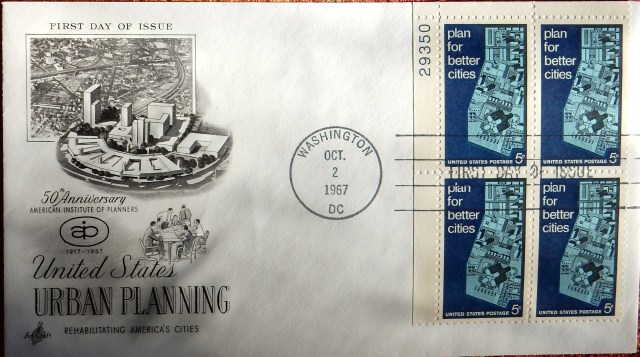
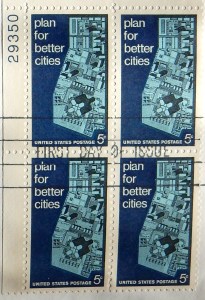
My friend Steve’s father Hugh Mields and his friend William K. Brussat (my dad) were city planners. Steve, who is both a philatelist and a fenestration cleanliness engineer, recently sent me an envelope postmarked Washington, D.C., Oct. 2, 1967, and stamped “First Day of Issue” in honor of the 50th anniversary of the American Institute of Planners. I don’t know whether this envelope was ever actually mailed, but it has four 5¢ stamps illustrated with the design of what looks like a plan for urban renewal. “Plan for Better Cities” is emblazoned in each stamp’s upper left-hand corner.

DSCN9971 - Version 2

DSCN9971 - Version 3

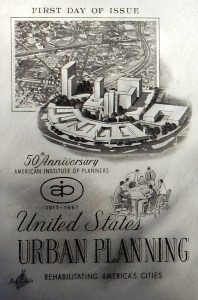
This is not funny, but the engraving on the left side of the “First Day” envelope is. In addition to celebrating the AIP (1917-1967), it reads “United States Urban Planning: Rehabilitating America’s Cities.” Above that is a small engraving of seven planners sitting or standing around a table with a plan. An engraving of the plan is above that. It shows a typical faceless modern collection of rectangular buildings arrayed above a massive semicircular parking garage. Above and in back of the plan is a photograph which we are supposed to understand is an aerial view of the urban setting into which the plan will be inserted.

Why is this funny? Well, it’s not really, but celebrating the accomplishments of what American planners have done to cities throughout the nation strikes me as just this side of foolishness, and not just in retrospect. It is difficult to imagine that planners really thought that this sort of thing would improve America, and yet it surely was believed by planners such as my dad and Steve’s. Hugh was involved in the Model Cities program and had a major hand in developing the “new town” of Reston, Va.* My grandmother moved there from the Bronx into a tower full of seniors. Her younger daughter Mona (my mom) and dad and we three boys used to visit her out there frequently, driving through the farmland that used to surround Reston. We used to drive past the CIA on Route 123 before there was a sign saying what it was. Hugh and Irene moved out to Reston, too, but Steve and the two elder of his sisters used to drive back to Washington at every opportunity to see their friends from the neighborhood and from their schools. In a couple of years they all moved back to D.C. I don’t believe I have a right to say they hated Reston but they could not stand living out there.

Likewise, I haven’t the history of long conversation with my dad about his career. He died in 1978. Hugh died in 1995. I have no idea what they thought of modern architecture. In fact, I don’t want to know. I did enjoy getting the two of them back together in a column I wrote for the Providence Journal after Hugh died, in which I wondered what influence my dad and Hugh might have had on my architectural tastes. We lived in relatively modest traditional houses on a traditiional street in Cleveland Park. Our house, on Rodman Street, was furnished from a store called Scan. You can imagine what it was like. And I liked it. I still do like that sort of sleek interior design (it is inside, after all, not outside – a private matter altogether). Steve, my brother Guy and I used to take the L4 down to the Federal Triangle and pass by the Commerce Department and the Labor Department – FDR classicism – on the way to visit museums on the mall. I used to sit on the steps of the Lincoln Memorial and gaze down past the Washington Monument to the U.S. Capitol. These were my influences. I could not connect the dots with my dad or Steve’s.

Well, it turns out that this post is not all that funny. Oh well. It does bring up wonderful memories for me if not for readers. It was sonic to have such great dads (and moms, too, I hasten to add). I will reprint the column of the two dads.

***

* Claudia Kedda, one of Steve Mields’s three sisters, who has spent her career in public and private housing and community-development organizations, wrote in to say that her father was not involved in the development of Reston, which was a privately developed New Town near (if not now within) the vast commercial megaplex known as Tyson’s Corner.

Posted in Architecture, Architecture History, Art and design, Blast from past, Development, Humor, Urbanism and planning | Tagged , , , , , , | Leave a comment