Skyscrapers vs. sprawl?

Screen Shot 2016-02-21 at 12.22.28 PM.png

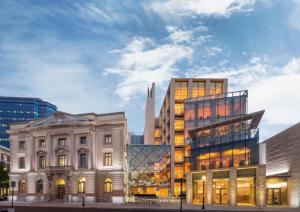
Crown of the Woolworth Building, in Lower Manhattan. (lussierphoto.com)

It is conventional wisdom that cities with lots of skyscrapers, such as New York City, are an ecofriendly bulwark against sprawl. Building up, it is said, avoids the need to build out. “Sprawl” is not just suburbia because suburbia can be nice. Inner rings of suburbia are often like the outer neighborhoods of a city. Sprawl is what much of suburbia has become – housing tracts choked by networks of highways and connectors that require you to have a car to go anywhere or do anything. And it’s not worth it, as the commercial roads are lined with shopping pods where, often, one must dip back out onto the road just to enter the next shopping pod over. What percentage of accidents take place in these areas? Are they legally required to be poorly planned? Or are suburban planners in league with the auto-repair industry?

While many American families who live in these territories have become accustomed to their face – oops! I meant fates! – in many cases it is because they arrived there from even less dulcet environments. The suburbs changed in recent decades from a sign of success for many families whose (mainly) fathers’ income enabled them to move out of crowded city neighborhoods before such places became chic. Today, the suburbs are more likely to be the only affordable place to live for families fleeing the inner city or dangerous overseas habitats. Suburbs are increasingly declassé. More and more of the wealthy, and especially the newly wealthy, forgo the suburbs for “historic districts” (neighborhoods built before 1950) or downtown skyscrapers.

That’s all now water under the bridge. What does it mean for the balance (if such a thing is possible) between cities and suburbs? Most people think that stacking families up in high-rise apartment buildings means minimizing the pressure that suburbia places on exurbia and the countryside (such of it that remains). This bit of conventional wisdom is partly true but not enough to warrant massive new investment in skycrapers.

A leading opponent of skyscrapers, Michael Mehaffy of Portland, Ore., and founder of the city think-tank Sustasis, has assembled an impressive report, “The Impacts of Tall Buildings: A Research Summary.” A key paragraph from its executive summary – which acknowledges that the value of tall buildings is mixed – identifies two major factors overlooked by those who consider major skyscraper cities to be “paragons of sustainability”:

But it’s often overlooked that tall buildings are only a fraction of all structures in these places, with the bulk of neighborhoods consisting of rowhouses, low-rise apartment buildings, and other much lower structures. They get their low-carbon advantages not only from density per se, but from an optimum distribution of daily amenities, walkability and access to transit, and other efficiencies of urban form.


The legal separation of civic functions (single-use zoning) is the distinguishing mark of the suburbs – tracing its roots to the removal of factories and mills from residential city neighborhoods. It is the return of mixed use to intown neighborhoods that has, at least in part, fueled the resurgence of downtown living in many American cities. The Mehaffy report’s eighth and final finding suggests that this, not skyscrapers, is the major reason why dense cities have become paragons of sustainability:

Tall buildings may not be compatible with the broader social and economic dimensions of sustainability, for “sustainability requires not only that we lessen our ecological impacts, but also that we create the urban and cultural frameworks in which we can attain full humanity, in contact with self, others, and nature. This might be the real reason that the tower seems an anachronism” (Peter Buchanan, Harvard Design Magazine, 2007).


My own opinion of towers is also mixed. I like the Woolworth Building and dislike the Seagram Building. I have not compiled a white paper filled with evidence for the proposition that sterile modernist towers impose a deadness on their surroundings that is not imposed by the surviving classical towers of the past, whose beauty still supplies an ineffable quality to life on the streets. I believe the proposition is self-evident. If developers, moving forward, were to embrace that ineffability of the classically beautiful skyscraper, then my doubts about this building type would be seriously deflated.

But that is, shall we say, highly unlikely. Mehaffy’s report was issued about a year ago but, with the accelerating rise of megatowers in Manhattan and elsewhere, the report’s sensible balance of thinking on skyscrapers, and its towering abundance of evidence, should become vital ammunition in the growing popular reaction against megatowers.
Posted in Architecture, Architecture History, Art and design, Development, Preservation, Urbanism and planning | Tagged , , , , , , , , , | 1 Comment

Architecture and emotion

DSCN3059 copy.JPG

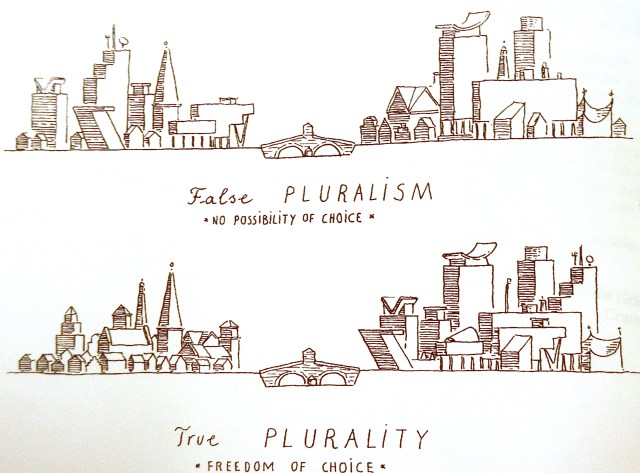
Perhaps this drawing by Leon Krier syncs with thoughts by Nikos Salingaros. (Krier)

Architecture causes changes in the emotions and feelings of those who see it, use it, live it. Powerfully felt or hidden in the subconscious, our reaction to our environment pleases or displeases, attracts or repulses, according to rules that are becoming less obscure with each passing year. A top investigator of this phenomenon is architectural theorist and mathematician Prof. Nikos Salingaros, of the University of Texas at San Antonio, who guest lectures at many other universities around the world. He was interviewed by the journal ArchiImpact, in Barcelona, which published his thoughts in English.

Architecture conveys “information” that is ordered or random, understandable or baffling. Salingaros believes that better feelings are naturally generated in humans by architecture that evolved by trial and error down over time, from builder to builder over thousands of years. That sort of architecture became naturally molded to our psyches, as a pair of jeans becomes naturally molded to our legs – fitting better, looking better.

In this micro-interview, Salingaros compares how buildings communicate to us with how people communicate with each other.

Communication with other humans obeys the same principles. We welcome and thrive on one-on-one interchanges with other persons. We are able to exchange ideas and complex messages. Not only the words of what we say matter, but most important are the simultaneous moods created by voice tone, musicality, cadence and rhythm; all of these contribute to a healthy conversation with another person. This process of emotional communication can be expanded to include other persons. However, a limit may be reached when too many people are talking at once, and the message becomes jumbled and random. We no longer find such a situation healing.

The dominant architecture today has only existed for a century and has not developed a coherent architectural language – and apparently it does not want to. Each modernist architect wants to do something new or different, and hence there has been no growth of a pattern language. This, Salingaros believes, causes it to generate feelings that people naturally try to resist, as they normally seek to resist incoherence, and, if they fail, the emotions that arise can be negative, or even unhealthy, causing vertigo or even illness.

Most of this is clearly evident to most people, but society has become infatuated with design of the second rather than the first type, and we have become trapped in a prison whose walls are infested with incoherence. So we need someone capable of bridging the intellectual gap and thus able to lead society from conventional wisdom back to common sense. Salingaros is leading the way in that most vital endeavor.

The drawing by Leon Krier atop this post is not directly related to the thoughts of Nikos Salingaros, but I am sure they have much in common.


Posted in Architects, Architecture, Architecture Education, Architecture History, Art and design, Urbanism and planning | Tagged , , , | 2 Comments

Poland’s “Crooked Forest”

Screen Shot 2016-02-20 at 11.34.57 AM.png

Poland’s Crooked Forest. (reddit.com)

The curved trunks of this grove of trees known as the Crooked Forest, in Poland, planted in 1930 when the land was in Pomerania, then part of Germany, raises interesting challenges for landscape architects. On the website iflscience.com, Justine Alford wondered “What Could Have Caused Poland’s Crooked Forest,” ruminating on why we know so little of how this happened. Few things in nature are as enticing as trees that seem to have grown in defiance of the rules of botany – most trees and their branches reach for the sun to offer their leaves the nourishment of photosynthesis.

Wikipedia describes the reigning ignorance regarding how the 400 or so pines of the Crooked Forest got that way:

The Crooked Forest (Polish: Krzywy Las), is a grove of oddly-shaped pine trees located outside Nowe Czarnowo, West Pomerania, Poland.

This grove of approximately 400 pines was planted around 1930, when its location was still within the German province of Pomerania. It is generally believed that some form of human tool or technique was used to make the trees grow this way, but the method and motive are not currently known.[1] It has been speculated that the trees may have been deformed to create naturally curved timber for use in furniture or boat building [2] Others surmise that a snowstorm could have knocked the trees like this, but to date nobody knows what really happened to these pine trees.

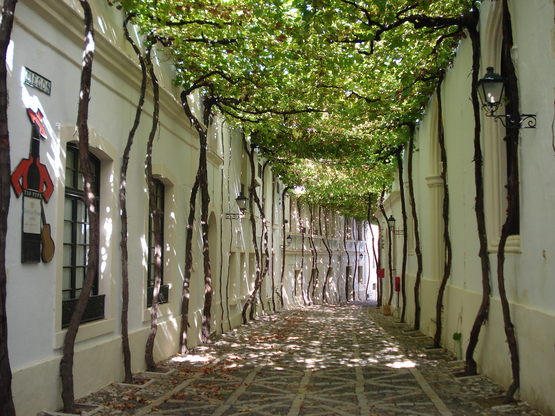
Imagine a marvelous garden whose creator understood how to foster a similar curvature of this magnitude in the garden’s little forest. Landscape architects, I am sure, already know of methods to form unnatural shapes in the trunks of trees. Grow them close to the side of a building, for example, as in this grove of street trees – grape vines, actually, apparently in Jerez, Spain.

Hats off to my wife, Victoria, who, amid her nightly perusal of interesting submittals to Facebook, shot this one to me.

Screen Shot 2016-02-20 at 11.37.32 AM.png

Grape vines in Jerez, Spain. (reddit.com)

Posted in Architecture, Art and design, Landscape Architecture, Other countries | Tagged , , , , , , , , | Leave a comment

Evolution of casino design

Screen Shot 2016-02-15 at 6.22.46 PM.png

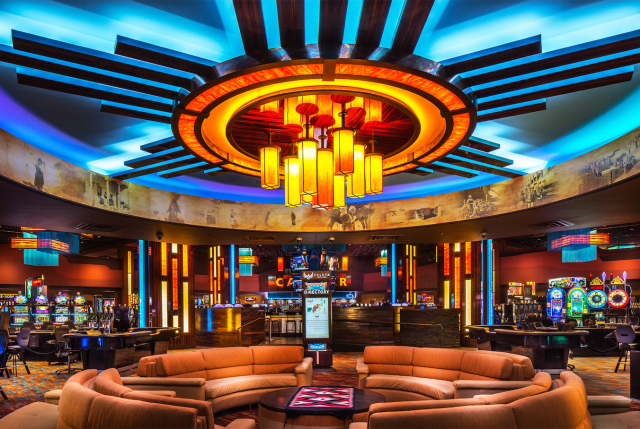
“Structures within structures” at the Isleta Casino & Resort, in Albuquerque.

Evolution of Casino Design

by Adam Samson

It’s no secret that casino operators employ certain strategies and techniques to keep their patrons spending, from the services that they offer right down to the interior design of the gaming floors. The bright lights, absence of clocks, etc., all set in a maze-like layout, are part of the psychological manipulation of players. Nevertheless, new research suggests that these stereotypical design features are no longer a priority for casino decorators.
This classic recipe for casino success was attributed to Bill Friedman, who studied the design elements of the most profitable establishments and elucidated the principles of “gaming” design – low ceilings, little decor beyond tables and machines, and a layout that somehow always leads you back to the casino’s gambling areas.

But that is changing. Now when people think of casino resorts, what immediately comes to mind is glamorous surroundings, even if the city itself isn’t that glamorous. While most new visitors expect a festive and animated atmosphere, they also look for luxury and want to feel welcomed by the design. No one wants to feel like they’re being tricked into gambling.

The shift from conventional casino design to David Krane’s “playground layout” design is reshaping the inner workings of casinos today, catapulting them into higher profits despite the violation of Friedman’s traditional principles. Studies show that gamblers responded more positively to varied color schemes, static lighting, symmetrical layouts and the clustering of machines by theme.

Furthermore, “the bigger, the better” for casinos no longer applies. One trend that seems to have sprouted over the last couple of years is a boutique ambiance, creating more intimate spaces within a big space by using what Paul Steelman, of the Las Vegas-based casino design firm Steelman Partners, calls “structures within structures.”

Another prominent trend that fellow designer Brad Friedmutter has observed is the use of layout to help the younger patrons interact with one another. [Editor’s note: Our imagination runs rampant. Some readers may not even want to know what that means!]

There has been a growing number of game apps offering the same style and approach. According to prominent mobile gaming software developer Gaming Realms, more than  70 percent of their gamers are now using mobile devices, which exceeds the industry average. The award-winning game developer of mobile casino software Pocketfruity adds that the proliferation of faster internet connections for mobile (4G) has led to more adoption of smartphones and tablets for gaming. At the end of the day, the most important thing is to give gamblers a seamless gaming and casino experience.

Although casino providers are constantly coming up with new ways to attract gamblers, the focus will always be on gambling. It’s just a matter of making gaming even more like play than like work.

Adam Samson is a freelance writer specializing in architectural design. He lives in Twickenham, U.K.

***

The author, Adam Samson, is an art enthusiast with a passion for old architecture, and hopes to learn the craft of restoration. Like me, he enjoys travel and walking around cities with his camera, taking photos of street scenes.

I take no position on whether the recent changes he describes in the interior design of casinos are good or bad. I am certain that however that may be, a gambling arena set in a building of traditional beauty is probably better for both players and owners than one set in a goofy modernist building. Perhaps author Samson agrees. But on second thought it occurs to me that modernist casinos might carry their own intrinsically baffling features, useful to fool gamblers into gambling in such places. Or might a confusing design cause gamblers to seek more alluring casinos? Any thoughts from readers?

Posted in Architects, Architecture, Art and design, Development, Interior Design | Tagged , , , , , , , , , | 5 Comments

Happy 14th birthday, ANN!

DSCN0051.JPG

Copley Place from the entrance of the Boston Public Library.

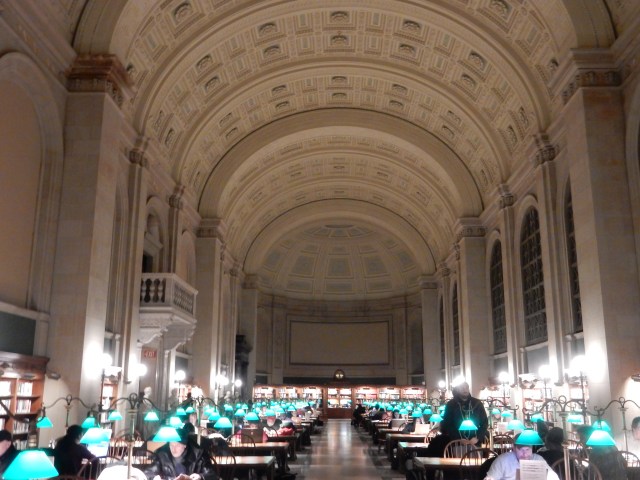
Today is ANN’s 14th birthday, the duoseptennial (neologism alert) anniversary of ArchitectureNewsNow.com – Kristen Richards’s glorious compendium of architectural news and opinion from around the world (at least the Anglosphere). I can think of no better way to commemorate this day than with the gift of fine architecture. I was in Boston last night with my camera. Before attending the board meeting of the New England chapter of the Institute of Classical Architecture & Art, I sat a while in Bates Hall, the main reading room of the Boston Public Library, designed by Charles Follen McKim. The 1972 half, designed by Philip Johnson in an attempt to crack a joke at the expense of the 1895 half, does not count even as architecture in any genuine sense of the word. Kristen will disagree, of course, and that will have no bearing on the beauty of her accomplishment.

***

DSCN0042.JPG

DSCN0045.JPG

DSCN0055.JPG

DSCN0089.JPG

DSCN0067.JPG

DSCN0088.JPG

DSCN0091.jpg

DSCN0092.jpg

DSCN0094.JPG

DSCN0061.JPG

DSCN0057.JPG

DSCN0063.JPG

DSCN0071.jpg

DSCN0087.jpg

DSCN0072.jpg

DSCN0086.jpg

DSCN0073.jpg

DSCN0082.JPG

DSCN0076.JPG

DSCN0097.JPG

DSCN0110.JPG

DSCN0098.JPG

DSCN0100.JPG

DSCN0096.jpg

DSCN0105.JPG

Posted in Architects, Architecture, Architecture Education, Architecture History, Art and design, Interior Design, Photography, Preservation | Tagged , , , , , , , | 2 Comments

That Providence renaissance

statehouse copy.jpg

Looking up between State House dome and one of four marble guardians. (Photo by David Brussat)

Randal Edgar, deputy editor of the Providence Journal’s editorial pages, has an opinion column today in which he reveals that he is “Still waiting for that R.I. renaissance.” At first I thought he might be writing about the famous Providence renaissance, maybe echoing the mistaken views, a year ago, of Mary Ann Sorrentino. The purpose of this post was to twit him on his use of the word “renaissance.” Providence’s renaissance is in full swing and full bloom. Rhode Island has piggybacked on the Providence renaissance to a degree, but has always had an abundance of physical and cultural allure.

But Randal is really talking about Rhode Island’s economy, which has seen no renaissance, if one insists on the word. But both the Ocean State and its capital are – or should be – well positioned to use their tourism assets and their broader quality of life to help the state’s economic recovery along.

The opportunity to translate those qualities into economic growth is considerable and well recognized by state officials, who are actively seeking to rebrand the state and hitch its future to its competitive advantages, such as they are. Unfortunately, the state simultaneously makes this more difficult by encouraging developers to build new buildings that do not add to but rather subtract from the Rhode Island brand. (Signs leading into the state still say “Discover Beautiful Rhode Island.”)

I have urged Governor Raimondo to ask developers of the I-195 Corridor and other parts of the city and state to revise their existing, early-stage designs to be more in keeping with the character of Rhode Island. I am not suggesting that new laws regulating style need to be enacted or that new subsidies for “correct” buildings need to be passed by the legislature. I am urging merely a phone call. Period. Developers are more interested in working with state and city officials to help their projects move forward than they are in what style their projects are built in. Remind them of that. Tell them their proposed building designs are undercutting the state’s effort to attract entrepreneurs to Rhode Island. Architecture people like is an “easy” development tool.

When people visit Rhode Island they go to Benefit Street and Bellevue Avenue, not Jefferson Boulevard. This reflects an intuitive sense of taste that has broad implications for economic growth in a state like Rhode Island. To urge the state to embrace it actively may be unconventional, and the design establishment is sure to object, but it taps into the spirit of our state’s creative juices – just as “slow food” is taking over Rhode Island cuisine. It is a spirit that is capable of inspiring entrepreneurs to relocate here.

Overall, if Rhode Island is to have an economic resurgence, it must rely on existing competitive advantages – such as beauty – before reforms in the state’s business climate kick in. Beauty can kick in right away if new buildings associated with economic development are designed to strengthen rather than undermine the state’s brand. That is true whether Mayor Elorza is overestimating the number of such projects or not.

Speaking of the mayor, city council member Sam Zurier’s op-ed, “Mayor Elorza overstates Providence’s resurgence,” just under Randal’s column, seemed to be kicking Providence in a manner similar to the way Randal seemed to be (but was not) kicking Rhode Island. (At least Zurier seemed to know the difference between a resurgence and a renaissance!)

To echo Zurier’s point, Providence and Rhode Island both have tantalizing qualities of beauty, historical character and quality of life that exist today, but also a lot of negatives standing in the way of their future well-being. Those negatives will probably win out if the city and state allow the projects designed to foster growth to undermine that growth by kicking the state’s brand in the shins. This is not rocket science.

Posted in Architecture, Architecture History, Art and design, Development, I-195 Redevelopment District, Preservation, Providence Journal, Rhode Island, Urbanism and planning | Tagged , , , , , , , , , | Leave a comment

New blog, old conversation

DSCN7320.JPG

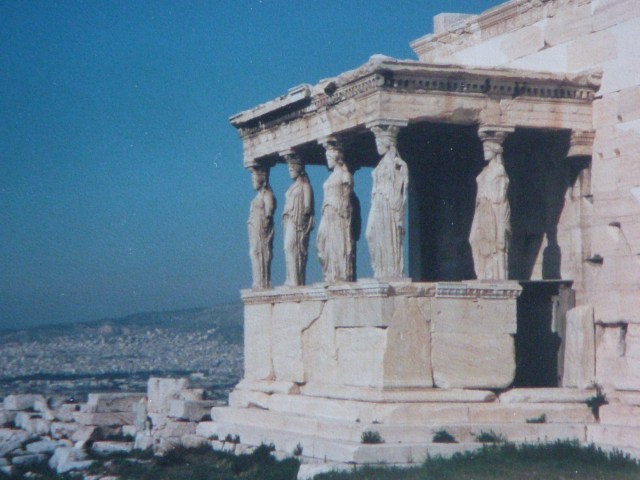
The Erechtheum, near the Parthenon on the Acropolis in Athens. (Photo by David Brussat)

The following is the first post published on my new blog with Traditional Building and Period Homes magazines. These are monthly and will be posted on this blog a month following their posting at TB and PH. My second post is now up for this new blog, called Architecture Old and New. It is about the different experiences facing those who want to buy elements of a proposed traditional building versus that facing modernist architects. It will appear here next month, but you can see it at Traditional Building now. The link is to TB’s home page. To reach my blog just scroll down to “WWCD: What would Corbu do?” I’m sure your scroll will be interrupted by other matters of interest along the way.

***

New blog, old conversation

Conversation about architecture, known as “the discourse,” has continued for centuries, even millennia. Today a new thread in the discourse, if I may be so bold as to call it that, is initiated with this blog. Architecture Old and New is hosted by the websites of Traditional Building and Period Homes, a pair of trade journals published by the Restore Media division of Active Interest Media – to whom I am grateful for the platform and hopeful of pleasing the 10 million readers who visit the websites annually.

AR-302139882

Eagles removed from Penn Station during 1963 demolition.

As the author of this new blog I benefit from the experience of my old blog, Architecture Here and There, which continues. It started in 2009 as an offshoot of my job as an editorial writer and architecture critic at The Providence Journal. There I worked for 30 years, writing for the last 25 years a weekly column on architecture. Today the blog is independent, speaking for traditional architecture and its allied arts and crafts, and against the modernist design establishment, no holds barred. This new blog is dedicated to the same principles but directed specifically at the makers, buyers and sellers of work grounded in those principles.

I do not know how you all came to choose tradition as the basis of your work, but I suspect that most of you feel that your choice arose from an approach to design that was more natural than its alternative.

2015-AIA-ALA-Library-Building-Awards-09-1

Addition to Slover Library, Norfolk. (aasarchitecture.com)

The discourse of this blog springs from its author’s belief that all humans experience architecture more intimately than other arts. From near birth we all experience houses and other buildings hour by hour, day after day, as long as we live. Except for those whose design educations have blunted their natural instincts, people have an intuitive grasp of what’s important about buildings and their appearance. While traditional architecture has evolved over centuries of trial and error, handing down best practices from generation to generation, the business model of modern architecture officially rejects precedent, which restricts practice to a limited variety of forms that almost always conflict with their setting and tend to alienate the public. As a result, most people have a strong natural preference for traditional buildings, arts and crafts.

Churchill said, “We shape our buildings and they shape us.” In fact, a few of us shape the buildings that shape the rest of us, and the conversation between those few and the rest of us, well, it tends to flag. The few are not listening.

Most modern architects have been taught to treat the public’s dislike for their work as a feather in their cap. The free market helps practitioners in other fields bend their efforts toward the satisfaction of public desires. Not architecture! Most major commissions for buildings are handed out by committees – panels of design apparatchiks who follow the party line of the architectural establishment. Only in single-family residences does traditional design still dominate the market – because most families still choose their own home.

So the discourse – the conversation about architecture among architects – is really a pair of discourses. The modernists, secure in their control of the establishment, have little to discuss: They do their work as they learned in school, establishment journals applaud, prize juries reward, and schools pump out more young architects trained to continue ignoring both their clients’ needs and their critics’ protests.

Since modern architecture claims to value innovation above all, firms have little incentive to share design ideas. Modernist conversations focus less on design and more on how the industry can address challenges of climate change, inequities of race and gender in hiring and promotion, the widely perceived inadequacy of the word “intern,” the industry’s interests in Washington, the heavy college debt load of architecture graduates, and other issues more important than the theory and practice of placemaking – including how to prevent the idea of “beauty” from rearing its ugly head.

soffit.gif

Soffit indicated in yellow. (doric-column.com)

The discourse among classical and traditional architects proceeds almost entirely apart from the discourse among modernists. To judge by my long experience as a member of the TradArch listserv (operated by Dr. Richard John from the University of Miami School of Architecture), the discourse of classical and traditional architects features two distinct arenas: 1) how classical and traditional work can recapture a share of the industry lost to modernism since 1950, and 2) how many soffits can dance on the head of a pin.

Excuse my chuckling at the technical discussion of architectural detail that animates so much of TradArch. A heated debate over some aspect of soffits was under way when I first joined the list. I did not even know what a soffit was. (It is the ledge under a cornice or the overhang of a roof.) But architects seeking advice from fellow practitioners on practical questions of design and construction is probably why TradArch is so valuable to most of its members, be they threadomaniacs or lurkers who read but are rarely heard in the discourse. The latter are of vital importance because they, too, transmit discourse into practice.

screen-shot-2015-04-04-at-9-03-58-pm

Plate from Heterodoxia Architectonia. (Andres Duany)

Since I’m not an architect, the question of how to give the boot to the Mods is my main concern. Andrés Duany, who is writing a treatise called Heterodoxia Architectonica, wants to broaden the definition of classical to include Louis Sullivan, other wayward classicists of the 19th century, and even some downright modernists. Capture territory, he cries – but the treatise (whose Book I was edited in part by me) is not yet published and so its impact remains to be seen – except on TradArch and other forums, where the “battle” is joined, its influence is felt, and its bearing on the discourse is often quite entertainingly termigant in tone.

Debates over terminology – whether the word “classical” is too backward-looking, or whether the word “modernist” is designed to take over the future – are entertaining to wordsmiths, but nomenclature will not be the silver bullet. Equally unlikely is the vision of a traditional beachhead in architecture schools. Architectural education will change only when the market for architecture changes. More demand for traditional buildings will create more demand for learning how to design them. That is why I believe that exercising our democratic rights is key: those who seek to bring beauty back to their communities should invade their city councils and demand it. Threaten to vote the ins out if, say, municipalities do not act to even the playing field for major architectural commissions so that traditionalists have a fair chance to beautify the public square as well as the residential neighborhoods. If it is true that most people prefer traditional styles – and I believe it is – then it will happen.

But maybe even that is unlikely, perhaps most unlikely of all. The people using their votes to demand that government do what they want? Yes, it is a stretch, but the alternative may be to just get used to ugliness. This, one might argue, is what we already have done. Still, all of these conversations on how to advance the classical revival add value to the discourse. I hope that this new blog can help Traditional Building and Period Homes move that discourse toward a future that doesn’t keep poking us in the eye.

Posted in Architects, Architecture, Architecture Education, Architecture History, Art and design, Development, Preservation, Urbanism and planning | Tagged , , , , , , , , , , | 1 Comment

“Orchestrate a Renaissance”

Screen Shot 2016-02-15 at 1.54.16 PM.png

Composing a comeback for classical music and classical architecture is the twin purpose, or so it seems, of the Future Symphony Institute, founded in Baltimore by Andrew Balio, the principal trumpet of that city’s symphony orchestra. Its latest project is the subject of this blog’s post just prior to this, “Krier’s symphony for London.”

Under the motto “Orchestrate a Renaissance,” trumpeter Balio and the philosopher and architectural theorist Roger Scruton have assembled a website to express the aims of Future Symphony. Those are enunciated in the site’s “About” section. I read it and had the devil of a time figuring out which paragraph to quote. Each one seems like a drooping bough on a tree whose fruit is truth. How to choose! I finally pegged on one, but urge readers to read the rest. So here is the paragraph summarizing the problem:

There should be no doubt about the need for a renaissance. The long retreat of music education from public school curriculums, the frequency of closures and lockouts among the nation’s longstanding musical institutions, the growing tendency to couch arguments for the relevance or irrelevance of classical music in political, utilitarian, antihistorical, and reductionist terms, the surge in popularity of “solutions” that offer to repudiate or even dismantle the tradition, the administration of the art form as a socialist program or government agency and the subsequent slouching toward bureaucratic bloat and uninspired mediocrity, and the paucity of viewpoints upon any of these subjects all point to a growing gap between those who speak today for classical music and the eternal and transcendent art form itself.

The paragraphs following summarize the gathering hope for such a renaissance, the nature of the beauty that classical music has in store for citizens, and the promise it holds out for a civic efflorescence in the world.

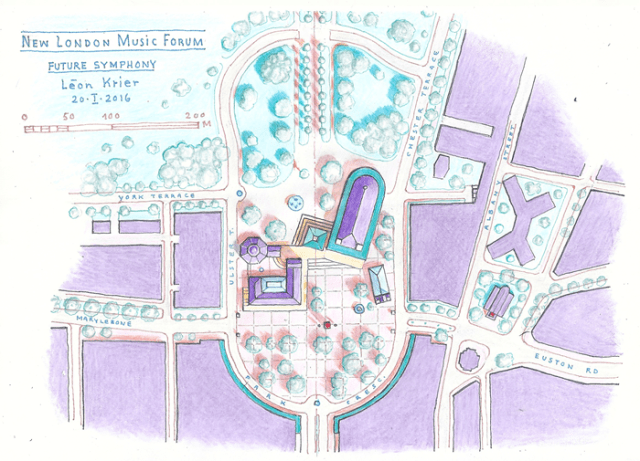
Substitute the word architecture throughout and the sentiments strike me as equally true. Indeed, by championing Leon Krier’s proposal for a London Music Forum, the Institute suggests that the renaissance of classical music it seeks cannot happen without a classical setting in which to unfold. Krier, in his description of the Forum, compares the lively and beautiful setting for classical concerts at Covent Garden with the dreary music halls at Southbank and the Barbican. He envisions restaurants and cafés behind the colonnade of John Nash’s Park Crescent, directly to the Forum’s south, serving concert goers and music students who will use the concert hall, chamber music hall, music school and exhibition gallery of which the Forum will be composed.

Go to the website to luxuriate in its insights, or simply to experience a space in cyberspace of truly elegant design, without the tiresome jumble and excitation common to most websites. The Institute’s website was created by its editor, Laura Jean Balio.

LMF-6-cropped.jpg

Proposed London Music Forum. (Leon Krier)

Posted in Architects, Architecture, Architecture Education, Architecture History, Art and design, Books and Culture, Preservation, Urbanism and planning | Tagged , , , , , , , , , , , , | 4 Comments

Krier’s symphony for London

LMF-6-cropped.jpg

Proposal for a new concert hall and complex at Regent’s Park, London. (Leon Krier)

On my first trip to London in 1979 I took in a classical performance of the London Symphony Orchestra at the Royal Festival Hall on the Southbank embankment of the Thames. I felt the hall’s demerits as architecture even back then, more than a decade before I started writing about buildings. I consider the experience as evidence that people who do not think about architecture nevertheless feel, intuitively, the difference between modernist and traditional design. It is not impossible to like modernist buildings, but aside from an occasional “Wow! factor” of initial response and an even more occasional positive response to extraordinarily rare good modernist design, it is a learned as opposed to a natural feeling. Often, however, it is a response embraced, if not genuinely felt, for reasons having more to do with social status, careerism, politics and ideology. The innocent dislike I felt for the design of the Royal Festival Hall back then vindicates a lot of my thinking about attitudes toward architectural style today.

Sorry. Please excuse my digression. I write this post to heap praise and glory on Léon Krier for his proposal to build a new concert hall, which he calls the London Music Forum, that would sit between Regent’s Park and Crescent Square in the West End. This location brings to mind the phrase “hidden in plain view.” Why have Londoners had to wait decades for such an obvious solution to the even more obvious problems of the Royal Festival Hall at Southbank and another major London concert center at the Barbican?

It is because beauty and common sense are not favorites of the design establishment or, for that matter, of any government. Beauty and common sense are especially tedious if they bring success, for that could very well set a precedent that would (those in authority assume) be difficult to meet, and the result might cause the public to demand more.

Krier’s call for a London Music Forum, which he says would be an “act of redemption,” is proposed as an alternative to current flawed plans to build a new home at various other locations for the London Symphony Orchestra. After detailing his proposal, Krier writes:

Astute observers will notice that this very specific vision represents a departure from the orthodoxies that have lately governed civic and urban development – and that left their indelible scars upon the face of London in both the Barbican and Southbank. While the machinery of mega-project planning is already underway to impose on Londoners yet another soul-crushing, inhumane super-structure, it would be prudent to take a step back and consider just what were the mistakes of the halls we now need to replace, what should be done differently this time, and what are the priorities that follow from a broader, long-range goal of making a truly accessible and enduring home for the London Symphony.

Encore bravo, maestro!

LMF-1-700.png

Posted in Architecture, Architecture Education, Architecture History, Art and design, Books and Culture, Development, Landscape Architecture, Other countries, Urbanism and planning | Tagged , , , , , , , , | 5 Comments

Heinrich Kley book trailers!

Screen Shot 2016-02-12 at 8.53.30 PM.png

Here are two book trailers – first I’ve heard of a book trailer! – for The Lost Art of Heinrich Kley, a two-volume set devoted to the work of the German illustrator. The set, published by Lost Art Books, boasts over 450 drawings and paintings – more than the Dover collection my father gave me (now residing in the Providence Journal’s clip-art archive, if it still exists – plus scholarship assessing Kley and his work. The drawings collected in this set largely avoid replicating illustrations from the Dover set (also two volumes). But check out these book trailers. They are a hoot! One sets Kley to rousing classical music; the other shows Volume Two being flipped through by a disembodied hand. Book trailers – now that’s a concept I can live with!

I posted “Heinrich Kley’s ‘Road Rage’” last Sunday.

Screen Shot 2016-02-12 at 8.51.18 PM.png

Posted in Architecture, Art and design, Book/Film Reviews, Books and Culture, Humor, Video | Tagged , , , , , | Leave a comment