Passages and lessons, 2016

Screen Shot 2017-01-01 at 9.16.13 AM.png

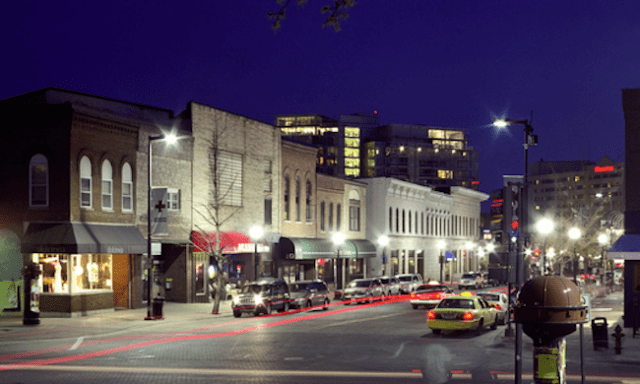
A main street in Iowa City. Is Donnelly’s still there? (hanna-law.com)

The passages referred to in the title of this post are from Home Free, a 1977 novel by Dan Wakefield, who earlier had written Going All the Way about the “free” lifestyle embraced by many in the late ’60s early ’70s. The lesson I take away from Home Free is that the free lifestyle isn’t really free, and that having a purpose, goals, standards and such is less of a hassle for your lifestyle (and your soul) than the alternative of a free-floating, pointless existence. At least that’s how it seems to be for the characters in Home Free.

So I pass that along, for what it’s worth, having given the boot to a personally very regrettable year: 2016? Geddidowdaheah! Good title for a book.

So, anyway, the passage that follows has Gene traveling across the country. He stops for several weeks in Iowa City, the third City of Literature (a 2008 designation of Unesco) and the only one in America. The state university is in Iowa City, and the town is a sort of nexus for the writers-workshop lifestyle. There are lots of poets living on the land around town. Gene often visits a bar on the strip, and in one visit he learns of awful plans for town:

One day in Donnelly’s Gene was telling the bartender how much he dug the place, the bar and the town both, and he learned to his amazement and outrage that it wouldn’t be that way for long. Urban renewal was coming. They would even tear down Donnelly’s. Tear it down! Shit, Gene thought it should be a national monument, a fuckin historic site. But it wouldn’t. It would just be a memory. Instead of old wood there’d be plastic here, like anywhere. Gene figured if they could do it way out here in the middle of the country then finally there wouldn’t be any towns left at all, just one big national strip of fast-food, quick-stop, Plexiglas and plastic, an Orange Julius on one end, and Taco Belle on the other, so you would know which coast it was. Along the way there’d be signs to tell you where the towns used to be.

The topic of urban renewal in Iowa City was raised here and immediately dropped, and never showed up again in the novel. I find no evidence that urban renewal ever did reach Iowa City – though there is a pedestrian mall – but the very thought, as explicated by Wakefield, is scary. To paraphrase the musical Fiddler on a Roof – “May the lord bless and keep urban renewal … far away from us!” For many cities and towns it is too late. Providence dodged most of a very large bullet in the 1960s. Happy New Year.

Posted in Architecture, Books and Culture, Uncategorized | Tagged , , , , , , | Leave a comment

Wolf von Eckardt’s critique

Screen Shot 2016-12-29 at 8.38.17 PM.png

Sketch from essay by Wolf von Eckardt, Harper’s, May 1966

Yesterday, into my email inbox, there came a 1966 Harper’s critique of the original World Trade Center by Wolf von Eckardt, the first architecture critic at the Washington Post. I was age 10 in 1963 when he was hired. In 1981, when he moved on to Time magazine, I moved out of D.C. to my first writing job in newspapers, at the Augusta (Ga.) Chronicle. So basically Wolf von Eckardt was at my breakfast table for 18 years of my existence as a young man. Yet I don’t ever remember actually reading any of his stuff. Hmm.

“New York’s Trade Center: World’s Tallest Fiasco,” sent to me by Ron Thomas, is behind the Harper’s paywall, but here are a few passages that thrilled me:

The project appears much like one of those Buck Rogers schemes of “the city of the future” we’ve seen in the comics for years and which have more amused than frightened us. We have never taken them seriously. But the lonely superstructures, superhighways and surrealist wastelands of these visions are now creeping up on us.

Remember, this was in 1966. Von Eckardt not only saw the barbarians storming the gates but the antidote – he was big on Jane Jacobs, whom he mentions. In suggesting an alternative for the WTC site, he writes:

New buildings would be carefully scaled in size and character to their environment. There might, to be sure, be a new skyscraper or two. But they could so easily be handsome and fitting additions to the skyline rather than its ruination.

The mid-’60s were a time of considerable introspection and argument in professional architectural circles. Were there other architecture critics like von Eckardt who challenged modern architecture? For that matter, how long did von Eckardt hold out? Did he eventually drink the modernist Kool Aid? Well, if he did, it was not until after 1977, when he wrote an amazing essay for The New Republic called “The Death of the Moderns.” He writes:

Screen Shot 2016-12-29 at 8.44.42 PM.png

Photos of the demolition in 1972 of the Pruitt-Igoe public housing complex in St. Louis, Mo. (The New Republic, 1977)

While Palladio was busy designing exquisite country houses for the Italian nobility, the peasants were quite capable of building their own habitat, using the accumulat- ed skill and wisdom of centuries as their blueprint. Architecture without architects, as we all know, adds up to lovely villages and towns and can be as delightful as the architecture of great masters — and is frequently more commodious.

Von Eckardt on Corbusier and Mies:

[The chapel at Ronchamp] was a work of abstract sculpture, “not a building, but a monu- ment,” as Le Corbusier put it. It was not so much a building to worship in, as a shrine to be worshipped.

And worshipped it was by the critics, curators, experts, cogniscenti, connoisseurs and teachers of architecture — as devoutly worship- ped as the Miesean glass box on the other end of that total, man- made environment. The common folk still seemed confused. It seems doubtful that the breathless and panting human animal experienced any sense of liberation or comfort. But then, nobody asked.

The marriage of art and technology was never consummated. To this day, building remains the industry tbe industrial revolution has overlooked. We still have a chronic and desperate shortage of decent housing, although there never seems to be a shortage of automobiles. Try as they would, the Modernists could never get houses to roll off the assembly line.

He continues his critique of architecture, the only field in human history that has stressed the importance of rejecting precedent, while at the same time expecting the result to be mass-produced. But no. The only thing mass-pro- duced is the hype. The hypocrisy involved is breathtaking, and yet those who misled the world have held it in modern architecture’s thrall to this day.

Being frustrated in evolving its own, new building technology — as the Gothic style had done — the Moderns substituted a machine esthetic that was mostly symbolic. Mies’s glossy, machine-precise, modular buildings are painstakingly and expensively handcrafted to look mechanical and machine-made; Mies insisted on designing different steel beams for practically every one of his buildings. The romantic wing of the Modern movement, led by Le Corbusier, soon tired even of machine-made materials, such as glass and metal components, and sculpted its bizarre forms mostly in rough, “organic”-looking concrete.

You will have to read the entire article to believe it. It would not be publishable today in any major “legacy” newspaper or magazine. The modernists are too well cemented into the broader establishment by now. I wonder why von Eckardt really left the Post in 1981. Revelations from his 1995 obituary in that paper suggest some possible answers:

On returning to this country [after World War II], he worked for the U.S. Information Agency and then the American Federation of Labor. His family recalled that his career there ended abruptly when he found the recorded music piped into the elevators intolerable and quit. …

After leaving The Post in 1981, he joined the staff of Time. He left Time after the term brownstones was inserted into one of his pieces as a substitute for the town houses he was writing about, according to his wife.

He obviously did not suffer fools gladly. But that does not answer the question of how I could possibly have spent 18 formative years in my youth, with von Eckardt’s opinions of modern architecture sitting before me on the breakfast table at home, without ever imbibing his spirit. I guess that’s a question that must remain unanswered.

By the way, the two illustrations with this post, the Pruitt-Igoe public housing and the Twin Towers, from Harper’s and from The New Republic respectively, both depict buildings designed by Minoru Yamasaki.  Wolf von Eckardt, who noted that in his TNR piece, would surely chuckle at the massive irony that eventually both would be knocked down.

Posted in Architecture | Tagged , , , , , | 7 Comments

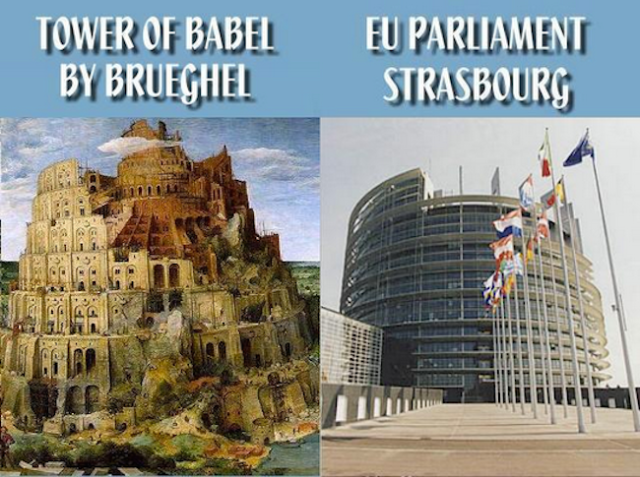
E.U.’s new Tower of Babel

Screen Shot 2016-12-28 at 3.04.21 PM.png

(biblelight.net)

Pairing the European Union’s new facility in Strasbourg with the medieval painter Brueghel’s Tower of Babel has occurred to not a few on the Internet, and not without very good reason. You can almost assume that the designer intended to dare critics to draw the obvious comparison. Modern architects are like that. Harum-scarum! But the E.U. is a fount of many voices, “out of many, one,” so to speak, and amounting to babble only in the eyes of critics. But the critics may be correct. The E.U. is a quagmire, but less of a babble, literally or figuratively, than the United Nations: Many more voices, even more babblicious.

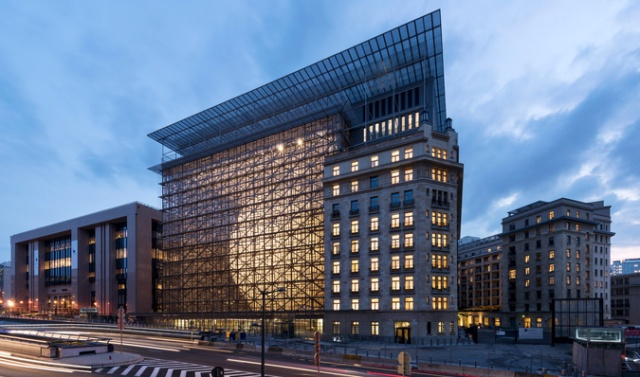
At the risk of shocking my friend Malcolm Millais’s eyeballs into a furious roll, I have to say that the photo he sent of the E.U.’s new headquarters in Brussels is quite cute. Modern architecture has here created something that may come as close to beautiful as can be imagined by objective observers in the full capacity of their sanity. Below is a nice photograph taken from an extensive shoot at Dezeen, “E.U. headquaters features glass box containing curvaceous glowing lantern.”

Screen Shot 2016-12-28 at 3.26.40 PM.png

New E.U. headquarters in Brussels. (Photos here and below from Dezeen)

The new building, whose design was led by the Belgian firm Samyn and Partners, perhaps does not even rely for its high aesthetic quality on the historical building at its lower right corner, to which the larger structure has been attached. Another photo below from an angle taken at dusk also shows off its delicate loveliness. The building appears pregnant with the future of Europe. (Yes, I myself cringe at the words flying off my keyboard.)

Screen Shot 2016-12-28 at 3.28.47 PM.png

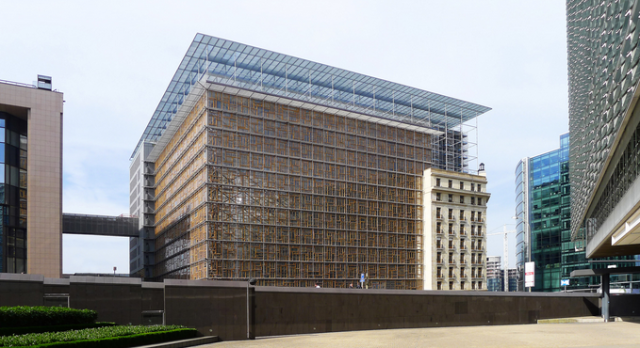
Having said all of this, let’s reiterate what has not been said: As architecture the building is ghastly, like almost all modernism. Like all such buildings, to imagine a classical or other traditional building in its place is to imagine an improvement in its civic beauty. However delicate it may be, the new E.U. headquarters still crushes the spirit of passersby, hazards the future potential for beauty on the rest of the boulevard, and is unsustainable. For that matter, it is not a building anyway but a sculpture, a big sculpture pretending to be a building. And if the next photo offers any evidence, there are times (such as daytime) when its elegance doesn’t really come up to snuff. Yawn!

Screen Shot 2016-12-28 at 3.31.59 PM.png

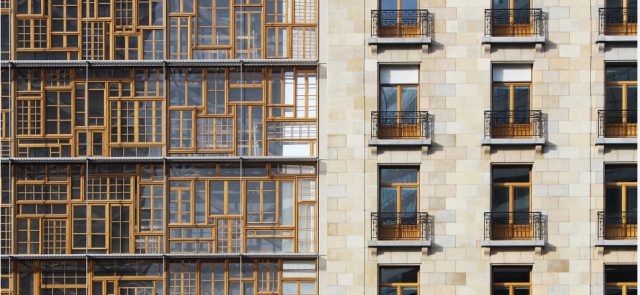
The box containing the lantern is interesting, regardless of the last picture. The picture below, contrasting the surface of the old building with the surface of the glass box in which the spherical “lantern” sits, or hangs, or whatever, is described below the photo by Alyn Griffiths, author of the Dezeen article, along with an architects’ statement.

Screen Shot 2016-12-28 at 4.38.18 PM.png

The transparent walls that wrap around the new northeast corner of the building comprise a patchwork of 3,750 recycled wooden window frames procured from renovation or demolition sites across Europe.

“This new facade will be both a practical and philosophical statement about the re-use of these traditional construction elements, expressing the European diversity of cultures,” said the architects.

Haw! Haw! That statement of the architects – how typical. Still, even I must admit that the patchwork of recycled windows is interesting and, if you get close enough, even elegant. How entirely sad that so few works of modern architecture can strive to merit even the derision in masquerade that is this seemingly glowing review from Architecture Here and There!

Posted in Architecture | Tagged , , , , , , , | 23 Comments

When there’s no there there

Screen Shot 2016-12-27 at 5.52.30 PM.png

Recently completed Gaillard Center, in Charleston, S.C. (DMSA)

The headline on this post is supposed to refer to Gertrude Stein’s famous line about Oakland – “There’s no there there.” The Huffington Post has an essay that tries to show, rather absurdly, that Stein did not mean to denigrate her native town but rather to express a “painful nostalgia.” She returned 45 years after leaving and was unable to find the house she grew up in, surrounded by orchards and farms. It had been turned into a residential development with hundreds of houses. She wrote:

[W]hat was the use of my having come from Oakland it was not natural to have come from there yes write about it if I like or anything if I like but not there, there is no there there.

Did she refer to Oakland itself, which had grown from 35,000 to 300,000 since she had left, or to her homestead? It’s hard to tell. The prose is, shall we say, modernist, which places no high regard on meaning, at least not in the direct sense understood by most readers. It seems to me that she was referring to Oakland – perhaps as seen through the context of her loss of home.

Screen Shot 2016-12-27 at 6.44.34 PM.png

Art on Oakland/Berkeley border. (HP)

In the Huffington essay “Gertrude Stein’s Oakland,” Matt Werner writes that one of the themes of his interviews involved “a notion of disenfranchisement similar to what Stein experienced by returning to a changed city.” The artists that he interviewed had created works of public art intended to generate context for the “no there there” city. One photograph shows a sculpture of the word “THERE” rendered in flat silvery sans-serif letters and propped up near a street that enters the city from Berkeley. … Uh-huh. Okay. Let’s not go there.

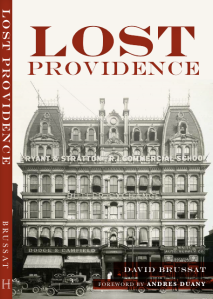
Like many cities, Oakland would be a nicer place with more there there if not for a period of many decades in which mounting assaults upon historical context was the norm in cities. My book Lost Providence, to be published in spring 2017, deals precisely with what happens when a policy of contra context is embraced by city planners. Which brings me to an excellent new essay on the Future Symphony Institute blog, which pursues the same theme from the other direction. But it’s really all about the amount of unnecessarily cogitation that must often be done to design a building that fits into its context, now that that’s considered (by some) to be okay.

Screen Shot 2016-12-27 at 5.56.45 PM.png

The institute’s blog has published “Designing Contextually in a Place Without Context,” by Steve Knight, of David M. Schwarz Architects, a firm that masterfully designs new traditional architecture and is headquartered in the District of Columbia. Knight describes the difficulties facing architects charged with designing buildings in locations that offer few obvious hints about how the building’s context should be interpreted. Fitting into a site whose there is actually there is not necessarily simple. Doing so with no there there is much harder. Knight writes:

Understanding context means more than delving into architectural guidebooks or looking at surveys and photographs of a site. It means that we have to go beyond the immediate boundaries of a building plot and look at the larger influences of a neighborhood, a city, or even the region in which a project is located. And when all of that study doesn’t reveal a particular feel or vibe, it likely means we haven’t dug deep enough. We need to look farther and wider to discover the context. This further study often requires talking to people in the community, looking into the history and tradition of the particular building type we find ourselves designing, studying users’ behavior, and asking users about their motivations, desires, and expectations. Above all, determining context requires a level of deference and curiosity.

Very true. Essentially, however, Knight is saying that without more obvious cues as to context, architects must reach out for secondary and tertiary sources of meaning – sources less likely to be clear. Steven Semes, in his pathbreaking 2009 book The Future of the Past, argues that sometimes when there is no context – or when the context is so evidently inimical to civic character – an architect must simply decide to ignore context and build something lovable that will begin the process of rolling back the existing (usually modernist) context. In fact, what this means is that the architect has been able to bring an unusually keen eye to the meaning of context.

Screen Shot 2016-12-27 at 6.08.56 PM.png

Knight’s essay eventually gets around to describing the thought process involved in fitting into Charleston, S.C. His firm designed the Gaillard Center, technically an addition to an existing 1960s municipal auditorium. (I believe the very large boxy building seen over the left shoulder of the new Gaillard in the top photo is the same building at the left of the photo of the original center.) Knight believes the problem is that the building (especially after it is to be enlarged) is too big for its context. That might be so if the project were to be a McMansion, but it is a civic building. As Léon Krier so elegantly describes in the drawing to the left, great cities are composed of lots of little background buildings and a few much larger institutional buildings. Knight did not need to have qualms about its size. His qualms were probably generated by blowback from local modernists and others pulling out their hair at the increasing strength of new traditional architecture in Charleston. Still, the strategy Knight chose to respond to this “design challenge” turned an eyesore alien to the city into a place of beauty fully integrated into the city’s historical character. Good for him! He takes an entirely sensible lesson from his experience:

What to do when that larger context either doesn’t exist or isn’t well-defined? Look harder. And, when you look harder and the aspirations and ephemeral context appear to be different from the physical context that is there, you may just have to build it yourself.

To me, “you may just have to build it yourself” reflects the bold attitude of Steven Semes toward context – or lack thereof. It is the attitude expressed by modernists toward context for almost a century, an impoverished attitude being transformed by new traditional architecture into one that reflects the idea that cities and civitas are both necessary to orchestrate urban creativity.

Or, to apply the motto of the Future Symphony Institute: “Orchestrate a Renaissance.”

Posted in Architecture, Urbanism and planning | Tagged , , , , , , , , , | Leave a comment

The good cheer of beauty

Screen Shot 2016-12-26 at 3.18.45 PM.png

Along the Rhine. (UNESCO World Heritage Collection)

Vanity Fair, by William Makepeace Thackeray, was published as a serial novel of 20 monthly parts in issues of Punch magazine from January 1847 to July 1848. So next month will be the 170th anniversary of its appearance in print. It was printed as a book in 1848 with the subtitle “A Novel without a Hero.” Thackeray did not depict much architectural beauty in the novel, except for the mansions of its several generally unheroic families, described in states of greater or lesser dilapidation, depending on how life treats the mansions (or the families) over the decade and a half or so of the novel’s plot line. Becky Sharp is the novel’s most memorable character but the actual heroine is Amelia Sedley (very much, ahem, like my wife Victoria). Toward the novel’s end, she, her lazy, vain brother Jos, her son Georgy and their friend Major Dobbin are vacationing on the Rhine, in the duchy of “Pumpernickel,” where the joy of beauty in landscape and music is described by Thackeray:

Mr Jos did not much engage in the afternoon excursions of his fellow-travellers. He slept a good deal after dinner, or basked in the arbours of the pleasant inn-gardens. Pleasant Rhine gardens! Fair scenes of peace and sunshine – noble purple mountains, whose crests are reflected in the magnificent stream – who has ever seen you, that has not had a grateful memory of those scenes of friendly repose and beauty? To lay down the pen, and even to think of that beautiful Rhineland makes one happy. At this time of summer evening, the cows are trooping down from the hills, lowing, and with their bells tinkling, to the old town, with its old moats, and grates, and spires, and chestnut-trees, with long blue shadows stretching over the grass; the sky and the river below flame in crimson and gold; and the moon is already out, looking pale towards the sunset. The sun sinks behind the great castle-crested mountains, the night falls suddenly, the river grows darker and darker, lights quiver in it from the windows in the old ramparts, and twinkle peacefully in the villages under the hills on the opposite shore.

My brother Tony and I once took a train ride along the Rhine just under those mountain crests and the villages seemed to creep up the walls of the valley like vines. For mile after mile along the Rhine the beauty was breathtaking. And then, toward the end, we saw down below in a village square a BP gas station with its apparently mandated big flat harsh green roof. It was the only out-of-character thing that we saw. That was in, I think, something like 2003. I wonder what it is like today.

Here is a passage about Mozart and his music’s effect on Amelia, and on those watching her at a performance, in Pumpernickel, of the opera:

Here it was that Emmy found her delight, and was introduced for the first time to the wonders of Mozart and Cimarosa. The Major’s musical taste has been before alluded to, and his performances on the flute commended. But perhaps the chief pleasure he had in these operas was in watching Emmy’s rapture while listening to them. A new world of love and beauty broke upon her when she was introduced to those divine compositions: this lady had the keenest and finest sensibility, and how could she be indifferent when she heard Mozart? The tender parts of ‘Don Juan’ awakened in her raptures so exquisite that she would ask herself when she went to say her prayers of a night, whether it was not wicked to feel so much delight as that with which ‘Vedrai Carino’ and ‘Batti Btti’ filled her gentle little bosom? But the Major, whom she consulted upon this head, as her theological adviser (and who himself had a pious and reverent soul), said that, for his part, every beauty of art or nature made him thankful as well as happy; and that the pleasure to be had in listening to fine music, as in looking at the stars in the sky, or at a beautiful landscape or picture, was a benefit for which we might thank Heaven as sincerely as for any other worldly blessing. …

During the astonishing Chorus of the Prisoners, over which the delightful voice of the actress rose and soared in the most ravishing harmony, the English lady’s face wore such an expression of wonder and delight that it struck even little Fipps, the blasé attaché, who drawled out as he fixed his glass upon her, ‘Gayd, it really does one good to see a woman caypable of that stayte of excaytement.’

Posted in Architecture, Books and Culture | Tagged , , , , , , , , | Leave a comment

Dull (not!) parody of Dwell

Screen Shot 2016-12-23 at 5.36.25 PM.png

Michael Mehaffy, the urbanist creator of the Sustasis Foundation, in Portland, Ore., has sent a divine parody of a Dwell magazine cover to his friends on the TradArch list. I offer it to my own friends and readers for (fill in your preferred holiday), although in fact Dec. 23 is two days early. Oh, and the other holidays too. Enjoy it anyway! Hang it on your tree.

By the way, a delightful romp via satire through the Dwell sensibility can also be enjoyed at Unhappy Hipsters. I’ve enjoyed this site many a time. See below. Now it’s your turn.

Screen Shot 2016-12-23 at 5.47.11 PM.png

Explaining the creepy neighbor had become a rite of passage. (Dwell)

Posted in Architecture, Humor | Tagged , , , , , | Leave a comment

Carpionato rides again!?

Screen Shot 2016-12-22 at 5.31.48 PM.png

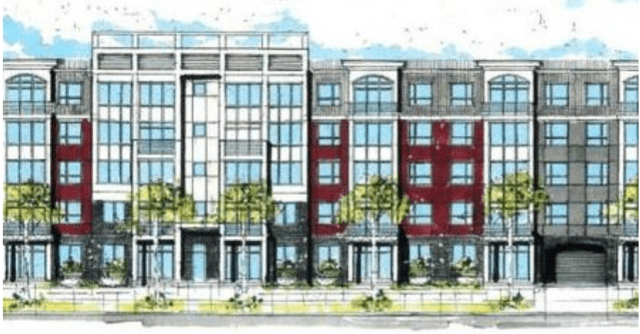
Facade segment of Harris Avenue proposal has Parisian feel. (Carpionato Group)

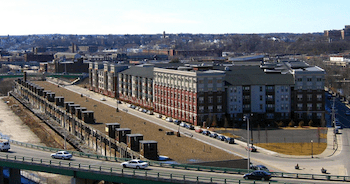
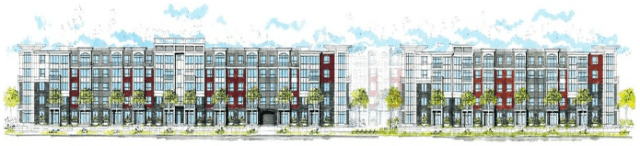
The proposed apartment complex on Harris Avenue behind Providence Place, near the 903 apartments, looks enchanting. Of course, the devil is in the details, and one fears the design will not even live up to the drawings above and below, such as they are. But if it does, or better yet surpasses them, then a Parisian sensibility almost Haussmannesque in its glory could emerge in the Promenade District. Baron Haussmann elegantly reconfigured Paris in the mid-19th century, providing the boulevards by which it is so well known. The former industrial powerhouse of a quarter through which the Woonasquatucket River runs has an abundance of fine mill architecture that stretches impressively, despite not a few demolitions, from Providence Place to Olneyville. This new proposal should strive to live up to its setting.

The Journal’s story on the project is “Luxury apartments in Providence clear first hurdle with city,” by Gregory Smith (glad to see they’ve put one of the newsroom’s best reporters back on the city beat). The story says nothing of the building’s aesthetic intentions, but it would only be five stories. Alas, in Providence, height seems to be the single factor that most people consider of interest in a proposed building. Sad. And in such a place as Providence …

[Joe] Pierik, a senior vice president for the development company Carpionato Group, enthusiastically described his company’s proposed construction of a 459-unit luxury apartment complex on Harris Avenue just west of Providence Place shopping mall.

The weedy, vacant 6.06-acre site, bisected by a Route 95 southbound exit ramp to the mall, has, he said, “great walkability and connectivity” to a train station, buses, highways and downtown. “Two hundred and fifty thousand cars a day go zooming past this site” on Routes 95, 6 and 10, he pointed out.

The 903’s traditional appeal is skin deep, but not bad considering the usual alternatives in Providence nowadays. A better building of the same sort nearby, across the street, will make the architecture of the 903 look better. The new will rub off on the old. A transference of good looks to less good happens, raising the aesthetic of the entire constellation of buildings. The delightful old mills across the Woonasquatucket, the Foundry, will contribute to this effect, as will the mall across Route 95, believe it or not.

Screen Shot 2016-12-22 at 5.47.36 PM.png

903, right, and produce terminal, left, prior to its demolition. (Greater City Providence)

The high number of proposed units for this complex in the Promenade District is titillating, and all the more so in light of the Fane development of up to three towers (two taller than the Industrial Trust) recently proposed for the 195 land. Is there a market? I got a call just a couple hours ago from Providence development maven Lee Juskalian, now living in California. He was excited, and said that given the new proposals piling up in and near downtown, including maybe 1,000 new jobs at high salaries, the market for housing might be plausible. Maybe he’s right. Of course, if more of the developments he cites were designed to boost rather than to undermine the historical character of Providence, as all too many are now, a further revitalization of Rhode Island’s capital city would be much more likely. Differentiation from competition is vital.

The Harris Avenue proposal comes from the Carpionato Group, of Johnston, which has developed the Chapel View mixed-use center next to Garden City on the state’s old reform school in Cranston, incorporating some of the latter’s stone architecture. A marvelously delicious restaurant does business in the old chapel, named the Chapel Grille. Carpionato also has a development history in Providence. Lovely proposals, with superb drawings that cause, at least in some, palpitations of the architectural heart. But we have been here before.

Carpionato proposed to replace on this same Harris Avenue site the old produce terminal that was demolished about a decade ago. A mixed-use commercial development intended to build on the strength of Providence Place. Nothing happened. Around the same time, it proposed a hotel on Parcel 12, the triangular land next to Kennedy Plaza. The Capital Center Commission’s design committee turned thumbs down because the proposal was traditional. Instead of striking back, Carpionato slunk off into the sunset. Carpionato was first to propose a mixed-use development on the east side of the 195 corridor. The design was adorable. The 195 commission shunted the project aside because another developer had a small proposal for part of the same land. Return with a new plan, said the commissioners to Carpionato. So why has its excellent proposal not been reconfigured to exclude that parcel and sent to the 195 commission again? Good question. … Greg?

So Carpionato gives good plan but seems weak on follow-through. Let’s hope for better results this time around.

Screen Shot 2016-12-22 at 5.06.27 PM.png

Screen Shot 2016-12-22 at 5.06.03 PM.png

Architect’s rendering of two sides of proposal. (Carpionato Group)

Posted in Providence, Uncategorized | Tagged , , , , , , , , | 11 Comments

Deconstructing Villa Savoye

Screen Shot 2016-12-20 at 9.58.49 AM.png

Google Earth lookdown at site of the Villa Savoye, at center. (Misfits’ Architecture)

Screen Shot 2016-12-20 at 10.11.27 AM.png

Villa Savoye, in France. (Archikey.com)

In the center of the photo above is the Villa Savoye, possibly the most famous work of Le Corbusier, the most influential of modern architecture’s founders. He inspired so much of the poor quality and deadening allure of the built environment in the world today. “The Darker Side of the Villa Savoye” is from the really marvelous blog Misfits’ Architecture, superintended by Graham McKay. I am not absolutely certain that the post is by him. It merely compiles the flaws of the building according to letters of complaint from the client (the Savoye family) to the architect, Monsieur Le Corbusier. In sum, it rained a lot inside the house. So instead of calling it a “machine for living in,” we should call it a “machine for swimming in.” Make sure you read the comments. They are hilarious.

Posted in Architecture | Tagged , , , , , | 1 Comment

‘Miestake’ at Charnel-House

Screen Shot 2016-12-19 at 11.44.47 AM.png

Mies van der Rohe (right) and Le Corbusier.

For someone who writes about Marxism, Ross Wolfe, author of the blog “The Charnel-House,” appears to be quite unusually frank in his discourse on modernism. Modernists are compelled by the obvious fallacy of modern architecture to confuse issues but often descend into pure lying and rank disinformation. Wolfe, on the other hand, while predictably laudatory of people and events to which he has devoted himself (in spite of their having hurt the world and so many of its populations), seems to have the confidence to look contrarian viewpoints directly in the eye. A good example comes from his recent post about founding modernist Ludwig Mies van der Rohe. Set alongside photos whose second shot shows Mies seemingly at odds with fellow founding modernist Le Corbusier, Wolfe’s interesting essay includes the following passage:

Mies’ choice to stay in Ger­many, and in­deed col­lab­or­ate with the fas­cist au­thor­it­ies, has been chron­icled at length by Elaine Hoch­man in her 1989 study Ar­chi­tects of For­tune. Co­hen dis­misses this book as a bit of journ­al­ist­ic sen­sa­tion­al­ism, but its charges are worth tak­ing ser­i­ously. Sibyl Mo­holy-Nagy, for her part, nev­er for­gave him for this. “When [Mies] ac­cep­ted the com­mis­sion for the Reichs­bank in Ju­ly 1933, after the com­ing to power of Hitler, he was a trait­or to all of us and to everything we had fought for,” she wrote.

Of course there is a little bit of the disingenuous in that passage. What Hochman deplores in her book isn’t so much Mies’s accepting the job to build the German state bank but his effort to have modern architecture and design enshrined as the default aesthetic of the Third Reich. While Hitler rejected modern architecture (accepting it only for factories and other such utilitarian structures), he did so mainly because he accepted classicism as the longstanding style in which nationality had been elucidated architecturally for centuries. Why replace something that has worked with something still basically experimental, Hitler may well have asked himself. It says a lot more about modern architecture than about Mies that he thought Hitler might buy into modernism as genuinely symbolic of Nazism. Totalitarianism, after all, views populations as tools for manipulation and people as cogs in the machine of society – a machine, in the case of Nazi Germany, for conquest.

Today, the equation of modernism and fascism should give us pause in our easy, thoughtless acceptance of modernism as America’s default aesthetic.

In a passage from the writing of critic Moholoy-Nagy, wife of another major Bauhaus figure who emigrated to America, László Moholy-Nagy, Wolfe brings up Mies’s role in modernism’s founding error. She writes:

Yet he was the only one of the di­a­spora ar­chi­tects cap­able of start­ing a new life as a cre­at­ive de­sign­er fol­low­ing World War II, be­cause to him tech­no­logy was not a ro­mantic catch­word, as it had been for the Bauhaus pro­gram, but a work­able tool and an in­es­cap­able truth.

Technology is a indeed a truth, but it need not be a style. Modernism’s error was to assume that a machine age required a machine architecture. That was a great mistake, for it boxed modernism into a design conceit that did dirt to cities worldwide. In the final line of his essay, Wolfe suggests the sadness of this mistake by Mies and his fellow modernist architects.

Really, it is a shame that Mies’ sig­na­ture style has lent it­self so eas­ily to im­it­a­tion, be­cause the fea­tures which seem rep­lic­able con­ceal the subtler secret of their pro­por­tions.

Proportions are usually attributed to classicism, but even they are not why classicism is humane. The Mieslings who reproduced the glass box up and down Park Avenue and around the world were the inevitable upshot of modernism’s founding error. Modernism is easily replicable because, as a design motif, its machine aesthetic is inherently simplistic. Classicism is replicable because it has rules. That classicism nevertheless conceives itself as art rather than as technology is key to its natural humanism. Modernism’s minimal connection to humanity is what makes it so hurtful.

Posted in Architecture | Tagged , , , , , , | 3 Comments

Holy crystal meth, Batman!

Screen Shot 2016-12-18 at 10.21.46 AM.png

Unfinished pyramidal hotel and other projects in Pyongyang. (Dezeen)

News out of Pyongyang via Dezeen reports that its construction boom is fueled by crystal meth. A drug that jacks up levels of energy, alertness and self-esteem might well be usefully fed to workers undertaking delicate work with rivets while balancing on girders high above the ground. Way to speed the rise of skyscrapers! But I wonder why it has not worked so well on the city’s iconic Ryugyong Hotel? It has reached 105 stories (insists the regime) but its construction has bogged down, not yet having reached completion.

Downer!

Without necessarily alluding to the brutal speed of modern architecture’s invasion of that field’s establishment in the 1930s and ’40s, I note a new book, Blitzed: Drugs in Nazi Germany, by Norman Ohler. It goes well beyond the old news that Hitler abused drugs. The German chancellor had soldiers and workers blitzed on methamphetamine. This may explain the ability of the Wehrmacht to freak out the French army in 1940. Ohler’s research

unearthed new details about how soldiers of the Wehrmacht were regularly supplied with methamphetamine of a quality that would give Walter White, of “Breaking Bad,” pangs of envy. Millions of doses, packaged as pills, were gobbled up in battles throughout the war, part of an officially sanctioned factory-to-front campaign against fatigue. As surely as hangover follows high, this pharma- cological stratagem worked for a while — it was crucial to the turbocharged 1940 invasion and defeat of France — and then did not, most notably when the Nazis were mired in the Soviet Union.

All this is interesting. Totalitarian regimes have ways of making you ingest stuff your mama would not allow. Workers in Pyongyang scraping the sky on crystal meth may be one thing, but stormtroopers on high are something else. Still, reading these news items I could not help but wonder whether modern architecture is a form of drug abuse. Perhaps the wacky modernist buildings that poke us in the eye as they arise on our city skylines may be attributed to their architects’ ingestion of LSD or other mind-altering psychelelics. I have no evidence of this beyond the appearance of the buildings themselves. I just put it out as a topic for potential exploration by researchers in the groves of architectural history and practice.

Screen Shot 2016-12-18 at 1.14.04 PM.png

Poster by Rem Koolhaas of world’s iconic skyscrapers. (rialnodesigns.com)

Posted in Architecture | Tagged , , , , , , , , | 4 Comments