Best skyscrapers 2016: Yawn

Screen Shot 2016-12-18 at 10.06.47 AM.png

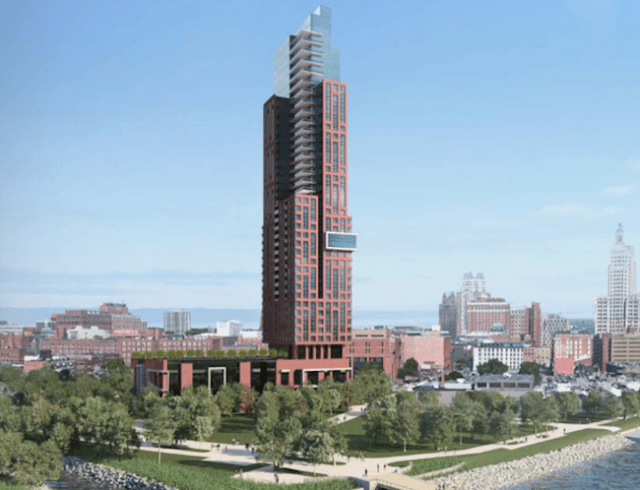
Yes, this is New York, which gets ridiculouser and ridiculouser. (Dezeen)

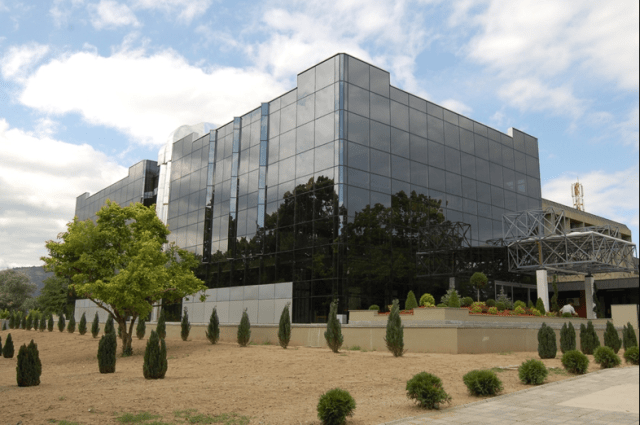
No surprise here, but Dezeen has published a list of the ten best skyscrapers of 2016. I’ve chosen to spotlight the pyramidal monstrosity in New York City by Bjarke Ingels, the Danish architect and founder of the firm BIG. The buildling stands out because it stands out. The others are delightful in a masochistic way. I assume all of these are actually finished. “Enjoy.”

Posted in Architecture | Tagged , , , , | 1 Comment

“Lost Prov” on the march

Screen Shot 2016-12-16 at 4.39.49 PM.png

Bird’s-eye view of Providence in 1894. Note that at right Union Depot survives while its replacement, Union Station, is built. (Digital copy of archival photo courtesy of John Resseger)

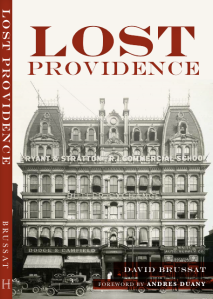
To update readers on my upcoming book Lost Providence, I finished writing it at the beginning of November, a month after I delivered its 99 illustrations to the publisher, which is The History Press, headquartered in Charleston, S.C. My editor there is Banks Smither, who took over from Edward Mack, who had conceived the project, superintended its initiation and my early writing. Banks helped me get through the complexities of the image acquisition and permission phase, and is now roughing out a schedule for publication, which could happen as early as May. His associate, Rick Delaney, performed a light initial copyedit, implementing the mandates of the Chicago Manual of Style and deftly suggesting improvements in the flow of my prose. Under his able guidance I was able to untangle some of my more circuitous sentences. Plus I was able to make some corrections and add passages to address people or events that I’d neglected to include in the first draft. I sent that back to him in early December. He and Banks will soon be sending actual page proofs, with text and illustrations as they will appear in the final book, along with the index and a forward by Andrés Duany. I will do a final read when I get the proofs but will only be able to make such minor changes as will not cause any disruption of the page layout.

Banks has had me select possible images for the front cover, plus a slate of images from the book that will be made into booklets of postcards. Soon we will be starting to market the book. I will be doing readings, book signings and lectures as part of a publicity campaign to be directed from Charleston.

Lost Providence is a history of architectural change in one city, taking in almost four centuries but focusing on the last two, and especially the projects that have shaped Providence (or not) since World War II. It originated with a column I wrote in 2014 called “Providence’s 10 best lost buildings,” but goes beyond that to examine what I have called “lost projects.” The book ends happily with an account of projects that have rejuvenated the capital of the nation’s smallest but most obstreperous state.

One friend and expert in the subject who has already read the book is Mark Motte, who with Fran Leazes wrote the the most comprehensive and erudite history of Providence’s revival over the past several decades. Providence: The Renaissance City is a remarkable book. Mark’s assessment of my own book is also remarkable, and he has permitted me to quote some of it below:

This is a marvelous book. It complements previous work (including your own), yet manages to be original and to cover much new ground.

I am delighted by the carefully delimited scope (to which you adhere consistently throughout, never straying far from your design-centered theme); the richness of your research and originality of the case studies and anecdotes that buttress your narrative; the rigor of and consistency in your use of solid evidence; the corrections you politely make to distorted past renderings of elements of the renaissance story; and, in particular, how you manage to rein yourself in at just the right moments, halting just ahead of the precipice of unsupported assertion and grand-standing. …

The book somehow manages to teach without condescending; to persuade without preaching; and to amuse without ever appearing frivolous. It will be of interest to both the scholar-urbanist and the lay reader (by which I mean a person with absolutely no background in architecture, urban design or the history of the American city). Your work invites all comers by weaving a tale of honest intrigue: of visionary design steps taken and of opportunities sadly (and perhaps forever) missed.

Most importantly to me, your book will stir anew the traditionalist versus modernist debate in architecture and urban design. You muster the arguments made by all the right players in the traditionalist canon, and boy do you blast their cannons without mercy?!  (Sorry for punning, but it seemed suddenly called for.)

Of course I was immensely gratified by Mark’s kind words. This project is naturally very exciting to me. It will be my first book. Having to write 40,000 words due several months in the future is a scary proposition for someone accustomed to writing 800 words due by tomorrow. Forty thousand words is about 50 of my old Providence Journal columns in a third of the time. I am glad the end is in sight, and I hope readers of this blog will enjoy reading the book as much as I enjoyed writing it.

Posted in Architecture, Books and Culture, Providence | Tagged , , , , , , | 8 Comments

A more Nordic Scandinavia?

Screen Shot 2016-12-15 at 12.53.39 PM.png

Bjarke Ingels, of BIG, stands next to a machine for diluting identity. (Dezeen)

The five nations of Scandinavia want to “build a new brand identity for the five countries that make up the Nordic region.” This is nuts. This is stupid. I am a quarter Norwegian so I can say this. I have been reading articles about bad ideas for years, mostly in the realm of architecture (where bad ideas are almost mandatory) and this is the most idiotic that I have read so far.

Scandinavia does not need a new identity.

And as if to demonstrate the region’s fecklessness, it is putting part of the project into the hands of a screwy modernist architecture firm called BIG.

BIG to rebrand Nordic region,” by Eleanor Gibson in Dezeen, is difficult to believe. BIG, a design firm founded by Denmark’s Bjarke Ingels (“Bjarking Mad Ingels” in the opinion of some), is part of a plot to scam Scandinavia. BIG and several other firms are conspiring to persuade the leaders of the five nations – Denmark, Norway, Sweden, Finland and Iceland – that in order to thrive they need “a new collective identity.” Gibson writes that “the Branding and Positioning of the Nordic Region initiative intends to differentiate the region from the rest of the world and leverage its potential.”

This is ridiculous. Patently absurd. Scandinavia has perhaps the most cohesive identity of any region in the world. Healthy social democracies with a strong sense of design; a region of personal warmth enforced by a climate of cold. It is a strong identity because it has continued basically unchanged for centuries. BIG will not sharpen but blunt the image of Scandinavia around the world – if it has any impact at all, which is the most likely result. Except that a gang of pranksters will have defrauded the good taxpayers of the five nations.

Just look at the photo accompanying the Dezeen article. It shows Bjarke Ingels standing in front of his Serpentine Pavilion, in Hyde Park, which eclipses a lovely historic structure. Perfect! Modern architecture, for decades known fatuously as the International Style, is the best way to dilute the identity of any place where it is allowed. Unfortunately, it is allowed everywhere. No wonder a lot of folks complain that cities they love look increasingly like anyplace in the world – and hence no place at all. Way to strengthen the beloved national character!

The elected leaders who infest Copenhagen, Oslo, Stockholm, Helsinki and Reykjavik should hang their heads in shame.

Rhode Island recently went through a similar exercise, spending time and money to rebrand a place with an identity that is already strong. It even featured a video that expressed pride at the cool places in Rhode Island. Except that one of the places in the video (actually the only shot of modern architecture) was in Iceland. This led to the state’s new  accidental brand: “New Iceland.” That was only one of many stupid errors and idiotic concepts in the scheme. The rebranding was scuttled, mostly, but not before a lot of time and money was flushed down the drain. Consultants are working on a new rebranding scheme for Rhode Island, certain to be just as ridiculous.

One of the purposes of government is to find new ways to waste taxpayer dollars. Places with strong identities, such as Scandanavia and Rhode Island, can be thankful when money is all that is lost. Weaker places may find that “rebranding” also costs them what identity they have. And yet this kind of thing is becoming more popular in capitals around the globe. Go figure.

Posted in Art and design | Tagged , , , , , , , | 3 Comments

The Trumpster’s Roark

Screen Shot 2016-12-14 at 1.43.21 PM.png

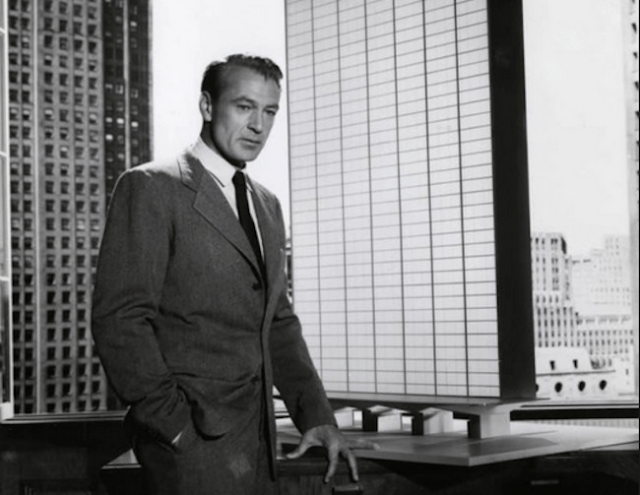
Gary Cooper as Howard Roark in “The Fountainhead” (Metropolis)

It seems that Donald Trump and a host of his cabinet nominees are fans of the late Ayn Rand. Her philosophy of “objectivism” exalted the individual over the group. Her two best-selling novels are Atlas Shrugged and The Fountainhead. The first is a paean to innovative business tycoons who must surmount government obstacles to succeed. The second, which was made into a film starring Gary Cooper in the role of Howard Roark, is about a modern architect who bucks his profession’s establishment.

Both books are fascinating reads, veritable page-turners except for their occasional tedious descent into “objectivist” philosophizing, which can last for page after page and has surely caused many readers to bail.

I have little to say about Atlas Shrugged. Maybe government should get out of the way. Ayn Rand was not the first to have that thought! You can be an individualist without also having to hate the government or the people or democracy or religion. These traits make politicians uncomfortable, but you can believe in God and Darwinism at the same time. (Didn’t God create evolution on Day 6?) I’ll let greater minds mull the effect of reading Rand on Trump, his cabinet and their policy agenda.

But Trump’s admiration for Fountainhead protagonist Howard Roark does worry me. The Providence Journal ran a story, “Influence of Rand permeates Trump’s circle,” by James Hohmann in the Washington Post. He writes:

The president-elect said this spring that he’s a fan of Rand and identifies with Howard Roark, the main character in “The Fountainhead.” Roark, played by Gary Cooper in the film adaptation, is an architect who dynamites a housing project he designed because the builders did not precisely follow his blueprints. “It relates to business, beauty, life and inner emotions. That book relates to … everything,” Trump told Kirsten Powers for a piece in USA Today.

The Fountainhead was published in 1943, and would have been conceived and written before modern architecture became the default style of the field’s establishment. Supposedly based on Frank Lloyd Wright, Roark is portrayed by Rand as the independent man against the architectural establishment, ramming his skyscrapers up the wazoo of the tightly sphinctered Peter Keating, the novel’s prototypical establishmentarian traditionalist. Through Roark, modern styles of design are seen as bold, independent and innovative, charting the field’s progress into the future. As a literary hero, the fictional Roark is responsible for the decision of many young people in the postwar era to enter the field of architecture, hoping to heave dead cats onto the porches of authority (channeling Mencken).

Today, however, modern architecture is the establishment and has been since not long after the book was published. In almost every relevant way, modern architecture reflects the worst habits of entrenched power. It betrays all the flaws of cronyism, authoritarianism, bureaucratic stultification, delusions of grandeur and omniscience, massive and systemic incompetence, abhorrence of self-examination, and the suppression of those who disagree – all of the things that Rand criticizes about government in Atlas Shrugged.

Lance Hosey painted the picture eloquently in “The Fountainhead: Everything that’s Wrong with Architecture” for ArchDaily in 2013 (a very rare instance of self-criticism in an establishment architectural journal).

I realize that Trump Tower is water under the bridge, but if the Trump administration really wants to make America great again, its leader should understand that if The Fountainhead were written today, Howard Roark would be a classical architect. Trump should bear that in mind. Flipping the bird at the hated establishment means, among many things, promoting architecture that the actual people will love. Those who voted for him would expect no less.


Posted in Architecture, Video | Tagged , , , , , , , | 3 Comments

Music and architecture, cont.

Screen Shot 2016-12-13 at 6.40.17 PM.png

In October, Roger Scruton visited the belly of the musical beast, in Germany, to deliver a lecture against atonal composition. It was as if  the superhero of classical architecture, Henry Hope Reed, arose from his grave to address the celebrants at the Pritzker Prize awards ceremony. I’m sure Scruton must wonder whether his audience – at the Donaueschingen Festival, the most prestigious celebration of contemporary music, founded in 1921 – was suitably chastened.

The Music of the Future” is a long essay but of interest to those with architectural concerns. Many aspects of the shift of classical music toward its 20th century atonal flim-flammery resemble the movement, over the same period, of architecture from its emphasis on new methods to bring greater virtuosity to the creation of beauty in building to an emphasis, instead, on novelty, innovation, the avant-garde and the Zeitgeist. Thinking about the history of building as one reads Scruton’s thoughts on music generates a deeper understanding of architecture and its curious history. Here is one among many very interesting passages:

Thomas Mann wrote a great novel about this, Doktor Faustus, meditating on the fate of Germany in the last century. Mann takes the tradition of tonal music as both a significant part of our civilisation, and a symbol of its ultimate meaning. Music is the Faustian art par excellence, the defiant assertion of the human voice in a cosmos of unknowable silence. Mann therefore connects the death of the old musical language with the death of European civilisation. And he re-imagines the invention of twelve-tone serialism as a kind of demonic response to the ensuing sense of loss. Music is to be annihilated, re-made as the negation of itself. The composer Adrian Leverkühn, in the grip of demonic possession, sets out to “take back the Ninth Symphony.” Such is the task that Mann proposes to his devil-possessed composer, and one can be forgiven for thinking that there are composers around today who have made this task their own.

The last line causes me to happily recall that I have posted an interview with musicologist Robert Reilly on the revival of classical music, “Modern music in recovery,” in which Reilly talks about the flourishing, now, of composers who are not devil-possessed.

Melody, harmony and rhythm are as essential to beautiful music as they are to beautiful architecture. And although their absence does not necessarily kill interest, it certainly does kill pleasure. To enjoy the parallels between music and architecture, read the entire essay by Scruton, whose The Classical Vernacular: Architectural Principles in an Age of Nihilism is one of my bibles. He is a founding member of the Future Symphony Institute,  where I found his lecture on modernist composition, and whose motto is “Orchestrate a Renaissance.” (The Reilly interview also was reprinted on its website.)

Here is another passage. What is called serial music is contemporary music that is not exactly atonal but has musical phraseology arranged according to mathematical rather than the traditional musical terms of harmony, melody and rhythm. In short, serial music has not gone quite as far in abandoning music’s classical traditions.  The concluding metaphor is perfect. By the way, I think it is fair to say that, as far as musical tradition is concerned, most popular musical types, even jazz, are much more tonal than atonal, which is why people can hum them from memory.

The result of this is that, while we can enjoy and be moved by serial compositions, this is largely because we hear them as organised as tonal music is organized, so that “next” sounds “right.” We may notice the serial structure; but it is the progressive, linear structure that we enjoy. In a great serial composition, such as the Berg Violin Concerto, we hear harmonies, melodies, sequences, and rhythmical regularities, just as in the great works of the tonal tradition, and we do so because we are hearing against the serial order. It is as though the composer, having bound himself in chains, is able nevertheless to dance in them, like a captive bear.

Posted in Architecture, Art and design | Tagged , , , , , , , | 2 Comments

Hope Point Tower(s) sliced?

Screen Shot 2016-12-12 at 1.47.32 PM.png

The middling tower, 43 stories, of Hope Point Towers. (Fane)

Tonight at 5 the I-195 Redevelopment District Commission meets. On top of its agenda is a picture of the recently proposed Hope Point Towers project, missing two of its projected three high-rises. But the project itself is not on the public agenda specifically, though it might be discussed behind closed doors in the executive session.

Nothing really has changed, since from the start two of the three towers were aspirational, or maybe I should say proposed to come on line possibly not all at once but in stages. The Fane Organization seems to believe that repositioning or reconceptualizing the project as one tower rather than three will help it brave mounting local opposition.

Personally, I am concerned at the lack of P.R. savvy of a developer who waltzes into town with a huge development proposal and then proceeds to denigrate the dear historical character upon which Providence prides itself. “Cutesy,” indeed. But, hey! Lack of P.R. savvy is not necessarily accompanied by lack of financial or development savvy. After all, Fane is headquartered in New York City’s Rockefeller Center, so who am I to raise my eyebrows?

My opposition would diminish considerably if the tower, or three of them, were relocated to downtown. Even at their proposed heights, intelligent placement of the towers on one or more open parcels now used as parking lots would enable higher population density to spark greater vivacity than putting them in the Jewelry District, where their height (be it 33, 43 and 55 stories or just 43) is not just out of character but illegal. I don’t care whether the status of the Industrial Trust as the city’s tallest tower survives, but if it is to be lapped then let it be lapped usefully. Centralizing density downtown in a manner that adds to our skyline rather than scattering it would be useful.

Is there an objection to downtown? Could it be that it lacks the state and city incentives associated with the 195 land? Well, those incentives have already been extended to Capital Center. Why – if they are such a good idea – should they not be extended also to the downtown?

Oh yes. Can the five-story platform be deep-sixed? Whether in the Jewelry District or downtown, it is a mammoth intrusion on the grid and the (potential) life of the street.

And finally, how about losing the Minion windows?

More to come on this project, no doubt. Details of tonight’s meeting are on the agenda.

Posted in Architecture, Providence | Tagged , , , , , , , | Leave a comment

A visit to East Greenwich

DSCN0126 - Version 2.JPG

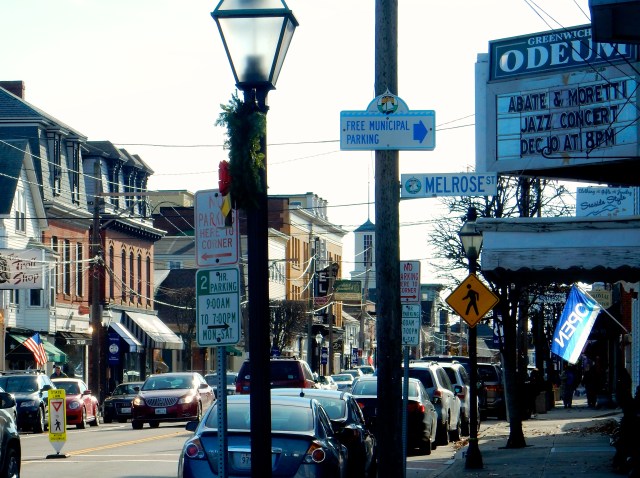
Looking south on Main Street, East Greenwich, R.I. (Photo by David Brussat)

The other day I paid a brief visit to East Greenwich, one of Rhode Island’s most lovely towns. Main Street has long been a charming rendition of civic life, ever a pleasure to drive through or, better yet, stop and grab a bite or snoop for antiques. The buildings are mostly of an unassuming traditional vernacular, but with lots of architectural animation, not to mention here and there very fine buildings such as the courthouse, which used to be one of five rotating state houses, and the Beaux Arts post office, now a restaurant.

Recently, a string of minor improvements has extended the pleasure of this road. You see, if you are driving south on Main, after several blocks you get to a bend in the road near London Street. Historically, after this point, Main Street feels suburban. As soon as you round that bend you want to turn back.

Well, this did not happen on my last visit. I was actually pulled along by the feeling that it was not so bad around that bend anymore. It appeared as if several bland buildings had graced their facades and their sidewalks with more traditional features. There seemed to be a slew of new commercial buildings, some in curious but unequivocally historical styles. Maybe I don’t know East Greenwich well enough to specify this transformation, but it certainly did extend for several blocks the joy of a drive south on Main. And I did turn around and come back, heading north, and it was just as good in reverse. Then I turned back to head south yet again, just to make sure I was not deluding myself. And so far as I could tell, I was still in my right mind.

In various guises, this has happened elsewhere in Rhode Island. Over a decade or so, Barrington erected period lampposts and tweaked its zoning code, encouraging more tradition in the styles of its string of shopping plazas along County Road. Barrington as a result doesn’t seem as Borington as it used to. Even in North Providence, Mineral Spring Avenue has evolved in three decades through several generations of crudscape. Over time, its merchants and big-box stores have embraced more and more traditional elements in their cheesy architecture. Mineral Spring is still a deplorable heap, but it has indisputably become somewhat less unbearable.

Those are just two examples of what may be a good many more, just in Rhode Island. The point is that even minor changes pushing even the most desultory urbanism in the right direction can make a big difference. A lot of the changes, especially on Mineral Spring Avenue, would be greeted by rolling eyeballs from many of my favorite classicists, who consider bad classicism to be a worse enemy than modernism. But the proof that this is not so is probably more evident in stretches of American cityscape and – to again use the fabulous coinage of James Howard Kunstler – the crudscape of suburbia. Little traditional touches of even retrograde quality make a big difference in the charm – or if you must, the “charm” – of a street. Architects must try to remember that architecture is for all of the people, not just the clients, design magazine editors or other architects.

Yes, developers, merchants and others whose buildings decorate our cities and towns (for better or worse) should be encouraged to reach for the highest quality of design they can afford. Nevertheless, small and even dubious movement in the right direction, toward tradition, can make visible and positive differences on our streets, inching them toward the beauty that we all, as taxpayers and as human beings, deserve in our civic realm.

Somebody in the planning offices of East Greenwich seems to have discovered this hidden principle, and all of us, whether we live, work or visit in the town, are the beneficiaries.

Posted in Architecture, Urbanism and planning | Tagged , , , , , , , | 4 Comments

Skopje’s classical ambition

Screen Shot 2016-12-08 at 8.05.33 PM.png

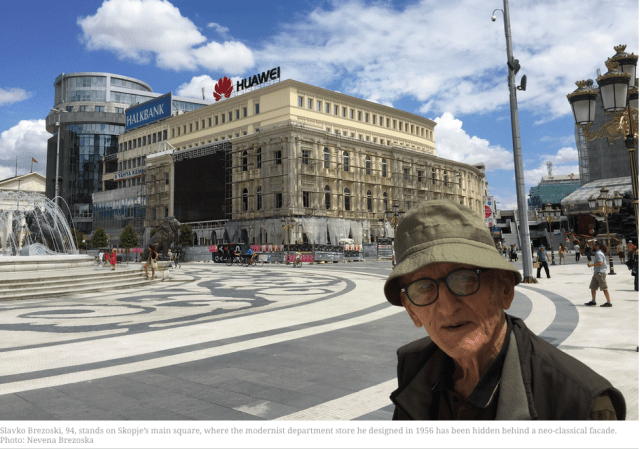
Slavsko Brezovski near department store he designed in 1956. (Nevena Brezoska)

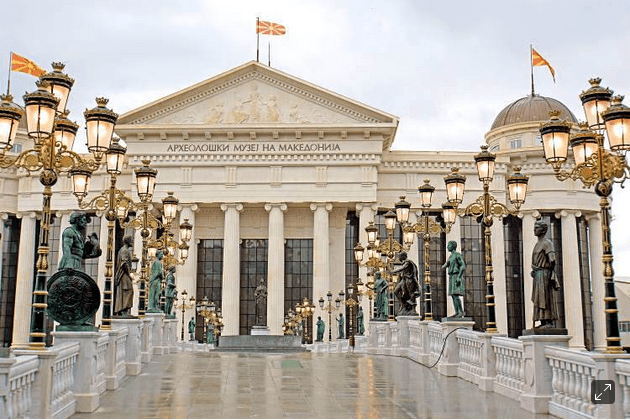
Architectural writers have had a field day criticizing Skopje for its classical makeover. Costly and often sloppy in the embellishment of Macedonia’s capital city, the new buildings feature a lot more enthusiasm than canonical scholarship. But the work is being done at the expense of the city’s modernist experiment following a 1963 quake. Under the post-communist government’s classical revival, façades in some cases literally cover up the Brutalism of the past. A third grader can see that whatever its flaws, the work done under a program known as Skopje 2014, announced in 2010, is more beautiful and engaging than what it displaces. So the modernists are heaving their brickbats with a vengeance.

Reader Russell Jenkins sent me “Architects of Modernist Skopje Decry Retrograde Model,” by Bojan Blazhevski, who wrote it for the Balkan Fellowship for Journalistic Excellence. So for its manifold absurdities I blame the writer, who should know better, more than the poor sods whom he interviewed – mostly aging modernists who worked long ago for the communist government of Yugoslavia and are now watching their life work slide into oblivion. That it is deserved merely makes them crankier.

For example, Blazhevski interviews Slavko Brezoski, the architect pictured in the photo above, one of whose buildings, erected in 1960 before the quake, is now being covered over with a new façade. The journalist writes:

It is one of dozens of buildings hidden or about to be hidden behind neo-classical facades and hollow colonnades in a radical makeover of the city called Skopje 2014, designed to resurrect antiquity and burnish a sense of national identity based on Macedonia’s claim to Alexander the Great. Now 94 years old, it pains Brezoski to see what has become of his work, worse still, he says, because he never gave his consent.

Consent!? When has it ever been the practice of developers or property owners (say, the government) to get consent from an architect to alter or demolish a building? What about the building that was there before Brezoski waltzed onto the Skopje stage? Was its designer, let alone its owner, asked for his “consent”? Hardly likely, with Josip Braz Tito in charge.

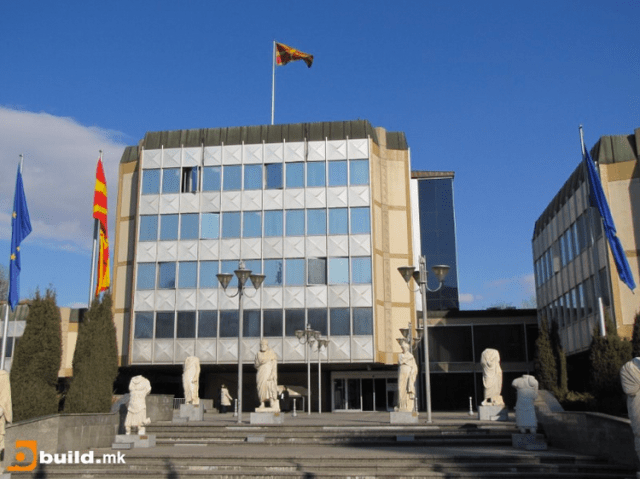
Another building being refaçaded under Skopje 2014 is what amounts to the center of government for the province Macedonia once was as part of Yugoslavia. It was built in 1971. Vladimir Kulic, a co-curator of an exhibit on Yugoslavian modernism scheduled to open at New York’s Museum of Modern Art in 2018, had some tart remarks for Blazhevski about its proposed new classical façades:

It is deeply ironic that a building that articulated a modern Macedonian identity through inspiration from local vernacular architecture was dressed up in a laughably illiterate version of international classicism precisely in an attempt to forge an alleged “Macedonianness.”

I lack the credentials to judge any attempt to reconnect Macedonia with its history. But Yugoslavia’s modernists benefited from modern architecture’s global effort to snuff out classical education and craftsmanship. It ill behooves them now to complain that the new classicism in Skopje is insufficiently canonical. Their hypocrisy beggars the imagination.

It is true that some proportions seem off and the Macedonian classicists don’t seem to realize that column capitals are supposed to stick out a bit from the architraves they uphold. I will not presume here to defend the orthodoxy of these buildings – which for all I know may well represent Macedonian classicism’s attempts at noncanonical experimentation, or some sort of architectural wit. Some classicists among my dear readers will want to slap them down, and argue that “bad trad” is a greater enemy of the classical revival than modern architecture. Yet Macedonia is one of the few nations seeking to undo the architectural atrocities committed against it – it hopes to comprehensively beautify its capital with classical architecture. At least they are trying to do the right thing. I say goodonya.

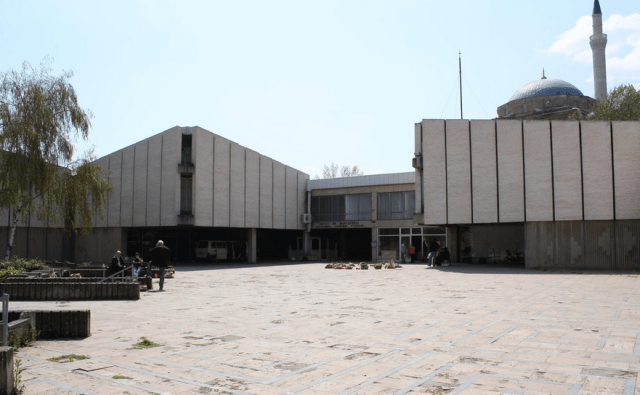
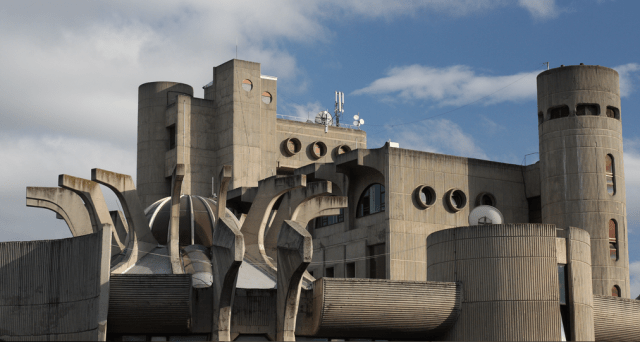
Below is what I assume to be the government building, criticized above, before its facelift, and below that is the same building as it will appear after its facelift. I may be wrong about the first image because the website I grabbed it from, which I believe portrays the design competition entries from which the public made its choice, was in the Macedonian (?) language and I could find no other photo of the government building. That was probably because it would only serve to weaken its own defense. Below that is the new museum of Macedonian archaeology. It is followed by a string of shots of major cultural facilities designed in the architectural styles that the citizens of Skopje are trying to get rid of.

Can you blame them one bit?

Screen Shot 2016-12-08 at 9.19.39 PM.png

Screen Shot 2016-12-08 at 9.19.25 PM.png

Screen Shot 2016-12-08 at 7.29.03 PM.png

Screen Shot 2016-12-08 at 8.44.18 PM.png

Screen Shot 2016-12-08 at 8.48.12 PM.png

Screen Shot 2016-12-08 at 8.45.35 PM.png

Screen Shot 2016-12-08 at 10.20.46 PM.png

I rest my case.

Posted in Architecture | Tagged , , , , , , , , , | 3 Comments

Charleston misunderstood

Screen Shot 2016-12-06 at 2.00.00 PM.png

Proposed office building recently approved in Charleston, S.C. (Board of Architectural Review)

Charleston’s modernist wannabes have placed their dream of more modern architecture in the hands of a blog called “Buildings Are Cool.” It is written in a breezy style by a young architect named Steve Ramos, who in a recent post asks “Why Charleston Lacks Contemporary Architecture.”

Actually, there is too much contemporary architecture in Charleston. It may not all be “true” contemporary architecture, which, according to Ramos, is “unapologetic and reflects the spirit of the time.” Most of it falls into two categories, which Ramos calls “sandwich” and “mullet.” A sandwich is a contemporary building “hidden” amidst “something familiar and tasty.” A mullet is a contemporary building with “a front façade that addresses the street in a familiar traditional way. And then you have a little modern flourish in the back.”

Unfortunately, Ramos is incorrect to assert that so much contemporary architecture in Charleston may be characterized as timid. Much that is not timid was built several decades ago. Perhaps Ramos means so much recent contemporary architecture. Disrupting the beauty of old streets has become more difficult since the city’s recent battle over a proposed contemporary school of architecture for Clemson and recent reforms designed to bring the development process into better alignment with the laws protecting the city’s historical character. In the face of such sensible reforms, Ramos argues that architecture should be disruptive. Thankfully, Charlestonians have developed a shrinking patience for such shenanigans.

Ramos proposes four plausible reasons Charleston supposedly lacks contemporary architecture. All of these reasons equally explain why Charleston should lack contemporary architecture.

  1. “Contemporary Architecture Is Harder to Fit In”
  2. “Contemporary Architecture Is Hard to Evaluate”
  3. “Contemporary Architecture Can Be Scary”
  4. “Contemporary Design Is Too Risky”

All are good reasons to avoid contemporary architecture, and they explain why, if you are a member of the city’s Board of Architectural Review, it is (to Ramos’s regret) “a lot easier just to say no.” He admits that “the people of Charleston love the beautiful historic context in which we live. We are lucky to live in such a special place.” What Ramos and many of his profession do not seem to realize is that people love the city precisely because it has so little contemporary architecture. For that reason, the BAR finds it “a lot easier to say no” for some very good reasons. (See reasons 1-4 above.) I believe that Ramos & Co. do realize why a majority of Charlestonians want to limit contemporary architecture. They just don’t want to admit it.

Ramos makes his case with reference to a proposed office building at 663 King St., designed by Neil Stevenson Architects, that took three trips to the BAR to be approved. Ramos believes this demonstrates all four reasons why contemporary architecture is difficult in Charleston. Reasons 1, 3 and 4 apply in obvious ways. Reason 4, which says that contemporary buildings are “hard to evaluate,” is a bit more elusive. With admirable candor, Ramos admits that he cannot tell which of the three versions shown at three meetings of the BAR is “superior.” Well, neither can I.

Screen Shot 2016-12-06 at 2.08.28 PM.png

Maybe Design #1 is superior because it is more of a “true” contemporary building that better “reflects the spirit of the time.” Why? Because it looks more like it is about to collapse, more accurately reflecting the chaos of our era, with its four stories more discombobulated than #2 and #3. (Architects like Ramos and Stevenson long ago abandoned the idea that their profession should help solve society’s problems and now just strives to “reflect” them.) But is there a rule saying that to be a true contemporary building it must be even more ridiculous than the competition? I don’t think so!

Contemporary architecture is hard to evaluate because there are no reliable standards to guide judgment. Modern architecture is a century old and it still has not developed a language understandable to most people, apparently not even to trained architects like Ramos. Traditional architecture of the kind that makes Charleston lovable has evolved over successive generations of practitioners handing down best practices developed by trial and error over centuries. For half a century, architecture has been the only field of human endeavor whose establishment has embraced a professional philosophy that abjures precedent. There is no way to have a plausible rationale for judging the quality of design where no established standards prevail, and there is no standard language to express its quality or lack thereof. So there is no way to judge the superiority of the three versions of 663 King that is not based on pure unadulterated personal taste.

It’s no wonder that most people prefer traditional buildings over alternatives whose ethos favors innovation over the familiar. Human nature naturally resists instability. So it is depressing that Ramos cannot refrain from looking down his nose at Charlestonians. He writes:

True contemporary architecture has the tendency to be very abstract and sculptural.  It requires a very sophisticated eye to discern the good stuff.  It is definitely going to be a challenge for a volunteer board composed of two architects and three non-architects.

Like almost every other modernist, Ramos deludes himself as to the “sophistication” of his stylistic preference. He and they misunderstand genuine creativity, believing it to be that which achieves design as different as possible from previous designs. In fact, true creativity is the discovery of new methods for achieving greater virtuosity in the conventional production of beauty – a new form of brush stroke in painting, a new form of fingering a bassoon, a new form of turning a corner in a colonnade. Having abolished most of the tools for the making of beauty, modern architects have limited themselves to a palette that forces them to embrace the creative gestures of larger scale, with rapidly diminishing returns that lead to more and more ridiculous design conceits, inevitably emphasizing shock value over beauty. Indeed, the calendar of architectural scholarship is chock-a-block with panels and symposia where practitioners and theorists exercise their reluctance to discuss beauty. Architectural scholars have been scratching their heads for decades. By now, modern architecture is best described as a cult. It takes an education in architecture school to design a school of architecture as far out of character for Charleston as the one proposed by Clemson and wisely rejected by the citizens of that fair city.

It is understandable that Charlestonians are reluctant to embrace design strategies that will inevitably undermine the beauty of their city. They reject those strategies because they have watched the ugliness creep in for over half a century. They say no not because it is easier to say no but because it makes more sense to say no.

To conclude, here’s some good news from “Buildings Are Cool”: Note the careful use by Ramos of the phrase “contemporary architecture.” He avoids the phrase “modern architecture” like the plague. Obviously, he fears that readers will cringe if he uses the more conventional phrase. That’s progress! Maybe modernism’s kidnapping of the word modern is not working after all.

Screen Shot 2016-12-06 at 6.08.31 PM.png

Proposed Clemson architecture school in Charleston.(Brussat archive)

Screen Shot 2016-12-06 at 6.09.27 PM.png

Superior counter-proposal by Jenny Bevan and Christopher Liberatos. (Bevan & Liberatos)

Posted in Architecture | Tagged , , , , | 10 Comments

My explosive TB blog post

Screen Shot 2016-12-05 at 4.22.01 PM.png

Preservationists opposed slender building next to alley. (HS Jessup Architecture)

Screen Shot 2016-12-05 at 4.24.29 PM.png

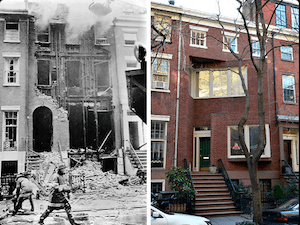
Greenwich Village townhouse, blown up and redesigned. (James Barron/NTY)

My November blog post written for Traditional Building magazine was explosive, to say the least. It is about two buildings that blew up and a third building that bodes well to beautify its neighborhood by not blowing up its context. Still, it was opposed by some preservationists who prefer to imagine that their advocacy benefits the Upper East Side of New York, and mostly you could say it does. And yet … Read all about it in my November TB blog post here.

Posted in Architecture, Preservation | Tagged , , , , , | 1 Comment