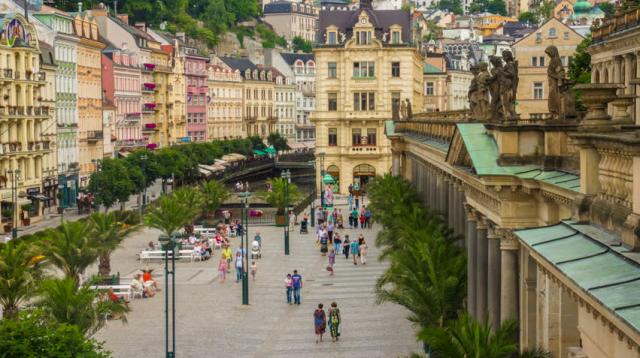
Jan Michl: “If the task was to design a new public square in a small town, the modernists, equipped only with their abstract, minimalist visual vocabulary, would have no chance of creating a common space with such unassuming, pleasant qualities as this one [Karlovy Vary, town in the Czech Republic].”
Jan Michl, the design theorist at the Norwegian University of Science and Technology, saw my post “
Huxtable versus Huxtable” and sent me a recent paper called “
Towards Understanding Visual Styles as Inventions Without Expiration Dates.” In it, he argues that the late British philosopher Karl Popper had come up with an alternative to Huxtable’s “historicism.”
According to Huxtable and most architectural historians, architectural history advances no further than modern architecture, where it reaches nirvana. That sounds arrogant, but yes, they do actually believe that all prior architectural styles are inappropriate to build in modernity because they reflect the past, not today. That is the “expiration date” to which Michl refers in his title. This attitude architects call “historicism.” (They use the same word to criticize building designs inspired by historic architecture.)
As is often the case, however, the average man on the street sees things much more clearly, intuitively and naturally. Most folks do not discriminate against building styles based on when they were invented. They accept architecture of every type openly and judge it based not on when it was invented but on whether they like it. Michl writes:
[T]he common-sense feeling here ascribed to the public, that art of the past is a natural part of the modern present, has been seldom clearly articulated. … It has been incomparably more prestigious to side with the modernist cause and applaud the “avant-garde” positions than to espouse the perspective of the “philistine” public.
Modern architecture, according to historicism, is based on the idea that the course of history is set, and that with modernism, architectural history has arrived at its logical, rational, scientific conclusion. Traditional architecture, old or new, stands in the way of the new order by evoking sentiments that connect individuals to the past, causing them to resist new buildings that may or may not reflect our time but which definitely lack familiarity.
That is historicism in a nutshell. If it sounds vaguely Marxist, “vague” is the wrong word. It is, say Popper and Michl, directly influenced by Marx, who put a stopping point – socialism, the goal of communist government – on Hegel’s dialectical analysis of time and progress. The idea that human will and individual action can affect the course of history is traditional architecture’s original sin.
It is no accident (as Marx would say) that futuristic films featuring authoritarian governments that try to stifle free will almost always also feature settings of modern architecture. Look at Fahrenheit 451 or Blade Runner. In the Star Wars series, the bad guys live in places like the Death Star, while the good guys (that is, the oppressed) on various planets live in different sorts traditional villages, towns or cities. Are the directors of these films (such as George Lucas) aware of the philosophical debate that plays out in the sets they create for their films? I suspect not.
Popper sets up an ontological triad consisting of the physical world, the mental world, and the world of ideas for things created over time in the mental world. It is the latter entity, which Popper called “World 3,” that supplants historicism. World 3, or objective knowledge, is a “cultural commons” that enables each human to freely borrow from all of man’s past creativity. This, Michl writes,
represents a truly bold attempt to conceptualize a fact known or at least suspected by every productive person. Namely, that our human creativity is anchored in, and incessantly draws upon, a realm outside the individual creator’s head. … I submit that it implies a powerful alternative to the governing modernists’ “time-keeping” [historicism], and simultaneously a more realistic view of the nature of creativity in the field of architecture and design.
He adds later:
[I]t is neither something eternal nor divine, but entirely man-made, just as birds’ nests and spiders’ webs are created by birds and spiders. … Had Popper been still alive and active today, he would have probably resorted to up-to-date analogies in order to make the concept of World 3 more widely understandable, such as, for example, “World Wide Web,” “Public Domain,” “Open Source,” or “Creative Commons.” Creative Commons in particular might serve as an accessible synonym for Popper’s World 3.
Of the use of locutions such as “historicist,” “pastiche,” “faux,” and “not of our time” by architects trying to solve design problems, he writes:
[T]here can be many reasons for finding a formal solution objectionable, but not the one that points out that it hails from a past epoch – which is what the modernist critical arguments against contemporary non-modernist stylistic idioms invariably boil down to. As already suggested, such branding makes sense only when one subscribes to the [historicist] belief that there is an intrinsically correct aesthetic expression pertaining to the modern period and that this correctness can be discovered only by designers and architects who have turned their back on the past.
The awkwardness of architectural periods that architectural historians have managed to talk around so adeptly is that most historical buildings of whatever “period” have more characteristics in common than not. That is because they all evolve to a greater or lesser degree from Greco-Roman classicism, which is a reflection of both nature and human nature. The traditional idiom, or language, evolved for centuries, honing refinements to building practice. Then modern architecture tried to throw it onto the ash heap of history and replace it with an experiment that rejects precedent. Imagine that! The degree of their success, given the poverty of their basic idea, is astonishing. But given modernism’s inability to develop its own coherent architectural language despite the passage of a century, there is ever more reason to hope today that modernism will be forced to relinquish its hold on architectural authority.
Modern architecture suffered epic fail more than half a century ago, a truth evident to all outside the cocoon of modernism. That is why historic preservation went from being a niche hobby to a mass movement in the snap of a finger after 1960. Jan Michl’s revival of Karl Popper’s thoughts on the invalidity of a central mantra of the modernist cult will be an invaluable tool for readmitting beauty and other shunned qualities to architecture.
My effort to sum up these important ideas should be reinforced by reading Michl’s elegant, evocative and persuasive paper, which is here. A page sent by Audun Engh linking to 30 other papers on architecture, design and education in those fields is here.
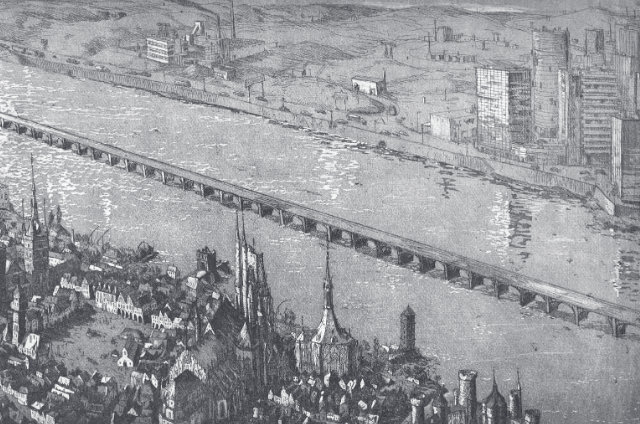
“The Bridge” (1976), by Jan Soucek. Michl: “In the [historicist] view of the modernist architects, the past and the present are seen as two separate worlds, and tht is why they ought not to be connected in any manner. Soucek deemed such a conviction preposterous.”










 Architecture Here and There