My Jane’s Walk next week

Screen Shot 2017-04-29 at 1.30.02 PM.png

Jane Jacobs in 1961, leading fight for West Village at Lions Head restaurant, in NYC.

Jane Jacobs’s 101st birthday is coming up on Thursday, May 4, so my Jane’s Walk tour along the Providence waterfront, starting at Crawford Street Bridge near Hemenway’s, will be on Saturday, May 6. Providence’s river walks were part of a large government redevelopment project of the sort that Jacobs scorned. That only goes to show that such projects are not good or bad because they are big or small. Their merits rest on their characteristics, and it is fair to say that those characteristics are good or bad based on whe- ther Jane Jacobs would like them or not. The bridges, walkways and parks along the Providence and Woonasquatucket rivers are walkable, sittable and lovable. Jane Jacobs would have loved them.

This year will see a host of tours in Providence through Jane’s Walk, which has become an international endeavor. Many municipal and state planning departments have jettisoned modern planning myths and are now run with an eye toward principles she developed through her journalism and activism. Some of the tours will show off how Providence epitomizes these – largely because so much of our city has not been butchered by modern design and planning. Click the link above to see what other parts of the city will be celebrated on Friday, May 5, Saturday, May 6 and Sunday, May 7.

My walk, entitled “Providence’s Waterfront: The Good, the Bad and the Ugly” will start at noon and stroll north along the Providence and the west up the Woonasquatucket to Waterplace Park. The tour is free, though my radical opinions on architecture might be unsettling to some.

Screen Shot 2017-04-29 at 1.32.34 PM.png

Me leading my Jane’s Walk on the Providence River.

Posted in Architecture, Architecture History, Urbanism and planning | Tagged , , , , , | 3 Comments

ID this painting! Is it Miami?

Screen Shot 2017-04-14 at 10.57.22 AM.png

The painting above is considered a capriccio – a drawing of an ideal but imaginary collection of buildings by themselves or within a designed rustic landscape. I ran across it the other day looking for something in my iPhoto library. My wife Victoria and I had encountered it in 2009 on a trip to South Beach, or possibly we saw it on a side trip to Miami. Maybe it was  hanging at the Fountainbleau, I’m not sure. Perhaps it was a vision of what Miami might have been like had the Depression not interrupted a building boom fueled in part by the designs of Addison Mizner, later Philip Trammell Shutze, and other traditionalists. Can anyone help me identify it?

[Tim Kelly comments: “The painting is a collection of projects and works by Shultz & Weaver. The Biltmore Hotel in Coral Gables is the far left building. The Sherry-Netherland is at the far right. The name of the firm is just barely legible at the bottom.” Several others have joined Tim in identifying the capriccio in emails.]

Coincidentally, I have just finished reading Robert Adam’s book Classic Columns: 40 Years of Writing on Architecture, which I will review shortly, perhaps after a couple more posts extracting passages from the book. Toward its end are two essays on capricci. Adam writes:

As an expression of a fantasy world where the city is perfect, antiquity is alive, the rustic world is romantic, or ruins are charmingly scattered in a rural arcadia, the paintings depict an unattainable ideal or allow the imagination to range free without the limitations of an often prosaic or constrained reality. For their maximum effect, however, these capricci suggest places that look as if they could have been or even could be real. The culmination of the architectural capriccio is when the imagination of the painter turns into the reality of architecture.

If architecture’s history had not been so rudely interrupted by modern architecture, the entire built world might by now look like a capriccio. Our imaginary idea of what a city could look like is tainted by the interlopement of modernism. It may be difficult but it is nevertheless realistic to imagine creating cities of the future that look like capriccios of the past. Compared with what we must look at today, the past was indeed largely the realization of Adam’s “culmination of the architectural capriccio.”

The capriccio below, drawn in 2005 and near the end of Adam’s book, is by Chris Draper. He was commissioned by Adam Architecture to sketch this capriccio arrayed around Atlanta’s Millennium Gate, the brainchild of Rod- ney Mims Cook Jr. Cook’s National Monuments Foundation organized an international competition. Hugh Petter, of Adam Architecture, was brought in to massage the winning concepts into a final design, which was inspired by the Arch of Titus, in Rome. Cook toured me through the arch and the muse- um on top when I was in Atlanta in 2011 to serve on the jury of that year’s Shutze Awards, founded by the Southeast chapter of the Institute of Classical Architecture & Art. Needless to say, reality being what it is, the setting of the arch today is far from what is imagined in Draper’s capriccio, which includes work by the directors of Adam’s firm. He describes it in the caption:

A town is depiected with Hugh Petter’s Atlanta arch at the end of a long canal. Nigel Anderson’s apartment block is behind the arch and his “pink castle” from Poundbury sits in front of it. A new office building of my design dominates the building group to the right and behind it is my library in Oxford. A baroque country house by Hugh Petter overlooks the composition from a hill behind.

DSCN0683.JPG

Posted in Architecture, Art and design | Tagged , , , , , , , , | 4 Comments

25 million books in limbo

Screen Shot 2017-04-27 at 12.52.16 PM.png

What Library of Alexandria might have looked like. (all images crystallinks.com)

The latest Atlantic Monthly (as it was once called) has a fascinating piece called “Torching the Modern-Day Library of Alexandria,” by James Somers. It chills me to realize that but for a judge’s diktat, 25 million books – not pages, books – are locked in a computer at Google, books that Google had digitized on behalf of the public – and for some money to repay its heavy expense of at least $125 million to scan the books, pay for the copyrights, legal fees and other expenses. Downloading a book in print was to have cost between $1.99 and $29.99; downloading out-of-print books or searching digitized books in or out of print would be free. The revenue would be split between Google and publishers or authors. It was a win-win-win for the public, authors/pub- lishers and Google. But a judge ruled that the class-action settlement that emerged in the effort to balance all the competing rights was sub-par ac- cording to the Federal Rules of Civil Procedure.

Screen Shot 2017-04-27 at 12.51.14 PM.png

Inside the Royal Library of Alexandria.

Between conception in 2002 and 2011, the latest stage of scanning, 25 million books were copied and stored. They are still there – 50 or 60 petabytes on disk – but nobody is allowed to read them or peek into the digital library except for a dozen or so engineers charged with keeping them locked down. (The original goal of Google was to copy all of history’s approximately 129 million books.) Somers writes:

When the library at Alexan- dria burned it was said to be an “international catastro- phe.” When the most significant humanities project of our time was dismantled in court, the scholars, archivists, and librarians who’d had a hand in its undoing breathed a sigh of relief, for they believed, at the time, that they had narrowly averted disaster.

So the deal was queered because so many people (and rivals such as Microsoft and Amazon) who testified at the hearings about the deal automatically assumed that Google was evil and would end up taking advantage of the public, the authors and the publishers. Maybe Google is evil, that’s above my pay grade to assess, but if this was the mega-corp.’s method of expiation, it behooved the judge to let it go forward. If legal hitches developed later, they could be dealt with later.

For me, such a library would help to offer my passages from books I’m reading (on paper) to readers without having to type them in. That can be tedious. Being able to go to the passage and copy it for you for free in Google Books would have been great. I suppose my “interest” doesn’t quite stack up in the pantheon of scholarship. Still, those near the bottom of the pecking order of those who might find a digital library of all the world’s books useful have a right to feel cheated by Judge Denny Chin.

In his lengthy article Somers does an excellent job describing how Project Ocean was conceived, how books were scanned, the ways competing interests were balanced, and the horns of successive dilemmas faced by Google, Judge Chin and the various parties involved. I hope the authorities can figure out how to let the public visit this incredible library. Meanwhile, it (the article) is a damn fine read.

Screen Shot 2017-04-27 at 12.57.13 PM.png

Parchment scrolls (right) of the type that held books in ancient Egypt and for centuries after.

Posted in Architecture, Books and Culture | Tagged , , , , , , , | 1 Comment

Architecture into politics

Screen Shot 2017-04-26 at 1.31.30 PM.png

This building in Poundbury was designed by Craig Hamilton. (Dezeen)

In his Dezeen essay “To confront populism, all architects should become classicists,” Phineas Harper suggests that the architectural profession should compromise its aesthetics and embrace classicism in order to build social housing that is often blocked by NIMBY forces when it is designed in mod- ernist styles. He links to a populist UKIP party video. (The United Kingdom Independence Party led last year’s Brexit fight.) Its video, untitled, expresses anger at how classicism is stomped on and rubbed out by a professional elite of modernist architects, and pledges an official reverse in policy.

The video is linked in the essay by Harper, who feels its pain while evidently deploring its populism. Still, it is excellent. Watch it!

The idea Harper puts forth is ridiculous. Modernists are not going to turn classicist just to support their generally leftist political ideology. But Harper asks why not? And his essay makes many, many good points regarding, um, architecture. Here is one passage:

Whether in academia or in practice, most respectable architects stick doggedly to a late-modern century Swiss(ish) tame-form modernism with occasional extravagant set pieces provided by starchitects. Yet simultaneously we all know that classicism remains hugely popular with the public and planners alike. They might not know the difference between the Doric and Ionic orders, nor possess a detailed lexicon of astragals and finials, but they know what they like, and what they like generally has a cornice. If the public is the ultimate client for architecture, isn’t it elitist to consistently dismiss their taste?

More importantly, huge resistance faces the construction of essential new public buildings. Isn’t it morally imperative that architects swallow their aesthetic qualms and design in the style most able to garner the political support needed to overcome any barriers? There are buildings that urgently need to be built; hospitals, housing, schools and so on. Why, then, do architects consistently throw potentially derailing obstacles in the way of these projects by insisting on modern styling, knowing full well that doing so hardens public opposition and chips away at political will? …

We will happily make many other compromises to see work built – so why not style? We will work for dubious developers who we know are more interested in their shareholders than end users. We will squeeze out communal spaces, reduce ceiling heights and shrink rooms to the minimum standards at the behest of miserly clients. We will climb into bed on estate regeneration schemes that lead to the displacement of poor families, and will routinely overwork our staff while failing to give them proper credit. But work in a classical style? Unthinkable!

UKIP has basically done what I have for years urged the Democrats or the Republicans to do here in America: The first party to embrace new tradi- tional architecture as a policy issue could easily steal a march on its oppo- nents. Whether it will succeed or not, who knows, but this is what UKIP has done. This is what the GOP or the Democrats should do.

Enjoy both the essay and the UKIP video linked to the essay. And thank you, Hank Dittmar, for sending Harper’s essay and the three-and-a-half minute UKIP video to the TradArch list.

Posted in Architecture, Urbanism and planning, Video | Tagged , , , , , , , , , | 4 Comments

A tale of two PPS events

Dig.Comms@ric.png

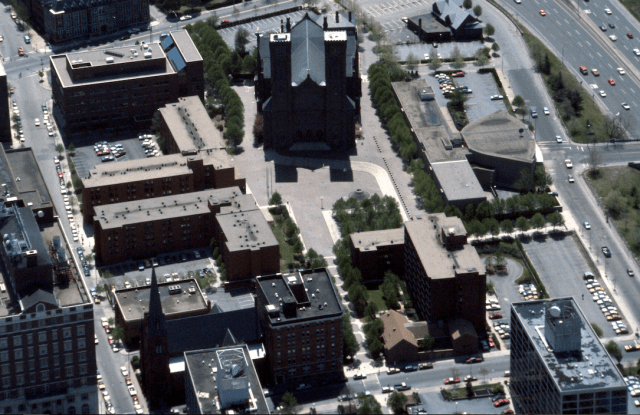
Aerial view of Cathedral Square shows many entry points into the plaza. (Digital Commons @ RIC)

Over the course of four days the Providence Preservation Society hosted two events, one about Cathedral Square, which I’ll discuss first, and the other about the Jewelry District.

The first event, held at the Department of Planning and Development’s offices last Friday evening, featured a panel on Cathedral Square, part of the Weybosset Hill segment of the Downtown Providence 1970 plan (announced in 1960) and one of the blessedly few parts of that plan that was realized. Before the site was razed, it was an active part of town where Westminster and Weybosset met at the far end of the “bow” originating near the Provi- dence River. A panel including Boston planner Tim Love and landscape historian Charles Birnbaum described how Cathedral Square came to be but had little to say regarding why it failed.

Mack Woodward, of the Rhode Island Historical Preservation & Heritage Commission, wrote in the 2003 PPS guide to Providence, “The vast, lifeless plaza designed by I.M. Pei and Zion & Breen is an insulting contrast to the building’s vigorous design,” referring to the Cathedral of Sts. Peter & Paul (1878). Elsewhere, he wrote of the plaza: “Despite being designed by world class architects and urban planners, namely I.M. Pei and Zion & Breen, the space has been universally decried as an utter failure.”

I’d replace “Despite being designed …” with “Because it was designed … .”

After their presentations, I raised my hand and moderator Christina Bevilacqua, the famous curator of conversation, called on me. I noted that the panelists had not really discussed why the plaza failed, and asked whether it might have been more successful if its design were more in keeping with that of the cathedral, and downtown Providence generally. Predictably, being modernists, they both dodged the question.

In fact, it failed  at least in part because it was unattractive. It might someday succeed if its cold modernist façades could be covered up or replaced by tra- ditional façades. Also, the unused Bishop McVinney Auditorium should be razed so that Westminster Street can be reopened from Empire Street through the plaza. Then it could cross the bridge over Route 95 to reunite downtown with the West Side – with or without the Ponte Vecchio accou- trements suggested in 2004 by Andrés Duany and snickered at, for some reason, by Tim Love.

Screen Shot 2017-04-25 at 9.29.40 PM.png

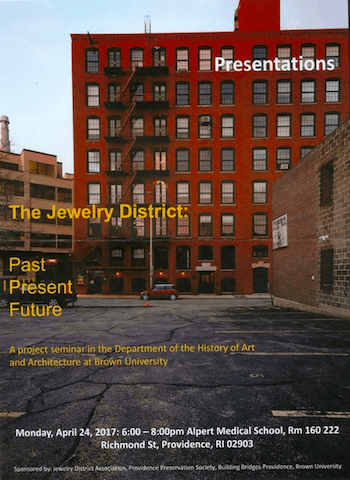
On Monday, a much more productive and entertaining event was held about the history of the Jewelry District. Little was said about the I-195 Corridor, though its executive director, Peter McNally, was there. The event was sponsored by PPS, Brown University, the Jewelry District Association and Building Bridges Providence, which has pushed for the pe- destrian bridge now supposedly under construction.

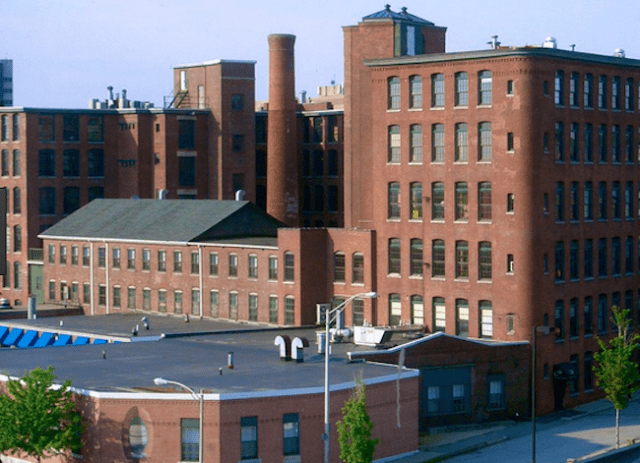
The event featured 19 Brown University students in an architectural history course taught by Professor Dietrich Neumann. They all described their favorite of the pair of buildings each chose to research for the class. Most of them were traditional brick mill buildings, and many of the students whose building was gone used fancy computer footwork to superimpose its image on a photograph of the site today. The audience at Brown’s medical school in the Jewelry District (the Little Nemo Building) was thrilled by each of these instances. As I say, Peter McNally was in the audience. Maybe he learned something useful.

Hint, hint: Now that the downtown zone reaches into the Jewelry District, new development must by law “protect the historic character of downtown.”

All of the presentations were clear, persuasive and entertaining. The students were articulate and well spoken. Some could step right into careers as stand- up comics, but scholarship was their game on Monday evening. If they are typical of what Brown is producing these days, then we need not have any worries for the younger generation. (Here is a video of the entire event.)

Screen Shot 2017-04-25 at 9.25.52 PM.png

Posted in Architecture, Preservation, Urbanism and planning | Tagged , , , , , , , | 3 Comments

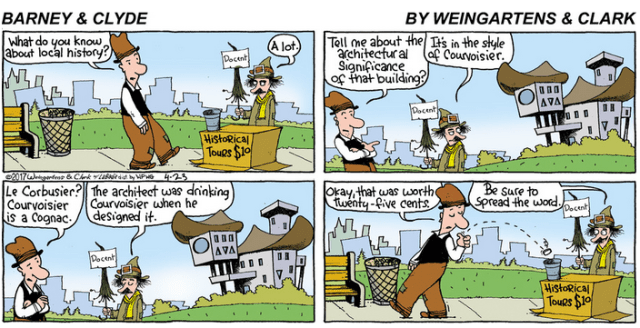
Corbusier on Courvoisier

Screen Shot 2017-04-24 at 11.44.25 AM.png

This hilarious Barney & Clyde cartoon was sent to me by a correspondent in Washington, Arnold Berke, a contributing editor of Preservation magazine.

My reaction to the cartoon?

If only!

If only Le Corbusier had suffered from overindulgence in the pleasures of alcohol rather than the displeasures of autism. If only Corbu’s architecture, as translated by Weingarten, Weingarten & Clark) were as cartoonish as the loopy house in the strip, the International Style drunk on postmodernism. One might then have hoped that a tippling Corbu might have toppled from atop of one of his machines for living before inspiring so many towers of hopelessness for the poor, providing options for suicide and murder from their dangerous rooftops and other precincts of modern architecture.

Anybody see The Architect (from 2006, not the latest movie of the same name), with Isabella Rosellini and Viola Davis, about a designer of public housing who tries to dodge being guilt-tripped by angry tenants into demol- ishing one of his towers? Before he succumbs, a resident leaps off its roof.

If only there were no Corbu, maybe a lot of this might not have happened, and the world would be a happier place.

If only.

[GoComics offers Barney & Clyde, by Gene Weingarten, Dan Weingarten and David Clark, and other comics.]

Posted in Architecture, Humor | Tagged , , , | Leave a comment

Christo laundry, wacko RISD

Screen Shot 2017-04-21 at 10.15.45 AM.png

Screenshot from the Jewelry District Association’s website.

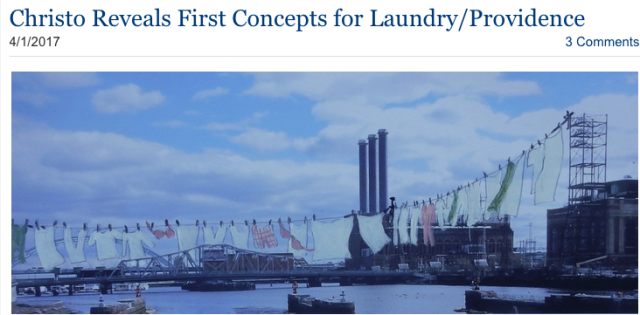
The Jewelry District Association, in Providence, reports that Christo is going to cross the Providence River and line India Point Park with laundry, pegged on a giant laundry line. In my book, that crosses an important boundary, as does RISD’s art installation that has since winter draped a white rail gate in front of the RISD Museum’s main facade on Benefit Street.

Okay, so which of these is the April Fool’s joke? The Christo, it seems. Not that it would be all that surprising to have the famous cloak-and-stagger artist do a contemporary art installation in Providence. The city is near the top in lots of tourist polls measuring the latest “hot” places. And with good reason. It stands to reason that someone like Christo would be brought in to help the city attract visitors with something super stupid.

Christo covered the Reichstag/Bundestag in Berlin with cloth a couple of decades ago and more recently lined Central Park with orange cloth “gates.” The latter project resulted in a Colbert humor sketch that is by far the best thing to emerge from Christo’s entire career as an “artist.” If I could trade a few weeks of my dignity for a sketch that funny, I would consider it seriously. But I cannot take seriously the idea that Providence’s top cultural institution would allow such a joke, in the name of art, to be played on it.

So the RISD gate makes more sense as an April Fool’s joke. But it is actually the threat of a Christo event in Providence that is the joke. A friend sent me a link to the website of the Jewelry District Association and I read three or four paragraphs into the story it before it occurred to me to check the date. You guessed it. April 1, 2017.

(By the way, congratulations to the Jewelry District for its successful cam- paign to avoid official rebrandment as “The Knowledge District.” It will always be the Jewelry District to anyone who loves Providence.)

RISD has not returned my call yet about its own gate, pictured below, but I suspect that it is a work of art – one that scrapes its fingernails on the elegant blackboard of the RISD Art Museum’s original Georgian frontage on Benefit Street. As such, it is a perfectly conventional work of contemporary installation art in the early 21st century.

I assume there’s a date upon which the installation will be removed. I will report back when I find out. My main comment is that this is not quite as inelegant a blotch as Brown’s idiotic giant blue bear erected last year on Simmons (Lincoln) Field, but it is worse because it is in a more prominent location. In both cases, art and the public are both the loser. Art indeed!

***

Matt Berry, of RISD, just returned my call and told me that the work was indeed an art installation, called “White Wall,” by Cameron Kucera (RISD BArch 2019, Architecture), Makoto Moses Kumasaka (RISD BFA 2018, Furniture), and Vuthy Lay (RISD BArch 2019, Architecture). They are part winners of this year’s Dorner Prize. “The Wall” was installed on Feb. 16 and will be deinstalled on June 4. Here is a description:

White Wall, a winning entry for the Dorner Prize 2017, is a bamboo screen and performance space that formalizes the invisible socioeconomic obstructions to museum accessibility. This piece seeks to take the architectural conditions of the Radeke Building and redefine them as a platform for discussion, demonstration, and contact. Intervention art as well as institutional critique, this project is offered by the artists as a scaffolding for others to join the conversation.

DSCN0562.JPG

Apparently temporary installation art on Benefit Street. (Photo by David Brussat)

Posted in Architecture, Art and design, Humor | Tagged , , , , , , | 11 Comments

Ugly by accident or design?

Screen Shot 2017-04-20 at 5.40.52 PM.png

The illustration atop the famous critic’s website. (stephenbayley.com)

Christopher Woodward, the director of London’s Garden Museum, wrote “Why Are So Many New Buildings Ugly?” for its website. He had read British critic Stephen Bayley’s 2013 book Ugly: The Aesthetics of Everything, and describes an exchange Bayley had with architect Robert A.M. Stern:

At one dinner party Bayley asks a visiting American architect ‘Could you set out to design an ugly building?’ Robert Stern, a star of debonair neo-classicism, laughs. ‘Of course. Architects do it the whole time!’ And laughter moves the conversation on. But Stern misses the point, notes Bayley. You can sketch a parody of what you think an ugly building looks like. But no one consciously sets out to design an ugly building.

Is ugliness a consequence of aesthetic intentions, or of the process of design and construction? More and more I think it’s the latter.

Yesterday, a commenter, Bruce MacGunnigle, alerted me to Woodward’s essay, and I went to Stern’s defense, arguing:

Bruce, I have begun to read the essay from the Garden Museum site, and I must say I have to agree with Stern. Perhaps architects don’t literally start out intending to design ugly buildings, but by dint of aesthetic principles they embrace which seek to contradict and contrast traditional ideas of beauty, they are coming about as close as you can to purposely designing ugly buildings. I will read the rest of the essay and possibly post on it, and will let you know if my opinion of what the author is saying changes.

Well, I’ve finished Woodward’s essay, and I see a sort of a flaw in my defense of Stern’s reply to Bayley. I was not tough enough on the bastards. I would argue even more strenuously that yes, modernists consciously strive to produce ugly buildings. Modernism, in rejecting traditional concepts of beauty, by definition exalts traditional concepts of ugly. And ugly is as ugly does. So, yes, modernist architects purposely design ugly buildings. If they occasionally fail to carry out the principles of modern architecture and create an insufficiently unattractive building, it is accidental.

Perhaps this seems tendentious, circular reasoning, but modernists have got to sleep in the bed they have made. They have tried to dethrone traditional aesthetics, and to a great extent they have succeeded, in that hundreds of thousands of ugly buildings have been built to the applause, over the years, of hundreds of mod-symp architecture critics (the only kind that can get jobs writing about architecture). Ugly design is almost all that is taught in schools of architecture. The very, very rich spend millions to build ugly houses, and more millions to put up ugly art on the walls. The development processes in cities and towns throughout this nation and the world are rigged to give commissions to developers who will build ugly buildings. And yet while aesthetic modernists in every field of art, including architecture, have, to this very remarkable extent, succeeded in turning the world upside down, they have not changed the minds of most people. So, yes: they have failed. My defense is not circular but a reflection of basic common sense.

Regarding architecture, the people are literally smarter than the experts. To this extent, expertise, as Tom Nichols’s new book The Death of Expertise argues, is indeed dead. Nichols argues that it is being killed not by its own fatuity but by the internet, which gives people more access than ever to challenges to expertise. In the case of architecture, however, Nichols is dead wrong. The public is correct. I have argued for years that people, who all experience architecture constantly from near birth, have an innate solidity of judgment on architecture that they do not have in most other arts. The high percentage of the public that does not like modern architecture is a result of the survival – in the face of powerful cultural authority – of the individual’s intuitive (and highly intelligent) respect for beauty.

The museum director Woodward contends that ugly is not the result of intent but of “the process of design and construction.” Since he has almost finished renovating the Garden Museum, that is understandable. But he has put the cart before the horse. The process of design and construction is difficult at least in part because design and construction are nowadays often directed at the achievement of projects that make no aesthetic sense.

In the same way, the design and development process in cities is difficult because a developer and his architectural team must gain permits from committees whose members are generally sympathetic to modernist design but who are appointed by politicians who depend on the votes of a public that dislikes modern architecture. Thus, these panel members must dissem- ble – as I have heard them do time and again – in their recommendations to developers, pushing modernist design changes without making it too obvious that they are doing so. That causes confusion, misinterpretation of such rec- ommendations, and more time spent at the drawing board and returning to the panel to seek approval of revised plans, again and again.

Woodward may understand this now that he has led his museum through a year’s closure for renovations. The difficulties caused by design and con- struction are not the cause of ugliness but the result of what happens when the system’s preference for ugliness grinds up against the public’s preference for beauty.

If developers would embrace the public’s idea of beauty – and accept its preference for traditional architecture – there would be more simplicity in the process of development, fewer cost overruns, less frustration, and more beauty in the urban environment.

I’ve gotten off track, but the pursuit of ugliness, whether intentional or not, causes disruption in the function of the economy all the way down the line. I’m not sure that Woodward, Bayley, Nichols or even Stern would agree – though I’d hope that Stern would see the logic of the proposition. Anyhow, that’s why so many new buildings are ugly.

Posted in Architecture, Art and design | Tagged , , , , , , , | 5 Comments

No, not halfway to Houston

Screen Shot 2017-04-18 at 8.13.44 PM.png

Yesterday’s post, “Prov’s halfway to Houston,” generated some blowback in my own mind, especially when, later in the day, I came across two reports that lifted my heart and my hopes about Providence and its future. Maybe “halfway” to Houston is a little too pessimistic.

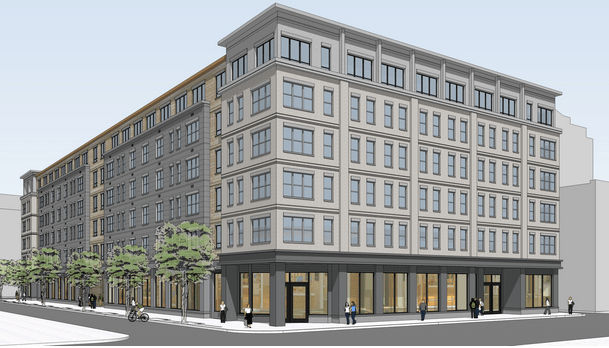
On my visit to the website of Greater City Providence in search of illustrations of the South Street Landing garage, I happened upon the agenda of the Downtown Design Review Committee‘s March 13 meeting. It had a rendering of the building proposed by Buff Chace to fill the parking lot of the Providence Journal, whose office at 75 Fountain St. (where I worked for 30 years) he had purchased a year or so before, along with the lot across the street. At that time he suggested to reporters that he had a building in mind for the lot, and hinted that it would be traditional in style. Well, as you see from the above illustration, by Cube3 Architects, he is a man of his word.

Of course, no rendering gives more than a general idea of what a building will look like upon completion. The drawing above suggests, however, that even without additional detail beyond what is shown, the building would add significantly to its setting – not a high bar on Fountain, but every little bit helps. Perhaps the pilasters on the building’s ground floor and middle floors and on the columns of its top floor could boast fasciae or other types of molding to bring out the vivacity of otherwise plain, static piers.

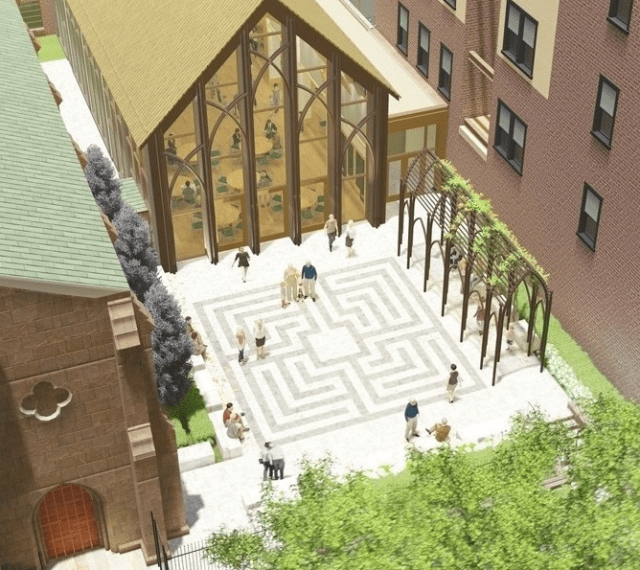
Another reason to smile at developments downtown – here I refer to the old downtown, not the recently expanded downtown of D-1 zoning, which takes in the Jewelry District and the I-195 Corridor – is at the gracious intersection of Westminster and Mathewson streets, where Grace Episcopal Church’s new parish hall or pavilion is taking shape.

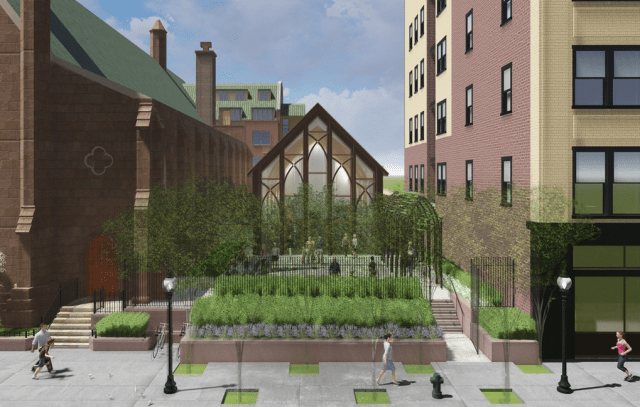
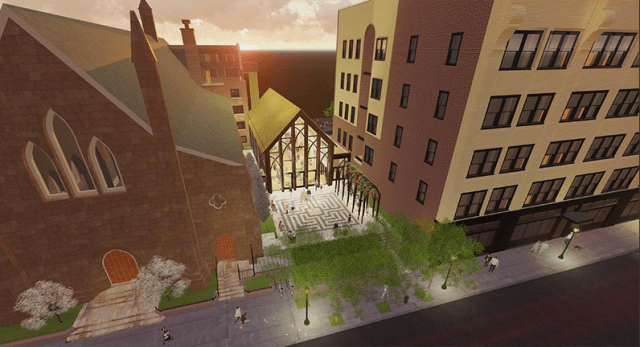
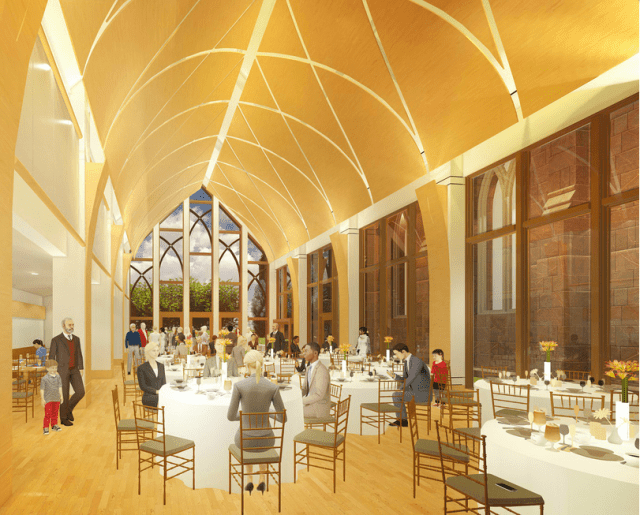
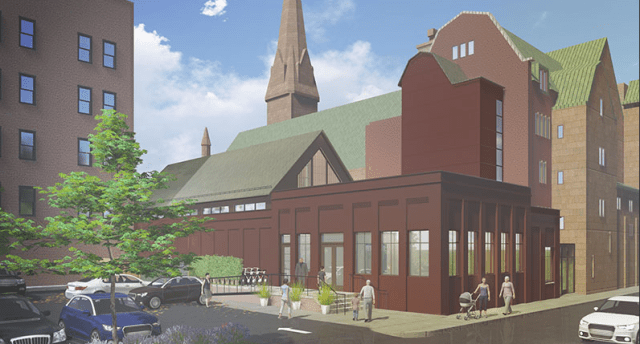
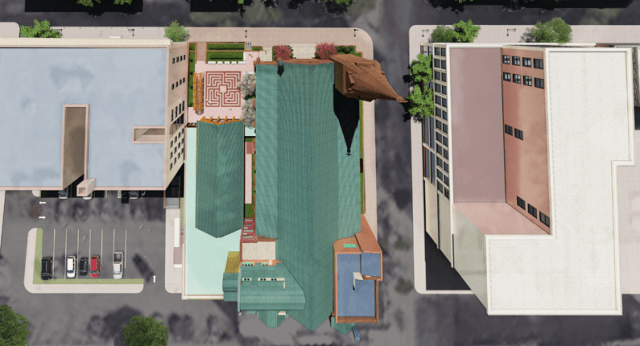
To judge by the renderings below, it will look mahvelous!

Apparently, some early concepts for the pavilion were modernist. I did a couple of posts on the proposal, for which no design had been publicly released. (See “Failure of grace alert!,” “Reverend, grace and Grace,” and “More grace in glass additions.”) Whatever effect those may have had back in 2015, the final design by Centerbrook Architects looks suavely elegant in a decidedly traditional manner. The delicate tracery of its front glass façade sets an appropriate Gothic theme. Its gable roof hints to observers that the pavilion intends to fit into the setting of Grace Church, built in 1845 to Richard Upjohn’s Gothic Revival specifications. (Believe it or not, modern architects consider it a virtue to elbow the ribs of old buildings with con- trasting new ones that don’t fit.)

The pavilion will fill what was once a parking lot. In fact, the lot was created on the site of the old Nickel Theater, a gorgeous confection whose unfortu- nate demolition damaged its ecclesiastical neighbor. Speaking of which, it looks as if the demolition of the Fogarty Building between Fountain and Sabin streets, a block away, has been halted temporarily, at least in part due to fears of injuring the poopy postmodernist building in which the toymaker Hasbro has offices. (Its cubic logo does a regrettable pirouette up above.)

But rest assured, the “iconic” example of modernist Brutalism is coming down. The hotel destined to replace the Fogarty started out with a modernist design suitable for (again) poor Jefferson Boulevard. But the Procaccianti Group, bless it, switched to a traditional design. Another hotel going up just off of Burnside Park/Kennedy Plaza is also traditional in style, thanks to the intelligent sensibility of First Bristol Corp., which developed the pleasing Hampton Inn on Weybosset Street. Neither of the trad hotels soon to break ground are quite up to snuff from a strictly canonical classicist perspective, but they definitely push downtown’s stylistic needle in the right direction.

It seems that downtown developers (and their municipal overseers) are obeying the law that mandates that new development protect downtown’s historic character, whereas the developers of the I-195 Corridor are decidedly not obeying the law. The governor and the mayor clearly do not care. They do not care about strengthening the city’s natural brand. They sacrifice beauty and historic character to future profits that their own lack of care may be expected to negate. They are, to be gentle, nincompoops.

But again, maybe I am too pessimistic. It is not too late to flip-flop in a more alluring direction. Just do it.

Screen Shot 2017-04-18 at 9.14.23 PM.png

Screen Shot 2017-04-18 at 9.19.04 PM.png

Screen Shot 2017-04-18 at 9.14.48 PM.png

Screen Shot 2017-04-18 at 9.15.13 PM.png

Screen Shot 2017-04-18 at 9.19.28 PM.png

Screen Shot 2017-04-18 at 9.20.11 PM.png

Posted in Architecture, Providence, Urbanism and planning | Tagged , , , , , , , , , | 2 Comments

Prov’s halfway to Houston

Screen Shot 2017-04-18 at 1.20.59 PM.png

Proposed “River View Hotel” on South Water Street. (Kendall Hotel LLC)

Those who are running Providence these days should realize that a beautiful city can become an ugly city. It will not happen at once, but it is likely to happen before most people notice it, and too late to be stopped.

Providence seems hell-bent on ugly. In “Developer proposes Providence riverfront hotel on former 195 land,” today’s Providence Journal reports a proposed “River View Hotel” on South Water Street, along the embank- ment of the Providence River. The drawing above tells the tale. It looks as if it belongs on Jefferson Boulevard, in Warwick. (Someday I will have to apologize when Providence itself looks like Jefferson Boulevard.)

The five-story hotel will put its thumb into view corridors toward downtown from 195 and toward the waterfront and new 195 bridge from downtown.

For that matter, look at the new garage built at South Street Landing, near the old power plant being renovated as two state nursing schools. (That’s not a typo. The two schools are apparently not going to merge.) The garage is tarted up with shiny screened panels. On the ground floor are huge black-and-white photos of old Providence. These are supposed to help us forgive and forget the garage’s assault on the neoclassical power station, views of which the garage also blocks for those driving south on Allens Avenue.

Jef Nickerson, who runs the indispensable Greater City Providence blog, recently stated, “‘Eddy Street is so vibrant!’ nobody will say, ever.” He is correct, though he was probably referring to the lack of ground-floor retail along the street edge of the garage, not how ugly it is. But why would any retailer want to lease space in such a dog? (How, wonders Nickerson, did its developer manage to get an exemption for that? By promising to put up historic shots of how beautiful Providence used to be?)

The residential buildings proposed for the other side of the power plant, in the parking lot for the old Davol Square, take their architectural bearings not from the power plant but from the garage!

Right next to the news of the proposed River View Hotel is news that state officials are still churning about the proposed bus subhub at Providence Station, just a couple of blocks from Kennedy Plaza. Voters approved a bond referendum to build this white elephant, but officials still don’t really know what to do, except they are sure they want a “skyline altering” tower to go with it. (Just as I am beginning to feel kindly toward the modernist design of Providence Station, newly restored, they want to wreck it.)

Now, according to “R.I. DOT hits ‘reset’ button on ‘skyline altering’ project,” there is talk of putting state employees into the proposed tower. That means the project has had problems luring potential tenants. But what the transit folks thought they needed – a better connection between Kennedy Plaza and the train station – could have been provided with a bus loop at several thou- sand bucks a year. Instead, the public will pay multi-millions for a new bus hub with a skyscraper attached. So far, its appearance has not been hinted at, let alone illustrated with a rendering. Good luck with that!

In the past year there have been more than enough news stories of bad architecture we’ll have to suffer soon. Some call this development, but it would be so easy for the governor to ask developers to propose projects that bolster the state brand instead of undermining it. And they would probably agree. They are much more interested in retaining the good will of the state (and taxpayers) than in upholding their “right” to build ugly. The point is that we are speeding toward Houston. Unless we get off this bus soon, we will be there before anyone notices. Having thrown away one of our chief competitive advantages – our reputation for beauty – our economic pros- pects might also turn out to be up a creek.

Screen Shot 2017-04-18 at 2.08.01 PM.png

Garage at South Street Landing. (South Street Landing)

Screen Shot 2017-04-18 at 2.49.31 PM.png

Providence Station, newly restored and soon to have skyscraper attached. (Architect)

Screen Shot 2017-04-18 at 2.45.44 PM.png

South Street Power Station, built in 1913. (South Street Landing)

Screen Shot 2017-04-18 at 2.44.28 PM.png

Apartment buildings along waterfront. (Greater City Providence)

Posted in Architecture, Urbanism and planning | Tagged , , , , , , | 11 Comments