Ugly by accident or design?

Screen Shot 2017-04-20 at 5.40.52 PM.png

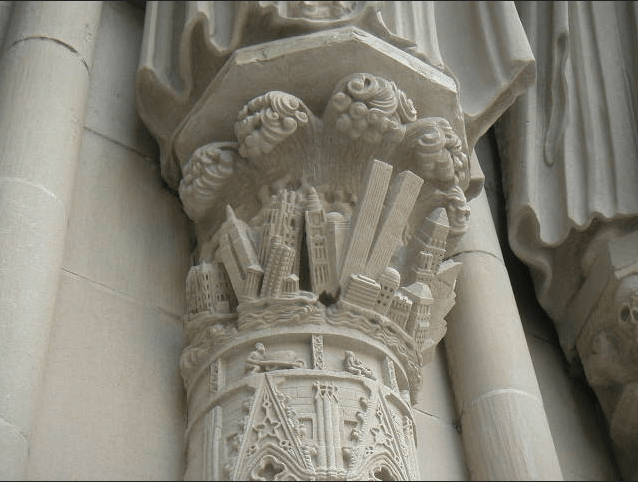
The illustration atop the famous critic’s website. (stephenbayley.com)

Christopher Woodward, the director of London’s Garden Museum, wrote “Why Are So Many New Buildings Ugly?” for its website. He had read British critic Stephen Bayley’s 2013 book Ugly: The Aesthetics of Everything, and describes an exchange Bayley had with architect Robert A.M. Stern:

At one dinner party Bayley asks a visiting American architect ‘Could you set out to design an ugly building?’ Robert Stern, a star of debonair neo-classicism, laughs. ‘Of course. Architects do it the whole time!’ And laughter moves the conversation on. But Stern misses the point, notes Bayley. You can sketch a parody of what you think an ugly building looks like. But no one consciously sets out to design an ugly building.

Is ugliness a consequence of aesthetic intentions, or of the process of design and construction? More and more I think it’s the latter.

Yesterday, a commenter, Bruce MacGunnigle, alerted me to Woodward’s essay, and I went to Stern’s defense, arguing:

Bruce, I have begun to read the essay from the Garden Museum site, and I must say I have to agree with Stern. Perhaps architects don’t literally start out intending to design ugly buildings, but by dint of aesthetic principles they embrace which seek to contradict and contrast traditional ideas of beauty, they are coming about as close as you can to purposely designing ugly buildings. I will read the rest of the essay and possibly post on it, and will let you know if my opinion of what the author is saying changes.

Well, I’ve finished Woodward’s essay, and I see a sort of a flaw in my defense of Stern’s reply to Bayley. I was not tough enough on the bastards. I would argue even more strenuously that yes, modernists consciously strive to produce ugly buildings. Modernism, in rejecting traditional concepts of beauty, by definition exalts traditional concepts of ugly. And ugly is as ugly does. So, yes, modernist architects purposely design ugly buildings. If they occasionally fail to carry out the principles of modern architecture and create an insufficiently unattractive building, it is accidental.

Perhaps this seems tendentious, circular reasoning, but modernists have got to sleep in the bed they have made. They have tried to dethrone traditional aesthetics, and to a great extent they have succeeded, in that hundreds of thousands of ugly buildings have been built to the applause, over the years, of hundreds of mod-symp architecture critics (the only kind that can get jobs writing about architecture). Ugly design is almost all that is taught in schools of architecture. The very, very rich spend millions to build ugly houses, and more millions to put up ugly art on the walls. The development processes in cities and towns throughout this nation and the world are rigged to give commissions to developers who will build ugly buildings. And yet while aesthetic modernists in every field of art, including architecture, have, to this very remarkable extent, succeeded in turning the world upside down, they have not changed the minds of most people. So, yes: they have failed. My defense is not circular but a reflection of basic common sense.

Regarding architecture, the people are literally smarter than the experts. To this extent, expertise, as Tom Nichols’s new book The Death of Expertise argues, is indeed dead. Nichols argues that it is being killed not by its own fatuity but by the internet, which gives people more access than ever to challenges to expertise. In the case of architecture, however, Nichols is dead wrong. The public is correct. I have argued for years that people, who all experience architecture constantly from near birth, have an innate solidity of judgment on architecture that they do not have in most other arts. The high percentage of the public that does not like modern architecture is a result of the survival – in the face of powerful cultural authority – of the individual’s intuitive (and highly intelligent) respect for beauty.

The museum director Woodward contends that ugly is not the result of intent but of “the process of design and construction.” Since he has almost finished renovating the Garden Museum, that is understandable. But he has put the cart before the horse. The process of design and construction is difficult at least in part because design and construction are nowadays often directed at the achievement of projects that make no aesthetic sense.

In the same way, the design and development process in cities is difficult because a developer and his architectural team must gain permits from committees whose members are generally sympathetic to modernist design but who are appointed by politicians who depend on the votes of a public that dislikes modern architecture. Thus, these panel members must dissem- ble – as I have heard them do time and again – in their recommendations to developers, pushing modernist design changes without making it too obvious that they are doing so. That causes confusion, misinterpretation of such rec- ommendations, and more time spent at the drawing board and returning to the panel to seek approval of revised plans, again and again.

Woodward may understand this now that he has led his museum through a year’s closure for renovations. The difficulties caused by design and con- struction are not the cause of ugliness but the result of what happens when the system’s preference for ugliness grinds up against the public’s preference for beauty.

If developers would embrace the public’s idea of beauty – and accept its preference for traditional architecture – there would be more simplicity in the process of development, fewer cost overruns, less frustration, and more beauty in the urban environment.

I’ve gotten off track, but the pursuit of ugliness, whether intentional or not, causes disruption in the function of the economy all the way down the line. I’m not sure that Woodward, Bayley, Nichols or even Stern would agree – though I’d hope that Stern would see the logic of the proposition. Anyhow, that’s why so many new buildings are ugly.
Posted in Architecture, Art and design | Tagged , , , , , , , | 5 Comments

No, not halfway to Houston

Screen Shot 2017-04-18 at 8.13.44 PM.png

Yesterday’s post, “Prov’s halfway to Houston,” generated some blowback in my own mind, especially when, later in the day, I came across two reports that lifted my heart and my hopes about Providence and its future. Maybe “halfway” to Houston is a little too pessimistic.

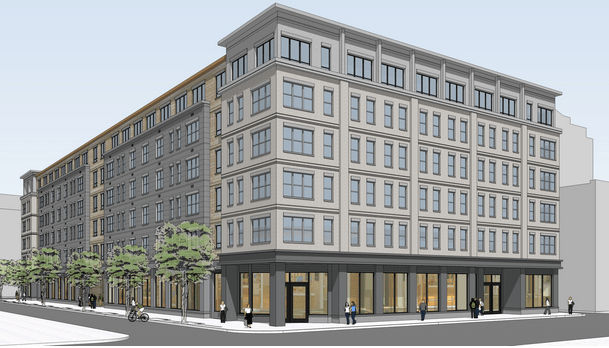
On my visit to the website of Greater City Providence in search of illustrations of the South Street Landing garage, I happened upon the agenda of the Downtown Design Review Committee‘s March 13 meeting. It had a rendering of the building proposed by Buff Chace to fill the parking lot of the Providence Journal, whose office at 75 Fountain St. (where I worked for 30 years) he had purchased a year or so before, along with the lot across the street. At that time he suggested to reporters that he had a building in mind for the lot, and hinted that it would be traditional in style. Well, as you see from the above illustration, by Cube3 Architects, he is a man of his word.

Of course, no rendering gives more than a general idea of what a building will look like upon completion. The drawing above suggests, however, that even without additional detail beyond what is shown, the building would add significantly to its setting – not a high bar on Fountain, but every little bit helps. Perhaps the pilasters on the building’s ground floor and middle floors and on the columns of its top floor could boast fasciae or other types of molding to bring out the vivacity of otherwise plain, static piers.

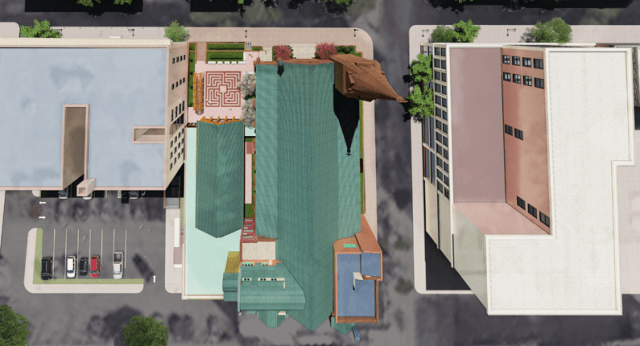
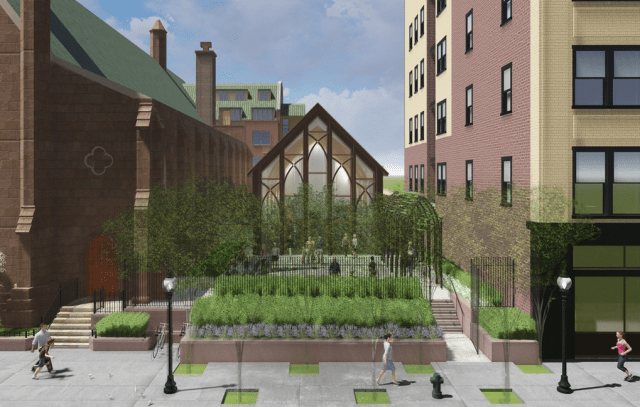
Another reason to smile at developments downtown – here I refer to the old downtown, not the recently expanded downtown of D-1 zoning, which takes in the Jewelry District and the I-195 Corridor – is at the gracious intersection of Westminster and Mathewson streets, where Grace Episcopal Church’s new parish hall or pavilion is taking shape.

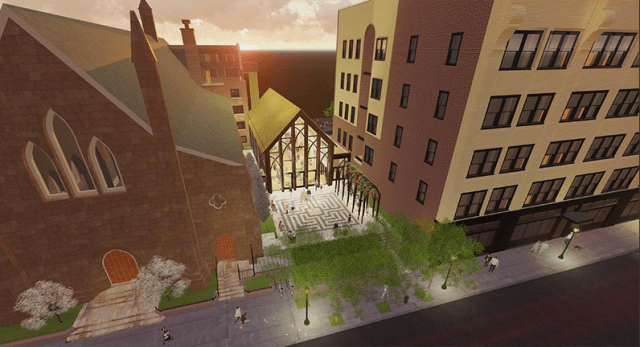
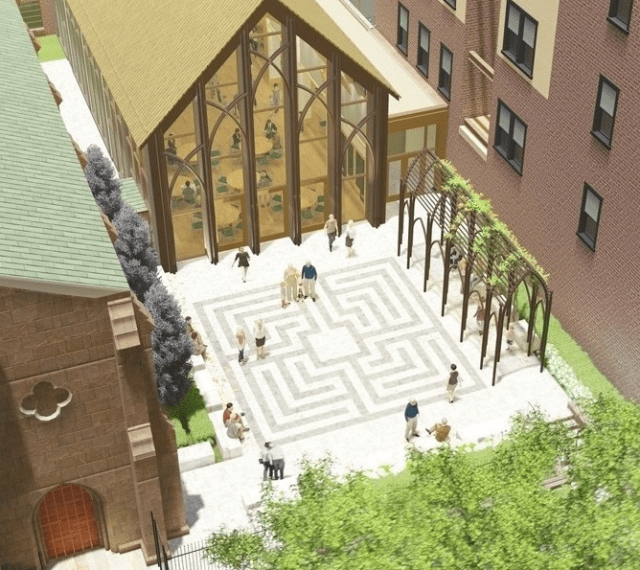
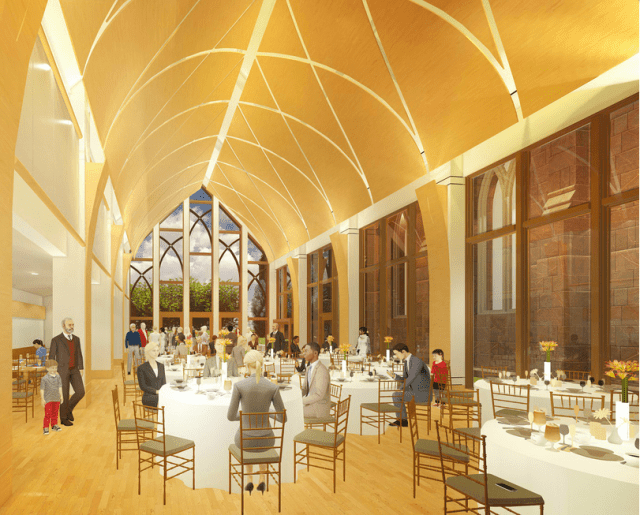
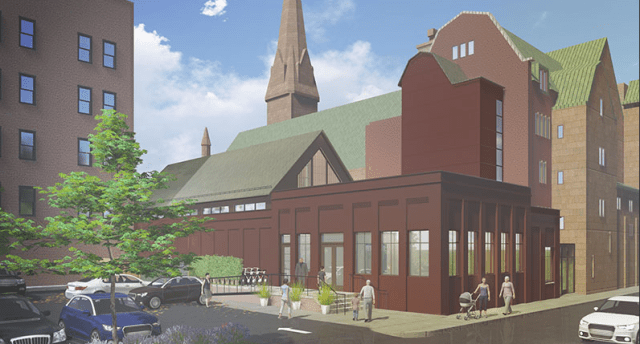
To judge by the renderings below, it will look mahvelous!

Apparently, some early concepts for the pavilion were modernist. I did a couple of posts on the proposal, for which no design had been publicly released. (See “Failure of grace alert!,” “Reverend, grace and Grace,” and “More grace in glass additions.”) Whatever effect those may have had back in 2015, the final design by Centerbrook Architects looks suavely elegant in a decidedly traditional manner. The delicate tracery of its front glass façade sets an appropriate Gothic theme. Its gable roof hints to observers that the pavilion intends to fit into the setting of Grace Church, built in 1845 to Richard Upjohn’s Gothic Revival specifications. (Believe it or not, modern architects consider it a virtue to elbow the ribs of old buildings with con- trasting new ones that don’t fit.)

The pavilion will fill what was once a parking lot. In fact, the lot was created on the site of the old Nickel Theater, a gorgeous confection whose unfortu- nate demolition damaged its ecclesiastical neighbor. Speaking of which, it looks as if the demolition of the Fogarty Building between Fountain and Sabin streets, a block away, has been halted temporarily, at least in part due to fears of injuring the poopy postmodernist building in which the toymaker Hasbro has offices. (Its cubic logo does a regrettable pirouette up above.)

But rest assured, the “iconic” example of modernist Brutalism is coming down. The hotel destined to replace the Fogarty started out with a modernist design suitable for (again) poor Jefferson Boulevard. But the Procaccianti Group, bless it, switched to a traditional design. Another hotel going up just off of Burnside Park/Kennedy Plaza is also traditional in style, thanks to the intelligent sensibility of First Bristol Corp., which developed the pleasing Hampton Inn on Weybosset Street. Neither of the trad hotels soon to break ground are quite up to snuff from a strictly canonical classicist perspective, but they definitely push downtown’s stylistic needle in the right direction.

It seems that downtown developers (and their municipal overseers) are obeying the law that mandates that new development protect downtown’s historic character, whereas the developers of the I-195 Corridor are decidedly not obeying the law. The governor and the mayor clearly do not care. They do not care about strengthening the city’s natural brand. They sacrifice beauty and historic character to future profits that their own lack of care may be expected to negate. They are, to be gentle, nincompoops.

But again, maybe I am too pessimistic. It is not too late to flip-flop in a more alluring direction. Just do it.

Screen Shot 2017-04-18 at 9.14.23 PM.png

Screen Shot 2017-04-18 at 9.19.04 PM.png

Screen Shot 2017-04-18 at 9.14.48 PM.png

Screen Shot 2017-04-18 at 9.15.13 PM.png

Screen Shot 2017-04-18 at 9.19.28 PM.png

Screen Shot 2017-04-18 at 9.20.11 PM.png

Posted in Architecture, Providence, Urbanism and planning | Tagged , , , , , , , , , | 2 Comments

Prov’s halfway to Houston

Screen Shot 2017-04-18 at 1.20.59 PM.png

Proposed “River View Hotel” on South Water Street. (Kendall Hotel LLC)

Those who are running Providence these days should realize that a beautiful city can become an ugly city. It will not happen at once, but it is likely to happen before most people notice it, and too late to be stopped.

Providence seems hell-bent on ugly. In “Developer proposes Providence riverfront hotel on former 195 land,” today’s Providence Journal reports a proposed “River View Hotel” on South Water Street, along the embank- ment of the Providence River. The drawing above tells the tale. It looks as if it belongs on Jefferson Boulevard, in Warwick. (Someday I will have to apologize when Providence itself looks like Jefferson Boulevard.)

The five-story hotel will put its thumb into view corridors toward downtown from 195 and toward the waterfront and new 195 bridge from downtown.

For that matter, look at the new garage built at South Street Landing, near the old power plant being renovated as two state nursing schools. (That’s not a typo. The two schools are apparently not going to merge.) The garage is tarted up with shiny screened panels. On the ground floor are huge black-and-white photos of old Providence. These are supposed to help us forgive and forget the garage’s assault on the neoclassical power station, views of which the garage also blocks for those driving south on Allens Avenue.

Jef Nickerson, who runs the indispensable Greater City Providence blog, recently stated, “‘Eddy Street is so vibrant!’ nobody will say, ever.” He is correct, though he was probably referring to the lack of ground-floor retail along the street edge of the garage, not how ugly it is. But why would any retailer want to lease space in such a dog? (How, wonders Nickerson, did its developer manage to get an exemption for that? By promising to put up historic shots of how beautiful Providence used to be?)

The residential buildings proposed for the other side of the power plant, in the parking lot for the old Davol Square, take their architectural bearings not from the power plant but from the garage!

Right next to the news of the proposed River View Hotel is news that state officials are still churning about the proposed bus subhub at Providence Station, just a couple of blocks from Kennedy Plaza. Voters approved a bond referendum to build this white elephant, but officials still don’t really know what to do, except they are sure they want a “skyline altering” tower to go with it. (Just as I am beginning to feel kindly toward the modernist design of Providence Station, newly restored, they want to wreck it.)

Now, according to “R.I. DOT hits ‘reset’ button on ‘skyline altering’ project,” there is talk of putting state employees into the proposed tower. That means the project has had problems luring potential tenants. But what the transit folks thought they needed – a better connection between Kennedy Plaza and the train station – could have been provided with a bus loop at several thou- sand bucks a year. Instead, the public will pay multi-millions for a new bus hub with a skyscraper attached. So far, its appearance has not been hinted at, let alone illustrated with a rendering. Good luck with that!

In the past year there have been more than enough news stories of bad architecture we’ll have to suffer soon. Some call this development, but it would be so easy for the governor to ask developers to propose projects that bolster the state brand instead of undermining it. And they would probably agree. They are much more interested in retaining the good will of the state (and taxpayers) than in upholding their “right” to build ugly. The point is that we are speeding toward Houston. Unless we get off this bus soon, we will be there before anyone notices. Having thrown away one of our chief competitive advantages – our reputation for beauty – our economic pros- pects might also turn out to be up a creek.

Screen Shot 2017-04-18 at 2.08.01 PM.png

Garage at South Street Landing. (South Street Landing)

Screen Shot 2017-04-18 at 2.49.31 PM.png

Providence Station, newly restored and soon to have skyscraper attached. (Architect)

Screen Shot 2017-04-18 at 2.45.44 PM.png

South Street Power Station, built in 1913. (South Street Landing)

Screen Shot 2017-04-18 at 2.44.28 PM.png

Apartment buildings along waterfront. (Greater City Providence)

Posted in Architecture, Urbanism and planning | Tagged , , , , , , | 11 Comments

Is terra-cotta rising again?

Screen Shot 2017-04-17 at 2.40.14 PM.png

Architect magazine has an article called “The Rise, Fall and Rise of Archi- tectural Terra-Cotta” that seems to have come out of nowhere. No, it was sent me by Kristen Richards, of the indispensable ArchNewsNow.com; what I mean is that there seems no rhyme nor reason to such an article’s existence in the mouthpiece of the American Institute of Architects. I may well exag- gerate its loathing for new traditional architecture, but the journal’s prefer- ence for modern architecture is beyond indisputable. After all, the article on terra-cotta is part of a monthly series called “Throw-Back Thursdays.”

But is there a “rise” of terra-cotta afoot? I hope so. The article’s author, Mike Jackson, writes, “While architectural terra-cotta largely disappeared by the mid-20th century, there is now an active market for terra-cotta restoration products to maintain the legacy of landmark terra-cotta buildings.” He has nothing to say, it seems, about the usefulness of terra-cotta in constructing new traditional buildings. And yet most of the New Jersey Terra Cotta Co. pamphlet from which Jackson draws his article’s illustrations is devoted to terra-cotta used as wall construction systems for new buildings. Maybe members of the TradArch list who read this can comment on whether terra-cotta is on the way back.

Either way, backward-looking though it may be, and assuming its editors are not rolling their eyes in dismay that they must put this sort of thing on their pages, Architect merits applause for running the piece. It is accompanied by some very interesting commercial promotions from the archives of the Building Technology Heritage Library, a project of the Association for Preservation Technology. Definitely worth a look.

Gary Brewer, a partner at Robert A.M. Stern Architects, writes of the firm Roman and Williams, leaders in the “slow design” movement specializing in craft interiors, but also branching out into whole buildings:

Roman and Williams’s Fitzroy apartment building which is under construction in the Meatpacking District is clad in terra cotta.  I was invited to their developer’s launch party at the Boom Boom Room (which R&W designed in the Standard Hotel) and if the crowd was any indication terra cotta could join the palette of materials of the hip set once the building is complete.  Building materials are not immune to the shifts of fashion.

Screen Shot 2017-04-17 at 2.39.23 PM.png

Posted in Architecture | Tagged , , , , | 1 Comment

If dentists were modernists

Screen Shot 2017-04-15 at 1.42.27 PM.png

Jan Michl, whose paper on architectural historicism I discussed yesterday in “Pop the ‘historicist’ bugaboo,” wrote another paper, “Form Follows What?,” which he introduced with a riff from Woody Allen. Naturally, I encourage readers to read the whole paper, but get a load of this!

A letter received by Theo van Gogh from his dentist brother Vincent:

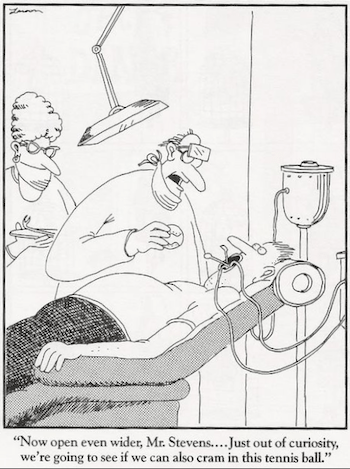
Dear Theo: Will life ever treat me decently? I am wracked by despair! My head is pounding! Mrs. Sol Schwimmer is suing me because I made her bridge as I felt it and not to fit her ridiculous mouth! That’s right! I can’t work to order like a common tradesman! I decided her bridge should be enormous and billowing, with wild, explosive teeth flaring up in every direction like fire! Now she is upset because it won’t fit in her mouth! She is so bourgeois and stupid, I want to smash her! I tried forcing the false plate in but it sticks out like a star-burst chandelier. Still, I find it beautiful. She claims she can’t chew! What do I care whether she can chew or not! Theo, I can’t go on like this much longer … Vincent

This is from “If the Impressionists Had Been Dentists,” a piece Allen wrote in 1978. In ten letters from van Gogh to his brother, Theo hears about the dental practices of other famous Impressionist painters. Beyond hilarious!

The cartoon, of course, is by Gary Larson.

Posted in Architecture, Humor | Tagged , , , , | Leave a comment

Pop the ‘historicist’ bugaboo

karlovyvary.png

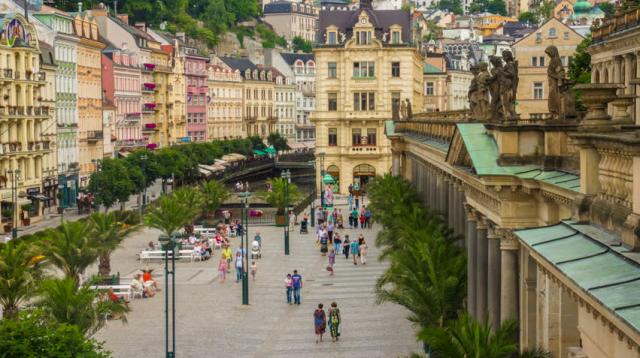
Jan Michl: “If the task was to design a new public square in a small town, the modernists, equipped only with their abstract, minimalist visual vocabulary, would have no chance of creating a common space with such unassuming, pleasant qualities as this one [Karlovy Vary, town in the Czech Republic].”

Jan Michl, the design theorist at the Norwegian University of Science and Technology, saw my post “Huxtable versus Huxtable” and sent me a recent paper called “Towards Understanding Visual Styles as Inventions Without Expiration Dates.” In it, he argues that the late British philosopher Karl Popper had come up with an alternative to Huxtable’s “historicism.”

According to Huxtable and most architectural historians, architectural history advances no further than modern architecture, where it reaches nirvana. That sounds arrogant, but yes, they do actually believe that all prior architectural styles are inappropriate to build in modernity because they reflect the past, not today. That is the “expiration date” to which Michl refers in his title. This attitude architects call “historicism.” (They use the same word to criticize building designs inspired by historic architecture.)

As is often the case, however, the average man on the street sees things much more clearly, intuitively and naturally. Most folks do not discriminate against building styles based on when they were invented. They accept architecture of every type openly and judge it based not on when it was invented but on whether they like it. Michl writes:

[T]he common-sense feeling here ascribed to the public, that art of the past is a natural part of the modern present, has been seldom clearly articulated. … It has been incomparably more prestigious to side with the modernist cause and applaud the “avant-garde” positions than to espouse the perspective of the “philistine” public.

Modern architecture, according to historicism, is based on the idea that the course of history is set, and that with modernism, architectural history has arrived at its logical, rational, scientific conclusion. Traditional architecture, old or new, stands in the way of the new order by evoking sentiments that connect individuals to the past, causing them to resist new buildings that may or may not reflect our time but which definitely lack familiarity.

That is historicism in a nutshell. If it sounds vaguely Marxist, “vague” is the wrong word. It is, say Popper and Michl, directly influenced by Marx, who put a stopping point – socialism, the goal of communist government – on Hegel’s dialectical analysis of time and progress. The idea that human will and individual action can affect the course of history is traditional architecture’s original sin.

It is no accident (as Marx would say) that futuristic films featuring authoritarian governments that try to stifle free will almost always also feature settings of modern architecture. Look at Fahrenheit 451 or Blade Runner. In the Star Wars series, the bad guys live in places like the Death Star, while the good guys (that is, the oppressed) on various planets live in different sorts traditional villages, towns or cities. Are the directors of these films (such as George Lucas) aware of the philosophical debate that plays out in the sets they create for their films? I suspect not.

Popper sets up an ontological triad consisting of the physical world, the mental world, and the world of ideas for things created over time in the mental world. It is the latter entity, which Popper called “World 3,” that supplants historicism. World 3, or objective knowledge, is a “cultural commons” that enables each human to freely borrow from all of man’s past creativity. This, Michl writes,

represents a truly bold attempt to conceptualize a fact known or at least suspected by every productive person. Namely, that our human creativity is anchored in, and incessantly draws upon, a realm outside the individual creator’s head. … I submit that it implies a powerful alternative to the governing modernists’ “time-keeping” [historicism], and simultaneously a more realistic view of the nature of creativity in the field of architecture and design.

He adds later:

[I]t is neither something eternal nor divine, but entirely man-made, just as birds’ nests and spiders’ webs are created by birds and spiders. … Had Popper been still alive and active today, he would have probably resorted to up-to-date analogies in order to make the concept of World 3 more widely understandable, such as, for example, “World Wide Web,” “Public Domain,” “Open Source,” or “Creative Commons.” Creative Commons in particular might serve as an accessible synonym for Popper’s World 3.

Of the use of locutions such as “historicist,” “pastiche,” “faux,” and “not of our time” by architects trying to solve design problems, he writes:

[T]here can be many reasons for finding a formal solution objectionable, but not the one that points out that it hails from a past epoch – which is what the modernist critical arguments against contemporary non-modernist stylistic idioms invariably boil down to. As already suggested, such branding makes sense only when one subscribes to the [historicist] belief that there is an intrinsically correct aesthetic expression pertaining to the modern period and that this correctness can be discovered only by designers and architects who have turned their back on the past.

The awkwardness of architectural periods that architectural historians have managed to talk around so adeptly is that most historical buildings of whatever “period” have more characteristics in common than not. That is because they all evolve to a greater or lesser degree from Greco-Roman classicism, which is a reflection of both nature and human nature. The traditional idiom, or language, evolved for centuries, honing refinements to building practice. Then modern architecture tried to throw it onto the ash heap of history and replace it with an experiment that rejects precedent. Imagine that! The degree of their success, given the poverty of their basic idea, is astonishing. But given modernism’s inability to develop its own coherent architectural language despite the passage of a century, there is ever more reason to hope today that modernism will be forced to relinquish its hold on architectural authority.

Modern architecture suffered epic fail more than half a century ago, a truth evident to all outside the cocoon of modernism. That is why historic preservation went from being a niche hobby to a mass movement in the snap of a finger after 1960. Jan Michl’s revival of Karl Popper’s thoughts on the invalidity of a central mantra of the modernist cult will be an invaluable tool for readmitting beauty and other shunned qualities to architecture.

My effort to sum up these important ideas should be reinforced by reading Michl’s elegant, evocative and persuasive paper, which is here. A page sent by Audun Engh linking to 30 other papers on architecture, design and education in those fields is here.

Screen Shot 2017-04-14 at 5.55.03 PM.png

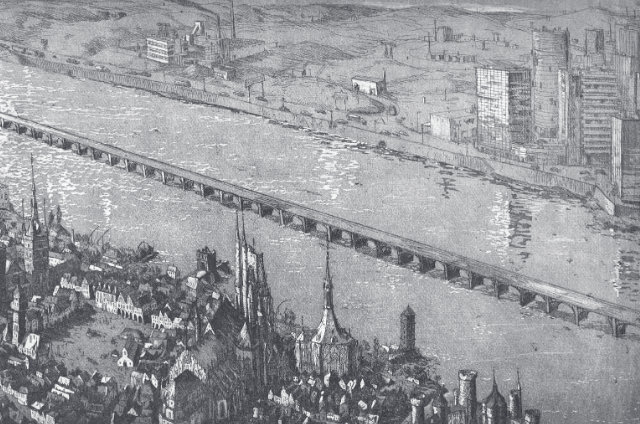
“The Bridge” (1976), by Jan Soucek. Michl: “In the [historicist] view of the modernist architects, the past and the present are seen as two separate worlds, and tht is why they ought not to be connected in any manner. Soucek deemed such a conviction preposterous.”

Posted in Architecture, Architecture Education | Tagged , , , , , , , | 8 Comments

London then and now

Screen Shot 2017-04-13 at 7.51.02 PM.png

Piccadilly Circus in 2015 and 1896. (Yestervid)

This video, “Oldest Footage of London Ever,” from Yestervid, one-ups its own videos of old footage of New York posted here a few days ago by including not only the old footage but also side-by-side old and new footage – not stills – of the city, mostly from the early 1900s but as far back as 1890. The helpful maps are there, too. Again, observers nowadays must be mindful that people a century ago saw the “now” clips we see today in crisp living color in equally crisp living color, not the somewhat jumpy, grainy, smudgy, black & white “then” clips on this video. Fascinating nevertheless, especially the people walking along the streets and the horse taxis. “Hop aboard, Holmes! Where to?” How Londoners on foot negotiated the melee of street traffic a century ago defies the imagination.

Posted in Old Video | Tagged , , , , , | Leave a comment

Words that protect a nude

Screen Shot 2017-04-11 at 11.41.46 AM.png

“A Roman Slave Market” (1884), by Jean-Leon Gerome. (Pinterest)

The essay that accompanies the girl being sold at a Roman slave market in the 1884 painting by Jean-Léon Gérôme (1824-1904) tries to cover up the nude with protective words. The writer, Titus Techera, performs an act of charity in his description of the slave girl, her audience who want to buy her, and their relationships with the artist and his own audience (we might add the writer and his audience as well). Techera admits the salaciousness of the painting, distracting us from it and minimizing its leverage over our feelings and, perhaps, helping the girl to feel less exposed. I won’t try to describe the whole essay – better to read it (on the website Ricochet). It is much more straitforward than most examples of art criticism. But here is a passage:

We are the audience of this painting and the scene that attracts our attention has an audience of its own. We are shown the back of a denuded slave girl, as well as her discarded robe, whereas they are shown the frontal view. This may seem like a crazy suggestion, but we need each other to make a whole of our two partial perspectives. The painter, like any of us, knows we have a power in our soul to make wholes of the fleeting, partial things we see. We know what girls look like and this image-making power of the soul would supply what is missing, that we may recognize from an inevitably partial perspective the whole that is a being. That power is our first inner critic, so to speak, letting us know what we see when we look around, and whether the painter has given us an adequate image of that which we know within ourselves.

Gérôme was part of the Academic school of painting in Paris and was among those favored artists challenged by the Impressionists, who held a counter- salon to protest their exclusion from the art establishment. Although the Impressionists did lovely work, the schools of art that followed them lacked not just beauty but the ability to engage an audience with subtle social and psychological commentary on the full range of subjects of interest to society. With the later modernist schools, art became fascinated by itself and itself alone. In what amounted to a hissy fit against realism, art basically threw its own greatest tools into the trash heap. Titus Techera has a good idea of what has been lost. The world of music suffered likewise. Both closely parallel what was lost when architecture threw out the tools of its art.

Posted in Architecture, Art and design | Tagged , , , , , , , , | Leave a comment

Huxtable versus Huxtable

Screen Shot 2017-04-10 at 5.44.32 PM.png

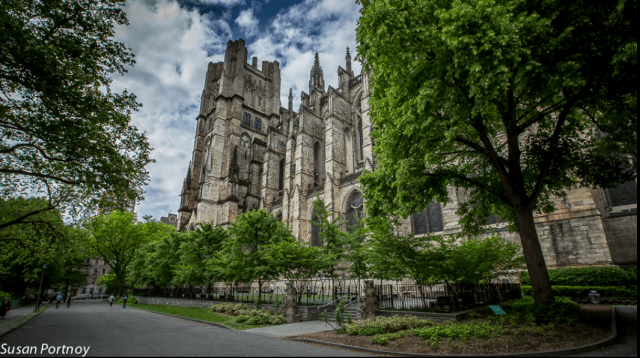
Cathedral of St. John the Divine, in Harlem, New York. (Susan Portnoy/The Insatiable Traveler)

Ada Louise Huxtable’s first collection of her New York Times criticism, Will They Ever Finish Bruckner Boulevard?, is subtitled “A Primer on Urbicide.” The widely admired book, first published in 1970, is less than the sum of its parts. It contradicts itself page by page, often sentence by sentence. Its failure to re- cognize the nature of the crisis of cities is total. Her columns pit her support for modern architecture against her support for historic preservation. The latter makes no sense in light of the former. Preservation is necessary only because of the threat to cities posed by modernism. Each old building pre- served is a job robbed from a modern architect. They are natural enemies.

Screen Shot 2017-04-10 at 5.21.22 PM.png

(Wikipedia)

But for decades, in part because of the influence of Huxtable’s writing, preservationists have been in bed with the modernists, who have persuaded them to play down their original purpose of saving historic buildings in favor of modernist interventions in historic districts and saving mid-century modern architecture. Huxtable, who died in 2013, has been a primary source of the sort of thinking that nowadays makes it hard for preservationists to support efforts to strengthen the setting of preserved buildings, in part by supporting new buildings today that would have inspired preservation efforts yesterday.

The ham-handed slabs she prefers will never spark a preservation movement.

Huxtable’s columns were published weekly on Sundays in the Real Estate section between 1963 and 1982. In later years she wrote for the Wall Street Journal. As I said in a post on April 1, “The Huxtable joke’s on us,” she ima- gined herself a thorn in the side of the architectural establishment when in fact she was its tribune. She fell hook, line and sinker for the full modernist credo: that modern architecture expresses our times, and that any other type of architecture is obsolete because it is part of history, and therefore not part of the present or the future. Her fiercest barbs were aimed at new architec- ture that compromised with the past or, worse, was inspired by the past.

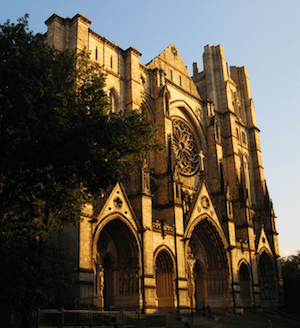
It’s hard to pluck one quote that epitomizes this attitude, but the following passage from her Dec. 4, 1966, column “Of Symbolism and Flying Saucers” will do. It is about the Cathedral of St. John the Divine, in New York’s Morningside Heights. Begun in 1891 and, with a shift in style from Romanesque to Gothic two decades later, it remains incomplete.

The misconceptions of its builders are reflected accurately in the vicessitudes of its construction. When a church evolved from Romanesque to Gothic from the eleventh to the thirteenth centuries, art and history, not a board of trustees, made the decision. When St. John the Divine was redesigned from Roman- esque to Gothic, Ralph Adams Cram, the Gothic revivalist who replaced the original firm of Heins and La Farge in 1911, opted for the change, and it really didn’t matter. It was not important because neither style grew out of the conditions of the time. …

Out of context, the formula is not reproducible. The same moment and the same results never come twice. Archaeological copying will not make it so. This is an ineluctable reality of art and life. Until it is understood, we will continue to have the pious repro- ductions, the dead reconstructions, the vacuum-packed imitations and the false, nostalgic standards that, at best, evoke only the second-hand suggestion of the artistic glories of some other age, or at worst, throttle creativity and subvert values in our own.

Here Huxtable clings, as always, to her “of our time” mantra. If any of it were valid in the least, then all architecture prior to modern architecture would be illegitimate, because all architecture that predates modernism was based on adherence to precedent. The architects of St. John the Divine were copying only to the extent that they were inspired by earlier work. The client/trustee changed his mind for reasons of fashion (Huxtable assures us) in 1911, but that did not invalidate the work done before or since. There is no specific church they are seeking to replicate stone by stone. Their meticulous labor well reflects the sort of meticulous labor of the pre-Renaissance cathedral builders. Huxtable’s framing of this process as lacking in creativity is a form of dishonesty. Her own writing has made “copying the past” a sort of sin in which specificity falsely stands in for generality. (Almost no new buildings literally copy old buildings.) Her assurance that the new cathedral could not reflect its time assumes that every age is a unitary event; no, it is a collection of a million complexities, most of which flow from the years before. She might have a point if she were decrying work done poorly rather than well, but she was not. She was decrying the use of precedent in art. In short, she was a fool. Hers was a mistake of profound misunderstanding – if she actually believed her own nonsense.

Huxtable makes her errors again and again because she buys into a fiction created by architectural historians covering up for the errors at the root of modern architecture. Historical buildings are pigeon-holed into styles ap- propriate to specific periods based on their differences from styles before and after. However, architectural history is much more a continuum of stylistic change, punctuated by revivals, not a series of more or less discrete jumps from one period to the next, reflecting some sharp turn in the character of a period of time, from which each style allegedly springs. Historians struggle to understand historic periods with the tools of language, thought and hind- sight – architects working in mute materials can hardly be expected to speak with any genuine coherence. Throughout the entire string of architectural periods, old buildings are much more alike than different. That is why his- toric buildings of diverse styles fit so well together on a street. Only since the advent of modern architecture has fitting in been a problem.

Most old buildings spring from the Greco-Roman classical orders (or their predecessors in Egypt and elsewhere). Some adhere rigidly and others loosely, often very loosely, to those ancient precepts. Change came slowly, with successive generations of builders, craftsmen and architects adopting the best practices and technologies to bring measured change that fulfilled the needs of humans and societies far more usefully and creatively than the revolutionary change of modern architecture. Traditional architecture and urbanism grow organically, a process that mirrors nature itself.

In so doing, old buildings reflect time with far more veracity than either modernism – which abhors precedent (or at least pretends to) – or the fraudulent stylistic periods invented by architectural historians and em- braced by Huxtable and her camp followers. This is obvious in any honest and intelligent reading of her collection of columns.

Even her writing isn’t what it’s cracked up to be: her style is often fuddled, no doubt because her ideas lack the cogency required to explicate with clarity. Her prose is not witty but a long sneer at people with whom she disagrees, including the public, for which she has no respect. It is enough for her that modernists may be relied upon to snicker into their sleeves. And yet Will They Ever Finish Bruckner Boulevard should be required reading for every architect interested in correcting the deep and tragic mistakes in the building arts of the past half century and more. Know thine enemy!

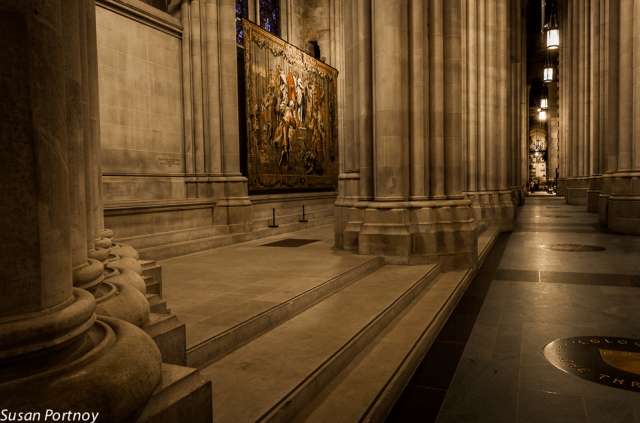
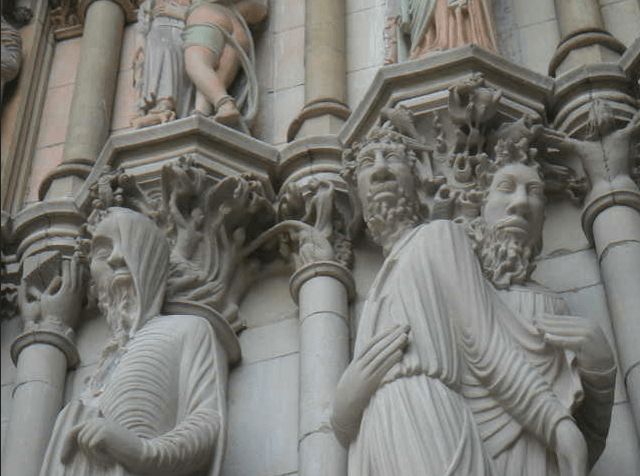
A few more photos of St. John the Divine are below, to counteract the slan- der of the critic.

Screen Shot 2017-04-10 at 8.26.10 PM.png

Screen Shot 2017-04-10 at 5.45.26 PM.png

Screen Shot 2017-04-10 at 5.46.16 PM.png

Screen Shot 2017-04-09 at 4.11.20 PM.png

Screen Shot 2017-04-09 at 4.07.56 PM.png

Screen Shot 2017-04-09 at 4.09.10 PM.png

Screen Shot 2017-04-09 at 4.10.05 PM.png

Posted in Architecture, Books and Culture | Tagged , , , , , | 8 Comments

New York then and now

Screen Shot 2017-04-08 at 8.38.03 PM.png

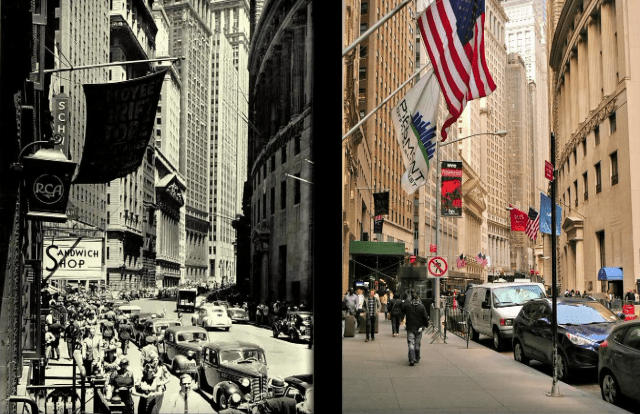
Broad Street looking toward the New York Stock Exchange. (Cora Drimus)

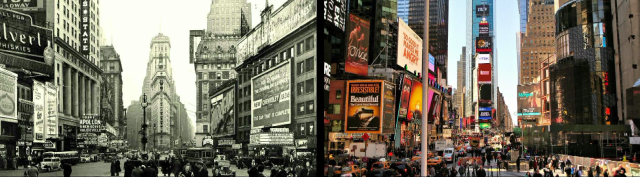
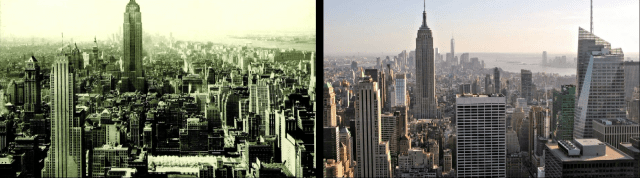
Yesterday I posted a series of film clips shot between 1896 and 1905, and urged readers familiar with the city to use the tools supplied with the video to imagine what those places look like today. Well, a reader, Barry Schiller, found a video in the YouTube list next to the one I had posted, titled “Once Upon a Time in New York,” that does just that – a video that places still shots of the same place and the same angle from the past and the present next to each other. You don’t have to know the city intimately to see what time has wrought. Some of the shots force us to recast our assumption (mine, at any rate) that New York has gotten uglier. That feeling might give rise to an internal debate on the influence of black & white versus color on one’s assessment of the relative allure of any given pair of shots. Whatever your conclusion, the juxtapositions are fascinating.

The new photos were taken by Cora Drimus in April of 2014, who conceived the idea for this video and edited it. The old photos come from a variety of sources, including shorpy.com, Facebook.com/OldNewYorkImages, and two books, both called New York Then and Now, by E.B. Watson and E.V. Gillon and by M. Reiss and E. Joseph, respectively.

Screen Shot 2017-04-08 at 8.37.04 PM.png

Screen Shot 2017-04-08 at 8.38.53 PM.png

Posted in Architecture | Tagged , , , , | 1 Comment