Manhattan puddle mystery

Screen Shot 2017-06-06 at 2.18.40 PM.png

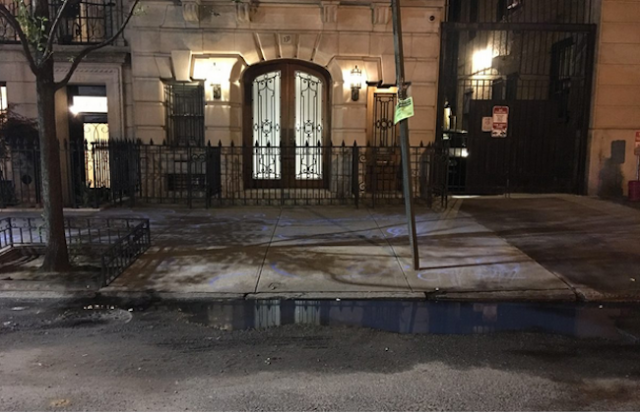
Puddle on E64th St. between Park and Lexington avenues. (This East Side)

Here is a story worthy of the literary bent of the author of the book A Burglar’s Guide to the City.” Geoff Manaugh has a blog, wittily framed as BLDGBLOG. The letters seem to read “blog-blog” until you look at it more closely. Manaugh’s building blog concerns itself a lot with the infrastructure of cities. Now Froma Harrop, in her This East Side blog (it used to be the Silkstocking blog), reports, in “Mystery of the East 64th Street Puddle,” on the mysterious origin of a puddle on the Upper East Side that never seems to go away. To be sure, if I lived on the UES I would never go away either.

Harrop springs a pop quiz on her readers:

The East 64th Street puddle is caused by:

  • A broken fire hydrant
  • A leaky underground pipe
  • A washing machine dumping its rinse cycle onto the street
  • None of the above.

And the answer (otherwise it would not be much of a mystery) is “None of the above.” It turns out that the puddle is in fact not a puddle at all but a spring that feeds the De Voor Mills stream – an underground aquifer that is one of many brooks and streams that were buried, paved over, possibly redirected but not snuffed out, and which survives under who knows how many levels of pavement. Calling Dr. Manaugh! Assistance on East 64th Street! Required to determine the layers of infrastructure that lie between the “spring” and the sidewalk! Its gutter never says adieu to the puddle, which many scorn as a source of mosquitoes.

When I lived in the Smith Building in downtown Providence, there was a puddle that frequented the rutty asphalt pavement just outside the front door. I used to enjoy taking pictures of the banking towers of Fulton Street (Kennedy Plaza) as reflected in the puddle. In 2011, the year after we moved out of the Smith, the “street,” really an alley, was paved over nicely, no doubt just to spite the departing architecture critic. This no doubt meant doomsday for the poor puddle, which probably did not have a hidden stream to assure its longevity, as the East 64th Street puddle has.

Screen Shot 2017-06-06 at 2.39.30 PM.png

Viele’s Map of 1865 shows path of De Voor Mills stream under East 64th Street. (TES)

Posted in Urbanism and planning | Tagged , , , , , , , , , | 3 Comments

Warp speed in St. Petersburg

Screen Shot 2017-06-05 at 2.40.37 PM.png

Normally I’m leery of using fancy video techniques to film beautiful cities. Often the techniques undermine the focus on the beauty. Maybe that’s true in this case, “White Nights in St. Petersburg,” but the virtuosity of the work has totally defeated my skepticism, and it does omit the wilder, much more discombobulating techniques. So here is the video, by Kirill Neiezhmakov, a specialist in time lapse and hyperlapse videography, from Kuriositas.

Posted in Architecture, Video | Tagged , , , , , , | 1 Comment

London bridges standing up

Screen Shot 2017-06-04 at 4.44.23 PM.png

London Bridge in 1616. Drawing by Claes Van Visscher.

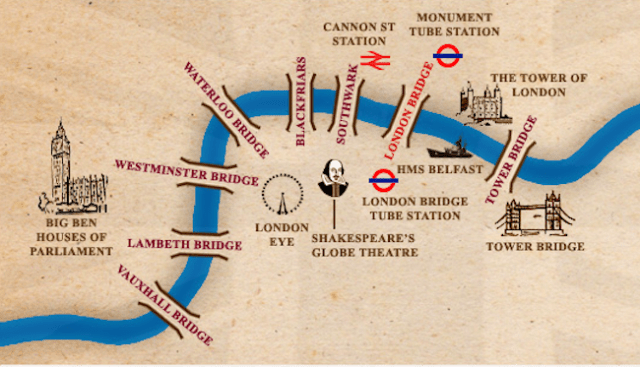
Yesterday’s terror attack on London Bridge follows by about two and a half months a similar attack on Westminster Bridge, four bridges east of London Bridge. Thirty-three bridges span the River Thames in Greater London. The most famous is Tower Bridge, near the Tower of London. The bridge that was taken down and rebuilt in Arizona is not, as some think, the Tower Bridge but an earlier version of the London Bridge attacked last night. That London Bridge was auctioned off to the founder of a planned community in Arizona. The first London Bridge was built in A.D. 50 and (Wikipedia says) rebuilt in 1209 and 1831. The just-victimized London Bridge replaced the 1831 bridge in 1973, after it was found to be sinking into the riverbed of the Thames.

In fact, the old ditty “London Bridge Is Falling Down” does relate to the instability of the bridge that was rebuilt in Arizona. It had been considered “at risk” for centuries. The song has been traced back to the 17th century. In those days, London Bridge had buildings lining the span. Many states, such as Rhode Island, hyperventilate with regularity that their bridges are at risk of falling down. All bridges are at risk of falling down, especially since bridge engineers use computers these days to calculate the strength requirement of bridges before they are built. (Today’s engineers may be more likely to think that they can figure out those requirements exactly, whereas old bridges were engineered with a superabundance of strength because professional humility made for a commendable degree of caution.) I officially raise my eyebrows at Wikipedia’s assertion that the first London Bridge lasted from A.D. 50 to A.D. 1209, or that the 1209 version stood until 1831. Maybe they did.

On a bridgeworthy note, in 2016 a New York City-based artist, Leo Villareal, who designed the lighting for the San Francisco Bay Bridge, was chosen to light up the 17 bridges of central London. His plan appears encouragingly subdued, seeming to avoid the gaudy effects one might reasonably fear in a huge project of “the arts.” A video of it is on the Thames Leisure website.

workflow.arts.ac.uk:.png

The primary bridges of central London. (workflow.arts.ac.uk)

Screen Shot 2017-06-04 at 4.11.59 PM.png

Photo of the Thames showing major spans. Tower Bridge is the bottom. (Wikipedia)

Posted in Architecture, Video | Tagged , , , , , , , , | 2 Comments

D’town PVDfest vids galore

DSCN0837.JPG

We – not the editorial we but the family we, as in me, Victoria and Billy – visited PVDfest in downtown Providence this afternoon – whoa, Nellie! a lot going on! Downtown was jamming. More different types of people than you could shake a stick at, and all enjoying themselves to the hilt. And there were some mighty fine buildings, too, and sometimes my lens was unable to resist the urge to pan them – not to pan them, for gosh sake!, to pan on them!

So there are a number of still shots and then 12 videos running mostly between 30 and 60 seconds each, topped by one lasting a minute and 56 seconds, which was of the irresistible scene flowing past the window of Blake’s, where we have a developing tradition of situating ourselves to watch PVDfest (and its prior incarnations) roll by. I have placed the videos in the order I shot them. The first several are of the scene on Westminster Street, then a couple on Dorrance Street near Kennedy Plaza, then a few from our table inside Blake’s, where we had a ringside seat. And finally a couple taking in the view on Washington Street. Pop through them and see what we saw – second only to being there.

DSCN0838.JPG

DSCN0839.JPG

DSCN0851.JPG

DSCN0852.JPG

DSCN0860.JPG

DSCN0866.JPG

Posted in Architecture, Providence, Video | Tagged , , , , , , | 7 Comments

“Within Walking Distance”

Screen Shot 2017-06-02 at 8.57.43 PM.png

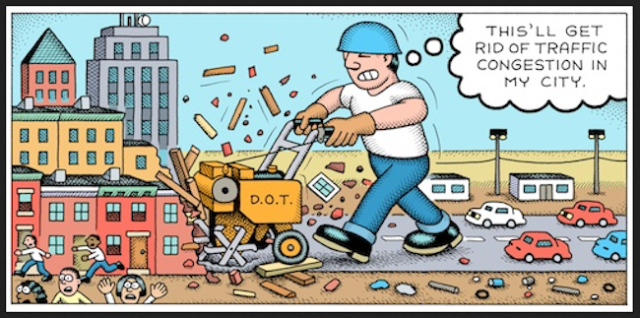
Cartoon by Andy Singer.

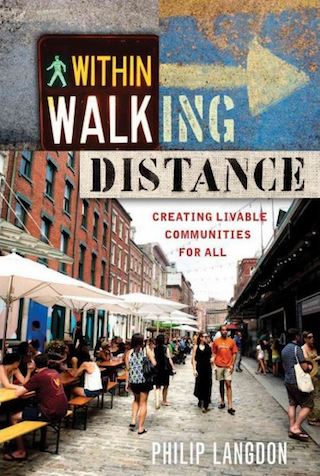
Philip Langdon’s new book Within Walking Distance, published by Island Press, uses six examples of walkable communities to show how they are made. No, unfortunately they do not arise spontaneously, at least not anymore, not since the postwar era, in America, of modern city planning and architecture. Although many municipal planning offices have embraced at least the rhetoric of the New Urbanism (the old urbanism renewed), and sing the praises of Jane Jacobs and her streetsmart urbanism, most cities and towns still retain laws and regulations that make it harder to generate neighborhoods people will naturally want to inhabit.
Screen Shot 2017-06-03 at 11.53.18 AM.png

Andrés Duany, a founder of the Congress for the New Urbanism, likes to say that a historic district is nothing but a typical neighborhood built before World War II. And a historic district is just another name for a walkable community.

Langdon takes as his exemplars of walkability a series of neighborhoods in Philadelphia, New Haven, Chicago, Portland, Brattleboro, Vt., and the “Cotton District” in Starkville, Mississippi. The chapters examine the history of each district, and the cooperation among their inhabitants that went into bringing about, protecting and improving upon the qualities that make the six neighborhoods so livable.

The stories behind their success amount to an education in placemaking, and Langdon – who edited the CNU’s New Urban News for years – tells those tales with a gentle eye toward the extraordinary people who made it happen. The author has a firm grasp of the principles and stratagems that promote walkability, which itself is key to places that are livable and lovable. The book distills them admirably, and so beyond noting this fact I will limit my own comments to highlighting the importance Langdon places on traditional architecture as another such key to walkable places.

For example, in the Northern Liberties neighborhood near the city center in Philadelphia, he cites the Piazza at Schmidt’s (site of a former brewery) as a lost opportunity for commercial development there. He writes:

“Transformational projects” aimed at radically reshaping neighborhoods and revolutionizing their images have been launched in countless U.S. cities since the 1950s. Sometimes they have succeeded, but often they have succumbed to what [Bryn Mawr professor Matt] Ruben calls “a monoculture,” to being “dominated by a certain vibe.” Rundown areas do need new energy, but in most cases a better strategy is to work in a more organic fashion, with smaller increments of development and with close attention to neighborhood context.

The New Haven neighborhood of East Rock features small blocks with short streets. Small blocks are helpful for creating walkability. In a neighborhood of small blocks a pedestrian can map a variety of routes to his destination, deciding which one to take according to his needs or his mood. But what if the blocks are long? Langdon writes:

A couple of streets, Livingston and Everit, had blocks that stretched on for more than a third of a mile. From a pedestrian perspective, that would ordinarily be a problem, but those two 1,900-foot blocks had such beautiful early twentieth century houses that I rarely minded the length.

Langdon goes full archiporn in his description of the streets of Brattleboro, a town I was smitten by when I first visited in 2013. His vivid language suggests his love for the kinds of buildings people actually do love, and the frequency of architectural style in his book suggests its vital role in giving streets a head start toward the goal of walkability.

Straight ahead is a jewel box of a building, three stories high and three bays wide, all dressed up with neoclassical accoutrements: fluted pilasters, lintels with keystones, and windows subdivided into small panes. Nearby are buildings with vigorously indented cornices or parapets, meeting the sky with strength and dignity.

In his chapter on Portland, widely considered the bigger American city that has made the greatest strides toward livability, Langdon clearly enjoys discussing its Pearl District, of which he is so enchanted that he chides its northern sector for going off-message.

As development moved north, there was less context to relate to, and many of the new buildings adopted more contemporary styling. With simple, straightforward shapes, smooth walls, and little or no applied ornament, many of them did not feel as rich or idiosyncratic as the best of the old buildings, but they made a decent backdrop to the streets. …

Langdon quotes a neighborhood planning advocate as saying that after the last recession, “the city was hungry for just anything to get built. You can really feel the difference between the old neighborhood that has context versus the area to the north.”

Langdon quotes a local architect and association member as saying “We want some bolder architecture.” Portland’s planners were listening. An example of what resulted is the Cosmopolitan, at 28 stories of reflective glass the tallest building in Portland. When it opened in 2013, some people were “elated.” Others not so much. Langdon quotes a Rollins College professor, Bruce Stephenson, as saying he “detests” it: “It sticks out. It doesn’t fit in. The glare from it is such a blinding light. … It eviscerates the view you want to have. It destroys any sense of visual continuity.”

Let me take a wild guess that Stephenson is not an professor of architecture!

Langdon quotes an essay in Planetizen by one of the nation’s leading urbanists, Michael Mehaffy, about this wrong turn in the development of the Pearl. Mehaffy, who founded the urbanist think tank Sustasis, wrote:

[I]nstead of clear, predictable form-based codes that guide development to blend sensitively with the scale of its neighbors and mitigate its impacts, the city imposes a subjective game of “impress the design panelists” and “who’s the best renderer” – for drawings that are famously unlike the built result. … Architecture has become a novelty machine, in which the name of the game is to be exciting and dramatic and different – or at any rate like the latest fashion, which is different from the previous fashion, whatever that is. But this is not a problem-solving approach; it’s a novelty-for-novelty’s-sake approach.

Mehaffy has put his finger on one of the broader problems, but while Langdon seems to agree, he nevertheless states: “In the Brewery Blocks, one of the most outstanding developments in the district, new Modern structures and decades-old brick buildings make a dynamic combination.”

Oh? So which is it going to be? The one weakness of Langdon’s book may be that it makes no attempt to suggest a solution to the problem identified by Mehaffy. In my opinion, the solution has as much to do with coordination among local residents as it does in other aspects of neighborhood creation, whose procedures are fully addressed in the book.

The most curious and fascinating of Langdon’s examples is the Cotton District, near the Mississippi State University campus in the college town of Starkville, Miss. It is the long-term project of one man, Dan Camp, a former shop teacher who has pretty much built the neighborhood from scratch by himself. He has a small staff, but it is inspired by Camp, who seems to be a one-man McKim, Mead & White. All of the hundred or so buildings in the Cotton District are classical, often leaning toward the vernacular but always, it seems, slightly off, sometimes purposely so, and with marvelous results.

Architect and planner Sara Hines sent me some pictures of the Cotton District three years ago and was I astonished! I’d never heard of it before. I posted on it, running Hines’s photos, about three days after I lost my job at the Providence Journal. My blog lit up like a switchboard, with thousands of hits coming in from readers of “The Cotton District.” I still have no idea why. Maybe it was because I wrote this:

The permitting and design approval process drives developers nuts in so many places, including Providence, because in most places planning officials do not learn. They do not learn that if developers build what people like, permitting goes down like an oyster. They prefer, for some reason, to build junk, and when resistance arises, they slog through the permitting process and then go home and cry into their beer.

Over the decades, Camp has learned that he’s had an easier and easier time with the planning apparatchiks in Starkville (especially, I suppose, when he was its mayor) as they come to understand his earnest desire to build what people like. He wrote about that on the Cotton District’s website and I picked up on that in my post. Now Langdon picks up on it, sort of, in his book. The passage, if inverted, simply says “Build nice buildings”:

Modernism promulgated the idea that buildings can be designed “from the inside out,” letting the needs of the interior determine the nature of the exterior. For architects, this concept was liberating, but it frequently had the unintentional result of harming the public realm.

I’m not sure how unintentional it was. But of course the average modernist architect does not purposely harm the public realm. Today’s architects are (almost) completely innocent of the philosophy upon which modernism (architectural and otherwise) rests. But what Camp has learned over the decades of his Cotton District project is that it gets easier and easier to handle the local permitting bodies once they understand that you are trying to build things people will actually like. This makes officials look good, as if they are actually doing their jobs, and they appreciate that. But of course you actually do have to try designing buildings that people will like. It’s not rocket science, but it is also not the conventional wisdom.

A few years ago I reviewed Street Design: The Secret to Great Cities and Towns, by Victor Dover and John Massengale. Their fine book collected, assessed and ranked all the principles and instructions involved in making great streets, but here is the secret: you make great streets by lining them with great buildings. Within Walking Distance has pretty much the same charm. Its principles and instructions are valid, but they are secondary. Line the streets of a neighborhood with lovable buildings and it will be – presto, chango! – a walkable neighborhood. The principle could be enunciated in about three pages, but books three pages long often go unpublished. So most authors would rather take it a few steps further. I think in his heart Philip Langdon understands this perfectly well, and that is why his book is so good.

Posted in Architecture, Urbanism and planning | Tagged , , , , , , , , , , , , , | 2 Comments

Fix in on worse Ike Gehry

Screen Shot 2017-05-31 at 8.49.33 PM.png

General Eisenhower speaks with men of the 101st Airborne on June 5, 1944. (National Archives)

Catesby Leigh, writing in City Journal, reports the terrible news about the Frank Gehry designed proposal for an Eisenhower memorial. The formerly skeptical Eisenhower family now backs it. President Trump now backs it. In his proposed 2018 budget, Trump throws $45 million at a project (stiffed for years by Congress) that in every facet epitomizes the swamp Trump promised to drain. Leigh itemizes the counts in that indictment in his essay, entitled “Monumental Folly: The proposed memorial to President Eisenhower becomes even less appealing.”

The subtitle refers to the recent rejection by the U.S. Commission of Fine Arts of proposed alterations. One switches out the Kansas landscape in the design’s colossal “tapestry” for a landscape of today’s beach at Normandy. Another relocates the statue of the young Ike so as to kill off the memorial’s only (if not saving) grace note – the statue of the boy looking in awe at statuary representing his accomplishments as a man.

Leigh brilliantly explains the difference between Gehry’s fatuous exercise in self-indulgence and a real work of memorialization. “The Lincoln Memorial, for example, does not tell us the story of Abraham Lincoln. It enshrines his memory in a majestic temple while the statue within evokes the essence of the martyred president—his thoughtfulness and determination.”

Still, Leigh’s article is the most depressing thing I’ve read in a long time. The prospect of blocking the abhorrent Gehry design, which so recently seemed so close, was the biggest story in architecture, at least in bringing media attention to the important battle between traditional and modernist architecture. “The memorial’s recently anticipated completion date of June 6, 2019 – D-Day’s 75th anniversary – is probably out of reach,” writes Leigh. “But it’s going to get built.” At his essay’s conclusion, with a punchy permit joke, Leigh tries to lift the spirits of those who consider Gehry’s design a paean to himself and an insult to Ike. But he doffs his cap to sad reality:

In a less imperfect world, President Trump’s secretary of the Interior, Ryan Zinke, would refuse to dignify Gehry’s scheme with a building permit. … But that’s a happier ending than the Washington swamp will likely accommodate.

Catesby Leigh believes that the cause has indeed been lost – or so it seems. (Well, I do live in a state whose motto is Hope.)

Posted in Architecture | Tagged , , , , , | 1 Comment

Steve Mouzon’s new book

Screen Shot 2017-05-30 at 11.28.11 AM.png

Cover illustration of another book about Bahamian architecture. (amazon.com)

Steve Mouzon’s excellent book The Original Green reflects thoughts I described in a review of that book and in my 2015 post “Love, beauty, architecture.” One of architecture’s most ambitious and creative thinkers, Mouzon is bringing out a second edition of his 2007 book, A Living Tradition: Architecture of the Bahamas, whose publication he hopes to attain through a Kickstarter funding effort. Everyone who contributes will get a free copy of his and his wife Wanda’s next book, Outdoor Room Design.- assuming, of course, that the Kickstarter goal of $18,000 is reached by 5 p.m. EDT this Friday ($15,565 has already been donated). What follows is the description of the book and the funding effort, including a link to his Kickstarter campaign, all of which is worthy of everyone’s attention:

***

The Kickstarter to publish the second edition of A Living Tradition [Architecture of the Bahamas] has only three days to go and we’re getting close to the $18,000 Stretch Goal. If we reach it, everyone who has pledged any amount gets a copy of Outdoor Room Design, which is an e-book (iBooks or Kindle) Wanda and I are now finishing. So if you’ve pledged support, please spread the word so you get the book, and if you haven’t pledged yet, please consider doing it now.

Outdoor Room Design steps through the process of designing a tapestry of outdoor rooms meant to be inhabited, not just viewed from indoors. It’s a little-known fact that one of the best sustainability moves we can make is to entice people outdoors so they get conditioned to the local environment. When they return indoors, they just might be able to turn the A/C off and throw the windows open… and there’s no equipment so efficient as that which is off.

The book starts with general principles like south-facing outdoors, positive outdoor space, and the really important “hints from houses.” It then lays out a number of room types you might want to consider, such as the hearth garden, dinner garden, breakfast terrace, kitchen garden, couple’s garden, frontage garden, meditation garden, coffee cove, children’s maze, orchard run, motor court/sport court, and even the secret garden. Once the rooms have been laid into the landscape, the next step is to set the borders, then lay out any garden structures. Next comes the water, with a focus on useful water elements that are not solely ornamental. The passages between the rooms are next, then the finishes, fixtures, furnishings, and finally the plant material.

Here’s a typical page screen shot. Again, anyone who pledges any level of support to the Kickstarter gets this book as a reward if we reach the $18,000 Stretch Goal. So thanks in advance for spreading the word… much appreciated! Here’s the Kickstarter link.

Steve Mouzon

Copyright © 2017 Mouzon Design, All rights reserved.
Hi, you’re receiving this email because you subscribed to Mouzon Design updates. Our site is mouzon.com.Our mailing address is:

Mouzon Design

PO Box 191217

Miami Beach, FL 33119

Add us to your address book

Posted in Architecture | Tagged , , , , | 2 Comments

Saving the history underfoot

Screen Shot 2017-05-30 at 10.36.44 AM.png

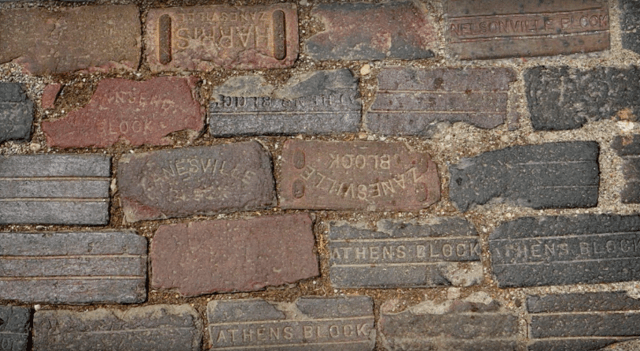
Pavement at Westminster and Eddy streets, in downtown Providence. (Pinterest)

Robin Williams, an architectural historian at the Savannah College of Art & Design, delivered a TED talk to explain “How Historic Street Pavement Modernized the City.” Williams has a pleasant manner that conveys his conviction that historic pavement is a neglected treasure that often is hiding in plain view right beneath our feet. In honor of the operation by the city of Providence to restore its own downtown’s historic pavement (it harks all the way back to the mid-1980s) – but seriously, it is very beautiful, and it is being restored right now – I am posting this video of Williams’s talk in Savannah to explain the vitality and importance of that work, and his own to preserve historic pavement. Here are some choice passages from his peroration:

Pavement is our most democratic form of built heritage. It’s accessible to everyone, and it bridges areas rich and poor. Indeed, there are enough historic pavement areas existing around the country to provide a bridge to the past, helping us to understand the struggle to make our cities livable.  Try to imagine a time before street pavement when all of our streets were dirt. No water mains, no sewers, no pavement. Just dirt. Well, the problem of getting stuck in a muddy street was common enough that it could be satirized, as in this view from San Francisco [see below]. But seriously, dirt streets pose a very important threat to the health and safety of the citizens of any given American city.

[Cities] had to decide what was most important for that street. Was it durability, smoothness, being quiet or being affordable? Because no pavement could be all of those things. Cities experimented with a bewildering variety of pavements. … Wood blocks seemed a promising option. They were smooth, cheap and quiet, like magic, but in wet weather they were slippery, and in southern cities termites and humidity eroded them quickly. In the South, readily available oyster shells were also cheap and provided a smooth ride, but turned to clouds of annoying dust. A more durable option was rectangular Belgian blocks, which were strong enough to take the heavy cart loads of waterfront and warehouse districts in cities like New York and Baltimore and other port cities. But Belgian blocks were bumpy and, worst of all, they were incredibly noisy under the metal hooves of horses. After 1880, vitrified bricks became the most popular and widely used pavement in America. … The development of modern asphalt in the 1920s was a game-changer. [It] was spread over older pavements but with a loss of local identity.

Williams goes on to describe how in many cities neighbors have fought back against asphalt, even confronting contractors with rakes and hoes (and let’s not forget pitchforks) to scrape away the affronting goo as it was being laid.

These two examples from Columbus and Philadelphia illustrate the power of pavement to activate civic pride and to define local identity. … Pavement can even be good for your health, as some researchers in Oregon discovered. … So if you really want to appreciate the distinctiveness of where you live, just look down!

Screen Shot 2017-05-30 at 9.50.50 AM.png

Cartoon mocks muddy streets of San Francisco, circa 1849. (TED talk, YouTube)

Screen Shot 2017-05-30 at 10.06.34 AM.png

Pavement in Ohio from image in Robin Williams’s TED talk. (Screenshot of YouTube)

Posted in Architecture, Landscape Architecture, Preservation, Video | Tagged , , , , , | Leave a comment

More on Penn Sta. rebuild

Screen Shot 2017-05-27 at 1.48.14 PM.png

The Gothamist yesterday ran a long article by Jake Offenhartz, “A Dramatic Plan to Rebuild Penn Station & Restore its Lost Grandeur,” that explains the several initiatives involved in the proposal to rebuild Penn Station in its original Beaux Arts style.

The first would be to bring the idea to the attention of the political, bureaucratic, design and corporate elites who control the station’s future (if anyone does). The second would be to incorporate rebuilding the McKim, Mead & White masterpiece (opened in 1910 and demolished in 1963) into evolving plans to upgrade Penn’s transportation system, which is literally falling apart. A vital and creative proposal to solve cascading problems with the rails and platforms would involve turning Penn from the terminus of the Long Island Railroad and New Jersey commuter rail into a through station. A third would be to flesh out the MM&W design, preserved in a set of all 353 blueprints at the New York Historical Society. It must be meshed with new materials and technologies, with modern needs, and commercial facilities that would revitalize the area around the station, said to be undervalued by 30 percent compared to the area around Grand Central Terminal.

Architect Richard Cameron of Atelier & Co. proposed this plan a couple of years ago after having thought it through for more than a decade. He has been joined by the National Civic Art Society, led by Justin Shubow, which, one hopes, might be able to put a bug in the ear of President Trump as part of his infrastructure program. Newly enlisted behind the Rebuild Penn plan is an urban policy center, RethinkStudio, whose director, Jim Venturi, was first to reimagine Penn as a through station.

So far, New York Gov. Andrew Cuomo has not acknowledged the Rebuild Penn plan. His proposal for a lame renovation that would address none of the station’s or the system’s main problems has been opposed editorially by the New York Times, but the newspaper has come out strongly in favor of a proposal to move the Garden to the Farley Post Office next door and replace its circular structure with a glass drum. Better than the current situation but … yawn! Moving the Garden is a necessary step in any useful plan for Penn; the Farley is now envisioned, however, as an extension of Penn for Amtrak, an elegant step that still would not solve the system’s mounting crises.

The general awfulness of Penn Station today is made all the more painful by the grandeur of the first version. Inspired by the Roman Baths of Caracalla, the original McKim, Mead and White masterpiece featured 150 foot glass ceilings, pink granite walls, and 84 Doric columns.The general waiting room, large enough to fit the entirety of Grand Central Station, possessed nine acres of travertine and granite. Summarizing the difference between that station and the one that came after it, architecture critic Vincent Scully famously said: “One entered the city like a god; one scuttles in now like a rat.”

I had been unaware the Grand Central Terminal could be fit entirely into the waiting room of the original Pennsylvania Station. It seems evident that rebuilding Penn Station in its old style within a broader revitalization of the area for commerce would transform the neighborhood, raising revenue in such a way as to minimize the cost to taxpayers of the entire project. More important, it would retrieve part of the city’s lost soul. It would, one might dare to say, make New York City great again. If only someone could be got to listen and hear the argument for Rebuild Penn.

The drawing above and those below are by Jeff Stikeman for Rebuild Penn.

Screen Shot 2017-05-27 at 1.39.37 PM.png

Screen Shot 2017-05-27 at 3.17.46 PM.png

Posted in Architecture, Development | Tagged , , , , , , , | 5 Comments

Own a free villa in Italy

Screen Shot 2017-05-26 at 7.44.54 PM.png

Torre Angellara in Salemo (all photos courtesy Agenzia Del Demanio)

Truly! Since not everyone is logged in to the roster of programmes gushing from Italy’s bureaucracy, such as it may be, check out this from the website Hyperallergic. Yes, Italy is giving away free castles, villas and other unused historic state-owned properties. The one catch, if you can call it that, is that you have to restore the property and turn it into a hotel, restaurant or other attractive spot for walking and biking enthusiasts.

Italy Is Giving Away 103 Historic Buildings,” by Claire Voon, displays 10 of the 103 properties (there will be future rounds of give-aways) and describes the program:

The Cammini e Percosi (Paths and Tracks) program, launched by the State Property Agency and Ministry of Cultural Heritage, arises as a unique way to promote the country’s treasures that lie off the beaten path. It’s also intended as a solution to the overcrowding of popular urban destinations, from Rome to Venice, and one that theoretically guarantees the longterm oversight of neglected sites.

“The project will promote and support the development of the slow tourism sector,” Roberto Reggi, a spokesperson for the State Property Agency, told The Local. “The goal is for private and public buildings which are no longer used to be transformed into facilities for pilgrims, hikers, tourists, and cyclists.”

So, no, you won’t be able to snag a slice of Rome on the cheap, but wherever you snag your villa or castle, it can’t be very far away from the Eternal City. And you may even learn to enjoy being out of the hubbub, making eternal friendships with the relaxed folk who have been sucked into the meandering maw of the slow tourism movement.

Hey! All you conquistador wannabes! Just do it! Veni, vidi, vici and all that!

Screen Shot 2017-05-26 at 8.04.22 PM.png

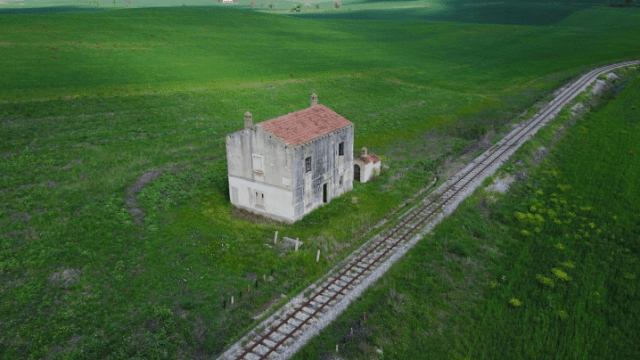
House in Irsina.

Posted in Architecture, Development, Preservation | Tagged , , , , , , , | Leave a comment