R.I. State House at risk

cdnassets.hw.net.png

Providence Station with State House at left beyond. (cdnassets.hw.net)

Rhode Island transportation officials want to spend millions in tax money to accomplish a goal achievable for mere thousands, and to do so in part on the State House Lawn. The Capital Center Commission, which has overseen the development district’s degradation for over three decades, seems suddenly reluctant to allow this latest desecration, which has mushroomed in cost and ambition, threatening views of the vintage 1901 State House in violation of the commission’s own bylaws.

The Department of Transportation first proposed a subsidiary bus hub to take pressure off the main bus hub at Kennedy Plaza and to provide a link to Providence Station, built in 1986. The work was to be done with $35 million in bond money approved in 2014, ostensibly to build the sub hub atop Amtrak’s rails as they emerge from beneath the station heading north. But now the plan has changed. The sub hub will be the main hub, replacing rather than relieving the hub at Kennedy Plaza. The proposal has grown to include private investment, which has morphed, at least partially, into space for state offices – that is, DOT was unable to locate a plausible private participant in the project. Last month, the state re-issued its call for developers to partner with the state.

This evolution seems to have taken place largely under the radar, with little input from the public. Either that, or coverage of the issue by the shrinking Providence Journal has been extraordinarily sparse.

Today’s story on the latest plan is “Grounds for debate: Capitol-area development project would be built on land including State House lawn, trees.” Written by Patrick Anderson, the article makes no mention of a proposed “skyline-altering” tower, mentioned in a June 12 story, the last one published on this topic. Troubles with the tower and other aspects of the proposal were noted in an April 17 story. The possibility of a tower was first mentioned in a Sept. 2, 2016 story. One can only hope it went unmentioned in the latest story because that part of the project has evaporated.

The original goal of the bond was mainly to provide a link for train and bus passengers who now walk a long three or four blocks between Kennedy Plaza and Providence Station. That could be achieved with a bus or trolley loop from the plaza to the station at a cost of mere thousands annually.

Instead, we now have the prospect of a major development project consisting of several new buildings in open space on either side of Providence Station, blocking views of the State House. Renovating Kennedy Plaza seems to be on the back burner, after changes that removed the beautiful Art Nouveau bus waiting kiosks in 2015. I have heard no word at all – or seen any mention at all on relevant official websites – of the lovely plan by Union Studio for Kennedy Plaza. Has it been “frog marched” out of the picture, as I said in a 2014 column, “Let’s ruin Kennedy Plaza“?

Buses will apparently still run through the plaza, but if it is not to be a major bus depot, what will become of the Intermodal Transit Center built there just a decade and a half ago?

At least one cynic fears that the whole charade has been intended to clear out the plaza’s homeless, panhandling or otherwise riff-raffy population, a suspicion that recently grew after the city passed legislation to ban tobacco smoking in and around the plaza. (I have spent years walking and taking buses in and out of the plaza without being troubled by this element.) Where will these people go? Will they remain blissfully unaware of where the buses are going? Will the city and state have to devise new social and legislative strategies to prevent them from migrating north to nearby Capital Center?

As an aside (but one that picks at one of my usual scabs), I note that today’s Journal story quotes DOT’s description of the new bus hub’s architectural program, which is to:

create a smart and enduring bus facility that from a design perspective complements the historically significant Rhode Island State House and surrounding Capital Center, but stands out with an aesthetically attractive design that alters the traditional perception of a bus terminal.

Huh? So it complements the State House and its setting but alters the traditional perception of a bus terminal? This smacks of the confusion that has driven development in Providence for decades, and more particularly those who oversee it. You can’t have it both ways, and if you try you will irk both sides. But the sentence does helpfully suggest that Ocean State design apparatchiks realize they must contend with two opposing forces around here – those who favor tradition (the public) and those who generally object to tradition (the design elite). Governor Raimondo should know which side her – and her state’s – bread is buttered on.

But alas, she does not. If she did, the process of economic development would become less cumbersome and enervating at the snap of a finger. Let’s hope she thinks for one minute about this. Development that strengthens Rhode Island’s natural brand of historic beauty instead of undermining it would save both time and money. Something has gone wrong in this new public/private project near the State House, and it would be easy to set it right. But is that likely to happen? Of course not.

Former Capital Center Commission chairwoman Leslie Gardner, who was at Tuesday’s design review meeting, was quoted by the Journal as calling the plan “a little bizarre.” She is correct, but it seems bizarre coming from  the same Leslie Gardner who, after she and the commission spent 1995-2000 approving for the district architecture of traditional style that does fit into its setting (such as Providence Place), then called on developers to instead offer something “different.” The GTECH (now ITC) building and other disasters near Waterplace Park were the result.

At the end of the article, she remarks: “When the rivers were moved, there was a hue and cry of what would be at risk, would it be compatible with historic structures, particularly the State House.” Good grief! Now she gets it?

I myself would be more inclined to support this plan if the new architecture along the east side of a newly realigned Gaspee Street were designed to pay homage to the old and new architecture along the west side of Francis Street. A view up Francis Street of the State House visible between two sets of classical buildings, as great buildings in Europe often pop into view suddenly, could well be worth losing the open space at risk today.

Screen Shot 2017-07-13 at 4.46.24 PM.png

Suggested buildings (in gray) on open space near State House. (RIDOT)

designcollective.com.png

Red lines show land contemplated for new buildings. (RIDOT)

Screen Shot 2017-07-13 at 5.24.45 PM.png

This is not the plan but a map from a charrette for the Providence 2020 masterplan, included here to convey the distance from Kennedy Plaza to Providence Station. (designcollective.com)


Posted in Architecture, Development | Tagged , , , , , , , , , | 2 Comments

A timeline of “authenticity”

Screen Shot 2017-07-11 at 12.38.52 PM.png

Bonaguil Castle in the Aquitaine. (eupedia.com)

Authenticity must rank near the top of the list of dubious words. Authentic has been split from its original meaning and used to brush a patina of merit upon many dubious ideas. A good example is its use by the late architecture critic Ada Louise Huxtable to distinguish genuine creative design from what she calls “copying the past.” Since almost every advance in every field in the sciences, technology and the arts has relied on previous advances, the idea of progress unattached to the past is the height of absurdity. And yet that is the conceit of most modern architecture today.

Here is a more useful take on the word from the novel Timeline, written by Michael Crichton in 1999, two years after the publication of Huxtable’s notorious (my word) book The Unreal America. In that book she seeks to show that new traditional architecture brands America as culturally wedded to inauthenticity. She equates all new traditional architecture with Disney theme parks. Huxtable’s notion that modernism represents genuine creativity and thus genuine authenticity turns truth on its head. Crichton’s passage below seems almost a direct rebuttal to Huxtable’s thinking.

Timeline tracks a corporation’s development of quantum technology that enables it to send a team of archaeologists back to the Middle Ages to rescue a colleague trapped in a French castle just before a major battle during the Hundred Years’ War. The company’s CEO plans to give a speech to investors describing the technology’s potential to help historians and archaeologists better understand and learn from the past.

In practicing his speech, the CEO, Robert Donziger, states:

“Authenticity will be the buzzword of the twenty-first century. And what is authentic? Anything that is not devised and structured to make a profit. Anything that is not controlled by corporations. Anything that exists for its own sake, that assumes its own shape. But of course nothing in the modern world is allowed to assume its own shape. The modern world is the corporate equivalent of a formal garden, where everything is planted and arranged for effect. Where nothing is untouched, where nothing is authentic.

Up to this point in the speech, Crichton seems to be channeling Huxtable. But he goes on:

“Where, then, will people turn for the rare and desirable experience of authenticity? They will turn to the past.

“The past is unarguably authentic. The past is a world that already existed before Disney and Murdoch and Nissan and Sony and IBM and all the other shapers of the present day. The past was here before they were. The past rose and fell before their intrusion and molding and selling. The past is real. It’s authentic. And this will make the past unbelievably attractive. That is why I say the future is the past. The past is the only real alternative to– Yes? Diane, what is it?” He turned as she walked into the room.

“There’s a problem in the transit room.”

Substitute for “the past” the words “architecture before modernism” and you have a call to move into the future by continuing to evolve according to the more authentic design principles that had shaped the previous two or three thousand years. This applies in all fields that have abandoned home truths and traditional practices – for example, cuisine, which has largely emerged from its Rice-A-Roni bout of midcentury modernism. Likewise, we ought to move beyond GMA – genetically modified architecture.

When, toward the end of the book, it appears to Donziger that flaws in the technology will be fixed and the stranded team of researchers will be rescued, he actually gives his speech. Only then do readers learn (surprise!) that he plans to apply the technology not to science, history or scholarship but to creating a new sector of the entertainment industry in which people will pay to travel to a historical period of their choosing.

So it appears that as far as authenticity goes, it’s the same old same old. New traditional architecture is clearly part of the alternative. Without it, modern architecture will lead to the fearful authoritarian world imagined by Orwell, Huxley and Bradbury or in films such as Ridley Scott’s Blade Runner. Those dystopian books and films were set in a fictional architecture of modernist machine sterility and inhumanity. Must we like it or lump it? Stay tuned! (Indeed, there is a movie. See Timeline trailer. Where’s my Netflix?)

Posted in Architecture, Video | Tagged , , , , , , , | Leave a comment

The cat and the bunny

Screen Shot 2017-07-10 at 6.00.13 PM.png

I shot this brief video earlier today in a state of astonishment. I had just returned home and saw our cat, Gato, sitting out on our front stoop with a strange bunny. They sat as I approached. I hoped to get inside and fetch my camera. I did so, left by the back door and came back around front, expecting they’d be gone by the time I returned. But they were there, and they stayed for a bit, as you’ll see. This video, unedited, is a minute and seven seconds.

I cannot think of any way to relate this to architecture, except perhaps by a recent post of mine, “Duo vs. the style wars,” in which I interpret a line from a piece by Duo Dickinson as wondering “Can’t we all just get along?” If Gato and this local bunny can get along, maybe so can classicists and modernists. Although it might be fun, I will not attempt to suggest which creature most closely represents which stylistic model. (Not that I necessarily think it would be a good thing if the two architectural camps were to get along; still, it is hard to be against comity.) The video is below:

Posted in Architecture, Humor, Video | Tagged , , , , , , | 14 Comments

Hamburg in the crosshairs

Screen Shot 2017-07-09 at 12.20.29 PM.png

Hamburg canals split off harbor. (wall.alphacoders.com)

The annual G20 conference of the world’s major economies met in Hamburg last week, with leaders convening in palaces and demonstrators rioting in the streets. It brought to mind the cheerful violence that greeted me and my brother, Tony, on a tour boat trip during our visit to the North Sea port back in, I think, 2003. We began on the city lake and ended up plying rivers with campgrounds and beer houses along verdant shores, from which groups in small boats would embark, approach, then launch attacks with hand-thrown water balloons at our boat. We would duck behind the gunwales. (Sorry, no shots of projectiles in mid-flight; the fotog was busy ducking!) Fun, but a bit edgy, given the scruffy look of most of our interlocutors. Some of them may also have been in launch mode at last week’s summit.

The video here is a German product. The weather is gray and Christmas is near. There is no narration (but a couple of musical interludes that may be zipped through). The video demonstrates very graphically how difficult it is to meld modern architecture into the architecture of history and tradition, of which Hamburg still has long stretches. But the Germans, too, are trying to find a middle way that works, such as seems to be on display in the long, curved, then sharp, mainly traditional building pictured in the screenshot below. Nah, turns out to be from the 1920s. Oh well. Beneath that is another shot of Hamburg’s canals. The shot on top of this post shows the same canal scene today lit at night. Finally are a few shots from our Hamburg visit a decade and a half ago, with apologies for the flawed photography.

Screen Shot 2017-07-09 at 11.55.02 AM.png

Screen Shot 2017-07-09 at 11.48.38 AM.png

Screen Shot 2017-07-09 at 12.36.57 PM.png

Screen Shot 2017-07-09 at 12.17.44 PM.png

Screen Shot 2017-07-09 at 12.41.06 PM.png

Screen Shot 2017-07-09 at 12.41.55 PM.png

Screen Shot 2017-07-09 at 12.16.47 PM.png

Screen Shot 2017-07-09 at 12.43.13 PM.png

Screen Shot 2017-07-09 at 12.15.50 PM.png

Posted in Architecture, Video | Tagged , , , , | 2 Comments

Tom Low’s village progress

Screen Shot 2017-07-04 at 1.09.34 PM.png

Photo of completed stage of Pocket Court Project near Asheville, N.C. (Tom Low)

Last February and before that, in December, I posted “Is this possible anymore?” and “Christmas card community” about village architecture. Both mentioned architect Tom Low’s plan for a village near Asheville, N.C.  At the time, the pocket neighborhood he had in mind existed mostly in his head. Maybe there was some beginning foundation work. There were drawings evoked, it seemed to me, by French villages that had piqued my interest in “Is this possible anymore?” (We can land a man on the moon, so why can’t we …”). Coincidentally, I am reading a 1999 novel, Timeline, by Michael Crichton that takes place in villages and castles along the Dordogne River, near the town pictured in the bottom photograph. Its protagonists find themselves transported to 1357.

Anyway, Tom has now posted to the TradArch list photographs of progress on the first phase of the village near Asheville he refers to as the Pocket Court Project. One is above and the others below are accompanied by a drawing of the original idea from above. So to the question I posed in “Is this possible anymore?,” the answer clearly is yes.

By the way, Low, whose excellent website is called “Civic By Design,” conveyed in an email to the TradArchers the product of a recent whimsical midsummer’s notion and gave me permission to pass it along to readers of this blog. He writes:

Regarding the next phases this is an open question. I have this idea to pitch that if we could attract 10 of the architects on this list to bring their client investors and commission one house each on the remaining lots, can you imagine the showcase we would have for traditional and classical architecture!? Each lot averages about 3500 sf. with some smaller and some larger with the option of including a carriage house.  If any of you are interested and capable of joining in on this group idea please let me know as I would love to pitch it to my partners.

Sounds good to me. He has received some positive feedback thus far. Maybe some architects not on the TradArch list might also be interested. Shouldn’t be too hard to give Columbus, Ind., a run for its money at a fraction of the cost.

Screen Shot 2017-07-08 at 3.16.03 PM.png

Screen Shot 2017-07-08 at 3.16.28 PM.png

Screen Shot 2017-07-07 at 3.21.13 PM.png

Posted in Architecture, Development | Tagged , , , , , , , , , | 6 Comments

Duo vs. the “style wars”

Screen Shot 2017-07-06 at 2.40.32 PM.png

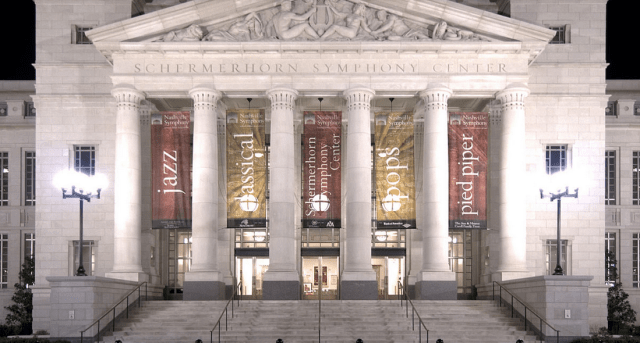
Schermerhorn Concert Hall, by David Schwarz Architects. (Wikipedia)

Architect and commentator Duo Dickinson spends nine-tenths of his essay “Does the New Traditionalism Have a Point?,” on the website Common|Edge, describing new traditional architecture as if it were a recent novelty, a niche phenomenon worthy of a look but without much practical purpose. What’s the point, he asks, as if he did not already know.

After citing chapter and verse how outbreaks of new traditional architecture have been coming on strong of late, Dickinson concludes:

This revived movement may be compared to a “separate but equal” approach of creating a distinct set of rules and criteria for direction and judgment, but it’s really about architects who feel that they are the oppressed and ignored minority rising up to speak truth to power. Rejectionism of any sort is inherently reactionary and shallow. I long for a time when “Good” and “Bad” is sufficient architectural judgment—no style screed necessary.

As Dickinson admits, modern architecture has big problems. “America has felt the failures of Modernism up close and personal,” he writes. And yet “architectural culture, as defined by the vast majority of professors, journalists and ‘thought leaders,’ has a clear bias against traditional styles.”

Nevertheless, after describing valid reasons for the anger of many new traditionalists and a public (let’s not forget them, Duo) that has seen its built environment trashed by modernism for decades, Dickinson trashes those who call for an alternative.

“Irrational and defensive as it seems, the anger against Modernism is real and often absurdly extreme.” “The noise and rancor of these ‘Style Wars’ is reductionist nonsense.” It is “inherently reactionary and shallow.” It embraces a “separate but equal” approach. And anyway, new traditional buildings such as those in two almost completed Collegiate Gothic-style campuses at Yale by Robert A.M. Stern are “Hogwarts.”

And yet Dickinson is one of the few members of the establishment design culture who bothers to acknowledge the existence, if not the validity, of a traditional alternative – one that is in its third millennium, has successfully resisted modernism in the private home market for half a century (as people can choose houses and don’t want modernist ones), and has become a movement not just lately but since the 1960s, when modernist-based criticism of modernism led to the postmodernist movement.

Modernism became a movement over a period of 20 years leading up to its capture of the architectural establishment in the postwar years. Preservation changed from a hobby of antiquarians into a movement just as swiftly and about 20 years later, as average people organized to oppose modernism in their cities and neighborhoods. The classical revival has taken longer to become a mass movement, 50 years and counting, because unlike historical preservation, tradition is actively opposed by the modernist establishment.

But as Dickinson seems to sense, tradition has in fact survived modernist extermination, and is rebounding – now strongly enough that critics like Dickinson cannot ignore it. He realizes that tradition is powerful, and is forced to feign confusion at such an easily understood phenomenon.

Dickinson wonders why can’t we all just get along (“I long for a time when ‘Good’ and ‘Bad’ is sufficient architectural judgment—no style screed necessary”). Just before he attests to his confusion, he quotes architectural theorist Steven Semes, a professor at Notre Dame and director of its new program in preservation, at some length, even though Semes’s words undercut the last remaining modernist excuse – that “we can’t build that way any more.” This mantra has been used time and again to shut down those who can’t see why buildings must look like machines. Why not revive the beautiful, humane places society once enjoyed? He quotes Semes:

The relation between form and technology has been completely reversed since we were in school. With digital representation, 3D printing, and virtual reality capabilities, the idea that ‘the machine’ has any bearing on the shapes and forms that architects design has gone out the window. Anything is possible, so to avoid chaos, one might look to a well-established, visually rich, and culturally resonant tradition as a framework. I see a great opportunity to explore highly innovative new classical expressions making use of all of this technology and encourage my students and colleagues to pursue this.

C’mon, Duo. Come on over to the light side. The view is much clearer over here.


Posted in Architecture | Tagged , , , , , , , , | 10 Comments

Changing cities in China

Screen Shot 2017-07-05 at 11.47.55 AM.png

Shanghai away from its center-city supertowers. (Paulson Institute)

Over a half century or so, China has changed from a largely rural to a largely urban country. The communists had brutal power and used it brutally, a sort of cultural revolution without the violence. China went from cities of small streets stitching together networks of courtyard houses to superblocks on the Corbusier model. Streets went from a lane or two clogged with bicycles to eight or ten lanes clogged with cars. Smog stank up the place, sickened the population, and you couldn’t see much of anything, not that in the New Red China there was much worth seeing.

This situation only grew worse after China decided that it must copy Western capitalism in its infatuation with Western celebrity architects. Beijing’s CCTV headquarters, for example, is designed by Rem Koolhaas, and looks as if it is stomping on the people. In a clear effort to deflect the obvious power of that authoritarian metaphor, they gave the building a cute moniker, Big Pants.

And we’ve all heard about new Chinese cities that are built but not yet occupied.

Now the Chinese seem to be undergoing yet another massive social about- face. Now they desire to at least pretend to be setting a green agenda for their economy. They realize that superblocks and superhighways cause pollution and stultify the mobility of goods and services. So with the signature of a authoritarian edict, China is again trying to do the exact opposite of what it was doing five minutes ago, on a massive scale.

And this, one must suppose, is good. The soft total state is surely preferable to the hard total state, assuming the trains still run on time. Beijing has hired Peter Calthorpe, the leading advocate in America of transit-oriented design, to help China flip from unlivable to livable urbanism. He has been surprised at how open the government has been to planning concepts that take people into account and leave a smaller carbon footprint.

Calthorpe discussed “China’s new agenda” in an interview with the Future of Places Research Network. After answering questions about China’s new green policies and its more sensible urbanism, Calthorpe fielded a question on its shift in architecture:

Q: The government is calling for architecture that preserves Chinese culture—an apparent about-face from the radical designs seen in cities like Beijing. What brought about this change in mentality?

They’ve come to realize that they’ve been destroying their identity and cultural continuity as well as the environment. In a way, we did the same thing in the U.S. when urban renewal gutted our cities in the ’50s and ’60s. We didn’t have historic preservation laws. Piece by piece, great historic buildings came down. In China, the superstar architecture world was wreaking havoc with buildings that looked like they were flown in from outer space. Now, the government is saying [to] focus more on durability, function, and energy efficiency. To modern architects it is controversial, ambiguous, and challenging — to find an architecture that relates to place and climate rather than image.

Q: Do you consider yourself an anti-modernist?

I am for modern architecture, but I want it to be historically, culturally, and environmentally connected to its place. The construction quality and materials in China are such that buildings barely last 30 years. The government is now basically saying, “Let’s make buildings that stand the test of time.”

Good luck with that! If Calthorpe can get that kind of modernism from actual modernists, let’s not hesitate to notify the Nobel Prize committee. Last year, “odd-shaped” buildings were forbidden by edict. (See “Oh to be in, um, China!“) Maybe the Chinese will ramp up their program of copying Western tourist attractions. Not that there’s anything wrong about providing the public with urbanism it likes, even at second hand. It would be interesting to hear what Calthorpe has to say about Chinese “copy the past” cities. Maybe China will decide, under its new agenda, to copy its own past.

Still, all chuckling aside, this is good, and combined with recent news from Steven Semes about change afoot in the American preservation movement (see “News for preservationists“) maybe the future for us all is not so bleak.

Posted in Architecture, Urbanism and planning | Tagged , , , , , | Leave a comment

Beauty, nature or nurture?

Screen Shot 2017-07-04 at 2.10.36 PM.png

United States Capitol (USA Today)

I often repeat the idea that our love for beauty – and for architecture whose ornament stimulates that love – arises from our prehistoric neurobiology. Primitive man on the savannah needed to be aware of details revealing dangers to be met or avoided. Today, we love buildings whose decoration triggers an atavistic desire for detail. Perhaps. But it may be, it surely is, more complicated than that.

The thought was brought to mind yesterday by a passage from Jack London’s 1916 novel The Assassination Bureau, Ltd., about an organization of assassins for hire who will only kill people who deserve killing. But they are constantly arguing about their principles. (Actually, they remind me of Rhode Island’s founder, Roger Williams!) Here is the passage:

“It is a curious problem,” Murgweather continued. “The sacred- ness of human life is a social concept. The primitive natural man never had any qualms about killing his fellow man. Theoretically, I should have none. Yet I do have. The question is: how do they arise? Has the long evolution to civilization impressed this concept into the cerebral cells of the race? Or is it due to my training in childhood and adolescence, before I became an emancipated thinker? It is very curious”

“I am sure it is,” Hall answered dryly. “But what are you going to do about the Chief?”

“Kill him.”

So what are we going to do about beauty? Love it, of course. Or kill it if you are a modernist trained to reject beauty. But maybe primitive man did have qualms about killing his fellow biped, qualms he may have experienced in the form of anxiety. Maybe life forced primitive man to stifle his live-and-let-live preferences and embrace a “live-and-let-die” credo only when rival tribes clashed over the carcass of a woolly mammoth – please excuse me if I have confused my prehistoric eras – and then relapsed into a more natural softheartedness after the battle.

Hmm.

Today is Independence Day, and so we worship freedom. Is our love for freedom innate or has it been pounded into us by propaganda? Love liberty – or else? Tribes among us have different levels of reverence for the idea of freedom, yes? Is this good or bad? Is there a valid parallel here to our love for beauty and our love for life? Discuss.

Hate to leave these questions hanging, dear reader, but the beach beckons.

Posted in Architecture, Books and Culture | Tagged , , , , , , , , | Leave a comment

My Milton Grenfell payback

Screen Shot 2017-07-03 at 1.58.25 PM.png

Proposal for Museum of the American Revolution, in Philadelphia. (Grenfill Architecture)

Strolling through the blogs of Traditional Building magazine’s website, I came across an article by Gordon Bock from two years ago about Milton Grenfell, a Washington, D.C., architect who designs classical buildings. Now, Milton Grenfell holds a lofty place in my heart not just for his work but for having sent a letter to the editor 17 years ago in praise of my writing at the Journal. At a time when deans and professors of architecture at Brown and RISD, among others, were regularly denouncing me on the Journal’s letter page, Grenfell’s letter was timely and extraordinarily gratifying.

Screen Shot 2017-07-03 at 2.02.05 PM.png

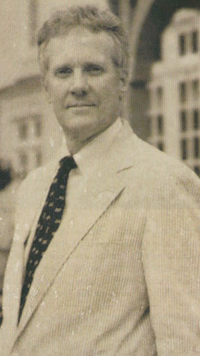
Milton Wilfred Grenfell

Bock’s piece on Grenfell, “Beyond the Call of Duty,” was written after the architect had won TB’s Clem Labine Award in 2015 for his efforts to promote traditional building and arts. TB’s Palladio Awards ceremony is coming up on July 18, in Salem, Mass. And in fact, it is for TB founder Clem Labine’s blog posts that I was searching for when I happened on Bock’s piece. So well written stylistically and of such elegance structurally is Bock’s essay on Grenfell, and so fully does he capture Grenfell’s ethos, that I might as easily have devoted this post to the writer as to the architect he celebrates. But it is Grenfell who once heaped praise on me, so this post is dedicated to him, long, long overdue.

(Posts on individuals, however marvelous, are generally beyond the scope of my blog, as requiring too much subtlety to attempt. In my whole run of 25 years as an architecture critic as an architecture critic at the Journal, I think I have thus memorialized only three: Henry Hope Reed, Antoinette Downing and Bill Warner.)

In a brilliant essay, “Of Time and Architecture,” Grenfell segues from describing the decline in the design and construction of factories as seen from the windows of Amtrak’s Eastern Seaboard line into philosophizing about the decline of architecture in America and, well, supposedly America itself. He writes:

We have been told that our society has grown wealthier over these last 200 years, yet our building record tells a different story. The record we read here is of a civilization entering a dark age. Instead of the settling of a continent as manifested in our nation’s first 200 years of building, begun in 1607, the last 200 years, in Wendell Berry’s memorable phrase, reflect the “unsettling of America.” The record along the rail line speaks of a people who no longer build for the future. And surely, underlying the barbarity of all dark ages is life lived without much attention to the future, much less any hope for it. For barbarians, like animals, only the present moment matters.

Or, as Theodore Dalrymple noted in regard to plans to demolish much of the city of Bath (thankfully thwarted), “The British are barbarians camped out in the relics of an older and superior civilization to whose beauties they are oblivious.” Our eyes tell us this is true of America today – surrounded as we are by evidence of how beauty is built, we continue to build ugliness instead. (I might quarrel over whether this has been the case since 1807, if I may be permitted to take Grenfell literally.) A growing beachhead of new traditional architects has been working against this sad and curious phenomenon, early as it may or may not have begun, for decades. Milton Grenfell is among the most elegant and prescient of its practitioners and theorists.

Here is his letter to the Journal, “Clone Brussat,” on July 19, 2000:

As a practicing architect and sometime town planner, I visit scores of towns and cities around the world, with your fair city of Providence being one of the places that it’s been my distinct pleasure to have visited. It was a double delight, therefore, to discover in The Providence Journal the trenchant, wise and finely crafted architecture/urbanism columns of David Brussat.

When compared with his ostensible counterparts in every other paper I’ve ever read, without exception, his bold and sensible essays stand out as diamonds from coal. He is a jewel that Providence should treasure just as surely as he treasures the many architectural jewels of your city. I suspect that for many I merely belabor the obvious, but I hasten to proclaim his prowess in the knowledge that, alas, a saint is often nowhere without honor except in his own town.

Could Mr. Brussat be loaned out, franchised, or cloned? How the modernism-blasted world of this land cries out for more Mr. Brussats, a man who cuts with lapidary clarity straight through modernism’s monolithic tyranny of the media.

Thank you, Milton!

Posted in Architects, Architecture | Tagged , , , , , | 4 Comments

Dirty truths of modernism

Screen Shot 2017-07-01 at 5.45.23 PM.png

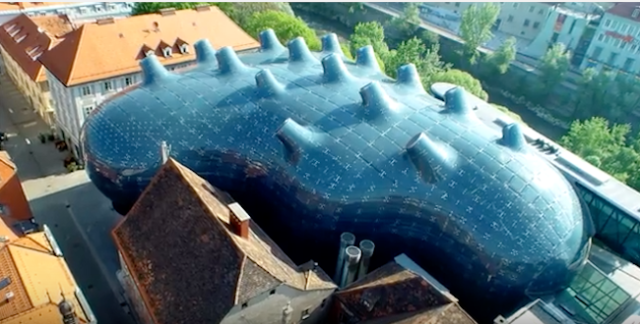
Grazer Kunsthaus art museum in Graz, Austria. (Universalmuseum Joanneum)

Sometimes truth comes out of the mouths of babes. Other times it comes out of the mouths of potty. That does not make it any less true, and since truth on any topic is a rare commodity, Paul Joseph Watson’s pottymouth video “Why Modern Architecture SUCKS” commands attention, and respect.

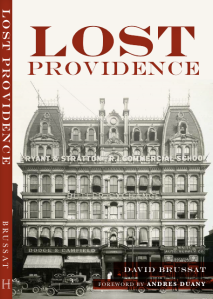
Paul Joseph Watson has every reason to be angry, and so have we all if what he says is true, and every word is true. One need not accept his verdict on modern art in order to accept his verdict on modern architecture. His discourse thankfully includes clips from such generally less pottymouthed thinkers as Prince Charles, Roger Scruton and James Howard Kunstler. (Coincidentally, the latter two blurbed my new book Lost Providence.)

The video is up to date, with a brief segment on the latest modernist abomination, the Grenfell tower fire in London. But while he mentions the totalitarian Le Corbusier, he leaves out Ludwig Mies van der Rohe, who tried to persuade Hitler that modern architecture was an appropriate stylistic template for the Third Reich. Architects never try to explain that away, they just ignore it. The photo above is a plug-ugly I had never seen before, the Grazer Kunsthaus art museum in Graz, Austria.

Toward the end of the video, Watson expresses this overarching truth about our era: “In an age of ugliness, a work of beauty is an act of defiance.” He concludes, “We must never accept ugliness as a form of beauty.” Enjoy.

Posted in Architecture, Video | Tagged , , , , , , , | 12 Comments