“Lost Providence” update

Screen Shot 2017-02-09 at 2.57.40 PM.png

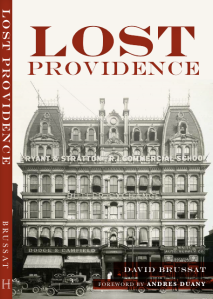
The back and front covers of Lost Providence, on sale August 28. (History Press)

Yesterday, the author’s allotment of five (5) free copies of his book arrived at his happy household in Providence. Today, I started reading it to my wife, and when it goes on sale this August 28 I will start hectoring – oops, I mean lecturing – broader audiences at a series of book events designed to publicize Lost Providence. The book is a history of architectural change in the capital of Rhode Island, and a primer on how citizens can seek to assure that change where they live is good rather than bad.

So far, with the assistance of my publisher, History Press, I have arranged four events. I am amidst negotiations for a dozen others, and have yet to contact yet another dozen or more organizations – schools, bookshops, newspapers, radio and TV stations – that might be willing to offer their patrons the controversial ideas packed into Lost Providence.

Here are the four book events arranged so far:

  • Aug. 28, Symposium Books, 240 Westminster St., Providence: book launch, Monday, time TBA; free
  • Sept. 20, Providence Public Library, 150 Empire St., slide lecture, Wednesday, 6:30 p.m.; free
  • Sept. 25, Rochambeau Community Library, 708 Hope St., slide lecture, Monday, 7 p.m.; free
  • Sept. 28, Preservation Society of Newport County, Rosecliff, 548 Bellevue Ave., slide lecture, Thursday, 6 p.m.; $10 members, $15 nonmembers

Lost Providence will also be available as an e-book. A set of postcards of illustrations from the book will be available in bookstores. This blog will have new pages devoted to the book, including one with illustrations of lost buildings that did not get a chapter in the book or illustrations that further illuminate the theme of the book but did not make it into the book, and a page where readers can share their own favorite lost buildings.

I will list more book events here on this blog as they are confirmed. Below is the house discussed in the book’s first chapter, called “Lost: Benjamin Hoppin House.”

Screen Shot 2017-07-01 at 7.43.03 PM.png

Benjamin Hoppin House, erected 1816 on Westminster Street. (Providence Public Library)

Posted in Architecture, Books and Culture | Tagged , , , , | 8 Comments

News for preservationists

DSCN9817.JPG

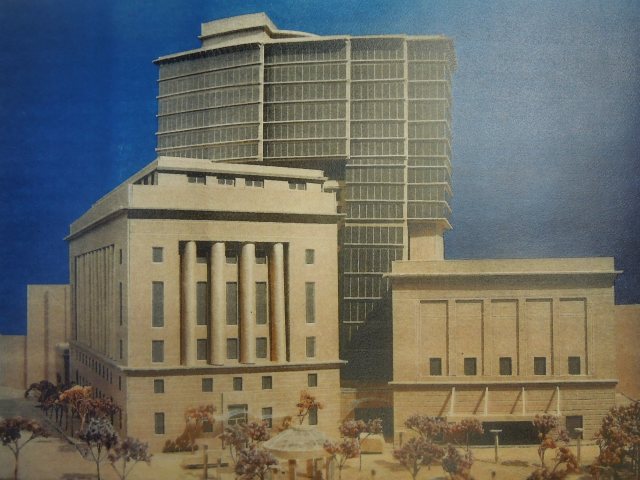
Proposed circa 2000 addition to Masonic Temple, in Providence, nixed by U.S. Park Service, risking demolition of building at left, later renovated as a hotel with traditional addition.

The author of one of my bibles, The Future of the Past, is Steven Semes, the Notre Dame scholar whose thinking pops up on this blog a lot. In 2014, he was named chairman of the new graduate program in historic preservation at ND’s school of architecture, and I am hopeful that his curriculum will reflect the wisdom of his 2009 book. Primarily, it argues that preservation should protect, maintain and augment the character of historic buildings and districts with a mind to retaining their original beauty and harmony.

For decades, preservation organizations have mostly lost focus on that goal.

Semes replied reassuringly: “The new MSHP degree program is more or less premised on the viewpoint of the book.” He added that its “viewpoint turns out to be increasingly mainstream.” He then described what he meant at some length, listing items of news of which I’d been unaware.

Most international bodies and charters setting up principles for historic preservation have, in spite of the modernist turn of their interpretation, for decades, by most theorists and practitioners, “pretty consistently called for harmonious new development in historic settings. … None of them are ringing endorsements of classical/traditional architecture, but an overview of the literature reveals that modernist contrast is not in any way mandated, nor is traditional work prohibited.”

A main exception is the Venice Charter, which is usually interpreted as supporting a modernist call for “contrast” in adding to historic buildings and districts. Some of Semes’s research has lately examined mistranslations in the charter. He writes:

That line in Article 9 about new work needing to “depart from the original composition” and “bear a contemporary stamp” is a mistranslation from the original French text. It doesn’t say that at all. In any case, the idea of “departing” from the composition violates two other articles (6 and 13) in the same Charter. Hence, the modernist interpretation is wrong.

Semes also shared news of positive evolution in the thinking of upper echelons of the American preservation movement.

Stephanie Meeks, president of the National Trust for Historic Preservation, received a standing ovation after her talk at the Congress for the New Urbanism in Seattle last month. Her book, The Past and Future City, is a tribute to Jane Jacobs and the New Urbanists, bringing a strongly urbanist viewpoint to preservation – I would say almost for the first time at this level. There is more emphasis on preservation as a means of community identity and empowerment, and the old modernist-contrast school of thought does not advance that viewpoint very well.

Semes also notes that

[T]he recent statement “Preservation for People: A Vision of the Future,” published by the NTHP, calls for reform of the Secretary [of the Interior]’s Standards. I think things are changing fast and our program [at Notre Dame], once it is fully under way in the coming years, will be riding and leading a wave that is already in progress.”

This is very good news.

The standards for rehabilitation of the Secretary of the Interior are principles that must be followed to qualify for federal preservation grants. Over the years, the standards, administered by the U.S. Park Service, became de-facto guidelines for preservation at the state and local levels, but are frequently misinterpreted as mandating modernist contrast in additions and infill. With that phenomenon in mind, the standards were partly rewritten two decades ago to make such misinterpretation more difficult, but the phenomenon persists, and new language for the standards is being formulated, with Steve Semes in the midst of the proceedings.

The modernist demand for “contrast” reflects a concern that the alternative of “fitting in” will degrade the authenticity of historic districts by fostering confusion as to what was built long ago and what was built yesterday. Such concern, however, privileges matters of curatorial interest over the public interest, which is in the continuity of architecture and urbanism whose preservation arises, in the first place, from a love for their beauty.

Shown in a model on top of this post, a circa-2000 modernist addition was proposed to renovate the Masonic Temple (left, 1929, never completed), in Providence, as a hotel. The modernist addition had garnered the support of almost every preservationist organization in the state, none of which could bring itself to support a traditionally styled solution to the hotel’s need for more rooms. The Park Service rejected the developer’s request for federal historic tax credits, causing Rhode Island’s governor to throw up his hands in frustration and urge that the temple, which had stood unused for seven decades, be demolished. At the last moment, Sage Hospitality, of Denver, a developer willing to erect a more traditional addition, and of much lesser height, rode in on a white horse to save the temple. The hotel project was completed in 2007 as the Marriott Renaissance, pictured below adjoining a historic state Veterans Memorial Auditorium (right). Nevertheless, when the finished project received a host of well-deserved awards, the preservationist community here basked in the glow, forgetting its deplorable role in the building’s close brush with demolition.

All preservationist organizations, public and private, at the state and local levels, should pay close attention to news emerging from the movement’s leading theorists, including the National Trust. Decades of error that have eroded the character of American cities can and should be corrected to return preservation to its roots – and to what no doubt are the expectations of members who support the good work of preservation societies.

Click for more information about the Master’s Program in Historical Preservation at Notre Dame’s School of Architecture.

Screen Shot 2017-06-28 at 12.57.00 PM.png

Marriott Renaissance Hotel (left) after its completion in 2007. (Goldstar)

Posted in Architecture, Preservation | Tagged , , , , , , , , , | 4 Comments

Our pushy American tongue

Screen Shot 2017-06-27 at 5.43.11 PM.png

As a proud owner of one of the several editions of H.L. Mencken’s The American Language, I was tickled to see him cited in an essay about how, after a battle of centuries, American English has conquered English English. The writer of “American English has conquered the world,” by Geoffrey (the English version of Jeffrey) Wheatcroft, in The Spectator, is a Brit, of course, or his essay’s subtitle would not be “Should we give a hoot that our language has been corrupted – or should we back off and call it a day.”

American English, English American – shall we call the whole thing off?

Okay, so corrupted may be more apt than conquered. Or maybe not. The staid tongue of our Anglo forefathers has certainly been loosened by imports from across the Atlantic. Some will say that’s good, others not.

Let me get my edition of Mencken’s masterwork, open it up, and pilfer a passage of predictable (this is Mencken, after all) profundity. Referring, in his preface, to how “certain American pedants” consider his exposing the differences between the two linguistic cousins to be an “anti-social act,” Mencken writes:

All it indicates, stripped of sophistry, is a somewhat childish effort to gain the approval of Englishmen, a belated efflorescence of the colonial spirit, often commingled with fashionable aspiration. The plain fact is that the English themselves are not deceived, nor do they grant the approval so ardently sought for.

How topsy-turvy the relationship is today, with American English having largely swept the field not just in Britain but around the world. Even the French, who have an official government agency to protect their language from foreign invasion, are drowning in vocabulary exported from our side of the pond (often with an initial stop in Britain).

Every branch of human endeavor features battles for dominance in the field, with one nation eventually pulling ahead in the race to perfect an art, a science, a commercial application of a technological innovation, or a method of using language to express a thought. Since it happens among individual practitioners, so inevitably it must happen among nations. This is no less true of architectural development than of linguistic development. Britain, France and other European nations were once the source for most architectural developments in America and other new societies. Now the American skyscraper is on the march around the world. (Which is merely to admit that U.S. power is not always used as it ought to be.)

The essay by Wheatcroft, which reviews Matthew Engels’s That’s the Way It Crumbles: The American Conquest of the English Language, struck me as way too short. It fields several lists of examples of American words and phrases that have squirmed (or wormed) their way into English English. Here is one:

Plenty of Americanisms which we no longer even know are immigrants arrived in Edwardian times or during the Great War (“cakewalk,” “give the game away,” “railroad” as a verb, “sex appeal”). In the 1920s, there was “gangster,” “down and out” (which Orwell, another symbol of Englishry, used as [he means “in”] the title of Down and Out in Paris and London in 1933), and “give a hoot” (which Neville Chamberlain used in a letter in 1938). In the 1960s we got “back off,” “spin-off” and “blue collar” (100 years ago we called office workers “black coat” rather than “white collar” — which are both now meaningless, to look around an office).

I could wallow in this stuff for hours. My copy of Mencken’s The American Language: An Inquiry into the Development of English in the United States weighs in at well above 700 pages. It is the Fourth Edition, published in 1936, one of several updated editions published since the First Edition came out in 1919. The question is how, on top of his more popular journalistic fecundity, he managed to find time for this. (The link above is not to my copy but to a full text of the First Edition.)

Posted in Architecture, Books and Culture | Tagged , , , , , , , | 2 Comments

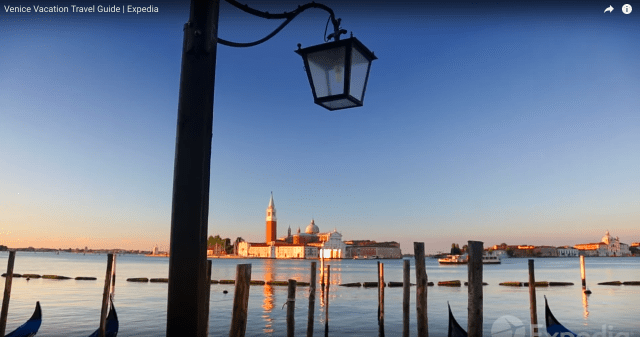
Lovely Venice, lovely video

Screen Shot 2017-06-26 at 5.22.37 PM.png

I want to go back.

To Venice.

Ahhh. And to a degree, this Expedia video provides the cheapest, fastest and perhaps the most intensely beautiful way to go. Not that being there is not the best. It is. But few tourist videos surmount the beauty of this one, and the narrator’s voice is almost as sensual as the city itself. Here are some of the many nicknames of Venice: “La Dominante,” “Serenissima,” “Queen of the Adriatic,” “City of Water,” “City of Masks,” “City of Bridges,” “The Floating City,” and “City of Canals.”

Victoria and I visited Venice in 2005. It is the world’s most beautiful city – any doubters? – but as I often as I return to my photographic record, this video shows how many places we failed to see. It shows the range of Venetian beauty, the grand down to the subtle.

Screen Shot 2017-06-26 at 5.24.39 PM.png

Screen Shot 2017-06-26 at 5.26.25 PM.png

Screen Shot 2017-06-26 at 5.25.32 PM.png

Screen Shot 2017-06-26 at 5.27.10 PM.png

Screen Shot 2017-06-26 at 5.19.40 PM.png

Screen Shot 2017-06-26 at 5.18.45 PM.png

Screen Shot 2017-06-26 at 5.20.20 PM.png

Screen Shot 2017-06-26 at 5.21.15 PM.png

Ahhh!

Posted in Architecture, Video | Tagged , , , , | 2 Comments

Tragic London tower lesson

Screen Shot 2017-06-25 at 8.48.41 PM.png

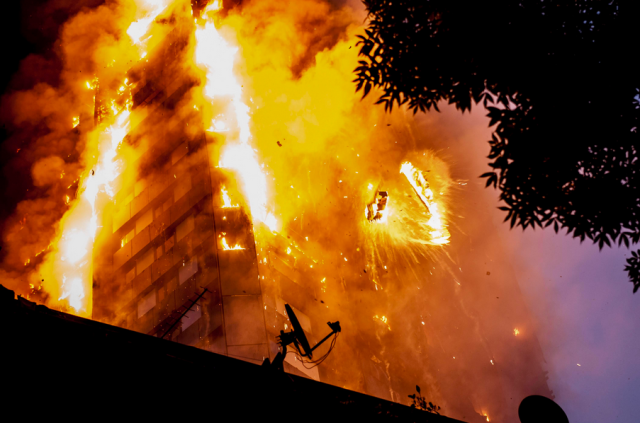
Grenfell Tower aflame in London. (thesun.co.uk)

The Grenfell Tower that burned in London, costing several score of lives, offers lessons that we can and will again fail to heed. No building can be perfectly fireproof, and no ladder truck can reach beyond 20 stories anyhow. If we treated the safety of towers the way we treat, nowadays, the safety of almost everything else, the law would already bar their construction, would have barred it two or three decades ago, especially for the poor. In the case of towers, however, the money interests are even more difficult to defeat than their tenants are difficult to protect. Now the authorities are going after the manufacturers of cladding that stints on safety to achieve low-cost aesthetic relief, on the theory that new crap can improve the appearance of old crap.

As Simon Jenkins points out in his excellent Guardian piece “The lesson from Grenfell is simple: Stop building towers,” London has 400 towers waiting in line for construction when what Londoners – and citizens of cities worldwide – need is neighborhoods. The claim that only skyscrapers can provide the densities cities need to grow is a fraud.

The housing expert Anne Power spoke of the craving of architects and planners at the time for “something distinctive and prestigious.” Architects even invented a vocabulary to justify what was in effect a sales pitch. They would build “vertical streets … villages in the sky … new cities for a new age.” Social consequences were damned. … There is no need to build high at all. The developers’ cry, that cities must build high to “survive,” is self-serving rubbish, the more absurd when their towers are left half-empty. … [T]he most “crowded” parts of London are not around towers but in eight-storey Victorian terraces. The boulevards of central Paris have treble London’s residential density without towers.

Jenkins adds that

[P]eople are entitled to the city they want. When in the 1980s Liverpool’s Militant movement asked Everton’s inhabitants what should be done with their towers, the reply was pull them down and give us back the streets. It was done.

Then, of course, he notes that public housing no longer drives the market for high-rises. No, it is the global rich who want to park their wealth (no doubt honestly accrued!) in a gated apartment they might visit a couple of times a year. I hope that these are built on the sites of old modernist low-rise crap of the sort that London built on Luftwaffe lots for decades before the onrush of towermania. And if – perish the thought – they started building beautiful towers reminiscent of the heyday of Manhattan, then perhaps the case for skyscrapers might carry some weight. But for now, as Jenkins understands, towers are tragedies even if they don’t burn down.

Posted in Architecture | Tagged , , , , , | 9 Comments

Mozart, music, architecture

Screen Shot 2017-06-23 at 7.37.42 PM.png

I’m reading a biography of Mozart by Marcia Davenport, published in 1932. It is excellently written. Of course, Mozart is famous for writing the most enchanting music without crossing out notation on his manuscripts in the least. That is because he wrote the music in his head and merely transcribed it onto paper when he had the time, which could be amid parties, the chatter of friends and other environmental conditions that would block most writers, musical or otherwise. But it was as if his mind were giving his hand dictation. Here is a passage about how Mozart wrote his three greatest symphonies in eight weeks, even though he was depressed by the recent failure of his opera, Don Giovanni, to translate from success in Prague to further success in Vienna, where he was a court composer for Emperor Joseph. The Jupiter was written 1788, just a few years before his untimely death in 1791:

Yet his conception of the symphony is perhaps less remarkable than the development he showed from one work to the next. If each symphony had been written a couple of years after the other it would be much more comprehensible. The poetically beautiful E flat has been chosen for the honor of being Wolfgang’s farewell to his youth. The dramatic G minor is supposed to be the culmination of all the tragedy and frustration in his life. And the mighty Jupiter is the salute to the future – the promise of the next century. This may or may not be true, depending upon one’s taste for reading things into music. Certainly Wolfgang himself had no such ideas. He wrote these symphonies like everything else – in pure creative power and mental delight. “Whence or how they came,” he neither knew nor cared. As soon as one was written down he was ready to retire into solitude and start evolving the next. This remarkable feature of his development is not the romantic one, the dividing his life into periods each to be expressed by a type of music, but the plain matter of the instrumentation. In these three symphonies he made successive strides straight into the full-voiced expressions of the nineteenth century, the world of orchestral giants.

Architecture has been famously compared to music (“Architecture is frozen music,” said Goethe) with good reason. There may be an interesting parallel to be drawn, in the passage by Davenport, from how Mozart (and perhaps composers generally) inject “meaning” into their work and how architects do so (or not) with their buildings. She adds a couple of pages later:

Even while one is captivated by the beguiling beauty of his melody and the subtle brilliance of his orchestration, the science of Mozart’s music is, in the end, more thrilling than its loveliness. It has irresistible appeal to minds trained in the great schools of art and logic. One word has repeatedly been used about it: architecture. And it is a good word to use, for the music is built with the same instinct for proportion and the same fidelity to elemental laws of structure that built the Parthenon and Chartres Cathedral. Bach’s music, in a sturdier and less lyric way, is of the same kind. The surface ornaments of Mozart, like the scrolls and cherubs on a Baroque façade, have preoccupied many and have diverted their attention from the underlying structure, but those who see it as a whole know its universal value. The accident that Mozart happened also to be full of spontaneous melody, dramatic fire, tender humor, sophisticated grace, and profound emotion is a bonanza of Providence. Such an accident does not happen twice.

Here is the closing fugue (Schlussfuge) of Mozart’s Jupiter Symphony.

Posted in Architecture, Art and design, Video | Tagged , , , | 2 Comments

Westminister Street daze

Screen Shot 2017-06-22 at 9.22.05 PM.png

Misspelled street sign in downtown Providence. (Channel 12 News)

Channel 12 News reported last night that Westminster Street is spelled Westminister Street on a couple of signs in downtown Providence, one of them at the corner of Empire Street. And that it has been that way for years. And nobody noticed until now. One man quoted said he felt “stupid” for not noticing. So do I. But I am not on TV so I have time to explain why. (Time to explain things is not a typical characteristic of TV news.)

Screen Shot 2017-06-22 at 10.48.35 PM.png

Roger Williams

As Dr. Downtown (my longtime nom de plume when I was at the Providence Journal), I have been aware that the street is named Westminster for over three decades. Why should I look at a street sign? I know where I am, and know how it’s spelled. That’s my story and I’m sticking to it.

On the other hand, I am a journalist, too, in fact a “print” journalist, to the extent anyone can be such a thing these days. I type on a keyboard, even if you can’t line your birdcage or wrap your fish in it, unless a reader prints it out on a printer. So as a print journalist with pretensions to a capacity for editing and proofreading the printed word, and as a print journalist whose gaze often takes in the misspelled street signs, I should have noticed that the name Westminster was misspelled on those street signs, no doubt by an accidental assumption that the reference in the name is to some sort of minister, probably a man of religion.

No, the reference is to a section of London known as Westminster, where the nobs (the nobility) live, work (or don’t) and breed (or used to). By way of apology for not noticing the error on the street signs and raising a stink about it, I offer a historical tidbit or factoid of which many local readers may be unaware.

In fact, I will quote a passage on page 33 of my book Lost Providence, published by History Press, which goes on sale August 28. Chapter 1, called “Lost: The Benjamin Hoppin House,” tells the story of the breakup of a congregation in the town, then a bit over a century in existence.

The congregational breach is described in Weybosset Bridge by Arthur E. Wilson. Suffice it to say that Roger Williams’s principles of religious freedom – “soul liberty” – did not preclude schism, secession and every sort of doctrinal squabble. Indeed, in the previous century, the aging Williams was given the post of toll-taker for the Weybosset Bridge by the General Assembly, which stripped him of the post not much later for reasons that have not come down to us but that may stem from the founder’s argumentative character. As one can imagine, he may have caused unwanted delay in crossing the bridge. Williams was long gone by the time Snow set up the New Light [church], but his cranky spirit lingered, as suggested by Snow’s petition to the General Assembly in 1770 to split off his village, too, from Providence to form the town of Westminster (“Weybosset” is scratched out and overwritten on the petition). In London, Westminster was (and is) the seat of Parliament, which often tried the patience of British royalty, much as Snow and his followers chafed under the “despotic rule,” as they put it, of the descendants of Roger Williams on the Neck [Now the East Side]. The assembly rejected the petition.

So there you are. Westminster Street may have been named by a minister, but not for a minister. It is not spelled Westminister Street. One month after my book is published I will be speaking about it in a talk hosted by the Preservation Society of Newport County. The event will be at Rosecliff, on Bellview Avenue – oops! I mean Bellevue Avenue.

Posted in Books and Culture | Tagged , , , , , | 2 Comments

Too late to squash-bust it

DSCN1019.jpg

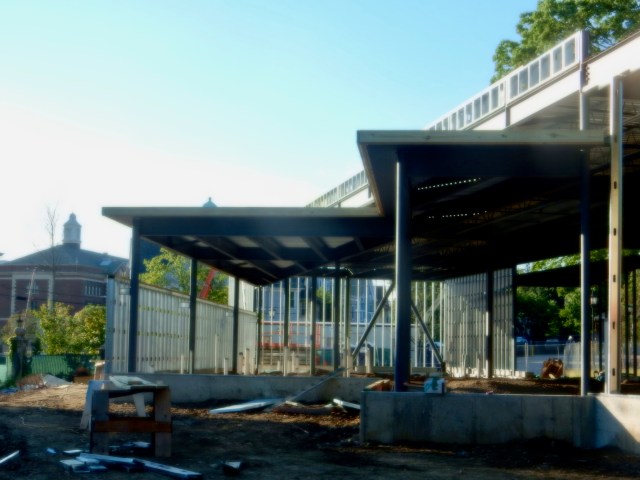
Portion of SquashBuster Center at Moses Brown on Tuesday evening.

The alien spaceship being erected on the Moses Brown School campus facing Hope Street telegraphs its strangeness to everyone who passes along that stretch of Hope. Two sets of angled girders thrust akimbo toward Hope, like the wings of a stealth fighter jet. Out they come from the structure’s two- story rectangular body, seemingly bent on disrupting the flow of traffic.

What can this be, most passersby must surely be asking.

It is the SquashBusters (sic) Center at Moses Brown. The latter is an elite local private school. Perhaps it is good that when complete the new facility will not quite live up to the edgy quality suggested by what’s there now. The local firm of Lerner Ladds Bartels may be blamed for this subdued atrocity, but the leadership of the school is responsible. The design’s pretense to cool, however unrealized, uglifies a stretch of Hope long – but no longer – graced by the physical charms of the Moses Brown campus, which SB@MB serves to squash, or at least largely to block from the view of passersby.

Except for its trendy misspelling, SquashBusters is a perfectly respectable nonprofit that combines after-school sports and academics, to date mostly in the Boston area. Its twelve new squash courts on Hope Street will allegedly be made available to the public. Too bad its tepid stylistic egotism, which would be a perfect fit for a suburban commercial strip, has already crash-landed on one of the great streets of our historic city. No doubt the spirit of school founder Moses Brown (1738-1836) is spinning in his grave.

Screen Shot 2017-06-20 at 6.36.19 PM.png

Rendering of SquashBusters Center at Moses Brown. (LBB)

Posted in Architecture | Tagged , , , , , | Leave a comment

WaterFire’s ribbon-de-fe

DSCN1009.jpg

Barnaby Evans opens ribbon-cutting speaking program.

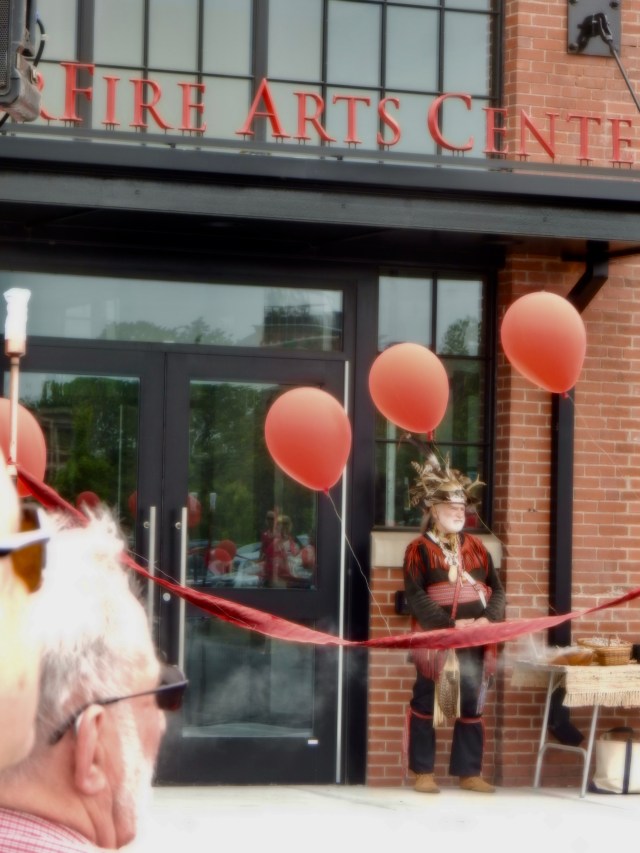
At the end of my tour of the WaterFire Arts Center on Sunday (“WaterFire’s crib opens today,”), Waterfire creator Barnaby Evans told me to look out for “a surprise” at the next day’s ribbon-cutting. Well, I have it on video. They did not cut the ribbon, they immolated the ribbon. Fortunately, since things didn’t quite get out of hand, there was no need for “water” to douse the “fire” – get it? … WaterFire!!!

Seriously, it was a great event heralding a great new facility not just for WaterFire Providence but for the community. So here are a few photo and video reminiscences. The second “ribbon-cutting” video suggests how edgy (my dear and normally potty-mouth-averse mother-in-law, Agnes Somlo, used an edgier word) the ribbon-de-fé threatened to become.

But hey! L’art pour l’art, n’est-ce pas? Anything for art’s sake! And I caught Rose Weaver spinning her WaterFire anthem (to the tune of “Summertime”) to open the speaking program. I wish I’d taped the whole thing.

The photos and videos below are shown in the order they were taken. Enjoy.

DSCN1011.jpg

DSCN1014.jpg

Posted in Art and design, Providence | Tagged , , , , , | 4 Comments

WaterFire crib opens today

DSCN0966.jpg

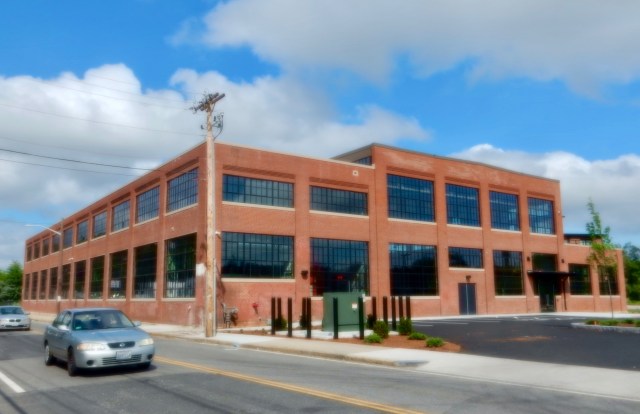
WaterFire Arts Center, 475 Valley St. (Photos by David Brussat)

Barnaby Evans, the creator of WaterFire Providence, toured me through the new WaterFire Arts Center yesterday, mere hours before its ribbon-cutting scheduled for 10:30 this morning. The sun played hide and seek with the clouds at 4 yesterday, finally letting me take the above photo of the place, which was built in 1929 for the U.S. Rubber Co.

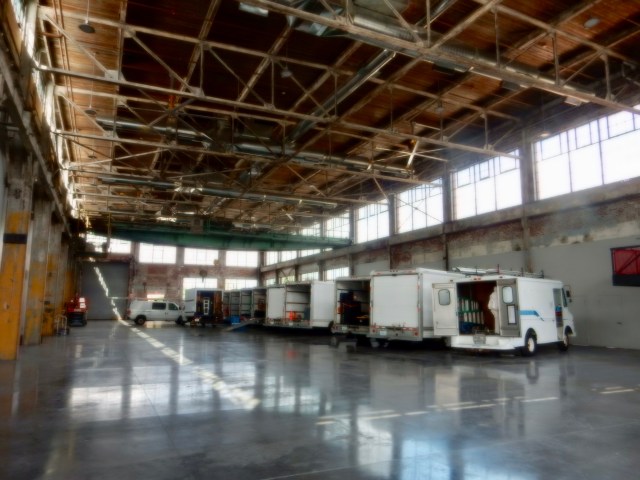
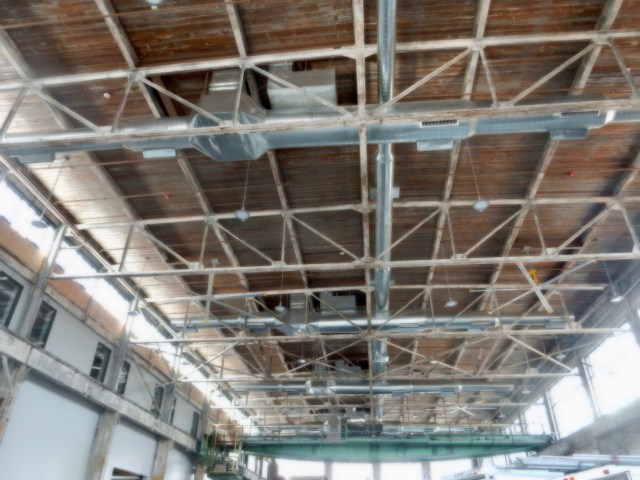
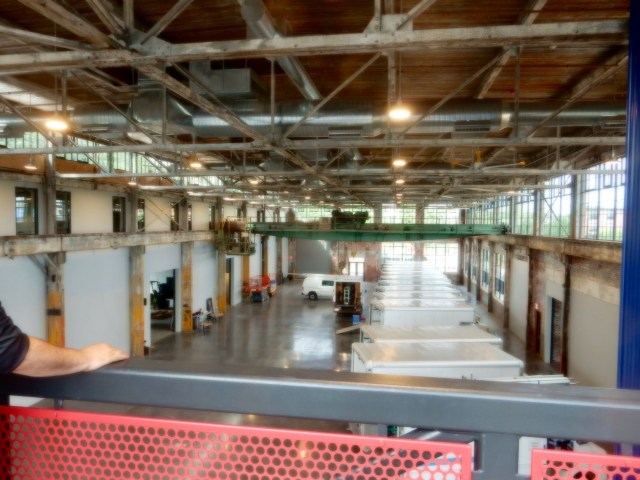
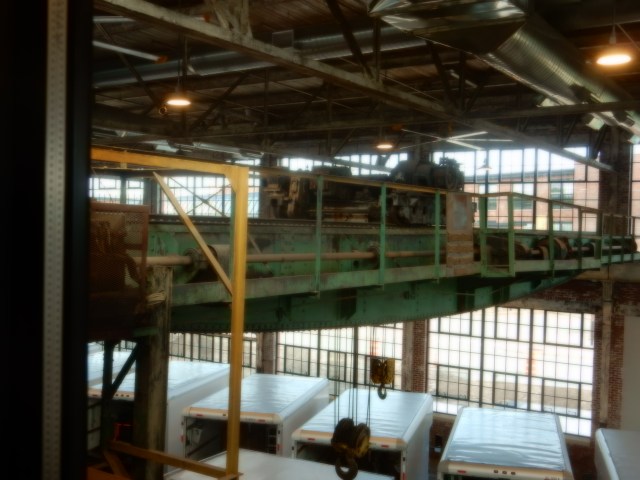
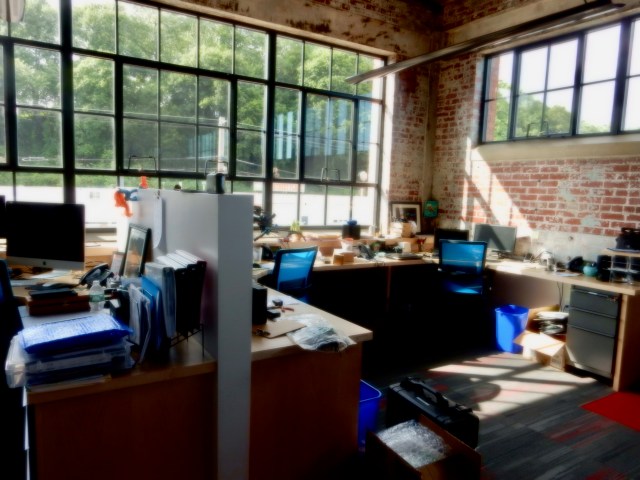
We entered the building’s cavernous space, whose square footage betters those of PPAC and Veterans Memorial Auditorium, and almost that of the Cranston Street Armory (not currently usable). Capable of a 2,300-person standing occupancy, or 1,000 seated banquet style, the plant originally constituted a single huge room that has a new rear second floor platform built in that houses WaterFire’s offices and other function spaces – including one large room designed to be used primarily for the construction of boats, of which the organization already has 32.

As a plant for U.S. Rubber, one of up to 29 of its plants in the city’s industrial Valley District long ago, its workers manufactured various products over the years, ranging from golf balls and the interior linings for railroad tanker cars to the rubber soles for Keds sneakers (“tennis shoes”) – but not automobile tires. Joseph Banigan was the Providence industrial magnate who founded the Banigan Rubber Co., merged it with U.S. Rubber, and eventually supplied 80 percent of the U.S. high-quality rubber market after it had developed the process of vulcanization, which enabled rubber to retain its flexibility at low temperatures. Entire freight cars of rubber from Brazil used to pull, on rails, through a huge door in the plant to be unloaded inside the space where some of those reading this will sit for this morning’s ceremony.

Barnaby is one of the relatively few leading citizens of Providence who seem to really like modern architecture, and he appeared to take some small pleasure in asserting that the plant is of modernist design. Its construction came at a time when that style of design was challenging traditional styles for dominance in the profession, at first chiefly in the realm of utilitarian structures. Even Hitler, who with the rest of the world preferred the reigning classical style for civic, institutional, residential and commercial structures, thought modernism was acceptable for factories.

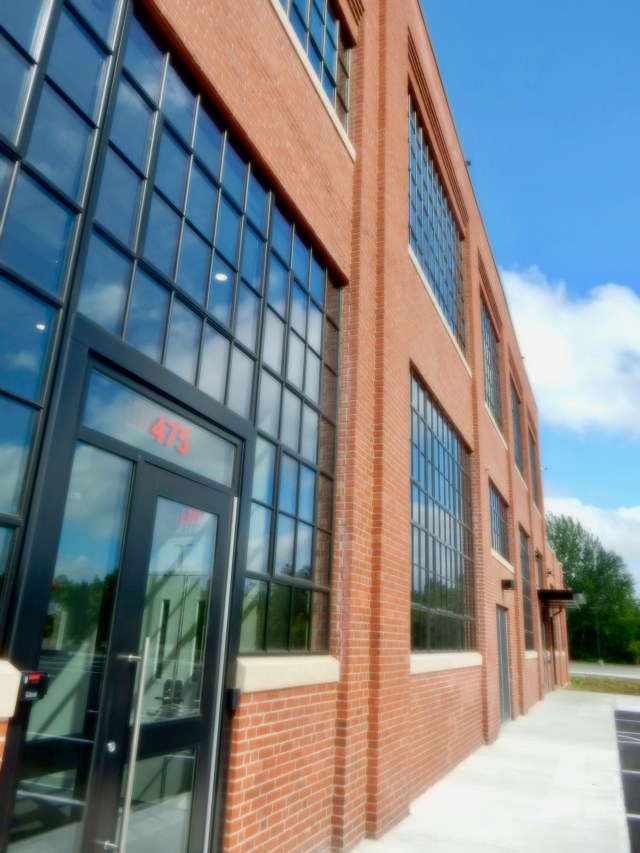
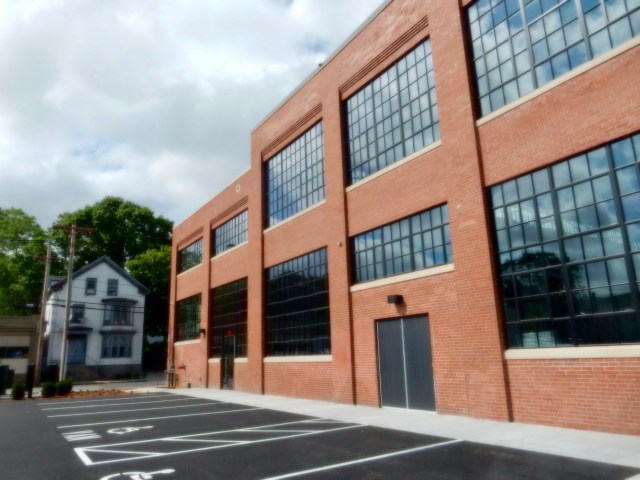
The building’s fenestration of large windows features many small panes of glass (including several sets accidentally laid with horizontal panes), all reproduced as originally built. The building’s brickwork includes such nonutilitarian decoration as a segmented band of stepped brickwork running around the building above the upper of its two levels of windows. Typical of traditional work in the second quarter of the 20th century, the building’s design attempts to address the challenge of modernism by applying that style’s flattened and unadorned features within an otherwise traditional factory format. Or vice versa, if you insist!

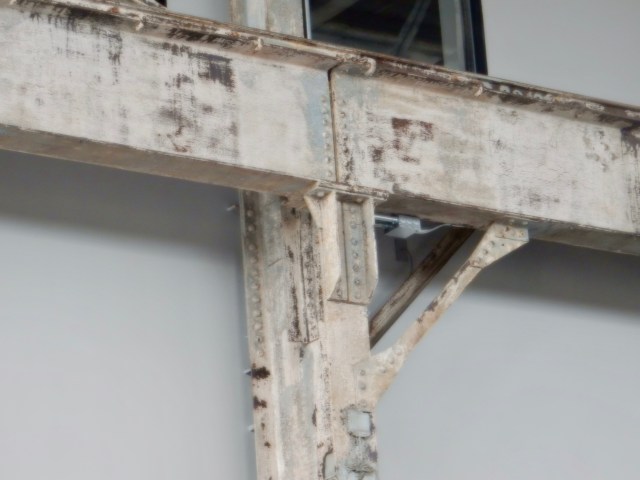
The coloration of some interior features, especially the new structure of its frieght elevator, doffs its cap to the artist Piet Mondrian, using WaterFire’s signature color scheme of black, red, yellow and blue. In general, WaterFire, working with architect DBVW and contractor TRAC Builders, kept as much original detailing, including old graffiti and cracked paint, as possible but, in keeping with one theory of preservation practice (if not the best theory), sought to make sure new features would look “newish” so as not be confused with original features. The building’s historical appearance was considered secondary to the needs of curatorial authenticity. Still, the broader idea was to modernize its functionality while maintaining, to the most feasible extent, the way it looked in 1929.

It worked. They did a great job. The building still looks primarily “historical” whether you are inside or outside.

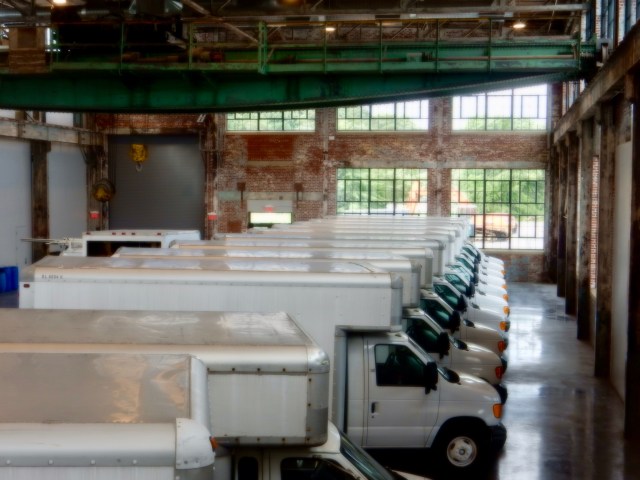
Yesterday, the huge floor just inside the long front wall of the building was lined with a dozen or so of the white trucks WaterFire uses to transport its equipment downtown for event nights. The trucks were not parked higgledy-piggledy – not at all! They were parked on a precise diagonal, each truck seeming to have been situated with meticulous care, as if they were a combat battalion on parade before the general staff.

They may be gone now, but yesterday they struck me as a fine metaphor to symbolize a complex organization run with a healthy degree of managerial savvy. WaterFire has long since become a tradition – a real tradition, not a “new tradition” as some things aspire to these days. Generalissimo Barnaby and his board of directors seem to be expanding the scope of the mission of the organization beyond its original purpose of art to include the facilitation of socially useful education and training, above and beyond renting out its grand new space for occasions. WaterFire is doing good for the citizens of Providence and Rhode Island – without watering down its art in the least.

All of this is, of course, just mahvelous. But in case you don’t make it in time to rummage around the building – where does the WaterFire general staff plot further global conquest!? – here are some photos taken yesterday:

DSCN0964.jpg

DSCN0962.jpg

DSCN0990.jpg

DSCN0987.jpg

DSCN0991.jpg

DSCN0992.jpg

DSCN0983.jpg

DSCN0967.jpg

DSCN0975.jpg

DSCN0977.jpg

DSCN0980.jpg

DSCN0979.jpg

DSCN0984.jpg

DSCN1008.JPG

DSCN0996.jpg

DSCN1000.jpg

DSCN1006.jpg

DSCN1004.jpg

DSCN0970.jpg

DSCN0968.jpg

DSCN0973.jpg

Posted in Architecture, Preservation | Tagged , , , , , , , | 5 Comments