Hooked on bridges, are ya?

Screen Shot 2017-07-30 at 8.28.47 PM.png

Well, here’s a treat for you. This collection of 29 “Stunning Bridges From Around the World” has some real beauts, plus a few bummers thrown in to help you appreciate the beauts a little more. The group, from the website BabaMail.com, is entitled by its editor “These Stunning Bridges Are Where Strength Meets Beauty.”

Please let me quarrel just a tad with that. “Where strength meets beauty”? What does that actually mean? Many of the most beautiful bridges hark back to a time when the people who built bridges made them superstrong because they lacked the technological ability to measure precisely how much strength would be enough to keep them from collapsing. Nowadays, bridge engineers can determine that requirement with precision by computer, using the most aerodynamic of calculations. As a result, we can cut corners to save costs with supreme confidence that we are not stinting on necessary strength.

Or so they say. Sometimes bridges collapse anyway and we wish that the engineers had used the old-fashioned way: estimate the strength required, then multiplying it by two or three to make sure we have enough for any contingency. My engineer friends will know what I mean. And my architect friends will guess that I suspect the modernist bridges in this collection may not stack up, redundancy-of-strengthwise.

Still, by far most of these are lovely. Even a couple of the modernist ones are not so bad. Hats off to my wife Victoria for sending these spans to me from Facebook. It’s time for you to enjoy!

Posted in Architecture, Photography | Tagged , , , , , | 1 Comment

Crystal Palace of the mods

Screen Shot 2017-07-29 at 5.49.29 PM.png

The Crystal Palace of 1851 housing the Great Exhibition of London. (Pinterest)

[In seeking to confirm that former RISD Prof. Derek Bradford was, in fact, born in London I learned to my great dismay that he had passed away in January. Derek and I maintained a most friendly badinage for years from our opposite corners of the architectural discourse. For years, his was the most knowledgeable architectural voice on the design review panel of the Capital Center Commission. My columns over two decades were festooned with quotations from Derek, which I tried my best to rebut. He invariably responded to my criticisms kindly, if not quite gently. I convey my condolences to his widow Sara. The following post is exactly as written prior to my discovering the news.]

The construction in 1851 at Hyde Park, in London, of the Crystal Palace, designed by Joseph Paxton, is felt by many modernists to be the beginning of modern architecture.

My baptism by fire in the fervor of this belief came in a debate during the mid-1990s with RISD Prof. Derek Bradford here in Providence at Laurelmead, a living center for seniors the city’s East Side.  Bradford, raised in London, declared the Crystal Palace a turning point in architecture. With his elegant British accent, he basically mopped up the floor with me. But the audience remained on my side all the way, favoring tradition and staunchly upholding the idea that a house should look like a house. But since then I’ve heard all the hoo-rah about the Crystal Palace a million times.

Never mind that platforms at railroad stations had been covered with networks of glass and iron for at least a decade, that the development of glass and metal structure was just another in the succession of technical improvements in construction practice, or that the Crystal Palace itself featured fairly modest but clearly visible decorative embellishment inside and out. Somehow, the Crystal Palace was a turning point.

So my gratification was unbounded when I read in Victorian Architecture, by Roger Dixon and Stefan Muthesius, in a section entitled “Changing attitudes to iron buildings,” that “iron, which in the Early Victorian period had all the appeal of a new, daring constructional material, now became associated in the mind of the public with cheap utilitarian buildings.” Well, fancy that!

“Bishops refused to consecrate iron churches,” the authors write, adding that after the Crystal Palace’s success, a temporary museum of science and art was erected in Brompton, south of Hyde Park.

The exterior was faced with corrugated iron. The public reaction was not favourable: the building was dubbed the “Brompton Boilers” by George Godwin, editor of The Builder, and the name stuck. It was eventually moved to the East End of London, where since 1873, decently clothed in a brick exterior wall by J.W. Wild (1814-92), it has housed the Bethnal Green Museum. On the other hand, the court of the Oxford Museum, begun in 1855 by Woodward, shows an attempt by the Gothicists at a more ornate and “architectural” iron structure.

Where metal and glass buildings were constructed in the Mid-Victorian period they tended to become less stark, and to be overlaid with architectural decoration.

So when one hears of the public rejection of Victorian architecture, maybe it was this short-lived effort to minimize embellishment of structure that is being referred to!

Screen Shot 2017-07-29 at 5.51.36 PM.png

A London museum nicknamed the Brompton Boilers. (media.vam.ac.uk/)

Posted in Architecture | Tagged , , , , , , | 2 Comments

More Hayes on beauty

Screen Shot 2017-07-27 at 7.58.42 PM.png

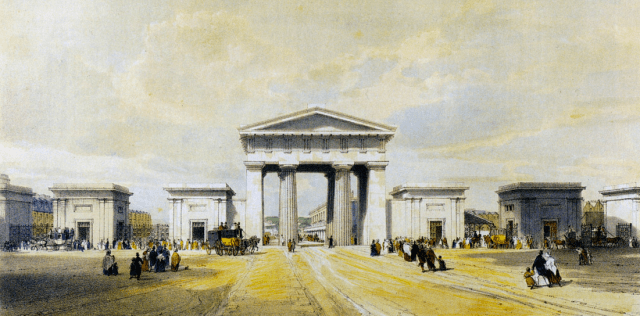
The arch at Euston Station, which could be restored. (cabinetroom.wordpress.com)

British Transport Minister John Hayes’s remarks about beauty and transit infrastructure were quoted on Tuesday in “Sic transit beautiful? Not!” It is brilliant, but I had intended to post instead the full text of “Hayes’s speech on beauty,” a different oration, in which he states the case for beauty in an era of nihilism. He notably asserts here that “most of what has been built in my lifetime could be demolished without aesthetic cost.”

How true. If anything, Hayes understates the case. But he certainly was not channeling Frank Gehry, who in 2014 shouted to a press gaggle in Spain that “98 percent of what gets built today is shit.” What Gehry had in mind was that 98 percent of what is built today is not by Frank Gehry.

So read Hayes’s speech in its entirety. Here are a couple of juicy passages:

This brings me to the third and final misconception that I want to challenge, that beauty belongs somehow to the past. For it is often considered, sometimes unthinkingly, that it is no longer possible to build beautiful buildings.

This is perhaps why increasing regard is given to the beautiful places and buildings that have survived intact. We have somehow, rather depressingly, come to believe that the supply of beauty is both finite and exhausted.  This is perhaps because people assume that it must be somehow dated or even kitsch to build according to the principles of classical architecture. Or because they assume that beauty comes at too high a price, and must be sacrificed for the sake of utility.

Both of these conceptions are false. … There are no good reasons why we cannot continue to build beautiful buildings and public infrastructure.

That is what I have undertaken to achieve as a Minister of State at the Department for Transport. To make it an uplifting experience to navigate the roads, stations and other public infrastructure in our country. We spend so much of our time traveling – to work, to see friends and family. We must not resign ourselves to being miserable as we get from place to place.

A doff of the cap to Robert Orr for alerting me to Hayes’s latest oration.

Posted in Architecture, Art and design | Tagged , , , | 1 Comment

Victorian hotel evolution

speel.me.uk.png

Sculpture on facade of Victoria Station, London. (speel.me.uk)

With the grand history of train station hotel design no doubt cavorting in the back of his mind, British Transport Minister John Hayes argues in yesterday’s post “Sic beautiful transit? Not!” that Britons do not need to put up with the ugliness that modernists have inflicted on Great Britain. As I read his speech “Beauty in Transit,” I thought of passages I had just read yesterday in Victorian Architecture about 19th century hotels.

Here is a passage in which the authors, Roger Dixon and Stefan Muthesius, hint at the churning that animated the evolution of building styles. They are writing about hotels, which in several decades of the third quarter of the 19th century had sprouted from inns and hostels to grand hotels (while dropping the s in hostel). But they could be writing about any building type in which the elements of style are interesting enough to generate thought, debate, emulation and creativity. In the 19th century this led to the creation of new styles or new wrinkles on old styles – as it had in earlier centuries, but which stopped in the mid-20th century when modernist styles proved too simple-minded to generate interesting thoughts about design. The modernist credo – do something completely different – has proved, on the contrary, to be a sure source of vapidity in the evolution of design.

But I am straying. Here is the passage from Victorian Architecture that intrigued me yesterday.

Only the very largest office buildings could compete with the later [train] station hotels in size and splendour. From the point of view of architectural style and elevational treatment there are many similarities. The most common modes of decoration were the Classical and Renaissance styles. The Great Western Hotel in Bristol relates to the post-0Georgian terraces of Clifton; Hardwick’s Great Western, with its stuccoed front, has many features in common with the largest terraces of Paddington. But by 1850 most architects were searching for new, hitherto unused historical styles, or combinations of styles. The Paddington hotel was called “Louis XIV,” referring to its flanking towers and mansard roof. They correspond closely to what was to be called the Second Empire style, after Napoleon III’s extensions to the Louvre – a somewhat impure and ornate version of palatial architecture, with a smattering of the Picturesque and French Renaissance in the use of towers and roofs.

The mind boggles at the idea of “an ornate version of palatial architecture.” Isn’t a palace the ne plus ultra in ornatitude? And don’t you just love that most architects were seeking “new, hitherto unused historical styles”? What mavericks! I am not kidding. Today, they would be called revolutionaries by the moss-backed modernist establishment. Off with their heads!

Dixon and Muthesius continue:

As in office buildings, the problem arose of how to squeeze the growing number of storeys into the traditional framework of the two- or three-storeyed Classical elevation. Knowles, at the Grosvenor Hotel, got round this by playing down the divisions between the stories and by having a very pronounced main cornice and a massive carved roof which dominates the building. Thus the proportions of a Classical building remained basically the same, although the whole is very much larger. In addition, Knowles was to some extent a follower of Ruskin and his theories on decoration, and provided a lot of carved vegetation as well as sculptured heads of famous politicians. The hotel was thus elevated into the realm of modern “art” architecture.

Hmm. Now there’s a possibility. Encourage classical architecture in today’s building market by promising that a politician’s mug might end up as statuary flanking the entrance portico of a grand hotel. This enticement could also serve as a threat: your mug as a gargoyle if you don’t give the public the architecture it wants.

Posted in Architecture, Rhode Island | Tagged , , , , , | Leave a comment

Sic transit beautiful? Not!

hiddeneurope-magazine.eu.png

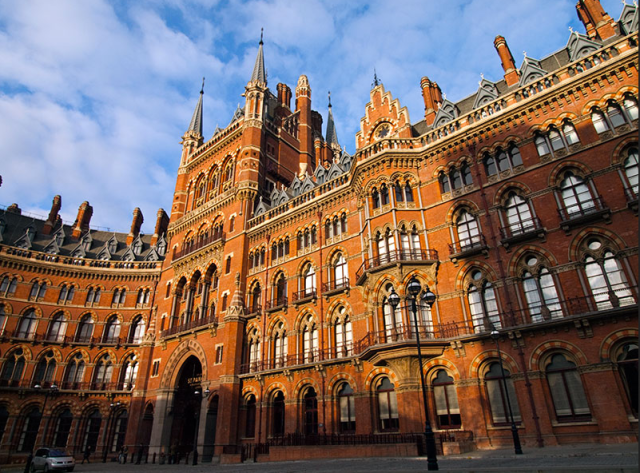
St. Pancras Station, London, its original hotel restored in 2011. (hiddeneurope-magazine.eu)

The race is on to see whether British Prime Minister Theresa May or American President Donald Trump will win the bilateral infrastructure beauty sweepstakes. At least we know Britain has entered. May’s Transport Minister John Hayes recently gave a speech, “On Beauty in Transport,” laced with a great deal of profundity in regard to what citizens of a civilized state deserve and by right ought to demand from their government, and not just regarding bridges, highways and train stations.

(Trigger Warning: Hayes is a member of a cabinet dominated by the prime minister’s Conservative Party. The reader is advised that any agreement with Minister Hayes’s remarks on beauty in no way requires or implies agreement with Hayes or May on any other matters.)

Hayes quotes the critic Richard Morrison describing Euston Station, which was once an elegant exercise in pedimental archways but is now … well, let Morrison tell the tale:

Euston is one of the nastiest concrete boxes in London: devoid of any decorative merit; seemingly concocted to induce maximum angst among passengers; The design […] gives the impression of having been scribbled on the back of a soiled paper bag by a thuggish android with a grudge against humanity and a vampiric loathing of sunlight.

Hayes then remarks: “For better or worse, transport hubs like Euston frame our working days, and punctuate our working lives. When transport design is done well, it raises expectations.” As for the “old stations such as Paddington and St. Pancras,” Hayes adds, quoting the philosopher and architectural theorist Roger Scruton:

The architecture is noble, serene, upright. The spaces open before you. Everything is picked out with ornamental details. You are at home here, and you have no difficulty finding the ticket office, the platform or the way through the crowds.

Hayes describes how beauty serves to aid utility. Today utility is conceived by most of our leading aesthetic theorists, and by modern architects, as untied to beauty, whereas the reverse is true: Utility without beauty eventually will lose its usefulness as ugliness and sterility erode our care for a structure’s maintenance. Eventually, as Scruton has pointed out, such a building will serve best as an opportunity to make way for a prettier building.

That is, if beauty ever wins its own sweepstakes with the muscle-bound iron horse of modernist utility – and who cares whether May or Trump leave the starting gate or reach the finish line first – as long as they get there. I see more and more reasons nowadays to hope that I needn’t warn readers not to hold their breath. In her transport minister May has a head start, but Trump could trump May by using his as-yet-unproposed infrastructure program to rebuild Penn Station in its original, classical McKim, Mead & White style.

Screen Shot 2017-07-25 at 6.36.19 PM.png

Euston Station today, give or take a remodeling or two. (Londonist)

Posted in Architecture, Urbanism and planning | Tagged , , , , , , , , , | 2 Comments

Many more shots of Yale

Screen Shot 2017-07-24 at 6.33.57 PM.png

Photos of Yale expansion by Phil Handler. (Fly on the Wall Productions)

My desire to post more photos of Yale’s expansion – two residential quads, Benjamin Franklin College and Pauli Murray College, designed by Robert A.M. Stern Architects – was answered yesterday by Phil Handler. He owns Fly on the Wall Productions, the industry leader in creating indexed video and photographs for construction, real estate and facilities management firms. To see hundreds of shots of the two campuses at Yale taken as recently as last week, go to Fly on the Wall and click on “My Photographs,” then “All My Photographs,” then select from a slew of sets devoted to Yale’s expansion, which are labeled “New Colleges.” Some are posted here. Enjoy!

Screen Shot 2017-07-24 at 6.34.54 PM.png

Screen Shot 2017-07-24 at 6.45.16 PM.png

Screen Shot 2017-07-24 at 6.37.57 PM.png

Screen Shot 2017-07-24 at 6.45.35 PM.png

Screen Shot 2017-07-24 at 6.43.37 PM.png

Screen Shot 2017-07-24 at 6.44.07 PM.png

Screen Shot 2017-07-24 at 6.42.23 PM.png

Posted in Architecture, Photography | Tagged , , , , , | Leave a comment

New Yale campus progress

Screen Shot 2017-07-22 at 4.22.09 PM.png

This photo and the first below were sent by RAMSA partner Gary Brewer.

Gary Brewer has sent two photographs of the work to date on the two new residential colleges at Yale, Benjamin Franklin and Pauli Murray. They are exquisite, to quote Elizabeth Moule’s assessment in an email to the TradArch listserv. Also to the list, Helen Gordon writes: “These sturdy, architecturally stunning and perfectly lovable buildings will endure through the ages.” She adds, “The low maintenance alone, compared to the usual high maintenance of signature modern buildings, will easily repay any up-front expenses due to excellent detailing and craftsmanship.”

These two photographs must do for now until Gary (who designed RAMSA’s Jonathan Nelson Fitness Center but was not involved at Yale) sends more photos, or indicates where I can get more. But wait! I checked on Yale’s website and there is a package that offers more photos, elevations, before-and-after shots and original project renderings, plus the rendering of a bird’s eye overview of the project. To show some detail work, I have added some of this down below the second of the two photographs from Gary.

Visiting the Yale campus last year after construction had been under way for maybe a year or two, I posted many shots of the work to date in “Work on new Yale campus.” Then your investigative pundit, wandering around near dusk, was unable to breach the security fencing. Perhaps next time I visit I will be able to invade the place as if I were an actual student – hordes of whom are vying to get in for next spring. Then you will see some shots!

Bob Stern, RAMSA and their architects for this project deserve a huge round of applause for the quality of their work on this project – appreciation of which, from this corner, will not end here.

Screen Shot 2017-07-22 at 4.20.50 PM.png

Screen Shot 2017-07-22 at 4.32.10 PM.png

Photo by Phil Handler, Fly on the Wall Productions

Screen Shot 2017-07-22 at 4.32.59 PM.png

Screen Shot 2017-07-22 at 4.15.12 PM.png

In this view, the top left line points to a “large courtyard” and the bottom three to “small courtyards.”

Posted in Architecture | Tagged , , , , , , | 6 Comments

Among ye olde Victorians

Screen Shot 2017-07-21 at 1.51.18 PM.png

Bestwood Lodge (1864), Nottinghamshire, designed by S.S. Teulon. (Destinia)

Victorian architecture, seen as the architecture of the long reign of Queen Victoria, shows the absurdity of those who claim that Victorian styles fell out of favor during the 1950s and ’60s, as many observers attest, modernist and otherwise. My suspicion, unprovable, is that Victorian architecture truly lost popularity only among architectural historians with a modernist bent. Many others who don’t disdain historical styles also say Victorian went out of style among the public. I think they say that because that’s what they’ve heard or were taught to believe in schools of architecture.

So now I am reading Victorian Architecture by Roger Dixon and Stefan Muthesius, published in 1978. Their account only deepens my suspicion that Victorian architecture has been steadily popular among most people from the Victorian era onward. Some who maintain the reverse are thinking of “painted lady” Victorians – after many of those old houses went without care and repair in America during the Depression and World War II. To argue that the broader Victorian age styles suffered a loss of esteem is to argue that every style that predates modernism suffered a loss of esteem. Not so.

Victorian architecture was a series of revivals of prior styles – Gothic, Georgian, Tudor, Baroque, Classical, or, casting a broader net, Vernacular, Picturesque, what have you. So to assert a widespread attitude against Victorian architecture in the midcentry-modern years is to play into the hands of modernists. Modernists believe that historical styles – especially contemporary architecture inspired by the past – are illegitimate because modern architecture alone truly reflects the modern era. It is clear that such an attitude cannot “get along” with any attitude classicists embrace.

There is a curious passage in the introduction to Victorian Architecture where the authors react to an earlier book about Victorian architecture:

Some critics argued that a new style could and should be “invented.” Terms such as “novelty,” “modern style” and even “Victorian style” were used, mainly in the 1840s and 1850s, when the discussion was at its height. However, these attempts were not considered intellectually respectable by the major practitioners. The relatively little-known architect Thomas Harris (1830-1900), when he published Victorian Architecture in 1860, was soon put in his place by critics who pointed out that his architecture was merely a mixture of known revival styles.

The authors of this Victorian Architecture probably smiled when they wrote that, because that’s precisely what they believe – at least up to page 53.

As you read through their book, you find that, layered into any honest description of Victorian architecture, is its deep relationship with tradition. The problem for architectural historians who classify historical architecture into “periods” is that each period has more in common with the periods it follows and those it precedes than the differences that historians like to pull their chins about. But architecture is a continuum of stylistic evolution, not a string of segregated styles. “Oh, this old building is important because it is a precursor to modern architecture!” they like to say, citing, perhaps, a large plate glass window – when in fact a lot of pre-modernist architecture had large windows, including some of plate glass. (See the photo above.)

I have not read very far into Victorian Architecture, but if authors Dixon and Muthesius turn out to be your standard-issue architectural historians, I will let you know, quoting chapter and verse.

Posted in Architecture, Architecture History | Tagged , , , , , | 2 Comments

Monty Python on architects

Screen Shot 2017-07-20 at 8.09.01 PM.png

Scene from Monty Python sketch mocking modern architecture (and Freemasonry)

In September of 2014 I posted the famous Monty Python sketch on modern architecture as a reward, so I said at the time to readers of this blog, for those who managed to make it through my several prior posts. Why a reward was appropriate I don’t recall. Today, I offer the same skit as a reward for making it through my past several days of postlessness.

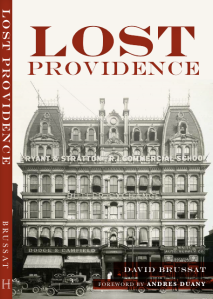
I have not posted because, first, I have done a job for a local institution that needed expert assistance (which they thought I had), and, second, because I have filled out a very tedious (but arguably necessary) form to help my publisher market my new book, Lost Providence, coming out on August 28 from History Press. Reading it will be its own reward.

It is, of course, my delusion perhaps that readers need to be rewarded for struggling through several days without any posts from AHAT (Architecture Here and There), but I will let that pass without comment so you can click on the Monty Python skit, “The Architect Sketch,” without further delay or obfuscation. Enjoy!

[A commenter, Lew Dana, notes the irony of this in light of the recent tower fire in London.]

Posted in Architecture, Humor, Video | Tagged , , , , , | 5 Comments

Just one crane in Providence

Screen Shot 2017-07-15 at 9.42.44 AM.png

Providence Station Commons, said to be the only local project using a crane. (tocci.com)

GoLocalProv.com has a story complaining about the paucity of cranes – not birds but rigs to lift heavy construction loads – in Providence compared with other cities. “Top 12 U.S. Crane Cities Have Nearly 300; Providence Has One” is the GoLocal headline on its story, based on a report by the construction industry consultant Rider Levett Bucknall. Go Local’s business team writes:

The cities range from the top crane city — Seattle, Washington, which has 58 active major crane projects, followed by Los Angeles with 36 and Denver with 35. One big surprise is that Portland, Oregon, a city much closer in size to Providence than Seattle or LA, has 32 cranes.

Whereas Providence has one crane up now, at the site of Providence Station Commons, a residential project next to Capitol Cove along the Moshassuck River where Canal Street crosses Smith Street near the State House.

The GoLocal story describes local projects that have been slow to get off the ground – for example, the Procaccianti hotel on the site of the demolished Fogarty Building. Its developer wants even more public money. The First Bristol hotel project on Parcel 12, at the northeast corner of Burnside Park, is one of several others, mostly hotels, whose slow progress toward breaking ground irks some observers of development in Providence. The Jason Fane proposal for three high-rises has been shown a cold shoulder, and has now been downgraded to one tower, if it survives at all. The innovation corridor’s relative abundance of high-tech proposals have also advanced through the process at a sluggish pace.

The RLB report describes a 43 percent increase in cranes operating in Seattle, which causes GoLocal to pout: “And if Seattle’s data is not depressing enough for Rhode Island, RLB’s report from Toronto, Canada is cataclysmic.” Toronto expects to see over 260 high-rises go up in the next few years.

In this city, the low crane rate may reflect the fact that developers here shoulder costs of construction equal to those in Boston but expect a return on investment only half that of Boston in terms of lease income, rent and other types of profit. On average, at least, it doesn’t pay to build here. The state’s generous development subsidies are meant to narrow the gap.

Providence also festoons its state and local development tools with all sorts of strings on construction by way of local hiring percentages, number of minority and female-headed contractors and other such well-meaning requirements that often add to administrative costs and delays. Not to mention the expensive and convoluted path that a project must travel through the design review and permitting boards.

Frankly, however, I would like to think that citizens of Providence, and elsewhere in Rhode Island, have a deep-seated recognition and regard, often inchoate, for the extent to which their quality of life is enhanced by civic beauty. Cranes often generate anxiety about whether that beauty is likely to survive the ravages of “progress.”

Providence has a far more than typical degree of historic fabric, built before modern architecture spurned beauty in favor of pure utility – abandoned now in favor of sheer goofiness. Because of its beauty, this city gets rave reviews from tourist and livability sites far beyond what its size suggests.

Since most projects no longer try very hard to maintain much of a pretense of adding to the beauty of a place, most people around here react to projects by shrugging their shoulders. Those who try to oppose insensitive projects do so in a bureaucratic environment that, in spite of the ingrained modernist proclivities of individual committee members and staff, may be a bit more mindful of citizens’  concerns, at least compared to other places. After all, their positions often depend on politicians, many of whom have some sense of what voters want.

This may slow the growth of jobs and population, but as Mark Motte and Francis Leazes say in their brilliant 2004 book Providence: The Renaissance City, reluctance to embrace a decade’s worth of unwise major development proposals in downtown and on College Hill in the 1950s and 1960s resulted in the preservation of the capital city’s unusual beauty:

The failure of the Downtown Providence 1970 plan to generate interest contains an important early lesson concerning renaissance activities: sometimes the decision not to do something is more important than actions undertaken. … It was a fortunate inattention to downtown renewal planning and the eventual demise of federal urban renewal that would mark the 1960s as a critical epoch in the future of renaissance Providence. Downtown Providence remained intact.

Maybe that is what is happening today in a more piecemeal fashion. Citizens are not wrong to cast a gimlet eye on what passes for civic improvement these days.

Once the top level of Providence and Rhode Island authorities starts to encourage development that strengthens rather than weakens the brand of the city and state, the chilly local attitude toward projects will defrost, and we will get development proposals that find it easier to make it through the permitting process because they come off as doing more to improve the quality of life in Providence and Rhode Island instead of just making it bigger. Yes, we want cranes, but not wrecking cranes.

Posted in Architecture, Development, Preservation | Tagged , , , , , , , , | 4 Comments