Chinese Gordon’s Khartoum

Screen Shot 2018-03-08 at 8.46.55 PM

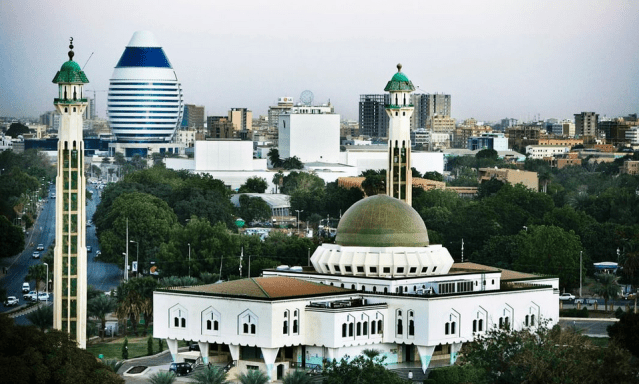
Contemporary photo of central Khartoum. (The Guardian)

I have just completed Lytton Strachey’s Eminent Victorians without finding much if anything to quote about architecture beyond what I conveyed in my post “The special beauty of decay.” Strachey contemplates four Victorians – Cardinal Manning, Florence Nightingale, Thomas Arnold (headmaster of Rugby) and Gen. Charles Gordon. He digs with an almost unseemly gleeful diligence for the hypocrisy embedded in the character of each.
Screen Shot 2018-03-08 at 10.35.14 PM

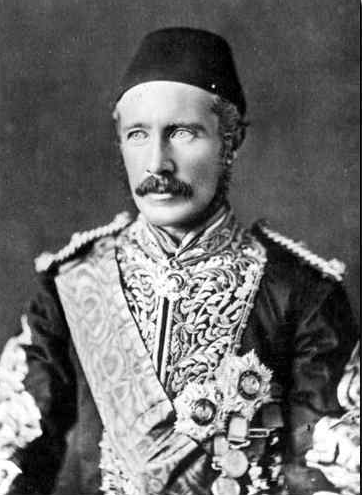
Chinese Gordon. (en.wikipedia)

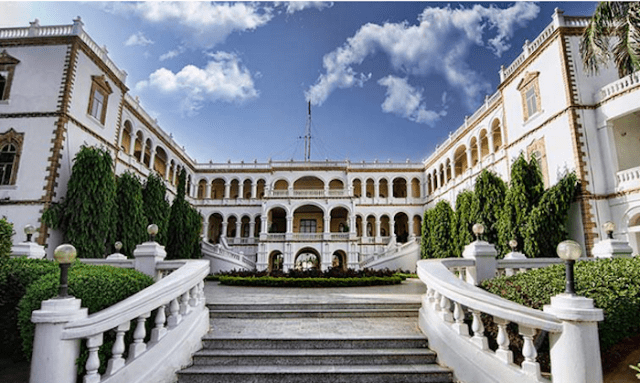
The last, Charles George Gordon, was beheaded after the siege of Khartoum by the forces of the Mahdi (emissary of Mohammad). In the absence of anything especially architectural in the description of the end of Gordon’s life, I looked for an image of the palace where, at the top of its staircase, he received a spear in the chest (or was hacked to bits by scimitar, believe what you will). Not long after, his head was chopped off and stuck atop a pole. I found the palace (see below). I went to the library to find the 1966 movie Khartoum, starring Charleton Heston and Sir Laurence Olivier, but it was out. (You can see the trailer here). But I did find, online, a startling but sad and predictable shot of Khartoum.

Before considering that image, consider the following from an essay on contemporary Khartoum after the civil war that split Sudan and South Sudan into two nations. I wonder whether Nesrine Malik, the UK Guardian columnist and author of “Khartoum: the most selfish city?,” was referring to the Mahdi’s investment of Khartoum in 1885 in the opening line of this passage toward the end of her essay. She writes:

Rebel movements have twice approached and once entered Khartoum, an unthinkable prospect for its dwellers. There is a sense that the hordes are closing in, and that decades of grievances and marginalisation will finally close in and cannibalise a centre of power that has got away with divide, marginalise and rule for too long. Almost 60 years after independence, the model of the elitist city has proven to be a catastrophic failure.

Who knows? But from the photograph of contemporary central Khartoum above, it is clear that the hordes have already closed in. Look at all the bad trad poking up among the earlier modernist buildings! But must one not admit that even the bad trad, in its attempts to at least make reference to Muslim architectural traditions, has served Khartoum by defending it against being invested (that is, in Victorian terminology, conquered) by more typical sorts of modern architecture? Deny it – I dare you!

Interesting also is a story from the Middle East Eye, “New presidential palace opened on resonant date for Sudan,” about the new presidential palace built in Khartoum right next to the old one, where General Gordon died, which was not torn down. The author, who is not named in the article, discusses not only the new palace but the fact that it was financed, as is so much in Sudan these days, by the Chinese, who are heavily invested in Sudanese oil drilling operations. And he points out that the opening came on the same day, 130 years later, that Gordon lost his head.

It seems as if the author was quite unaware that Gordon’s nickname was “Chinese.” That would be worth putting in the article, ya think? Journalists tend to go weak in the knees at any hint of irony that they can pop into their stories. The anonymous author missed a biggie here.

Chinese Gordon was so named because of his prowess in military strategy and tactics and the courage he showed in China during the 1860s when, as a sort of British mercenary, he led the Chinese regulars – the so-called “Ever Victorious Army” – in defeating the Taiping Rebellion.

Internet images and their descriptions of the Khartoum palace in which Gordon died are so confused (or at least to me at 10:38 p.m. this evening) that I cannot tell whether the photo below is the original palace, the palace as rebuilt after the British retook Khartoum more than a decade later, a replica of the original palace apparently built by the Chinese, or the new palace recently also built by the Chinese as referred to above. If a reader knows, please tell me!
Screen Shot 2018-03-08 at 10.37.01 PM

Presidential Palace in Khartoum. (africaranking.com)

Posted in Architecture | Tagged , , , , , | Leave a comment

The sinister self-driving car

Screen Shot 2018-03-07 at 9.09.45 PM.png

Image of data-gathering by self-driving car on highway. (KitGuru)

The Atlantic has a very interesting article, “How Self-Driving Cars Will Threaten Privacy,” by Adrienne LaFrance. It actually ran a couple of years ago, and looks forward to the convenience of life with a self-driving car. The car will listen to your conversations and take your unwitting advice by, say, putting on your grocery list a type of beer you praised on the phone to a friend, or, without having to be told, adding a coffee stop on your way to work. Nice!

But there’s a darker side to all this, too. Let’s rewind and take a closer look at your commute for a minute.

There we were. The car picked us up. We wanted coffee. It suggested Peet’s. But if we’d stopped to look at the map on the screen when this happened, we might have noticed that Peet’s wasn’t actually the most efficient place to stop, nor was it on your list of preferred coffee shops, which the car’s machine-learning algorithm developed over time. Peet’s was, instead, a sponsored destination—not unlike a sponsored search result on Google. The car went ever-so-slightly out of the way to take you there.

The analysis by LaFrance goes into chilling detail about how the desire for profit might cause your car to edit your life.

Still, a lot of people will decide to put up with self-driving surveillance of this sort. We already put up with it online, allowing Google or other busybody behemoths to place ads for things they know we want in the articles we read on our laptops. And who knows what else. Better living through algorithms!

However many billions or trillions that Google, GM, and other corporations (including Uncle Sam) plow into self-driving cars, I don’t think they are in the cards. Our brains function faster and better behind the wheel using intuition developed over many thousands of years than any computer. Maybe computers can do a lot more calculations at once, and maybe they don’t drink and drive, but they can also be relied on to break down in little ways that don’t matter so much on our desktops but might matter a lot more hurtling down the highway at 65 miles per hour. The amazing thing is not how many accidents we have today but how few. Thank your brain.

So I think that after a while, after more serious testing ramps up and demonstrates the beauty of our natural onboard computers, we will shrug our shoulders and admit … no can do. Hopefully, we’ll have some useful things that are spun off by the research, like Tang was spun off by the space program.

But if it does happen – and this is one of many good reasons for it not to happen – what I worry about most is if, one day when self-driving cars are installed, I write a piece describing how we still have not been able to work out the 3D Rubik’s Cube of changes that will be required to reconcile the massive dislocations in technological, commercial, infrastructural, social, civic, economic and other systems that emerge over time because of the self-driving car. Suppose someone at Google decides to get the Ministry of Truth to issue a warrant for my arrest. All they have to do is plug a new itinerary into my car’s computer and instead of driving me to Peet’s, my car (or some corporate fleet’s car) will drive me straight to jail.

Nah. This cannot be allowed to happen.

Posted in Urbanism and planning | Tagged , , , , , , , | 4 Comments

Mighty pen on Penn Station

Screen Shot 2018-03-05 at 1.51.47 PM.png

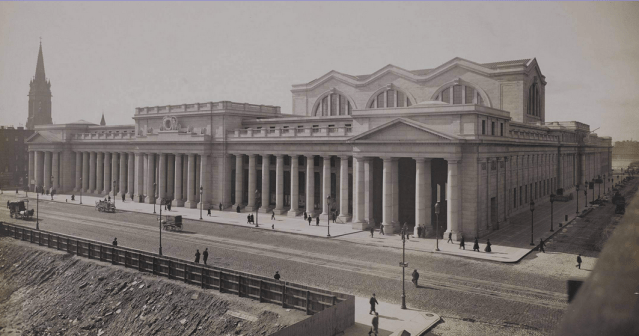
Penn Station in 1910. (Photo by L.H. Dreyer)

In “Mighty Penn,” The New Criterion has a brilliant extended reflection on the idea of rebuilding Pennsylvania Station, in New York City, as it was originally designed in 1903 by Charles Follen McKim of McKim Mead & White. Many facts of which I was unaware are unearthed by its author, Michael J. Lewis. And, in fact, I am heartened by Lewis’s support for the project. Over the years his criticism has usually left me underwhelmed. I cannot recall exactly why, but there always seemed a hesitancy on his part to support new traditional buildings, even to condemn modern architecture. No such demurral is evident in this essay. It is excellent from A to Z.

In the elegant passage below, Lewis informs readers that much of McKim’s architectural plan – spaces, walls, halls, entrances, exits, etc., drawn on paper as seen from above – survives to this day within the current Penn Station under Madison Square Garden.

And yet if the plan survives, it does so without those changes in proportion and scale, the sequence of compression and release, that gave it decorum and grace, and that treated the station’s users not as objects to be channeled efficiently through troughs, as in an abattoir, but as citizens, invested with dignity and self-respect. There can hardly be a more devastating rebuke to functionalism than the translation of McKim’s glorious sequence of spaces into a mere two-dimensional diagram of paths of movement.

Hear, hear! Below, however, is a passage that I disagree with. In outlining the largely political and psychological difficulties facing Rebuild Penn Station, led by the National Civic Art Society, Lewis writes:

Our [American] society is reluctant to acknowledge that there is any realm in which our predecessors were more capable or accomplished than we are.

Not really, I think. In the realm of architecture most people are capable of understanding that our predecessors were more capable and accomplished than we are. Most people are highly skeptical of modern architecture and have been since its beginning. It is the leading men and women of society’s political, financial and cultural institutions, mainly in the architecture and design professions, who resist acknowledging the obvious.

I’m not sure how to defeat that, but I believe it is possible, and eventually it must be done, because our current design establishment is preparing for us an environment that, aside from being plug ugly, has “Sinister” stamped on its forehead. It has been carrying us toward the sort of authoritarian societies predicted by George Orwell, Aldous Huxley and almost every other prophet of dystopia. We don’t want to go there, at least most of us don’t, whether by plane, train, ship or self-driving car.

The best quote about this whole thing is from the late Vincent Scully, who wrote after Penn Station was demolished in 1963 and rebuilt: “One entered the city like a god. Perhaps it was really too much. Now one scuttles in like a rat.” The middle sentence is usually omitted, with or without ellipses. No, it was not too much, and we deserve to enter it gloriously again.  Especially young (or old) people who never had that chance.

Screen Shot 2018-03-05 at 3.00.50 PM.png

Today’s Penn Station. (Here and Now/WBUR)

Posted in Architecture, Development, Preservation | Tagged , , , , , , , | 2 Comments

See ‘Lost Prov’ in Barrington

Screen Shot 2018-03-02 at 12.43.56 PM.png

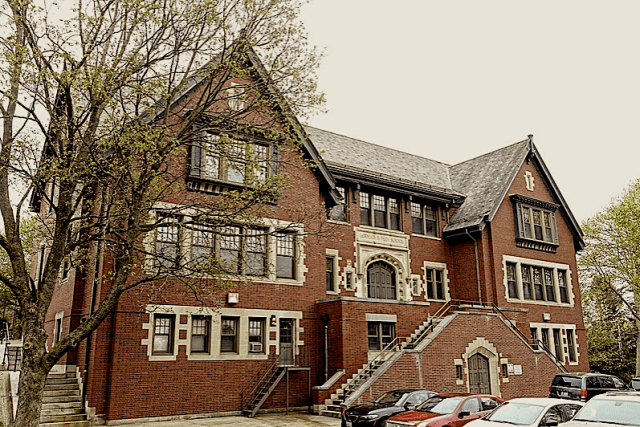
The Barrington Public Library, formerly the Leander Peck School. (Wikimedia Commons)

Next Tuesday at 6:30 p.m., the Barrington Public Library will host what may turn out to be my final public lecture about my book, Lost Providence. Only private talks have been scheduled for now from here on out, but at this open talk the public can learn things about our architectural environment that may be new to them, and for free.

That has to do with why the Barrington Public Library and its neighbor, Barrington Town Hall, and all other buildings that prize beauty not over but alongside utility, as opposed to utility alone (and often a bogus utility), are virtually banned in the field of architecture, and have been for over half a century. That means buildings such as the library are always at risk, whether local preservationists are aware of it or not.

Screen Shot 2018-03-02 at 5.40.11 PM.png

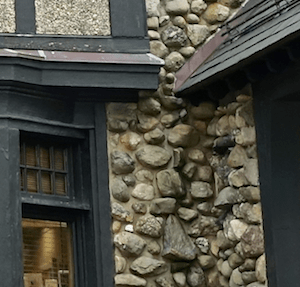
The library sits right next to Barrington Town Hall, one of Rhode Island’s most exquisite municipal buildings, finished in 1888 to the design of Stone, Carpenter & Willson. We all know what it looks like – a romantic exercise in the Tudor manor style, with gables and turrets and rustic walls of fieldstone (left) and half timber. One might swoon just driving by it, and perhaps overlook the Barrington Public Library. That would be a mistake.

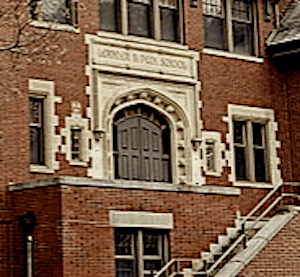
The Leander Peck School was completed in 1917. The town library was moved there from the town hall sometime after 1976. Its Elizabethan Revival style, designed by the Providence firm of Martin & Hall, does not play second fiddle to town hall. Its aesthetic pedigree is as steeped in history (below left) as the town hall, even though it may be a notch below it in sheer romance.

Screen Shot 2018-03-02 at 5.45.22 PM.png

But that notch scarcely limits its allure in the least, and the people of Barrington (and whoever else might show up at the party) have a right to know why beautiful buildings are, nowadays, the rarest buildings to arise. The profession of architecture harbors a bias against tradition. It discriminates against beauty. Ugliness is considered a feather in its cap. It is not just, and it’s not fair, but it’s true today. Find out why on Tuesday.

Screen Shot 2018-03-02 at 12.49.34 PM.png

Barrington Town Hall. (Wikipedia)

Posted in Architecture, Lost Providence | Tagged , , , , , | 2 Comments

Ha ha ha ha! Seriously?

Screen Shot 2018-03-01 at 2.36.09 PM.png

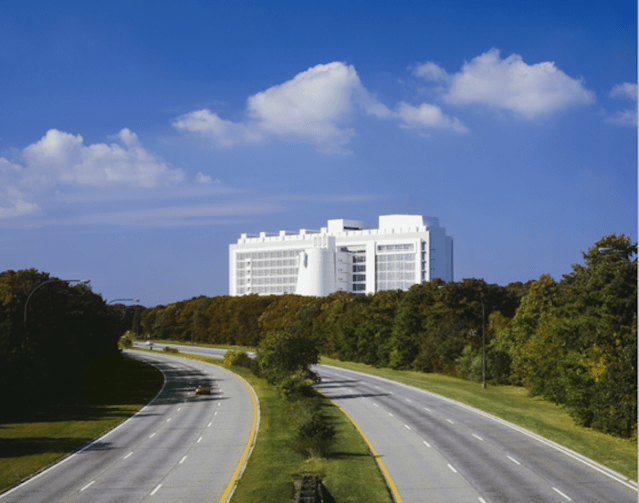
The Alphonse D’Amato Federal Courthouse on the way to the Hamptons. (American Way)

Kristen Richards’s ArchNewsNow for today has several surprises. One is in an article by Beth Dunlop for American Way magazine, “Light Fantastic,” which is about the celebrated modernist architect Richard Meier. It has a line that shivered the marrow of my funny bone.

Meier’s 2000 Alfonse M. D’Amato United States Courthouse in Central Islip, Long Island, is so beloved that even after 18 years, weekend commuters to and from the Hamptons detour past it to bask in the glow of its façade.

Really? “What the hell’s that assassinating the landscape?” is more like what I’d expect to hear. But I am sure Dunlop is correct. There are a predictable number of cranks and lunatics in any given group of 1,000 commuters to the Hamptons. On the other hand, it does remind me of when I was a kid in our Rambler station wagon zooming round the Washington Beltway waiting for the betowered Mormon Temple to rise up around a bend on the horizon and then disappear as we sped by. But that’s a good memory. The temple puts the D’Amato federal courthouse to shame.

Then there’s another article in ANN, “Save the Union Carbide building!” by Douglas Feiden, written for Our Town: The Local Paper for the Upper East Side. Designed by Natalie Griffin de Blois of Skidmore, Owings & Merrill, the UCB, completed in 1961, is a black glass box virtually indistinguishable from the Seagram Building, by Mies, which, unfortunately, is not also slated to come down. The UCB would become the tallest building ever to be razed on purpose. If it does, it would take that status away from the sainted Singer Building, the tallest tower to be demolished intentionally since 1968, when it came down at Broadway and Liberty, to be replaced by the U.S. Steel tower, another black glass box, now called One Liberty. Like all these blotches, the Union Carbide, at 270 Park Ave., is a corporate borathon. I say let ‘er rip.

And get a load of this quote:

Indeed, SOM has belatedly acknowledged that the firm’s signature works on Park Avenue could never have taken shape without de Blois.

For she not only cracked the glass ceiling, she also built it.

Bully for her! I’m not sure I’d brag so hard on that these days, especially not a man on a woman’s behalf. That line’s a great example of the advice old editors give to young writers: Kill your babies. If it sounds too cute at first blush, it deserves to be cut. Build the glass ceiling, indeed! What ever happened to crack on and keep on crackin’ that glass ceiling? That’s the spirit, not build the glass ceiling.

But put that aside. ANN has Claire Berlinski’s excellent piece on Paris from City Journal, featured on this blog as “Berlinski: Sacking of Paris.” It’s on today’s list. ANN obviates a host of sins for that.

Posted in Architecture | Tagged , , , , , , | 3 Comments

Millais on rebuilding Berlin

Screen Shot 2018-02-28 at 10.58.06 PM.png

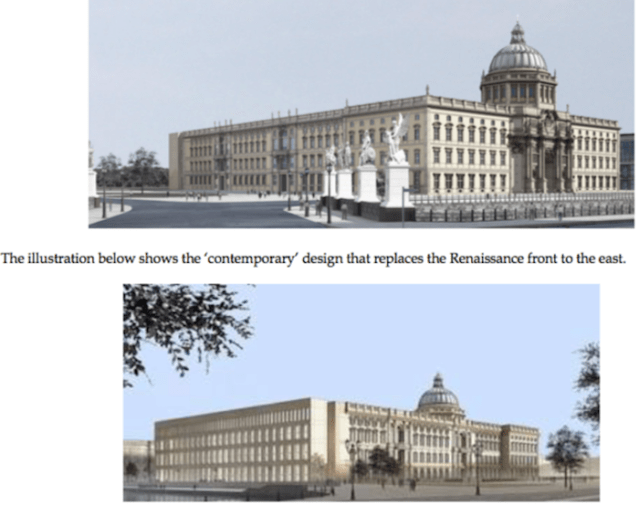
The Berliner Schloss, completed in 1845, bombed in 1945 and replaced by East Germany with the modernist People’s Palace, has been rebuit with three sides traditional and one modernist.

Malcolm Millais, author of Le Corbusier, the Dishonest Architect and Exploding the Myths of Modern Architecture, recently visited Berlin, in part to investigate four examples of how Germans have reconstructed historic buildings damaged by Allied bombs in World War II. His unique combination of pasted excerpts from online descriptions of the four examples, separated by his commentary upon them and followed by his conclusions, is a valuable short course in the rise and fall of European historical preservation.

It value is heightened considerably by the extensive links included by Millais, clustered after each of the four examples, that allow readers to draw their own conclusions about the debate that has raged in Berlin and Germany for decades. [To view document, click on the PDF link at the end of this post.]

And its value survives the dangers of working with multiple online sources in a difficult format. These include redundancies caused by clips from different sources that cover the same ground, pastings where dropped words lead to awkward phraseology, and page-design challenges.

Still, the evidence of vast confusion in directing Germany’s reconstruction over the half century or more since the war is damning. The modernist influence Millais describes and rightly condemns has inscribed the face of Berlin with vast architecture incoherence – especially regrettable in the city’s most venerable historical structures.

Visiting the now “restored” Neues Museum, colloquialisms like “mish-mash,” “pig’s ear” and “dog’s breakfast” come to mind. This just illustrates the incompatibility between normal building and what is known as modern architecture. The fact that the restoration has generated bitter controversy is unsurprising.

Perhaps the consensus ought to have been to destroy what remained of buildings whose erection was directly linked to the hubris that caused Germany to initiate two world wars (though the causes of the first were mixed in ways that causes of the second were not). And maybe this was the course taken with many ruins in the postwar years. It would take more familiarity with German cities than I claim to make such a judgment.

The four buildings described in their various types of restoration are the Berliner Schloss (Berlin Palace), Berlin Dom (Cathedral), the Neues (New) Museum and the Kaiser Wilhelm Memorial Church.

The examples presented by Millais argue strenuously for an even higher priority in favor not of monkeying around with these cultural artifacts but of rebuilding ruins as they were before the buildings were damaged. This may explain the public’s apparent preference (as I read it) for keeping historical accuracy uppermost in mind.

Upon seeing this post, Malcolm sent me a quote he’d just stumbled on in Isherwood’s Goodbye to Berlin:

… are modernist lamps, designed to look like pressure-gauges, thermometers and switchboard dials. But the furniture doesn’t match the house and its fittings. The place is like a power-station which the engineers have tried to make comfortable with chairs and tables from an old-fashioned, highly respectable boarding-house. On the austere metal walls hang highly varnished nineteenth-century landscapes in massive gold frames. Herr Bernstein probably ordered the villa from a popular avant-garde architect in a moment of recklessness, was horrified at the result and tried to cover it up as much as possible with family belongings.

Fates of Four of Berlin_s Iconic Buildings copy

Posted in Architecture, Preservation | Tagged , , , , , , , | Leave a comment

The special beauty of decay

Screen Shot 2018-02-26 at 6.06.26 PM.png

Ruins of the Forum of Julius Caesar, in Rome. (Leon’s Message Board)

I’ve been trying to decide whether to post the only passage I thought worth quoting from the section on Cardinal Manning in Lytton Strachey’s Eminent Victorians, recently read by your peripatetic couch-potato. When I discovered it was not a quote by Manning – the famous traitor to the Anglican Church who ended up a cardinal of the Roman Catholics, I was shaken in my resolve to post it. I mean, the book has absolutely nothing to say about architecture. But then I found that the passage came from Sir Mountstuart Elphinstone Grant-Duff. I decided to post it to memorialize the oddity of the name.

Screen Shot 2018-02-26 at 5.56.46 PM.png

Sir M.E Grant Duff. (Wikipedia)

Well, you have to admit that it is an odd one even for a member of the British aristocracy in the Victorian period. The name seems almost to mock Victorian bric-a-brac, yes? So here is the passage, which comes toward the end of Strachey’s very sly and subtle defenestration of the great ecclesiastic and his seemingly unchristian desire to step upon any obstacle in his rise up the ecclesiastical ladder. Manning enjoyed being the eminence gris at such places as the Metaphysical Society, in London, where he occasionally condescended to read a paper of his own. The passage that follows considers the occasionally curious subjects of the members’ papers, which they read aloud at meetings of the society. The brackets, by the way, are Strachey’s, so maybe he inserted the quote because he was as amused by the name as I am.

I think the paper that interested me the most of all that were ever read at our meetings [says Sir Mountstuart Elphinstone Grant- Duff] was one on “Wherein consists the special beauty of imperfection and decay?” in which were propounded the questions “Are not ruins recognized and felt to be more beautiful than perfect structures? Why are they so? Ought they to be so?”

This was the only passage in the Manning chapters that touched on architecture. I have long felt so myself, regarding decay more than ruins. I prefer the degeneracy of the French Quarter of New Orleans and on trips to Charleston have always enjoyed seeing ancient houses as they look before they are restored. But I don’t really know why. Of course, this can be taken too far. Around here (in Providence) if a building gets to looking too old, it might pass right through the stage of “ruin” to the stage of demolition, which is almost always sad because these days a lovely old building is almost never replaced by a lovely new building.

Where have I heard the name Grant-Duff before? Was it from an episode of “Jeeves & Wooster,” the excellent series starring Stephen Fry and based on the humorous novels by P.G. Wodehouse? [Here is a full episode.]

Looking up Mountstuart Elphinstone Grant-Duff, I find this Wikipedia entry. The first line runs thusly:

Sir Mountstuart Elphinstone Grant Duff GCSI CIE PC FRS (21 February 1829 – 12 January 1906), known as M. E. Grant Duff before 1887 and as Sir Mountstuart Grant Duff thereafter, was a Scottish politician, administrator and author. He served as the Under-Secretary of State for India from 1868 to 1874, Under-Secretary of State for the Colonies from 1880 to 1881 and the Governor of Madras from 1881 to 1886.

It seems that the hyphen has been dropped since Lytton Strachey’s day. Is it not time to return it to its traditional place?

Posted in Architecture, Books and Culture | Tagged , , , , , , , , | 4 Comments

Berlinski: Sacking of Paris

Screen Shot 2018-02-25 at 4.49.50 PM.png

Paris along the Seine, with skyscrapers outside the Peripherique. (Traveler Corner)

Claire Berlinski’s masterful summary of the sad situation in Paris is out in the latest City Journal under the title, “The Architectural Sacking of Paris.” I am looking also for Joe Queenan’s no doubt hilarious essay “London Beats Paris in the Tower Olympics,” but that is, alas, 1) behind the Wall Street Journal paywall and 2) from way back in 2012. I include the link in case some readers are WSJ subscribers. (If so, maybe someone will, bless you, cut-and-past a copy to me. Thank you in advance.)

Berlinski’s article was sorely depressing in its description of the 2014 mayoral race that pitted Nathalie Kosciusko-Morizet, who opposed the gargantuan Tour Triangle project, against Socialist Anne Hidalgo, who wants to “rupture” Paris from its past and make it into another London, towers and all. Berlinski writes that the race was “notable for its cattiness.”

Polls show that 62 percent of Parisians oppose skyscrapers in their town, but the woman they should have supported lost. Berlinski, who lives in Paris, does not dwell on that, but also does not suggest that much in the way of mass protests or class-action suits are in the offing to try to sway Hidalgo from her Vandal-like plans.

A while back, my deep source on all things Parisian, Mary Campbell Gallagher, president of the International Coalition for the Preservation of Paris, wrote about a suit brought by lawyers against plans to move French legal agencies from the Isle de Paris into a proposed skyscraper. And in fact, SOS Paris (another group she is linked to) sued in October to stop the Triangle, and other organizations are seeking referenda on the skyscraper issue. She sent Berlinski’s piece to me via the TradArch list-serv, adding, “I hope the tide is turning.”

Who cannot harbor such a fond hope? But the future is dicey.

The past, however, is described in depth by Berlinski, who informs readers of the city’s roots as a Roman outpost (though that makes it sound like a stockade) up to the changes made by Georges-Eugène Haussmann, the city prefect under Napoleon III, and, more recently, the sordid history of the modernist assault on Parisian beauty. As Belinski points out, apologists for the tragedy now unfolding there like to assert that Haussmann brought “rupture” to Paris, too, but they neglect the fact that his style of rupture was productive, not destructive, of beauty.

The question is not whether Paris can prevent change – it “can’t remain pickled in aspic,” writes Berlinski, and should not want to – but why French architects think change and beauty are mutually exclusive. Haussmann proved that this need not be so.

Berlinski’s long essay seems never to end, but is so full of insight that at its conclusion we wish it never would.

[I expect shortly a note of update from MCG, delightfully written if not necessarily filled with delightful news. But one can hope! …  Good news! MCG did indeed almost immediately send an update of anti-skyscraper activities, which I’ve incorporated above.]

Posted in Architecture, Development | Tagged , , , , , , , | 1 Comment

Johnston, we hardly knew ye

Screen Shot 2018-02-23 at 10.18.31 PM.png

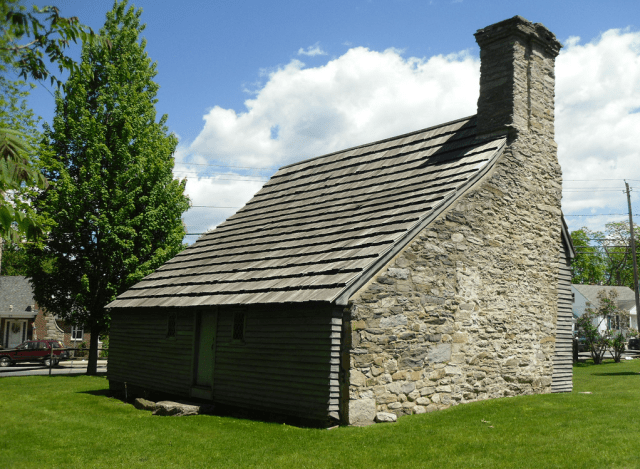
The Clemence-Irons House, circa 1691, restored by Norman Isham circa 1940. (flickr.com)

Fifteen years ago I wrote about Johnston, R.I., as part of a series that ran monthly (or at far longer intervals eventually) under the kicker “Outside Providence.” Each month, proceeding in alphabetical order, I’d visit a city or town outside the state capital and describe how well it had weathered the assault of modernity on its historical character. I’ve been back often since, but mainly on the “leash” I describe below. Has Johnston changed? For the better? For the worse?

I always tried to look at the positive, but maybe the citizens of Johnston, where I’ll be delivering a lecture on my book Lost Providence at the Johnston Historical Society next Wednesday, will run me out of town on a rail for what I would argue is the positive assessment that follows. (At the time I lived in downtown Providence and did not own a car.)

***

Johnston looms in the mind of your rent-a-car correspondent, heading west on Route 6 from Providence, as the most daunting town thus far to fall under his microscope. Sprawlsville, USA. Fast-food paradise. Land of big hair, coiffed up high as . . . well, high as the Central Landfill.

Jaaahn-st’n. Yeah, we Rhode Islanders think we know this place by heart, don’t we?

I hop off 6 onto Hartford Avenue, head over the Providence line, and what do I find but a string of grand old houses as pretty as you might ever expect to see. This, in Johnston? It was, alas, but a brief reprieve, evaporating with the onset of the Johnston we know too well, the intersection of Hartford and Atwood: Central Casting for Crudscape America.

Subway, Walgreen, Burger King, Jiffy Lube, McDonald’s, CVS, Blockbuster, BJ’s, Wendy’s, Dunkin’ Donuts, Walt’s Roast Beef, Sunoco, Brooks Drug, KFC, Hurd Pontiac, D’Angelo’s, etc., etc. (A friend often chides me for not including in these “Outside Providence” columns more names of local businesses. Now are you satisfied???). And right in the middle of this jumbled junk jungle, this McMegamerican crossroads, was my destination: Town Hall.

Town Hall is an imposing neo-colonial with a cupola high above a central pavilion flanked by two gabled wings. It must have towered above its almost rural surroundings in 1933. Architect Oresto DiSaia cannot have imagined how imperiously it would preside today over its Augean vicinity.

I pulled into a parking lot with a “For Town Employees Only” sign, which led to another, then another. Where, I wondered, do visitors park? Finally, a woman returning to her car after a pleasant visit with her friendly tax collector said, tartly, that I could park “down there, past all the bigwigs.”

At Town Hall, I met Johnston’s town planner, Jeanne Tracey-McAreavey, and local historian Louis McGowan, chief author of two fine books in the “Images of America” series, Johnston (1997) and Johnston, Volume II (1999). They assured me not only that Town Hall was slated for spiffing up, but that a Herculean plan to beautify its vicinity was being drawn up by landscape architect Wil Gates.

We then set out on a grand tour of Johnston.

As I said to myself while motoring on Route 6 at the beginning of this column, “How will I ever find anything nice to say about Johnston?”

Easy. Try looking beyond Hartford-and-Atwood. Most Rhode Islanders just don’t know Johnston. We are tethered to Route 95, Route 2, Route 6, and get on or off to get to work or home. We strain our vehicular leashes only to visit a few friends’ houses, a few favorite non-mall shops and eateries. No, most Rhode Islanders do not really know Rhode Island.

Our attitude toward Johnston is rivaled only by our attitude toward Craaanston, and proves the validity of this generalization. We do not know what Johnston looks like, let alone that it is the 28th town founded in what was still a colony. Or that it seceded from Providence in 1759, and ceded back to the capital its bustling heart, Olneyville, in 1898. Or that its namesake was a popular colonial attorney general, Augustus Johnston – popular, that is, until he was run out of town for his loyalty to the Crown in the Revolution. Or that Gov. Samuel Ward King, who suppressed the Dorr Rebellion in 1842, was from Johnston. Not that much history in Johnston; probably a good thing. A lot of mill owners with jobs for sturdy men and women. Increasingly, these were immigrant Italians who, in turn, immigrated to Johnston from Silver Lake, Federal Hill, Mount Pleasant – an unusual number of whom, to judge by the photos in McGowan’s books, were beautiful. Good bones, thick dark hair, strong features.

Strong features also mark the districts of Johnston we visited: Thornton, athwart Providence, retains its dense urban feel. Graniteville, Hughesdale and Simmonsville murmur of their past as mill villages, despite bombardment by split ranches and the like. In their narrow winding streets, they retain the feel of yore, with the occasional house, here and there a string of houses, reaching back a century – or three. The town’s oldest, the Clemence/Irons House (circa 1680), is a classic stone-ender, restored in 1939 by early preservationist Norman Isham. Many recent houses fetch you back in time. And who’d have thought so much of Johnston was rural, with up to 10 farms? Charming little Belknap enchanted this visitor with its village appeal.

Having borne the brunt of suburban flight, Johnston has weathered its proximity to Providence better than you might think, much better than you do think – better, surely, than this bug-eyed reporter once thought. So, Rhode Island, think again.

Johnston is a-okay. Maybe even aa-okay.

Copyright © 2003. LMG Rhode Island Holdings, Inc. All Rights Reserved.
Record Number: MERLIN_189520

[The Clement-Irons House was built circa 1691, not 1680 as stated above.]

Posted in Architecture, Development | Tagged , , , , | 2 Comments

Fit Brown’s hall into the Hill

Screen Shot 2018-02-22 at 7.58.02 PM.png

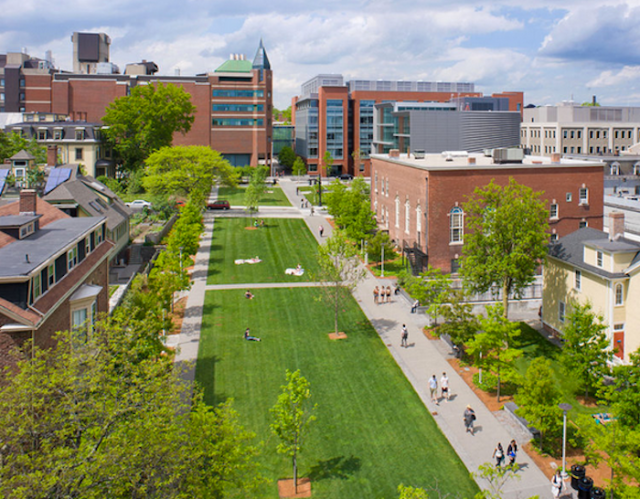
Proposed new site of Brown concert hall would extend from relocated Lucien Sharpe House (yellow, upper left) to edge of spire (top middle). Granoff Center is gray building (upper right). Old site was to be left of first two grassy swards of The Walk. (Brown)

Brown University pleased many by rethinking its plan to demolish four old buildings on its campus to make way for an ugly concert hall. Now it plans to build an ugly concert hall without demolishing any old buildings.

The surprising announcement was made on Tuesday. And it is progress. Undeniably. Bravo, Brown!

By ugly I mean a concert hall that does not fit into the historical character of College Hill. I would sadly accept four old houses going down to make way for a major concert hall that does fit into the historical character of College Hill. That might not be popular with diehard preservationists, but it would not just preserve the existing historical character but revive lost historical character and create new historical character, so to speak, going forward. Of course, saving the four houses and building a concert hall that fits in would be best. That does not seem to be in the cards. Still, you never know.

Screen Shot 2018-02-22 at 8.06.29 PM.png

Central campus of Brown University.

Although Brown retains its lovely central campus almost intact, and has spent many millions to restore old buildings, almost everything Brown has built anew in the past half a century has degraded the character of College Hill. When the performing arts center’s original site was announced in December, Brown’s chief architect, Collette Creppell, informed the City Plan Commission that its setting was already so architecturally diverse – a gentle pseudonym for degraded – that almost any design could be said to fit in.

So, while saving those four buildings means that their absence will not further degrade the setting, the setting will be further degraded by any concert hall that is likely to come from the studios of REX, of New York, the arch-modernist firm selected last year for the job.

Screen Shot 2018-02-22 at 8.45.14 PM.png

Granoff Center. (ArchDaily)

As things stand, the performing arts center has been moved a block north, requiring only the relocation of one old building. Good. But that means the concert hall must face off against the Granoff Center for the Creative Arts, directly opposite on The Walk. It will be amusing to see how REX plans to one-up the accordion struck by an earthquake designed by Diller Scofidio + Renfro, which boasts an equally ridiculous portfolio.

Fun, to be sure. But how much better for Brown and its neighbors to build a concert hall that actually fits into its setting – that is, what remains of a once enchanted setting. Instead of further degrading the campus and College Hill by adding yet another wrinkle to its diversity, why not build a concert hall that helps to walk the campus back toward the beauty of College Hill, exemplified by the College Green and Lincoln (now Simmons) Field?

Screen Shot 2018-02-22 at 8.01.59 PM.png

Nelson Athletic Center. (RAMSA)

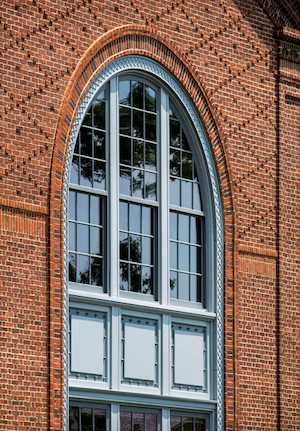
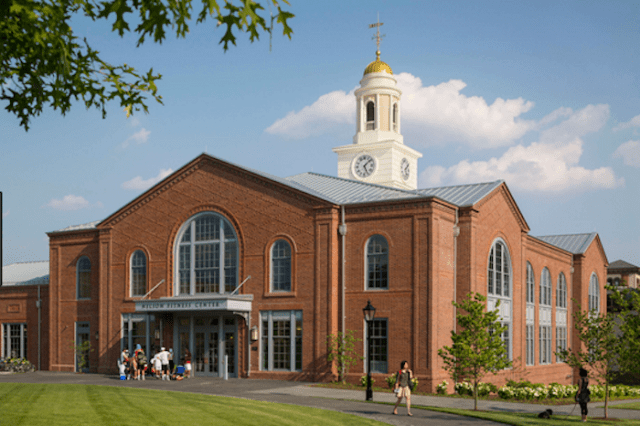
As it happens, Brown did exactly that not long ago when it agreed to switch the architects for a fitness center originally designed in the usual glass and concrete style. The lead donor, Jonathan Nelson, asked Brown President Ruth Simmons to make the change. She resisted but Nelson persisted and prevailed. The beautiful fitness center that bears his name, designed by Robert Stern Architects, now presides at Brown’s athletic complex on Hope Street. It may be the first traditional building erected by Brown in half a century.

Nelson has by now won a host of architectural prizes for patronage, and Brown has an excellent model for evolving the campus toward a better future. This process should commence with the performing arts center. Brown’s trouble with its College Hill neighbors arises not because it has expanded but because it has expanded ugly. Turn that around and Brown will see its community relations grow a lot more pacific.

And while nobody can deny Brown’s fundraising chops, they are sure to grow as the campus offers more charming memories for its graduates – better fundraising through architecture. This is not rocket science, President Paxson, but it does require thinking outside the box. Try it, you’ll like it. So will the students, the faculty, the staff and the neighbors.

Screen Shot 2018-02-22 at 8.03.09 PM.png

Jonathan Nelson Fitness Center (2012), on Hope Street in Providence. (RAMSA)

Posted in Architecture | Tagged , , , , , , , , , , | Leave a comment